Description:
Editorial Reviews
About the Author
Reviews:
5.0 out of 5 stars Great book to read as we tread through the Age of AI!
Shout out to Tim Dasey! Your book AI Wisdom: Volume One takes metathinking and applies it to our lives as we move ahead with AI. The idea of being aware of how you think, learn, solve problems, and make decisions is all part of your essential durable skills! I believe every teacher seeking to understand how AI works and how to evaluate one’s own thinking should read it! I thoroughly enjoyed it!
5.0 out of 5 stars Useful read for educators promoting AI literacy and understanding
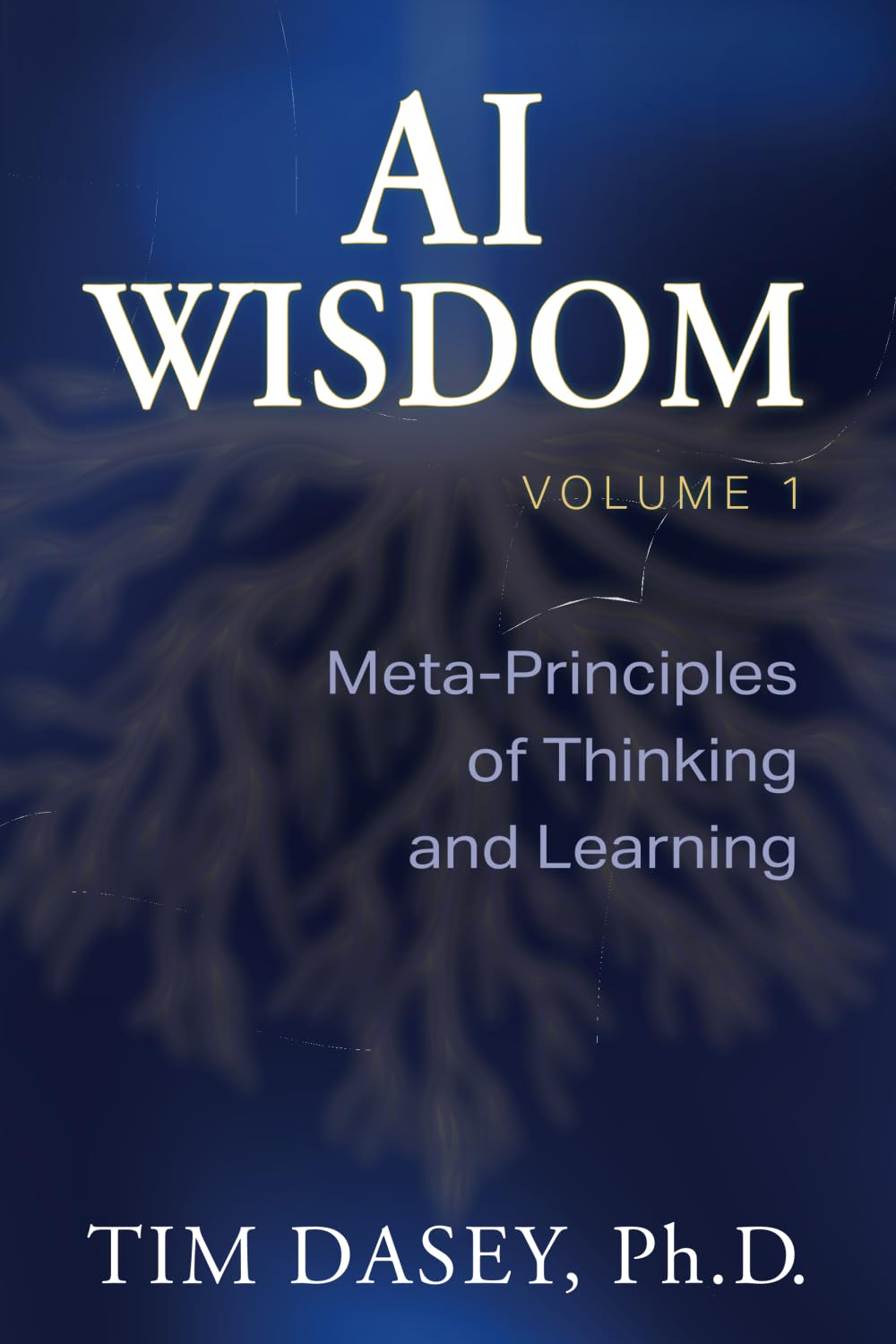
In this book, Tim Dasey, PhD, draws on his background in training neural networks and concern for education to explain some of the core principles that underpin both human and artificial intelligence (AI). The book is divided into two parts: Part 1 covers meta-cognition and Part 2 covers meta-learning and teaching. Dasey aims to show that the roots of AI are the meta-principles of thinking and learning, meaning that teaching about the essence of AI doesn't necessarily need to even involve using AI or using a computer. I appreciate the viewpoint that people, particularly students coming through the system, should be able to gain durable knowledge and skills that will outlast any changes in AI models or technologies. hat I found particularly valuable about this book was Dasey’s ability to use analogies to communicate the concepts in AI. These help concretize what he’s talking about and make it more understandable, and I appreciate that they are often centered on an educational context. His description of neural networks and how they work in a distributed way, like humanity’s cultural knowledge, makes more sense than a lot of other explanations of AI I’ve come across. Dasey also uses hypothetical data plotted in graphs to illustrate how AI categorizes information and why it’s not going to be 100% accurate all of the time. It has to draw boundaries somewhere, and the visualizations help reinforce the points made. These explanations helped inform his discussion of different types of biases, too. One of my favorite images was of neural networks as a stained-glass window, where the input is the pattern of light, the hidden layers and weights are the glass, and the output is the pattern of colored light that shows through at the end. I can see myself using this in the future for non-technical audiences. Dasey challenges the criticism that “AI ‘just’ analyzes patterns” as showing a misunderstanding about intelligence, because this is how natural intelligence works as well. To support his point, he mentions Daniel Kahneman’s book Thinking, Fast and Slow and how brains have a conscious and unconscious part, but the latter is where most action happens because the unconscious part is fast and constantly analyzing patterns. Although our minds are much less verbal than AI and its large language models, there are similarities in how our minds process information and how AI conducts pattern analysis. One of the most valuable insights in the book concerns Dasey’s discussion about how AI is a conceptual creature. He observes that decades of science fiction media have made us think of intelligent machines as being reliable when it comes to facts and being precise, but we can’t think of Generative AI in that way. It deals in concepts rather than facts. Those of us familiar with the concept of the platonic ideal of forms will know the difficulty in defining even what seems obvious. Dasey explains how AI is built not to store lists of facts, “but rather a complex web of conceptual relationships from which fact-like behavior emerges approximately”. His examples made sense in fleshing out this idea and strike to the heart of how we can know something without necessarily knowing all of the facts related to it. Dasey uses his understanding of AI and how it is and will impact society to call for changes in education systems that are often still built around precise metrics, age-based grouping, and separate subject areas. There is need for harder-to-measure skills like critical thinking and a system that encourages exploration and flexibility. One issue is that teachers may feel the need to know a lot about AI before trying to teach it. But teachers don’t need to be experts to introduce new topics or technologies, in the same way that physicians can explore new treatments and engineers can solve new problems. Mastery isn’t needed, Dasey writes, and in fact a lack of expertise allows space for students to take on more agency and gain a deeper understanding.Each chapter of the book ends with key meta-principles and an example learning progression that shows how the principles could relate to different education levels (e.g. young children, high schoolers, college-age students). Dasey clearly wants to help educators understand the fundamental principles and frameworks that will serve them and their students no matter how AI develops in the coming years. This first of two books on AI balances some of the technical aspects of this technology with easy-to-grasp analogies and direct comparisons to education. It is a useful read for those of us who want to promote AI literacy at a foundational level across a wide range of contexts.Disclosure: This was from a review copy I requested after following Dasey's work on LinkedIn for some time. It is an excerpt of the review on my website.
Visit the Rejuvenate Publishing Store
AI Wisdom Volume 1: Meta-Principles of Thinking and Learning
AED15108
Quantity:
Order today to get by 7-14 business days
Delivery fee of AED 20. Free for orders above AED 200.
Imported From: United States
At BOLO, we work hard to ensure the products you receive are new, genuine, and sourced from reputable suppliers.
BOLO is not an authorized or official retailer for most brands, nor are we affiliated with manufacturers unless specifically stated on a product page. Instead, we source verified sellers, authorized distributors or directly from the manufacturer.
Each product undergoes thorough inspection and verification at our consolidation and fulfilment centers to ensure it meets our strict authenticity and quality standards before being shipped and delivered to you.
If you ever have concerns regarding the authenticity of a product purchased from us, please contact Bolo Support. We will review your inquiry promptly and, if necessary, provide documentation verifying authenticity or offer a suitable resolution.
Your trust is our top priority, and we are committed to maintaining transparency and integrity in every transaction.
All product information, images, descriptions, and reviews originate from the manufacturer or from trusted sellers overseas. BOLO is not affiliated with, endorsed by, or an authorized retailer for most brands listed on our website unless stated otherwise.
While we strive to display accurate information, variations in packaging, labeling, instructions, or formulation may occasionally occur due to regional differences or supplier updates. For detailed or manufacturer-specific information, please contact the brand directly or reach out to BOLO Support for assistance.
Unless otherwise stated, all prices displayed on the product page include applicable taxes and import duties.
BOLO operates in accordance with the laws and regulations of United Arab Emirates. Any items found to be restricted or prohibited for sale within the UAE will be cancelled prior to shipment. We take proactive measures to ensure that only products permitted for sale in United Arab Emirates are listed on our website.
All items are shipped by air, and any products classified as “Dangerous Goods (DG)” under IATA regulations will be removed from the order and cancelled.
All orders are processed manually, and we make every effort to process them promptly once confirmed. Products cancelled due to the above reasons will be permanently removed from listings across the website.
More from this brand
Similar items from “Intelligence & Semantics”
Share with
Or share with link
https://www.bolo.ae/products/UO0S1A2JFMF
Visit the Rejuvenate Publishing Store
AI Wisdom Volume 1: Meta-Principles of Thinking and Learning

AED15108
Quantity:
Order today to get by 7-14 business days
Delivery fee of AED 20. Free for orders above AED 200.
Imported From: United States
At BOLO, we work hard to ensure the products you receive are new, genuine, and sourced from reputable suppliers.
BOLO is not an authorized or official retailer for most brands, nor are we affiliated with manufacturers unless specifically stated on a product page. Instead, we source verified sellers, authorized distributors or directly from the manufacturer.
Each product undergoes thorough inspection and verification at our consolidation and fulfilment centers to ensure it meets our strict authenticity and quality standards before being shipped and delivered to you.
If you ever have concerns regarding the authenticity of a product purchased from us, please contact Bolo Support. We will review your inquiry promptly and, if necessary, provide documentation verifying authenticity or offer a suitable resolution.
Your trust is our top priority, and we are committed to maintaining transparency and integrity in every transaction.
All product information, images, descriptions, and reviews originate from the manufacturer or from trusted sellers overseas. BOLO is not affiliated with, endorsed by, or an authorized retailer for most brands listed on our website unless stated otherwise.
While we strive to display accurate information, variations in packaging, labeling, instructions, or formulation may occasionally occur due to regional differences or supplier updates. For detailed or manufacturer-specific information, please contact the brand directly or reach out to BOLO Support for assistance.
Unless otherwise stated, all prices displayed on the product page include applicable taxes and import duties.
BOLO operates in accordance with the laws and regulations of United Arab Emirates. Any items found to be restricted or prohibited for sale within the UAE will be cancelled prior to shipment. We take proactive measures to ensure that only products permitted for sale in United Arab Emirates are listed on our website.
All items are shipped by air, and any products classified as “Dangerous Goods (DG)” under IATA regulations will be removed from the order and cancelled.
All orders are processed manually, and we make every effort to process them promptly once confirmed. Products cancelled due to the above reasons will be permanently removed from listings across the website.
Description:
Editorial Reviews
About the Author
Reviews:
5.0 out of 5 stars Great book to read as we tread through the Age of AI!
Shout out to Tim Dasey! Your book AI Wisdom: Volume One takes metathinking and applies it to our lives as we move ahead with AI. The idea of being aware of how you think, learn, solve problems, and make decisions is all part of your essential durable skills! I believe every teacher seeking to understand how AI works and how to evaluate one’s own thinking should read it! I thoroughly enjoyed it!
5.0 out of 5 stars Useful read for educators promoting AI literacy and understanding
In this book, Tim Dasey, PhD, draws on his background in training neural networks and concern for education to explain some of the core principles that underpin both human and artificial intelligence (AI). The book is divided into two parts: Part 1 covers meta-cognition and Part 2 covers meta-learning and teaching. Dasey aims to show that the roots of AI are the meta-principles of thinking and learning, meaning that teaching about the essence of AI doesn't necessarily need to even involve using AI or using a computer. I appreciate the viewpoint that people, particularly students coming through the system, should be able to gain durable knowledge and skills that will outlast any changes in AI models or technologies. hat I found particularly valuable about this book was Dasey’s ability to use analogies to communicate the concepts in AI. These help concretize what he’s talking about and make it more understandable, and I appreciate that they are often centered on an educational context. His description of neural networks and how they work in a distributed way, like humanity’s cultural knowledge, makes more sense than a lot of other explanations of AI I’ve come across. Dasey also uses hypothetical data plotted in graphs to illustrate how AI categorizes information and why it’s not going to be 100% accurate all of the time. It has to draw boundaries somewhere, and the visualizations help reinforce the points made. These explanations helped inform his discussion of different types of biases, too. One of my favorite images was of neural networks as a stained-glass window, where the input is the pattern of light, the hidden layers and weights are the glass, and the output is the pattern of colored light that shows through at the end. I can see myself using this in the future for non-technical audiences. Dasey challenges the criticism that “AI ‘just’ analyzes patterns” as showing a misunderstanding about intelligence, because this is how natural intelligence works as well. To support his point, he mentions Daniel Kahneman’s book Thinking, Fast and Slow and how brains have a conscious and unconscious part, but the latter is where most action happens because the unconscious part is fast and constantly analyzing patterns. Although our minds are much less verbal than AI and its large language models, there are similarities in how our minds process information and how AI conducts pattern analysis. One of the most valuable insights in the book concerns Dasey’s discussion about how AI is a conceptual creature. He observes that decades of science fiction media have made us think of intelligent machines as being reliable when it comes to facts and being precise, but we can’t think of Generative AI in that way. It deals in concepts rather than facts. Those of us familiar with the concept of the platonic ideal of forms will know the difficulty in defining even what seems obvious. Dasey explains how AI is built not to store lists of facts, “but rather a complex web of conceptual relationships from which fact-like behavior emerges approximately”. His examples made sense in fleshing out this idea and strike to the heart of how we can know something without necessarily knowing all of the facts related to it. Dasey uses his understanding of AI and how it is and will impact society to call for changes in education systems that are often still built around precise metrics, age-based grouping, and separate subject areas. There is need for harder-to-measure skills like critical thinking and a system that encourages exploration and flexibility. One issue is that teachers may feel the need to know a lot about AI before trying to teach it. But teachers don’t need to be experts to introduce new topics or technologies, in the same way that physicians can explore new treatments and engineers can solve new problems. Mastery isn’t needed, Dasey writes, and in fact a lack of expertise allows space for students to take on more agency and gain a deeper understanding.Each chapter of the book ends with key meta-principles and an example learning progression that shows how the principles could relate to different education levels (e.g. young children, high schoolers, college-age students). Dasey clearly wants to help educators understand the fundamental principles and frameworks that will serve them and their students no matter how AI develops in the coming years. This first of two books on AI balances some of the technical aspects of this technology with easy-to-grasp analogies and direct comparisons to education. It is a useful read for those of us who want to promote AI literacy at a foundational level across a wide range of contexts.Disclosure: This was from a review copy I requested after following Dasey's work on LinkedIn for some time. It is an excerpt of the review on my website.
More from this brand
Similar items from “Intelligence & Semantics”
Share with
Or share with link
https://www.bolo.ae/products/UO0S1A2JFMF