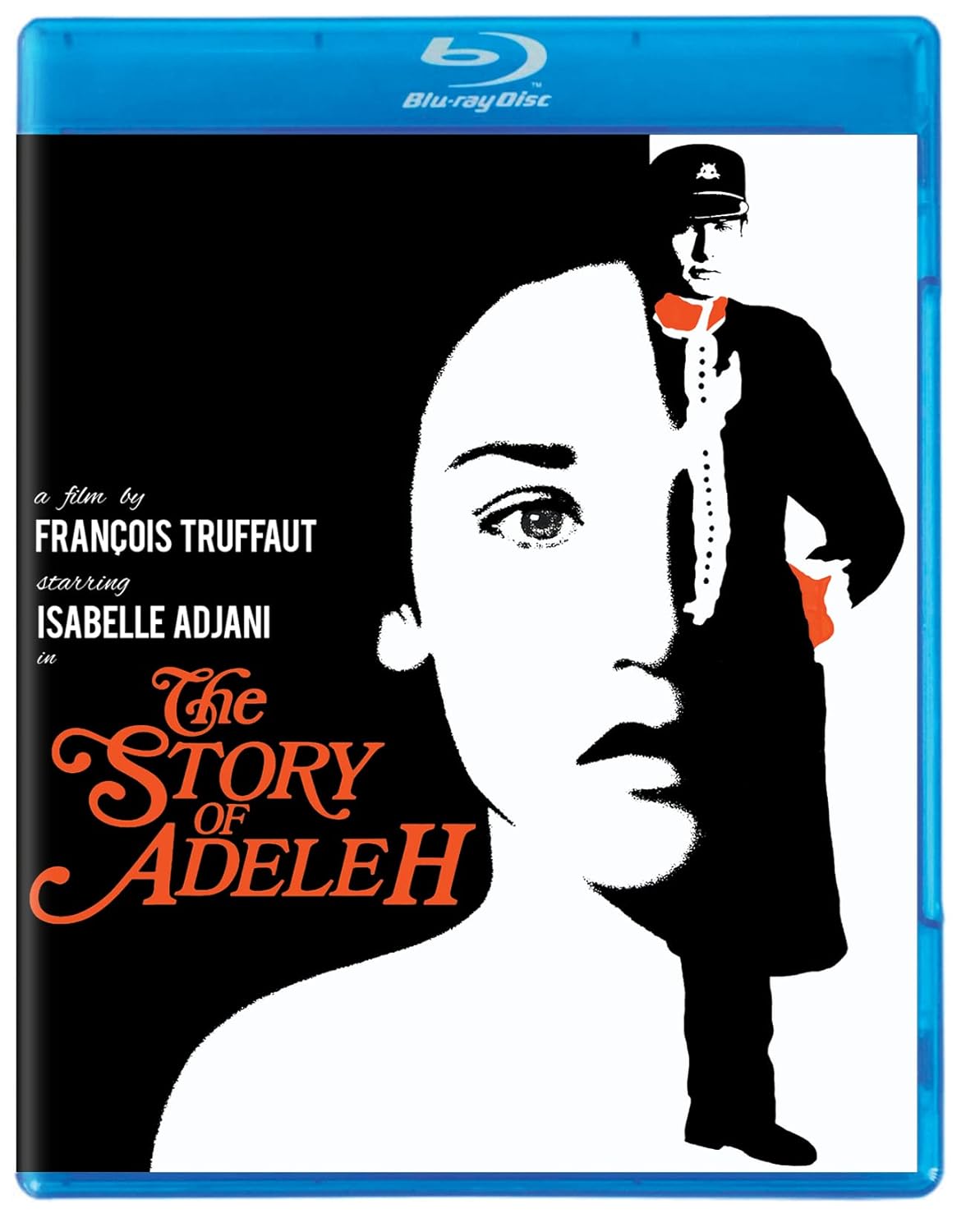
Description:
Love is my religion, the young woman wrote in her diary. The god of that religion was a British lieutenant in Nova Scotia, 1863—a soldier who wanted nothing to do with the woman who adored him. Cinema icon François Truffaut (The Bride Wore Black, Mississippi Mermaid) directs the stunning Isabelle Adjani (Possession, Camille Claudel) in the staggeringly powerful The Story of Adele H. The “H” stands for Hugo and, like her famed father Victor Hugo, Adele had a gift for writing. However, she wrote in code, creating a secret diary. Only in modern times was the diary deciphered, revealing the true-life story of Adele’s obsessive quest to make the soldier love her. Impeccably photographed by Nestor Almendros (The Wild Child, Days of Heaven), this musical, lilting film with a tidal pull to it (Pauline Kael) earned Adjani numerous Best Actress honors, including an Oscar nomination, and features Bruce Robinson (director of Withnail & I) as the obscure object of Adele’s desire.
Special Features:
-Audio Commentary by Film Historians Julie Kirgo and Nick Redman
-Theatrical Trailer
-In French with Optional English Subtitles
Reviews:
5.0 out of 5 stars Truly Extraordinary
(function() { P.when('cr-A', 'ready').execute(function(A) { if(typeof A.toggleExpanderAriaLabel === 'function') { A.toggleExpanderAriaLabel('review_text_read_more', 'Read more of this review', 'Read less of this review'); } }); })(); .review-text-read-more-expander:focus-visible { outline: 2px solid #2162a1; outline-offset: 2px; border-radius: 5px; } Thirty years later it is hard to imagine "The Story of Adele H" without the then twenty-year old Isabelle Adjani as the title character. But at the time Truffaut's decision to cast the young French theatre star was very risky. Not because there was any doubt about Adjani's acting, but because casting someone who was arguably the most beautiful actress in the world as a character driven mad by unrequited love raised a potential credibility issue. Would viewers believe that the advances of a woman so beautiful, passionate, and intelligent were rejected? And could someone like that elicit sympathy from the average viewer.But Truffaut knew what he was doing because Adjani's Adele Hugo is 100% convincing. And rather than going for audience sympathy they go for audience frustration as the viewer is increasingly exasperated over Adele's self-destructive behavior. Adjani's breathtaking beauty actually is an asset as Truffaut wants you convinced that the world offers unlimited possibilities for Adele if only she can let go of her obsession. Adjani plays the character with such intensity that you are finally relieved when Adele's madness has reached the stage where she is no longer aware of her own suffering.Apparently Adele had other issues before going on her obsessive quest for love. Her sister drowned a few years before and her parents had always strongly favored her sister. Adele has recurrent nightmares about drowning. Marriage and her pursuit of Pinson are her only way to escape from her famous father. Truffaut's stays with blacks, browns, and blues; with much of each frame filled with shadows; not exactly dreary but consistent with a character who has found little non-fantasy happiness during her life.The camera loves Adjani, a good thing as she is on screen for over 90% of the film. She was the youngest nominee ever for best actress. It was the best performance of the 1970's, probably no one but Adjani could have conveyed such inner emotional violence. It is that extremely rare visual performance that does not need subtitles or even sound.As Roger Ebert noted: "Truffaut finds a certain nobility in Adele. He quotes one of the passages in her diaries twice: She writes that she will walk across the ocean to be with her lover. He sees this, not as a declaration of love, but as a statement of a single-mindedness so total that a kind of grandeur creeps into it. Adele was mad, yes, probably - but she lived her life on such a vast and romantic scale that it's just as well Pinson never married her. He would have become a disappointment".Then again, what do I know? I'm only a child.
4.0 out of 5 stars A female version of “Of Human Bondage”…
A number of decades ago I read W. Somerset Maugham’s “Of Human Bondage,” about one man’s mental but not physical enslavement to a woman. A terrible obsession, I remember, and little else; other than the takeaway that I would not be bound in such a manner, since, well, there are a lot of fish in the sea. About the same time, I saw “The Story of Adele H.” at my favorite one-and-only Atlanta art theater. In general, it seemed to be a visual flip side of Maugham’s novel, another terrible, literally maddening obsession of one woman for a man. I remember some green fields, wandering, and a lot of tediousness.I have immense respect for the French director, Francois Truffaut, who regrettably left us at the early age of 52, almost four decades ago. I found his movie “Small Change” worth a journey, and visited Thiers, in the Auvergne, to walk those steep cobbled streets where the kids ran (like so many other small town shopping areas, it was struggling in 1990). There are numerous other memorable movies that he directed: “The Wild Child,” “Jules and Jim,” “Day for Night,” “Fahrenheit 451” and more.The “H” in the title stands for Hugo. Adele Hugo is the daughter of one of the most famous French writers of the 19th century: Victor Hugo. It is a true story. Isabelle Adjani plays the obsessed Adele well. The movie opens in 1863 in Halifax, Nova Scotia. Adele has just arrived from the Channel Island of Guernsey, where her father lives in exile, having run afoul of Emperor Napoleon III. It was at Guernsey that she met and fell in love/obsession with Lt. Pinson, of the 16th Hussars. Purportedly there had been marriage offers/refusals in the background, with Pere Hugo refusing to grant his permission. The sort of denial which only stokes the fires of desire. And as a little-known footnote to the American Civil War, the British 16th Hussars were in Nova Scotia due to the possibility that the British (and the French) might recognize the Confederacy. (No statues to that today!)The second time around I still found it tedious and disappointing. In a way, it is just about as exciting as watching a drug addict shoot up again. True, it was well-played, and Adele’s desperate delusions of the reciprocity of love both pathetic and heartbreaking… hers more than mine.By another director other than my beloved Truffaut, who helped me in my formative cinema-watching years, I might give the movie less than 4-stars.
5.0 out of 5 stars A Perfect Movie!
Everything about this movie is perfect. Isabel Adjani's performance is extraordinary. The story of Adele Hugo is compelling and the cinematography is beautiful. It is not an easy movie to watch because of the intense emotional journey but I highly recommend it.
2.0 out of 5 stars Painfully slow, the film diverges from the real story
I didn't care much for this film when it came out, and I don't care about it now either. Adjani's performance is pretty good, but what lacks from the story is that at the time Adele H was 35, considered an older woman past her prime, and that might have been the main reason the Lieutenant pushed her away. Here we are watching a young beautiful woman trying to seduce the man who once asked her to marry him, and it's a totally different premise. This film is mostly a vehicle for Adjani to be noticed as an actress, but even that couldn't keep my interest on this dreadfully slow and boring film.
A sad story of obsession
(function() { P.when('cr-A', 'ready').execute(function(A) { if(typeof A.toggleExpanderAriaLabel === 'function') { A.toggleExpanderAriaLabel('review_text_read_more', 'Read more of this review', 'Read less of this review'); } }); })(); .review-text-read-more-expander:focus-visible { outline: 2px solid #2162a1; outline-offset: 2px; border-radius: 5px; } Such a beautiful woman, driven mad in an obsession with an unworthy man. Its actually amazing how lovely Adelle (Isabelle Adjani) looks even in her most wretched state. The saddest part was probably when she tries to buy her love... but a close second was her reaction to the book shop keeper who unknowingly gave her a book by her father.
ISABELLE
TUTTO OK
Heart in pieces
Adele Hugo (1830-1915) was the youngest child and second daughter of famed French writer Victor Hugo (1802-85) who fathered five children. Or he’s credited with having fathered five, speculation forever swirling that Adele was the daughter of her mother’s paramour, not the child of Hugo. At any rate, she was accepted into the family as his own and subsequently pampered and spoiled.Born in Paris, Adele grew up in a rich and cultured household, learning to play the piano well. Renowned for her figure, beauty and long dark hair, she sat for many portraits. As the youngest child and girl she was overprotected. Also, when her elder — and only — sister Leopoldine drowned in a boating accident on the Seine at age 19 Adele was left as the only girl in the family among two brothers (a third having died in infancy). If she was not a princess in practice, she may have felt like one in spirit. Certainly, she was self-regarding throughout her life, expecting the fame of her father to grant her special dispensations, even if she viewed such fame and its consequences as double-edged.The family were forced into political exile in 1851, settling in the Channel Islands, first on Jersey, then on Guernsey. A champion of the poor and liberal reformer, Hugo had alienated himself from the regime of Napoleon III after publicly denouncing the emperor as a traitor to the values of the French Revolution of 1789, especially to the value of equality. Hugo was popular, famous and powerful, but not as powerful as an emperor, so he had to go. After the cultural riches of Paris, the isolation of the Channel Islands, remote from anything but themselves, affected Adele strongly, and not for the good.This passage from a biography of Hugo* describes her situation well following a visit to the family from the writer Balzac:“The girl who had stunned Balzac with her dark beauty [in Paris] had grown long in the face, stale and two-dimensional, filling her time with little fads and habits. She listened to the sea and then wrote melancholy, wordless songs on the piano…Having nothing else to do, she had become obsessed with a young English lieutenant-colonel, Albert Pinson, who briefly had been stationed on Jersey. She wrote to Pinson, ‘You are an Englishman who loves a Frenchwoman, a royalist who loves a republican, a fair-haired man who loves a brunette, a man of the past who loves a woman of the future, a man of the material world who loves a woman of the ideal.’”Later she is described as suffering from “fevers, delirium, constipation, gastro-enteritis and probably anorexia, [her arms looking like] spindles.”In other words, she was a sensitive, intense, nervous, highly strung person, prone to fevers and fantasies.This is the young woman we are introduced to in this fine, famous film by François Truffaut, a film made with several difficulties, legal and otherwise. One legal hurdle: permission to film the story of Adele, eventually granted by a surviving descendent of Hugo (with the proviso that Victor Hugo himself not be portrayed in it by a modern actor). Truffaut assented. Another difficulty was finding a young actress with the requisite intensity and complexity to play Adele. He found those qualities in Isabelle Adjani who was only 19 at the time. Equally important to him, Isabelle looked as Adele had in her twenties, a pale, thin, dark-haired beauty. Truffaut later confessed that Adjani was also difficult to work with (just as Adele had been to live with). Why? Because being so young and inexperienced in film she couldn’t break character, or wouldn’t, perhaps lacking the confidence to do so. Therefore, so absorbed in the role, she remained emotionally Adele throughout the shoot. Needless to say, the results were extraordinary, making Isabelle Adjani an international star overnight.We meet Adele in 1863, not in the Old World but the New. She’s in Halifax, Nova Scotia, one of the maritime provinces in Canada, having followed Lieutenant Pinson all the way to the Americas to be nearer him. This sounds terribly romantic and perhaps would be if he still cared for her. He does, it transpires, but for one reason only — the same he has for most attractive young women. He’s a womaniser. Yet Adele is adept at denial, screening unwanted, unpleasant knowledge from consciousness. She tells herself his arms and kisses are meant for her only — kisses over which she later rhapsodises in her diaries, as much in love with the idea of love as with the physical sensations it brings. A line she wrote to him in a letter revealingly suggests this:“I love you as the sculptor loves the clay.”So, he’s putty in her hands and imagination, as is love.For her purposes abroad her name is no longer Mademoiselle Adele Hugo: instead, Miss Adele Lewly, though later she will have others refer to herself as Madame Pinson.The Civil War is raging in America when Adele arrives in Canada. Security is tight at the docks in Halifax, the authorities on their guard for spies, mercenaries and other undesirables. Adele manages to get through on the fiction that she’s now in Canada on behalf of a cousin in France who’s engaged to an English officer in the 16th regiment, which is now stationed in Halifax. Adele’s spoken English is far from perfect but good enough to communicate basic ideas. That’s a benefit she has received from living in the Channel Islands, as they are culturally both French and English.Rather than stay in a hotel in town she moves into a boarding house as a lodger, the guest of Mr. and Mrs. Saunders, a kind, elderly couple who speak some French. They like Adele and take her under their wing, especially Mrs. Saunders. The women chat about many things, including Adele’s past, although Adele is careful to screen it carefully from her and everyone, lying about many details when it suits her purposes. Mrs. Saunders appreciates Adele’s refinement, noting to others how intelligent, educated and cultured she is, though she also sees sadness in her eyes and agitation in her manner. She’s a troubled young woman and cannot hide her sorrow completely.At night she suffers from nightmares. She is wet and drowning. As with her dear dead sister Leopoldine, death is calling her home. But death isn’t what she seeks. She wants salvation in the form of love.There are three places in the town she visits most: the post office, bank and a bookshop that’s also a stationers. At the post office she sends letters home. It takes at least a month to receive answers to them. At the bank she cashes money orders sent to her from her father. And in the bookshop she browses books and buys paper and pencils for writing. Her upstairs room in the boarding house is like a garret. In it she writes letters, keeps diaries, reads and sleeps, or tries to sleep.Mr. Saunders knows some officers in the English regiment, including Lieutenant Pinson. At a forthcoming gathering he will be meeting them. Adele uses this opportunity to have a letter from her hand-delivered by Mr. Saunders to the lieutenant. This is accomplished but the lieutenant is unresponsive. In fact, Mr. Saunders thought it strange when Pinson took the letter from him. He did it unsmilingly, and, looking at the handwriting on the envelope, didn’t bother to open it, tucking it quickly away in his tunic.At length the lieutenant can make no more excuses to himself and to Adele. He comes to the boarding house and there, left alone in he parlour with her, an emotional scene unfolds. Adele clings to him, sobbing on his chest, her arms round his neck, begging to be kissed and loved. What has happened? Why is behaving as if he doesn’t love her, when all that she feels suggests otherwise to her? He stands immobile, erect, rigid, his face unsmiling, his heart unfeeling. Adele is beside herself, paralyzed with panic-fear, the fear of losing what she has come so far to redeem. It’s true he proposed to her in the past. She was foolish to have rejected him, to have listened to the reasoning and insistent opportuning of her parents. She was wrong to have followed her head instead of her heart. She knows it now and begs him to forgive her. He does so now but does it coldly, devoid of empathy. He wants his freedom, having lost faith and interest in her. More important to him is his profession, rank, the regiment, other women. Unlike Adele, he is not living in the past.In her delusional state, a world of fantasy and regret based on acute desire, desperation and need, the things she feels ring true because emotionally they are true for her. She doesn’t experience them as false because they aren’t false in feeling. She’s honest to herself emotionally, acknowledging the truth of what she feels. What is false is the reality beyond her that doesn’t mirror and accommodate these feelings, her emotional being rebuffed by that reality, her love unrequited, unacknowledged, unreturned. This seems inconceivable to her, so it must be false. How can the intensity of her desire, the authenticity of love, the depth of feeling, not be understood and reciprocated? Her mind cannot fathom it, so the sense of it happening rings false to her. Her dreams and visions thus become more real to her than the tawdry, bloodless, passionless reality that surrounds her, a reality shallow in feeling and expression. The austerity and coldness of Lieutenant Pinson cannot be real. It’s a front, a veil, a screen that hides his true emotion from the world, one that shields his love from her. Why? What has happened? Is it fear, anxiety and doubt that impede him now? Was the force of rejection so great he will never trust her again? Oh, how sorry she is for the past! How stupid she was to listen to her parents, especially to her father. What could he know of her heart? What can anyone know? He could only advise and guess, even if he cared to guess.She was wrong. Even in the moment of saying “no” to the lieutenant she knew she was wrong. She hurt his hopes, dreams, pride. Why oh why did she do it? Why was obedience to her father more important than love? Why be the dutiful daughter, the expected good girl, when all is lost by being it? She was blind. She threw away what mattered most. She understands now. She sees. She has crossed the great ocean to make this confession, to beg for forgiveness, to earnestly and contritely take back the past, to undo and replace it with the truth of what she feels now and felt even then in that foolish moment of denial of it to herself and him. Oh, how cruel and stupid she was!Her arms are still round his neck, her head on his chest. But he stands inert, distant, cool, his mind and heart closed to her and the past. Proud and stubborn, he is lost to her now, her beauty, intelligence and love no longer important to him. The earth has cycled on. Time and place are gone. He will love someone new in Halifax now. He’s engaged to the daughter of the local governor of the province. Or if he doesn’t marry her, if the engagement is broken, he and his unit will be posted to Barbados next, and after that he’ll return to England and marry an heiress there, leaving Adele high and dry. All these things, in fact, come to pass.Even so, they are not things that correspond with her heart. She is his and he hers, this the truth of what she feels and has always felt.The sight of all this is sad and pitiful of course. Anyone who has been hurt and broken by love will understand and recognise what she feels. Her mind, spirit and heart are broken. In a daze she follows him and the regiment to Barbados next. She is there physically, but her mind is lost, crushed by the weight of an irretrievable love. She is that drowning woman, her sister, her nightmares now made real.A kind woman in Barbados named Madame Céline Alvarez Baa, a former slave, pities her. She takes Adele in and cares for her, writing to her father when Adele’s true identity is revealed. Madame Baa escorts Adele all the way back to France, where her grateful father rewards her for her kindness and charity.Adele is placed in a sanatorium in a quiet green suburb of Paris. There she gardens and plays music. There she is safe in a sheltered peaceful place, the world no longer able to harm her. Her heart still beats but what she feels now no one can say. Perhaps she feels nothing, her heart emptied of all emotion.Victor Hugo died in 1885. He had returned to Paris triumphant in 1870 when the regime of Napoleon III crumbled. Thereafter he was resurrected as a national hero, a writer of liberty whose passion for the people never waned. His body lay in state at the foot of the Arc de Triomphe and over two million people visited it. He was the Shakespeare, Dante and Tolstoy of France, its greatest writer in a century filled with great writers.Adele outlived them all — her parents, brothers and drowned sister. She died in Paris at the sanatorium on 21 April 1915, aged 84. Two notices of her death appeared in Parisian papers, though attention was diverted elsewhere at the time, principally to the Western Front where soldiers in their millions — mainly French, British and German — were dying. If Adele had lost her mind, the world had too, but where is the sanatorium in which we can put the world?A final clinical note.The young Adele suffered from erotomania, a fancy word that means passionate sexual desire unmediated by rational consideration. It’s the throwing off of inhibition, the casting of one’s fate to the wind, as it were. And as with any drug externally taken or self-generated, the lows always follow the highs, lows made worse too by the punishments of self-loathing and masochism.Such psychiatric language was unknown at the time, but not the symptoms and conditions of neuroses. The stress of Adele’s emotional and psychological distress only worsened her mind and hold on reality. The loved one, so possessed by the mind of the lover, ends up possessing the mind of the lover instead, possession turned inward on itself. It’s what the Buddhists call the wheel of samsara, the wheel of endless suffering, desire chasing desire ad infinitum. Or what the Christians call hell, eternal damnation and torment. Passion without moderation becomes obsession, and few things are as psychologically dangerous as obsession.Action and plot are not the devices that make the film. It’s an interior story with two main areas of exposition: the small rooms and spaces Adele occupies physically and the interior of her mind where she dwells emotionally. This is primarily what Truffaut wanted to say and show. Beautifully filmed and deeply felt, it’s a classic of modern cinema made by a man of compassion, wisdom and imagination.*Victor Hugo: A Biography (1997) by Graham Robb
Listen to parents' advice - better ask for it first!
Splendid cautionary tale -human nature out of control
A woman of consuming passion
History's female legion of sexual prey is innumerable and made up almost entirely of figures now indistinct. Here, though, is an engaging atttempt to give sharp outline and some depth to Adèle Hugo, a would-be writer and the youngest child of the celebrated 19th-century French author Victor Hugo.She developed an obsession with a British army officer, believing, with some cause initially, that he would marry her and therefore following him to postings in Canada and the Caribbean. Her self-humiliating and expensive pursuit was never subject to any notion that she should accept his repeated rebuffs and the clear evidence of his philandering, and so dry her eyes and seek a life of the emotions elsewhere.The film packs a complex story into a busy narrative, with several resorts to actors uttering condensed chunks of plot-line to keep the tale moving along. The enterprise relies, as it must, on the main performance, given convincingly and intensely by Isabelle Adjani, who was barely out of her teens at the time of production and looks it. Here lies a slight misrepresentation for the real Adèle was in her mid-30s by 1863, when the action of the film starts, so the claim in the opening credits that the story being unrolled (and somewhat compressed) in the movie is "authentic" does not quite ring true.Not to fret: the account grips throughout, the period settings and costumes are excellent, the English sub-titles are very good, and Nestor Almendros, that fine cinematographer, manages the images with his usual skill. François Truffaut, the director and script-writer, gives himself a walk-on part, à la Hitchcock - blink twice and you might miss it.All in all, this is a decent, entertaining and pacey venture into an era when a woman, eager for the liberation of her sex yet fatefully disoriented by a misplaced passion for an unworthy man, was more apt to consume her spirit beyond recovery. You'll feel for her in her self-destructive distress - even as you may be urging her to wash her hands of the handsome wastrel and get over him. Not easy in those days - or at any time, for hearts that love too well.
Visit the Kl Studio Classics Store
The Story of Adele H.
AED7960
Quantity:
Order today to get by 7-14 business days
Delivery fee of AED 20. Free for orders above AED 200.
Imported From: United States
At BOLO, we work hard to ensure the products you receive are new, genuine, and sourced from reputable suppliers.
BOLO is not an authorized or official retailer for most brands, nor are we affiliated with manufacturers unless specifically stated on a product page. Instead, we source verified sellers, authorized distributors or directly from the manufacturer.
Each product undergoes thorough inspection and verification at our consolidation and fulfilment centers to ensure it meets our strict authenticity and quality standards before being shipped and delivered to you.
If you ever have concerns regarding the authenticity of a product purchased from us, please contact Bolo Support. We will review your inquiry promptly and, if necessary, provide documentation verifying authenticity or offer a suitable resolution.
Your trust is our top priority, and we are committed to maintaining transparency and integrity in every transaction.
All product information, images, descriptions, and reviews originate from the manufacturer or from trusted sellers overseas. BOLO is not affiliated with, endorsed by, or an authorized retailer for most brands listed on our website unless stated otherwise.
While we strive to display accurate information, variations in packaging, labeling, instructions, or formulation may occasionally occur due to regional differences or supplier updates. For detailed or manufacturer-specific information, please contact the brand directly or reach out to BOLO Support for assistance.
Unless otherwise stated, all prices displayed on the product page include applicable taxes and import duties.
BOLO operates in accordance with the laws and regulations of United Arab Emirates. Any items found to be restricted or prohibited for sale within the UAE will be cancelled prior to shipment. We take proactive measures to ensure that only products permitted for sale in United Arab Emirates are listed on our website.
All items are shipped by air, and any products classified as “Dangerous Goods (DG)” under IATA regulations will be removed from the order and cancelled.
All orders are processed manually, and we make every effort to process them promptly once confirmed. Products cancelled due to the above reasons will be permanently removed from listings across the website.
Similar suggestions by Bolo
More from this brand
Similar items from “Drama”
Share with
Or share with link
https://www.bolo.ae/products/UO0OCWFS1XQ
Visit the Kl Studio Classics Store
The Story of Adele H.

AED7960
Quantity:
Order today to get by 7-14 business days
Delivery fee of AED 20. Free for orders above AED 200.
Imported From: United States
At BOLO, we work hard to ensure the products you receive are new, genuine, and sourced from reputable suppliers.
BOLO is not an authorized or official retailer for most brands, nor are we affiliated with manufacturers unless specifically stated on a product page. Instead, we source verified sellers, authorized distributors or directly from the manufacturer.
Each product undergoes thorough inspection and verification at our consolidation and fulfilment centers to ensure it meets our strict authenticity and quality standards before being shipped and delivered to you.
If you ever have concerns regarding the authenticity of a product purchased from us, please contact Bolo Support. We will review your inquiry promptly and, if necessary, provide documentation verifying authenticity or offer a suitable resolution.
Your trust is our top priority, and we are committed to maintaining transparency and integrity in every transaction.
All product information, images, descriptions, and reviews originate from the manufacturer or from trusted sellers overseas. BOLO is not affiliated with, endorsed by, or an authorized retailer for most brands listed on our website unless stated otherwise.
While we strive to display accurate information, variations in packaging, labeling, instructions, or formulation may occasionally occur due to regional differences or supplier updates. For detailed or manufacturer-specific information, please contact the brand directly or reach out to BOLO Support for assistance.
Unless otherwise stated, all prices displayed on the product page include applicable taxes and import duties.
BOLO operates in accordance with the laws and regulations of United Arab Emirates. Any items found to be restricted or prohibited for sale within the UAE will be cancelled prior to shipment. We take proactive measures to ensure that only products permitted for sale in United Arab Emirates are listed on our website.
All items are shipped by air, and any products classified as “Dangerous Goods (DG)” under IATA regulations will be removed from the order and cancelled.
All orders are processed manually, and we make every effort to process them promptly once confirmed. Products cancelled due to the above reasons will be permanently removed from listings across the website.
Description:
Love is my religion, the young woman wrote in her diary. The god of that religion was a British lieutenant in Nova Scotia, 1863—a soldier who wanted nothing to do with the woman who adored him. Cinema icon François Truffaut (The Bride Wore Black, Mississippi Mermaid) directs the stunning Isabelle Adjani (Possession, Camille Claudel) in the staggeringly powerful The Story of Adele H. The “H” stands for Hugo and, like her famed father Victor Hugo, Adele had a gift for writing. However, she wrote in code, creating a secret diary. Only in modern times was the diary deciphered, revealing the true-life story of Adele’s obsessive quest to make the soldier love her. Impeccably photographed by Nestor Almendros (The Wild Child, Days of Heaven), this musical, lilting film with a tidal pull to it (Pauline Kael) earned Adjani numerous Best Actress honors, including an Oscar nomination, and features Bruce Robinson (director of Withnail & I) as the obscure object of Adele’s desire.
Special Features:
-Audio Commentary by Film Historians Julie Kirgo and Nick Redman
-Theatrical Trailer
-In French with Optional English Subtitles
Reviews:
5.0 out of 5 stars Truly Extraordinary
(function() { P.when('cr-A', 'ready').execute(function(A) { if(typeof A.toggleExpanderAriaLabel === 'function') { A.toggleExpanderAriaLabel('review_text_read_more', 'Read more of this review', 'Read less of this review'); } }); })(); .review-text-read-more-expander:focus-visible { outline: 2px solid #2162a1; outline-offset: 2px; border-radius: 5px; } Thirty years later it is hard to imagine "The Story of Adele H" without the then twenty-year old Isabelle Adjani as the title character. But at the time Truffaut's decision to cast the young French theatre star was very risky. Not because there was any doubt about Adjani's acting, but because casting someone who was arguably the most beautiful actress in the world as a character driven mad by unrequited love raised a potential credibility issue. Would viewers believe that the advances of a woman so beautiful, passionate, and intelligent were rejected? And could someone like that elicit sympathy from the average viewer.But Truffaut knew what he was doing because Adjani's Adele Hugo is 100% convincing. And rather than going for audience sympathy they go for audience frustration as the viewer is increasingly exasperated over Adele's self-destructive behavior. Adjani's breathtaking beauty actually is an asset as Truffaut wants you convinced that the world offers unlimited possibilities for Adele if only she can let go of her obsession. Adjani plays the character with such intensity that you are finally relieved when Adele's madness has reached the stage where she is no longer aware of her own suffering.Apparently Adele had other issues before going on her obsessive quest for love. Her sister drowned a few years before and her parents had always strongly favored her sister. Adele has recurrent nightmares about drowning. Marriage and her pursuit of Pinson are her only way to escape from her famous father. Truffaut's stays with blacks, browns, and blues; with much of each frame filled with shadows; not exactly dreary but consistent with a character who has found little non-fantasy happiness during her life.The camera loves Adjani, a good thing as she is on screen for over 90% of the film. She was the youngest nominee ever for best actress. It was the best performance of the 1970's, probably no one but Adjani could have conveyed such inner emotional violence. It is that extremely rare visual performance that does not need subtitles or even sound.As Roger Ebert noted: "Truffaut finds a certain nobility in Adele. He quotes one of the passages in her diaries twice: She writes that she will walk across the ocean to be with her lover. He sees this, not as a declaration of love, but as a statement of a single-mindedness so total that a kind of grandeur creeps into it. Adele was mad, yes, probably - but she lived her life on such a vast and romantic scale that it's just as well Pinson never married her. He would have become a disappointment".Then again, what do I know? I'm only a child.
4.0 out of 5 stars A female version of “Of Human Bondage”…
A number of decades ago I read W. Somerset Maugham’s “Of Human Bondage,” about one man’s mental but not physical enslavement to a woman. A terrible obsession, I remember, and little else; other than the takeaway that I would not be bound in such a manner, since, well, there are a lot of fish in the sea. About the same time, I saw “The Story of Adele H.” at my favorite one-and-only Atlanta art theater. In general, it seemed to be a visual flip side of Maugham’s novel, another terrible, literally maddening obsession of one woman for a man. I remember some green fields, wandering, and a lot of tediousness.I have immense respect for the French director, Francois Truffaut, who regrettably left us at the early age of 52, almost four decades ago. I found his movie “Small Change” worth a journey, and visited Thiers, in the Auvergne, to walk those steep cobbled streets where the kids ran (like so many other small town shopping areas, it was struggling in 1990). There are numerous other memorable movies that he directed: “The Wild Child,” “Jules and Jim,” “Day for Night,” “Fahrenheit 451” and more.The “H” in the title stands for Hugo. Adele Hugo is the daughter of one of the most famous French writers of the 19th century: Victor Hugo. It is a true story. Isabelle Adjani plays the obsessed Adele well. The movie opens in 1863 in Halifax, Nova Scotia. Adele has just arrived from the Channel Island of Guernsey, where her father lives in exile, having run afoul of Emperor Napoleon III. It was at Guernsey that she met and fell in love/obsession with Lt. Pinson, of the 16th Hussars. Purportedly there had been marriage offers/refusals in the background, with Pere Hugo refusing to grant his permission. The sort of denial which only stokes the fires of desire. And as a little-known footnote to the American Civil War, the British 16th Hussars were in Nova Scotia due to the possibility that the British (and the French) might recognize the Confederacy. (No statues to that today!)The second time around I still found it tedious and disappointing. In a way, it is just about as exciting as watching a drug addict shoot up again. True, it was well-played, and Adele’s desperate delusions of the reciprocity of love both pathetic and heartbreaking… hers more than mine.By another director other than my beloved Truffaut, who helped me in my formative cinema-watching years, I might give the movie less than 4-stars.
5.0 out of 5 stars A Perfect Movie!
Everything about this movie is perfect. Isabel Adjani's performance is extraordinary. The story of Adele Hugo is compelling and the cinematography is beautiful. It is not an easy movie to watch because of the intense emotional journey but I highly recommend it.
2.0 out of 5 stars Painfully slow, the film diverges from the real story
I didn't care much for this film when it came out, and I don't care about it now either. Adjani's performance is pretty good, but what lacks from the story is that at the time Adele H was 35, considered an older woman past her prime, and that might have been the main reason the Lieutenant pushed her away. Here we are watching a young beautiful woman trying to seduce the man who once asked her to marry him, and it's a totally different premise. This film is mostly a vehicle for Adjani to be noticed as an actress, but even that couldn't keep my interest on this dreadfully slow and boring film.
A sad story of obsession
(function() { P.when('cr-A', 'ready').execute(function(A) { if(typeof A.toggleExpanderAriaLabel === 'function') { A.toggleExpanderAriaLabel('review_text_read_more', 'Read more of this review', 'Read less of this review'); } }); })(); .review-text-read-more-expander:focus-visible { outline: 2px solid #2162a1; outline-offset: 2px; border-radius: 5px; } Such a beautiful woman, driven mad in an obsession with an unworthy man. Its actually amazing how lovely Adelle (Isabelle Adjani) looks even in her most wretched state. The saddest part was probably when she tries to buy her love... but a close second was her reaction to the book shop keeper who unknowingly gave her a book by her father.
ISABELLE
TUTTO OK
Heart in pieces
Adele Hugo (1830-1915) was the youngest child and second daughter of famed French writer Victor Hugo (1802-85) who fathered five children. Or he’s credited with having fathered five, speculation forever swirling that Adele was the daughter of her mother’s paramour, not the child of Hugo. At any rate, she was accepted into the family as his own and subsequently pampered and spoiled.Born in Paris, Adele grew up in a rich and cultured household, learning to play the piano well. Renowned for her figure, beauty and long dark hair, she sat for many portraits. As the youngest child and girl she was overprotected. Also, when her elder — and only — sister Leopoldine drowned in a boating accident on the Seine at age 19 Adele was left as the only girl in the family among two brothers (a third having died in infancy). If she was not a princess in practice, she may have felt like one in spirit. Certainly, she was self-regarding throughout her life, expecting the fame of her father to grant her special dispensations, even if she viewed such fame and its consequences as double-edged.The family were forced into political exile in 1851, settling in the Channel Islands, first on Jersey, then on Guernsey. A champion of the poor and liberal reformer, Hugo had alienated himself from the regime of Napoleon III after publicly denouncing the emperor as a traitor to the values of the French Revolution of 1789, especially to the value of equality. Hugo was popular, famous and powerful, but not as powerful as an emperor, so he had to go. After the cultural riches of Paris, the isolation of the Channel Islands, remote from anything but themselves, affected Adele strongly, and not for the good.This passage from a biography of Hugo* describes her situation well following a visit to the family from the writer Balzac:“The girl who had stunned Balzac with her dark beauty [in Paris] had grown long in the face, stale and two-dimensional, filling her time with little fads and habits. She listened to the sea and then wrote melancholy, wordless songs on the piano…Having nothing else to do, she had become obsessed with a young English lieutenant-colonel, Albert Pinson, who briefly had been stationed on Jersey. She wrote to Pinson, ‘You are an Englishman who loves a Frenchwoman, a royalist who loves a republican, a fair-haired man who loves a brunette, a man of the past who loves a woman of the future, a man of the material world who loves a woman of the ideal.’”Later she is described as suffering from “fevers, delirium, constipation, gastro-enteritis and probably anorexia, [her arms looking like] spindles.”In other words, she was a sensitive, intense, nervous, highly strung person, prone to fevers and fantasies.This is the young woman we are introduced to in this fine, famous film by François Truffaut, a film made with several difficulties, legal and otherwise. One legal hurdle: permission to film the story of Adele, eventually granted by a surviving descendent of Hugo (with the proviso that Victor Hugo himself not be portrayed in it by a modern actor). Truffaut assented. Another difficulty was finding a young actress with the requisite intensity and complexity to play Adele. He found those qualities in Isabelle Adjani who was only 19 at the time. Equally important to him, Isabelle looked as Adele had in her twenties, a pale, thin, dark-haired beauty. Truffaut later confessed that Adjani was also difficult to work with (just as Adele had been to live with). Why? Because being so young and inexperienced in film she couldn’t break character, or wouldn’t, perhaps lacking the confidence to do so. Therefore, so absorbed in the role, she remained emotionally Adele throughout the shoot. Needless to say, the results were extraordinary, making Isabelle Adjani an international star overnight.We meet Adele in 1863, not in the Old World but the New. She’s in Halifax, Nova Scotia, one of the maritime provinces in Canada, having followed Lieutenant Pinson all the way to the Americas to be nearer him. This sounds terribly romantic and perhaps would be if he still cared for her. He does, it transpires, but for one reason only — the same he has for most attractive young women. He’s a womaniser. Yet Adele is adept at denial, screening unwanted, unpleasant knowledge from consciousness. She tells herself his arms and kisses are meant for her only — kisses over which she later rhapsodises in her diaries, as much in love with the idea of love as with the physical sensations it brings. A line she wrote to him in a letter revealingly suggests this:“I love you as the sculptor loves the clay.”So, he’s putty in her hands and imagination, as is love.For her purposes abroad her name is no longer Mademoiselle Adele Hugo: instead, Miss Adele Lewly, though later she will have others refer to herself as Madame Pinson.The Civil War is raging in America when Adele arrives in Canada. Security is tight at the docks in Halifax, the authorities on their guard for spies, mercenaries and other undesirables. Adele manages to get through on the fiction that she’s now in Canada on behalf of a cousin in France who’s engaged to an English officer in the 16th regiment, which is now stationed in Halifax. Adele’s spoken English is far from perfect but good enough to communicate basic ideas. That’s a benefit she has received from living in the Channel Islands, as they are culturally both French and English.Rather than stay in a hotel in town she moves into a boarding house as a lodger, the guest of Mr. and Mrs. Saunders, a kind, elderly couple who speak some French. They like Adele and take her under their wing, especially Mrs. Saunders. The women chat about many things, including Adele’s past, although Adele is careful to screen it carefully from her and everyone, lying about many details when it suits her purposes. Mrs. Saunders appreciates Adele’s refinement, noting to others how intelligent, educated and cultured she is, though she also sees sadness in her eyes and agitation in her manner. She’s a troubled young woman and cannot hide her sorrow completely.At night she suffers from nightmares. She is wet and drowning. As with her dear dead sister Leopoldine, death is calling her home. But death isn’t what she seeks. She wants salvation in the form of love.There are three places in the town she visits most: the post office, bank and a bookshop that’s also a stationers. At the post office she sends letters home. It takes at least a month to receive answers to them. At the bank she cashes money orders sent to her from her father. And in the bookshop she browses books and buys paper and pencils for writing. Her upstairs room in the boarding house is like a garret. In it she writes letters, keeps diaries, reads and sleeps, or tries to sleep.Mr. Saunders knows some officers in the English regiment, including Lieutenant Pinson. At a forthcoming gathering he will be meeting them. Adele uses this opportunity to have a letter from her hand-delivered by Mr. Saunders to the lieutenant. This is accomplished but the lieutenant is unresponsive. In fact, Mr. Saunders thought it strange when Pinson took the letter from him. He did it unsmilingly, and, looking at the handwriting on the envelope, didn’t bother to open it, tucking it quickly away in his tunic.At length the lieutenant can make no more excuses to himself and to Adele. He comes to the boarding house and there, left alone in he parlour with her, an emotional scene unfolds. Adele clings to him, sobbing on his chest, her arms round his neck, begging to be kissed and loved. What has happened? Why is behaving as if he doesn’t love her, when all that she feels suggests otherwise to her? He stands immobile, erect, rigid, his face unsmiling, his heart unfeeling. Adele is beside herself, paralyzed with panic-fear, the fear of losing what she has come so far to redeem. It’s true he proposed to her in the past. She was foolish to have rejected him, to have listened to the reasoning and insistent opportuning of her parents. She was wrong to have followed her head instead of her heart. She knows it now and begs him to forgive her. He does so now but does it coldly, devoid of empathy. He wants his freedom, having lost faith and interest in her. More important to him is his profession, rank, the regiment, other women. Unlike Adele, he is not living in the past.In her delusional state, a world of fantasy and regret based on acute desire, desperation and need, the things she feels ring true because emotionally they are true for her. She doesn’t experience them as false because they aren’t false in feeling. She’s honest to herself emotionally, acknowledging the truth of what she feels. What is false is the reality beyond her that doesn’t mirror and accommodate these feelings, her emotional being rebuffed by that reality, her love unrequited, unacknowledged, unreturned. This seems inconceivable to her, so it must be false. How can the intensity of her desire, the authenticity of love, the depth of feeling, not be understood and reciprocated? Her mind cannot fathom it, so the sense of it happening rings false to her. Her dreams and visions thus become more real to her than the tawdry, bloodless, passionless reality that surrounds her, a reality shallow in feeling and expression. The austerity and coldness of Lieutenant Pinson cannot be real. It’s a front, a veil, a screen that hides his true emotion from the world, one that shields his love from her. Why? What has happened? Is it fear, anxiety and doubt that impede him now? Was the force of rejection so great he will never trust her again? Oh, how sorry she is for the past! How stupid she was to listen to her parents, especially to her father. What could he know of her heart? What can anyone know? He could only advise and guess, even if he cared to guess.She was wrong. Even in the moment of saying “no” to the lieutenant she knew she was wrong. She hurt his hopes, dreams, pride. Why oh why did she do it? Why was obedience to her father more important than love? Why be the dutiful daughter, the expected good girl, when all is lost by being it? She was blind. She threw away what mattered most. She understands now. She sees. She has crossed the great ocean to make this confession, to beg for forgiveness, to earnestly and contritely take back the past, to undo and replace it with the truth of what she feels now and felt even then in that foolish moment of denial of it to herself and him. Oh, how cruel and stupid she was!Her arms are still round his neck, her head on his chest. But he stands inert, distant, cool, his mind and heart closed to her and the past. Proud and stubborn, he is lost to her now, her beauty, intelligence and love no longer important to him. The earth has cycled on. Time and place are gone. He will love someone new in Halifax now. He’s engaged to the daughter of the local governor of the province. Or if he doesn’t marry her, if the engagement is broken, he and his unit will be posted to Barbados next, and after that he’ll return to England and marry an heiress there, leaving Adele high and dry. All these things, in fact, come to pass.Even so, they are not things that correspond with her heart. She is his and he hers, this the truth of what she feels and has always felt.The sight of all this is sad and pitiful of course. Anyone who has been hurt and broken by love will understand and recognise what she feels. Her mind, spirit and heart are broken. In a daze she follows him and the regiment to Barbados next. She is there physically, but her mind is lost, crushed by the weight of an irretrievable love. She is that drowning woman, her sister, her nightmares now made real.A kind woman in Barbados named Madame Céline Alvarez Baa, a former slave, pities her. She takes Adele in and cares for her, writing to her father when Adele’s true identity is revealed. Madame Baa escorts Adele all the way back to France, where her grateful father rewards her for her kindness and charity.Adele is placed in a sanatorium in a quiet green suburb of Paris. There she gardens and plays music. There she is safe in a sheltered peaceful place, the world no longer able to harm her. Her heart still beats but what she feels now no one can say. Perhaps she feels nothing, her heart emptied of all emotion.Victor Hugo died in 1885. He had returned to Paris triumphant in 1870 when the regime of Napoleon III crumbled. Thereafter he was resurrected as a national hero, a writer of liberty whose passion for the people never waned. His body lay in state at the foot of the Arc de Triomphe and over two million people visited it. He was the Shakespeare, Dante and Tolstoy of France, its greatest writer in a century filled with great writers.Adele outlived them all — her parents, brothers and drowned sister. She died in Paris at the sanatorium on 21 April 1915, aged 84. Two notices of her death appeared in Parisian papers, though attention was diverted elsewhere at the time, principally to the Western Front where soldiers in their millions — mainly French, British and German — were dying. If Adele had lost her mind, the world had too, but where is the sanatorium in which we can put the world?A final clinical note.The young Adele suffered from erotomania, a fancy word that means passionate sexual desire unmediated by rational consideration. It’s the throwing off of inhibition, the casting of one’s fate to the wind, as it were. And as with any drug externally taken or self-generated, the lows always follow the highs, lows made worse too by the punishments of self-loathing and masochism.Such psychiatric language was unknown at the time, but not the symptoms and conditions of neuroses. The stress of Adele’s emotional and psychological distress only worsened her mind and hold on reality. The loved one, so possessed by the mind of the lover, ends up possessing the mind of the lover instead, possession turned inward on itself. It’s what the Buddhists call the wheel of samsara, the wheel of endless suffering, desire chasing desire ad infinitum. Or what the Christians call hell, eternal damnation and torment. Passion without moderation becomes obsession, and few things are as psychologically dangerous as obsession.Action and plot are not the devices that make the film. It’s an interior story with two main areas of exposition: the small rooms and spaces Adele occupies physically and the interior of her mind where she dwells emotionally. This is primarily what Truffaut wanted to say and show. Beautifully filmed and deeply felt, it’s a classic of modern cinema made by a man of compassion, wisdom and imagination.*Victor Hugo: A Biography (1997) by Graham Robb
Listen to parents' advice - better ask for it first!
Splendid cautionary tale -human nature out of control
A woman of consuming passion
History's female legion of sexual prey is innumerable and made up almost entirely of figures now indistinct. Here, though, is an engaging atttempt to give sharp outline and some depth to Adèle Hugo, a would-be writer and the youngest child of the celebrated 19th-century French author Victor Hugo.She developed an obsession with a British army officer, believing, with some cause initially, that he would marry her and therefore following him to postings in Canada and the Caribbean. Her self-humiliating and expensive pursuit was never subject to any notion that she should accept his repeated rebuffs and the clear evidence of his philandering, and so dry her eyes and seek a life of the emotions elsewhere.The film packs a complex story into a busy narrative, with several resorts to actors uttering condensed chunks of plot-line to keep the tale moving along. The enterprise relies, as it must, on the main performance, given convincingly and intensely by Isabelle Adjani, who was barely out of her teens at the time of production and looks it. Here lies a slight misrepresentation for the real Adèle was in her mid-30s by 1863, when the action of the film starts, so the claim in the opening credits that the story being unrolled (and somewhat compressed) in the movie is "authentic" does not quite ring true.Not to fret: the account grips throughout, the period settings and costumes are excellent, the English sub-titles are very good, and Nestor Almendros, that fine cinematographer, manages the images with his usual skill. François Truffaut, the director and script-writer, gives himself a walk-on part, à la Hitchcock - blink twice and you might miss it.All in all, this is a decent, entertaining and pacey venture into an era when a woman, eager for the liberation of her sex yet fatefully disoriented by a misplaced passion for an unworthy man, was more apt to consume her spirit beyond recovery. You'll feel for her in her self-destructive distress - even as you may be urging her to wash her hands of the handsome wastrel and get over him. Not easy in those days - or at any time, for hearts that love too well.
Similar suggestions by Bolo
More from this brand
Similar items from “Drama”
Share with
Or share with link
https://www.bolo.ae/products/UO0OCWFS1XQ