Description:
“THIS. This is the right book for right now. Yes, learning requires focus. But, unlearning and relearning requires much more—it requires choosing courage over comfort. In Think Again, Adam Grant weaves together research and storytelling to help us build the intellectual and emotional muscle we need to stay curious enough about the world to actually change it. I’ve never felt so hopeful about what I don’t know.”
—Brené Brown, Ph.D., #1 New York Times bestselling author of Dare to Lead
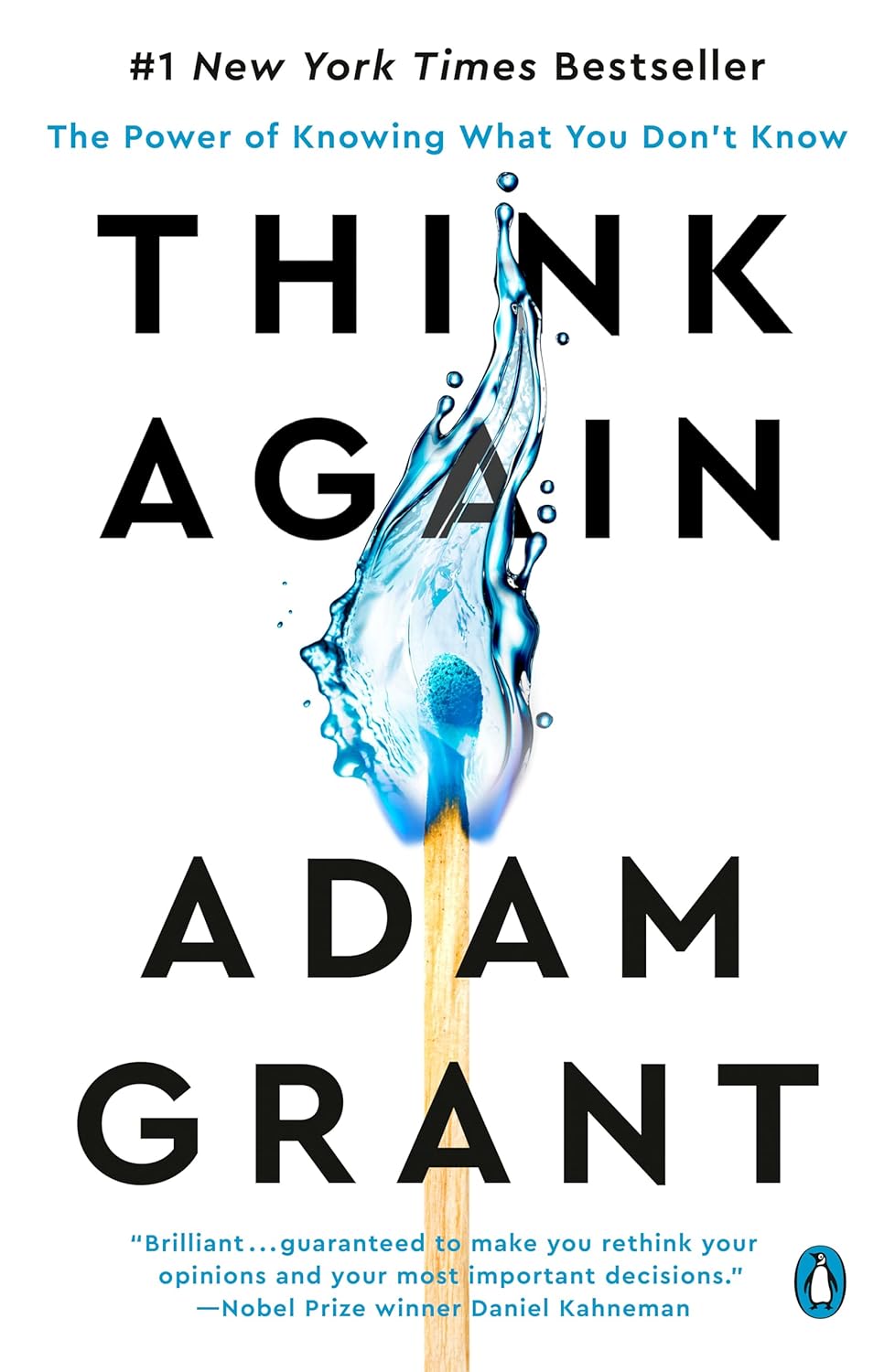
The #1 New York Times bestselling author of Hidden Potential, Originals, and Give and Take examines the critical art of rethinking: learning to question your opinions and open other people's minds, which can position you for excellence at work and wisdom in life
Intelligence is usually seen as the ability to think and learn, but in a rapidly changing world, there's another set of cognitive skills that might matter more: the ability to rethink and unlearn. In our daily lives, too many of us favor the comfort of conviction over the discomfort of doubt. We listen to opinions that make us feel good, instead of ideas that make us think hard. We see disagreement as a threat to our egos, rather than an opportunity to learn. We surround ourselves with people who agree with our conclusions, when we should be gravitating toward those who challenge our thought process. The result is that our beliefs get brittle long before our bones. We think too much like preachers defending our sacred beliefs, prosecutors proving the other side wrong, and politicians campaigning for approval--and too little like scientists searching for truth. Intelligence is no cure, and it can even be a curse: being good at thinking can make us worse at rethinking. The brighter we are, the blinder to our own limitations we can become.
Organizational psychologist Adam Grant is an expert on opening other people's minds--and our own. As Wharton's top-rated professor and the bestselling author of Originals and Give and Take, he makes it one of his guiding principles to argue like he's right but listen like he's wrong. With bold ideas and rigorous evidence, he investigates how we can embrace the joy of being wrong, bring nuance to charged conversations, and build schools, workplaces, and communities of lifelong learners. You'll learn how an international debate champion wins arguments, a Black musician persuades white supremacists to abandon hate, a vaccine whisperer convinces concerned parents to immunize their children, and Adam has coaxed Yankees fans to root for the Red Sox. Think Again reveals that we don't have to believe everything we think or internalize everything we feel. It's an invitation to let go of views that are no longer serving us well and prize mental flexibility over foolish consistency. If knowledge is power, knowing what we don't know is wisdom.
Editorial Reviews
Review
"Renowned Wharton professor Grant spotlights one of the most important and impactful themes of our time: questioning one's own deeply held beliefs. Grant frames true knowledge as not knowing everything, but rather, listening as if we knew nothing at all in this intrepid book that is what our present moment requires."
—Newsweek, "Our 21 Favorite Books of 2021"
“In a world of aggressive certitude, Adam Grant’s latest book is a refreshing mandate for humble open-mindedness. Think Again offers a particularly powerful case for rethinking what we already know . . . that is not just a useful lesson; it could be a vital one.”
—Financial Times
“In his latest book, Think Again: The Power of Knowing What You Don’t Know, [Grant] is in vintage form.”
—The Wall Street Journal
“Think Again delivers smart advice on unlearning assumptions and opening ourselves up to curiosity and humility.”
—The Washington Post
“Adam Grant’s latest book pushes us to reconsider, rethink, reevaluate and reimagine our beliefs, thoughts, and identities and get to the core of why we believe what we do, why it is so important to us, and why we are steadfast to hold on to those ideas and beliefs. . . . It teaches us to stop digging our heels and doubling down and consider other people’s points of view so that we may grow our own. Once again, Adam Grant succeeded in turning our very way of thinking upside down as he pushes us to examine the obvious.”
—Forbes
"This book blends psychology and self-help to prove how doubt, failing, and rethinking are instrumental to improving ourselves and our world. . . . In three sections, he outlines why we struggle to embrace feedback, how we can help others rethink effectively, and how our communities can shift to encourage rethinking."
—Business Insider
“Grant is a born communicator—engaging and impossibly articulate. . . . Think Again . . . digs into the synaptic weirdness of why we think how we do and how we know what (we think) we know. The bottom line: In a world that’s constantly changing, we could all benefit from deliberately reassessing our cherished opinions.”
—Goodreads user
“Adam Grant believes that keeping an open mind is a teachable skill. And no one could teach this hugely valuable skill better than he does in this wonderful read. The striking insights of this brilliant book are guaranteed to make you rethink your opinions and your most important decisions.”
—Daniel Kahneman, Nobel Prize winner in economics and #1 New York Times bestselling author of Thinking, Fast and Slow
“THIS. This is the right book for right now. Yes, learning requires focus. But, unlearning and relearning requires much more - it requires choosing courage over comfort. In Think Again, Adam Grant weaves together research and storytelling to help us build the intellectual and emotional muscle we need to stay curious enough about the world to actually change it. I’ve never felt so hopeful about what I don’t know.”
—Brené Brown, Ph.D., #1 New York Times bestselling author of Dare to Lead
“Adam Grant makes a captivating argument that if we have the humility and curiosity to reconsider our beliefs, we can always reinvent ourselves. Think Again helped me learn about how great thinkers and achievers don’t let expertise or experience stand in the way of being perpetual students.”
—M. Night Shyamalan, director of The Sixth Sense and Split
“Readers will find common ground in many of his compelling arguments (ideologies, sports rivals), making this a thought-provoking read.”
—Booklist
“[A] fast-paced account by a leading authority on the psychology of thinking.”
—Library Journal, (starred review)
“For anyone who wants to create a culture of learning and exploration at home, work or school, Grant distills complex research into a compelling case for why each of us should continually question old assumptions and embrace new ideas and perspectives.”
—Entrepreneur
“It’s the idea of flexibility and how to achieve it that I found most compelling in Think Again. As I read the book, I couldn’t help but reflect on the times I’d clung to an opinion past its expiration date or imagine what I might have learned from a debate, had I asked a question instead of hurling a rebuttal.”
—Behavioral Scientist
About the Author
Excerpt. © Reprinted by permission. All rights reserved.
Chapter 1
A Preacher, a Prosecutor, a Politician, and a Scientist Walk into Your Mind
Progress is impossible without change; and those who cannot change their minds cannot change anything.
-George Bernard Shaw
You probably don't recognize his name, but Mike Lazaridis has had a defining impact on your life. From an early age, it was clear that Mike was something of an electronics wizard. By the time he turned four, he was building his own record player out of Legos and rubber bands. In high school, when his teachers had broken TVs, they called Mike to fix them. In his spare time, he built a computer and designed a better buzzer for high school quiz-bowl teams, which ended up paying for his first year of college. Just months before finishing his electrical engineering degree, Mike did what so many great entrepreneurs of his era would do: he dropped out of college. It was time for this son of immigrants to make his mark on the world.
Mike's first success came when he patented a device for reading the bar codes on movie film, which was so useful in Hollywood that it won an Emmy and an Oscar for technical achievement. That was small potatoes compared to his next big invention, which made his firm the fastest-growing company on the planet. Mike's flagship device quickly attracted a cult following, with loyal customers ranging from Bill Gates to Christina Aguilera. "It's literally changed my life," Oprah Winfrey gushed. "I cannot live without this." When he arrived at the White House, President Obama refused to relinquish his to the Secret Service.
Mike Lazaridis dreamed up the idea for the BlackBerry as a wireless communication device for sending and receiving emails. As of the summer of 2009, it accounted for nearly half of the U.S. smartphone market. By 2014, its market share had plummeted to less than 1 percent.
When a company takes a nosedive like that, we can never pinpoint a single cause of its downfall, so we tend to anthropomorphize it: BlackBerry failed to adapt. Yet adapting to a changing environment isn't something a company does-it's something people do in the multitude of decisions they make every day. As the cofounder, president, and co-CEO, Mike was in charge of all the technical and product decisions on the BlackBerry. Although his thinking may have been the spark that ignited the smartphone revolution, his struggles with rethinking ended up sucking the oxygen out of his company and virtually extinguishing his invention. Where did he go wrong?
Most of us take pride in our knowledge and expertise, and in staying true to our beliefs and opinions. That makes sense in a stable world, where we get rewarded for having conviction in our ideas. The problem is that we live in a rapidly changing world, where we need to spend as much time rethinking as we do thinking.
Rethinking is a skill set, but it's also a mindset. We already have many of the mental tools we need. We just have to remember to get them out of the shed and remove the rust.
Second Thoughts
With advances in access to information and technology, knowledge isn't just increasing. It's increasing at an increasing rate. In 2011, you consumed about five times as much information per day as you would have just a quarter century earlier. As of 1950, it took about fifty years for knowledge in medicine to double. By 1980, medical knowledge was doubling every seven years, and by 2010, it was doubling in half that time. The accelerating pace of change means that we need to question our beliefs more readily than ever before.
This is not an easy task. As we sit with our beliefs, they tend to become more extreme and more entrenched. I'm still struggling to accept that Pluto may not be a planet. In education, after revelations in history and revolutions in science, it often takes years for a curriculum to be updated and textbooks to be revised. Researchers have recently discovered that we need to rethink widely accepted assumptions about such subjects as Cleopatra's roots (her father was Greek, not Egyptian, and her mother's identity is unknown); the appearance of dinosaurs (paleontologists now think some tyrannosaurs had colorful feathers on their backs); and what's required for sight (blind people have actually trained themselves to "see"-sound waves can activate the visual cortex and create representations in the mind's eye, much like how echolocation helps bats navigate in the dark). Vintage records, classic cars, and antique clocks might be valuable collectibles, but outdated facts are mental fossils that are best abandoned.
We're swift to recognize when other people need to think again. We question the judgment of experts whenever we seek out a second opinion on a medical diagnosis. Unfortunately, when it comes to our own knowledge and opinions, we often favor feeling right over being right. In everyday life, we make many diagnoses of our own, ranging from whom we hire to whom we marry. We need to develop the habit of forming our own second opinions.
Imagine you have a family friend who's a financial adviser, and he recommends investing in a retirement fund that isn't in your employer's plan. You have another friend who's fairly knowledgeable about investing, and he tells you that this fund is risky. What would you do?
When a man named Stephen Greenspan found himself in that situation, he decided to weigh his skeptical friend's warning against the data available. His sister had been investing in the fund for several years, and she was pleased with the results. A number of her friends had been, too; although the returns weren't extraordinary, they were consistently in the double digits. The financial adviser was enough of a believer that he had invested his own money in the fund. Armed with that information, Greenspan decided to go forward. He made a bold move, investing nearly a third of his retirement savings in the fund. Before long, he learned that his portfolio had grown by 25 percent.
Then he lost it all overnight when the fund collapsed. It was the Ponzi scheme managed by Bernie Madoff.
Two decades ago my colleague Phil Tetlock discovered something peculiar. As we think and talk, we often slip into the mindsets of three different professions: preachers, prosecutors, and politicians. In each of these modes, we take on a particular identity and use a distinct set of tools. We go into preacher mode when our sacred beliefs are in jeopardy: we deliver sermons to protect and promote our ideals. We enter prosecutor mode when we recognize flaws in other people's reasoning: we marshal arguments to prove them wrong and win our case. We shift into politician mode when we're seeking to win over an audience: we campaign and lobby for the approval of our constituents. The risk is that we become so wrapped up in preaching that we're right, prosecuting others who are wrong, and politicking for support that we don't bother to rethink our own views.
When Stephen Greenspan and his sister made the choice to invest with Bernie Madoff, it wasn't because they relied on just one of those mental tools. All three modes together contributed to their ill-fated decision. When his sister told him about the money she and her friends had made, she was preaching about the merits of the fund. Her confidence led Greenspan to prosecute the friend who warned him against investing, deeming the friend guilty of "knee-jerk cynicism." Greenspan was in politician mode when he let his desire for approval sway him toward a yes-the financial adviser was a family friend whom he liked and wanted to please.
Any of us could have fallen into those traps. Greenspan says that he should've known better, though, because he happens to be an expert on gullibility. When he decided to go ahead with the investment, he had almost finished writing a book on why we get duped. Looking back, he wishes he had approached the decision with a different set of tools. He might have analyzed the fund's strategy more systematically instead of simply trusting in the results. He could have sought out more perspectives from credible sources. He would have experimented with investing smaller amounts over a longer period of time before gambling so much of his life's savings.
That would have put him in the mode of a scientist.
A Different Pair of Goggles
If you're a scientist by trade, rethinking is fundamental to your profession. You're paid to be constantly aware of the limits of your understanding. You're expected to doubt what you know, be curious about what you don't know, and update your views based on new data. In the past century alone, the application of scientific principles has led to dramatic progress. Biological scientists discovered penicillin. Rocket scientists sent us to the moon. Computer scientists built the internet.
But being a scientist is not just a profession. It's a frame of mind-a mode of thinking that differs from preaching, prosecuting, and politicking. We move into scientist mode when we're searching for the truth: we run experiments to test hypotheses and discover knowledge. Scientific tools aren't reserved for people with white coats and beakers, and using them doesn't require toiling away for years with a microscope and a petri dish. Hypotheses have as much of a place in our lives as they do in the lab. Experiments can inform our daily decisions. That makes me wonder: is it possible to train people in other fields to think more like scientists, and if so, do they end up making smarter choices?
Recently, a quartet of European researchers decided to find out. They ran a bold experiment with more than a hundred founders of Italian startups in technology, retail, furniture, food, health care, leisure, and machinery. Most of the founders' businesses had yet to bring in any revenue, making it an ideal setting to investigate how teaching scientific thinking would influence the bottom line.
The entrepreneurs arrived in Milan for a training program in entrepreneurship. Over the course of four months, they learned to create a business strategy, interview customers, build a minimum viable product, and then refine a prototype. What they didn't know was that they'd been randomly assigned to either a "scientific thinking" group or a control group. The training for both groups was identical, except that one was encouraged to view startups through a scientist's goggles. From that perspective, their strategy is a theory, customer interviews help to develop hypotheses, and their minimum viable product and prototype are experiments to test those hypotheses. Their task is to rigorously measure the results and make decisions based on whether their hypotheses are supported or refuted.
Over the following year, the startups in the control group averaged under $300 in revenue. The startups in the scientific thinking group averaged over $12,000 in revenue. They brought in revenue more than twice as fast-and attracted customers sooner, too. Why? The entrepreneurs in the control group tended to stay wedded to their original strategies and products. It was too easy to preach the virtues of their past decisions, prosecute the vices of alternative options, and politick by catering to advisers who favored the existing direction. The entrepreneurs who had been taught to think like scientists, in contrast, pivoted more than twice as often. When their hypotheses weren't supported, they knew it was time to rethink their business models.
What's surprising about these results is that we typically celebrate great entrepreneurs and leaders for being strong-minded and clear-sighted. They're supposed to be paragons of conviction: decisive and certain. Yet evidence reveals that when business executives compete in tournaments to price products, the best strategists are actually slow and unsure. Like careful scientists, they take their time so they have the flexibility to change their minds. I'm beginning to think decisiveness is overrated . . . but I reserve the right to change my mind.
Just as you don't have to be a professional scientist to reason like one, being a professional scientist doesn't guarantee that someone will use the tools of their training. Scientists morph into preachers when they present their pet theories as gospel and treat thoughtful critiques as sacrilege. They veer into politician terrain when they allow their views to be swayed by popularity rather than accuracy. They enter prosecutor mode when they're hell-bent on debunking and discrediting rather than discovering. After upending physics with his theories of relativity, Einstein opposed the quantum revolution: "To punish me for my contempt of authority, Fate has made me an authority myself." Sometimes even great scientists need to think more like scientists.
Decades before becoming a smartphone pioneer, Mike Lazaridis was recognized as a science prodigy. In middle school, he made the local news for building a solar panel at the science fair and won an award for reading every science book in the public library. If you open his eighth-grade yearbook, you'll see a cartoon showing Mike as a mad scientist, with bolts of lightning shooting out of his head.
When Mike created the BlackBerry, he was thinking like a scientist. Existing devices for wireless email featured a stylus that was too slow or a keyboard that was too small. People had to clunkily forward their work emails to their mobile device in-boxes, and they took forever to download. He started generating hypotheses and sent his team of engineers off to test them. What if people could hold the device in their hands and type with their thumbs rather than their fingers? What if there was a single mailbox synchronized across devices? What if messages could be relayed through a server and appear on the device only after they were decrypted?
As other companies followed BlackBerry's lead, Mike would take their smartphones apart and study them. Nothing really impressed him until the summer of 2007, when he was stunned by the computing power inside the first iPhone. "They've put a Mac in this thing," he said. What Mike did next might have been the beginning of the end for the BlackBerry. If the BlackBerry's rise was due in large part to his success in scientific thinking as an engineer, its demise was in many ways the result of his failure in rethinking as a CEO.
As the iPhone skyrocketed onto the scene, Mike maintained his belief in the features that had made the BlackBerry a sensation in the past. He was confident that people wanted a wireless device for work emails and calls, not an entire computer in their pocket with apps for home entertainment. As early as 1997, one of his top engineers wanted to add an internet browser, but Mike told him to focus only on email. A decade later, Mike was still certain that a powerful internet browser would drain the battery and strain the bandwidth of wireless networks. He didn't test the alternative hypotheses.
Details:
Visit the Penguin Books Store
Think Again: The Power of Knowing What You Don't Know
AED9527
Quantity:
Order today to get by 7-14 business days
Delivery fee of AED 20. Free for orders above AED 200.
 Imported From: United States
At BOLO, we work hard to ensure the products you receive are new, genuine, and sourced from reputable suppliers.
Every product in the BOLO catalogue is sourced through our Verified Global Supply Network of verified sellers, authorized distributors or directly from the manufacturer.
Each product undergoes thorough inspection and verification at our consolidation and fulfilment centers to ensure it meets our strict authenticity and quality standards before being shipped and delivered to you.
If you ever have concerns regarding the authenticity of a product purchased from us, please contact Bolo Support. We will review your inquiry promptly and, if necessary, provide documentation verifying authenticity or offer a suitable resolution.
Your trust is our top priority, and we are committed to maintaining transparency and integrity in every transaction.
While we strive to display accurate information, variations in packaging, labeling, instructions, or formulation may occasionally occur due to regional differences or supplier updates. For detailed or manufacturer-specific information, please contact the brand directly or reach out to BOLO Support for assistance.
Unless otherwise stated, all prices displayed on the product page include applicable taxes and import duties.
BOLO operates in accordance with the laws and regulations of United Arab Emirates. Any items found to be restricted or prohibited for sale within the United Arab Emirates will be cancelled prior to shipment. We take proactive measures to ensure that only products permitted for sale in United Arab Emirates are listed on our website.
All items are shipped by air, and any products classified as “Dangerous Goods (DG)” under IATA regulations will be removed from the order and cancelled.
All orders are processed manually, and we make every effort to process them promptly once confirmed. Products cancelled due to the above reasons will be permanently removed from listings across the website.
Similar suggestions by Bolo
More from this brand
Similar items from “Motivation & Self-Improvement”
Share with
Or share with link
https://www.bolo.ae/products/U1984878123
Visit the Penguin Books Store
Think Again: The Power of Knowing What You Don't Know
AED9527
Quantity:
Order today to get by 7-14 business days
Delivery fee of AED 20. Free for orders above AED 200.
Imported From: United States
At BOLO, we work hard to ensure the products you receive are new, genuine, and sourced from reputable suppliers.
Every product in the BOLO catalogue is sourced through our Verified Global Supply Network of verified sellers, authorized distributors or directly from the manufacturer.
Each product undergoes thorough inspection and verification at our consolidation and fulfilment centers to ensure it meets our strict authenticity and quality standards before being shipped and delivered to you.
If you ever have concerns regarding the authenticity of a product purchased from us, please contact Bolo Support. We will review your inquiry promptly and, if necessary, provide documentation verifying authenticity or offer a suitable resolution.
Your trust is our top priority, and we are committed to maintaining transparency and integrity in every transaction.
While we strive to display accurate information, variations in packaging, labeling, instructions, or formulation may occasionally occur due to regional differences or supplier updates. For detailed or manufacturer-specific information, please contact the brand directly or reach out to BOLO Support for assistance.
Unless otherwise stated, all prices displayed on the product page include applicable taxes and import duties.
BOLO operates in accordance with the laws and regulations of United Arab Emirates. Any items found to be restricted or prohibited for sale within the United Arab Emirates will be cancelled prior to shipment. We take proactive measures to ensure that only products permitted for sale in United Arab Emirates are listed on our website.
All items are shipped by air, and any products classified as “Dangerous Goods (DG)” under IATA regulations will be removed from the order and cancelled.
All orders are processed manually, and we make every effort to process them promptly once confirmed. Products cancelled due to the above reasons will be permanently removed from listings across the website.
Description:
“THIS. This is the right book for right now. Yes, learning requires focus. But, unlearning and relearning requires much more—it requires choosing courage over comfort. In Think Again, Adam Grant weaves together research and storytelling to help us build the intellectual and emotional muscle we need to stay curious enough about the world to actually change it. I’ve never felt so hopeful about what I don’t know.”
—Brené Brown, Ph.D., #1 New York Times bestselling author of Dare to Lead
The #1 New York Times bestselling author of Hidden Potential, Originals, and Give and Take examines the critical art of rethinking: learning to question your opinions and open other people's minds, which can position you for excellence at work and wisdom in life
Intelligence is usually seen as the ability to think and learn, but in a rapidly changing world, there's another set of cognitive skills that might matter more: the ability to rethink and unlearn. In our daily lives, too many of us favor the comfort of conviction over the discomfort of doubt. We listen to opinions that make us feel good, instead of ideas that make us think hard. We see disagreement as a threat to our egos, rather than an opportunity to learn. We surround ourselves with people who agree with our conclusions, when we should be gravitating toward those who challenge our thought process. The result is that our beliefs get brittle long before our bones. We think too much like preachers defending our sacred beliefs, prosecutors proving the other side wrong, and politicians campaigning for approval--and too little like scientists searching for truth. Intelligence is no cure, and it can even be a curse: being good at thinking can make us worse at rethinking. The brighter we are, the blinder to our own limitations we can become.
Organizational psychologist Adam Grant is an expert on opening other people's minds--and our own. As Wharton's top-rated professor and the bestselling author of Originals and Give and Take, he makes it one of his guiding principles to argue like he's right but listen like he's wrong. With bold ideas and rigorous evidence, he investigates how we can embrace the joy of being wrong, bring nuance to charged conversations, and build schools, workplaces, and communities of lifelong learners. You'll learn how an international debate champion wins arguments, a Black musician persuades white supremacists to abandon hate, a vaccine whisperer convinces concerned parents to immunize their children, and Adam has coaxed Yankees fans to root for the Red Sox. Think Again reveals that we don't have to believe everything we think or internalize everything we feel. It's an invitation to let go of views that are no longer serving us well and prize mental flexibility over foolish consistency. If knowledge is power, knowing what we don't know is wisdom.
Editorial Reviews
Review
"Renowned Wharton professor Grant spotlights one of the most important and impactful themes of our time: questioning one's own deeply held beliefs. Grant frames true knowledge as not knowing everything, but rather, listening as if we knew nothing at all in this intrepid book that is what our present moment requires."
—Newsweek, "Our 21 Favorite Books of 2021"
“In a world of aggressive certitude, Adam Grant’s latest book is a refreshing mandate for humble open-mindedness. Think Again offers a particularly powerful case for rethinking what we already know . . . that is not just a useful lesson; it could be a vital one.”
—Financial Times
“In his latest book, Think Again: The Power of Knowing What You Don’t Know, [Grant] is in vintage form.”
—The Wall Street Journal
“Think Again delivers smart advice on unlearning assumptions and opening ourselves up to curiosity and humility.”
—The Washington Post
“Adam Grant’s latest book pushes us to reconsider, rethink, reevaluate and reimagine our beliefs, thoughts, and identities and get to the core of why we believe what we do, why it is so important to us, and why we are steadfast to hold on to those ideas and beliefs. . . . It teaches us to stop digging our heels and doubling down and consider other people’s points of view so that we may grow our own. Once again, Adam Grant succeeded in turning our very way of thinking upside down as he pushes us to examine the obvious.”
—Forbes
"This book blends psychology and self-help to prove how doubt, failing, and rethinking are instrumental to improving ourselves and our world. . . . In three sections, he outlines why we struggle to embrace feedback, how we can help others rethink effectively, and how our communities can shift to encourage rethinking."
—Business Insider
“Grant is a born communicator—engaging and impossibly articulate. . . . Think Again . . . digs into the synaptic weirdness of why we think how we do and how we know what (we think) we know. The bottom line: In a world that’s constantly changing, we could all benefit from deliberately reassessing our cherished opinions.”
—Goodreads user
“Adam Grant believes that keeping an open mind is a teachable skill. And no one could teach this hugely valuable skill better than he does in this wonderful read. The striking insights of this brilliant book are guaranteed to make you rethink your opinions and your most important decisions.”
—Daniel Kahneman, Nobel Prize winner in economics and #1 New York Times bestselling author of Thinking, Fast and Slow
“THIS. This is the right book for right now. Yes, learning requires focus. But, unlearning and relearning requires much more - it requires choosing courage over comfort. In Think Again, Adam Grant weaves together research and storytelling to help us build the intellectual and emotional muscle we need to stay curious enough about the world to actually change it. I’ve never felt so hopeful about what I don’t know.”
—Brené Brown, Ph.D., #1 New York Times bestselling author of Dare to Lead
“Adam Grant makes a captivating argument that if we have the humility and curiosity to reconsider our beliefs, we can always reinvent ourselves. Think Again helped me learn about how great thinkers and achievers don’t let expertise or experience stand in the way of being perpetual students.”
—M. Night Shyamalan, director of The Sixth Sense and Split
“Readers will find common ground in many of his compelling arguments (ideologies, sports rivals), making this a thought-provoking read.”
—Booklist
“[A] fast-paced account by a leading authority on the psychology of thinking.”
—Library Journal, (starred review)
“For anyone who wants to create a culture of learning and exploration at home, work or school, Grant distills complex research into a compelling case for why each of us should continually question old assumptions and embrace new ideas and perspectives.”
—Entrepreneur
“It’s the idea of flexibility and how to achieve it that I found most compelling in Think Again. As I read the book, I couldn’t help but reflect on the times I’d clung to an opinion past its expiration date or imagine what I might have learned from a debate, had I asked a question instead of hurling a rebuttal.”
—Behavioral Scientist
About the Author
Excerpt. © Reprinted by permission. All rights reserved.
Chapter 1
A Preacher, a Prosecutor, a Politician, and a Scientist Walk into Your Mind
Progress is impossible without change; and those who cannot change their minds cannot change anything.
-George Bernard Shaw
You probably don't recognize his name, but Mike Lazaridis has had a defining impact on your life. From an early age, it was clear that Mike was something of an electronics wizard. By the time he turned four, he was building his own record player out of Legos and rubber bands. In high school, when his teachers had broken TVs, they called Mike to fix them. In his spare time, he built a computer and designed a better buzzer for high school quiz-bowl teams, which ended up paying for his first year of college. Just months before finishing his electrical engineering degree, Mike did what so many great entrepreneurs of his era would do: he dropped out of college. It was time for this son of immigrants to make his mark on the world.
Mike's first success came when he patented a device for reading the bar codes on movie film, which was so useful in Hollywood that it won an Emmy and an Oscar for technical achievement. That was small potatoes compared to his next big invention, which made his firm the fastest-growing company on the planet. Mike's flagship device quickly attracted a cult following, with loyal customers ranging from Bill Gates to Christina Aguilera. "It's literally changed my life," Oprah Winfrey gushed. "I cannot live without this." When he arrived at the White House, President Obama refused to relinquish his to the Secret Service.
Mike Lazaridis dreamed up the idea for the BlackBerry as a wireless communication device for sending and receiving emails. As of the summer of 2009, it accounted for nearly half of the U.S. smartphone market. By 2014, its market share had plummeted to less than 1 percent.
When a company takes a nosedive like that, we can never pinpoint a single cause of its downfall, so we tend to anthropomorphize it: BlackBerry failed to adapt. Yet adapting to a changing environment isn't something a company does-it's something people do in the multitude of decisions they make every day. As the cofounder, president, and co-CEO, Mike was in charge of all the technical and product decisions on the BlackBerry. Although his thinking may have been the spark that ignited the smartphone revolution, his struggles with rethinking ended up sucking the oxygen out of his company and virtually extinguishing his invention. Where did he go wrong?
Most of us take pride in our knowledge and expertise, and in staying true to our beliefs and opinions. That makes sense in a stable world, where we get rewarded for having conviction in our ideas. The problem is that we live in a rapidly changing world, where we need to spend as much time rethinking as we do thinking.
Rethinking is a skill set, but it's also a mindset. We already have many of the mental tools we need. We just have to remember to get them out of the shed and remove the rust.
Second Thoughts
With advances in access to information and technology, knowledge isn't just increasing. It's increasing at an increasing rate. In 2011, you consumed about five times as much information per day as you would have just a quarter century earlier. As of 1950, it took about fifty years for knowledge in medicine to double. By 1980, medical knowledge was doubling every seven years, and by 2010, it was doubling in half that time. The accelerating pace of change means that we need to question our beliefs more readily than ever before.
This is not an easy task. As we sit with our beliefs, they tend to become more extreme and more entrenched. I'm still struggling to accept that Pluto may not be a planet. In education, after revelations in history and revolutions in science, it often takes years for a curriculum to be updated and textbooks to be revised. Researchers have recently discovered that we need to rethink widely accepted assumptions about such subjects as Cleopatra's roots (her father was Greek, not Egyptian, and her mother's identity is unknown); the appearance of dinosaurs (paleontologists now think some tyrannosaurs had colorful feathers on their backs); and what's required for sight (blind people have actually trained themselves to "see"-sound waves can activate the visual cortex and create representations in the mind's eye, much like how echolocation helps bats navigate in the dark). Vintage records, classic cars, and antique clocks might be valuable collectibles, but outdated facts are mental fossils that are best abandoned.
We're swift to recognize when other people need to think again. We question the judgment of experts whenever we seek out a second opinion on a medical diagnosis. Unfortunately, when it comes to our own knowledge and opinions, we often favor feeling right over being right. In everyday life, we make many diagnoses of our own, ranging from whom we hire to whom we marry. We need to develop the habit of forming our own second opinions.
Imagine you have a family friend who's a financial adviser, and he recommends investing in a retirement fund that isn't in your employer's plan. You have another friend who's fairly knowledgeable about investing, and he tells you that this fund is risky. What would you do?
When a man named Stephen Greenspan found himself in that situation, he decided to weigh his skeptical friend's warning against the data available. His sister had been investing in the fund for several years, and she was pleased with the results. A number of her friends had been, too; although the returns weren't extraordinary, they were consistently in the double digits. The financial adviser was enough of a believer that he had invested his own money in the fund. Armed with that information, Greenspan decided to go forward. He made a bold move, investing nearly a third of his retirement savings in the fund. Before long, he learned that his portfolio had grown by 25 percent.
Then he lost it all overnight when the fund collapsed. It was the Ponzi scheme managed by Bernie Madoff.
Two decades ago my colleague Phil Tetlock discovered something peculiar. As we think and talk, we often slip into the mindsets of three different professions: preachers, prosecutors, and politicians. In each of these modes, we take on a particular identity and use a distinct set of tools. We go into preacher mode when our sacred beliefs are in jeopardy: we deliver sermons to protect and promote our ideals. We enter prosecutor mode when we recognize flaws in other people's reasoning: we marshal arguments to prove them wrong and win our case. We shift into politician mode when we're seeking to win over an audience: we campaign and lobby for the approval of our constituents. The risk is that we become so wrapped up in preaching that we're right, prosecuting others who are wrong, and politicking for support that we don't bother to rethink our own views.
When Stephen Greenspan and his sister made the choice to invest with Bernie Madoff, it wasn't because they relied on just one of those mental tools. All three modes together contributed to their ill-fated decision. When his sister told him about the money she and her friends had made, she was preaching about the merits of the fund. Her confidence led Greenspan to prosecute the friend who warned him against investing, deeming the friend guilty of "knee-jerk cynicism." Greenspan was in politician mode when he let his desire for approval sway him toward a yes-the financial adviser was a family friend whom he liked and wanted to please.
Any of us could have fallen into those traps. Greenspan says that he should've known better, though, because he happens to be an expert on gullibility. When he decided to go ahead with the investment, he had almost finished writing a book on why we get duped. Looking back, he wishes he had approached the decision with a different set of tools. He might have analyzed the fund's strategy more systematically instead of simply trusting in the results. He could have sought out more perspectives from credible sources. He would have experimented with investing smaller amounts over a longer period of time before gambling so much of his life's savings.
That would have put him in the mode of a scientist.
A Different Pair of Goggles
If you're a scientist by trade, rethinking is fundamental to your profession. You're paid to be constantly aware of the limits of your understanding. You're expected to doubt what you know, be curious about what you don't know, and update your views based on new data. In the past century alone, the application of scientific principles has led to dramatic progress. Biological scientists discovered penicillin. Rocket scientists sent us to the moon. Computer scientists built the internet.
But being a scientist is not just a profession. It's a frame of mind-a mode of thinking that differs from preaching, prosecuting, and politicking. We move into scientist mode when we're searching for the truth: we run experiments to test hypotheses and discover knowledge. Scientific tools aren't reserved for people with white coats and beakers, and using them doesn't require toiling away for years with a microscope and a petri dish. Hypotheses have as much of a place in our lives as they do in the lab. Experiments can inform our daily decisions. That makes me wonder: is it possible to train people in other fields to think more like scientists, and if so, do they end up making smarter choices?
Recently, a quartet of European researchers decided to find out. They ran a bold experiment with more than a hundred founders of Italian startups in technology, retail, furniture, food, health care, leisure, and machinery. Most of the founders' businesses had yet to bring in any revenue, making it an ideal setting to investigate how teaching scientific thinking would influence the bottom line.
The entrepreneurs arrived in Milan for a training program in entrepreneurship. Over the course of four months, they learned to create a business strategy, interview customers, build a minimum viable product, and then refine a prototype. What they didn't know was that they'd been randomly assigned to either a "scientific thinking" group or a control group. The training for both groups was identical, except that one was encouraged to view startups through a scientist's goggles. From that perspective, their strategy is a theory, customer interviews help to develop hypotheses, and their minimum viable product and prototype are experiments to test those hypotheses. Their task is to rigorously measure the results and make decisions based on whether their hypotheses are supported or refuted.
Over the following year, the startups in the control group averaged under $300 in revenue. The startups in the scientific thinking group averaged over $12,000 in revenue. They brought in revenue more than twice as fast-and attracted customers sooner, too. Why? The entrepreneurs in the control group tended to stay wedded to their original strategies and products. It was too easy to preach the virtues of their past decisions, prosecute the vices of alternative options, and politick by catering to advisers who favored the existing direction. The entrepreneurs who had been taught to think like scientists, in contrast, pivoted more than twice as often. When their hypotheses weren't supported, they knew it was time to rethink their business models.
What's surprising about these results is that we typically celebrate great entrepreneurs and leaders for being strong-minded and clear-sighted. They're supposed to be paragons of conviction: decisive and certain. Yet evidence reveals that when business executives compete in tournaments to price products, the best strategists are actually slow and unsure. Like careful scientists, they take their time so they have the flexibility to change their minds. I'm beginning to think decisiveness is overrated . . . but I reserve the right to change my mind.
Just as you don't have to be a professional scientist to reason like one, being a professional scientist doesn't guarantee that someone will use the tools of their training. Scientists morph into preachers when they present their pet theories as gospel and treat thoughtful critiques as sacrilege. They veer into politician terrain when they allow their views to be swayed by popularity rather than accuracy. They enter prosecutor mode when they're hell-bent on debunking and discrediting rather than discovering. After upending physics with his theories of relativity, Einstein opposed the quantum revolution: "To punish me for my contempt of authority, Fate has made me an authority myself." Sometimes even great scientists need to think more like scientists.
Decades before becoming a smartphone pioneer, Mike Lazaridis was recognized as a science prodigy. In middle school, he made the local news for building a solar panel at the science fair and won an award for reading every science book in the public library. If you open his eighth-grade yearbook, you'll see a cartoon showing Mike as a mad scientist, with bolts of lightning shooting out of his head.
When Mike created the BlackBerry, he was thinking like a scientist. Existing devices for wireless email featured a stylus that was too slow or a keyboard that was too small. People had to clunkily forward their work emails to their mobile device in-boxes, and they took forever to download. He started generating hypotheses and sent his team of engineers off to test them. What if people could hold the device in their hands and type with their thumbs rather than their fingers? What if there was a single mailbox synchronized across devices? What if messages could be relayed through a server and appear on the device only after they were decrypted?
As other companies followed BlackBerry's lead, Mike would take their smartphones apart and study them. Nothing really impressed him until the summer of 2007, when he was stunned by the computing power inside the first iPhone. "They've put a Mac in this thing," he said. What Mike did next might have been the beginning of the end for the BlackBerry. If the BlackBerry's rise was due in large part to his success in scientific thinking as an engineer, its demise was in many ways the result of his failure in rethinking as a CEO.
As the iPhone skyrocketed onto the scene, Mike maintained his belief in the features that had made the BlackBerry a sensation in the past. He was confident that people wanted a wireless device for work emails and calls, not an entire computer in their pocket with apps for home entertainment. As early as 1997, one of his top engineers wanted to add an internet browser, but Mike told him to focus only on email. A decade later, Mike was still certain that a powerful internet browser would drain the battery and strain the bandwidth of wireless networks. He didn't test the alternative hypotheses.
Details:
Similar suggestions by Bolo
More from this brand
Similar items from “Motivation & Self-Improvement”
Share with
Or share with link
https://www.bolo.ae/products/U1984878123