Description:
“A marvelous fiction about the power of language to elevate or repress.”—Geraldine Brooks, New York Times bestselling author of People of the Book
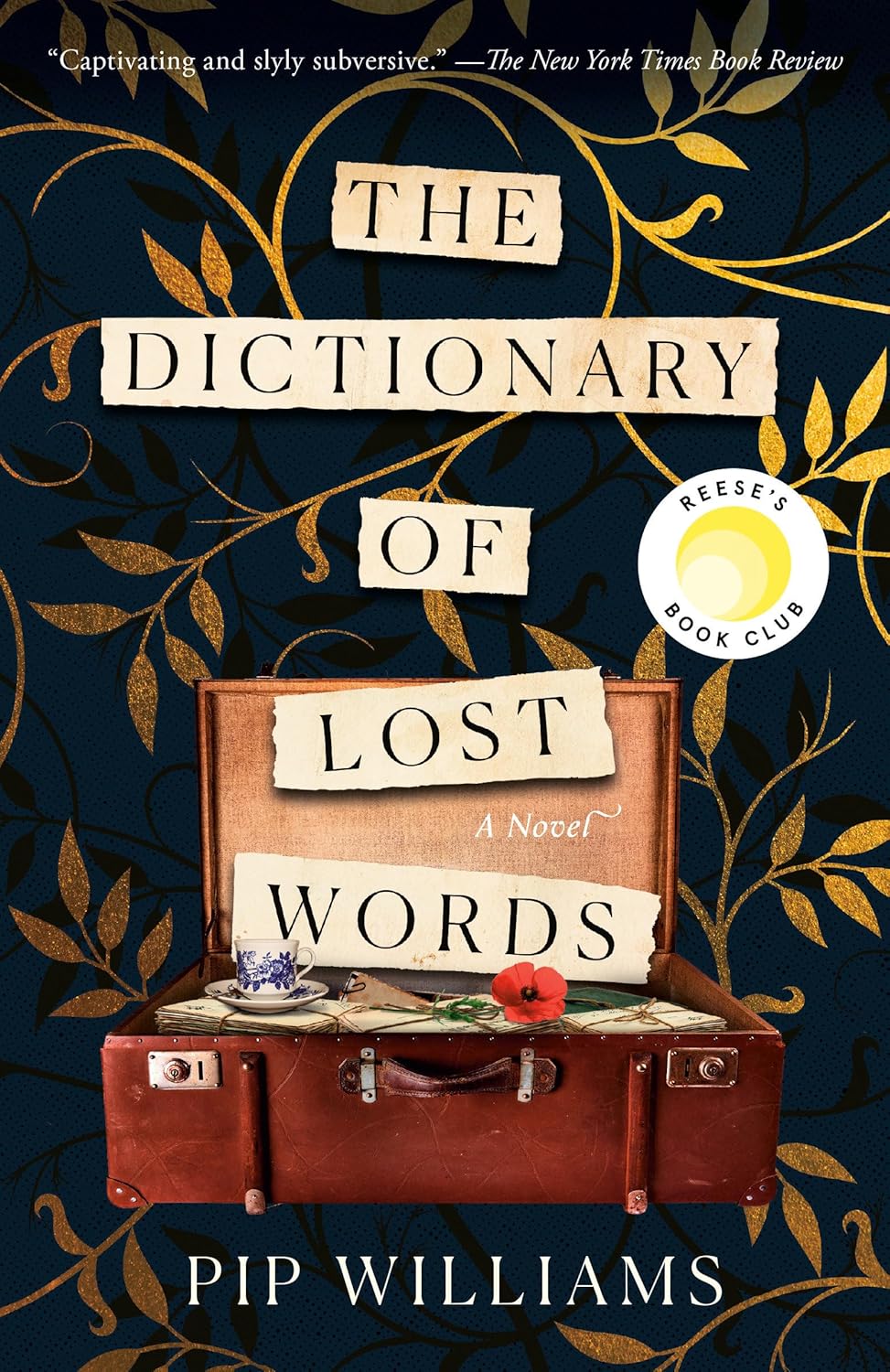
Esme is born into a world of words. Motherless and irrepressibly curious, she spends her childhood in the Scriptorium, an Oxford garden shed in which her father and a team of dedicated lexicographers are collecting words for the very first Oxford English Dictionary. Young Esme’s place is beneath the sorting table, unseen and unheard. One day a slip of paper containing the word bondmaid flutters beneath the table. She rescues the slip and, learning that the word means “slave girl,” begins to collect other words that have been discarded or neglected by the dictionary men.
As she grows up, Esme realizes that words and meanings relating to women’s and common folks’ experiences often go unrecorded. And so she begins in earnest to search out words for her own dictionary: the Dictionary of Lost Words. To do so she must leave the sheltered world of the university and venture out to meet the people whose words will fill those pages.
Set during the height of the women’s suffrage movement and with the Great War looming, The Dictionary of Lost Words reveals a lost narrative, hidden between the lines of a history written by men. Inspired by actual events, author Pip Williams has delved into the archives of the Oxford English Dictionary to tell this highly original story. The Dictionary of Lost Words is a delightful, lyrical, and deeply thought-provoking celebration of words and the power of language to shape the world.
WINNER OF THE AUSTRALIAN BOOK INDUSTRY AWARD
Review
“This remarkable novel tries to rectify a glaring oversight in the historical accounts of the first Oxford English Dictionary—the contributions of women . . . without whom the English language wouldn’t have evolved as fully and colorfully as it has.”—Boston magazine
“Enchanting, sorrowful, and wonderfully written, the book is a one-of-a-kind celebration of language and its importance in our lives. A must-have.”—Library Journal (starred review)
“In Williams’s exuberant, meticulously researched debut, the daughter of a lexicographer devotes her life to an alternative dictionary. . . . Williams’s feminist take on language will move readers.”—Publishers Weekly
“Williams turns history as we know it on its head in this delightful debut, spotlighting those women and their contributions, using the awe-inspiring power of words themselves to illuminate them.”—Newsweek
“[A] masterfully written, beautiful first novel that tells a fascinating story of language, love and loss.”—Historical Novel Society
“The writing is glorious; I dog-eared many pages as I read, marking passages that helped me see words in a new way.”—Manhattan Book Review (starred review)
“The novel you’ve been waiting for without even realizing it . . . Williams will convince you of a word’s importance in a most lovely and charismatic story.”—Bookreporter
“A lexicographer’s dream of a novel, this is a lovely book to get lost in, an imaginative love letter to dictionaries.”—Booklist
“Williams provides readers with detailed background and biographical information pointing to extensive research about the [Oxford English Dictionary] and its editors, many of whom appear as characters in Esme’s life. The result is a satisfying amalgam of truth and historical fiction.”—Kirkus Reviews
“In the annals of lexicography, no more imaginative, delightful, charming, and clever book has yet been written.”—Simon Winchester, author of The Professor and the Madman: A Tale of Murder, Insanity, and the Making of the Oxford English Dictionary
“What a novel of words, their adventure, and their capacity to define and, above all, challenge the world. There will not be this year a more original novel published. I just know it.”—Thomas Keneally, author of Schindler’s List
“What a compelling, fresh look at historical women! This marvelous exploration into the ways in which spoken and written language impact us is a delight and an education.”—Marie Benedict, author of The Mystery of Mrs. Christie
“This charming, inventive, and utterly irresistible novel is the story we all need right now. Words have never mattered more, as Pip Williams illuminates in her unforgettable debut.”—Susan Wiggs, author of The Lost and Found Bookshop
About the Author
Excerpt. © Reprinted by permission. All rights reserved.
May 1887
Scriptorium. It sounds as if it might have been a grand building, where the lightest footstep would echo between marble floor and gilded dome. But it was just a shed, in the back garden of a house in Oxford.
Instead of storing shovels and rakes, the shed stored words. Every word in the English language was written on a slip of paper the size of a postcard. Volunteers posted them from all over the world, and they were kept in bundles in the hundreds of pigeon-holes that lined the shed walls. Dr. Murray was the one who named it the Scriptorium—he must have thought it an indignity for the English language to be stored in a garden shed—but everyone who worked there called it the Scrippy. Everyone but me. I liked the feel of Scriptorium as it moved around my mouth and landed softly between my lips. It took me a long time to learn to say it, and when I finally did nothing else would do.
Da once helped me search the pigeon-holes for scriptorium. We found five slips with examples of how the word had been used, each quotation dating back little more than a hundred years. All of them were more or less the same, and none of them referred to a shed in the back garden of a house in Oxford. A scriptorium, the slips told me, was a writing room in a monastery.
But I understood why Dr. Murray had chosen it. He and his assistants were a little like monks, and when I was five it was easy to imagine the Dictionary as their holy book. When Dr. Murray told me it would take a lifetime to compile all the words, I wondered whose. His hair was already as grey as ash, and they were only halfway through B.
Da and Dr. Murray had been teachers together in Scotland long before there was a scriptorium. And because they were friends, and because I had no mother to care for me, and because Da was one of Dr. Murray’s most trusted lexicographers, everyone turned a blind eye when I was in the Scriptorium.
The Scriptorium felt magical, like everything that ever was and ever could be had been stored within its walls. Books were piled on every surface. Old dictionaries, histories and tales from long ago filled the shelves that separated one desk from another, or created a nook for a chair. Pigeon-holes rose from the floor to the ceiling. They were crammed full of slips, and Da once said that if I read every one, I’d understand the meaning of everything.
In the middle of it all was the sorting table. Da sat at one end, and three assistants could fit along either side. At the other end was Dr. Murray’s high desk, facing all the words and all the men who helped him define them.
We always arrived before the other lexicographers, and for that little while I would have Da and the words all to myself. I’d sit on Da’s lap at the sorting table and help him sort the slips. Whenever we came across a word I didn’t know, he would read the quotation it came with and help me work out what it meant. If I asked the right questions, he would try to find the book the quotation came from and read me more. It was like a treasure hunt, and sometimes I found gold.
“This boy had been a scatter-brained scapegrace from his birth.” Da read the quotation from a slip he had just pulled out of an envelope.
“Am I a scatter-brained scapegrace?” I asked.
“Sometimes,” Da said, tickling me.
Then I asked who the boy was, and Da showed me where it was written at the top of the slip.
“Ala-ed-Din and the Wonderful Lamp,” he read.
When the other assistants arrived I slipped under the sorting table.
“Be quiet as a mouse and stay out of the way,” Da said.
It was easy to stay hidden.
At the end of the day I sat on Da’s lap by the warmth of the grate and we read “Ala-ed-Din and the Wonderful Lamp.” It was an old story, Da said. About a boy from China. When I asked if there were others, he said there were a thousand more. The story was like nothing I had heard, nowhere I had been, and no one I knew of. I looked around the Scriptorium and imagined it as a genie’s lamp. It was so ordinary on the outside, but on the inside full of wonder. And some things weren’t always what they seemed.
The next day, after helping with the slips, I pestered Da for another story. In my enthusiasm I forgot to be as quiet as a mouse; I was getting in his way.
“A scapegrace will not be allowed to stay,” Da warned, and I imagined being banished to Ala-ed-Din’s cave. I spent the rest of the day beneath the sorting table, where a little bit of treasure found me.
It was a word, and it slipped off the end of the table. When it lands, I thought, I’ll rescue it, and hand it to Dr. Murray myself.
I watched it. For a thousand moments I watched it ride some unseen current of air. I expected it to land on the unswept floor, but it didn’t. It glided like a bird, almost landing, then rose up to somersault as if bidden by a genie. I never imagined that it might land in my lap, that it could possibly travel so far. But it did.
The word sat in the folds of my dress like a bright thing fallen from heaven. I dared not touch it. It was only with Da that I was allowed to hold the words. I thought to call out to him, but something caught my tongue. I sat with the word for a long time, wanting to touch it, but not. What word? I wondered. Whose? No one bent down to claim it.
After a long while I scooped the word up, careful not to crush its silvery wings, and brought it close to my face. It was difficult to read in the gloom of my hiding spot. I shuffled along to where a curtain of sparkling dust hung between two chairs.
I held the word up to the light. Black ink on white paper. Eight letters; the first, a butterfly B. I moved my mouth around the rest as Da had taught me: O for orange, N for naughty, D for dog, M for Murray, A for apple, I for ink, D for dog, again. I sounded them out in a whisper. The first part was easy: bond. The second part took a little longer, but then I remembered how the A and I went together. Maid.
The word was bondmaid. Below it were other words that ran together like a tangle of thread. I couldn’t tell if they made up a quotation sent in by a volunteer or a definition written by one of Dr. Murray’s assistants. Da said that all the hours he spent in the Scriptorium were to make sense of the words sent in by volunteers, so that those words could be defined in the Dictionary. It was important, and it meant I would get a schooling and three hot meals and grow up to be a fine young lady. The words, he said, were for me.
“Will they all get defined?” I once asked.
“Some will be left out,” Da said.
“Why?”
He paused. “They’re just not solid enough.” I frowned, and he said, “Not enough people have written them down.”
“What happens to the words that are left out?”
“They go back in the pigeon-holes. If there isn’t enough information about them, they’re discarded.”
“But they might be forgotten if they’re not in the Dictionary.”
He’d tilted his head to one side and looked at me, as if I’d said something important. “Yes, they might.”
I knew what happened when a word was discarded. I folded bondmaid carefully and put it in the pocket of my pinny.
A moment later, Da’s face appeared under the sorting table. “Run along now, Esme. Lizzie’s waiting for you.”
I peered between all the legs--chairs’, table’s, men’s--and saw the Murrays’ young maid standing beyond the open door, her pinafore tied tight around her waist, too much fabric above and too much fabric below. She was still growing into it, she told me, but from under the sorting table she reminded me of someone playing at dress up. I crawled between the pairs of legs and scampered out to her.
“Next time you should come in and find me; it would be more fun,” I said, when I got to Lizzie.
“It’s not me place.” She took my hand and walked me to the shade of the ash tree.
“Where is your place?"
She frowned, then shrugged. “The room at the top of the stairs, I s’pose. The kitchen when I’m helping Mrs. Ballard, but definitely not when I ain’t. St. Mary Magdalen on a Sunday.”
“Is that all?”
“The garden, when I’m caring for you—so we don’t get under Mrs. B’s feet. And more and more the Covered Market, ’cos of her cranky knees.”
“Has Sunnyside always been your place?” I asked.
“Not always.” She looked down at me, and I wondered where her smile had gone.
“Where did it used to be?”
She hesitated. “With me ma and all our littluns.”
“What are littluns?”
“Children.”
“Like me?”
“Like you, Essymay.”
“Are they dead?”
“Just me ma. The littluns was taken away, I don’t know where. They was too young for service.”
Details:
Visit the Ballantine Books Store
The Dictionary of Lost Words: Reese's Book Club: A Novel
AED12307
Quantity:
Order today to get by 7-14 business days
Delivery fee of AED 20. Free for orders above AED 200.
 Imported From: United States
At BOLO, we work hard to ensure the products you receive are new, genuine, and sourced from reputable suppliers.
Every product in the BOLO catalogue is sourced through our Verified Global Supply Network of verified sellers, authorized distributors or directly from the manufacturer.
Each product undergoes thorough inspection and verification at our consolidation and fulfilment centers to ensure it meets our strict authenticity and quality standards before being shipped and delivered to you.
If you ever have concerns regarding the authenticity of a product purchased from us, please contact Bolo Support. We will review your inquiry promptly and, if necessary, provide documentation verifying authenticity or offer a suitable resolution.
Your trust is our top priority, and we are committed to maintaining transparency and integrity in every transaction.
While we strive to display accurate information, variations in packaging, labeling, instructions, or formulation may occasionally occur due to regional differences or supplier updates. For detailed or manufacturer-specific information, please contact the brand directly or reach out to BOLO Support for assistance.
Unless otherwise stated, all prices displayed on the product page include applicable taxes and import duties.
BOLO operates in accordance with the laws and regulations of United Arab Emirates. Any items found to be restricted or prohibited for sale within the United Arab Emirates will be cancelled prior to shipment. We take proactive measures to ensure that only products permitted for sale in United Arab Emirates are listed on our website.
All items are shipped by air, and any products classified as “Dangerous Goods (DG)” under IATA regulations will be removed from the order and cancelled.
All orders are processed manually, and we make every effort to process them promptly once confirmed. Products cancelled due to the above reasons will be permanently removed from listings across the website.


More from this brand
Similar items from “Biographical”
Share with
Or share with link
https://www.bolo.ae/products/U1984820745
Visit the Ballantine Books Store
The Dictionary of Lost Words: Reese's Book Club: A Novel
AED12307
Quantity:
Order today to get by 7-14 business days
Delivery fee of AED 20. Free for orders above AED 200.
Imported From: United States
At BOLO, we work hard to ensure the products you receive are new, genuine, and sourced from reputable suppliers.
Every product in the BOLO catalogue is sourced through our Verified Global Supply Network of verified sellers, authorized distributors or directly from the manufacturer.
Each product undergoes thorough inspection and verification at our consolidation and fulfilment centers to ensure it meets our strict authenticity and quality standards before being shipped and delivered to you.
If you ever have concerns regarding the authenticity of a product purchased from us, please contact Bolo Support. We will review your inquiry promptly and, if necessary, provide documentation verifying authenticity or offer a suitable resolution.
Your trust is our top priority, and we are committed to maintaining transparency and integrity in every transaction.
While we strive to display accurate information, variations in packaging, labeling, instructions, or formulation may occasionally occur due to regional differences or supplier updates. For detailed or manufacturer-specific information, please contact the brand directly or reach out to BOLO Support for assistance.
Unless otherwise stated, all prices displayed on the product page include applicable taxes and import duties.
BOLO operates in accordance with the laws and regulations of United Arab Emirates. Any items found to be restricted or prohibited for sale within the United Arab Emirates will be cancelled prior to shipment. We take proactive measures to ensure that only products permitted for sale in United Arab Emirates are listed on our website.
All items are shipped by air, and any products classified as “Dangerous Goods (DG)” under IATA regulations will be removed from the order and cancelled.
All orders are processed manually, and we make every effort to process them promptly once confirmed. Products cancelled due to the above reasons will be permanently removed from listings across the website.
Description:
“A marvelous fiction about the power of language to elevate or repress.”—Geraldine Brooks, New York Times bestselling author of People of the Book
Esme is born into a world of words. Motherless and irrepressibly curious, she spends her childhood in the Scriptorium, an Oxford garden shed in which her father and a team of dedicated lexicographers are collecting words for the very first Oxford English Dictionary. Young Esme’s place is beneath the sorting table, unseen and unheard. One day a slip of paper containing the word bondmaid flutters beneath the table. She rescues the slip and, learning that the word means “slave girl,” begins to collect other words that have been discarded or neglected by the dictionary men.
As she grows up, Esme realizes that words and meanings relating to women’s and common folks’ experiences often go unrecorded. And so she begins in earnest to search out words for her own dictionary: the Dictionary of Lost Words. To do so she must leave the sheltered world of the university and venture out to meet the people whose words will fill those pages.
Set during the height of the women’s suffrage movement and with the Great War looming, The Dictionary of Lost Words reveals a lost narrative, hidden between the lines of a history written by men. Inspired by actual events, author Pip Williams has delved into the archives of the Oxford English Dictionary to tell this highly original story. The Dictionary of Lost Words is a delightful, lyrical, and deeply thought-provoking celebration of words and the power of language to shape the world.
WINNER OF THE AUSTRALIAN BOOK INDUSTRY AWARD
Review
“This remarkable novel tries to rectify a glaring oversight in the historical accounts of the first Oxford English Dictionary—the contributions of women . . . without whom the English language wouldn’t have evolved as fully and colorfully as it has.”—Boston magazine
“Enchanting, sorrowful, and wonderfully written, the book is a one-of-a-kind celebration of language and its importance in our lives. A must-have.”—Library Journal (starred review)
“In Williams’s exuberant, meticulously researched debut, the daughter of a lexicographer devotes her life to an alternative dictionary. . . . Williams’s feminist take on language will move readers.”—Publishers Weekly
“Williams turns history as we know it on its head in this delightful debut, spotlighting those women and their contributions, using the awe-inspiring power of words themselves to illuminate them.”—Newsweek
“[A] masterfully written, beautiful first novel that tells a fascinating story of language, love and loss.”—Historical Novel Society
“The writing is glorious; I dog-eared many pages as I read, marking passages that helped me see words in a new way.”—Manhattan Book Review (starred review)
“The novel you’ve been waiting for without even realizing it . . . Williams will convince you of a word’s importance in a most lovely and charismatic story.”—Bookreporter
“A lexicographer’s dream of a novel, this is a lovely book to get lost in, an imaginative love letter to dictionaries.”—Booklist
“Williams provides readers with detailed background and biographical information pointing to extensive research about the [Oxford English Dictionary] and its editors, many of whom appear as characters in Esme’s life. The result is a satisfying amalgam of truth and historical fiction.”—Kirkus Reviews
“In the annals of lexicography, no more imaginative, delightful, charming, and clever book has yet been written.”—Simon Winchester, author of The Professor and the Madman: A Tale of Murder, Insanity, and the Making of the Oxford English Dictionary
“What a novel of words, their adventure, and their capacity to define and, above all, challenge the world. There will not be this year a more original novel published. I just know it.”—Thomas Keneally, author of Schindler’s List
“What a compelling, fresh look at historical women! This marvelous exploration into the ways in which spoken and written language impact us is a delight and an education.”—Marie Benedict, author of The Mystery of Mrs. Christie
“This charming, inventive, and utterly irresistible novel is the story we all need right now. Words have never mattered more, as Pip Williams illuminates in her unforgettable debut.”—Susan Wiggs, author of The Lost and Found Bookshop
About the Author
Excerpt. © Reprinted by permission. All rights reserved.
May 1887
Scriptorium. It sounds as if it might have been a grand building, where the lightest footstep would echo between marble floor and gilded dome. But it was just a shed, in the back garden of a house in Oxford.
Instead of storing shovels and rakes, the shed stored words. Every word in the English language was written on a slip of paper the size of a postcard. Volunteers posted them from all over the world, and they were kept in bundles in the hundreds of pigeon-holes that lined the shed walls. Dr. Murray was the one who named it the Scriptorium—he must have thought it an indignity for the English language to be stored in a garden shed—but everyone who worked there called it the Scrippy. Everyone but me. I liked the feel of Scriptorium as it moved around my mouth and landed softly between my lips. It took me a long time to learn to say it, and when I finally did nothing else would do.
Da once helped me search the pigeon-holes for scriptorium. We found five slips with examples of how the word had been used, each quotation dating back little more than a hundred years. All of them were more or less the same, and none of them referred to a shed in the back garden of a house in Oxford. A scriptorium, the slips told me, was a writing room in a monastery.
But I understood why Dr. Murray had chosen it. He and his assistants were a little like monks, and when I was five it was easy to imagine the Dictionary as their holy book. When Dr. Murray told me it would take a lifetime to compile all the words, I wondered whose. His hair was already as grey as ash, and they were only halfway through B.
Da and Dr. Murray had been teachers together in Scotland long before there was a scriptorium. And because they were friends, and because I had no mother to care for me, and because Da was one of Dr. Murray’s most trusted lexicographers, everyone turned a blind eye when I was in the Scriptorium.
The Scriptorium felt magical, like everything that ever was and ever could be had been stored within its walls. Books were piled on every surface. Old dictionaries, histories and tales from long ago filled the shelves that separated one desk from another, or created a nook for a chair. Pigeon-holes rose from the floor to the ceiling. They were crammed full of slips, and Da once said that if I read every one, I’d understand the meaning of everything.
In the middle of it all was the sorting table. Da sat at one end, and three assistants could fit along either side. At the other end was Dr. Murray’s high desk, facing all the words and all the men who helped him define them.
We always arrived before the other lexicographers, and for that little while I would have Da and the words all to myself. I’d sit on Da’s lap at the sorting table and help him sort the slips. Whenever we came across a word I didn’t know, he would read the quotation it came with and help me work out what it meant. If I asked the right questions, he would try to find the book the quotation came from and read me more. It was like a treasure hunt, and sometimes I found gold.
“This boy had been a scatter-brained scapegrace from his birth.” Da read the quotation from a slip he had just pulled out of an envelope.
“Am I a scatter-brained scapegrace?” I asked.
“Sometimes,” Da said, tickling me.
Then I asked who the boy was, and Da showed me where it was written at the top of the slip.
“Ala-ed-Din and the Wonderful Lamp,” he read.
When the other assistants arrived I slipped under the sorting table.
“Be quiet as a mouse and stay out of the way,” Da said.
It was easy to stay hidden.
At the end of the day I sat on Da’s lap by the warmth of the grate and we read “Ala-ed-Din and the Wonderful Lamp.” It was an old story, Da said. About a boy from China. When I asked if there were others, he said there were a thousand more. The story was like nothing I had heard, nowhere I had been, and no one I knew of. I looked around the Scriptorium and imagined it as a genie’s lamp. It was so ordinary on the outside, but on the inside full of wonder. And some things weren’t always what they seemed.
The next day, after helping with the slips, I pestered Da for another story. In my enthusiasm I forgot to be as quiet as a mouse; I was getting in his way.
“A scapegrace will not be allowed to stay,” Da warned, and I imagined being banished to Ala-ed-Din’s cave. I spent the rest of the day beneath the sorting table, where a little bit of treasure found me.
It was a word, and it slipped off the end of the table. When it lands, I thought, I’ll rescue it, and hand it to Dr. Murray myself.
I watched it. For a thousand moments I watched it ride some unseen current of air. I expected it to land on the unswept floor, but it didn’t. It glided like a bird, almost landing, then rose up to somersault as if bidden by a genie. I never imagined that it might land in my lap, that it could possibly travel so far. But it did.
The word sat in the folds of my dress like a bright thing fallen from heaven. I dared not touch it. It was only with Da that I was allowed to hold the words. I thought to call out to him, but something caught my tongue. I sat with the word for a long time, wanting to touch it, but not. What word? I wondered. Whose? No one bent down to claim it.
After a long while I scooped the word up, careful not to crush its silvery wings, and brought it close to my face. It was difficult to read in the gloom of my hiding spot. I shuffled along to where a curtain of sparkling dust hung between two chairs.
I held the word up to the light. Black ink on white paper. Eight letters; the first, a butterfly B. I moved my mouth around the rest as Da had taught me: O for orange, N for naughty, D for dog, M for Murray, A for apple, I for ink, D for dog, again. I sounded them out in a whisper. The first part was easy: bond. The second part took a little longer, but then I remembered how the A and I went together. Maid.
The word was bondmaid. Below it were other words that ran together like a tangle of thread. I couldn’t tell if they made up a quotation sent in by a volunteer or a definition written by one of Dr. Murray’s assistants. Da said that all the hours he spent in the Scriptorium were to make sense of the words sent in by volunteers, so that those words could be defined in the Dictionary. It was important, and it meant I would get a schooling and three hot meals and grow up to be a fine young lady. The words, he said, were for me.
“Will they all get defined?” I once asked.
“Some will be left out,” Da said.
“Why?”
He paused. “They’re just not solid enough.” I frowned, and he said, “Not enough people have written them down.”
“What happens to the words that are left out?”
“They go back in the pigeon-holes. If there isn’t enough information about them, they’re discarded.”
“But they might be forgotten if they’re not in the Dictionary.”
He’d tilted his head to one side and looked at me, as if I’d said something important. “Yes, they might.”
I knew what happened when a word was discarded. I folded bondmaid carefully and put it in the pocket of my pinny.
A moment later, Da’s face appeared under the sorting table. “Run along now, Esme. Lizzie’s waiting for you.”
I peered between all the legs--chairs’, table’s, men’s--and saw the Murrays’ young maid standing beyond the open door, her pinafore tied tight around her waist, too much fabric above and too much fabric below. She was still growing into it, she told me, but from under the sorting table she reminded me of someone playing at dress up. I crawled between the pairs of legs and scampered out to her.
“Next time you should come in and find me; it would be more fun,” I said, when I got to Lizzie.
“It’s not me place.” She took my hand and walked me to the shade of the ash tree.
“Where is your place?"
She frowned, then shrugged. “The room at the top of the stairs, I s’pose. The kitchen when I’m helping Mrs. Ballard, but definitely not when I ain’t. St. Mary Magdalen on a Sunday.”
“Is that all?”
“The garden, when I’m caring for you—so we don’t get under Mrs. B’s feet. And more and more the Covered Market, ’cos of her cranky knees.”
“Has Sunnyside always been your place?” I asked.
“Not always.” She looked down at me, and I wondered where her smile had gone.
“Where did it used to be?”
She hesitated. “With me ma and all our littluns.”
“What are littluns?”
“Children.”
“Like me?”
“Like you, Essymay.”
“Are they dead?”
“Just me ma. The littluns was taken away, I don’t know where. They was too young for service.”
Details:
More from this brand
Similar items from “Biographical”
Share with
Or share with link
https://www.bolo.ae/products/U1984820745