Review
"It is evident that improvement science methodology has the great potential for accelerating improvement, and those serious about transforming education should read this book." -- Sharon L. Contreras, PhD, Superintendent, Guilford County Schools
“Though other books and publications exist that present and discuss improvement science (many of which are cited throughout the series), the Improvement Science in Education series exhibits the most comprehensive coverage of improvement science currently available. Crow, Hinnant-Crawford, and Spaulding have curated a collection of books that showcases the breadth and depth of improvement science appealing to a variety of audiences, regardless of backgrounds, expertise, and readiness levels. . . Certainly, improvement science is a challenging undertaking, but this series empowers those ready and willing to try.” -- Review by Christopher Benedetti for Impacting Education: Journal on Transforming Professional Practice, Vol. 8 No. 3 (2023)
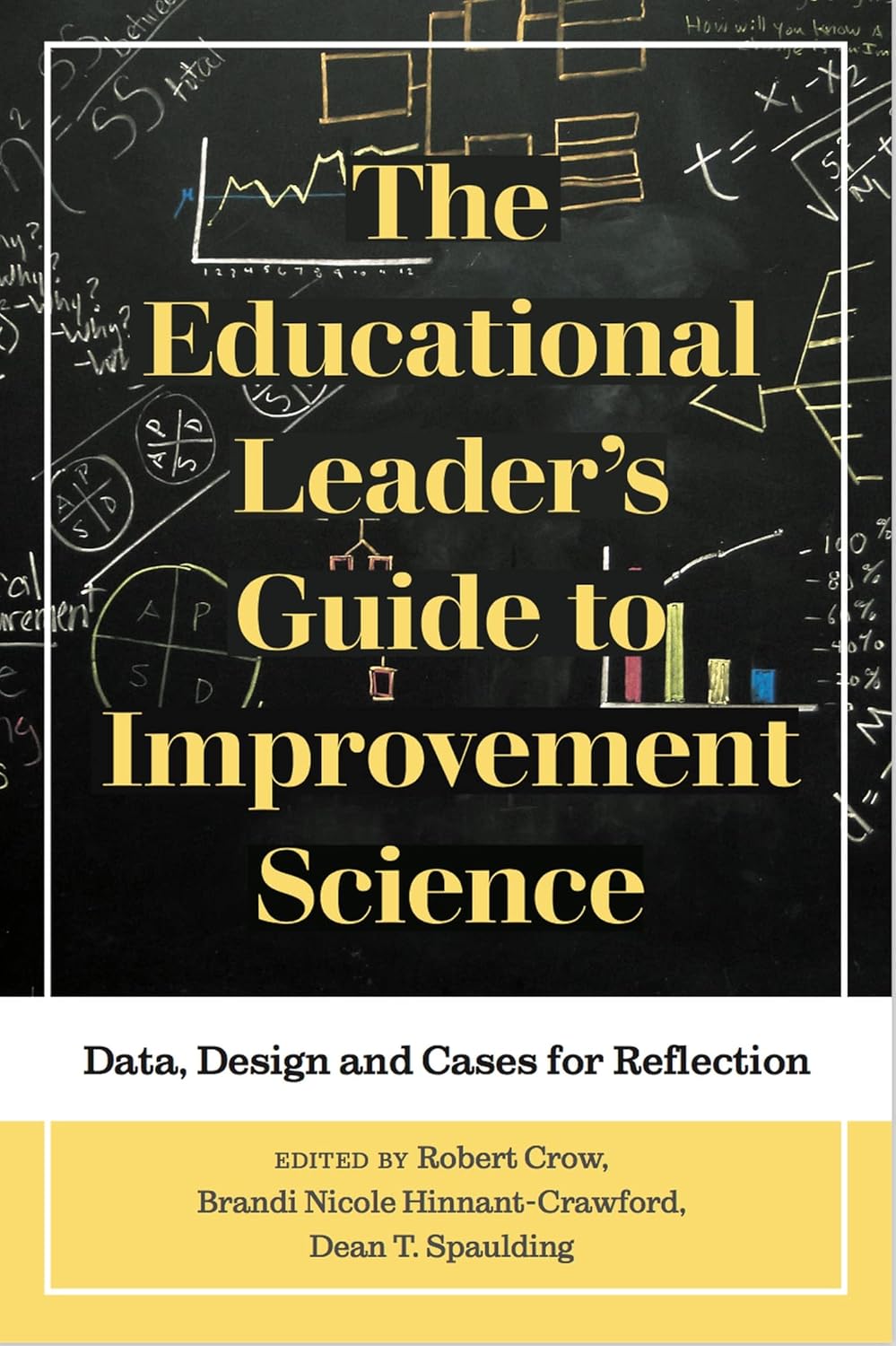
"Educators spend a great deal of time having to think about and justify their actions related to continuous improvement initiatives within their programs and district. Often, these introspective investigations occur without the theoretical or foundational supports necessary to help guide these inquiries, leaving the participants grappling at artifacts and data, with no cohesive way to utilize that content for continuous improvement. The Educational Leader’s Guide to Improvement Science: Data, Design and Cases for Reflection edited by Robert Crow, Brandi Nicole Hinnant-Crawford, and Dean T. Spaulding will provide an indispensable resource for practitioners and researchers as they address the effective utilization of data to guide their improvement science initiatives. This readable and useful text provides informational support for novice as well as expert improvement scientists as they learn and apply the terms and concepts related to the field. A generous utilization of figures and graphs provide effective visuals that make the relationships between concepts more approachable and understandable. Cases situated around realistic educational contexts provide opportunities for the reader to interrogate the topics in a meaningful fashion, thus leading to new understandings of the way improvement science can be utilized within their individual programs." (Full review can be found in the August 2020 issue of School Administrator.) -- School Administrator magazine, August 2020
"Across educational sectors, we strive to make our make our curricula rigorous and relevant for students; The Educational Leader’s Guide to Improvement Science challenges educational leaders to be rigorous in our analysis of problems and relevant as we implement context-specific solutions. While introducing improvement science as a methodology, The Guide gives leaders a handbook of tools with examples for authentic utilization. Additionally, the contributors illustrate the applicability of the method in micro and macro settings, making it a useful tool for everyone from aspiring leaders to CEOs. It is evident that improvement science methodology has the great potential for accelerating improvement, and those serious about transforming education should read this book." -- Sharon L. Contreras, PhD, Superintendent, Guilford County Schools
"Crow, Hinnant-Crawford and Spaulding's book on the intersection of school leadership and improvement science is an essential resource for those transforming the education doctorate as well as for those preparing to lead schools. The book features a dozen chapters by practitioners of improvement science as well as chapters showcasing the promise of this important pedagogy. Both novices and experienced practitioners will find much to enhance their use of improvement science." -- David Imig, Senior Fellow, Carnegie Foundation; Chair, Carnegie Project on the Education Doctorate Board; Professor of the Practice at the University of Maryland
Review
“Though other books and publications exist that present and discuss improvement science (many of which are cited throughout the series), the Improvement Science in Education series exhibits the most comprehensive coverage of improvement science currently available. Crow, Hinnant-Crawford, and Spaulding have curated a collection of books that showcases the breadth and depth of improvement science appealing to a variety of audiences, regardless of backgrounds, expertise, and readiness levels. . . Certainly, improvement science is a challenging undertaking, but this series empowers those ready and willing to try.” -- Review by Christopher Benedetti for Impacting Education: Journal on Transforming Professional Practice, Vol. 8 No. 3 (2023)
"Educators spend a great deal of time having to think about and justify their actions related to continuous improvement initiatives within their programs and district. Often, these introspective investigations occur without the theoretical or foundational supports necessary to help guide these inquiries, leaving the participants grappling at artifacts and data, with no cohesive way to utilize that content for continuous improvement. The Educational Leader’s Guide to Improvement Science: Data, Design and Cases for Reflection edited by Robert Crow, Brandi Nicole Hinnant-Crawford, and Dean T. Spaulding will provide an indispensable resource for practitioners and researchers as they address the effective utilization of data to guide their improvement science initiatives. This readable and useful text provides informational support for novice as well as expert improvement scientists as they learn and apply the terms and concepts related to the field. A generous utilization of figures and graphs provide effective visuals that make the relationships between concepts more approachable and understandable. Cases situated around realistic educational contexts provide opportunities for the reader to interrogate the topics in a meaningful fashion, thus leading to new understandings of the way improvement science can be utilized within their individual programs." (Full review can be found in the August 2020 issue of School Administrator.) -- School Administrator magazine, August 2020
"Across educational sectors, we strive to make our make our curricula rigorous and relevant for students; The Educational Leader’s Guide to Improvement Science challenges educational leaders to be rigorous in our analysis of problems and relevant as we implement context-specific solutions. While introducing improvement science as a methodology, The Guide gives leaders a handbook of tools with examples for authentic utilization. Additionally, the contributors illustrate the applicability of the method in micro and macro settings, making it a useful tool for everyone from aspiring leaders to CEOs. It is evident that improvement science methodology has the great potential for accelerating improvement, and those serious about transforming education should read this book." -- Sharon L. Contreras, PhD, Superintendent, Guilford County Schools
"Crow, Hinnant-Crawford and Spaulding's book on the intersection of school leadership and improvement science is an essential resource for those transforming the education doctorate as well as for those preparing to lead schools. The book features a dozen chapters by practitioners of improvement science as well as chapters showcasing the promise of this important pedagogy. Both novices and experienced practitioners will find much to enhance their use of improvement science." -- David Imig, Senior Fellow, Carnegie Foundation; Chair, Carnegie Project on the Education Doctorate Board; Professor of the Practice at the University of Maryland
About the Author
Robert Crow, PhD, is an associate professor of educational research at Western Carolina University. His expertise in assessment and evaluation has led to collaborations with other 4-year institutions, community colleges, PK-12 schools, and institutional accreditation agencies such as SACS-COC. Dr. Crow's research interests include assessment and evaluation of student learning and of learning environments.
Dr. Brandi Nicole Hinnant-Crawford is an Associate Professor of Educational Leadership at Clemson University. She holds bachelors degrees in English and Communication from North Carolina State University, a masters in Urban Education Policy from Brown University, and a PhD in Educational Studies from Emory University. Brandi has studied and worked in K-12 and higher education policy for the last 10 years, doing research, evaluation, and policy analysis with entities as varied as the University System of Georgia and Syracuse City School District. Her research agenda employs justice framework where she intentionally seeks to expose policies and practices related to exploitation, domination, and marginalization; her broad interest include multicultural education, teacher activism, African American activism, improvement science, and education policy.
Dean T. Spaulding is the Vice President and Director of Grant Writng and Program Evaluation with Z Score Inc. He is also former chair of the Teaching Evaluation SIG for the American Evaluation Association. Dr. Spaulding has conducted research for New York State Department of Education, New York State Department of Public Health, and the New York State Office of Mental Health (OMH). He has had experience serving as external evaluator on technology-related projects such as state and federal technology catalyst grants PT3: Preparing Tomorrow’s Teachers to Use Technology and several Title III Technology Literacy Challenge Grants. He currently serves as external evaluator on a National Science Foundation and a Howard Hughes Foundation grant. Dr. Spaulding is one of the authors of Methods in Educational Research: From Theory to Practice (2010, 2nd edition), Jossey-Bass Wiley, and the author of Program Evaluation in Practice: Core Concepts and Examples for Discussion and Analysis (2014, 2nd edition) Jossey-Bass Wiley. He is also the co-author of Action Research for School Leaders (2012) Pearson, Instructional Coaches and the Instructional Leadership Team (2012) Corwin, and What Does Your School Data Team Sound Like? Strategies to Improve the Conversation Around Data (August, 2018) Corwin.
 Imported From: United States