Deliver toUnited Arab Emirates
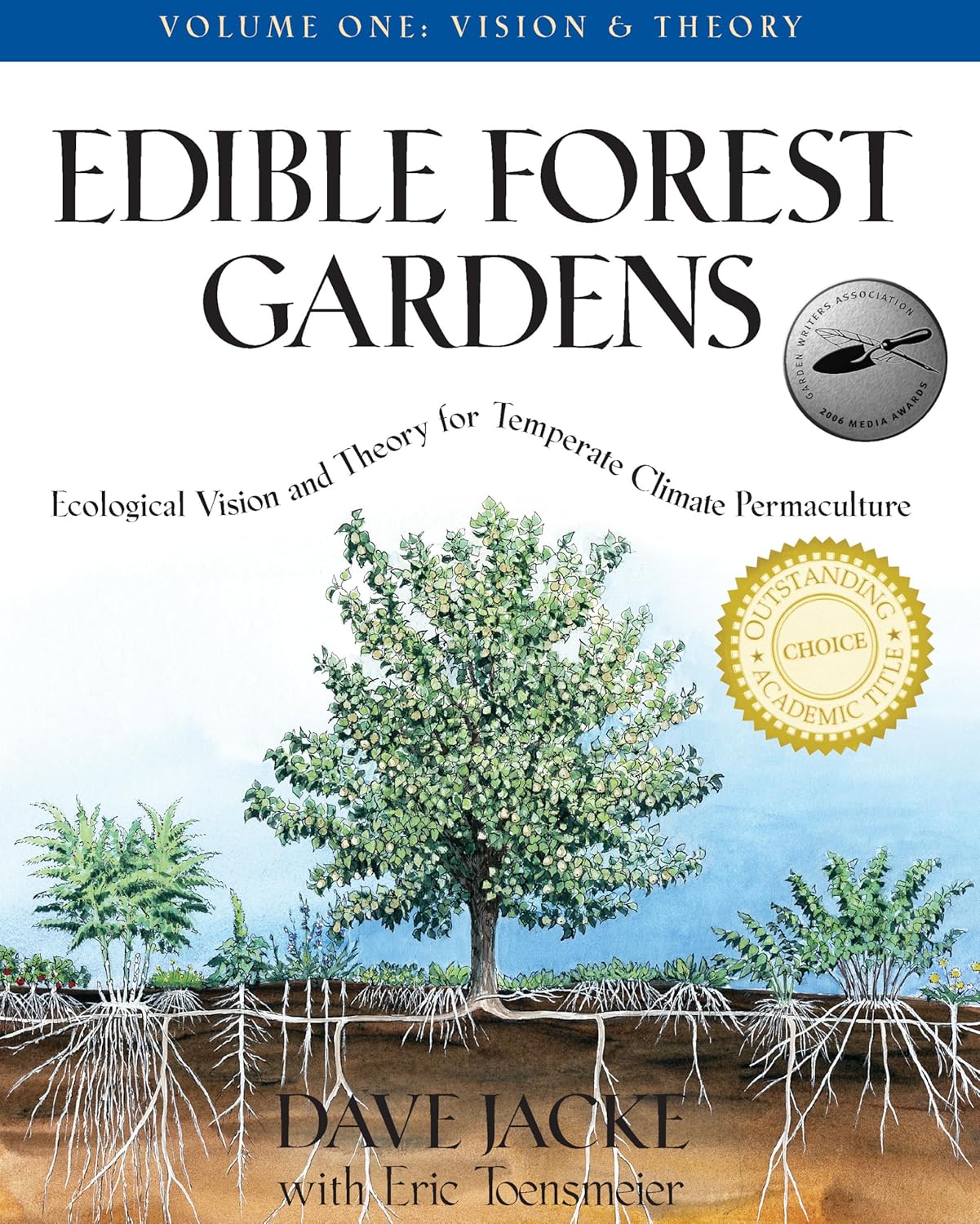
Edible Forest Gardens, Vol. 1: Ecological Vision and Theory for Temperate Climate Permaculture

Description:

Edible Forest Gardens is a groundbreaking two-volume work that spells out and explores the key concepts of forest ecology and applies them to the needs of natural gardeners in temperate climates.

Volume I lays out the vision of the forest garden and explains the basic ecological principles that make it work. In Volume II, Dave Jacke and Eric Toensmeier move on to practical considerations: concrete ways to design, establish, and maintain your own forest garden. Along the way they present case studies and examples, as well as tables, illustrations, and a uniquely valuable “plant matrix” that lists hundreds of the best edible and useful species.

Taken together, the two volumes of
Edible Forest Gardens offer an advanced course in ecological gardening–one that will forever change the way you look at plants and your environment.

"These will be the benchmark works in the field for many years. The level of scholarship and meticulous footnoting is unsurpassed by anything I've seen in permaculture literature."—Toby Hemenway, author of Gaia's Garden


Editorial Reviews

Review

“Understanding that knowledge on "nest practices" for temperate-zone forest gardening needs to be established experimentally can be exciting for those willing and able to adopt the scientific attitude: no matter how they turn out, the results of an experiment, performed appropriately (meaning especially that adequate control treatments are provided), are never "bad." In other words, we think that would-be temperate-zone forest gardeners who are sincerely interested in helping to establish this novel form of agriculture should proceed by trying to test some of Jacke and Toensmeier's numerous design, site preparation, species choice and establishment, and management guidelines. We view Volume 2 of Edible Forest Gardens not as a recipe book for what works but rather as a compendium of possibilities for what could work—an invitation par excellence to experimentation instead of complacency. Right on!”—HortIdeas

“Jacke and Toensmeier offer a radical vision for stepping out of the conceptual continuum of conventional agriculture and organic farming. . . Edible Forest Gardens is an ambitious two-volume work whose influence should extend well beyond ecologists and permaculturists and, in the best of all outcomes, reach into the mainstream. . . I have no doubt the set will be an indispensable reference for gardeners and farmers for decades.”Patricia Jonas, Brooklyn Botanic Garden, in Plants and Gardens News

"A tree de force! A must-have set of books for anyone serious about polyculture, integrated organic garden and landscape design, permaculture in the temperate zones and, of course, food forests. The charts of condensed information alone are worth the price of admission. The best book on these topics in years Keep these books within arm's reach at all times!"—
Robert Kourick, author of Designing and Maintaining Your Edible Landscape Naturally

"These will be the benchmark works in the field for many years. The level of scholarship and meticulous footnoting is unsurpassed by anything I've seen in permaculture literature."
—Toby Hemenway, author of Gaia's Garden

From the Publisher

"...But the book I will be keeping by me for the seasons ahead... is Edible Forest Gardens by Dave Jacke with Eric Toensmeier. In its way this book--the first of two volumes--is a sequel to the wonderful Tree Crops: A Permanent Agriculture (1929) by J. Russell Smith.... Edible Forest Gardens offers a vision of the garden that reaches well beneath its aesthetic surface and into its ecological depths. It reminds us that whatever gardens are an oasis from, they can never be an oasis from the natural world or our own underlying economic needs." --Verlyn Klinkenborg The New York Times Book Review June 5, 2005

"This is certainly the most thorough and realistic assessment of the potential for temperate perennial-based gardening that I have seen -- and I've read everything I've been able to find on temperate perennial crops, going back to J. Russell Smith and John Hershey...

The first volume of Edible Forest Gardens is a superb primer on ecology as it relates to horticulture in general, and I highly recommend it even for gardeners who aren't primarily interested in useful perennials..." --Greg Williams Publisher, Hort Ideas

Reviews:

5.0 out of 5 stars An Amazing, in-Depth Reference

G.R. · March 25, 2010

It's no surprise to learn that Dave and Eric worked for seven years to write the Edible Forest Gardens books; the depth and breadth of permaculture knowledge that they present is incredible. Although I've heard some say that these books are not an easy read, I've found them to be fascinating, enjoyable and indispensable. I started my journey into permaculture with Gaia's Garden by Toby Hemenway, then decided to plant an edible forest in the back yard, so I purchased Volume 2 of Edible Forest Gardens, since it covers the practical consideration of forest gardening. I was so impressed with the book that I then purchased volume 1, which focuses on the ecological vision and theory for temperate climate permaculture. Highly recommended!

5.0 out of 5 stars One of the greatest permacultural resources I've come across

A.C. · June 26, 2018

One of the greatest permacultural resources I've come across, with extremely in depth and applicable information. I would recommend this to anyone with an interest in any aspect of agroforestry- from the soil to the sun, from water to waste management.

5.0 out of 5 stars A must have!!

A.C. · May 23, 2016

This book is a necessity if you want to learn about , and impliment using perennial vegetables in your garden..And it's a great read as well!!!

5.0 out of 5 stars You cannot spend your money in a better way

O.M. · May 26, 2025

This is the beginning of the end, and then back to the future.The end of this ridiculous idea of artificial life, disconnected from other forms of lives in over-civilized, robotic, materialistic societies. We cannot eat money, perhaps future machines can. We can't.And then back to the future: This is the path to re-take control of our own lives, to find connection with all forms of life, and create life WITH them and nature in meaningful, beneficial relationships. This is the path to healthier, more meaningful lives, living fully, and letting live, fully.This book is amazingly well written, full of information and has the best tone ever.This can truly change your life, and not just yours: your kids', and the future of the globe - and all amazing other forms of life out there, threatened by the Selfish Ape.

5.0 out of 5 stars but really filled with great

f.S. · June 9, 2016

Just starting this, but really filled with great information

5.0 out of 5 stars Incredible resource for applied agro-ecological development

B.F. · November 5, 2005

This book adds depth to the existing research in agro-ecology. It provides new information and examples specific to temperate, especially warmer-temperate climates. It also highlights applications of this information in the first section: "Vision." The authors have put together a massive work that will certainly serve my reference for years to come. This work is primarily an information-packed textbook that includes much in the way of strategies and principles which apply to all biological development of landscapes. In this regard the book can serve as a text in any regenerative landscape studies.For me, the most valuable aspects of this book are:-the articulation of integrated design principles (so many good one's under one cover)-the masterful graphics (who did them all?)-the development and refining of new language for thinking about agro-ecosystems. E.g. they've taken out the word "invasive" and use the word "opportunist" instead; advancing our approach in this perennial challenge and contextualizing it in a more proper problem-solving/use-based approach, as opposed to the useless conservationist/alarmist approach that can't find the leverage.-the case studies, although I wish there were more.-The "top 100" plant list for temperate climates = awesome resource.-the depth of research (which is fairly mind-blowing) including aspects such as cross sectional mapping of root systems, nutrient flows in agro-ecosystems, and much much more.It is obvious why this book has taken many years to produce.I am left with several confusions/questions. One is the name: "Forest" gardening. The authors show the differences between forest and woodland systems (as in % canopy cover) and are clearly explaining strategies for WOODLAND gardening with some light coming in through a partially open canopy. "Edible Woodland Gardening" would make more sense and the term Forest is a bit misleading. (This is not a book about mushroom cultivation, or understory crops alone). Maybe it's simply that woodland is a fairly unused term in the States.Another frustration is in the case studies/examples. The case studies are few and examples of strategy applications are brief. They are also only from fairly warm-temperate sites: southern England, North Carolina, etc. I did not see any from New England, for instance, where both authors reside. Of course there are not an abundance of sites to use as examples, but there are many more than are shown. I wonder why the Bullock Bros. woodland garden in a temperate region of the US was not highlighted or referenced, for instance. I am hoping that Volume II has more of these case studies.Overall an incredible work of research with an applied focus and a super useful source of ecological design principles that are crucial for any student in any field connected with biological landscape development.Ben FalkWhole Systems Design, LLCMoretown, Vermont, USA

Good

J.C.C. · July 31, 2018

A fantastic book

Wichtiges Buch

S.K. · October 1, 2024

Wer einen nachhaltigen regenerativen Waldgarten oder Agroforst anlegen möchte kommt an diesem Buch nicht vorbei. Viele Praxistipps, Sorten und Insides machen dieses Buch so gut 😊💚📖🌳🌳🌳

Good stuff

F. · December 8, 2017

Wife's birthday and I get a big kiss

Edible Forest Gardens, Vol. 1: Ecological Vision and Theory for Temperate Climate Permaculture

Product ID: U1931498792
Condition: New

4.9

AED46698

Price includes VAT & Import Duties
Type: Hardcover
Availability: In Stock

Quantity:

|

Order today to get by 7-14 business days

This item qualifies for free delivery

Returns & Warranty policies

Imported From: United States

At BOLO, we work hard to ensure the products you receive are new, genuine, and sourced from reputable suppliers.

BOLO is not an authorized or official retailer for most brands, nor are we affiliated with manufacturers unless specifically stated on a product page. Instead, we source verified sellers, authorized distributors or directly from the manufacturer.

Each product undergoes thorough inspection and verification at our consolidation and fulfilment centers to ensure it meets our strict authenticity and quality standards before being shipped and delivered to you.

If you ever have concerns regarding the authenticity of a product purchased from us, please contact Bolo Support. We will review your inquiry promptly and, if necessary, provide documentation verifying authenticity or offer a suitable resolution.

Your trust is our top priority, and we are committed to maintaining transparency and integrity in every transaction.

All product information, images, descriptions, and reviews originate from the manufacturer or from trusted sellers overseas. BOLO is not affiliated with, endorsed by, or an authorized retailer for most brands listed on our website unless stated otherwise.

While we strive to display accurate information, variations in packaging, labeling, instructions, or formulation may occasionally occur due to regional differences or supplier updates. For detailed or manufacturer-specific information, please contact the brand directly or reach out to BOLO Support for assistance.

Unless otherwise stated, all prices displayed on the product page include applicable taxes and import duties.

BOLO operates in accordance with the laws and regulations of United Arab Emirates. Any items found to be restricted or prohibited for sale within the UAE will be cancelled prior to shipment. We take proactive measures to ensure that only products permitted for sale in United Arab Emirates are listed on our website.

All items are shipped by air, and any products classified as “Dangerous Goods (DG)” under IATA regulations will be removed from the order and cancelled.

All orders are processed manually, and we make every effort to process them promptly once confirmed. Products cancelled due to the above reasons will be permanently removed from listings across the website.

Similar suggestions by Bolo

More from this brand

Similar items from “Temperate”

Edible Forest Gardens, Vol. 1: Ecological Vision and Theory for Temperate Climate Permaculture

Product ID: U1931498792
Condition: New

4.9

Edible Forest Gardens, Vol. 1: Ecological Vision and Theory for Temperate Climate Permaculture-0
Type: Hardcover

AED46698

Price includes VAT & Import Duties
Availability: In Stock

Quantity:

|

Order today to get by 7-14 business days

This item qualifies for free delivery

Returns & Warranty policies

Imported From: United States

At BOLO, we work hard to ensure the products you receive are new, genuine, and sourced from reputable suppliers.

BOLO is not an authorized or official retailer for most brands, nor are we affiliated with manufacturers unless specifically stated on a product page. Instead, we source verified sellers, authorized distributors or directly from the manufacturer.

Each product undergoes thorough inspection and verification at our consolidation and fulfilment centers to ensure it meets our strict authenticity and quality standards before being shipped and delivered to you.

If you ever have concerns regarding the authenticity of a product purchased from us, please contact Bolo Support. We will review your inquiry promptly and, if necessary, provide documentation verifying authenticity or offer a suitable resolution.

Your trust is our top priority, and we are committed to maintaining transparency and integrity in every transaction.

All product information, images, descriptions, and reviews originate from the manufacturer or from trusted sellers overseas. BOLO is not affiliated with, endorsed by, or an authorized retailer for most brands listed on our website unless stated otherwise.

While we strive to display accurate information, variations in packaging, labeling, instructions, or formulation may occasionally occur due to regional differences or supplier updates. For detailed or manufacturer-specific information, please contact the brand directly or reach out to BOLO Support for assistance.

Unless otherwise stated, all prices displayed on the product page include applicable taxes and import duties.

BOLO operates in accordance with the laws and regulations of United Arab Emirates. Any items found to be restricted or prohibited for sale within the UAE will be cancelled prior to shipment. We take proactive measures to ensure that only products permitted for sale in United Arab Emirates are listed on our website.

All items are shipped by air, and any products classified as “Dangerous Goods (DG)” under IATA regulations will be removed from the order and cancelled.

All orders are processed manually, and we make every effort to process them promptly once confirmed. Products cancelled due to the above reasons will be permanently removed from listings across the website.

Description:

Edible Forest Gardens is a groundbreaking two-volume work that spells out and explores the key concepts of forest ecology and applies them to the needs of natural gardeners in temperate climates.

Volume I lays out the vision of the forest garden and explains the basic ecological principles that make it work. In Volume II, Dave Jacke and Eric Toensmeier move on to practical considerations: concrete ways to design, establish, and maintain your own forest garden. Along the way they present case studies and examples, as well as tables, illustrations, and a uniquely valuable “plant matrix” that lists hundreds of the best edible and useful species.

Taken together, the two volumes of
Edible Forest Gardens offer an advanced course in ecological gardening–one that will forever change the way you look at plants and your environment.

"These will be the benchmark works in the field for many years. The level of scholarship and meticulous footnoting is unsurpassed by anything I've seen in permaculture literature."—Toby Hemenway, author of Gaia's Garden


Editorial Reviews

Review

“Understanding that knowledge on "nest practices" for temperate-zone forest gardening needs to be established experimentally can be exciting for those willing and able to adopt the scientific attitude: no matter how they turn out, the results of an experiment, performed appropriately (meaning especially that adequate control treatments are provided), are never "bad." In other words, we think that would-be temperate-zone forest gardeners who are sincerely interested in helping to establish this novel form of agriculture should proceed by trying to test some of Jacke and Toensmeier's numerous design, site preparation, species choice and establishment, and management guidelines. We view Volume 2 of Edible Forest Gardens not as a recipe book for what works but rather as a compendium of possibilities for what could work—an invitation par excellence to experimentation instead of complacency. Right on!”—HortIdeas

“Jacke and Toensmeier offer a radical vision for stepping out of the conceptual continuum of conventional agriculture and organic farming. . . Edible Forest Gardens is an ambitious two-volume work whose influence should extend well beyond ecologists and permaculturists and, in the best of all outcomes, reach into the mainstream. . . I have no doubt the set will be an indispensable reference for gardeners and farmers for decades.”Patricia Jonas, Brooklyn Botanic Garden, in Plants and Gardens News

"A tree de force! A must-have set of books for anyone serious about polyculture, integrated organic garden and landscape design, permaculture in the temperate zones and, of course, food forests. The charts of condensed information alone are worth the price of admission. The best book on these topics in years Keep these books within arm's reach at all times!"—
Robert Kourick, author of Designing and Maintaining Your Edible Landscape Naturally

"These will be the benchmark works in the field for many years. The level of scholarship and meticulous footnoting is unsurpassed by anything I've seen in permaculture literature."
—Toby Hemenway, author of Gaia's Garden

From the Publisher

"...But the book I will be keeping by me for the seasons ahead... is Edible Forest Gardens by Dave Jacke with Eric Toensmeier. In its way this book--the first of two volumes--is a sequel to the wonderful Tree Crops: A Permanent Agriculture (1929) by J. Russell Smith.... Edible Forest Gardens offers a vision of the garden that reaches well beneath its aesthetic surface and into its ecological depths. It reminds us that whatever gardens are an oasis from, they can never be an oasis from the natural world or our own underlying economic needs." --Verlyn Klinkenborg The New York Times Book Review June 5, 2005

"This is certainly the most thorough and realistic assessment of the potential for temperate perennial-based gardening that I have seen -- and I've read everything I've been able to find on temperate perennial crops, going back to J. Russell Smith and John Hershey...

The first volume of Edible Forest Gardens is a superb primer on ecology as it relates to horticulture in general, and I highly recommend it even for gardeners who aren't primarily interested in useful perennials..." --Greg Williams Publisher, Hort Ideas

Reviews:

5.0 out of 5 stars An Amazing, in-Depth Reference

G.R. · March 25, 2010

It's no surprise to learn that Dave and Eric worked for seven years to write the Edible Forest Gardens books; the depth and breadth of permaculture knowledge that they present is incredible. Although I've heard some say that these books are not an easy read, I've found them to be fascinating, enjoyable and indispensable. I started my journey into permaculture with Gaia's Garden by Toby Hemenway, then decided to plant an edible forest in the back yard, so I purchased Volume 2 of Edible Forest Gardens, since it covers the practical consideration of forest gardening. I was so impressed with the book that I then purchased volume 1, which focuses on the ecological vision and theory for temperate climate permaculture. Highly recommended!

5.0 out of 5 stars One of the greatest permacultural resources I've come across

A.C. · June 26, 2018

One of the greatest permacultural resources I've come across, with extremely in depth and applicable information. I would recommend this to anyone with an interest in any aspect of agroforestry- from the soil to the sun, from water to waste management.

5.0 out of 5 stars A must have!!

A.C. · May 23, 2016

This book is a necessity if you want to learn about , and impliment using perennial vegetables in your garden..And it's a great read as well!!!

5.0 out of 5 stars You cannot spend your money in a better way

O.M. · May 26, 2025

This is the beginning of the end, and then back to the future.The end of this ridiculous idea of artificial life, disconnected from other forms of lives in over-civilized, robotic, materialistic societies. We cannot eat money, perhaps future machines can. We can't.And then back to the future: This is the path to re-take control of our own lives, to find connection with all forms of life, and create life WITH them and nature in meaningful, beneficial relationships. This is the path to healthier, more meaningful lives, living fully, and letting live, fully.This book is amazingly well written, full of information and has the best tone ever.This can truly change your life, and not just yours: your kids', and the future of the globe - and all amazing other forms of life out there, threatened by the Selfish Ape.

5.0 out of 5 stars but really filled with great

f.S. · June 9, 2016

Just starting this, but really filled with great information

5.0 out of 5 stars Incredible resource for applied agro-ecological development

B.F. · November 5, 2005

This book adds depth to the existing research in agro-ecology. It provides new information and examples specific to temperate, especially warmer-temperate climates. It also highlights applications of this information in the first section: "Vision." The authors have put together a massive work that will certainly serve my reference for years to come. This work is primarily an information-packed textbook that includes much in the way of strategies and principles which apply to all biological development of landscapes. In this regard the book can serve as a text in any regenerative landscape studies.For me, the most valuable aspects of this book are:-the articulation of integrated design principles (so many good one's under one cover)-the masterful graphics (who did them all?)-the development and refining of new language for thinking about agro-ecosystems. E.g. they've taken out the word "invasive" and use the word "opportunist" instead; advancing our approach in this perennial challenge and contextualizing it in a more proper problem-solving/use-based approach, as opposed to the useless conservationist/alarmist approach that can't find the leverage.-the case studies, although I wish there were more.-The "top 100" plant list for temperate climates = awesome resource.-the depth of research (which is fairly mind-blowing) including aspects such as cross sectional mapping of root systems, nutrient flows in agro-ecosystems, and much much more.It is obvious why this book has taken many years to produce.I am left with several confusions/questions. One is the name: "Forest" gardening. The authors show the differences between forest and woodland systems (as in % canopy cover) and are clearly explaining strategies for WOODLAND gardening with some light coming in through a partially open canopy. "Edible Woodland Gardening" would make more sense and the term Forest is a bit misleading. (This is not a book about mushroom cultivation, or understory crops alone). Maybe it's simply that woodland is a fairly unused term in the States.Another frustration is in the case studies/examples. The case studies are few and examples of strategy applications are brief. They are also only from fairly warm-temperate sites: southern England, North Carolina, etc. I did not see any from New England, for instance, where both authors reside. Of course there are not an abundance of sites to use as examples, but there are many more than are shown. I wonder why the Bullock Bros. woodland garden in a temperate region of the US was not highlighted or referenced, for instance. I am hoping that Volume II has more of these case studies.Overall an incredible work of research with an applied focus and a super useful source of ecological design principles that are crucial for any student in any field connected with biological landscape development.Ben FalkWhole Systems Design, LLCMoretown, Vermont, USA

Good

J.C.C. · July 31, 2018

A fantastic book

Wichtiges Buch

S.K. · October 1, 2024

Wer einen nachhaltigen regenerativen Waldgarten oder Agroforst anlegen möchte kommt an diesem Buch nicht vorbei. Viele Praxistipps, Sorten und Insides machen dieses Buch so gut 😊💚📖🌳🌳🌳

Good stuff

F. · December 8, 2017

Wife's birthday and I get a big kiss

Similar suggestions by Bolo

More from this brand

Similar items from “Temperate”