Description:
Editorial Reviews
From the Publisher
About the Author
Angus McBride was one of the world's most respected historical illustrators, and contributed to over 100 Osprey titles over several decades.
Reviews:
5.0 out of 5 stars Great overview of Assyrian history
I went into this book with no prior knowledge of Assyrian history and I found it to be very informative. I like the color pictures, they help you visualize some of the black and white photos of ancient artifacts and stone sculptures.
5.0 out of 5 stars The Assyrian Empire
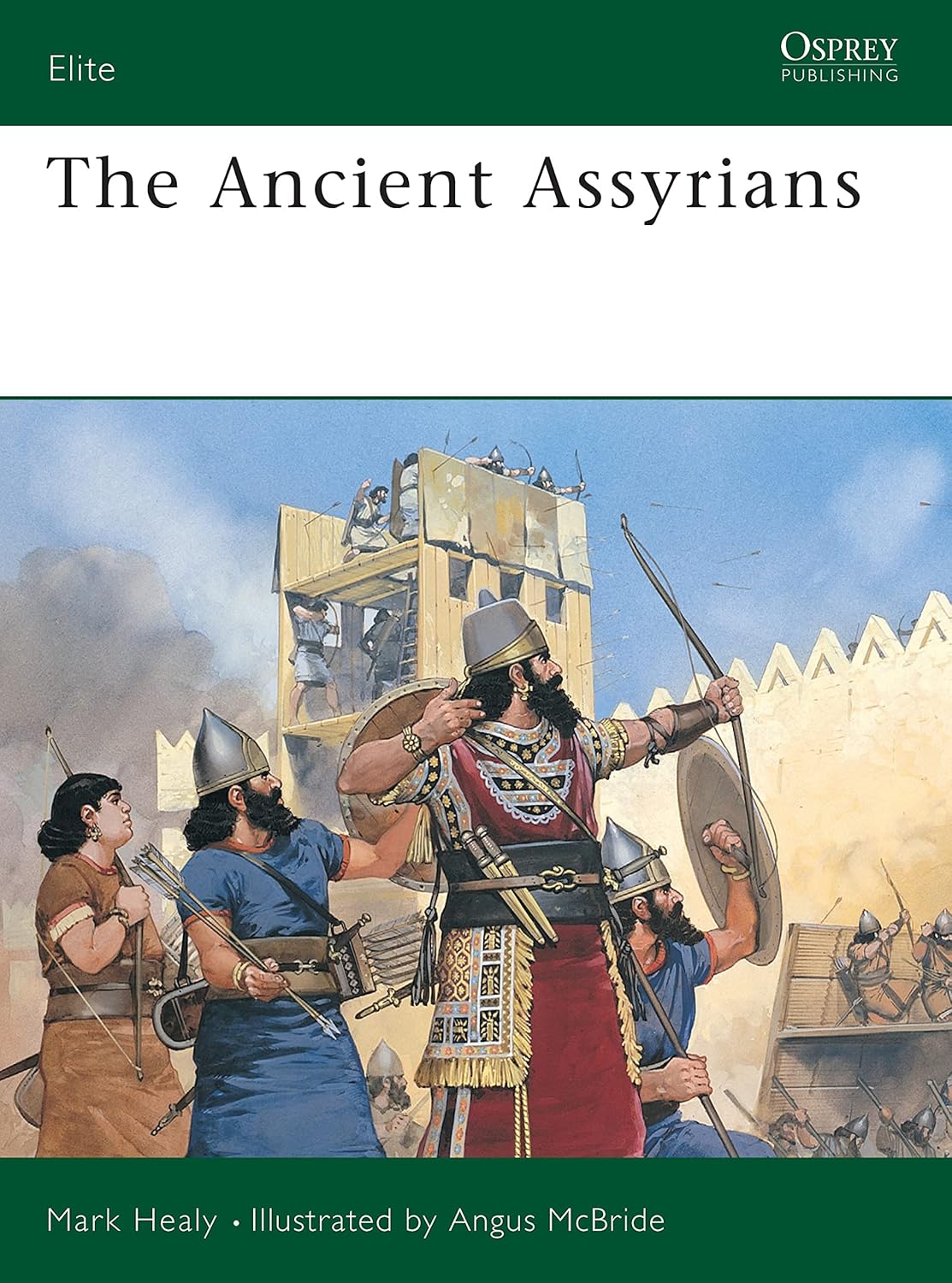
The typical elite title, focuses mostly on a detailed view of the different branches of the Assyrian army, their gear, roles, and tactics, but as it tells the story of the Assyrian army and campaigns in pretty much tells the story of Assyria. The Assyrians, although a very different people from the Mongols, still stand out like them in certain ways-both were sadistically cruel and thought nothing of slaughtering civilizations (a zesty description of Assyrian torture of rebel chieftains is given early in the book), but also showed great administrative skills and almost unnatural talent at all forms of warfare-light and heavy cavalry and infantry, and sieges. The Assyrians clashed with most of the powers of their day-the Egyptians, the Hittites, the Israelites, the Syrians, the Arabs, and the Elamites, and were also having to put down Babylonian rebellions many times every century. At their greatest extent they ruled over most all of modern Iraq east to Elam (Iran), along with Urartu (Armenia), eastern Turkey, the entire Palestinian coastline south into Egypt. It was only relentless rebellions and civil wars that finally brought them to their knees, but their destruction was complete-their capital was thoroughly razed and subsequently forgotten, and as the Biblical prophet said (Nahum 3:19), the Ancient World rejoiced. As would be expected, Angus McBride's artwork really brings them to life, but even without that this would still be an essential book.
4.0 out of 5 stars One of Osprey's helpful "cliff notes" for a military history topic. 64 pages. 4.5 stars
“Introduction” (p. 3) lays out the book’s parameters (primarily the Neo-Assyrian Empire from 10th Century BC to 7th Century BC), and puts the Neo-Assyrians in historical context. “The Land of Ashur” (pp. 3-6) takes Assyria from the 19th Century BC, through rise and humiliation, to a resurgence under Adad-Nirari at the end of the 10th Century BC. A chronology (p. 6) notes broad eras of Assyrian history (e.g. “Period of Mitannian domination approx. 15th C BC-mid-13th C BC”) and the rulers from 911 BC-811 BC, then from 745 BC-612 BC. “The Neo-Assyrian Empire” (pp. 6-13), “The Eclipse of Assyria” (pp. 13-17), and “The Great Reformer: Tiglath-Pileser III” (pp. 17-18) are largely campaign narratives from 911 BC-745 BC. “The Assyrian Army” is spilt between a continued campaign narrative (pp. 23-54) that carries the story to the height of Ashurbanipal’s reign (about 639 BC) and a description of the organization and gear of Tiglath-Pileser III’s “New Model army” army (pp. 18-23), which was a combination of the King’s professional army, full-time provincials, part-time conscripts, and allies. “Nineveh is Laid Waste” (pp. 54-57) briefly covers the Neo-Assyrian Empire to its fiery end in 612 BC.Healy notes that Assyria has several millennia of bad press, somewhat deserved. Assyrian kings, imbued with a devotion to the god Ashur, ruled a landlocked land without easily defendable borders, and suffered from limited resources, and consequently felt the need to deter rebellions and long sieges. The result was a deliberate policy of terror (see pp. 4-5, 7-9, 23).Although there is no bibliography, there are sources for the photos throughout the book and references to archaeological finds are made throughout the text and the commentary for the 11 color plates (A-K, on pp. 33-44); these show the clothing and gear of the Assyrian army. There is an index (p. 63), and for some reason, p. 64 is blank.Positive: The king list (p. 6) was helpful.Questionable: Healy writes that the “mass grave at Lachish was found to contain the remains of 1,500 Assyrian soldiers” (p. 23), but it seems that dead may have been the defenders/inhabitants, not Assyrians.Quibbles:1) Although the maps (pp. 8, 52) were helpful, there were a few places mentioned in the text that were not shown on the maps e.g. Barsippa; Bit Adidni; Lachish; Qarqar;2) The commentary on page 57 for color plate B describes a siege tower as “three meters in height”. Unless the Assyrian soldiers were midgets, it was a lot taller than that. Perhaps Healy meant three stories high? The siege tower does have three different levels of compartments, plus a tower.Despite a few minor issues, 4.5 stars.James GlickPO1, USNR (ret.)Austin Peay State UniversityClarksville, TN
5.0 out of 5 stars Five Stars
Very informative
5.0 out of 5 stars A Short Military History of the Ancient Assyrian Empire
This is a short history of the Armies and military capabilities of the Assyrians. The life of the Assyrian Empire as defined in this book extends from 900 B.C.E. through 612 B.C.E. This coincides with the time period when the Assyrian Empire dominated the Middle East.
5.0 out of 5 stars Unsurpassed Illustrations
Without detracting from an otherwise well researched & written book, the awesome artwork in this book is worth the price tenfold. Best illustrations anywhere on the subject.
4.0 out of 5 stars Four Stars
good book!
3.0 out of 5 stars Not bad for kids. Too simple for adults.
It's a decent introduction for children to learn about the first empire.
Buen libro
Las ilustraciones, y fotografias
Still handy
Although written some years ago, this Osprey title remains a handy guide to the ancient Assyrians who featured prominently in the Old Testament. The book does not shy away from their calculated policy of deportation and brutality, but the reader gets a sense of their history and achievement in the military sphere. I read this some time ago and was impressed enough to buy a copy for a friend.
Five Stars
Beautiful art work.
The later part of the Neo-Assyrian Empire
This is another good introductory volume from Osprey, despite its age (first published in 1991). There are however a few glitches and I will start with these before moving on to the book's more numerous qualities.First of all, the title is a bit misleading. The book is centred on the Neo-Assyrian Empire, and more particularly on its last 150 years (from BC 745 to the fall of Nineveh on BC 612), rather than on the whole history of Assyria, which begins in circa BC 1800. The previous periods are dealt with in three pages which are intended to provide background.Second, the book lacks both a table of contents, which is not much of a problem, but also a bibliography. The latter is more problematic, if only because books in this collection are meant as illustrated introduction to a topic. One could expect them to provide the means for interesting readers to learn more about the topic that they cover, as more recent Osprey publications seem to do systematically nowadays. There is a second - more specific - reason to regret this absence and this has to do with the topic itself. Given its location (in northern Irak), archaeology and excavations have not exactly been a priority over the last two or three decades. Apart from some publications which tend to cover middle-eastern civilizations more generally, and a few others which cover very specific aspects of the Ancient civilizations of Irak (religion, for instance), there are very few recent publications that are centred on the Assyrians themselves, and ever fewer on the Neo-Assyrian Empire.Having mentioned this, and as far as I can make out, the overview provided by this book seems to be complete and a good one. The reasons for the Assyrian expansion - it was essentially surrounded by hostile neighbours and had not direct access to vital mineral resources such as bronze and tin - are well presented. So are the reforms and the development of the army, the various services, and how the army was organized when on campaigns. Very appreciated are the various sections on the main campaigns of the main Assyrian warrior-kings from Tiglath-Pilaser III who introduced the first reforms to Assurbanipal, the last great king of what had become the Assyrian Empire and whose last years saw the Empire begin to crumble.Angus McBride's illustrations are, as always, quite wonderful. They are also well chosen since they cover the evolutions of the war chariots, from light to heavy, and the development of the cavalry, also from light to heavy. They also show on a double page a superb illustration of an Assyrian siege with the warrior king taking part in the assault. Assyrian kings figure prominently in three of the illustrations. This is hardly surprising given that they spend perhaps most of their lives on campaigns putting down rebellions or conquering new territories.Then there is the fearful reputation that the Assyrian forces earned for themselves, with massacres and mass deportation among other niceties. They were neither the first nor the last to use such means. These partly reflect their ruthless efficiency (a bit like the Romans a few centuries latter) but also deliberate policy choices made by their kings. With limited resources and surrounded by enemies, deportations was a good way of both weakening the potential of vanquished kingdoms that had been transformed into vassal states and of increasing the labour force in particular, and the population more generally, of the victor. The Hittites and the Egyptians, just to mention these two, did it also. Besides, there were, of course, no such niceties as Geneva conventions or even human rights at the time and behaviours that may strike us as horrific - and certainly were when you were on the receiving end - might have been much more common than what some of the sources (in the Ancient Testament, in particular) would seem to imply.
A good overview
A good introduction to the rise and fall of the Assyrian Empire and to its military campaigns. I knew only little about the Assyrians apart from a couple of kings' names, cities like Nineveh, and their reputation for warfare and cruelty. Of course, I had been overawed by the great sculptures and reliefs in the British Museum. This booklet gives one a more balanced and reasoned view of the Assyrians and their policy of expansion, which had much to do with trade routes. It is a good place to start.
Visit the Osprey Publishing Store
The Ancient Assyrians (Elite, 39)
AED13994
Quantity:
Order today to get by 7-14 business days
Delivery fee of AED 20. Free for orders above AED 200.
Imported From: United States
At BOLO, we work hard to ensure the products you receive are new, genuine, and sourced from reputable suppliers.
BOLO is not an authorized or official retailer for most brands, nor are we affiliated with manufacturers unless specifically stated on a product page. Instead, we source verified sellers, authorized distributors or directly from the manufacturer.
Each product undergoes thorough inspection and verification at our consolidation and fulfilment centers to ensure it meets our strict authenticity and quality standards before being shipped and delivered to you.
If you ever have concerns regarding the authenticity of a product purchased from us, please contact Bolo Support. We will review your inquiry promptly and, if necessary, provide documentation verifying authenticity or offer a suitable resolution.
Your trust is our top priority, and we are committed to maintaining transparency and integrity in every transaction.
All product information, images, descriptions, and reviews originate from the manufacturer or from trusted sellers overseas. BOLO is not affiliated with, endorsed by, or an authorized retailer for most brands listed on our website unless stated otherwise.
While we strive to display accurate information, variations in packaging, labeling, instructions, or formulation may occasionally occur due to regional differences or supplier updates. For detailed or manufacturer-specific information, please contact the brand directly or reach out to BOLO Support for assistance.
Unless otherwise stated, all prices displayed on the product page include applicable taxes and import duties.
BOLO operates in accordance with the laws and regulations of United Arab Emirates. Any items found to be restricted or prohibited for sale within the UAE will be cancelled prior to shipment. We take proactive measures to ensure that only products permitted for sale in United Arab Emirates are listed on our website.
All items are shipped by air, and any products classified as “Dangerous Goods (DG)” under IATA regulations will be removed from the order and cancelled.
All orders are processed manually, and we make every effort to process them promptly once confirmed. Products cancelled due to the above reasons will be permanently removed from listings across the website.
More from this brand
Similar items from “Assyria, Babylonia & Sumer”
Share with
Or share with link
https://www.bolo.ae/products/U1855321637
Visit the Osprey Publishing Store
The Ancient Assyrians (Elite, 39)

AED13994
Quantity:
Order today to get by 7-14 business days
Delivery fee of AED 20. Free for orders above AED 200.
Imported From: United States
At BOLO, we work hard to ensure the products you receive are new, genuine, and sourced from reputable suppliers.
BOLO is not an authorized or official retailer for most brands, nor are we affiliated with manufacturers unless specifically stated on a product page. Instead, we source verified sellers, authorized distributors or directly from the manufacturer.
Each product undergoes thorough inspection and verification at our consolidation and fulfilment centers to ensure it meets our strict authenticity and quality standards before being shipped and delivered to you.
If you ever have concerns regarding the authenticity of a product purchased from us, please contact Bolo Support. We will review your inquiry promptly and, if necessary, provide documentation verifying authenticity or offer a suitable resolution.
Your trust is our top priority, and we are committed to maintaining transparency and integrity in every transaction.
All product information, images, descriptions, and reviews originate from the manufacturer or from trusted sellers overseas. BOLO is not affiliated with, endorsed by, or an authorized retailer for most brands listed on our website unless stated otherwise.
While we strive to display accurate information, variations in packaging, labeling, instructions, or formulation may occasionally occur due to regional differences or supplier updates. For detailed or manufacturer-specific information, please contact the brand directly or reach out to BOLO Support for assistance.
Unless otherwise stated, all prices displayed on the product page include applicable taxes and import duties.
BOLO operates in accordance with the laws and regulations of United Arab Emirates. Any items found to be restricted or prohibited for sale within the UAE will be cancelled prior to shipment. We take proactive measures to ensure that only products permitted for sale in United Arab Emirates are listed on our website.
All items are shipped by air, and any products classified as “Dangerous Goods (DG)” under IATA regulations will be removed from the order and cancelled.
All orders are processed manually, and we make every effort to process them promptly once confirmed. Products cancelled due to the above reasons will be permanently removed from listings across the website.
Description:
Editorial Reviews
From the Publisher
About the Author
Angus McBride was one of the world's most respected historical illustrators, and contributed to over 100 Osprey titles over several decades.
Reviews:
5.0 out of 5 stars Great overview of Assyrian history
I went into this book with no prior knowledge of Assyrian history and I found it to be very informative. I like the color pictures, they help you visualize some of the black and white photos of ancient artifacts and stone sculptures.
5.0 out of 5 stars The Assyrian Empire
The typical elite title, focuses mostly on a detailed view of the different branches of the Assyrian army, their gear, roles, and tactics, but as it tells the story of the Assyrian army and campaigns in pretty much tells the story of Assyria. The Assyrians, although a very different people from the Mongols, still stand out like them in certain ways-both were sadistically cruel and thought nothing of slaughtering civilizations (a zesty description of Assyrian torture of rebel chieftains is given early in the book), but also showed great administrative skills and almost unnatural talent at all forms of warfare-light and heavy cavalry and infantry, and sieges. The Assyrians clashed with most of the powers of their day-the Egyptians, the Hittites, the Israelites, the Syrians, the Arabs, and the Elamites, and were also having to put down Babylonian rebellions many times every century. At their greatest extent they ruled over most all of modern Iraq east to Elam (Iran), along with Urartu (Armenia), eastern Turkey, the entire Palestinian coastline south into Egypt. It was only relentless rebellions and civil wars that finally brought them to their knees, but their destruction was complete-their capital was thoroughly razed and subsequently forgotten, and as the Biblical prophet said (Nahum 3:19), the Ancient World rejoiced. As would be expected, Angus McBride's artwork really brings them to life, but even without that this would still be an essential book.
4.0 out of 5 stars One of Osprey's helpful "cliff notes" for a military history topic. 64 pages. 4.5 stars
“Introduction” (p. 3) lays out the book’s parameters (primarily the Neo-Assyrian Empire from 10th Century BC to 7th Century BC), and puts the Neo-Assyrians in historical context. “The Land of Ashur” (pp. 3-6) takes Assyria from the 19th Century BC, through rise and humiliation, to a resurgence under Adad-Nirari at the end of the 10th Century BC. A chronology (p. 6) notes broad eras of Assyrian history (e.g. “Period of Mitannian domination approx. 15th C BC-mid-13th C BC”) and the rulers from 911 BC-811 BC, then from 745 BC-612 BC. “The Neo-Assyrian Empire” (pp. 6-13), “The Eclipse of Assyria” (pp. 13-17), and “The Great Reformer: Tiglath-Pileser III” (pp. 17-18) are largely campaign narratives from 911 BC-745 BC. “The Assyrian Army” is spilt between a continued campaign narrative (pp. 23-54) that carries the story to the height of Ashurbanipal’s reign (about 639 BC) and a description of the organization and gear of Tiglath-Pileser III’s “New Model army” army (pp. 18-23), which was a combination of the King’s professional army, full-time provincials, part-time conscripts, and allies. “Nineveh is Laid Waste” (pp. 54-57) briefly covers the Neo-Assyrian Empire to its fiery end in 612 BC.Healy notes that Assyria has several millennia of bad press, somewhat deserved. Assyrian kings, imbued with a devotion to the god Ashur, ruled a landlocked land without easily defendable borders, and suffered from limited resources, and consequently felt the need to deter rebellions and long sieges. The result was a deliberate policy of terror (see pp. 4-5, 7-9, 23).Although there is no bibliography, there are sources for the photos throughout the book and references to archaeological finds are made throughout the text and the commentary for the 11 color plates (A-K, on pp. 33-44); these show the clothing and gear of the Assyrian army. There is an index (p. 63), and for some reason, p. 64 is blank.Positive: The king list (p. 6) was helpful.Questionable: Healy writes that the “mass grave at Lachish was found to contain the remains of 1,500 Assyrian soldiers” (p. 23), but it seems that dead may have been the defenders/inhabitants, not Assyrians.Quibbles:1) Although the maps (pp. 8, 52) were helpful, there were a few places mentioned in the text that were not shown on the maps e.g. Barsippa; Bit Adidni; Lachish; Qarqar;2) The commentary on page 57 for color plate B describes a siege tower as “three meters in height”. Unless the Assyrian soldiers were midgets, it was a lot taller than that. Perhaps Healy meant three stories high? The siege tower does have three different levels of compartments, plus a tower.Despite a few minor issues, 4.5 stars.James GlickPO1, USNR (ret.)Austin Peay State UniversityClarksville, TN
5.0 out of 5 stars Five Stars
Very informative
5.0 out of 5 stars A Short Military History of the Ancient Assyrian Empire
This is a short history of the Armies and military capabilities of the Assyrians. The life of the Assyrian Empire as defined in this book extends from 900 B.C.E. through 612 B.C.E. This coincides with the time period when the Assyrian Empire dominated the Middle East.
5.0 out of 5 stars Unsurpassed Illustrations
Without detracting from an otherwise well researched & written book, the awesome artwork in this book is worth the price tenfold. Best illustrations anywhere on the subject.
4.0 out of 5 stars Four Stars
good book!
3.0 out of 5 stars Not bad for kids. Too simple for adults.
It's a decent introduction for children to learn about the first empire.
Buen libro
Las ilustraciones, y fotografias
Still handy
Although written some years ago, this Osprey title remains a handy guide to the ancient Assyrians who featured prominently in the Old Testament. The book does not shy away from their calculated policy of deportation and brutality, but the reader gets a sense of their history and achievement in the military sphere. I read this some time ago and was impressed enough to buy a copy for a friend.
Five Stars
Beautiful art work.
The later part of the Neo-Assyrian Empire
This is another good introductory volume from Osprey, despite its age (first published in 1991). There are however a few glitches and I will start with these before moving on to the book's more numerous qualities.First of all, the title is a bit misleading. The book is centred on the Neo-Assyrian Empire, and more particularly on its last 150 years (from BC 745 to the fall of Nineveh on BC 612), rather than on the whole history of Assyria, which begins in circa BC 1800. The previous periods are dealt with in three pages which are intended to provide background.Second, the book lacks both a table of contents, which is not much of a problem, but also a bibliography. The latter is more problematic, if only because books in this collection are meant as illustrated introduction to a topic. One could expect them to provide the means for interesting readers to learn more about the topic that they cover, as more recent Osprey publications seem to do systematically nowadays. There is a second - more specific - reason to regret this absence and this has to do with the topic itself. Given its location (in northern Irak), archaeology and excavations have not exactly been a priority over the last two or three decades. Apart from some publications which tend to cover middle-eastern civilizations more generally, and a few others which cover very specific aspects of the Ancient civilizations of Irak (religion, for instance), there are very few recent publications that are centred on the Assyrians themselves, and ever fewer on the Neo-Assyrian Empire.Having mentioned this, and as far as I can make out, the overview provided by this book seems to be complete and a good one. The reasons for the Assyrian expansion - it was essentially surrounded by hostile neighbours and had not direct access to vital mineral resources such as bronze and tin - are well presented. So are the reforms and the development of the army, the various services, and how the army was organized when on campaigns. Very appreciated are the various sections on the main campaigns of the main Assyrian warrior-kings from Tiglath-Pilaser III who introduced the first reforms to Assurbanipal, the last great king of what had become the Assyrian Empire and whose last years saw the Empire begin to crumble.Angus McBride's illustrations are, as always, quite wonderful. They are also well chosen since they cover the evolutions of the war chariots, from light to heavy, and the development of the cavalry, also from light to heavy. They also show on a double page a superb illustration of an Assyrian siege with the warrior king taking part in the assault. Assyrian kings figure prominently in three of the illustrations. This is hardly surprising given that they spend perhaps most of their lives on campaigns putting down rebellions or conquering new territories.Then there is the fearful reputation that the Assyrian forces earned for themselves, with massacres and mass deportation among other niceties. They were neither the first nor the last to use such means. These partly reflect their ruthless efficiency (a bit like the Romans a few centuries latter) but also deliberate policy choices made by their kings. With limited resources and surrounded by enemies, deportations was a good way of both weakening the potential of vanquished kingdoms that had been transformed into vassal states and of increasing the labour force in particular, and the population more generally, of the victor. The Hittites and the Egyptians, just to mention these two, did it also. Besides, there were, of course, no such niceties as Geneva conventions or even human rights at the time and behaviours that may strike us as horrific - and certainly were when you were on the receiving end - might have been much more common than what some of the sources (in the Ancient Testament, in particular) would seem to imply.
A good overview
A good introduction to the rise and fall of the Assyrian Empire and to its military campaigns. I knew only little about the Assyrians apart from a couple of kings' names, cities like Nineveh, and their reputation for warfare and cruelty. Of course, I had been overawed by the great sculptures and reliefs in the British Museum. This booklet gives one a more balanced and reasoned view of the Assyrians and their policy of expansion, which had much to do with trade routes. It is a good place to start.
More from this brand
Similar items from “Assyria, Babylonia & Sumer”
Share with
Or share with link
https://www.bolo.ae/products/U1855321637