Deliver toUnited Arab Emirates
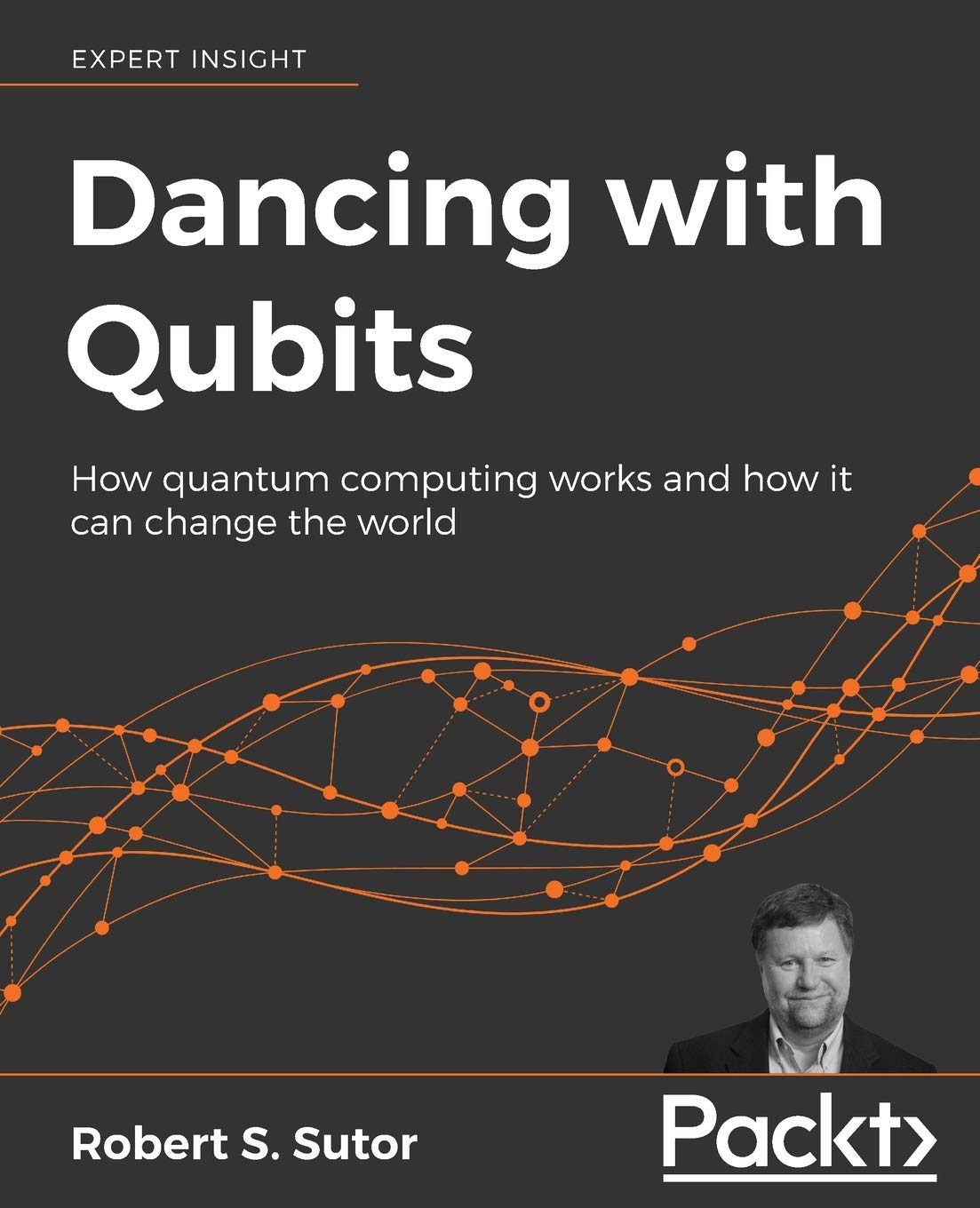
Dancing with Qubits: How quantum computing works and how it can change the world

Description:

Explore the principles and practicalities of quantum computing

Key Features

  • Discover how quantum computing works and delve into the math behind it with this quantum computing textbook
  • Learn how it may become the most important new computer technology of the century
  • Explore the inner workings of quantum computing technology to quickly process complex cloud data and solve problems

Book Description

Quantum computing is making us change the way we think about computers. Quantum bits, a.k.a. qubits, can make it possible to solve problems that would otherwise be intractable with current computing technology.

Dancing with Qubits is a quantum computing textbook that starts with an overview of why quantum computing is so different from classical computing and describes several industry use cases where it can have a major impact. From there it moves on to a fuller description of classical computing and the mathematical underpinnings necessary to understand such concepts as superposition, entanglement, and interference. Next up is circuits and algorithms, both basic and more sophisticated. It then nicely moves on to provide a survey of the physics and engineering ideas behind how quantum computing hardware is built. Finally, the book looks to the future and gives you guidance on understanding how further developments will affect you.

Really understanding quantum computing requires a lot of math, and this book doesn't shy away from the necessary math concepts you'll need. Each topic is introduced and explained thoroughly, in clear English with helpful examples.

What you will learn

  • See how quantum computing works, delve into the math behind it, what makes it different, and why it is so powerful with this quantum computing textbook
  • Discover the complex, mind-bending mechanics that underpin quantum systems
  • Understand the necessary concepts behind classical and quantum computing
  • Refresh and extend your grasp of essential mathematics, computing, and quantum theory
  • Explore the main applications of quantum computing to the fields of scientific computing, AI, and elsewhere
  • Examine a detailed overview of qubits, quantum circuits, and quantum algorithm

Who this book is for

Dancing with Qubits is a quantum computing textbook for those who want to deeply explore the inner workings of quantum computing. This entails some sophisticated mathematical exposition and is therefore best suited for those with a healthy interest in mathematics, physics, engineering, and computer science.

Table of Contents

  1. Why Quantum Computing?
  2. They're Not Old, They're Classics
  3. More Numbers than You Can Imagine
  4. Planes and Circles and Spheres, Oh My
  5. Dimensions
  6. What Do You Mean ""Probably""?
  7. One Qubit
  8. Two Cubits, Three
  9. Wiring Up the Circuits
  10. From Circuits to Algorithms
  11. Getting Physical
  12. Questions about the Future


Editorial Reviews

Review

"A much-needed and welcome addition to the emerging literature on quantum computing. Fresh, provocative, and deeply thought-out with sections on the essential mathematical tools that anyone can access. Highly recommended!"

--

Ilyas Khan, CEO, Cambridge Quantum Computing


"Dancing with Qubits is an excellent resource, both as a textbook in the classroom and as a reference for those learning and experimenting with quantum computing."

--

James L. Weaver, Quantum Developer Advocate, IBM


"One of the best new quantum computing books"

--

BookAuthority

About the Author

Robert S. Sutor has been a technical leader and executive in the IT industry for over 30 years. More than two decades of that have been spent in IBM Research in New York. During his time there, he worked on or led efforts in symbolic mathematical computation, optimization, AI, blockchain, and quantum computing. He is the co-author of several research papers and the book, Axiom: The Scientific Computation System with the late Richard D. Jenks.

He also was an executive on the software side of the business in areas including emerging industry standards, software on Linux, mobile, and open source. He's a theoretical mathematician by training, has a Ph.D. from Princeton University, and an undergraduate degree from Harvard College. He started coding when he was 15 and has used most of the programming languages that have come along.

Reviews:

5.0 out of 5 stars Math behind quantum computing

A. · February 20, 2020

This is a very important book for anyone working in quantum computing. Especially those starting out. I think you will be surprised by what you get. You can divide the book into two halves. The first 222 pages or so is the basic math that someone should have gone through in college (even high school) that supports the more advanced math used in linear algebra and complex vector calculations that are the foundation of quantum mechanics. Yes, quantum mechanics! This book is about "quantum" computing. The second half gets deeper into the Dirac notation, matrix manipulation and step by step derivation of the math for various quantum gates and popular quantum algorithms. You will arrive at Shor's algorithm around page 396 after you have fully explored quibit states through phase estimation and order finding.Wow, this is all very complicated stuff.Yes, but Bob does a fine job of simplifying it and taking the reader through bite sized steps to allow understanding and familiarity with how quantum computing and algorithms really work. It is not a book about slapping together a quantum circuit in QASM and getting some probability. You will know what probability you should have got with your circuit through the concepts in this book. Even the act of measurement is mathematically described.Can you do without this book? There are harder and more complex books that wave the magic wand and suddenly the answer is there. You can keep those books in your library, for now. If you really want to understand quantum computing keep this open close to your keyboard. And in time the more complex concepts, PhD level books and research papers will become readable.What you will not find in this book is any of the variational quantum algorithms - VQE or QAOA. Those were developed for our current low gate fidelity and noisy quantum computers. That might have added another 100 pages to the book, but I really wish it is addressed, with similar detail, by Bob in a future version.One final comment- I see a lot of programmers asking fundamental questions and somehow want to make the SDK they are using produce the result they want. That is not a sustainable way to solve quantum computing problems. I would recommend, understanding what is happening under the hood, which really means, understanding the math and the physics first. And we are fortunate that Bob has given the community a great start with this book.

5.0 out of 5 stars "Dancing with Qubits" is a must-read for people interested in quantum and computing.

D.K.L.S. · January 31, 2020

The book is a great review of the current state ofthe industry with each page thoughtfully designed. The reader is welcomed by a clean anduseful table of contents and the author’s style is colloquial, even humorous at times, making anotherwise tedious topic easy to digest and fun to explore. The book provides sufficient detailswhile also leaving more to be learned, providing thoughtful references throughout.The book highlights the significance of industry contributors throughout history anddetails developments in quantum computing as they relate to relevant topics. Images ofscientists are included adding a human element. The paragraphs are wonderfully short andconcise. Example problems are taught with a very detailed explanation of the “magic tricks” inphysics and mathematics, and leave no stone unturned. Dr. Sutor even shows alternate waysto get to the same answer in several cases.In summary, Dancing With Qubits is an excellent book for anyone looking to connectimportant dots in the topics of mathematics, computer science, and physics to expand theirunderstanding of computing and capacity with regard to quantum information. I look forward torecommending this book to a general audience and do think that Dr. Sutor successfullyemphasized how quantum computing can change the world. I will give a review of 5/5 stars.

4.0 out of 5 stars Crunchy, math-heavy introduction, not a quantum programming how-to

D. · December 29, 2022

Quantum computing has become a hobby interest of mine. The idea of quantum computers were first introduced decades ago, but until recently they were entirely theoretical. Today, the public's understanding of quantum computers largely reduces to "magic," which is how quantum computers are typically treated in science fiction. It's assumed that something "quantum" happens at the subatomic level and presto, quantum computers can perform massive computations faster than any classical computer, communicate faster than light, and do all sorts of other ridiculous things.Understanding how and why this is not the case, and what quantum computers actually <em>can</em> do, requires a lot of study. It also requires a lot of math.I picked up <i>Dancing with Qubits</i> because it looked like a fairly heavy but approachable layman's introduction to quantum computing. It is that, but it's <em>very</em> heavy, and dives deeply into the math, with many chapters on sets and fields and rings, number theory, logic, vector spaces, and matrix operations before you even get into the quantum. This book is clearly intended to be used as a textbook for a class and is probably a lot more digestible in that environment. Reading it entirely as independent study, as I did, was a pretty hard slog.My prior experience was playing around a little bit with the open source Qiskit API, and with IBM's Cloud Quantum Computing platform, which allows people to build quantum circuits and run them (for free!) on one of IBM's actual quantum computers.My background is in software engineering, with just the minimal amount of math necessary for a CS degree: a few semesters of calculus and linear algebra, and some basic statistics and probability theory. This is barely enough to do a deep dive into the math behind quantum computing, and I found myself buying refresher linear algebra and calculus workbooks to keep up.So I will freely admit that I did not actually work through all the problems, and at some points I skimmed through the math and the algorithmic proofs.Past the math, this is a thorough introduction to quantum computing, and eventually you start with simple 1-qubit operations, work your way up to Hadamard and Tiffoli gates, and then ever-more complex circuits, until you get to the chapter that explains Shor's Algorithm in detail.Shor's Algorithm, if you know anything about quantum computing, is the famous algorithm that will someday break private-key cryptography and thereby much of our information security infrastructure. To simplify greatly, a lot of modern cryptography (including the "https" connections you rely on to do secure banking with your phone app) relies on the computational difficulty of factoring very, very large prime numbers. Even supercomputers can't do it in less than centuries, for sufficiently large numbers. Shor's Algorithm is a quantum algorithm that has been mathematically proven capable of factoring very, very large prime numbers <em>much, much</em> faster than any classical computer can. So in theory, someday a quantum computer will be able to hack all banks everywhere and take over the Internet.So why isn't everyone panicking? It's complicated, and fully understanding it requires a book like, well, this one. Which requires kind of understanding the math. But it boils down to this, and these were some of the most useful chapters: what quantum computers can do <em>in theory</em> is still quite a long way from what any real-world quantum computers can do in practice. For example, IBM and Microsoft and China are bragging every day about how they have built a 10-qubit, 20-qubit, or 60-qubit quantum computer, and expect to have a 100-qubit quantum computer by 2024, etc. The catch is that those are <em>physical</em> qubits, and physical qubits are very fragile. They have to be generated using cryonics or lasers or nuclear magnetic resonance - not anything that you'll be able to put on your desktop this decade. And right now we need hundreds of physical qubits to reliably produce one usable <em>logical</em> qubit. Performing a <em>useful</em> quantum operation (such as, for example, using Shor's Algorithm to break private key cryptography) will require hundreds or thousands of logical qubits.So, it will happen eventually, but it's not going to happen tomorrow. And people are already working on quantum cryptography. It's also important to note that the nature of quantum computers is such that they are never going to "replace" classical computers. It would be enormously inefficient to use a quantum computer as a simple calculator, for example. Even though you theoretically could, most computing will always be cheaper and faster to do on classical computers. Quantum computing, when it "arrives," will be a hybrid where classical computers do their thing and occasionally hand off certain operations to quantum computers and process the results.None of this is quite as exciting as some quantum news sounds, is it? The bottom line is that although many companies and countries are investing billions in quantum research, there does not exist anywhere in the world today (2022) a quantum computer that can actually do anything <em>useful</em> and <em>practical</em>. Investors are starry-eyed about cryptography, pharmacology (quantum algorithms will eventually be able to model and test new drug molecules much faster than we currently can), information retrieval, and certain other specialty fields, but no quantum computer currently on the market.... actually does anything but toy problems.That said, don't bet against a field where Microsoft, IBM, and the People's Republic of China are all investing billions of dollars. So quantum computing will be "real" someday and it will make a major impact. Robert Sutor's book provides a grounding in the math and theory behind it, but not much in the way of <em>doing</em> things. He talks about "quantum volume" as a somewhat ill-defined but more useful way to measure how powerful a quantum computer actually is. He points you to some popular software packages and quantum simulators, but actually experimenting with quantum circuits is the next step for you to take on your own, and from a software engineering perspective, I've found you can, to a certain extent, do this already without knowing the deep background.I recommend this book if you really want to know the math and the theory behind quantum computing, and a good high-level introduction to the technology as it exists today. If you want to get into programming quantum algorithms with more foundational knowledge than just how to use a Python API, it's a great starter. If you don't want to dive into linear algebra and complex numbers and matrix operations, or going in the other direction, you want to know about quantum <em>physics</em>, this is probably not the book you want to start with.

Self-contained and accurate

a. · April 10, 2020

For me personally the best book I have read on quantum computing. It gives a thorough background on the required math. Covers the gates one by one and provides a lot of examples. It is self-contained and doesn't take any short-cuts. The questions in the book allow to practice the material.In contrast to a lot of other books the author doesn't try to explain the concepts with counter-intuitive visualizations which are hard to grasp and rather confusing. I am happy I found this book.

Bien mais ...

i. · March 25, 2021

Ai acheté ce livre car ne trouvant pas d'équivalent de qualité en français. L'anglais ne pose pas de problèmes et il y a vraiment un bon effort pédagogique. Le livre est abordable par un lecteur n'ayant que peu de bases mathématiques car tout l'attirail nécessaire est développé dans une (trop) copieuse première partie de la moitié du livre. Cette partie peut être vue rapidement pour les lecteurs ayant des bases de maths standards. On tarde malheureusement un peu pour aborder la notation de Dirac (Bracket) réellement utilisée dans le domaine. On y trouve des développements mathématiques inutiles pour la suite dont on aurait pu se passer. La deuxième partie couvre l'informatique quantique proprement dite en s'appuyant sur la mathématique précédente. On y décrit de façon claire les portes quantiques puis les circuits. On passe ensuite aux algorithmes qui deviennent beaucoup plus nébuleux. L'intrication, la téléportation et la superposition sont traités d'un point de vue purement mathématique et supposent des relectures et recherche de compléments sur internet (heureusement nombreux) pour comprendre. On termine par une partie sur l'implémentation physique de l'informatique quantique qui laisse vraiment sur sa faim. Les aspects de physique quantique sont abordés rapidement de façon trop élémentaire et pas très claires. La décohérence est simplement évoquée. On sort du livre sans avoir aucune idée sur la façon de réaliser un ordinateur quantique. En résumé c'est un bon premier livre avec une réelle ambition pédagogique à lire sur un domaine complexe et très vaste qui satisfera ceux qui souhaitent se limiter aux aspects mathématiques mais laissera sur leur faim ceux qui s'intéressent à la Physique et à la Technologie. Pour ceux là, le dernier livre en français de 2020 "Physique quantique , information et calcul" des éditions du CNRS constituera un complément plus général. Il est prévu en 2 volumes dont seul le premier est paru à ce jour.

Poor print resolution

V.S. · November 8, 2020

I am from India, ordered paperback version of this book through Bolo @ Rs.3093,this review is purely to the publisher. Presentation of topics and paper quality is very good. But the print resolution is very bad with pixels being clearly visibly at the boundaries of every letter, figure, lines. As we go to the end pages of book this print quality becomes more worse. I have replaced the book once, yet again same issue. All the good work by author and publisher done is masked by it.I ordered this with lot of enthusiasm to start with Quantum computing, now I am returning this book, hope this issue is with certain block of books and publisher will take note of it.

Meccanica quantistica applicata

l. · February 11, 2024

Passo dopo passo introduce il lettore alla scoperta del computer quantistico.

Excellent easy to follow book on the subject.

P.M.S. · August 23, 2021

Very good start for learning Quantum computing.

Dancing with Qubits: How quantum computing works and how it can change the world

Product ID: U1838827366
Condition: New

4.5

AED64473

Price includes VAT & Import Duties
Type: Paperback
Availability: In Stock

Quantity:

|

Order today to get by 7-14 business days

This item qualifies for free delivery

Returns & Warranty policies

Imported From: United States

At BOLO, we work hard to ensure the products you receive are new, genuine, and sourced from reputable suppliers.

BOLO is not an authorized or official retailer for most brands, nor are we affiliated with manufacturers unless specifically stated on a product page. Instead, we source verified sellers, authorized distributors or directly from the manufacturer.

Each product undergoes thorough inspection and verification at our consolidation and fulfilment centers to ensure it meets our strict authenticity and quality standards before being shipped and delivered to you.

If you ever have concerns regarding the authenticity of a product purchased from us, please contact Bolo Support. We will review your inquiry promptly and, if necessary, provide documentation verifying authenticity or offer a suitable resolution.

Your trust is our top priority, and we are committed to maintaining transparency and integrity in every transaction.

All product information, images, descriptions, and reviews originate from the manufacturer or from trusted sellers overseas. BOLO is not affiliated with, endorsed by, or an authorized retailer for most brands listed on our website unless stated otherwise.

While we strive to display accurate information, variations in packaging, labeling, instructions, or formulation may occasionally occur due to regional differences or supplier updates. For detailed or manufacturer-specific information, please contact the brand directly or reach out to BOLO Support for assistance.

Unless otherwise stated, all prices displayed on the product page include applicable taxes and import duties.

BOLO operates in accordance with the laws and regulations of United Arab Emirates. Any items found to be restricted or prohibited for sale within the UAE will be cancelled prior to shipment. We take proactive measures to ensure that only products permitted for sale in United Arab Emirates are listed on our website.

All items are shipped by air, and any products classified as “Dangerous Goods (DG)” under IATA regulations will be removed from the order and cancelled.

All orders are processed manually, and we make every effort to process them promptly once confirmed. Products cancelled due to the above reasons will be permanently removed from listings across the website.

Similar suggestions by Bolo

More from this brand

Similar items from “Intelligence & Semantics”

Dancing with Qubits: How quantum computing works and how it can change the world

Product ID: U1838827366
Condition: New

4.5

Dancing with Qubits: How quantum computing works and how it can change the world-0
Type: Paperback

AED64473

Price includes VAT & Import Duties
Availability: In Stock

Quantity:

|

Order today to get by 7-14 business days

This item qualifies for free delivery

Returns & Warranty policies

Imported From: United States

At BOLO, we work hard to ensure the products you receive are new, genuine, and sourced from reputable suppliers.

BOLO is not an authorized or official retailer for most brands, nor are we affiliated with manufacturers unless specifically stated on a product page. Instead, we source verified sellers, authorized distributors or directly from the manufacturer.

Each product undergoes thorough inspection and verification at our consolidation and fulfilment centers to ensure it meets our strict authenticity and quality standards before being shipped and delivered to you.

If you ever have concerns regarding the authenticity of a product purchased from us, please contact Bolo Support. We will review your inquiry promptly and, if necessary, provide documentation verifying authenticity or offer a suitable resolution.

Your trust is our top priority, and we are committed to maintaining transparency and integrity in every transaction.

All product information, images, descriptions, and reviews originate from the manufacturer or from trusted sellers overseas. BOLO is not affiliated with, endorsed by, or an authorized retailer for most brands listed on our website unless stated otherwise.

While we strive to display accurate information, variations in packaging, labeling, instructions, or formulation may occasionally occur due to regional differences or supplier updates. For detailed or manufacturer-specific information, please contact the brand directly or reach out to BOLO Support for assistance.

Unless otherwise stated, all prices displayed on the product page include applicable taxes and import duties.

BOLO operates in accordance with the laws and regulations of United Arab Emirates. Any items found to be restricted or prohibited for sale within the UAE will be cancelled prior to shipment. We take proactive measures to ensure that only products permitted for sale in United Arab Emirates are listed on our website.

All items are shipped by air, and any products classified as “Dangerous Goods (DG)” under IATA regulations will be removed from the order and cancelled.

All orders are processed manually, and we make every effort to process them promptly once confirmed. Products cancelled due to the above reasons will be permanently removed from listings across the website.

Description:

Explore the principles and practicalities of quantum computing

Key Features

  • Discover how quantum computing works and delve into the math behind it with this quantum computing textbook
  • Learn how it may become the most important new computer technology of the century
  • Explore the inner workings of quantum computing technology to quickly process complex cloud data and solve problems

Book Description

Quantum computing is making us change the way we think about computers. Quantum bits, a.k.a. qubits, can make it possible to solve problems that would otherwise be intractable with current computing technology.

Dancing with Qubits is a quantum computing textbook that starts with an overview of why quantum computing is so different from classical computing and describes several industry use cases where it can have a major impact. From there it moves on to a fuller description of classical computing and the mathematical underpinnings necessary to understand such concepts as superposition, entanglement, and interference. Next up is circuits and algorithms, both basic and more sophisticated. It then nicely moves on to provide a survey of the physics and engineering ideas behind how quantum computing hardware is built. Finally, the book looks to the future and gives you guidance on understanding how further developments will affect you.

Really understanding quantum computing requires a lot of math, and this book doesn't shy away from the necessary math concepts you'll need. Each topic is introduced and explained thoroughly, in clear English with helpful examples.

What you will learn

  • See how quantum computing works, delve into the math behind it, what makes it different, and why it is so powerful with this quantum computing textbook
  • Discover the complex, mind-bending mechanics that underpin quantum systems
  • Understand the necessary concepts behind classical and quantum computing
  • Refresh and extend your grasp of essential mathematics, computing, and quantum theory
  • Explore the main applications of quantum computing to the fields of scientific computing, AI, and elsewhere
  • Examine a detailed overview of qubits, quantum circuits, and quantum algorithm

Who this book is for

Dancing with Qubits is a quantum computing textbook for those who want to deeply explore the inner workings of quantum computing. This entails some sophisticated mathematical exposition and is therefore best suited for those with a healthy interest in mathematics, physics, engineering, and computer science.

Table of Contents

  1. Why Quantum Computing?
  2. They're Not Old, They're Classics
  3. More Numbers than You Can Imagine
  4. Planes and Circles and Spheres, Oh My
  5. Dimensions
  6. What Do You Mean ""Probably""?
  7. One Qubit
  8. Two Cubits, Three
  9. Wiring Up the Circuits
  10. From Circuits to Algorithms
  11. Getting Physical
  12. Questions about the Future


Editorial Reviews

Review

"A much-needed and welcome addition to the emerging literature on quantum computing. Fresh, provocative, and deeply thought-out with sections on the essential mathematical tools that anyone can access. Highly recommended!"

--

Ilyas Khan, CEO, Cambridge Quantum Computing


"Dancing with Qubits is an excellent resource, both as a textbook in the classroom and as a reference for those learning and experimenting with quantum computing."

--

James L. Weaver, Quantum Developer Advocate, IBM


"One of the best new quantum computing books"

--

BookAuthority

About the Author

Robert S. Sutor has been a technical leader and executive in the IT industry for over 30 years. More than two decades of that have been spent in IBM Research in New York. During his time there, he worked on or led efforts in symbolic mathematical computation, optimization, AI, blockchain, and quantum computing. He is the co-author of several research papers and the book, Axiom: The Scientific Computation System with the late Richard D. Jenks.

He also was an executive on the software side of the business in areas including emerging industry standards, software on Linux, mobile, and open source. He's a theoretical mathematician by training, has a Ph.D. from Princeton University, and an undergraduate degree from Harvard College. He started coding when he was 15 and has used most of the programming languages that have come along.

Reviews:

5.0 out of 5 stars Math behind quantum computing

A. · February 20, 2020

This is a very important book for anyone working in quantum computing. Especially those starting out. I think you will be surprised by what you get. You can divide the book into two halves. The first 222 pages or so is the basic math that someone should have gone through in college (even high school) that supports the more advanced math used in linear algebra and complex vector calculations that are the foundation of quantum mechanics. Yes, quantum mechanics! This book is about "quantum" computing. The second half gets deeper into the Dirac notation, matrix manipulation and step by step derivation of the math for various quantum gates and popular quantum algorithms. You will arrive at Shor's algorithm around page 396 after you have fully explored quibit states through phase estimation and order finding.Wow, this is all very complicated stuff.Yes, but Bob does a fine job of simplifying it and taking the reader through bite sized steps to allow understanding and familiarity with how quantum computing and algorithms really work. It is not a book about slapping together a quantum circuit in QASM and getting some probability. You will know what probability you should have got with your circuit through the concepts in this book. Even the act of measurement is mathematically described.Can you do without this book? There are harder and more complex books that wave the magic wand and suddenly the answer is there. You can keep those books in your library, for now. If you really want to understand quantum computing keep this open close to your keyboard. And in time the more complex concepts, PhD level books and research papers will become readable.What you will not find in this book is any of the variational quantum algorithms - VQE or QAOA. Those were developed for our current low gate fidelity and noisy quantum computers. That might have added another 100 pages to the book, but I really wish it is addressed, with similar detail, by Bob in a future version.One final comment- I see a lot of programmers asking fundamental questions and somehow want to make the SDK they are using produce the result they want. That is not a sustainable way to solve quantum computing problems. I would recommend, understanding what is happening under the hood, which really means, understanding the math and the physics first. And we are fortunate that Bob has given the community a great start with this book.

5.0 out of 5 stars "Dancing with Qubits" is a must-read for people interested in quantum and computing.

D.K.L.S. · January 31, 2020

The book is a great review of the current state ofthe industry with each page thoughtfully designed. The reader is welcomed by a clean anduseful table of contents and the author’s style is colloquial, even humorous at times, making anotherwise tedious topic easy to digest and fun to explore. The book provides sufficient detailswhile also leaving more to be learned, providing thoughtful references throughout.The book highlights the significance of industry contributors throughout history anddetails developments in quantum computing as they relate to relevant topics. Images ofscientists are included adding a human element. The paragraphs are wonderfully short andconcise. Example problems are taught with a very detailed explanation of the “magic tricks” inphysics and mathematics, and leave no stone unturned. Dr. Sutor even shows alternate waysto get to the same answer in several cases.In summary, Dancing With Qubits is an excellent book for anyone looking to connectimportant dots in the topics of mathematics, computer science, and physics to expand theirunderstanding of computing and capacity with regard to quantum information. I look forward torecommending this book to a general audience and do think that Dr. Sutor successfullyemphasized how quantum computing can change the world. I will give a review of 5/5 stars.

4.0 out of 5 stars Crunchy, math-heavy introduction, not a quantum programming how-to

D. · December 29, 2022

Quantum computing has become a hobby interest of mine. The idea of quantum computers were first introduced decades ago, but until recently they were entirely theoretical. Today, the public's understanding of quantum computers largely reduces to "magic," which is how quantum computers are typically treated in science fiction. It's assumed that something "quantum" happens at the subatomic level and presto, quantum computers can perform massive computations faster than any classical computer, communicate faster than light, and do all sorts of other ridiculous things.Understanding how and why this is not the case, and what quantum computers actually <em>can</em> do, requires a lot of study. It also requires a lot of math.I picked up <i>Dancing with Qubits</i> because it looked like a fairly heavy but approachable layman's introduction to quantum computing. It is that, but it's <em>very</em> heavy, and dives deeply into the math, with many chapters on sets and fields and rings, number theory, logic, vector spaces, and matrix operations before you even get into the quantum. This book is clearly intended to be used as a textbook for a class and is probably a lot more digestible in that environment. Reading it entirely as independent study, as I did, was a pretty hard slog.My prior experience was playing around a little bit with the open source Qiskit API, and with IBM's Cloud Quantum Computing platform, which allows people to build quantum circuits and run them (for free!) on one of IBM's actual quantum computers.My background is in software engineering, with just the minimal amount of math necessary for a CS degree: a few semesters of calculus and linear algebra, and some basic statistics and probability theory. This is barely enough to do a deep dive into the math behind quantum computing, and I found myself buying refresher linear algebra and calculus workbooks to keep up.So I will freely admit that I did not actually work through all the problems, and at some points I skimmed through the math and the algorithmic proofs.Past the math, this is a thorough introduction to quantum computing, and eventually you start with simple 1-qubit operations, work your way up to Hadamard and Tiffoli gates, and then ever-more complex circuits, until you get to the chapter that explains Shor's Algorithm in detail.Shor's Algorithm, if you know anything about quantum computing, is the famous algorithm that will someday break private-key cryptography and thereby much of our information security infrastructure. To simplify greatly, a lot of modern cryptography (including the "https" connections you rely on to do secure banking with your phone app) relies on the computational difficulty of factoring very, very large prime numbers. Even supercomputers can't do it in less than centuries, for sufficiently large numbers. Shor's Algorithm is a quantum algorithm that has been mathematically proven capable of factoring very, very large prime numbers <em>much, much</em> faster than any classical computer can. So in theory, someday a quantum computer will be able to hack all banks everywhere and take over the Internet.So why isn't everyone panicking? It's complicated, and fully understanding it requires a book like, well, this one. Which requires kind of understanding the math. But it boils down to this, and these were some of the most useful chapters: what quantum computers can do <em>in theory</em> is still quite a long way from what any real-world quantum computers can do in practice. For example, IBM and Microsoft and China are bragging every day about how they have built a 10-qubit, 20-qubit, or 60-qubit quantum computer, and expect to have a 100-qubit quantum computer by 2024, etc. The catch is that those are <em>physical</em> qubits, and physical qubits are very fragile. They have to be generated using cryonics or lasers or nuclear magnetic resonance - not anything that you'll be able to put on your desktop this decade. And right now we need hundreds of physical qubits to reliably produce one usable <em>logical</em> qubit. Performing a <em>useful</em> quantum operation (such as, for example, using Shor's Algorithm to break private key cryptography) will require hundreds or thousands of logical qubits.So, it will happen eventually, but it's not going to happen tomorrow. And people are already working on quantum cryptography. It's also important to note that the nature of quantum computers is such that they are never going to "replace" classical computers. It would be enormously inefficient to use a quantum computer as a simple calculator, for example. Even though you theoretically could, most computing will always be cheaper and faster to do on classical computers. Quantum computing, when it "arrives," will be a hybrid where classical computers do their thing and occasionally hand off certain operations to quantum computers and process the results.None of this is quite as exciting as some quantum news sounds, is it? The bottom line is that although many companies and countries are investing billions in quantum research, there does not exist anywhere in the world today (2022) a quantum computer that can actually do anything <em>useful</em> and <em>practical</em>. Investors are starry-eyed about cryptography, pharmacology (quantum algorithms will eventually be able to model and test new drug molecules much faster than we currently can), information retrieval, and certain other specialty fields, but no quantum computer currently on the market.... actually does anything but toy problems.That said, don't bet against a field where Microsoft, IBM, and the People's Republic of China are all investing billions of dollars. So quantum computing will be "real" someday and it will make a major impact. Robert Sutor's book provides a grounding in the math and theory behind it, but not much in the way of <em>doing</em> things. He talks about "quantum volume" as a somewhat ill-defined but more useful way to measure how powerful a quantum computer actually is. He points you to some popular software packages and quantum simulators, but actually experimenting with quantum circuits is the next step for you to take on your own, and from a software engineering perspective, I've found you can, to a certain extent, do this already without knowing the deep background.I recommend this book if you really want to know the math and the theory behind quantum computing, and a good high-level introduction to the technology as it exists today. If you want to get into programming quantum algorithms with more foundational knowledge than just how to use a Python API, it's a great starter. If you don't want to dive into linear algebra and complex numbers and matrix operations, or going in the other direction, you want to know about quantum <em>physics</em>, this is probably not the book you want to start with.

Self-contained and accurate

a. · April 10, 2020

For me personally the best book I have read on quantum computing. It gives a thorough background on the required math. Covers the gates one by one and provides a lot of examples. It is self-contained and doesn't take any short-cuts. The questions in the book allow to practice the material.In contrast to a lot of other books the author doesn't try to explain the concepts with counter-intuitive visualizations which are hard to grasp and rather confusing. I am happy I found this book.

Bien mais ...

i. · March 25, 2021

Ai acheté ce livre car ne trouvant pas d'équivalent de qualité en français. L'anglais ne pose pas de problèmes et il y a vraiment un bon effort pédagogique. Le livre est abordable par un lecteur n'ayant que peu de bases mathématiques car tout l'attirail nécessaire est développé dans une (trop) copieuse première partie de la moitié du livre. Cette partie peut être vue rapidement pour les lecteurs ayant des bases de maths standards. On tarde malheureusement un peu pour aborder la notation de Dirac (Bracket) réellement utilisée dans le domaine. On y trouve des développements mathématiques inutiles pour la suite dont on aurait pu se passer. La deuxième partie couvre l'informatique quantique proprement dite en s'appuyant sur la mathématique précédente. On y décrit de façon claire les portes quantiques puis les circuits. On passe ensuite aux algorithmes qui deviennent beaucoup plus nébuleux. L'intrication, la téléportation et la superposition sont traités d'un point de vue purement mathématique et supposent des relectures et recherche de compléments sur internet (heureusement nombreux) pour comprendre. On termine par une partie sur l'implémentation physique de l'informatique quantique qui laisse vraiment sur sa faim. Les aspects de physique quantique sont abordés rapidement de façon trop élémentaire et pas très claires. La décohérence est simplement évoquée. On sort du livre sans avoir aucune idée sur la façon de réaliser un ordinateur quantique. En résumé c'est un bon premier livre avec une réelle ambition pédagogique à lire sur un domaine complexe et très vaste qui satisfera ceux qui souhaitent se limiter aux aspects mathématiques mais laissera sur leur faim ceux qui s'intéressent à la Physique et à la Technologie. Pour ceux là, le dernier livre en français de 2020 "Physique quantique , information et calcul" des éditions du CNRS constituera un complément plus général. Il est prévu en 2 volumes dont seul le premier est paru à ce jour.

Poor print resolution

V.S. · November 8, 2020

I am from India, ordered paperback version of this book through Bolo @ Rs.3093,this review is purely to the publisher. Presentation of topics and paper quality is very good. But the print resolution is very bad with pixels being clearly visibly at the boundaries of every letter, figure, lines. As we go to the end pages of book this print quality becomes more worse. I have replaced the book once, yet again same issue. All the good work by author and publisher done is masked by it.I ordered this with lot of enthusiasm to start with Quantum computing, now I am returning this book, hope this issue is with certain block of books and publisher will take note of it.

Meccanica quantistica applicata

l. · February 11, 2024

Passo dopo passo introduce il lettore alla scoperta del computer quantistico.

Excellent easy to follow book on the subject.

P.M.S. · August 23, 2021

Very good start for learning Quantum computing.

Similar suggestions by Bolo

More from this brand

Similar items from “Intelligence & Semantics”