Description:
Editorial Reviews
Review
“The book does a superb job of simplifying complex topics by taking the reader through bite-sized steps, allowing understanding and familiarity with how quantum computing and algorithms really work. The strength of the book lies in ensuring you have the best mathematical foundation as you progress on your quantum journey. I highly recommend this book to anyone getting into quantum computing with a desire to understand how it works mathematically.”
Alex Khan, Advisor Quantum Computing
“The timely delivery of this book follows IBM's announcement of the Age of Quantum Utility. At a minimum, this book is a great foundation to Quantum Jumpstart your career in Quantum Information Science.
It serves as a great roadmap, guiding you on a Path of Entanglement as you learn to Dance with Qubits.”
Gregory Brown, Founder, The Quantum Synergistics Institute
About the Author
Robert S. Sutor has been a technical leader and executive in the IT industry for over 40 years. More than two decades of that were spent in IBM Research in Yorktown Heights, New York USA. During his time there, he worked on and led efforts in symbolic mathematical computation, mathematical programming languages, optimization, AI, blockchain, and quantum computing. He is the author of Dancing with Qubits: How quantum computing works and how it can change the world and Dancing with Python: Learn Python software development from scratch and get started with quantum computing, also with Packt. He is the published co-author of several research papers and the book Axiom: The Scientific Computation System with the late Richard D. Jenks.
Sutor was an IBM executive on the software side of the business in areas including Java web application servers, emerging industry standards, software on Linux, mobile, and open source. He was the Vice President of Corporate Development and, later, Chief Quantum Advocate, at Infleqtion, a quantum computing and quantum sensing company based in Boulder, Colorado USA. He is currently an Adjunct Professor in the Department of Computer Science and Engineering at the University at Buffalo, New York, USA.
He is a theoretical mathematician by training, has a Ph.D. from Princeton University, and an undergraduate degree from Harvard College. He started coding when he was 15 and has used most of the programming languages that have come along.
Reviews:
5.0 out of 5 stars The math you need to succeed in quantum computing
Robert Sutor’s book “Dancing with Qubits” is critical for anyone wanting to learn about quantum computing with a solid mathematical understanding. Therefore, whether you are in high school, in a non-STEM field, or like me, who had not dealt with any complex math for 20 years, this book was critical to familiarizing myself on the key mathematical concepts and which I later also used when I wrote my own book on quantum computing.“Dancing with Qubits” Second Edition is divided into three sections.Section IThis section covers the basic math that someone should have gone through in college (even high school) that supports the key concepts needed for quantum computing. This includes numbers, circles, dimensions, and probability. Probably a good refresher for many of us in business and jumping into quantum computing for different reasons.Section IIThis section starts with qubits and digs deeper into Dirac notation, the Bloch sphere, matrices, tensor products, quantum gates and then into algorithms. The chapters include detailed explanations, visualizations, and mathematical representation of the frequently used quantum gates. It includes step by step derivation of the math for various popular quantum algorithms. By the time you reach Shor's algorithm and modular exponentiation you would have fully explored qubit states through Quantum Fourier Transform (QFT), phase estimation and order finding.One chapter that I did not fully get into during my first reading of the book is Chapter 11. Getting Physical. It includes some important concepts for error correction, Shor code, benchmarking, and simulations. It also gets into some physical implementation of qubits such as photonics.Section IIIThe last section, which is new to this second edition, covers variational algorithms that make up the foundation for solving optimization and machine learning problems on quantum computers. For those who already have the first edition, this would be the motivation for ordering an additional copy, apart from other minor edits throughout the previous sections.Bob starts the discussion by reminding the user of single and multiple variable functions along with classical method for optimization to find their minimum and maximum. The book goes over Max-Cut which is frequently used in quantum computing as a baseline problem, and discusses Hermitian matrices, the variational principle, parameterized circuits, time evolution and the Hamiltonian. This then leads to an explanation of the Quantum Approximate Optimization Algorithm (QAOA) and the Variational Quantum Eigensolver (VQE). As I have tried to teach my students, understanding QAOA is a great place to start before getting into Quantum Machine Learning (QML). Bob does the same.The book then proceeds to the topic of QML. Bob spends some time explaining how to encode real world data into amplitudes or angles, before touching upon quantum neural network circuits and how their parameters might be optimized. Bob discusses support vector machines and quantum kernels as a use case for this area which is being heavily researched. Keep in mind that section III is more of an introduction to this vast topic of QML rather than a full treatment.SummaryOverall, the book does a superb job of simplifying complex topics by taking the reader through bite sized steps to allow understanding and familiarity with how quantum computing and algorithms really work. The strength of the book is to ensure you have the best mathematical foundation as you progress on your quantum journey. There are some connections to material covered in Bob's other book "Dancing with Python". I would highly recommend the book to anyone getting into quantum computing with the desire to understand how it works mathematically. The cover is in color, but the inside the figures are all b/w.
5.0 out of 5 stars A Must-Have Guide in Quantum Computing
This book is a valuable resource for anyone interested in quantum computing. It provides a good balance of mathematical rigor and clear explanations, making it suitable for beginners and experienced learners.The in-depth coverage of the essential mathematical concepts of quantum computing sets this book apart. The author breaks down complex concepts in an accessible way without sacrificing depth, and each chapter builds on the previous one for a thorough understanding. The book does an amazing work at explaining the basics of quantum computing from a mathematical perspective, offering detailed explanations that make even the most challenging concepts easier to understand.One of the book's highlights is its focus on essential quantum algorithms. The comprehensive and insightful coverage of basic quantum algorithms provides readers with practical knowledge crucial for progressing in the field. The step-by-step approach enhances understanding and equips readers with the skills needed to implement these algorithms.In summary, this book is an essential resource for anyone looking to invest in their educational journey in the quantum domain!
5.0 out of 5 stars Excellent book to start your quantum computing education with
The book starts with the basics and builds up to the state of the art. It’s a great overview of the subject. By necessity it is mathematical but it tries to lay out the mathematics needed and contains detailed derivations of the important results.If you are interested in learning about quantum computing, it is an excellent place to start. Coupled with some supplementary material, it is an excellent textbook as well.
4.0 out of 5 stars Recommended for serious QC developers. Disappointed that answers to the exercises are missing.
Great book on the subject. This is not a light treatment for management. Be prepared for a lot of foundational math before getting to qubits. The information is solid, but I noticed a number of typographical errors in the text (e.g. basic vs. basis) and in some of the math formulae (e.g. misplaced parentheses). They were obvious enough to not be misleading.I was disappointed that the answers to the exercises were not included. It would have been very valuable to be able to check my answers against a key.
5.0 out of 5 stars A Comprehensive and Practical Guide to Quantum Computing
Reading is a gateway to understanding, but it's the application that truly solidifies knowledge. This book perfectly encapsulates this philosophy.Quantum computing is both fascinating and complex, and Sutor’s updated edition handles both beautifully. He breaks down intricate concepts into digestible pieces without sacrificing depth or rigor, making learning both comprehensive and approachable.A standout aspect of this book is how it seamlessly blends theory with practical application. Sutor not only explains the 'what' and 'why' of quantum computing but also delves into the 'how' with hands-on exercises that reinforce the material.This is a must-read for anyone interested in quantum computing, whether you're a novice or looking to deepen your understanding. You don't need extensive prior knowledge in mathematics or physics; Sutor covers the most applicable pieces you need. Highly recommended!
Excellent book
Excellent book to have a solid mathematical foundation to understand quantum computing.Needs to be in your library if you want to enter the world of quantum computing.
Brilliant Book!
This book is a must-read for both beginners and advanced readers diving into the world of quantum computing. It’s clear, engaging, and strikes the perfect balance between accessibility and depth. The author's talent shines through in their intuitive explanations and practical examples, making complex concepts easy to grasp. Highly recommended for anyone seeking to explore or deepen their understanding of quantum computing.
Major print issues, otherwise a fascinating read
Received this fascinating read but there are major print issues as shown in the attached pictures
Visit the Packt Publishing Store
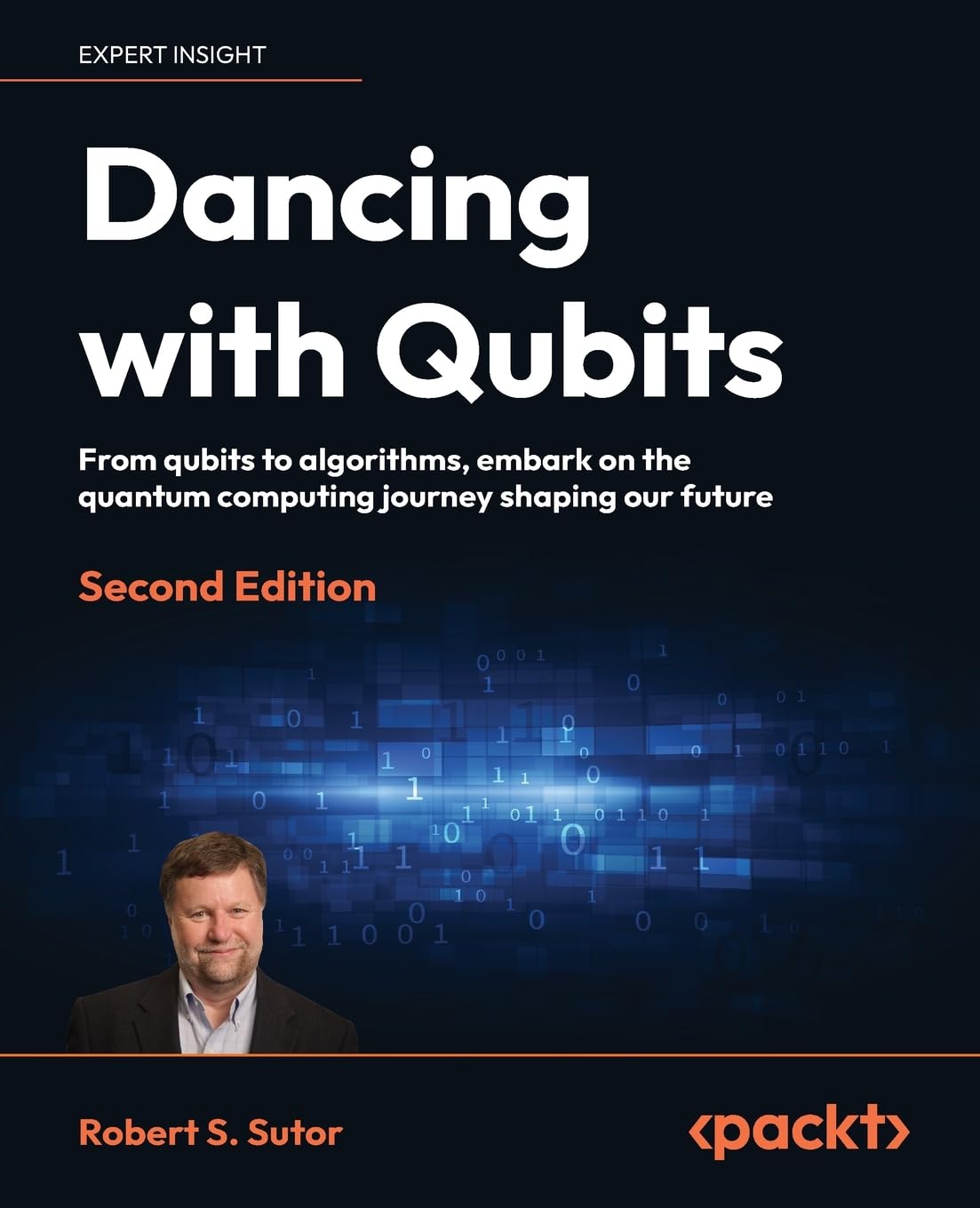
Dancing with Qubits: From qubits to algorithms, embark on the quantum computing journey shaping our future
AED22960
Quantity:
Order today to get by 7-14 business days
This item qualifies for free delivery
Imported From: United States
At BOLO, we work hard to ensure the products you receive are new, genuine, and sourced from reputable suppliers.
BOLO is not an authorized or official retailer for most brands, nor are we affiliated with manufacturers unless specifically stated on a product page. Instead, we source verified sellers, authorized distributors or directly from the manufacturer.
Each product undergoes thorough inspection and verification at our consolidation and fulfilment centers to ensure it meets our strict authenticity and quality standards before being shipped and delivered to you.
If you ever have concerns regarding the authenticity of a product purchased from us, please contact Bolo Support. We will review your inquiry promptly and, if necessary, provide documentation verifying authenticity or offer a suitable resolution.
Your trust is our top priority, and we are committed to maintaining transparency and integrity in every transaction.
All product information, images, descriptions, and reviews originate from the manufacturer or from trusted sellers overseas. BOLO is not affiliated with, endorsed by, or an authorized retailer for most brands listed on our website unless stated otherwise.
While we strive to display accurate information, variations in packaging, labeling, instructions, or formulation may occasionally occur due to regional differences or supplier updates. For detailed or manufacturer-specific information, please contact the brand directly or reach out to BOLO Support for assistance.
Unless otherwise stated, all prices displayed on the product page include applicable taxes and import duties.
BOLO operates in accordance with the laws and regulations of United Arab Emirates. Any items found to be restricted or prohibited for sale within the UAE will be cancelled prior to shipment. We take proactive measures to ensure that only products permitted for sale in United Arab Emirates are listed on our website.
All items are shipped by air, and any products classified as “Dangerous Goods (DG)” under IATA regulations will be removed from the order and cancelled.
All orders are processed manually, and we make every effort to process them promptly once confirmed. Products cancelled due to the above reasons will be permanently removed from listings across the website.
Similar suggestions by Bolo
More from this brand
Similar items from “Intelligence & Semantics”
Share with
Or share with link
https://www.bolo.ae/products/U1837636753
Visit the Packt Publishing Store
Dancing with Qubits: From qubits to algorithms, embark on the quantum computing journey shaping our future

AED22960
Quantity:
Order today to get by 7-14 business days
This item qualifies for free delivery
Imported From: United States
At BOLO, we work hard to ensure the products you receive are new, genuine, and sourced from reputable suppliers.
BOLO is not an authorized or official retailer for most brands, nor are we affiliated with manufacturers unless specifically stated on a product page. Instead, we source verified sellers, authorized distributors or directly from the manufacturer.
Each product undergoes thorough inspection and verification at our consolidation and fulfilment centers to ensure it meets our strict authenticity and quality standards before being shipped and delivered to you.
If you ever have concerns regarding the authenticity of a product purchased from us, please contact Bolo Support. We will review your inquiry promptly and, if necessary, provide documentation verifying authenticity or offer a suitable resolution.
Your trust is our top priority, and we are committed to maintaining transparency and integrity in every transaction.
All product information, images, descriptions, and reviews originate from the manufacturer or from trusted sellers overseas. BOLO is not affiliated with, endorsed by, or an authorized retailer for most brands listed on our website unless stated otherwise.
While we strive to display accurate information, variations in packaging, labeling, instructions, or formulation may occasionally occur due to regional differences or supplier updates. For detailed or manufacturer-specific information, please contact the brand directly or reach out to BOLO Support for assistance.
Unless otherwise stated, all prices displayed on the product page include applicable taxes and import duties.
BOLO operates in accordance with the laws and regulations of United Arab Emirates. Any items found to be restricted or prohibited for sale within the UAE will be cancelled prior to shipment. We take proactive measures to ensure that only products permitted for sale in United Arab Emirates are listed on our website.
All items are shipped by air, and any products classified as “Dangerous Goods (DG)” under IATA regulations will be removed from the order and cancelled.
All orders are processed manually, and we make every effort to process them promptly once confirmed. Products cancelled due to the above reasons will be permanently removed from listings across the website.
Description:
Editorial Reviews
Review
“The book does a superb job of simplifying complex topics by taking the reader through bite-sized steps, allowing understanding and familiarity with how quantum computing and algorithms really work. The strength of the book lies in ensuring you have the best mathematical foundation as you progress on your quantum journey. I highly recommend this book to anyone getting into quantum computing with a desire to understand how it works mathematically.”
Alex Khan, Advisor Quantum Computing
“The timely delivery of this book follows IBM's announcement of the Age of Quantum Utility. At a minimum, this book is a great foundation to Quantum Jumpstart your career in Quantum Information Science.
It serves as a great roadmap, guiding you on a Path of Entanglement as you learn to Dance with Qubits.”
Gregory Brown, Founder, The Quantum Synergistics Institute
About the Author
Robert S. Sutor has been a technical leader and executive in the IT industry for over 40 years. More than two decades of that were spent in IBM Research in Yorktown Heights, New York USA. During his time there, he worked on and led efforts in symbolic mathematical computation, mathematical programming languages, optimization, AI, blockchain, and quantum computing. He is the author of Dancing with Qubits: How quantum computing works and how it can change the world and Dancing with Python: Learn Python software development from scratch and get started with quantum computing, also with Packt. He is the published co-author of several research papers and the book Axiom: The Scientific Computation System with the late Richard D. Jenks.
Sutor was an IBM executive on the software side of the business in areas including Java web application servers, emerging industry standards, software on Linux, mobile, and open source. He was the Vice President of Corporate Development and, later, Chief Quantum Advocate, at Infleqtion, a quantum computing and quantum sensing company based in Boulder, Colorado USA. He is currently an Adjunct Professor in the Department of Computer Science and Engineering at the University at Buffalo, New York, USA.
He is a theoretical mathematician by training, has a Ph.D. from Princeton University, and an undergraduate degree from Harvard College. He started coding when he was 15 and has used most of the programming languages that have come along.
Reviews:
5.0 out of 5 stars The math you need to succeed in quantum computing
Robert Sutor’s book “Dancing with Qubits” is critical for anyone wanting to learn about quantum computing with a solid mathematical understanding. Therefore, whether you are in high school, in a non-STEM field, or like me, who had not dealt with any complex math for 20 years, this book was critical to familiarizing myself on the key mathematical concepts and which I later also used when I wrote my own book on quantum computing.“Dancing with Qubits” Second Edition is divided into three sections.Section IThis section covers the basic math that someone should have gone through in college (even high school) that supports the key concepts needed for quantum computing. This includes numbers, circles, dimensions, and probability. Probably a good refresher for many of us in business and jumping into quantum computing for different reasons.Section IIThis section starts with qubits and digs deeper into Dirac notation, the Bloch sphere, matrices, tensor products, quantum gates and then into algorithms. The chapters include detailed explanations, visualizations, and mathematical representation of the frequently used quantum gates. It includes step by step derivation of the math for various popular quantum algorithms. By the time you reach Shor's algorithm and modular exponentiation you would have fully explored qubit states through Quantum Fourier Transform (QFT), phase estimation and order finding.One chapter that I did not fully get into during my first reading of the book is Chapter 11. Getting Physical. It includes some important concepts for error correction, Shor code, benchmarking, and simulations. It also gets into some physical implementation of qubits such as photonics.Section IIIThe last section, which is new to this second edition, covers variational algorithms that make up the foundation for solving optimization and machine learning problems on quantum computers. For those who already have the first edition, this would be the motivation for ordering an additional copy, apart from other minor edits throughout the previous sections.Bob starts the discussion by reminding the user of single and multiple variable functions along with classical method for optimization to find their minimum and maximum. The book goes over Max-Cut which is frequently used in quantum computing as a baseline problem, and discusses Hermitian matrices, the variational principle, parameterized circuits, time evolution and the Hamiltonian. This then leads to an explanation of the Quantum Approximate Optimization Algorithm (QAOA) and the Variational Quantum Eigensolver (VQE). As I have tried to teach my students, understanding QAOA is a great place to start before getting into Quantum Machine Learning (QML). Bob does the same.The book then proceeds to the topic of QML. Bob spends some time explaining how to encode real world data into amplitudes or angles, before touching upon quantum neural network circuits and how their parameters might be optimized. Bob discusses support vector machines and quantum kernels as a use case for this area which is being heavily researched. Keep in mind that section III is more of an introduction to this vast topic of QML rather than a full treatment.SummaryOverall, the book does a superb job of simplifying complex topics by taking the reader through bite sized steps to allow understanding and familiarity with how quantum computing and algorithms really work. The strength of the book is to ensure you have the best mathematical foundation as you progress on your quantum journey. There are some connections to material covered in Bob's other book "Dancing with Python". I would highly recommend the book to anyone getting into quantum computing with the desire to understand how it works mathematically. The cover is in color, but the inside the figures are all b/w.
5.0 out of 5 stars A Must-Have Guide in Quantum Computing
This book is a valuable resource for anyone interested in quantum computing. It provides a good balance of mathematical rigor and clear explanations, making it suitable for beginners and experienced learners.The in-depth coverage of the essential mathematical concepts of quantum computing sets this book apart. The author breaks down complex concepts in an accessible way without sacrificing depth, and each chapter builds on the previous one for a thorough understanding. The book does an amazing work at explaining the basics of quantum computing from a mathematical perspective, offering detailed explanations that make even the most challenging concepts easier to understand.One of the book's highlights is its focus on essential quantum algorithms. The comprehensive and insightful coverage of basic quantum algorithms provides readers with practical knowledge crucial for progressing in the field. The step-by-step approach enhances understanding and equips readers with the skills needed to implement these algorithms.In summary, this book is an essential resource for anyone looking to invest in their educational journey in the quantum domain!
5.0 out of 5 stars Excellent book to start your quantum computing education with
The book starts with the basics and builds up to the state of the art. It’s a great overview of the subject. By necessity it is mathematical but it tries to lay out the mathematics needed and contains detailed derivations of the important results.If you are interested in learning about quantum computing, it is an excellent place to start. Coupled with some supplementary material, it is an excellent textbook as well.
4.0 out of 5 stars Recommended for serious QC developers. Disappointed that answers to the exercises are missing.
Great book on the subject. This is not a light treatment for management. Be prepared for a lot of foundational math before getting to qubits. The information is solid, but I noticed a number of typographical errors in the text (e.g. basic vs. basis) and in some of the math formulae (e.g. misplaced parentheses). They were obvious enough to not be misleading.I was disappointed that the answers to the exercises were not included. It would have been very valuable to be able to check my answers against a key.
5.0 out of 5 stars A Comprehensive and Practical Guide to Quantum Computing
Reading is a gateway to understanding, but it's the application that truly solidifies knowledge. This book perfectly encapsulates this philosophy.Quantum computing is both fascinating and complex, and Sutor’s updated edition handles both beautifully. He breaks down intricate concepts into digestible pieces without sacrificing depth or rigor, making learning both comprehensive and approachable.A standout aspect of this book is how it seamlessly blends theory with practical application. Sutor not only explains the 'what' and 'why' of quantum computing but also delves into the 'how' with hands-on exercises that reinforce the material.This is a must-read for anyone interested in quantum computing, whether you're a novice or looking to deepen your understanding. You don't need extensive prior knowledge in mathematics or physics; Sutor covers the most applicable pieces you need. Highly recommended!
Excellent book
Excellent book to have a solid mathematical foundation to understand quantum computing.Needs to be in your library if you want to enter the world of quantum computing.
Brilliant Book!
This book is a must-read for both beginners and advanced readers diving into the world of quantum computing. It’s clear, engaging, and strikes the perfect balance between accessibility and depth. The author's talent shines through in their intuitive explanations and practical examples, making complex concepts easy to grasp. Highly recommended for anyone seeking to explore or deepen their understanding of quantum computing.
Major print issues, otherwise a fascinating read
Received this fascinating read but there are major print issues as shown in the attached pictures
Similar suggestions by Bolo
More from this brand
Similar items from “Intelligence & Semantics”
Share with
Or share with link
https://www.bolo.ae/products/U1837636753