Description:
Reviews:
5.0 out of 5 stars Extraordinary claims supported by extraordinary evidence
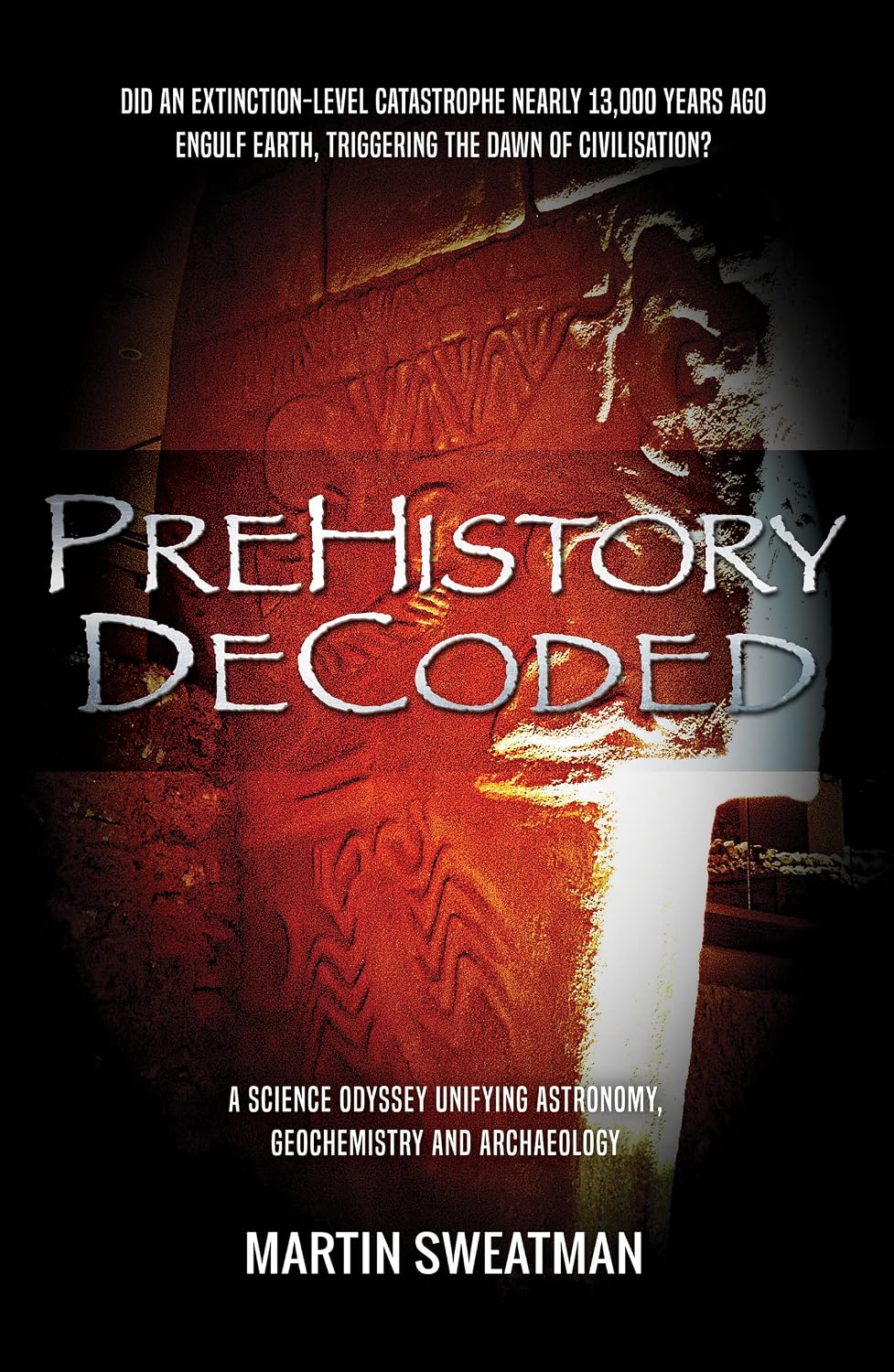
Martin Sweatman’s 2017 breakthrough publication was a shot heard around the world. Stunned silence was the general reaction. We are privileged to be among the first to break that silence.Sweatman’s key discovery was to translate paleolithic art into a vocabulary of constellations. He proved, to a statistical certainty, that a stone pillar at the prehistoric site of Göbekli Tepe represents the sky at summer solstice circa 10,950 BC – earlier than the date of the site by almost 1,500 years.This alone revolutionizes our understanding of human prehistory.But Sweatman went much further than that.He inquired why the architects of Göbekli Tepe took such pains to record this specific date from their deep past.He found that it coincided with a period of devastating climate change known as the Younger Dryas event.The nature of the Younger Dryas event has long been in dispute. Many have maintained it was a gradual shift. A minority have suggested a sudden catastrophe, such as cometary impact.Sweatman found that ca. 10,950 BC, earth’s orbit intersected the Taurid meteor stream – debris from an immense, decaying comet. He found corroborating evidence in inscriptions at Göbekli Tepe representing swarms of meteors emanating from the appropriate constellation.In 2018, Sweatman published additional tests of his extraordinary theory, analyzing two more famous paleolithic sites: Lascaux (ca. 15,000 BC) and Çatalhöyük (ca. 6,000 BC). In each case he found a coherent vocabulary of constellations little changed from that used at Göbekli Tepe. Crucially, he found representations of disaster emanating from the radiant of the Taurid meteor stream.With its periodicity of 3,000 years, the Taurids were now implicated as a major driver of human history – wiping out entire cultures, obliging survivors to commemorate the events in art, history, and ultimately myth.Extraordinary claims demand extraordinary evidence, and as anthropologists, we were eager to read the rebuttals.We are aware of only two, but they fell far short of overturning Sweatman’s evidence.Stunned silence, then, was the understandable reaction to undermining decades of archaeological orthodoxy. What could it all mean?Sweatman did not stop there.In 2019, he published the subject of this review: Prehistory Decoded, his eminently readable synthesis of all the current evidence for his astonishing theory.The book is a tour de force of the scientific method.Sweatman includes many jaw-dropping suggestions that we will not spoil for you here.His bombshell conclusion is that these cometary catastrophes may have engendered civilization itself, with agriculture as a secondary effect.We believe one reason Sweatman’s book has not garnered worldwide attention is the high level of education required to appreciate the gravity of his findings.Sweatman ably summarizes the science for the layman. But to appreciate not only the weight of his evidence, but the staggering implications of his theory, the reader requires acquaintance with the following disciplines:AnthropologyArchaeologyAstrologyAstronomyChemistryClimatologyGeologyHistoryLinguisticsMythologyOrbital MechanicsPhysicsStatisticsThe list is not comprehensive, but representative.Who, even among scholars, will bring this breadth of understanding to the subject?(Excepting, of course, the editorial board of the Journal of Anthropological Engineering.)We believe a second reason Sweatman’s book is not instantly famous is because of the many academic applecarts it upsets.The concept of gradualism in climate change is fatally challenged, as are contemporary explanations of human origins, language, culture, evolution and biology.Who will admit that so many years of antediluvian scholarship have washed away in biblical flood?However, like the comet swarm he investigates, Sweatman’s work is not simply destructive, but constructive.He breaks the fields of anthropology and archaeology wide open for new discoveries.We observe that 40,000 years is an evolutionary timescale, and we now look for evidence in human adaptation.We ask:Was pareidolia, that peculiar human affinity for pattern recognition, critical for transmitting a vocabulary of constellations – and the spur to the so-called “cognitive revolution”?We know that our paleolithic ancestors were taller and larger-brained than we are: were their eyesight and pattern recognition also keener?With their keen eyesight, and lives depending on understanding astronomy, did they anticipate not only Hipparchus – but Copernicus, Galileo, Kepler and Newton?Might archaeoastronomy explain why Homo Sapiens is the only hominin species left alive on Earth?We have hesitated to write this review because the more we contemplate Sweatman’s revelations, the more questions we have.But we need your help answering those questions.We paraphrase James Joyce:It took Martin Sweatman 40 years to write Prehistory Decoded: it should take you 40 years to read it.
4.0 out of 5 stars Good research
Developed description of the impact, no pun intended, of catastrophic events on human civilization.Applying archaeology and astronomy he seeks to identify the links that have caused both massive destruction and started major changes in our development. These events have also erased evidence of these past civilizations. I'm an amateur astronomer and about go out and watch the S. Taurids.
5.0 out of 5 stars Amazing eye opener - highly recommended
Dr. Sweatman gives an excellent argument backed up with a scientific analysis of currently available research. It is an alternative hypothesis on the origins of human civilization that challenges contemporary theories.I found the book to be an excellent read that was easy to follow with very good explanations of difficult concepts such as orbital precession and the scientific method of analysis. You have to approach this book with an open mind as Dr Sweatman is very clear that he is making some assumptions in his interpretations of the data and that much more research is need before any solid conclusions can be made.If you are interested in learning more about prehistory, anthropology, archeology, astronomy, and the foundations of modern religion and civilization, then I highly recommend reading Prehistory Decoded.
5.0 out of 5 stars Great analysis
I'm not a scientist or a statistician, but I do have a rational mind (or so I believe) and the author's analysis looks very solid to me. Assuming it is correct, of course it will take years or decades for the mainstream to recognize it as such. During my reading of this book, I also watched a National Geographic documentary in which the eminent scientist narrator assured me, paraphrasing, "one thing Gobekli Tepe is definitely not: a memorialization of a catastrophic event." Note Sweatman is not an archaeologist or anthropologist, but he is a credentialed scientist who has published in the appropriate journals. This is an excellent, entertaining book, no matter whether you are ultimately convinced of the YDIH and/or the author's interpretation of Gobekli Tepe.
3.0 out of 5 stars Inconclusive
Conclusions are far too speculative for me although the Younger Dryas impact event itself is very likely to have happened and affected human history. The animal carvings and their connections to the zodiac or constellations seem too far on the fringe imo.
5.0 out of 5 stars A great read
This was an excellent read, partially compelling because he goes to lengths to underpin his conclusions in a scientific way. Without that, his ideas are far enough from the conventional things we've been taught that they are hard to believe. Keep in mind that the comet that caused the dinosaur killing ELE sounded like total science fiction at its introduction, who would believe something so silly. Now it's well accepted.A look at the surface of the moon reminds us that the earth is not protected from space trash of various origins.
4.0 out of 5 stars Records
Opens up so much, ideas how much did the ancient people knowledge of star systems
A delectable and veritable page turner
A real page turner expanding upon the theories of other's regarding the Younger Dryas impact hypothesis. Delving deep into the zodiacal relationship of dating human history according to cosmic impacts and the effects on ancient civilisations. ..... Author once again shouted down aggressively by the nay-sayers of academia. Like all other maverick and free spirited thinkers in this field."We are a species with amnaesia...."
Prehistory
Describes the beginning of civilization really well.
Spot on
I approached this book with a heavy degree of scepticism since zodiacs have always varied in character and indeed depending who you talk to have 12 or more houses in them. I read this twice. Its very good, accounts for statistical likelihood of being correct, highlights when the statistics may not be in favour and sticks rigidly to the scientific research model. This is a scientific approach to what has heretofore been the reserve of enthusiastic amateur researches and writers. It works. And works very well.There has been extensive work on some of the cave art, all over the globe, that has highlighted 30 plus symbols that are also known to be present over tens of thousands of years accompanying the paintings highlighted in this book and having contacted the author on his blog, address in the book, it appears he is very concious of this and a second book may well be forthcoming.On a private note a friend sent me pictures of Pictish rune stones, and after reading the book it does appear they have dates identified by constellation positions on them too! The knowledge in this book doesnt make you an expert but it does help you to identofy other examples of this in our heritage.Combine this with the electric universe work being done by wal Thornhill et al and the Thunderbolts project and that symbology from history and you begin to see where quite a lot of modern symbology has its roots!Great book.
Respect our human heritage, we're amazing!
What impressed me most was Martin Sweatman's attitude to unravelling an enigma. His approach was logical and thorough. His suppositions clearly laid out. And yet an openness to be shown a different meaning. His "conclusion" is thought provoking, and for me, exciting. The "ancient" builders were so very modern in their understanding. Humans are amazing!
An interesting read
This is another take on the site, easy to read and very interesting, although the author labours the point about the scientific method seems a bit desperate to be believed. If you are interested in the site, then this is a good book to add to the collection. One day we will know what it is all about until then it is great to speculate.
Visit the Troubador Publishing Store
Prehistory Decoded
AED22649
Quantity:
Order today to get by 7-14 business days
This item qualifies for free delivery
Imported From: United States
At BOLO, we work hard to ensure the products you receive are new, genuine, and sourced from reputable suppliers.
BOLO is not an authorized or official retailer for most brands, nor are we affiliated with manufacturers unless specifically stated on a product page. Instead, we source verified sellers, authorized distributors or directly from the manufacturer.
Each product undergoes thorough inspection and verification at our consolidation and fulfilment centers to ensure it meets our strict authenticity and quality standards before being shipped and delivered to you.
If you ever have concerns regarding the authenticity of a product purchased from us, please contact Bolo Support. We will review your inquiry promptly and, if necessary, provide documentation verifying authenticity or offer a suitable resolution.
Your trust is our top priority, and we are committed to maintaining transparency and integrity in every transaction.
All product information, images, descriptions, and reviews originate from the manufacturer or from trusted sellers overseas. BOLO is not affiliated with, endorsed by, or an authorized retailer for most brands listed on our website unless stated otherwise.
While we strive to display accurate information, variations in packaging, labeling, instructions, or formulation may occasionally occur due to regional differences or supplier updates. For detailed or manufacturer-specific information, please contact the brand directly or reach out to BOLO Support for assistance.
Unless otherwise stated, all prices displayed on the product page include applicable taxes and import duties.
BOLO operates in accordance with the laws and regulations of United Arab Emirates. Any items found to be restricted or prohibited for sale within the UAE will be cancelled prior to shipment. We take proactive measures to ensure that only products permitted for sale in United Arab Emirates are listed on our website.
All items are shipped by air, and any products classified as “Dangerous Goods (DG)” under IATA regulations will be removed from the order and cancelled.
All orders are processed manually, and we make every effort to process them promptly once confirmed. Products cancelled due to the above reasons will be permanently removed from listings across the website.
Similar suggestions by Bolo
More from this brand
Similar items from “Astronomy”
Share with
Or share with link
https://www.bolo.ae/products/U178901638K
Visit the Troubador Publishing Store
Prehistory Decoded

AED22649
Quantity:
Order today to get by 7-14 business days
This item qualifies for free delivery
Imported From: United States
At BOLO, we work hard to ensure the products you receive are new, genuine, and sourced from reputable suppliers.
BOLO is not an authorized or official retailer for most brands, nor are we affiliated with manufacturers unless specifically stated on a product page. Instead, we source verified sellers, authorized distributors or directly from the manufacturer.
Each product undergoes thorough inspection and verification at our consolidation and fulfilment centers to ensure it meets our strict authenticity and quality standards before being shipped and delivered to you.
If you ever have concerns regarding the authenticity of a product purchased from us, please contact Bolo Support. We will review your inquiry promptly and, if necessary, provide documentation verifying authenticity or offer a suitable resolution.
Your trust is our top priority, and we are committed to maintaining transparency and integrity in every transaction.
All product information, images, descriptions, and reviews originate from the manufacturer or from trusted sellers overseas. BOLO is not affiliated with, endorsed by, or an authorized retailer for most brands listed on our website unless stated otherwise.
While we strive to display accurate information, variations in packaging, labeling, instructions, or formulation may occasionally occur due to regional differences or supplier updates. For detailed or manufacturer-specific information, please contact the brand directly or reach out to BOLO Support for assistance.
Unless otherwise stated, all prices displayed on the product page include applicable taxes and import duties.
BOLO operates in accordance with the laws and regulations of United Arab Emirates. Any items found to be restricted or prohibited for sale within the UAE will be cancelled prior to shipment. We take proactive measures to ensure that only products permitted for sale in United Arab Emirates are listed on our website.
All items are shipped by air, and any products classified as “Dangerous Goods (DG)” under IATA regulations will be removed from the order and cancelled.
All orders are processed manually, and we make every effort to process them promptly once confirmed. Products cancelled due to the above reasons will be permanently removed from listings across the website.
Description:
Reviews:
5.0 out of 5 stars Extraordinary claims supported by extraordinary evidence
Martin Sweatman’s 2017 breakthrough publication was a shot heard around the world. Stunned silence was the general reaction. We are privileged to be among the first to break that silence.Sweatman’s key discovery was to translate paleolithic art into a vocabulary of constellations. He proved, to a statistical certainty, that a stone pillar at the prehistoric site of Göbekli Tepe represents the sky at summer solstice circa 10,950 BC – earlier than the date of the site by almost 1,500 years.This alone revolutionizes our understanding of human prehistory.But Sweatman went much further than that.He inquired why the architects of Göbekli Tepe took such pains to record this specific date from their deep past.He found that it coincided with a period of devastating climate change known as the Younger Dryas event.The nature of the Younger Dryas event has long been in dispute. Many have maintained it was a gradual shift. A minority have suggested a sudden catastrophe, such as cometary impact.Sweatman found that ca. 10,950 BC, earth’s orbit intersected the Taurid meteor stream – debris from an immense, decaying comet. He found corroborating evidence in inscriptions at Göbekli Tepe representing swarms of meteors emanating from the appropriate constellation.In 2018, Sweatman published additional tests of his extraordinary theory, analyzing two more famous paleolithic sites: Lascaux (ca. 15,000 BC) and Çatalhöyük (ca. 6,000 BC). In each case he found a coherent vocabulary of constellations little changed from that used at Göbekli Tepe. Crucially, he found representations of disaster emanating from the radiant of the Taurid meteor stream.With its periodicity of 3,000 years, the Taurids were now implicated as a major driver of human history – wiping out entire cultures, obliging survivors to commemorate the events in art, history, and ultimately myth.Extraordinary claims demand extraordinary evidence, and as anthropologists, we were eager to read the rebuttals.We are aware of only two, but they fell far short of overturning Sweatman’s evidence.Stunned silence, then, was the understandable reaction to undermining decades of archaeological orthodoxy. What could it all mean?Sweatman did not stop there.In 2019, he published the subject of this review: Prehistory Decoded, his eminently readable synthesis of all the current evidence for his astonishing theory.The book is a tour de force of the scientific method.Sweatman includes many jaw-dropping suggestions that we will not spoil for you here.His bombshell conclusion is that these cometary catastrophes may have engendered civilization itself, with agriculture as a secondary effect.We believe one reason Sweatman’s book has not garnered worldwide attention is the high level of education required to appreciate the gravity of his findings.Sweatman ably summarizes the science for the layman. But to appreciate not only the weight of his evidence, but the staggering implications of his theory, the reader requires acquaintance with the following disciplines:AnthropologyArchaeologyAstrologyAstronomyChemistryClimatologyGeologyHistoryLinguisticsMythologyOrbital MechanicsPhysicsStatisticsThe list is not comprehensive, but representative.Who, even among scholars, will bring this breadth of understanding to the subject?(Excepting, of course, the editorial board of the Journal of Anthropological Engineering.)We believe a second reason Sweatman’s book is not instantly famous is because of the many academic applecarts it upsets.The concept of gradualism in climate change is fatally challenged, as are contemporary explanations of human origins, language, culture, evolution and biology.Who will admit that so many years of antediluvian scholarship have washed away in biblical flood?However, like the comet swarm he investigates, Sweatman’s work is not simply destructive, but constructive.He breaks the fields of anthropology and archaeology wide open for new discoveries.We observe that 40,000 years is an evolutionary timescale, and we now look for evidence in human adaptation.We ask:Was pareidolia, that peculiar human affinity for pattern recognition, critical for transmitting a vocabulary of constellations – and the spur to the so-called “cognitive revolution”?We know that our paleolithic ancestors were taller and larger-brained than we are: were their eyesight and pattern recognition also keener?With their keen eyesight, and lives depending on understanding astronomy, did they anticipate not only Hipparchus – but Copernicus, Galileo, Kepler and Newton?Might archaeoastronomy explain why Homo Sapiens is the only hominin species left alive on Earth?We have hesitated to write this review because the more we contemplate Sweatman’s revelations, the more questions we have.But we need your help answering those questions.We paraphrase James Joyce:It took Martin Sweatman 40 years to write Prehistory Decoded: it should take you 40 years to read it.
4.0 out of 5 stars Good research
Developed description of the impact, no pun intended, of catastrophic events on human civilization.Applying archaeology and astronomy he seeks to identify the links that have caused both massive destruction and started major changes in our development. These events have also erased evidence of these past civilizations. I'm an amateur astronomer and about go out and watch the S. Taurids.
5.0 out of 5 stars Amazing eye opener - highly recommended
Dr. Sweatman gives an excellent argument backed up with a scientific analysis of currently available research. It is an alternative hypothesis on the origins of human civilization that challenges contemporary theories.I found the book to be an excellent read that was easy to follow with very good explanations of difficult concepts such as orbital precession and the scientific method of analysis. You have to approach this book with an open mind as Dr Sweatman is very clear that he is making some assumptions in his interpretations of the data and that much more research is need before any solid conclusions can be made.If you are interested in learning more about prehistory, anthropology, archeology, astronomy, and the foundations of modern religion and civilization, then I highly recommend reading Prehistory Decoded.
5.0 out of 5 stars Great analysis
I'm not a scientist or a statistician, but I do have a rational mind (or so I believe) and the author's analysis looks very solid to me. Assuming it is correct, of course it will take years or decades for the mainstream to recognize it as such. During my reading of this book, I also watched a National Geographic documentary in which the eminent scientist narrator assured me, paraphrasing, "one thing Gobekli Tepe is definitely not: a memorialization of a catastrophic event." Note Sweatman is not an archaeologist or anthropologist, but he is a credentialed scientist who has published in the appropriate journals. This is an excellent, entertaining book, no matter whether you are ultimately convinced of the YDIH and/or the author's interpretation of Gobekli Tepe.
3.0 out of 5 stars Inconclusive
Conclusions are far too speculative for me although the Younger Dryas impact event itself is very likely to have happened and affected human history. The animal carvings and their connections to the zodiac or constellations seem too far on the fringe imo.
5.0 out of 5 stars A great read
This was an excellent read, partially compelling because he goes to lengths to underpin his conclusions in a scientific way. Without that, his ideas are far enough from the conventional things we've been taught that they are hard to believe. Keep in mind that the comet that caused the dinosaur killing ELE sounded like total science fiction at its introduction, who would believe something so silly. Now it's well accepted.A look at the surface of the moon reminds us that the earth is not protected from space trash of various origins.
4.0 out of 5 stars Records
Opens up so much, ideas how much did the ancient people knowledge of star systems
A delectable and veritable page turner
A real page turner expanding upon the theories of other's regarding the Younger Dryas impact hypothesis. Delving deep into the zodiacal relationship of dating human history according to cosmic impacts and the effects on ancient civilisations. ..... Author once again shouted down aggressively by the nay-sayers of academia. Like all other maverick and free spirited thinkers in this field."We are a species with amnaesia...."
Prehistory
Describes the beginning of civilization really well.
Spot on
I approached this book with a heavy degree of scepticism since zodiacs have always varied in character and indeed depending who you talk to have 12 or more houses in them. I read this twice. Its very good, accounts for statistical likelihood of being correct, highlights when the statistics may not be in favour and sticks rigidly to the scientific research model. This is a scientific approach to what has heretofore been the reserve of enthusiastic amateur researches and writers. It works. And works very well.There has been extensive work on some of the cave art, all over the globe, that has highlighted 30 plus symbols that are also known to be present over tens of thousands of years accompanying the paintings highlighted in this book and having contacted the author on his blog, address in the book, it appears he is very concious of this and a second book may well be forthcoming.On a private note a friend sent me pictures of Pictish rune stones, and after reading the book it does appear they have dates identified by constellation positions on them too! The knowledge in this book doesnt make you an expert but it does help you to identofy other examples of this in our heritage.Combine this with the electric universe work being done by wal Thornhill et al and the Thunderbolts project and that symbology from history and you begin to see where quite a lot of modern symbology has its roots!Great book.
Respect our human heritage, we're amazing!
What impressed me most was Martin Sweatman's attitude to unravelling an enigma. His approach was logical and thorough. His suppositions clearly laid out. And yet an openness to be shown a different meaning. His "conclusion" is thought provoking, and for me, exciting. The "ancient" builders were so very modern in their understanding. Humans are amazing!
An interesting read
This is another take on the site, easy to read and very interesting, although the author labours the point about the scientific method seems a bit desperate to be believed. If you are interested in the site, then this is a good book to add to the collection. One day we will know what it is all about until then it is great to speculate.
Similar suggestions by Bolo
More from this brand
Similar items from “Astronomy”
Share with
Or share with link
https://www.bolo.ae/products/U178901638K