Deliver toUnited Arab Emirates
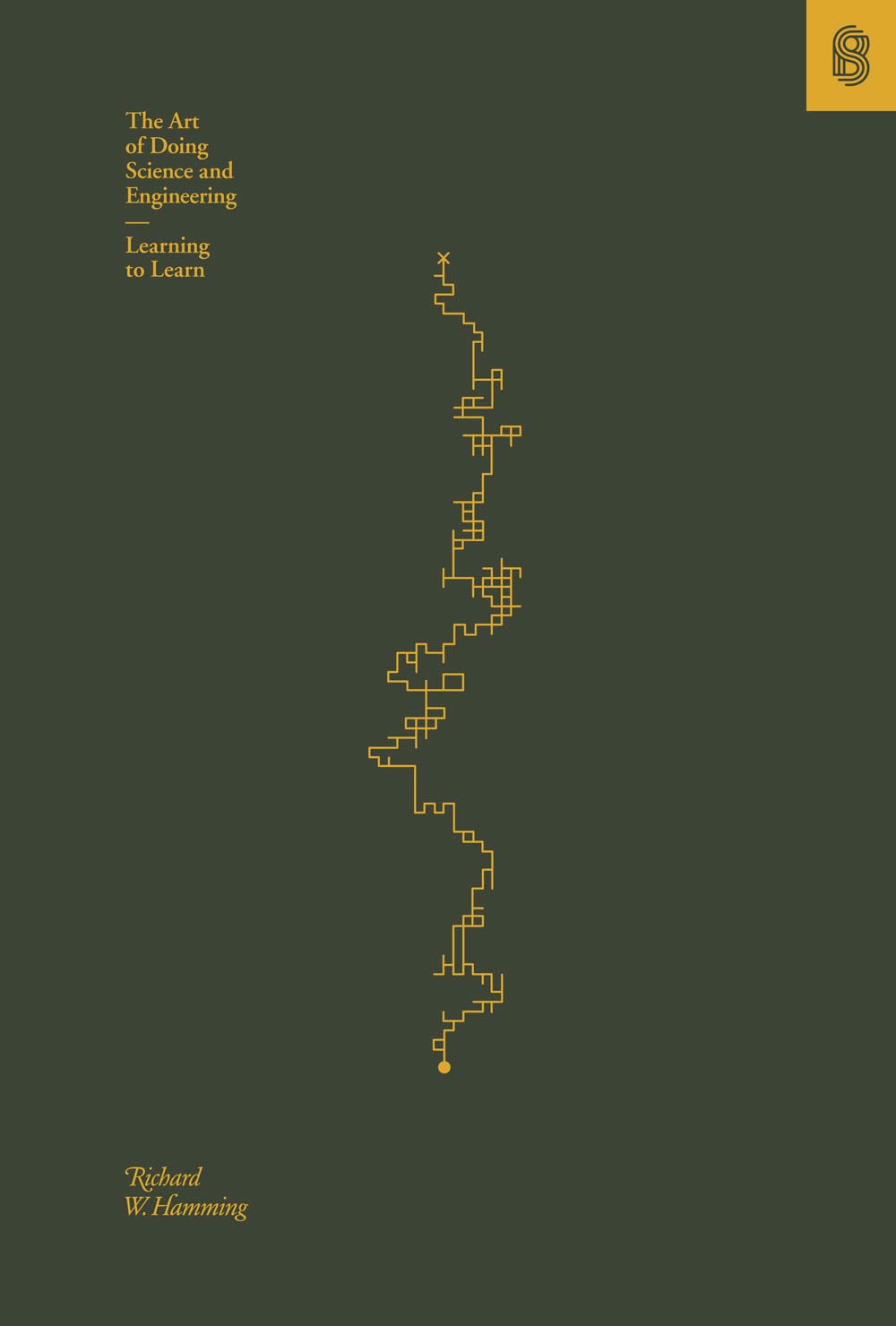
The Art of Doing Science and Engineering: Learning to Learn

Description:

A groundbreaking treatise by one of the great mathematicians of our age, who outlines a style of thinking by which great ideas are conceived.

What inspires and spurs on a great idea? Can we train ourselves to think in a way that will enable world-changing understandings and insights to emerge?

Richard Hamming said we can. He first inspired a generation of engineers, scientists, and researchers in 1986 with “You and Your Research,” an electrifying sermon on why some scientists do great work, why most don’t, why he did, and why you can—and should—too.
The Art of Doing Science and Engineering is the full expression of what “You and Your Research” outlined. It's a book about thinking; more specifically, a style of thinking by which great ideas are conceived.

The book is filled with stories of great people performing mighty deeds—but they are not meant simply to be admired. Instead, they are to be aspired to, learned from, and surpassed. Hamming consistently returns to Shannon’s information theory, Einstein’s theory of relativity, Grace Hopper’s work on high-level programming, Kaiser’s work on digital filters, and his own work on error-correcting codes. He also recounts a number of his spectacular failures as clear examples of what to avoid.

Originally published in 1996 and adapted from a course that Hamming taught at the US Naval Postgraduate School, this edition includes an all-new foreword by designer, engineer, and founder of Dynamicland Bret Victor, plus more than 70 redrawn graphs and charts.

The Art of Doing Science and Engineering is a reminder that a capacity for learning and creativity are accessible to everyone. Hamming was as much a teacher as a scientist, and having spent a lifetime forming and confirming a theory of great people and great ideas, he prepares the next generation for even greater distinction.


Editorial Reviews

Review

"Your last chance to read the words of thinking of one of the major intellects that the USA has produced."
—Eugene N. Miya, NASA researcher

"Hamming is here to tell you about excellence. His lessons unfold through personal stories of discovery and failure—life as an extraordinary scientist. But Hamming demands that you do extraordinary work, too, and for that he offers the best advice I know."
—Andy Matuschak, software engineer, designer, and researcher

"Hamming was always as much a teacher as a scientist, and having spent a lifetime forming and confirming a theory of great people, he felt he could prepare the next generation for even greater greatness. That's the premise and promise of this book."
—Bret Victor, founder of Dynamicland, designer, and engineer

About the Author

Richard W. Hamming (1915–1998) was a scientist and mathematician whose work inspired a generation of engineers, scientists, and researchers. He is best known for discovering mathematical formulas that allow computers to correct their own errors, a fundamental function of modems, compact disks, and satellite communications. Born in Chicago in 1915, he provided crucial programming support as a member of the Manhattan Project. After World War II, he joined Bell Labs, where over the next 15 years he was involved in nearly all of its most prominent achievements. He later taught and lectured at the Naval Postgraduate School in Monterey, California. Throughout his career, Hamming received many awards for his work, including the Turing Award in 1968, the highest honor in computer science. In 1988, the Institute of Electrical and Electronics Engineers created the Richard W. Hamming Medal in his honor, of which he was the first recipient. Chicago, IL

Reviews:

5.0 out of 5 stars Came for the engineering, stayed for the lessons

S.B. · June 7, 2021

I'm halfway tempted to write my engineering college and demand a full refund considering this book wasn't required reading. This is a must have for anyone in an engineering field(or any STEM field for that matter). The book is written so well. Hamming somewhat apologizes for the first person references in the intro, I would argue this is the best part. His anecdotes about how he learned a particular lesson were not only engaging to read, but clearly defined the message. It almost felt like I was having coffee with this guy and he was telling old war stories. Seriously one of the most unique science books I've ever read.The more technical chapters on error coding and filters were the real reason I purchased the book, as I had been doing some ECC implementations and was looking to really see how this was "discovered". These chapters (while brillant) were actually not the parts I enjoyed the most. The chapters on simulation actually had me screaming "YES!" when he describes reliance on simulation as a mistake, and that simulation only closely approximates reality. His insistence that while fast simulations are great, time between the simulations can be just as important, and that a true scientist should be thinking about the results before the results are calculated. These thought simulations allow the scientist/engineer to start thinking about the problem and what the simulation doesn't account for. It was quite refreshing to hear this.Ever since reading this book, I've started purchasing a copy for anyone who works under me. Understanding the math behind the problems isn't required. It's nice, to understand it, but certainly not the value you should receive out of this.Again, I honestly am floored that this wasn't required reading where I attended college. It's possible that someone in college would not be able to appreciate it, but after being in my career for 8 years, it is truly the most interesting and engaging STEM book I have read.

5.0 out of 5 stars Excellent wisdom from a computer science great

G. · June 28, 2021

While the book was written in 1994 and makes predictions about what computer science might look like in 2020, that isn't the point of the book. This is a great work by someone who got into the computing game in the 1940's right when things were starting to take off. The author's name should be familiar to you (aka the Hamming code) which adds a nice cachet of credibility.Hamming takes you through a fun history of computers and the art of computer programming but also with a larger point: trying to get you to think great thoughts. There are lots of wonderful insights in this book about management, corporate culture, scientific style and thinking about the future. The book is a beautifully made hardback priced like a softback -- a terrific value, and a thought provoking and inspiring read.

5.0 out of 5 stars Developing Better Thought Processes for Effective Problem Solving

M.M. · July 12, 2020

I came by Richard Hamming via a footnote on an essay on learning what it takes to become better at handling information. With my curiosity piqued, I decided to purchase this new edition, and I'm glad I did.I'm nearly two-thirds through it, and I've already jotted down several notes on passages where Professor Hamming goes into detail on communicating ideas better, coding, learning, and mathematics. His chapter on Claude Shannon's Information (Communication) Theory is worth the price of the book alone.I realise this book is not groundbreaking, but I've enjoyed his thought process as it differs from many similar books where it leaves me to reflect on things I was taking for granted in my thinking. And any book that's a cause for reflection on one's thoughts is a worthy exercise if it means overall better progress for oneself.

4.0 out of 5 stars Crafty book introducing techniques for understanding the world around us.

J. · April 30, 2023

Based on another's work, yet simultaneously original, great work, and perspective.

5.0 out of 5 stars Gift

R.L. · December 31, 2024

Was a gift for an engineering student that he asked for. Very appreciative when he received it.

5.0 out of 5 stars Great product! Met all expectations!

A.C. · December 28, 2024

Great product! Met all expectations!

5.0 out of 5 stars Excellent, but have a strong background in calc, particularly differential equations

T.H. · November 1, 2023

Book is great, but is best enjoyed with a strong background in math. Still, it doesn’t really focus on the math, uses it as an example and uses it to make points, not really to teach, so the book can be valuable to anyone who reads it. It changed the way I looked at my work.

5.0 out of 5 stars Beautiful hardcover of this classic and excellent Hamming work on "Learning To Learn"

D.B. · June 22, 2020

I've had the 1997 edition - paperback, Gordon and Breach Science publishers - for many years and it is among my favorites. Richard Hamming was an excellent writer - and this book is one of his best (I also very much like his "Methods of Mathematics" and "Numerical Methods for Scientists and Engineers".Anyway - without going at all into why this book is so good (for that i refer you to the reviews of the 1st edition at https://www.Bolo.com/Art-Doing-Science-Engineering-Learning/dp/9056995006 ) I wanted to say this new hardback edition is just a beautiful book. Very high quality production. I'm very glad to have it.

Misleading title

R.C. · June 22, 2025

Misleasing title... You won't understand most of the book if you are not in Math...

Good book

s.k. · March 25, 2023

Good book

Fantastic!

D.K.H. · February 4, 2025

Great book for any scientist/engineer or perhaps anyone else with an interest in learning and problem solving.

Required Reading 10/10

R.B. · June 3, 2025

Top tier read, re-ignitied my passion for learning and curiosity of the world around us. Recommend to anyone and everyone

Highly recommended

p. · July 22, 2025

A book full of wisdom by an exceptional thinker, scientist, and engineer.I let the author summarize its purpose:"The many small stories I have told you about myself are partly to convince you that you can be creative when your turn comes for guiding our society to its possible future."

The Art of Doing Science and Engineering: Learning to Learn

Product ID: U1732265178
Condition: New

4.6

AED18853

Price includes VAT & Import Duties
Type: Hardcover
Availability: In Stock

Quantity:

|

Order today to get by 7-14 business days

Delivery fee of AED 20. Free for orders above AED 200.

Returns & Warranty policies

Imported From: United States

At BOLO, we work hard to ensure the products you receive are new, genuine, and sourced from reputable suppliers.

BOLO is not an authorized or official retailer for most brands, nor are we affiliated with manufacturers unless specifically stated on a product page. Instead, we source verified sellers, authorized distributors or directly from the manufacturer.

Each product undergoes thorough inspection and verification at our consolidation and fulfilment centers to ensure it meets our strict authenticity and quality standards before being shipped and delivered to you.

If you ever have concerns regarding the authenticity of a product purchased from us, please contact Bolo Support. We will review your inquiry promptly and, if necessary, provide documentation verifying authenticity or offer a suitable resolution.

Your trust is our top priority, and we are committed to maintaining transparency and integrity in every transaction.

All product information, images, descriptions, and reviews originate from the manufacturer or from trusted sellers overseas. BOLO is not affiliated with, endorsed by, or an authorized retailer for most brands listed on our website unless stated otherwise.

While we strive to display accurate information, variations in packaging, labeling, instructions, or formulation may occasionally occur due to regional differences or supplier updates. For detailed or manufacturer-specific information, please contact the brand directly or reach out to BOLO Support for assistance.

Unless otherwise stated, all prices displayed on the product page include applicable taxes and import duties.

BOLO operates in accordance with the laws and regulations of United Arab Emirates. Any items found to be restricted or prohibited for sale within the UAE will be cancelled prior to shipment. We take proactive measures to ensure that only products permitted for sale in United Arab Emirates are listed on our website.

All items are shipped by air, and any products classified as “Dangerous Goods (DG)” under IATA regulations will be removed from the order and cancelled.

All orders are processed manually, and we make every effort to process them promptly once confirmed. Products cancelled due to the above reasons will be permanently removed from listings across the website.

Similar suggestions by Bolo

More from this brand

Similar items from “Research”

The Art of Doing Science and Engineering: Learning to Learn

Product ID: U1732265178
Condition: New

4.6

The Art of Doing Science and Engineering: Learning to Learn-0
Type: Hardcover

AED18853

Price includes VAT & Import Duties
Availability: In Stock

Quantity:

|

Order today to get by 7-14 business days

Delivery fee of AED 20. Free for orders above AED 200.

Returns & Warranty policies

Imported From: United States

At BOLO, we work hard to ensure the products you receive are new, genuine, and sourced from reputable suppliers.

BOLO is not an authorized or official retailer for most brands, nor are we affiliated with manufacturers unless specifically stated on a product page. Instead, we source verified sellers, authorized distributors or directly from the manufacturer.

Each product undergoes thorough inspection and verification at our consolidation and fulfilment centers to ensure it meets our strict authenticity and quality standards before being shipped and delivered to you.

If you ever have concerns regarding the authenticity of a product purchased from us, please contact Bolo Support. We will review your inquiry promptly and, if necessary, provide documentation verifying authenticity or offer a suitable resolution.

Your trust is our top priority, and we are committed to maintaining transparency and integrity in every transaction.

All product information, images, descriptions, and reviews originate from the manufacturer or from trusted sellers overseas. BOLO is not affiliated with, endorsed by, or an authorized retailer for most brands listed on our website unless stated otherwise.

While we strive to display accurate information, variations in packaging, labeling, instructions, or formulation may occasionally occur due to regional differences or supplier updates. For detailed or manufacturer-specific information, please contact the brand directly or reach out to BOLO Support for assistance.

Unless otherwise stated, all prices displayed on the product page include applicable taxes and import duties.

BOLO operates in accordance with the laws and regulations of United Arab Emirates. Any items found to be restricted or prohibited for sale within the UAE will be cancelled prior to shipment. We take proactive measures to ensure that only products permitted for sale in United Arab Emirates are listed on our website.

All items are shipped by air, and any products classified as “Dangerous Goods (DG)” under IATA regulations will be removed from the order and cancelled.

All orders are processed manually, and we make every effort to process them promptly once confirmed. Products cancelled due to the above reasons will be permanently removed from listings across the website.

Description:

A groundbreaking treatise by one of the great mathematicians of our age, who outlines a style of thinking by which great ideas are conceived.

What inspires and spurs on a great idea? Can we train ourselves to think in a way that will enable world-changing understandings and insights to emerge?

Richard Hamming said we can. He first inspired a generation of engineers, scientists, and researchers in 1986 with “You and Your Research,” an electrifying sermon on why some scientists do great work, why most don’t, why he did, and why you can—and should—too.
The Art of Doing Science and Engineering is the full expression of what “You and Your Research” outlined. It's a book about thinking; more specifically, a style of thinking by which great ideas are conceived.

The book is filled with stories of great people performing mighty deeds—but they are not meant simply to be admired. Instead, they are to be aspired to, learned from, and surpassed. Hamming consistently returns to Shannon’s information theory, Einstein’s theory of relativity, Grace Hopper’s work on high-level programming, Kaiser’s work on digital filters, and his own work on error-correcting codes. He also recounts a number of his spectacular failures as clear examples of what to avoid.

Originally published in 1996 and adapted from a course that Hamming taught at the US Naval Postgraduate School, this edition includes an all-new foreword by designer, engineer, and founder of Dynamicland Bret Victor, plus more than 70 redrawn graphs and charts.

The Art of Doing Science and Engineering is a reminder that a capacity for learning and creativity are accessible to everyone. Hamming was as much a teacher as a scientist, and having spent a lifetime forming and confirming a theory of great people and great ideas, he prepares the next generation for even greater distinction.


Editorial Reviews

Review

"Your last chance to read the words of thinking of one of the major intellects that the USA has produced."
—Eugene N. Miya, NASA researcher

"Hamming is here to tell you about excellence. His lessons unfold through personal stories of discovery and failure—life as an extraordinary scientist. But Hamming demands that you do extraordinary work, too, and for that he offers the best advice I know."
—Andy Matuschak, software engineer, designer, and researcher

"Hamming was always as much a teacher as a scientist, and having spent a lifetime forming and confirming a theory of great people, he felt he could prepare the next generation for even greater greatness. That's the premise and promise of this book."
—Bret Victor, founder of Dynamicland, designer, and engineer

About the Author

Richard W. Hamming (1915–1998) was a scientist and mathematician whose work inspired a generation of engineers, scientists, and researchers. He is best known for discovering mathematical formulas that allow computers to correct their own errors, a fundamental function of modems, compact disks, and satellite communications. Born in Chicago in 1915, he provided crucial programming support as a member of the Manhattan Project. After World War II, he joined Bell Labs, where over the next 15 years he was involved in nearly all of its most prominent achievements. He later taught and lectured at the Naval Postgraduate School in Monterey, California. Throughout his career, Hamming received many awards for his work, including the Turing Award in 1968, the highest honor in computer science. In 1988, the Institute of Electrical and Electronics Engineers created the Richard W. Hamming Medal in his honor, of which he was the first recipient. Chicago, IL

Reviews:

5.0 out of 5 stars Came for the engineering, stayed for the lessons

S.B. · June 7, 2021

I'm halfway tempted to write my engineering college and demand a full refund considering this book wasn't required reading. This is a must have for anyone in an engineering field(or any STEM field for that matter). The book is written so well. Hamming somewhat apologizes for the first person references in the intro, I would argue this is the best part. His anecdotes about how he learned a particular lesson were not only engaging to read, but clearly defined the message. It almost felt like I was having coffee with this guy and he was telling old war stories. Seriously one of the most unique science books I've ever read.The more technical chapters on error coding and filters were the real reason I purchased the book, as I had been doing some ECC implementations and was looking to really see how this was "discovered". These chapters (while brillant) were actually not the parts I enjoyed the most. The chapters on simulation actually had me screaming "YES!" when he describes reliance on simulation as a mistake, and that simulation only closely approximates reality. His insistence that while fast simulations are great, time between the simulations can be just as important, and that a true scientist should be thinking about the results before the results are calculated. These thought simulations allow the scientist/engineer to start thinking about the problem and what the simulation doesn't account for. It was quite refreshing to hear this.Ever since reading this book, I've started purchasing a copy for anyone who works under me. Understanding the math behind the problems isn't required. It's nice, to understand it, but certainly not the value you should receive out of this.Again, I honestly am floored that this wasn't required reading where I attended college. It's possible that someone in college would not be able to appreciate it, but after being in my career for 8 years, it is truly the most interesting and engaging STEM book I have read.

5.0 out of 5 stars Excellent wisdom from a computer science great

G. · June 28, 2021

While the book was written in 1994 and makes predictions about what computer science might look like in 2020, that isn't the point of the book. This is a great work by someone who got into the computing game in the 1940's right when things were starting to take off. The author's name should be familiar to you (aka the Hamming code) which adds a nice cachet of credibility.Hamming takes you through a fun history of computers and the art of computer programming but also with a larger point: trying to get you to think great thoughts. There are lots of wonderful insights in this book about management, corporate culture, scientific style and thinking about the future. The book is a beautifully made hardback priced like a softback -- a terrific value, and a thought provoking and inspiring read.

5.0 out of 5 stars Developing Better Thought Processes for Effective Problem Solving

M.M. · July 12, 2020

I came by Richard Hamming via a footnote on an essay on learning what it takes to become better at handling information. With my curiosity piqued, I decided to purchase this new edition, and I'm glad I did.I'm nearly two-thirds through it, and I've already jotted down several notes on passages where Professor Hamming goes into detail on communicating ideas better, coding, learning, and mathematics. His chapter on Claude Shannon's Information (Communication) Theory is worth the price of the book alone.I realise this book is not groundbreaking, but I've enjoyed his thought process as it differs from many similar books where it leaves me to reflect on things I was taking for granted in my thinking. And any book that's a cause for reflection on one's thoughts is a worthy exercise if it means overall better progress for oneself.

4.0 out of 5 stars Crafty book introducing techniques for understanding the world around us.

J. · April 30, 2023

Based on another's work, yet simultaneously original, great work, and perspective.

5.0 out of 5 stars Gift

R.L. · December 31, 2024

Was a gift for an engineering student that he asked for. Very appreciative when he received it.

5.0 out of 5 stars Great product! Met all expectations!

A.C. · December 28, 2024

Great product! Met all expectations!

5.0 out of 5 stars Excellent, but have a strong background in calc, particularly differential equations

T.H. · November 1, 2023

Book is great, but is best enjoyed with a strong background in math. Still, it doesn’t really focus on the math, uses it as an example and uses it to make points, not really to teach, so the book can be valuable to anyone who reads it. It changed the way I looked at my work.

5.0 out of 5 stars Beautiful hardcover of this classic and excellent Hamming work on "Learning To Learn"

D.B. · June 22, 2020

I've had the 1997 edition - paperback, Gordon and Breach Science publishers - for many years and it is among my favorites. Richard Hamming was an excellent writer - and this book is one of his best (I also very much like his "Methods of Mathematics" and "Numerical Methods for Scientists and Engineers".Anyway - without going at all into why this book is so good (for that i refer you to the reviews of the 1st edition at https://www.Bolo.com/Art-Doing-Science-Engineering-Learning/dp/9056995006 ) I wanted to say this new hardback edition is just a beautiful book. Very high quality production. I'm very glad to have it.

Misleading title

R.C. · June 22, 2025

Misleasing title... You won't understand most of the book if you are not in Math...

Good book

s.k. · March 25, 2023

Good book

Fantastic!

D.K.H. · February 4, 2025

Great book for any scientist/engineer or perhaps anyone else with an interest in learning and problem solving.

Required Reading 10/10

R.B. · June 3, 2025

Top tier read, re-ignitied my passion for learning and curiosity of the world around us. Recommend to anyone and everyone

Highly recommended

p. · July 22, 2025

A book full of wisdom by an exceptional thinker, scientist, and engineer.I let the author summarize its purpose:"The many small stories I have told you about myself are partly to convince you that you can be creative when your turn comes for guiding our society to its possible future."

Similar suggestions by Bolo

More from this brand

Similar items from “Research”