Deliver toUnited Arab Emirates
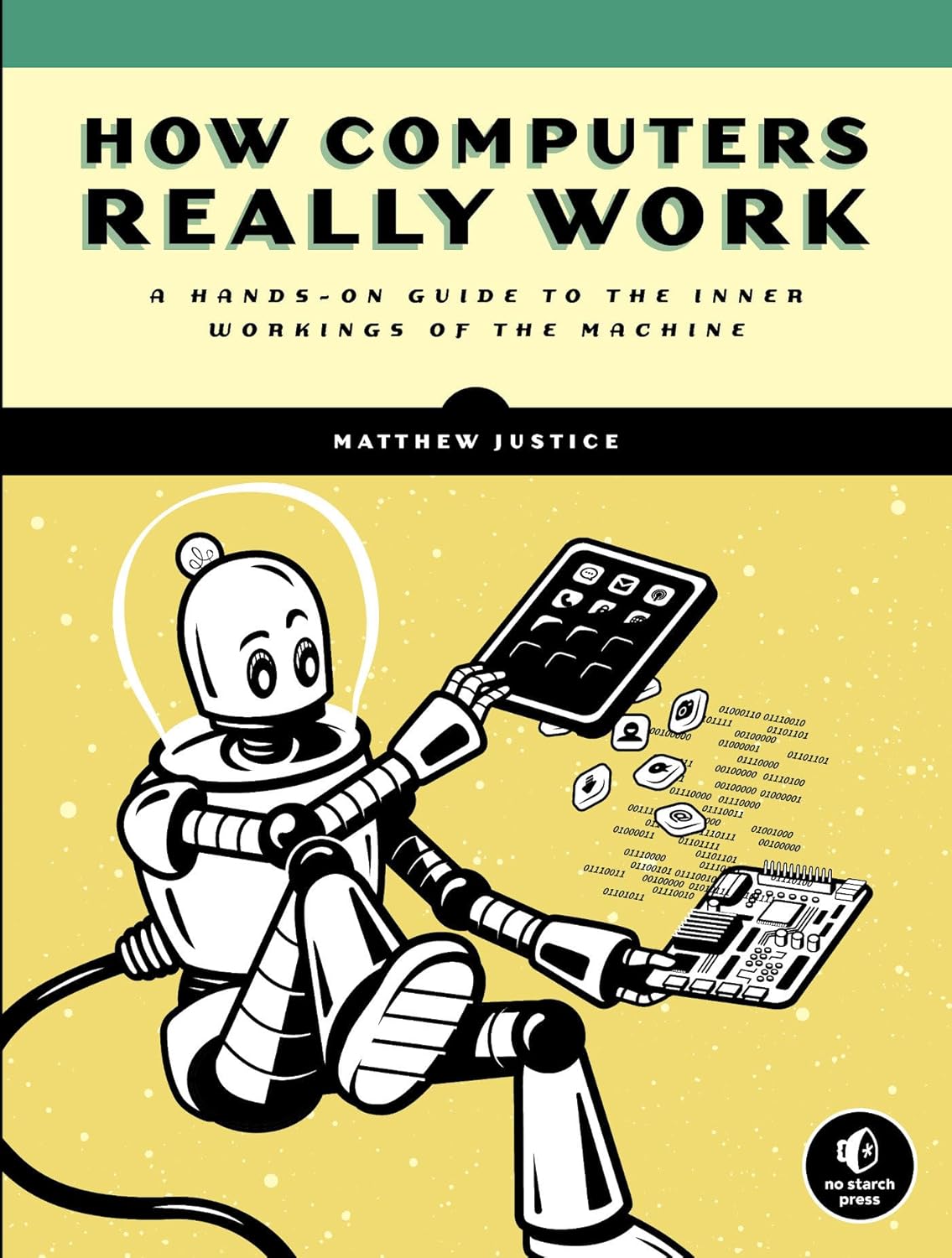
How Computers Really Work: A Hands-On Guide to the Inner Workings of the Machine

Description:

An approachable, hands-on guide to understanding how computers work, from low-level circuits to high-level code.

How Computers Really Work is a hands-on guide to the computing ecosystem: everything from circuits to memory and clock signals, machine code, programming languages, operating systems, and the internet.

But you won't just read about these concepts, you'll test your knowledge with exercises, and practice what you learn with 41 optional hands-on projects. Build digital circuits, craft a guessing game, convert decimal numbers to binary, examine virtual memory usage, run your own web server, and more.

Explore concepts like how to:
  • Think like a software engineer as you use data to describe a real world concept
  • Use Ohm's and Kirchhoff's laws to analyze an electrical circuit
  • Think like a computer as you practice binary addition and execute a program in your mind, step-by-step

The book's projects will have you translate your learning into action, as you:
  • Learn how to use a multimeter to measure resistance, current, and voltage
  • Build a half adder to see how logical operations in hardware can be combined to perform useful functions
  • Write a program in assembly language, then examine the resulting machine code
  • Learn to use a debugger, disassemble code, and hack a program to change its behavior without changing the source code
  • Use a port scanner to see which internet ports your computer has open
  • Run your own server and get a solid crash course on how the web works

And since a picture is worth a thousand bytes, chapters are filled with detailed diagrams and illustrations to help clarify technical complexities.

Requirements: The projects require a variety of hardware - electronics projects need a breadboard, power supply, and various circuit components; software projects are performed on a Raspberry Pi. Appendix B contains a complete list. Even if you skip the projects, the book's major concepts are clearly presented in the main text.


Editorial Reviews

Review

"Much more understandable than most books of this type, even when the author delves deeply into machine code, programming languages, operating systems and the internet. He details 41 hands-on projects, including games, running a web server, and so on. It's just right for the would-be software engineer."
—Joy Schwabach, Arkansas Democrat Gazette's On Computers

About the Author

Matthew Justice, a software engineer, spent 17 years at Microsoft where his work included debugging the Windows kernel, developing automated fixes, and leading a team of engineers building diagnostic tools and services. He has worked on everything from low-level software to high-level web applications.

Reviews:

5.0 out of 5 stars A clearly written book that covers important concepts without glossing over the details.

T. · April 22, 2024

I enjoyed this book and learnt a lot from it. Matthew writes clearly, includes real-world examples, gets into the technical details, and provides interesting stories of his time working on software engineering at Microsoft. The equipment to complete the practical exercises will cost about $100.Here is a summary of each chapter:Chapter 1: explains decimal number system (which we use in everyday life) and the binary and hexadecimal number systems used in computing.Chapter 2: encoding: now that you know about binary numbers, how do we represent the alphabets of the world in binary numbers? Logical operators (AND, OR, NOT, NAND, NOR, XOR) are also explained.Chapter 3: fundamentals of electric circuits. Voltage, current, and resistance. How these three relate to each other, described in Ohm's law.Chapter 4: how to build logical operators in the form of electrical circuits. Transistors explained. Integrated circuits explained.Chapter 5: arithmetic of binary numbers. How binary arithmetic can be carried out by electrical circuits built with logical operators.Chapter 6: how a bit can be stored in an electrical circuit called an SR Latch. Sequential logic circuits. How clock signals advance a sequential logic circuit.Chapter 7: the primary hardware components of a computer and how they work together to perform instructions provided by software.Chapter 8: how hardware must receive instructions in the form of machine code. Different examples of machine code and what instructions they convey. Assembly language is a more human-readable form of machine code.Chapter 9: how high-level programming languages (C, Python, etc.) are based on machine code. The advantages of writing in a high-level programming language as opposed to machine code. Various other concepts important in high-level programming.Chapter 10: on operating systems. How an operating system manages the computer's hardware, allowing multiple applications and programs to run at the same time. The major OSs, the types of hardware they typically manage, and their history and common origins.Chapter 11: the internet. A description of the physical components of the internet and the protocols they use to communicate.Chapter 12: how people use the infrastructure provided by the internet to create web pages and web services. The markup languages, programming languages, and data structures that are most frequently used to create web pages and web services.Chapter 13: a brief description of emerging computer technologies: Apps, Bitcoin, cloud computing, virtual reality and augmented reality.

5.0 out of 5 stars Really explains how computer works

A.F. · April 12, 2025

This is the book I wish I read before I took my Computer Architecture classes back in college.

5.0 out of 5 stars Good coverage

W.G. · March 29, 2025

Very good book. Covered a lot topics

5.0 out of 5 stars Knowledgeable read!

B. · February 4, 2025

I liked the hands on approach the author uses to get the reader involved in the topics discussed in the book!

5.0 out of 5 stars Best introductory and comprehensive book on Computer topics.

D. · January 30, 2024

This is the most clear, concise, objective, yet comprehensive book on computer basics that I have encountered so far. Additionally, the hands on projects and exercises are very well balanced in terms of difficulty.

5.0 out of 5 stars CARVE IT IN STONE!

J. · July 31, 2022

Here is my quick review about this AWESOME book, but first here's a caveat:You have to be interested in learning the material. I mean, that's why you are thinking about purchasing this book, right?Here is what I have to say about this book... "IT DESERVES TO BE CARVED IN STONE OK, OK; IN THIS DAY AND AGE IT CAN BE LASER ENGRAVED ON METAL PLATES."enough said?Buy the book, you'll love it.It's in my Top 10 favorite books of all time.An enormous thank you to the author Mathew, Justice for undertaking the task of writing this very comprehensive book.A huge thank you to his parents, wife and his daughters for the support they provided him.And also a big thank you to the entire team at No Starch Press for supporting the publication of this book for it has literally changed my life! :)

5.0 out of 5 stars Great for beginners

S. · May 18, 2024

I whimsically developed a desire to learn about computers and this book has been great. It starts at the barebones fundamentals and explains things clearly for beginners. Love the hands on experiments as well.

5.0 out of 5 stars Outstanding explanation of computer details

J. · December 26, 2022

Matthew Justice has a profound knowledge of computers and does a great job of explaining how they work. The author does not gloss over details and carefully defines terms such as "address space", "threads", "virtual memory" and so on. This is an eminently readable book.

Riveting

G. · December 17, 2024

Riveting

Livro não veio lacrado

C. · April 25, 2023

Por algum motivo, o livro veio sem plástico, com um pequeno amassado, achei estranho, pois o livro que pedi é novo e deveria ter vindo lacrado... Quanto ao livro, acredito ser uma boa referência.

Read it with a well rested and alert mind

P. · June 6, 2023

I think I will have to re-read this book, or at least parts of it to fully grasp everything.It starts out with the low level stuff like binary arithmetics, boolean algebra and electric and switching circuits. In the beginning everything is very basic, but soon turns pretty complex and a lot of it went over my head to be honest. I feel the author may have rushed a bit here, or maybe I’m just a slow learner.To get the most out if this book you will need to get the proper electronic components and a Raspberry Pi so you can do all the exercises and projects. The answers and solutions to all of these are at the end of the book.You’re also being introduced to assembly language, C, Python and basic web development.I liked the later chapters that are about operating systems, the Internet, WWW and modern computing. I learned quite a few new things there.This is a good and well written book that I can recommend, but No Starch Press have other books that seems to cover much of the same topics like ”Introduction to Computer Organization” and ”The Secret Life of Programs”. You may want to consider them also.

Phenomenal foundational book

H. · March 24, 2022

I have been a software developer/engineer for the last 3-4 years. I didn't study computer science at university, but I always had a nagging feeling that I needed to learn more about the fundamentals of computers and computer science. I've read textbooks, did the Harvard CS course, and picked up pieces here and there. But it was only after reading this book that that feeling went away, and in its place is more confidence and a continued desire to learn more (because it's an enormous and fascinating field).I cannot recommend this book highly enough for someone who wants to see how the various aspects of computers "glue" (not literally) together. Justice starts from binary/hexadecimal, binary math and Boolean logic, showing how these can be represented in electrical circuits. There is a section on computer organisation before it turns to software, programming, operating systems, and networking. There is a chapter on the web and then one on various other interesting developments.The explanations are fantastic, with clear examples. It is also chock-a-block with exercises and projects, which are well worth doing (buying the electronics etc will cost 100-200 quid but are a great investment), ranging from building circuits to doing port scans on a Raspberry Pi. They help you really see what is happening.After finishing this book I feel far more prepared to do a deep dive on some of the topics covered. Great job, Matthew Justice.

Gucci

V. · September 19, 2024

Arrived quickly (before than expected), I find it easy to read and it’s a good book :) Good stuff

How Computers Really Work: A Hands-On Guide to the Inner Workings of the Machine

Product ID: U1718500661
Condition: New

4.8

AED29717

Price includes VAT & Import Duties
Type: Paperback
Availability: In Stock

Quantity:

|

Order today to get by 7-14 business days

This item qualifies for free delivery

Returns & Warranty policies

Imported From: United States

At BOLO, we work hard to ensure the products you receive are new, genuine, and sourced from reputable suppliers.

BOLO is not an authorized or official retailer for most brands, nor are we affiliated with manufacturers unless specifically stated on a product page. Instead, we source verified sellers, authorized distributors or directly from the manufacturer.

Each product undergoes thorough inspection and verification at our consolidation and fulfilment centers to ensure it meets our strict authenticity and quality standards before being shipped and delivered to you.

If you ever have concerns regarding the authenticity of a product purchased from us, please contact Bolo Support. We will review your inquiry promptly and, if necessary, provide documentation verifying authenticity or offer a suitable resolution.

Your trust is our top priority, and we are committed to maintaining transparency and integrity in every transaction.

All product information, images, descriptions, and reviews originate from the manufacturer or from trusted sellers overseas. BOLO is not affiliated with, endorsed by, or an authorized retailer for most brands listed on our website unless stated otherwise.

While we strive to display accurate information, variations in packaging, labeling, instructions, or formulation may occasionally occur due to regional differences or supplier updates. For detailed or manufacturer-specific information, please contact the brand directly or reach out to BOLO Support for assistance.

Unless otherwise stated, all prices displayed on the product page include applicable taxes and import duties.

BOLO operates in accordance with the laws and regulations of United Arab Emirates. Any items found to be restricted or prohibited for sale within the UAE will be cancelled prior to shipment. We take proactive measures to ensure that only products permitted for sale in United Arab Emirates are listed on our website.

All items are shipped by air, and any products classified as “Dangerous Goods (DG)” under IATA regulations will be removed from the order and cancelled.

All orders are processed manually, and we make every effort to process them promptly once confirmed. Products cancelled due to the above reasons will be permanently removed from listings across the website.

Similar suggestions by Bolo

More from this brand

Similar items from “Circuits”

How Computers Really Work: A Hands-On Guide to the Inner Workings of the Machine

Product ID: U1718500661
Condition: New

4.8

How Computers Really Work: A Hands-On Guide to the Inner Workings of the Machine-0
Type: Paperback

AED29717

Price includes VAT & Import Duties
Availability: In Stock

Quantity:

|

Order today to get by 7-14 business days

This item qualifies for free delivery

Returns & Warranty policies

Imported From: United States

At BOLO, we work hard to ensure the products you receive are new, genuine, and sourced from reputable suppliers.

BOLO is not an authorized or official retailer for most brands, nor are we affiliated with manufacturers unless specifically stated on a product page. Instead, we source verified sellers, authorized distributors or directly from the manufacturer.

Each product undergoes thorough inspection and verification at our consolidation and fulfilment centers to ensure it meets our strict authenticity and quality standards before being shipped and delivered to you.

If you ever have concerns regarding the authenticity of a product purchased from us, please contact Bolo Support. We will review your inquiry promptly and, if necessary, provide documentation verifying authenticity or offer a suitable resolution.

Your trust is our top priority, and we are committed to maintaining transparency and integrity in every transaction.

All product information, images, descriptions, and reviews originate from the manufacturer or from trusted sellers overseas. BOLO is not affiliated with, endorsed by, or an authorized retailer for most brands listed on our website unless stated otherwise.

While we strive to display accurate information, variations in packaging, labeling, instructions, or formulation may occasionally occur due to regional differences or supplier updates. For detailed or manufacturer-specific information, please contact the brand directly or reach out to BOLO Support for assistance.

Unless otherwise stated, all prices displayed on the product page include applicable taxes and import duties.

BOLO operates in accordance with the laws and regulations of United Arab Emirates. Any items found to be restricted or prohibited for sale within the UAE will be cancelled prior to shipment. We take proactive measures to ensure that only products permitted for sale in United Arab Emirates are listed on our website.

All items are shipped by air, and any products classified as “Dangerous Goods (DG)” under IATA regulations will be removed from the order and cancelled.

All orders are processed manually, and we make every effort to process them promptly once confirmed. Products cancelled due to the above reasons will be permanently removed from listings across the website.

Description:

An approachable, hands-on guide to understanding how computers work, from low-level circuits to high-level code.

How Computers Really Work is a hands-on guide to the computing ecosystem: everything from circuits to memory and clock signals, machine code, programming languages, operating systems, and the internet.

But you won't just read about these concepts, you'll test your knowledge with exercises, and practice what you learn with 41 optional hands-on projects. Build digital circuits, craft a guessing game, convert decimal numbers to binary, examine virtual memory usage, run your own web server, and more.

Explore concepts like how to:
  • Think like a software engineer as you use data to describe a real world concept
  • Use Ohm's and Kirchhoff's laws to analyze an electrical circuit
  • Think like a computer as you practice binary addition and execute a program in your mind, step-by-step

The book's projects will have you translate your learning into action, as you:
  • Learn how to use a multimeter to measure resistance, current, and voltage
  • Build a half adder to see how logical operations in hardware can be combined to perform useful functions
  • Write a program in assembly language, then examine the resulting machine code
  • Learn to use a debugger, disassemble code, and hack a program to change its behavior without changing the source code
  • Use a port scanner to see which internet ports your computer has open
  • Run your own server and get a solid crash course on how the web works

And since a picture is worth a thousand bytes, chapters are filled with detailed diagrams and illustrations to help clarify technical complexities.

Requirements: The projects require a variety of hardware - electronics projects need a breadboard, power supply, and various circuit components; software projects are performed on a Raspberry Pi. Appendix B contains a complete list. Even if you skip the projects, the book's major concepts are clearly presented in the main text.


Editorial Reviews

Review

"Much more understandable than most books of this type, even when the author delves deeply into machine code, programming languages, operating systems and the internet. He details 41 hands-on projects, including games, running a web server, and so on. It's just right for the would-be software engineer."
—Joy Schwabach, Arkansas Democrat Gazette's On Computers

About the Author

Matthew Justice, a software engineer, spent 17 years at Microsoft where his work included debugging the Windows kernel, developing automated fixes, and leading a team of engineers building diagnostic tools and services. He has worked on everything from low-level software to high-level web applications.

Reviews:

5.0 out of 5 stars A clearly written book that covers important concepts without glossing over the details.

T. · April 22, 2024

I enjoyed this book and learnt a lot from it. Matthew writes clearly, includes real-world examples, gets into the technical details, and provides interesting stories of his time working on software engineering at Microsoft. The equipment to complete the practical exercises will cost about $100.Here is a summary of each chapter:Chapter 1: explains decimal number system (which we use in everyday life) and the binary and hexadecimal number systems used in computing.Chapter 2: encoding: now that you know about binary numbers, how do we represent the alphabets of the world in binary numbers? Logical operators (AND, OR, NOT, NAND, NOR, XOR) are also explained.Chapter 3: fundamentals of electric circuits. Voltage, current, and resistance. How these three relate to each other, described in Ohm's law.Chapter 4: how to build logical operators in the form of electrical circuits. Transistors explained. Integrated circuits explained.Chapter 5: arithmetic of binary numbers. How binary arithmetic can be carried out by electrical circuits built with logical operators.Chapter 6: how a bit can be stored in an electrical circuit called an SR Latch. Sequential logic circuits. How clock signals advance a sequential logic circuit.Chapter 7: the primary hardware components of a computer and how they work together to perform instructions provided by software.Chapter 8: how hardware must receive instructions in the form of machine code. Different examples of machine code and what instructions they convey. Assembly language is a more human-readable form of machine code.Chapter 9: how high-level programming languages (C, Python, etc.) are based on machine code. The advantages of writing in a high-level programming language as opposed to machine code. Various other concepts important in high-level programming.Chapter 10: on operating systems. How an operating system manages the computer's hardware, allowing multiple applications and programs to run at the same time. The major OSs, the types of hardware they typically manage, and their history and common origins.Chapter 11: the internet. A description of the physical components of the internet and the protocols they use to communicate.Chapter 12: how people use the infrastructure provided by the internet to create web pages and web services. The markup languages, programming languages, and data structures that are most frequently used to create web pages and web services.Chapter 13: a brief description of emerging computer technologies: Apps, Bitcoin, cloud computing, virtual reality and augmented reality.

5.0 out of 5 stars Really explains how computer works

A.F. · April 12, 2025

This is the book I wish I read before I took my Computer Architecture classes back in college.

5.0 out of 5 stars Good coverage

W.G. · March 29, 2025

Very good book. Covered a lot topics

5.0 out of 5 stars Knowledgeable read!

B. · February 4, 2025

I liked the hands on approach the author uses to get the reader involved in the topics discussed in the book!

5.0 out of 5 stars Best introductory and comprehensive book on Computer topics.

D. · January 30, 2024

This is the most clear, concise, objective, yet comprehensive book on computer basics that I have encountered so far. Additionally, the hands on projects and exercises are very well balanced in terms of difficulty.

5.0 out of 5 stars CARVE IT IN STONE!

J. · July 31, 2022

Here is my quick review about this AWESOME book, but first here's a caveat:You have to be interested in learning the material. I mean, that's why you are thinking about purchasing this book, right?Here is what I have to say about this book... "IT DESERVES TO BE CARVED IN STONE OK, OK; IN THIS DAY AND AGE IT CAN BE LASER ENGRAVED ON METAL PLATES."enough said?Buy the book, you'll love it.It's in my Top 10 favorite books of all time.An enormous thank you to the author Mathew, Justice for undertaking the task of writing this very comprehensive book.A huge thank you to his parents, wife and his daughters for the support they provided him.And also a big thank you to the entire team at No Starch Press for supporting the publication of this book for it has literally changed my life! :)

5.0 out of 5 stars Great for beginners

S. · May 18, 2024

I whimsically developed a desire to learn about computers and this book has been great. It starts at the barebones fundamentals and explains things clearly for beginners. Love the hands on experiments as well.

5.0 out of 5 stars Outstanding explanation of computer details

J. · December 26, 2022

Matthew Justice has a profound knowledge of computers and does a great job of explaining how they work. The author does not gloss over details and carefully defines terms such as "address space", "threads", "virtual memory" and so on. This is an eminently readable book.

Riveting

G. · December 17, 2024

Riveting

Livro não veio lacrado

C. · April 25, 2023

Por algum motivo, o livro veio sem plástico, com um pequeno amassado, achei estranho, pois o livro que pedi é novo e deveria ter vindo lacrado... Quanto ao livro, acredito ser uma boa referência.

Read it with a well rested and alert mind

P. · June 6, 2023

I think I will have to re-read this book, or at least parts of it to fully grasp everything.It starts out with the low level stuff like binary arithmetics, boolean algebra and electric and switching circuits. In the beginning everything is very basic, but soon turns pretty complex and a lot of it went over my head to be honest. I feel the author may have rushed a bit here, or maybe I’m just a slow learner.To get the most out if this book you will need to get the proper electronic components and a Raspberry Pi so you can do all the exercises and projects. The answers and solutions to all of these are at the end of the book.You’re also being introduced to assembly language, C, Python and basic web development.I liked the later chapters that are about operating systems, the Internet, WWW and modern computing. I learned quite a few new things there.This is a good and well written book that I can recommend, but No Starch Press have other books that seems to cover much of the same topics like ”Introduction to Computer Organization” and ”The Secret Life of Programs”. You may want to consider them also.

Phenomenal foundational book

H. · March 24, 2022

I have been a software developer/engineer for the last 3-4 years. I didn't study computer science at university, but I always had a nagging feeling that I needed to learn more about the fundamentals of computers and computer science. I've read textbooks, did the Harvard CS course, and picked up pieces here and there. But it was only after reading this book that that feeling went away, and in its place is more confidence and a continued desire to learn more (because it's an enormous and fascinating field).I cannot recommend this book highly enough for someone who wants to see how the various aspects of computers "glue" (not literally) together. Justice starts from binary/hexadecimal, binary math and Boolean logic, showing how these can be represented in electrical circuits. There is a section on computer organisation before it turns to software, programming, operating systems, and networking. There is a chapter on the web and then one on various other interesting developments.The explanations are fantastic, with clear examples. It is also chock-a-block with exercises and projects, which are well worth doing (buying the electronics etc will cost 100-200 quid but are a great investment), ranging from building circuits to doing port scans on a Raspberry Pi. They help you really see what is happening.After finishing this book I feel far more prepared to do a deep dive on some of the topics covered. Great job, Matthew Justice.

Gucci

V. · September 19, 2024

Arrived quickly (before than expected), I find it easy to read and it’s a good book :) Good stuff

Similar suggestions by Bolo

More from this brand

Similar items from “Circuits”