Description:
Editorial Reviews
Review
“Most sports books are pop flies to the infield. Miller’s is a screaming triple into the left field corner. He takes Weaver seriously; he understands why his tenure mattered to baseball; he is alert to the details of the unruly pageant that was his life; he explains, a bit ruefully, why he was probably the last of his kind, an unkempt dinosaur who ruled before the data geckos came into power.” —Dwight Garner, The New York Times
“Such lively fun . . . Miller’s affection for his subject, a character more colorful than the O’s black-and-orange bird mascot, jumps right off the bat. . . . His research is thorough and his interviews plentiful. . . . Miller captures the flawed man and nearly flawless manager in all his profane genius.”
—Patrick Sauer, The Washington Post
“Showman, scrapper, innovator, champion—this baseball manager did it all. . . . Unlike many of today’s relatively mild, predictable managers, Weaver was a crowd-pleasing ham and a rule-flouting trailblazer. An illuminating, entertaining biography of a mercurial tactician who changed the national pastime.” —Kirkus Reviews (starred review)
“[Miller] covers the notorious side of the Hall of Fame manager, including the hardscrabble St. Louis upbringing that stiffened his spine, while also revealing Weaver’s lesser-known strengths: an uncommon ability to adapt to circumstances, to put every one of his players in the best position to succeed, and to let go of the grudges that so easily form in the heat of a baseball season. A long overdue, humanizing reassessment of a near-mythic baseball figure.” —Booklist (starred review)
“Napoleonic in stature and executive style, funnier than Casey Stengel, more successful than any of his contemporaries in Major League dugouts, and arguably the most consequential manager ever, Earl Weaver has at last been given his due. In this rollicking read, John W. Miller gives us the man in full. Weaver would scream at an offending umpire, ‘Are you going to get any better, or is this it?’ Baseball books don’t get any better than this.” —George F. Will
“The Last Manager is a fantastic biography—with deep reporting, great writing, and one irresistible anecdote after another. John Miller brings to life one of the game’s great characters in all his fiery glory. He also makes a rock-solid case for Earl Weaver as one of baseball’s underrated pioneers. A special book that reminds us why we love baseball.” —Jonathan Eig, Pulitzer Prize–winning author of King: A Life, Ali: A Life, and Luckiest Man: The Life and Death of Lou Gehrig
“Miller expertly shows just how long Earl Weaver’s shadow still is. Weaver was the last of a breed of men, stunning geniuses all—profane, indefatigable, genuine characters—who shaped the golden age of baseball, in striking contrast to the careful, calculating corporate men who try to manage today.” —Ken Burns, Emmy Award–winning documentarian of Baseball
“Earl Weaver was an old school archetype—a heavy drinking, chain smoking, foul mouthed, umpire baiting terror—and a visionary statistical analyst long ahead of his time. John Miller’s fascinating and entertaining portrait shows us how his genius was formed. A great read.” —Ron Shelton, writer and director of Bull Durham
Who Is Earl Weaver?
“Weaver is the grandfather of the modern game. He understood better than anyone in his time the preciousness of the 27 outs (often regarding the sacrifice bunt as a waste of one), the folly of the hit-and-run, the value and symbiosis of pitching and defense, and the importance of batter-pitcher matchups, statistical analysis and on-base percentage. Weaver was the Copernicus of baseball. Just as Copernicus understood heliocentric cosmology a full century before the invention of the telescope, Weaver understood smart baseball a generation before it was empirically demonstrated. . . . Before Moneyball, before Beane, before Bill James—but not quite before Copernicus—Weaver, a white-haired gnome who never played a day of major league baseball, knew what worked. The most recent generation of general managers, armed with their computer printouts and Ivy League–educated assistants, all channel something from the Earl of Baltimore.” —Tom Verducci, Sports Illustrated
“Earl Weaver was a manager for all seasons. Some guys are good when they’re got a winning ball club, but when things start to go bad, they don’t know what to do. Or they’re a good manager with a good ball club, but a bad manager with a bad ball club. Or they look like a pretty good manager, but they’ve never been in a pennant race. Earl had everything. He drank his brains out. But he was a fucking genius.” —Frank Cashen, Baltimore Orioles GM 1971–1975
“I made no bones about it when I first got the job: I always wanted the next Earl Weaver as manager.” —Billy Beane, Oakland A’s GM 1997–2015
“He used everybody. Probably more than any other manager in history, Weaver had carefully defined roles for every player on his roster—not because he cared about the players, but because he cared about the games. It was important to Weaver to have a player matched up in his mind with every possible game situation.” —Bill James
“Weaver will remain most famous for his red-faced, hoarsely screaming set-tos with the umps, which produced hilarious photos, thanks to the size differential, but even here he was an intellectual at heart, having discovered that tipping the bill of his cap to one side would allow him to get an inch or two closer to the arbiter’s jaw, without incurring the automatic ejection of the tiniest physical contact. What Earl wanted, what he battled for and talked about and thought about endlessly, was that edge, the single pitch or particular play or minuscule advantage that could turn an inning or a day or a season his way. Long before Billy Ball, he had his coaches keep multicolored pitching and batting charts that told him which of his batters did well or poorly against each righty or lefty flinger in the league, and where on the field well-hit enemy line drives against one of his starters’ or relievers’ sliders or fastballs would probably land.” —Roger Angell, New Yorker
“Weaver marshaled a scholar’s familiarity with the rule book, a statistician’s data, a psychologist’s motivational skills, and a heckler’s needle into a relentless advocacy for the Orioles.” —Bruce Weber, New York Times
About the Author
Details:
Visit the Avid Reader Press / Simon & Schuster Store
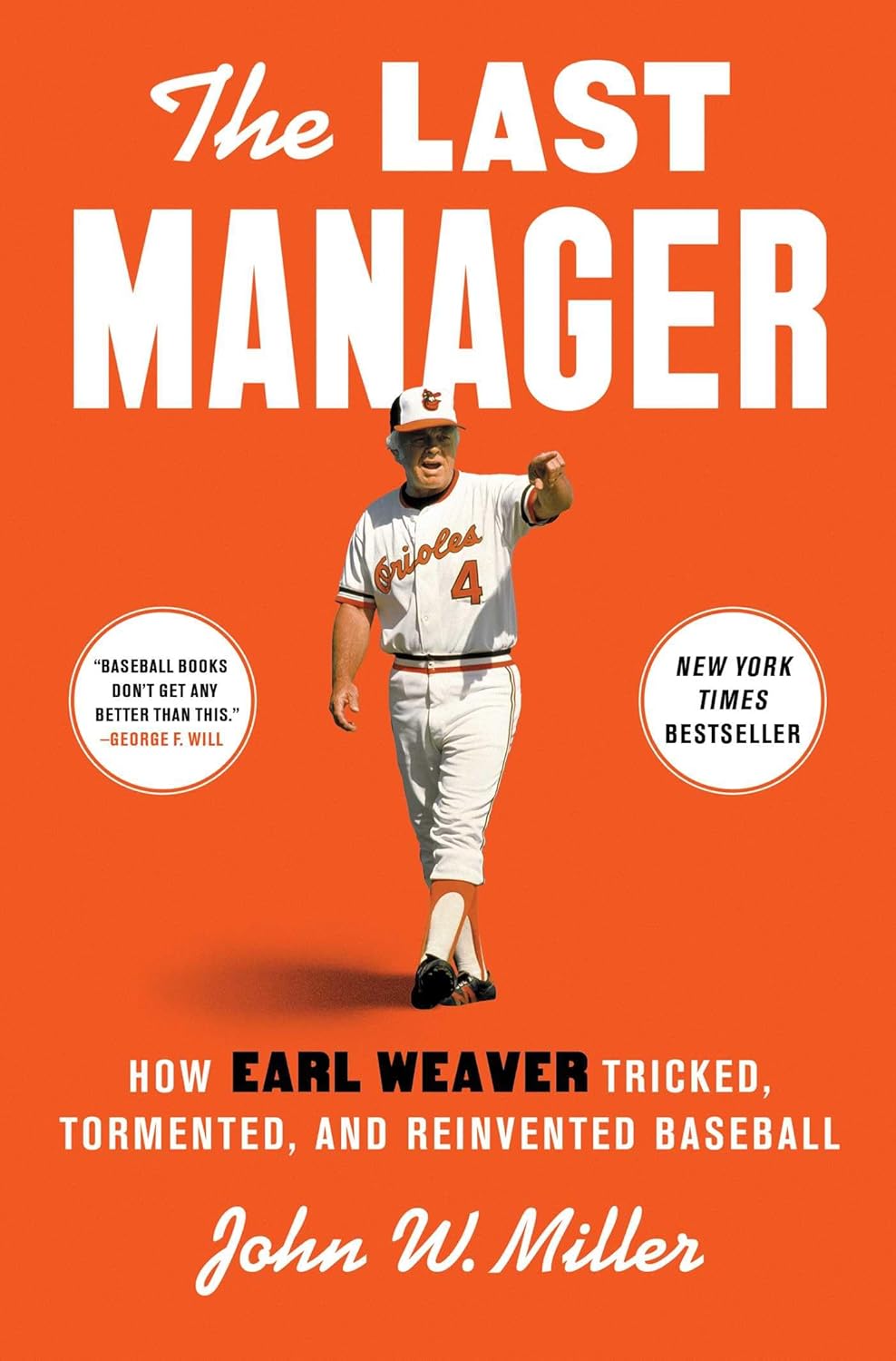
The Last Manager: How Earl Weaver Tricked, Tormented, and Reinvented Baseball
AED19781
Quantity:
Order today to get by 7-14 business days
Delivery fee of AED 20. Free for orders above AED 200.
 Imported From: United States
At BOLO, we work hard to ensure the products you receive are new, genuine, and sourced from reputable suppliers.
Every product in the BOLO catalogue is sourced through our Verified Global Supply Network of verified sellers, authorized distributors or directly from the manufacturer.
Each product undergoes thorough inspection and verification at our consolidation and fulfilment centers to ensure it meets our strict authenticity and quality standards before being shipped and delivered to you.
If you ever have concerns regarding the authenticity of a product purchased from us, please contact Bolo Support. We will review your inquiry promptly and, if necessary, provide documentation verifying authenticity or offer a suitable resolution.
Your trust is our top priority, and we are committed to maintaining transparency and integrity in every transaction.
While we strive to display accurate information, variations in packaging, labeling, instructions, or formulation may occasionally occur due to regional differences or supplier updates. For detailed or manufacturer-specific information, please contact the brand directly or reach out to BOLO Support for assistance.
Unless otherwise stated, all prices displayed on the product page include applicable taxes and import duties.
BOLO operates in accordance with the laws and regulations of United Arab Emirates. Any items found to be restricted or prohibited for sale within the United Arab Emirates will be cancelled prior to shipment. We take proactive measures to ensure that only products permitted for sale in United Arab Emirates are listed on our website.
All items are shipped by air, and any products classified as “Dangerous Goods (DG)” under IATA regulations will be removed from the order and cancelled.
All orders are processed manually, and we make every effort to process them promptly once confirmed. Products cancelled due to the above reasons will be permanently removed from listings across the website.
Similar suggestions by Bolo
More from this brand
Similar items from “Baseball”
Share with
Or share with link
https://www.bolo.ae/products/U1668030926
Visit the Avid Reader Press / Simon & Schuster Store
The Last Manager: How Earl Weaver Tricked, Tormented, and Reinvented Baseball
AED19781
Quantity:
Order today to get by 7-14 business days
Delivery fee of AED 20. Free for orders above AED 200.
Imported From: United States
At BOLO, we work hard to ensure the products you receive are new, genuine, and sourced from reputable suppliers.
Every product in the BOLO catalogue is sourced through our Verified Global Supply Network of verified sellers, authorized distributors or directly from the manufacturer.
Each product undergoes thorough inspection and verification at our consolidation and fulfilment centers to ensure it meets our strict authenticity and quality standards before being shipped and delivered to you.
If you ever have concerns regarding the authenticity of a product purchased from us, please contact Bolo Support. We will review your inquiry promptly and, if necessary, provide documentation verifying authenticity or offer a suitable resolution.
Your trust is our top priority, and we are committed to maintaining transparency and integrity in every transaction.
While we strive to display accurate information, variations in packaging, labeling, instructions, or formulation may occasionally occur due to regional differences or supplier updates. For detailed or manufacturer-specific information, please contact the brand directly or reach out to BOLO Support for assistance.
Unless otherwise stated, all prices displayed on the product page include applicable taxes and import duties.
BOLO operates in accordance with the laws and regulations of United Arab Emirates. Any items found to be restricted or prohibited for sale within the United Arab Emirates will be cancelled prior to shipment. We take proactive measures to ensure that only products permitted for sale in United Arab Emirates are listed on our website.
All items are shipped by air, and any products classified as “Dangerous Goods (DG)” under IATA regulations will be removed from the order and cancelled.
All orders are processed manually, and we make every effort to process them promptly once confirmed. Products cancelled due to the above reasons will be permanently removed from listings across the website.
Description:
Editorial Reviews
Review
“Most sports books are pop flies to the infield. Miller’s is a screaming triple into the left field corner. He takes Weaver seriously; he understands why his tenure mattered to baseball; he is alert to the details of the unruly pageant that was his life; he explains, a bit ruefully, why he was probably the last of his kind, an unkempt dinosaur who ruled before the data geckos came into power.” —Dwight Garner, The New York Times
“Such lively fun . . . Miller’s affection for his subject, a character more colorful than the O’s black-and-orange bird mascot, jumps right off the bat. . . . His research is thorough and his interviews plentiful. . . . Miller captures the flawed man and nearly flawless manager in all his profane genius.”
—Patrick Sauer, The Washington Post
“Showman, scrapper, innovator, champion—this baseball manager did it all. . . . Unlike many of today’s relatively mild, predictable managers, Weaver was a crowd-pleasing ham and a rule-flouting trailblazer. An illuminating, entertaining biography of a mercurial tactician who changed the national pastime.” —Kirkus Reviews (starred review)
“[Miller] covers the notorious side of the Hall of Fame manager, including the hardscrabble St. Louis upbringing that stiffened his spine, while also revealing Weaver’s lesser-known strengths: an uncommon ability to adapt to circumstances, to put every one of his players in the best position to succeed, and to let go of the grudges that so easily form in the heat of a baseball season. A long overdue, humanizing reassessment of a near-mythic baseball figure.” —Booklist (starred review)
“Napoleonic in stature and executive style, funnier than Casey Stengel, more successful than any of his contemporaries in Major League dugouts, and arguably the most consequential manager ever, Earl Weaver has at last been given his due. In this rollicking read, John W. Miller gives us the man in full. Weaver would scream at an offending umpire, ‘Are you going to get any better, or is this it?’ Baseball books don’t get any better than this.” —George F. Will
“The Last Manager is a fantastic biography—with deep reporting, great writing, and one irresistible anecdote after another. John Miller brings to life one of the game’s great characters in all his fiery glory. He also makes a rock-solid case for Earl Weaver as one of baseball’s underrated pioneers. A special book that reminds us why we love baseball.” —Jonathan Eig, Pulitzer Prize–winning author of King: A Life, Ali: A Life, and Luckiest Man: The Life and Death of Lou Gehrig
“Miller expertly shows just how long Earl Weaver’s shadow still is. Weaver was the last of a breed of men, stunning geniuses all—profane, indefatigable, genuine characters—who shaped the golden age of baseball, in striking contrast to the careful, calculating corporate men who try to manage today.” —Ken Burns, Emmy Award–winning documentarian of Baseball
“Earl Weaver was an old school archetype—a heavy drinking, chain smoking, foul mouthed, umpire baiting terror—and a visionary statistical analyst long ahead of his time. John Miller’s fascinating and entertaining portrait shows us how his genius was formed. A great read.” —Ron Shelton, writer and director of Bull Durham
Who Is Earl Weaver?
“Weaver is the grandfather of the modern game. He understood better than anyone in his time the preciousness of the 27 outs (often regarding the sacrifice bunt as a waste of one), the folly of the hit-and-run, the value and symbiosis of pitching and defense, and the importance of batter-pitcher matchups, statistical analysis and on-base percentage. Weaver was the Copernicus of baseball. Just as Copernicus understood heliocentric cosmology a full century before the invention of the telescope, Weaver understood smart baseball a generation before it was empirically demonstrated. . . . Before Moneyball, before Beane, before Bill James—but not quite before Copernicus—Weaver, a white-haired gnome who never played a day of major league baseball, knew what worked. The most recent generation of general managers, armed with their computer printouts and Ivy League–educated assistants, all channel something from the Earl of Baltimore.” —Tom Verducci, Sports Illustrated
“Earl Weaver was a manager for all seasons. Some guys are good when they’re got a winning ball club, but when things start to go bad, they don’t know what to do. Or they’re a good manager with a good ball club, but a bad manager with a bad ball club. Or they look like a pretty good manager, but they’ve never been in a pennant race. Earl had everything. He drank his brains out. But he was a fucking genius.” —Frank Cashen, Baltimore Orioles GM 1971–1975
“I made no bones about it when I first got the job: I always wanted the next Earl Weaver as manager.” —Billy Beane, Oakland A’s GM 1997–2015
“He used everybody. Probably more than any other manager in history, Weaver had carefully defined roles for every player on his roster—not because he cared about the players, but because he cared about the games. It was important to Weaver to have a player matched up in his mind with every possible game situation.” —Bill James
“Weaver will remain most famous for his red-faced, hoarsely screaming set-tos with the umps, which produced hilarious photos, thanks to the size differential, but even here he was an intellectual at heart, having discovered that tipping the bill of his cap to one side would allow him to get an inch or two closer to the arbiter’s jaw, without incurring the automatic ejection of the tiniest physical contact. What Earl wanted, what he battled for and talked about and thought about endlessly, was that edge, the single pitch or particular play or minuscule advantage that could turn an inning or a day or a season his way. Long before Billy Ball, he had his coaches keep multicolored pitching and batting charts that told him which of his batters did well or poorly against each righty or lefty flinger in the league, and where on the field well-hit enemy line drives against one of his starters’ or relievers’ sliders or fastballs would probably land.” —Roger Angell, New Yorker
“Weaver marshaled a scholar’s familiarity with the rule book, a statistician’s data, a psychologist’s motivational skills, and a heckler’s needle into a relentless advocacy for the Orioles.” —Bruce Weber, New York Times
About the Author
Details:
Similar suggestions by Bolo
More from this brand
Similar items from “Baseball”
Share with
Or share with link
https://www.bolo.ae/products/U1668030926