Deliver toUnited Arab Emirates
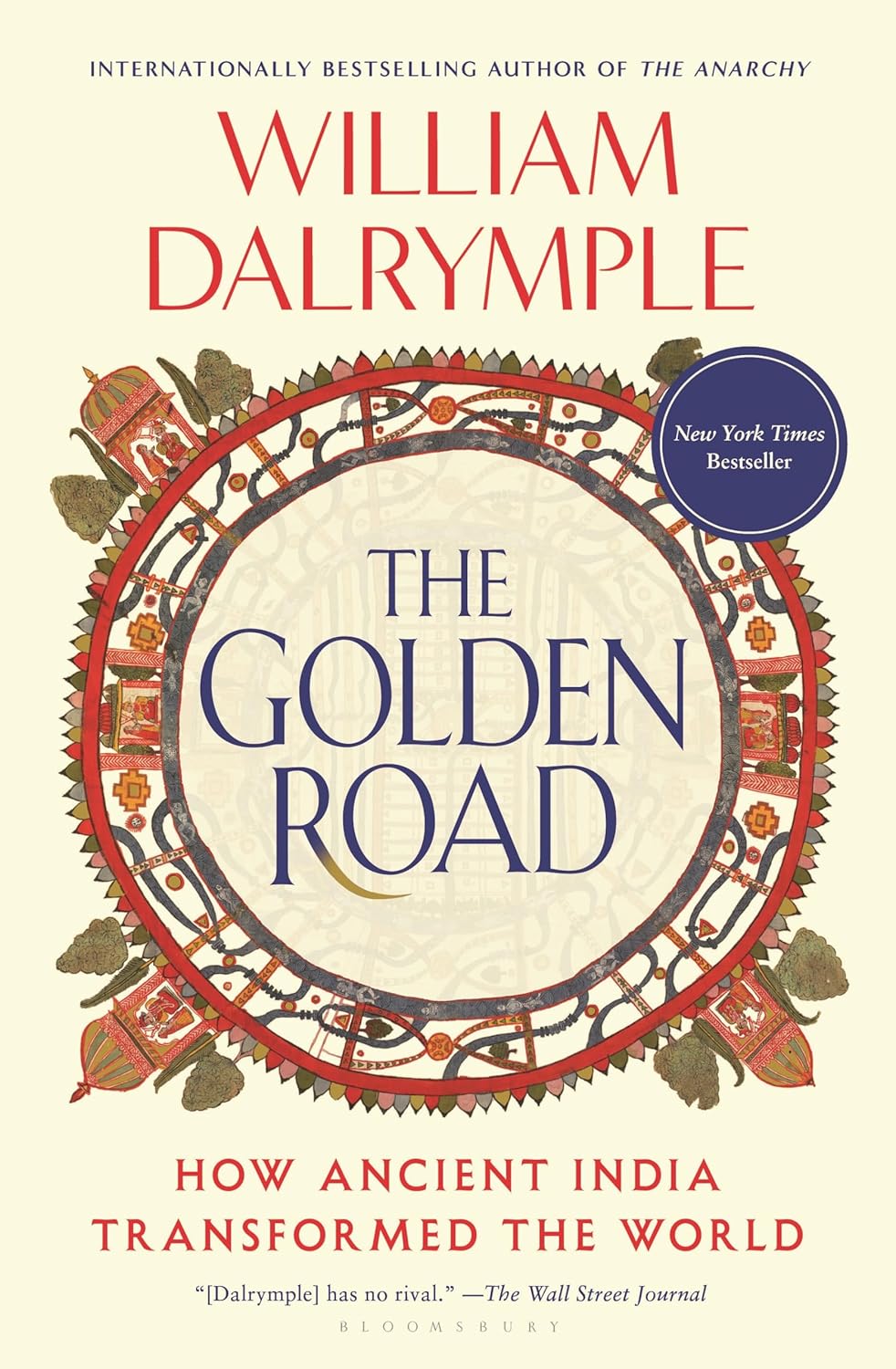
The Golden Road: How Ancient India Transformed the World

Description:

INSTANT NEW YORK TIMES BESTSELLER

USA TODAY BESTSELLER

A
Kirkus Reviews Best History Book of 2025 * A Library Journal Best Book of the Year * An NPR Book We Loved This Year

The instant
New York Times bestseller and international sensation-a sparkling, soaring history of ideas, tracing South Asia's underappreciated role in producing the world as we know it.

For a millennium and a half, India was a confident exporter of its diverse civilization. Indian art, religions, technology, astronomy, music, dance, literature, mathematics, and mythology blazed a trail across the world, along a Golden Road that stretched from the Red Sea to the Pacific.

In
The Golden Road, William Dalrymple gives a name to this spread of Indian ideas that transformed the world, drawing from a lifetime of scholarship to highlight India's oft-forgotten position as the heart of ancient Eurasia. From the largest Hindu temple in the world at Angkor Wat to the Buddhism of China, from the trade that helped fund the Roman Empire to the creation of the numerals we use today, India transformed the culture and technology of its ancient world-and our world today as we know it. And in this magisterial account, Dalrymple restores ancient India as a cultural and economic superpower.


Editorial Reviews

Review

“Dazzling . . . Not just a historical study but also a love letter.” ―Guardian

“[Dalrymple is] one of India's finest popular chroniclers . . . his great achievement is in assembling the disparate fragments of early India's engagements across the continent into a delightfully readable whole.” ―
New York Times

“An outstanding new account . . . The most compelling retelling we have had for generations.” ―
Financial Times

“Audacious . . . Mr. Dalrymple sets out to correct what he believes is a narrative wrong-the playing down of India and Indians in Western accounts of history . . . [he] must get credit for flying the flag of the land that has been lucky enough to become his obsession.” ―Tunku Varadarajan,
Wall Street Journal

“William Dalrymple's
The Golden Road puts ancient and early medieval India at the heart of an empire of ideas, trade, science, religion and culture. In this masterful work, Dalrymple . . . aims to correct "India's often forgotten position" as a cultural and economic superpower that, in his telling, transformed Asia and much of the world.” ―Nishant Dahiya, NPR

“In his masterful new work, . . . historian William Dalrymple argues that India has both the potential and the historical track record to catch up with its former peer to the northeast ...
The Golden Road fills an important gap in our understanding of the intra-Asian relations that predated the arrival of European colonisers.” ―Bloomberg

“Dalrymple's writing is always animated, enlivened by color plates that allow readers to readily envision the sights evoked here. A passionate tribute to the glories-and influence-of ancient India.” ―
Kirkus Reviews

“[A] magisterial and energetic account . . . This first-rate work is a must-read for any history lover.” ―
Publishers Weekly

“A masterpiece of its own, ancient yet thoroughly modern in its themes of globalization, cultural diffusion and soft power, as paradigm-shifting in its Indocentricity as anything I've read in popular history.” ―
LitHub

“This enchanting work of ancient history offers an important backdrop to understanding contemporary India.… The book might be considered a riposte to both right-wing and left-wing historiography in India; right-wing historians make fantastic claims that cloak India's real and substantial achievements, while those on the left prioritize social history in a way that displaces intellectual achievement. Dalrymple finds another India in the past: open to trade, tolerant, scientific, creative, and universalist.” ―
Foreign Affairs

“Historian Dalrymple's comprehensive and meticulously researched examination of ancient India reveals momentous and ubiquitous influences ... When considered holistically, as Dalrymple does so well, it's clear that India's impacts cannot be understated and have shaped the world for thousands of years.” ―
Booklist-starred review

“Yet another instant classic . . . The writing is engaging and narratively cohesive, elucidating Dalrymple's subject as clearly for lay readers as for specialists.” ―
Sarah Wolberg, Library Journal

“Marvelous.” ―
California Review of Books

“A sweeping new assessment of the Subcontinent's star player . . . Dalrymple makes his case through both exemplary scholarship and compelling storytelling. The reader will feel transported through time and space . . . [Dalrymple] challenges us to look at ancient India - and the entire world - in a whole new light.” ―Elizabeth J. Moore,
Washington Independent Review of Books

“Magisterial . . . Dalrymple is an energetic and learned histo­rian of India. In The Golden Road, he draws from siloed compartments of scholarship and synthesizes a new understanding of an age when “Indian culture and civilization trans­formed everything they touched.”” ―
BookPage

“Reading Dalrymple's prose is a lively journey for the modern-day armchair Marco Polo. The big picture is always present, but never at the expense of the adventure.” ―
New York Journal of Books

“An exceptionally interesting and scholarly account by Dalrymple, an acclaimed writer and historian, of one of the great civilizations in humanity's rich history . . . this kind of book, which celebrates historical achievements and cultural contributions, is needed in today's multicultural world.” ―
V. V. Raman, CHOICE

The Golden Road is an important book.” ―Chicago Review of Books

“[A]n extraordinary collection of stories that recount India's often-forgotten yet significant contributions to the ancient world.” ―Meera Kymal,
IndiaCurrents

“For pure prose style, it's hard to find a more pleasurable narrator than Dalrymple. His education in art history and his debuts as a travel writer always show through in his luminous prose.” ―
Asian Review of Books

“[
The Golden Road] doesn't just deliver facts-it weaves them with story, evidence, and deep research . . . Revelatory . . . This isn't revisionist history-it's a distinguished recovery. And Dalrymple delivers it with intellectual rigor and lyrical elegance.” ―Monita Soni, American Kahani

“Masterly.” ―
The American Conservative

“The Scottish popular historian William Dalrymple has written an informative and lively book-
The Golden Road, published earlier this year-on how India exported its culture eastward for a thousand years up to around 1200 A.D. That's how we got Angkor Wat, for instance, and Borobudur.” ―Tunku Varadarajan, Washington Free Beacon

The Golden Road is a magnificent achievement. It is informative, stunningly comprehensive, and its stories are lavishly and compelling told. It should help us recognize India in places where we could not before.” ―The Post and Courier

“This major work puts India at history's centre . . . With colourful storytelling and dramatic arcs, the eminent scholar follows the spread of the subcontinent's ideas - cosmology, architecture, Hinduism, Buddhism - to assert Indian civilization's outward influence.” ―
The Globe & Mail

About the Author

William Dalrymple is one of Britain's great historians and the bestselling author of The Golden Road, the Wolfson Prize-winning White Mughals, The Last Mughal, which won the Duff Cooper Prize, the Hemingway and Kapuscinski Prize-winning Return of a King, and The Anarchy, a finalist for the Cundill History Prize and one of Barack Obama's favorite books of 2019. A frequent broadcaster, he has written and presented three television series, one of which won the Grierson Award for Best Documentary Series at BAFTA. He has also won the Thomas Cook Travel Book Award, the Sunday Times Young British Writer of the Year Award, the Foreign Correspondent of the Year at the FPA Media Awards, and been awarded five honorary doctorates. He is a fellow of the Royal Society of Literature, the Royal Asiatic Society and the Royal Society of Edinburgh, and has held visiting fellowships at Princeton, Brown and All Souls, University of Oxford. He writes regularly for the New York Review of Books, the New Yorker and the Guardian. In 2018 he was presented with the prestigious President's Medal by the British Academy for his outstanding literary achievement and for co-founding the Jaipur Literature Festival. He is the co-host of chart-topping podcast Empire with Anita Anand. William lives with his wife and three children on a goat farm outside Delhi.

Reviews:

5.0 out of 5 stars This book is an incredibly detailed history of the influence of India in the Euro-Asian world

D.D. · January 7, 2026

This book is an incredibly detailed history of the influence of India, essentially as a cultural and economic center, of the passage of intellectual and engineering achievements with associated material goods, created within the engines of each edge, of flowing back and forth between the geographical and cultural boundaries of europe and Eastern asia to the reaches of Japan. It's thorough referencing is overwhelmingly impressive. It is a scholar's book, but in many parts quite readable as it extracts from many sources the day-to-day picture of the evolutions of critical events over many centuries. For example, note the story of the time of the arising of the first female emperor of China. Such a personally human story of people captured in the restricted binding in and of their time and place. Revealed are the connections and confluences of the Roman Empire ( more broadly Europe), China with the infusion of the cultures, religions and intellectual achievements into the birth of the nations of IndoChina from their constituent, isolated geographically separated entities .

5.0 out of 5 stars Well-Researched NF Non-Western History, going way back into ancient times. Highly Recommended!

C.i.p. · September 27, 2025

I'm still reading it. It is a really good, well-researched, intelligently-written work of Historical NF, Non-Western History, which due to its extensive research, and (apparent) fact-checking, reads like a first-rate historical novel. Since I've much interest in India's long past, into Ancient times, this book is one I'll likely never get rid of, and will read it multiple times.Just its Introduction already cought my attention, and taught me a great deal, already. I look forward to reading it, to the end.It contains Maps, routes, and extensive information and historical Cross-referencing with other contemporary Civilizations.I've forwarded it, with a recommendation, to my Sanskrit Teacher, who also has much interest in Ancient India.When I began reading, I became somewhat confused, wondering if I'd bought the right book, but that's because the author gives us an ancient beginnings historical overview, and devotes several paragraphs (a couple of pages), to Buddhism. Since I know many Indians are Hindus, I was initially confused. Reading on, I realized the extent of the Author's Scholarship.This book is NOT for someone just looking for photographic "light-reading;" it is dense, and very much what I like to read.

4.0 out of 5 stars Plenty of Information on an underserved place and time

N.&.G. · May 30, 2025

299 pages of text and maps; 48 pages of color and B&W plates; 62 pages of endnotes; 34 page Bibliography; 2 page Glossary; 2 page "Acknowledgements;" and a ribbon bookmark. The book addresses the contributions to world history of India over roughly the 1st Millennium BCE and 1st Millennium CE. It focuses on trade networks; the origin and spread of Buddhism; the spread of Hinduism; cultural, artistic, and architectural interactions with China, Southeast Asia, the Moslem world, and, to a lesser extent, Rome and the Western World; and its contributions to scientific and mathematical understanding, particularly with regard to the development of "zero" as a mathematical symbol. The book is very well written, but suffers from the need to compartmentalize its numerous topics. There is extensive treatment of the spread of Buddhism to China, but that topic has to be treated apart from the discussion of trade with Rome or the discussion of Southeast Asian architecture. As a result, the book isn't a continuous flow, but, rather, a compilation of topics. I found the book's use of endnotes to be particularly frustrating. Endnotes are great for citations. They enable a reader to go back and either further pursue a topic or check the basis for statements. However, they are terrible when amplifying or clarifying text. The reader must stop the read, flip to the back of the book, find the note, read it, and then locate where he/she is in the text and resume reading. Footnotes merely require looking at the bottom of the page. This book makes extensive use of endnotes for clarification and amplification, greatly chopping up the read. There are a couple of footnotes and I have no idea why they were selected for this treatment as opposed to the many other notes relegated to the back of the book. I highly recommend the book, but be prepared for the division of topics and the use of endnotes.

5.0 out of 5 stars History with some real surprises!

S. · January 13, 2026

What an achievement! Dalrymple writes history with prose worthy of a novel. While the stated argument of this book is that the trade routes between Rome and India were vastly more important than the Silk Road, this book does so much more. It gives a detailed account of the movement of Buddhism into Southeast Asia and China and a similarly detailed account of how Western numerals and mathematics came to Europe from India through Arab culture in the 10th century. It makes it clear that the most important culture in the ancient world was India’s. It also illustrates how trade historically is a much better facilitator of prosperity and the export of culture than military conquest. As a work of history it is a fine complement to A. L. Basham’s Wonder That Was India which ends with the advent of the Mogul emperors. We read it at night as we prepare for sleep and often reread noteworthy sentences.

The Golden Road: How Ancient India Transformed the World by William Dalrymple

T.M. · March 8, 2025

William Dalrymple’s The Golden Road is a masterful exploration of India’s profound and far-reaching influence on the world over a millennium and a half. This book is a testament to Dalrymple’s lifelong scholarship and his ability to weave together history, culture, and storytelling into a compelling narrative. It’s a must-read for anyone interested in understanding how ancient India shaped the world we live in today.A Vast Empire of IdeasDalrymple meticulously details how India, for over 1,500 years, was not just a cultural powerhouse but also a confident exporter of its civilisation. From art and religion to technology and mathematics, Indian ideas traveled far and wide along what Dalrymple aptly terms the “Golden Road” – a network of trade and cultural exchange that stretched from the Red Sea to the Pacific.The book highlights India’s contributions to global civilisation, such as the creation of the numeral system (including the revolutionary concept of zero), the spread of Buddhism across Asia, and the architectural marvels like Angkor Wat, the largest Hindu temple in the world. Dalrymple also delves into lesser-known but equally significant influences, such as Indian astronomy, music, dance, and mythology, which left an indelible mark on the ancient world.A Global Perspective on India’s LegacyWhat sets The Golden Road apart is its global perspective. Dalrymple doesn’t just focus on India in isolation; he situates it at the heart of ancient Eurasia, showing how Indian ideas interacted with and transformed other cultures. For instance, he explores how Indian trade helped fund the Roman Empire and how Indian religious and philosophical ideas shaped the spiritual landscape of China and Southeast Asia.Dalrymple’s writing is both scholarly and accessible, making complex historical processes easy to understand. His vivid descriptions and engaging storytelling bring the past to life, making the reader feel as though they are traveling along the Golden Road themselves.A Few Practical ConsiderationsWhile the content of the book is exceptional, I did find myself returning the hardback edition in favor of the Kindle version, which was £10 cheaper, and the paperback, which was £12 cheaper. For a book of this length and depth, the digital or paperback formats are more practical and economical, especially for readers who prefer a more portable option.Final ThoughtsThe Golden Road is a brilliant and enlightening read that sheds light on India’s often-overlooked role as a global influencer in ancient times. William Dalrymple’s passion for the subject shines through on every page, and his ability to connect the dots between India’s past and the modern world is nothing short of remarkable.Whether you’re a history enthusiast, a lover of Indian culture, or simply curious about how ancient civilisations shaped our world, this book is an invaluable addition to your library. Just be sure to opt for the Kindle or paperback edition to save a few pounds without compromising on the richness of the content. Highly recommended!

E

A.C. · November 24, 2025

Excelente!!

Good reading.

V.&.V. · November 4, 2025

A very interesting book, well thought out and well written.

Magnificent!

D.W.M. · August 26, 2025

Before I comment on this magisterial work, a protest to the publisher: I cannot imagine a worse binding for this book. The exterior is heavy card stock—and even with an embossed finish, feels cheep—hardly fitting for a book titled The Golden Road! The binding is so tight that it is almost impossible not to break as you seek to open the pages to read this magnificent work and review the carefully chosen images (three sections worth). It reeks of cost cutting and is simply a disgrace by the publisher. Dalrymple deserves better. Shame on you Bloomsbury.Now to the book:The content and writing is simply magnificent. Dalrymple truly has a profound capacity to communicate in writing (and orally, as in his podcast with Anita Anand, “Empire”). The Golden Road reads like a coffee time discussion and, at times, like a novel. History has rarely been so engaging and enjoyable!I recognize my praise is effusive. But Dalrymple is truly a master. I learned so much from each and every chapter: How Octavian’s victory over Marc Antony and Cleopatra opened the door for profound trade between India and Rome—so much trade that some Roman leaders became concerned at the scope of the wealth making its way to India. How Indian concepts like “zero” profoundly influenced western thought and philosophy. How the “Indosphere” emerged initially at sea, following monsoon winds to the west (Africa) and east (SE Asia and China); then, how it expanded across land under the reign of Ashoka in the fourth century BCE. How the great library of Nalanda rivaled Alexandria in terms of both size and influence. How Buddhism, born and developed in the subcontinent became dominant across Central Asia and especially China, transforming a whole society while back in the subcontinent it diminished under the growing influence of Hinduism. How Hinduism amazingly spread to SE Asia at the same time Islam swept across Asia into the subcontinent, and led to the world wonder Hindu temple, Angkor Wat, in what was, and is now, a predominantly Buddhist society.There are so many gems in this work! Ultimately, the invitation is to rediscover India and her rich history—to stop overlooking the profound role India played (plays!) in this world. I couldn’t recommend The Golden Road any more highly.

Dalrymple at his best

B.S. · October 18, 2024

This book is yet another classical tome from William Dalrymple. In his inimitable style, with depth of knowledge, gripping narration and a unique ability to hold us glued to the book with magnetic charm, he takes us on a voyage to distant lands, once dominated by Indian culture and commerce.The book sets out to dispel the myth of the celebrated ‘Silk Road’. The road that was at best a figment of imagination, and even a piece of propaganda for proving Chinese superiority and thereby advancing its foreign policy was first invented as late as 1877, by a Prussian geographer, Baron Von Richthofen, says the author. Not a single ancient record, either Chinese or western, refers to its existence, and was completely unknown in ancient and medieval times. Richthofen was charged with dreaming up a route for a railway linking Berlin with Beijing with a view to establishing German colonies and infrastructure projects in the region. That the real route that was paved not in silk, but literally in gold, lay not in the rugged lands in the interior, but in the waters of the Indian Ocean, with India as the anchor, connecting Red Sea in the West to China in the East, is the fascinating story that unfolds in the rest of the book.‘The Golden Road aims to highlight India’s often forgotten position as a crucial economic fulcrum, and civilisational engine, at the heart of the ancient and early medieval worlds and as one of the main motors of global trade and cultural transmission in early world history, fully on par with and equal to China’ (page 8) is an apt summary of this book.There are three main factors that were significant to make this happen. The perfect predictability and seasonality of the monsoons in the Indian Ocean helped ships to sail effortlessly from India to the East and West. This created a strong ship building industry and expertise, that enabled commerce that was several times faster, cheaper and safer than inland trade. Spices like pepper was the most sought-after commodity in the Roman Empire, which was happily paid in gold. The decline of the Roman empire led to Indians looking eastward, particularly to ‘Suvarnabhumi’, countries comprising Thailand, Java, Sumatra, Cambodia and China. The evidence of such trade worth in billions of dollars in current value, is amply demonstrated from the rich archaeological evidence as unearthed from a string of locations on the entire route.The main thrust to the cultural integration of these regions, under Indian influence begins with the advent of Buddhism in the 6 the century BCE, and thereafter the efforts of emperor Ashoka in the third century CE, to send missionaries to distant lands and spread the message of the Buddha.Buddhism appeared as a middle path between Hinduism and Jainism, the way of moderation between the extremes of self-torture and self-indulgence, between worldliness and asceticism. While Buddhism occupies center stage in the spread of Indian thought, through establishment of monasteries and royal patronage, Hinduism once again emerges as a dominant faith in the later part of the book, since 7 CE.The travels and detailed biography of the Chinese monk Xuanzang from 629 CE, to the greatest Buddhist monastery and university of Nalanda is perhaps the pinnacle of this book, which acts as a foundation of Buddhist influence on China and a historian’s delight.The book also covers the role of South Indian kings, notably from the era of Mahendra Varman Pallava (571 to 630 CE), the port city of Mamallapuram, the historic sites at Kanchipuram and the resurgence of puranic Hinduism led by poet saint Appar and the rich Tamil literature.It all started when a British hunting party led by Captain Smith accidentally discovered the Ajanta caves, while following the pug marks of an elusive tiger. The mesmerizing find was a priceless jewel in the annals of Indian history. The young officer got out his hunting knife and inscribed the words: ‘JOHN SMITH, 28 CAVALRY, 28 APRIL 1819’. Dalrymple takes over from Capt Smith !Unputdownable, Dalrymple at his best.

The Golden Road: How Ancient India Transformed the World

Product ID: U163973841K
Condition: New

4.6

(1,673 ratings)

AED12718

Price includes VAT & Import Duties
Type: Paperback
Availability: In Stock

Quantity:

|

Order today to get by 7-14 business days

Delivery fee of AED 20. Free for orders above AED 200.

Returns & Warranty policies

Imported From: United States

At BOLO, we work hard to ensure the products you receive are new, genuine, and sourced from reputable suppliers.

BOLO is not an authorized or official retailer for most brands, nor are we affiliated with manufacturers unless specifically stated on a product page. Instead, we source verified sellers, authorized distributors or directly from the manufacturer.

Each product undergoes thorough inspection and verification at our consolidation and fulfilment centers to ensure it meets our strict authenticity and quality standards before being shipped and delivered to you.

If you ever have concerns regarding the authenticity of a product purchased from us, please contact Bolo Support. We will review your inquiry promptly and, if necessary, provide documentation verifying authenticity or offer a suitable resolution.

Your trust is our top priority, and we are committed to maintaining transparency and integrity in every transaction.

All product information, images, descriptions, and reviews originate from the manufacturer or from trusted sellers overseas. BOLO is not affiliated with, endorsed by, or an authorized retailer for most brands listed on our website unless stated otherwise.

While we strive to display accurate information, variations in packaging, labeling, instructions, or formulation may occasionally occur due to regional differences or supplier updates. For detailed or manufacturer-specific information, please contact the brand directly or reach out to BOLO Support for assistance.

Unless otherwise stated, all prices displayed on the product page include applicable taxes and import duties.

BOLO operates in accordance with the laws and regulations of United Arab Emirates. Any items found to be restricted or prohibited for sale within the UAE will be cancelled prior to shipment. We take proactive measures to ensure that only products permitted for sale in United Arab Emirates are listed on our website.

All items are shipped by air, and any products classified as “Dangerous Goods (DG)” under IATA regulations will be removed from the order and cancelled.

All orders are processed manually, and we make every effort to process them promptly once confirmed. Products cancelled due to the above reasons will be permanently removed from listings across the website.

More from this brand

Similar items from “China”

The Golden Road: How Ancient India Transformed the World

Product ID: U163973841K
Condition: New

4.6

(1,673 ratings)
The Golden Road: How Ancient India Transformed the World-0
Type: Paperback

AED12718

Price includes VAT & Import Duties
Availability: In Stock

Quantity:

|

Order today to get by 7-14 business days

Delivery fee of AED 20. Free for orders above AED 200.

Returns & Warranty policies

Imported From: United States

At BOLO, we work hard to ensure the products you receive are new, genuine, and sourced from reputable suppliers.

BOLO is not an authorized or official retailer for most brands, nor are we affiliated with manufacturers unless specifically stated on a product page. Instead, we source verified sellers, authorized distributors or directly from the manufacturer.

Each product undergoes thorough inspection and verification at our consolidation and fulfilment centers to ensure it meets our strict authenticity and quality standards before being shipped and delivered to you.

If you ever have concerns regarding the authenticity of a product purchased from us, please contact Bolo Support. We will review your inquiry promptly and, if necessary, provide documentation verifying authenticity or offer a suitable resolution.

Your trust is our top priority, and we are committed to maintaining transparency and integrity in every transaction.

All product information, images, descriptions, and reviews originate from the manufacturer or from trusted sellers overseas. BOLO is not affiliated with, endorsed by, or an authorized retailer for most brands listed on our website unless stated otherwise.

While we strive to display accurate information, variations in packaging, labeling, instructions, or formulation may occasionally occur due to regional differences or supplier updates. For detailed or manufacturer-specific information, please contact the brand directly or reach out to BOLO Support for assistance.

Unless otherwise stated, all prices displayed on the product page include applicable taxes and import duties.

BOLO operates in accordance with the laws and regulations of United Arab Emirates. Any items found to be restricted or prohibited for sale within the UAE will be cancelled prior to shipment. We take proactive measures to ensure that only products permitted for sale in United Arab Emirates are listed on our website.

All items are shipped by air, and any products classified as “Dangerous Goods (DG)” under IATA regulations will be removed from the order and cancelled.

All orders are processed manually, and we make every effort to process them promptly once confirmed. Products cancelled due to the above reasons will be permanently removed from listings across the website.

Description:

INSTANT NEW YORK TIMES BESTSELLER

USA TODAY BESTSELLER

A
Kirkus Reviews Best History Book of 2025 * A Library Journal Best Book of the Year * An NPR Book We Loved This Year

The instant
New York Times bestseller and international sensation-a sparkling, soaring history of ideas, tracing South Asia's underappreciated role in producing the world as we know it.

For a millennium and a half, India was a confident exporter of its diverse civilization. Indian art, religions, technology, astronomy, music, dance, literature, mathematics, and mythology blazed a trail across the world, along a Golden Road that stretched from the Red Sea to the Pacific.

In
The Golden Road, William Dalrymple gives a name to this spread of Indian ideas that transformed the world, drawing from a lifetime of scholarship to highlight India's oft-forgotten position as the heart of ancient Eurasia. From the largest Hindu temple in the world at Angkor Wat to the Buddhism of China, from the trade that helped fund the Roman Empire to the creation of the numerals we use today, India transformed the culture and technology of its ancient world-and our world today as we know it. And in this magisterial account, Dalrymple restores ancient India as a cultural and economic superpower.


Editorial Reviews

Review

“Dazzling . . . Not just a historical study but also a love letter.” ―Guardian

“[Dalrymple is] one of India's finest popular chroniclers . . . his great achievement is in assembling the disparate fragments of early India's engagements across the continent into a delightfully readable whole.” ―
New York Times

“An outstanding new account . . . The most compelling retelling we have had for generations.” ―
Financial Times

“Audacious . . . Mr. Dalrymple sets out to correct what he believes is a narrative wrong-the playing down of India and Indians in Western accounts of history . . . [he] must get credit for flying the flag of the land that has been lucky enough to become his obsession.” ―Tunku Varadarajan,
Wall Street Journal

“William Dalrymple's
The Golden Road puts ancient and early medieval India at the heart of an empire of ideas, trade, science, religion and culture. In this masterful work, Dalrymple . . . aims to correct "India's often forgotten position" as a cultural and economic superpower that, in his telling, transformed Asia and much of the world.” ―Nishant Dahiya, NPR

“In his masterful new work, . . . historian William Dalrymple argues that India has both the potential and the historical track record to catch up with its former peer to the northeast ...
The Golden Road fills an important gap in our understanding of the intra-Asian relations that predated the arrival of European colonisers.” ―Bloomberg

“Dalrymple's writing is always animated, enlivened by color plates that allow readers to readily envision the sights evoked here. A passionate tribute to the glories-and influence-of ancient India.” ―
Kirkus Reviews

“[A] magisterial and energetic account . . . This first-rate work is a must-read for any history lover.” ―
Publishers Weekly

“A masterpiece of its own, ancient yet thoroughly modern in its themes of globalization, cultural diffusion and soft power, as paradigm-shifting in its Indocentricity as anything I've read in popular history.” ―
LitHub

“This enchanting work of ancient history offers an important backdrop to understanding contemporary India.… The book might be considered a riposte to both right-wing and left-wing historiography in India; right-wing historians make fantastic claims that cloak India's real and substantial achievements, while those on the left prioritize social history in a way that displaces intellectual achievement. Dalrymple finds another India in the past: open to trade, tolerant, scientific, creative, and universalist.” ―
Foreign Affairs

“Historian Dalrymple's comprehensive and meticulously researched examination of ancient India reveals momentous and ubiquitous influences ... When considered holistically, as Dalrymple does so well, it's clear that India's impacts cannot be understated and have shaped the world for thousands of years.” ―
Booklist-starred review

“Yet another instant classic . . . The writing is engaging and narratively cohesive, elucidating Dalrymple's subject as clearly for lay readers as for specialists.” ―
Sarah Wolberg, Library Journal

“Marvelous.” ―
California Review of Books

“A sweeping new assessment of the Subcontinent's star player . . . Dalrymple makes his case through both exemplary scholarship and compelling storytelling. The reader will feel transported through time and space . . . [Dalrymple] challenges us to look at ancient India - and the entire world - in a whole new light.” ―Elizabeth J. Moore,
Washington Independent Review of Books

“Magisterial . . . Dalrymple is an energetic and learned histo­rian of India. In The Golden Road, he draws from siloed compartments of scholarship and synthesizes a new understanding of an age when “Indian culture and civilization trans­formed everything they touched.”” ―
BookPage

“Reading Dalrymple's prose is a lively journey for the modern-day armchair Marco Polo. The big picture is always present, but never at the expense of the adventure.” ―
New York Journal of Books

“An exceptionally interesting and scholarly account by Dalrymple, an acclaimed writer and historian, of one of the great civilizations in humanity's rich history . . . this kind of book, which celebrates historical achievements and cultural contributions, is needed in today's multicultural world.” ―
V. V. Raman, CHOICE

The Golden Road is an important book.” ―Chicago Review of Books

“[A]n extraordinary collection of stories that recount India's often-forgotten yet significant contributions to the ancient world.” ―Meera Kymal,
IndiaCurrents

“For pure prose style, it's hard to find a more pleasurable narrator than Dalrymple. His education in art history and his debuts as a travel writer always show through in his luminous prose.” ―
Asian Review of Books

“[
The Golden Road] doesn't just deliver facts-it weaves them with story, evidence, and deep research . . . Revelatory . . . This isn't revisionist history-it's a distinguished recovery. And Dalrymple delivers it with intellectual rigor and lyrical elegance.” ―Monita Soni, American Kahani

“Masterly.” ―
The American Conservative

“The Scottish popular historian William Dalrymple has written an informative and lively book-
The Golden Road, published earlier this year-on how India exported its culture eastward for a thousand years up to around 1200 A.D. That's how we got Angkor Wat, for instance, and Borobudur.” ―Tunku Varadarajan, Washington Free Beacon

The Golden Road is a magnificent achievement. It is informative, stunningly comprehensive, and its stories are lavishly and compelling told. It should help us recognize India in places where we could not before.” ―The Post and Courier

“This major work puts India at history's centre . . . With colourful storytelling and dramatic arcs, the eminent scholar follows the spread of the subcontinent's ideas - cosmology, architecture, Hinduism, Buddhism - to assert Indian civilization's outward influence.” ―
The Globe & Mail

About the Author

William Dalrymple is one of Britain's great historians and the bestselling author of The Golden Road, the Wolfson Prize-winning White Mughals, The Last Mughal, which won the Duff Cooper Prize, the Hemingway and Kapuscinski Prize-winning Return of a King, and The Anarchy, a finalist for the Cundill History Prize and one of Barack Obama's favorite books of 2019. A frequent broadcaster, he has written and presented three television series, one of which won the Grierson Award for Best Documentary Series at BAFTA. He has also won the Thomas Cook Travel Book Award, the Sunday Times Young British Writer of the Year Award, the Foreign Correspondent of the Year at the FPA Media Awards, and been awarded five honorary doctorates. He is a fellow of the Royal Society of Literature, the Royal Asiatic Society and the Royal Society of Edinburgh, and has held visiting fellowships at Princeton, Brown and All Souls, University of Oxford. He writes regularly for the New York Review of Books, the New Yorker and the Guardian. In 2018 he was presented with the prestigious President's Medal by the British Academy for his outstanding literary achievement and for co-founding the Jaipur Literature Festival. He is the co-host of chart-topping podcast Empire with Anita Anand. William lives with his wife and three children on a goat farm outside Delhi.

Reviews:

5.0 out of 5 stars This book is an incredibly detailed history of the influence of India in the Euro-Asian world

D.D. · January 7, 2026

This book is an incredibly detailed history of the influence of India, essentially as a cultural and economic center, of the passage of intellectual and engineering achievements with associated material goods, created within the engines of each edge, of flowing back and forth between the geographical and cultural boundaries of europe and Eastern asia to the reaches of Japan. It's thorough referencing is overwhelmingly impressive. It is a scholar's book, but in many parts quite readable as it extracts from many sources the day-to-day picture of the evolutions of critical events over many centuries. For example, note the story of the time of the arising of the first female emperor of China. Such a personally human story of people captured in the restricted binding in and of their time and place. Revealed are the connections and confluences of the Roman Empire ( more broadly Europe), China with the infusion of the cultures, religions and intellectual achievements into the birth of the nations of IndoChina from their constituent, isolated geographically separated entities .

5.0 out of 5 stars Well-Researched NF Non-Western History, going way back into ancient times. Highly Recommended!

C.i.p. · September 27, 2025

I'm still reading it. It is a really good, well-researched, intelligently-written work of Historical NF, Non-Western History, which due to its extensive research, and (apparent) fact-checking, reads like a first-rate historical novel. Since I've much interest in India's long past, into Ancient times, this book is one I'll likely never get rid of, and will read it multiple times.Just its Introduction already cought my attention, and taught me a great deal, already. I look forward to reading it, to the end.It contains Maps, routes, and extensive information and historical Cross-referencing with other contemporary Civilizations.I've forwarded it, with a recommendation, to my Sanskrit Teacher, who also has much interest in Ancient India.When I began reading, I became somewhat confused, wondering if I'd bought the right book, but that's because the author gives us an ancient beginnings historical overview, and devotes several paragraphs (a couple of pages), to Buddhism. Since I know many Indians are Hindus, I was initially confused. Reading on, I realized the extent of the Author's Scholarship.This book is NOT for someone just looking for photographic "light-reading;" it is dense, and very much what I like to read.

4.0 out of 5 stars Plenty of Information on an underserved place and time

N.&.G. · May 30, 2025

299 pages of text and maps; 48 pages of color and B&W plates; 62 pages of endnotes; 34 page Bibliography; 2 page Glossary; 2 page "Acknowledgements;" and a ribbon bookmark. The book addresses the contributions to world history of India over roughly the 1st Millennium BCE and 1st Millennium CE. It focuses on trade networks; the origin and spread of Buddhism; the spread of Hinduism; cultural, artistic, and architectural interactions with China, Southeast Asia, the Moslem world, and, to a lesser extent, Rome and the Western World; and its contributions to scientific and mathematical understanding, particularly with regard to the development of "zero" as a mathematical symbol. The book is very well written, but suffers from the need to compartmentalize its numerous topics. There is extensive treatment of the spread of Buddhism to China, but that topic has to be treated apart from the discussion of trade with Rome or the discussion of Southeast Asian architecture. As a result, the book isn't a continuous flow, but, rather, a compilation of topics. I found the book's use of endnotes to be particularly frustrating. Endnotes are great for citations. They enable a reader to go back and either further pursue a topic or check the basis for statements. However, they are terrible when amplifying or clarifying text. The reader must stop the read, flip to the back of the book, find the note, read it, and then locate where he/she is in the text and resume reading. Footnotes merely require looking at the bottom of the page. This book makes extensive use of endnotes for clarification and amplification, greatly chopping up the read. There are a couple of footnotes and I have no idea why they were selected for this treatment as opposed to the many other notes relegated to the back of the book. I highly recommend the book, but be prepared for the division of topics and the use of endnotes.

5.0 out of 5 stars History with some real surprises!

S. · January 13, 2026

What an achievement! Dalrymple writes history with prose worthy of a novel. While the stated argument of this book is that the trade routes between Rome and India were vastly more important than the Silk Road, this book does so much more. It gives a detailed account of the movement of Buddhism into Southeast Asia and China and a similarly detailed account of how Western numerals and mathematics came to Europe from India through Arab culture in the 10th century. It makes it clear that the most important culture in the ancient world was India’s. It also illustrates how trade historically is a much better facilitator of prosperity and the export of culture than military conquest. As a work of history it is a fine complement to A. L. Basham’s Wonder That Was India which ends with the advent of the Mogul emperors. We read it at night as we prepare for sleep and often reread noteworthy sentences.

The Golden Road: How Ancient India Transformed the World by William Dalrymple

T.M. · March 8, 2025

William Dalrymple’s The Golden Road is a masterful exploration of India’s profound and far-reaching influence on the world over a millennium and a half. This book is a testament to Dalrymple’s lifelong scholarship and his ability to weave together history, culture, and storytelling into a compelling narrative. It’s a must-read for anyone interested in understanding how ancient India shaped the world we live in today.A Vast Empire of IdeasDalrymple meticulously details how India, for over 1,500 years, was not just a cultural powerhouse but also a confident exporter of its civilisation. From art and religion to technology and mathematics, Indian ideas traveled far and wide along what Dalrymple aptly terms the “Golden Road” – a network of trade and cultural exchange that stretched from the Red Sea to the Pacific.The book highlights India’s contributions to global civilisation, such as the creation of the numeral system (including the revolutionary concept of zero), the spread of Buddhism across Asia, and the architectural marvels like Angkor Wat, the largest Hindu temple in the world. Dalrymple also delves into lesser-known but equally significant influences, such as Indian astronomy, music, dance, and mythology, which left an indelible mark on the ancient world.A Global Perspective on India’s LegacyWhat sets The Golden Road apart is its global perspective. Dalrymple doesn’t just focus on India in isolation; he situates it at the heart of ancient Eurasia, showing how Indian ideas interacted with and transformed other cultures. For instance, he explores how Indian trade helped fund the Roman Empire and how Indian religious and philosophical ideas shaped the spiritual landscape of China and Southeast Asia.Dalrymple’s writing is both scholarly and accessible, making complex historical processes easy to understand. His vivid descriptions and engaging storytelling bring the past to life, making the reader feel as though they are traveling along the Golden Road themselves.A Few Practical ConsiderationsWhile the content of the book is exceptional, I did find myself returning the hardback edition in favor of the Kindle version, which was £10 cheaper, and the paperback, which was £12 cheaper. For a book of this length and depth, the digital or paperback formats are more practical and economical, especially for readers who prefer a more portable option.Final ThoughtsThe Golden Road is a brilliant and enlightening read that sheds light on India’s often-overlooked role as a global influencer in ancient times. William Dalrymple’s passion for the subject shines through on every page, and his ability to connect the dots between India’s past and the modern world is nothing short of remarkable.Whether you’re a history enthusiast, a lover of Indian culture, or simply curious about how ancient civilisations shaped our world, this book is an invaluable addition to your library. Just be sure to opt for the Kindle or paperback edition to save a few pounds without compromising on the richness of the content. Highly recommended!

E

A.C. · November 24, 2025

Excelente!!

Good reading.

V.&.V. · November 4, 2025

A very interesting book, well thought out and well written.

Magnificent!

D.W.M. · August 26, 2025

Before I comment on this magisterial work, a protest to the publisher: I cannot imagine a worse binding for this book. The exterior is heavy card stock—and even with an embossed finish, feels cheep—hardly fitting for a book titled The Golden Road! The binding is so tight that it is almost impossible not to break as you seek to open the pages to read this magnificent work and review the carefully chosen images (three sections worth). It reeks of cost cutting and is simply a disgrace by the publisher. Dalrymple deserves better. Shame on you Bloomsbury.Now to the book:The content and writing is simply magnificent. Dalrymple truly has a profound capacity to communicate in writing (and orally, as in his podcast with Anita Anand, “Empire”). The Golden Road reads like a coffee time discussion and, at times, like a novel. History has rarely been so engaging and enjoyable!I recognize my praise is effusive. But Dalrymple is truly a master. I learned so much from each and every chapter: How Octavian’s victory over Marc Antony and Cleopatra opened the door for profound trade between India and Rome—so much trade that some Roman leaders became concerned at the scope of the wealth making its way to India. How Indian concepts like “zero” profoundly influenced western thought and philosophy. How the “Indosphere” emerged initially at sea, following monsoon winds to the west (Africa) and east (SE Asia and China); then, how it expanded across land under the reign of Ashoka in the fourth century BCE. How the great library of Nalanda rivaled Alexandria in terms of both size and influence. How Buddhism, born and developed in the subcontinent became dominant across Central Asia and especially China, transforming a whole society while back in the subcontinent it diminished under the growing influence of Hinduism. How Hinduism amazingly spread to SE Asia at the same time Islam swept across Asia into the subcontinent, and led to the world wonder Hindu temple, Angkor Wat, in what was, and is now, a predominantly Buddhist society.There are so many gems in this work! Ultimately, the invitation is to rediscover India and her rich history—to stop overlooking the profound role India played (plays!) in this world. I couldn’t recommend The Golden Road any more highly.

Dalrymple at his best

B.S. · October 18, 2024

This book is yet another classical tome from William Dalrymple. In his inimitable style, with depth of knowledge, gripping narration and a unique ability to hold us glued to the book with magnetic charm, he takes us on a voyage to distant lands, once dominated by Indian culture and commerce.The book sets out to dispel the myth of the celebrated ‘Silk Road’. The road that was at best a figment of imagination, and even a piece of propaganda for proving Chinese superiority and thereby advancing its foreign policy was first invented as late as 1877, by a Prussian geographer, Baron Von Richthofen, says the author. Not a single ancient record, either Chinese or western, refers to its existence, and was completely unknown in ancient and medieval times. Richthofen was charged with dreaming up a route for a railway linking Berlin with Beijing with a view to establishing German colonies and infrastructure projects in the region. That the real route that was paved not in silk, but literally in gold, lay not in the rugged lands in the interior, but in the waters of the Indian Ocean, with India as the anchor, connecting Red Sea in the West to China in the East, is the fascinating story that unfolds in the rest of the book.‘The Golden Road aims to highlight India’s often forgotten position as a crucial economic fulcrum, and civilisational engine, at the heart of the ancient and early medieval worlds and as one of the main motors of global trade and cultural transmission in early world history, fully on par with and equal to China’ (page 8) is an apt summary of this book.There are three main factors that were significant to make this happen. The perfect predictability and seasonality of the monsoons in the Indian Ocean helped ships to sail effortlessly from India to the East and West. This created a strong ship building industry and expertise, that enabled commerce that was several times faster, cheaper and safer than inland trade. Spices like pepper was the most sought-after commodity in the Roman Empire, which was happily paid in gold. The decline of the Roman empire led to Indians looking eastward, particularly to ‘Suvarnabhumi’, countries comprising Thailand, Java, Sumatra, Cambodia and China. The evidence of such trade worth in billions of dollars in current value, is amply demonstrated from the rich archaeological evidence as unearthed from a string of locations on the entire route.The main thrust to the cultural integration of these regions, under Indian influence begins with the advent of Buddhism in the 6 the century BCE, and thereafter the efforts of emperor Ashoka in the third century CE, to send missionaries to distant lands and spread the message of the Buddha.Buddhism appeared as a middle path between Hinduism and Jainism, the way of moderation between the extremes of self-torture and self-indulgence, between worldliness and asceticism. While Buddhism occupies center stage in the spread of Indian thought, through establishment of monasteries and royal patronage, Hinduism once again emerges as a dominant faith in the later part of the book, since 7 CE.The travels and detailed biography of the Chinese monk Xuanzang from 629 CE, to the greatest Buddhist monastery and university of Nalanda is perhaps the pinnacle of this book, which acts as a foundation of Buddhist influence on China and a historian’s delight.The book also covers the role of South Indian kings, notably from the era of Mahendra Varman Pallava (571 to 630 CE), the port city of Mamallapuram, the historic sites at Kanchipuram and the resurgence of puranic Hinduism led by poet saint Appar and the rich Tamil literature.It all started when a British hunting party led by Captain Smith accidentally discovered the Ajanta caves, while following the pug marks of an elusive tiger. The mesmerizing find was a priceless jewel in the annals of Indian history. The young officer got out his hunting knife and inscribed the words: ‘JOHN SMITH, 28 CAVALRY, 28 APRIL 1819’. Dalrymple takes over from Capt Smith !Unputdownable, Dalrymple at his best.

More from this brand

Similar items from “China”