Deliver toUnited Arab Emirates
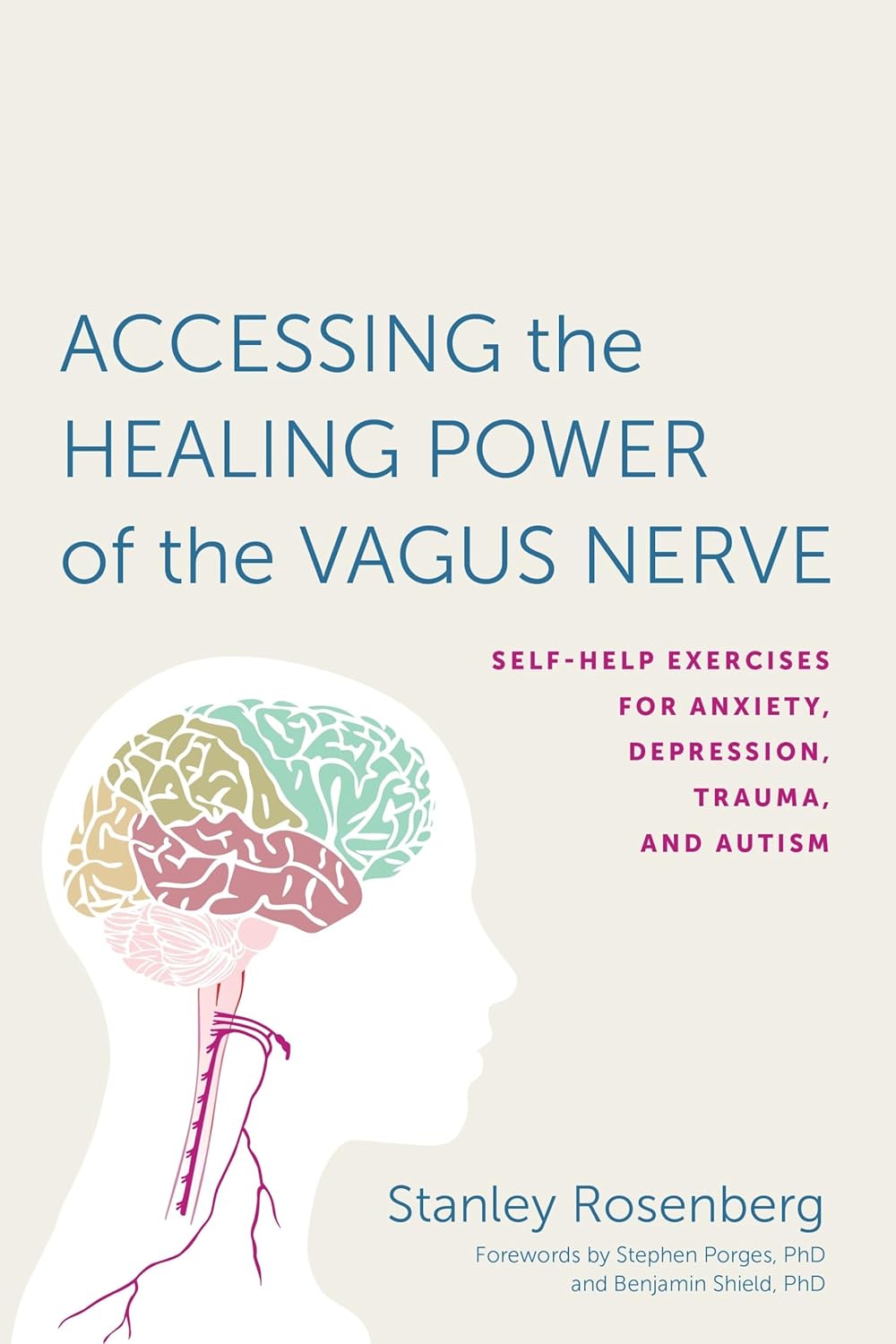
Accessing the Healing Power of the Vagus Nerve: Self-Help Exercises for Anxiety, Depression, Trauma, and Autism

Description:

Unlock lasting healing through the power of the vagus nerve—the bestselling guide to understanding how vagus nerve dysfunction and trauma impact inflammation, emotional health, autoimmune disease, and more

With practical exercises and body-based tools for regulating your nervous system, balancing your fight-or-flight response, and restoring body and mind

Dr. Stanley Rosenberg, PhD, offers an easy-to-understand overview of the vagus nerve—and helps you regulate your body’s innate capacity to heal from stress, trauma, anxiety, and injury.

Accessing the Healing Power of the Vagus Nerve dispels long-held myths about the autonomic nervous system (ANS) and offers readers a map to three neural circuits that are integral to whole-body healing and emotional wellness: the ventral vagal complex, the sympathetic nervous system, and the dorsal vagal complex. Based on Stephen Porges’s Polyvagal Theory, this book shows how each circuit shapes our sense of safety, connections with others, and resilience to stress, trauma, and inflammatory diseases like arthritis.

You’ll learn:

  • How to identify—and heal from—symptoms of ANS dysfunction
  • Somatic self-help exercises that are safe, effective, and easy to learn
  • Neurofascial release, migraine massage, and other hands-on techniques
  • Polyvagal applications for stress, anxiety, ADHD, fibromyalgia, PTSD, chronic pain, and more
  • How restoring health to the vagus nerve can enhance function throughout your whole body

This book is written for therapists, bodyworkers, trauma survivors, parents, and anyone struggling with chronic, embodied stress. Grounded in neurobiology research, clinical stories, and easy-to-follow exercises, this book gives you the tools to bring your body back into a state of safety, balance, and optimal functioning.


Editorial Reviews

Review

Accessing the Healing Power of the Vagus Nerve is Stanley Rosenberg’s personal expression of his insight into and appreciation of the role that vagal pathways play in the healing process by calming the body and enabling the body to welcome touch. By intuitively understanding this integrated process, Stanley has developed a system of manipulations that promote states of safety, allowing the body to retune the nervous system, thus optimizing behavior, mental health, and physiological homeostasis.… His powerful insights, metaphors, and treatment models are beautifully conveyed and archived.”—From the foreword by Stephen W. Porges, PhD, Distinguished University Scientist, Kinsey Institute, Indiana University, and professor of psychiatry, University of North Carolina
 
“Stanley Rosenberg has put his encyclopedic clinical knowledge to work through the lens of the Polyvagal Theory, illuminating the path away from the underlying cause of so much of today’s disease: anxiety. A tour de force.”—Tom Myers, author of
Anatomy Trains
 
“Stanley Rosenberg is one of the world’s most skilled and creative hands-on therapists. His diagnostic and treatment techniques have immediate application for everyone. Read and enjoy this book, and apply the techniques in your life or in your practice.”—James L. Oschman, PhD, author of 
Energy Medicine: The Scientific Basis
 
“An excellent and most valuable resource, written by one of the true masters in the field.”— Dr. Robert Schleip, director of the Fascia Research Group

About the Author

STANLEY ROSENBERG is an American-born author and body therapist. A
Rolfer since 1983 and a practicing craniosacral therapist since 1987, he
studied biomechanical craniosacral therapy for many years under Alain
Gehin, trained in craniosacral therapy at the Upledger Institute and in
biodynamic craniosacral courses with Giorgia Milne, studied applications
for treating children with Benjamin Shield, and took courses in
osteopathy with Jean-Pierre Barral.

For many years he led a school in Denmark, teaching structural
integration, myofascial release, release of scar tissue, biomechanical
craniosacral therapy, visceral massage, and biotensegrity. He is the
author of four books, published in Denmark:
Nevermore Pain in the
Back, Nevermore Stiff Neck, Pain Relief with Osteomassage, and Hwa
Yu Tai Chi. In addition to his work as a body therapist, he has worked
in theater— training actors in yoga, acrobatics, and voice—at various
institutions, including Yale University, Brandeis University, Swarthmore
College, and the National Theatre Schools of Denmark and Iceland.
More information about the techniques presented in this book can be
found on his website: www.stanleyrosenberg.com.

Reviews:

5.0 out of 5 stars Detailed and Evidence Based

R.M. · October 2, 2025

Very detailed information about stimulating the Vagus Nerve. I try to hum or sing when taking morning walks and I assume it helps my nervous system to settle down. I track my HRV with a Polar strap both before and after exercise and hope the stimulation makes a difference.

5.0 out of 5 stars Mind blowing

". · October 6, 2025

As a bodyworker and someone who has been through trauma and environmental illness, this book is a game changer. Explains SO MUCH of what I have experienced, and makes me proud to be a massage therapist.

5.0 out of 5 stars Struggling with you health? buy this book!

B.L.A. · May 28, 2025

Bought this for a friend who has been struggling with her health. She really enjoyed this book.

4.0 out of 5 stars I bought this book as I am on a quest to help my son with Aspergers.

P. · August 25, 2018

This author does an excellent job of describing the Polyvagal Theory for manual therapists. If you are not a manual therapist, you may still see some benefit from reading this book. The author describes the polyvagal theory thoroughly and explains some ways of improving your autonomic state from stress or dorsal vagal to social engagement.I came across this book title while searching for info on Dr. Porges and the Polyvagal Theory. I am a doctor of physical therapy and own a physical therapy practice called Muscle IQ. I have been in practice for over twenty years and use manual therapy techniques during every patient visit. So, I was able to quickly implement his recommended techniques. The Basic Exercise is one he thought up one night before addressing a group that was not licensed to touch clients. It is similar to the muscle energy technique I use for relocating the Atlas, so he does have good insight regarding manual therapy.The author Mr. Rosenberg is a highly skilled and experienced massage therapist that started a "school" to teach other massage therapists in Denmark some osteopathic techniques. I did love his focus on using manual therapy to make changes in a person’s physiological state as using an anatomical perspective is obviously a perfect match for me as a manual therapist.In the book he introduced me to the potential of the esophagus tightening up being a cause of the sensation of tightening in the chest that we might call anxiety. Using the technique he described in the book for this condition helped a patient of mine with COPD reduce some of his symptoms. But it was not a cure like the case he mentions in the book.I have been trying his method to turn the Vagus Nerve on with most all of my patients (and with my son). After following his precise instructions to perform the Basic Exercise (over the last 4 weeks) I have to say that I am disappointed in the results. I have not seen a big change in the uvula lift in most all of my patients (maybe I didn’t get them to yawn enough times).I am skeptical regarding the validity Mr. Rosenberg's assumptions. In physical therapy school we learned that some tests are what my professor called subjectively objective. This means that even though the test seems to qualify as objective, there is a good probability of the introduction of experimenter bias.I have to admit that this is one of the difficulties inherent to manual therapy. Especially in craniosacral therapy where ESP (yes, extra-sensory perception) is professed to be the way many practitioners determine whether a patient has positive results. So, I applaud Mr. Rosenberg’s attempt to use different measurements of palpating asymmetry, observation of the uvula lift, and palpation of tension in soft tissues. But again, experimenter bias is easily introduced in these subjectively objective measures.What’s more, how do we know that being able to lift the uvula demonstrates validity (of being in a social engagement state)? Validity in data collection means that your findings truly represent the phenomenon you are claiming to measure.Validity in what the author suggests in the book would be the following: If an individual passes the uvula test, then he/she should not have any of the chronic problems the author lists (e.g., my son’s autism is therefore cured) because the ventral vagus is active.Furthermore, how do we know what Stanley Rosenberg means when he repeatedly states that the client improved after performing the Basic Exercise? He does not quantify the improvement beyond his observation of change. Can the vagus nerve test be quantified? Can the uvula lift be graded like other muscle tests: 0 to 5 out of 5)?Another issue that should be addressed is yawning (one of the steps in the Basic Exercise that is repeated). Yawning causes the uvula to lift and retract until it almost disappears. So, is that just a warm up exercise that makes it easier to perform the uvula lift during the retest?He also claims to be able to tell whether someone has low or high heart rate variability by palpating a pulse while observing breathing and breath out. This may be true (or not) but how does he quantify the change. He has a training school so why has he not employed proper equipment to do data collection and publish it.I am on a quest to find help for my son with autism. The book title includes the word “Autism” but then he transitions to telling about a case study of an autistic client who received more than what is offered in the book. He has an example on YouTube of a student of his (in his two year program) who used craniosacral therapy (taught in the book) on his autistic brother. In a video on YouTube the bother states (contrary to what is in the book) that the main benefits and the cure came after multiple treatments by Mr. Rosenberg.So, there may be a conflict of interest with his claims of cures.I am highly skeptical regarding the validity Mr. Rosenberg's assumptions. It is well know that there are experimenter biases in regards to comparing the before and after measurements with observation and palpation. Because of this practitioners and massage therapists are convinced that they always get positive results.I have found that it is common for manual therapy gurus who teach their methods to over-state the effects of their techniques. "All will be cured with my technique in one visit." It is sometimes called "cherry picking" as one guru recommended that we charge a lot for two or three visits with the marketing ploy that the novel method we were using was better than any other.My conclusion is that much more is needed (than what the author describes in this book, specifically the Basic Exercise) to "pump up" vagal tone. And, the autism spectrum is more complicated than just poor blood flow to the brain stem. I have found other methods that are helping to down regulate my sons "mobilize with fear" state. I think a combination of a variety of stimuli for the vagus nerve (Rezzimax tuning device for example provided greater observable changes in uvula lift), self-talk therapy (especially with guided imagery), manual therapy in the cranial field, diet changes (keto is helpful, search "keto Dr. Berg" in YouTube or avoiding toxic food and MSG, search Katherine Reid unblindmymind.com), yoga breathing (specifically Breathwalk--which is synchronizing steps with segmented breaths of 4 sniffs and 4 puffs), kundalini breath of fire, therapist or parent using a prosodic voice, creating safe environments, EFT meridian tapping, and smile rehab exercises. In other words, more work than most people will be willing to do on their own (especially those who are trapped in a defense states of fear).I hope this review helps those who are also on a similar quest to help those we love to live a happy, peaceful, untroubled life.

5.0 out of 5 stars Easy To Understand

R. · July 18, 2025

What a wonderful resource!I highly recommend.

5.0 out of 5 stars Ventral vagal state enhanced

j. · July 22, 2025

A rare combination of rigorous, empirical, modern and cutting edge science, provocative and promising testable hypotheses, ample references and acknowledgements, personal and professional history and experience of clinical practice and development, and practical prescriptions for self-help, for patients and practitioners. Starting my experiments with the exercises now!

5.0 out of 5 stars good product, fast shipping

D.S. · September 15, 2025

good product, fast shipping

3.0 out of 5 stars Poorly organized and edited; valuable information

R. · October 29, 2018

It’s rare, but I’m giving this book both one star and five stars.The information Mr. Rosenberg provides here about the social cranial nerves and their function is extremely illuminating. The exercises are, for the most part, quick, quite easy to learn and perform, and effective. 5 stars.2 stars for it’s repetition, extraneous information, and wandering style. It even states on page 20 that the trapezius attaches to the mastoid bone and the SCMs, to the occipital. (It’s the other way ‘round). I’m on my seventh tour through the book in an effort to internalize a good structure to the information, and it shouldn’t take that many tries to do so.On the whole —definitely buy this book for the way it will help you and those you work with. Just expect to spend a lot of time extracting the help from the wandering style.

Nervo Vago

M. · August 23, 2025

Illuminante! Da leggere!

great

S. · June 19, 2020

Great book with plenty of techniques at the end

Very interesting read.

R. · February 2, 2025

Very helpful info to understand the nervous system and how to heal it.

.

C.K. · March 8, 2020

Practical and simple exercises to apply on improving our social engagement and body awareness. Interesting tips to work with autistic spectrum people. Extraordinary content! Thanks .

Great book

k. · January 15, 2020

Loved this book. Explained a lot and was able to use the suggestions immediately. Very helpful.

Accessing the Healing Power of the Vagus Nerve: Self-Help Exercises for Anxiety, Depression, Trauma, and Autism

Product ID: U1623170249
Condition: New

4.6

AED9123

Price includes VAT & Import Duties
Type: Paperback
Availability: In Stock

Quantity:

|

Order today to get by 7-14 business days

Delivery fee of AED 20. Free for orders above AED 200.

Returns & Warranty policies

Imported From: United States

At BOLO, we work hard to ensure the products you receive are new, genuine, and sourced from reputable suppliers.

BOLO is not an authorized or official retailer for most brands, nor are we affiliated with manufacturers unless specifically stated on a product page. Instead, we source verified sellers, authorized distributors or directly from the manufacturer.

Each product undergoes thorough inspection and verification at our consolidation and fulfilment centers to ensure it meets our strict authenticity and quality standards before being shipped and delivered to you.

If you ever have concerns regarding the authenticity of a product purchased from us, please contact Bolo Support. We will review your inquiry promptly and, if necessary, provide documentation verifying authenticity or offer a suitable resolution.

Your trust is our top priority, and we are committed to maintaining transparency and integrity in every transaction.

All product information, images, descriptions, and reviews originate from the manufacturer or from trusted sellers overseas. BOLO is not affiliated with, endorsed by, or an authorized retailer for most brands listed on our website unless stated otherwise.

While we strive to display accurate information, variations in packaging, labeling, instructions, or formulation may occasionally occur due to regional differences or supplier updates. For detailed or manufacturer-specific information, please contact the brand directly or reach out to BOLO Support for assistance.

Unless otherwise stated, all prices displayed on the product page include applicable taxes and import duties.

BOLO operates in accordance with the laws and regulations of United Arab Emirates. Any items found to be restricted or prohibited for sale within the UAE will be cancelled prior to shipment. We take proactive measures to ensure that only products permitted for sale in United Arab Emirates are listed on our website.

All items are shipped by air, and any products classified as “Dangerous Goods (DG)” under IATA regulations will be removed from the order and cancelled.

All orders are processed manually, and we make every effort to process them promptly once confirmed. Products cancelled due to the above reasons will be permanently removed from listings across the website.

Similar suggestions by Bolo

More from this brand

Similar items from “Holistic”

Accessing the Healing Power of the Vagus Nerve: Self-Help Exercises for Anxiety, Depression, Trauma, and Autism

Product ID: U1623170249
Condition: New

4.6

Accessing the Healing Power of the Vagus Nerve: Self-Help Exercises for Anxiety, Depression, Trauma, and Autism-0
Type: Paperback

AED9123

Price includes VAT & Import Duties
Availability: In Stock

Quantity:

|

Order today to get by 7-14 business days

Delivery fee of AED 20. Free for orders above AED 200.

Returns & Warranty policies

Imported From: United States

At BOLO, we work hard to ensure the products you receive are new, genuine, and sourced from reputable suppliers.

BOLO is not an authorized or official retailer for most brands, nor are we affiliated with manufacturers unless specifically stated on a product page. Instead, we source verified sellers, authorized distributors or directly from the manufacturer.

Each product undergoes thorough inspection and verification at our consolidation and fulfilment centers to ensure it meets our strict authenticity and quality standards before being shipped and delivered to you.

If you ever have concerns regarding the authenticity of a product purchased from us, please contact Bolo Support. We will review your inquiry promptly and, if necessary, provide documentation verifying authenticity or offer a suitable resolution.

Your trust is our top priority, and we are committed to maintaining transparency and integrity in every transaction.

All product information, images, descriptions, and reviews originate from the manufacturer or from trusted sellers overseas. BOLO is not affiliated with, endorsed by, or an authorized retailer for most brands listed on our website unless stated otherwise.

While we strive to display accurate information, variations in packaging, labeling, instructions, or formulation may occasionally occur due to regional differences or supplier updates. For detailed or manufacturer-specific information, please contact the brand directly or reach out to BOLO Support for assistance.

Unless otherwise stated, all prices displayed on the product page include applicable taxes and import duties.

BOLO operates in accordance with the laws and regulations of United Arab Emirates. Any items found to be restricted or prohibited for sale within the UAE will be cancelled prior to shipment. We take proactive measures to ensure that only products permitted for sale in United Arab Emirates are listed on our website.

All items are shipped by air, and any products classified as “Dangerous Goods (DG)” under IATA regulations will be removed from the order and cancelled.

All orders are processed manually, and we make every effort to process them promptly once confirmed. Products cancelled due to the above reasons will be permanently removed from listings across the website.

Description:

Unlock lasting healing through the power of the vagus nerve—the bestselling guide to understanding how vagus nerve dysfunction and trauma impact inflammation, emotional health, autoimmune disease, and more

With practical exercises and body-based tools for regulating your nervous system, balancing your fight-or-flight response, and restoring body and mind

Dr. Stanley Rosenberg, PhD, offers an easy-to-understand overview of the vagus nerve—and helps you regulate your body’s innate capacity to heal from stress, trauma, anxiety, and injury.

Accessing the Healing Power of the Vagus Nerve dispels long-held myths about the autonomic nervous system (ANS) and offers readers a map to three neural circuits that are integral to whole-body healing and emotional wellness: the ventral vagal complex, the sympathetic nervous system, and the dorsal vagal complex. Based on Stephen Porges’s Polyvagal Theory, this book shows how each circuit shapes our sense of safety, connections with others, and resilience to stress, trauma, and inflammatory diseases like arthritis.

You’ll learn:

  • How to identify—and heal from—symptoms of ANS dysfunction
  • Somatic self-help exercises that are safe, effective, and easy to learn
  • Neurofascial release, migraine massage, and other hands-on techniques
  • Polyvagal applications for stress, anxiety, ADHD, fibromyalgia, PTSD, chronic pain, and more
  • How restoring health to the vagus nerve can enhance function throughout your whole body

This book is written for therapists, bodyworkers, trauma survivors, parents, and anyone struggling with chronic, embodied stress. Grounded in neurobiology research, clinical stories, and easy-to-follow exercises, this book gives you the tools to bring your body back into a state of safety, balance, and optimal functioning.


Editorial Reviews

Review

Accessing the Healing Power of the Vagus Nerve is Stanley Rosenberg’s personal expression of his insight into and appreciation of the role that vagal pathways play in the healing process by calming the body and enabling the body to welcome touch. By intuitively understanding this integrated process, Stanley has developed a system of manipulations that promote states of safety, allowing the body to retune the nervous system, thus optimizing behavior, mental health, and physiological homeostasis.… His powerful insights, metaphors, and treatment models are beautifully conveyed and archived.”—From the foreword by Stephen W. Porges, PhD, Distinguished University Scientist, Kinsey Institute, Indiana University, and professor of psychiatry, University of North Carolina
 
“Stanley Rosenberg has put his encyclopedic clinical knowledge to work through the lens of the Polyvagal Theory, illuminating the path away from the underlying cause of so much of today’s disease: anxiety. A tour de force.”—Tom Myers, author of
Anatomy Trains
 
“Stanley Rosenberg is one of the world’s most skilled and creative hands-on therapists. His diagnostic and treatment techniques have immediate application for everyone. Read and enjoy this book, and apply the techniques in your life or in your practice.”—James L. Oschman, PhD, author of 
Energy Medicine: The Scientific Basis
 
“An excellent and most valuable resource, written by one of the true masters in the field.”— Dr. Robert Schleip, director of the Fascia Research Group

About the Author

STANLEY ROSENBERG is an American-born author and body therapist. A
Rolfer since 1983 and a practicing craniosacral therapist since 1987, he
studied biomechanical craniosacral therapy for many years under Alain
Gehin, trained in craniosacral therapy at the Upledger Institute and in
biodynamic craniosacral courses with Giorgia Milne, studied applications
for treating children with Benjamin Shield, and took courses in
osteopathy with Jean-Pierre Barral.

For many years he led a school in Denmark, teaching structural
integration, myofascial release, release of scar tissue, biomechanical
craniosacral therapy, visceral massage, and biotensegrity. He is the
author of four books, published in Denmark:
Nevermore Pain in the
Back, Nevermore Stiff Neck, Pain Relief with Osteomassage, and Hwa
Yu Tai Chi. In addition to his work as a body therapist, he has worked
in theater— training actors in yoga, acrobatics, and voice—at various
institutions, including Yale University, Brandeis University, Swarthmore
College, and the National Theatre Schools of Denmark and Iceland.
More information about the techniques presented in this book can be
found on his website: www.stanleyrosenberg.com.

Reviews:

5.0 out of 5 stars Detailed and Evidence Based

R.M. · October 2, 2025

Very detailed information about stimulating the Vagus Nerve. I try to hum or sing when taking morning walks and I assume it helps my nervous system to settle down. I track my HRV with a Polar strap both before and after exercise and hope the stimulation makes a difference.

5.0 out of 5 stars Mind blowing

". · October 6, 2025

As a bodyworker and someone who has been through trauma and environmental illness, this book is a game changer. Explains SO MUCH of what I have experienced, and makes me proud to be a massage therapist.

5.0 out of 5 stars Struggling with you health? buy this book!

B.L.A. · May 28, 2025

Bought this for a friend who has been struggling with her health. She really enjoyed this book.

4.0 out of 5 stars I bought this book as I am on a quest to help my son with Aspergers.

P. · August 25, 2018

This author does an excellent job of describing the Polyvagal Theory for manual therapists. If you are not a manual therapist, you may still see some benefit from reading this book. The author describes the polyvagal theory thoroughly and explains some ways of improving your autonomic state from stress or dorsal vagal to social engagement.I came across this book title while searching for info on Dr. Porges and the Polyvagal Theory. I am a doctor of physical therapy and own a physical therapy practice called Muscle IQ. I have been in practice for over twenty years and use manual therapy techniques during every patient visit. So, I was able to quickly implement his recommended techniques. The Basic Exercise is one he thought up one night before addressing a group that was not licensed to touch clients. It is similar to the muscle energy technique I use for relocating the Atlas, so he does have good insight regarding manual therapy.The author Mr. Rosenberg is a highly skilled and experienced massage therapist that started a "school" to teach other massage therapists in Denmark some osteopathic techniques. I did love his focus on using manual therapy to make changes in a person’s physiological state as using an anatomical perspective is obviously a perfect match for me as a manual therapist.In the book he introduced me to the potential of the esophagus tightening up being a cause of the sensation of tightening in the chest that we might call anxiety. Using the technique he described in the book for this condition helped a patient of mine with COPD reduce some of his symptoms. But it was not a cure like the case he mentions in the book.I have been trying his method to turn the Vagus Nerve on with most all of my patients (and with my son). After following his precise instructions to perform the Basic Exercise (over the last 4 weeks) I have to say that I am disappointed in the results. I have not seen a big change in the uvula lift in most all of my patients (maybe I didn’t get them to yawn enough times).I am skeptical regarding the validity Mr. Rosenberg's assumptions. In physical therapy school we learned that some tests are what my professor called subjectively objective. This means that even though the test seems to qualify as objective, there is a good probability of the introduction of experimenter bias.I have to admit that this is one of the difficulties inherent to manual therapy. Especially in craniosacral therapy where ESP (yes, extra-sensory perception) is professed to be the way many practitioners determine whether a patient has positive results. So, I applaud Mr. Rosenberg’s attempt to use different measurements of palpating asymmetry, observation of the uvula lift, and palpation of tension in soft tissues. But again, experimenter bias is easily introduced in these subjectively objective measures.What’s more, how do we know that being able to lift the uvula demonstrates validity (of being in a social engagement state)? Validity in data collection means that your findings truly represent the phenomenon you are claiming to measure.Validity in what the author suggests in the book would be the following: If an individual passes the uvula test, then he/she should not have any of the chronic problems the author lists (e.g., my son’s autism is therefore cured) because the ventral vagus is active.Furthermore, how do we know what Stanley Rosenberg means when he repeatedly states that the client improved after performing the Basic Exercise? He does not quantify the improvement beyond his observation of change. Can the vagus nerve test be quantified? Can the uvula lift be graded like other muscle tests: 0 to 5 out of 5)?Another issue that should be addressed is yawning (one of the steps in the Basic Exercise that is repeated). Yawning causes the uvula to lift and retract until it almost disappears. So, is that just a warm up exercise that makes it easier to perform the uvula lift during the retest?He also claims to be able to tell whether someone has low or high heart rate variability by palpating a pulse while observing breathing and breath out. This may be true (or not) but how does he quantify the change. He has a training school so why has he not employed proper equipment to do data collection and publish it.I am on a quest to find help for my son with autism. The book title includes the word “Autism” but then he transitions to telling about a case study of an autistic client who received more than what is offered in the book. He has an example on YouTube of a student of his (in his two year program) who used craniosacral therapy (taught in the book) on his autistic brother. In a video on YouTube the bother states (contrary to what is in the book) that the main benefits and the cure came after multiple treatments by Mr. Rosenberg.So, there may be a conflict of interest with his claims of cures.I am highly skeptical regarding the validity Mr. Rosenberg's assumptions. It is well know that there are experimenter biases in regards to comparing the before and after measurements with observation and palpation. Because of this practitioners and massage therapists are convinced that they always get positive results.I have found that it is common for manual therapy gurus who teach their methods to over-state the effects of their techniques. "All will be cured with my technique in one visit." It is sometimes called "cherry picking" as one guru recommended that we charge a lot for two or three visits with the marketing ploy that the novel method we were using was better than any other.My conclusion is that much more is needed (than what the author describes in this book, specifically the Basic Exercise) to "pump up" vagal tone. And, the autism spectrum is more complicated than just poor blood flow to the brain stem. I have found other methods that are helping to down regulate my sons "mobilize with fear" state. I think a combination of a variety of stimuli for the vagus nerve (Rezzimax tuning device for example provided greater observable changes in uvula lift), self-talk therapy (especially with guided imagery), manual therapy in the cranial field, diet changes (keto is helpful, search "keto Dr. Berg" in YouTube or avoiding toxic food and MSG, search Katherine Reid unblindmymind.com), yoga breathing (specifically Breathwalk--which is synchronizing steps with segmented breaths of 4 sniffs and 4 puffs), kundalini breath of fire, therapist or parent using a prosodic voice, creating safe environments, EFT meridian tapping, and smile rehab exercises. In other words, more work than most people will be willing to do on their own (especially those who are trapped in a defense states of fear).I hope this review helps those who are also on a similar quest to help those we love to live a happy, peaceful, untroubled life.

5.0 out of 5 stars Easy To Understand

R. · July 18, 2025

What a wonderful resource!I highly recommend.

5.0 out of 5 stars Ventral vagal state enhanced

j. · July 22, 2025

A rare combination of rigorous, empirical, modern and cutting edge science, provocative and promising testable hypotheses, ample references and acknowledgements, personal and professional history and experience of clinical practice and development, and practical prescriptions for self-help, for patients and practitioners. Starting my experiments with the exercises now!

5.0 out of 5 stars good product, fast shipping

D.S. · September 15, 2025

good product, fast shipping

3.0 out of 5 stars Poorly organized and edited; valuable information

R. · October 29, 2018

It’s rare, but I’m giving this book both one star and five stars.The information Mr. Rosenberg provides here about the social cranial nerves and their function is extremely illuminating. The exercises are, for the most part, quick, quite easy to learn and perform, and effective. 5 stars.2 stars for it’s repetition, extraneous information, and wandering style. It even states on page 20 that the trapezius attaches to the mastoid bone and the SCMs, to the occipital. (It’s the other way ‘round). I’m on my seventh tour through the book in an effort to internalize a good structure to the information, and it shouldn’t take that many tries to do so.On the whole —definitely buy this book for the way it will help you and those you work with. Just expect to spend a lot of time extracting the help from the wandering style.

Nervo Vago

M. · August 23, 2025

Illuminante! Da leggere!

great

S. · June 19, 2020

Great book with plenty of techniques at the end

Very interesting read.

R. · February 2, 2025

Very helpful info to understand the nervous system and how to heal it.

.

C.K. · March 8, 2020

Practical and simple exercises to apply on improving our social engagement and body awareness. Interesting tips to work with autistic spectrum people. Extraordinary content! Thanks .

Great book

k. · January 15, 2020

Loved this book. Explained a lot and was able to use the suggestions immediately. Very helpful.

Similar suggestions by Bolo

More from this brand

Similar items from “Holistic”