Deliver toUnited Arab Emirates
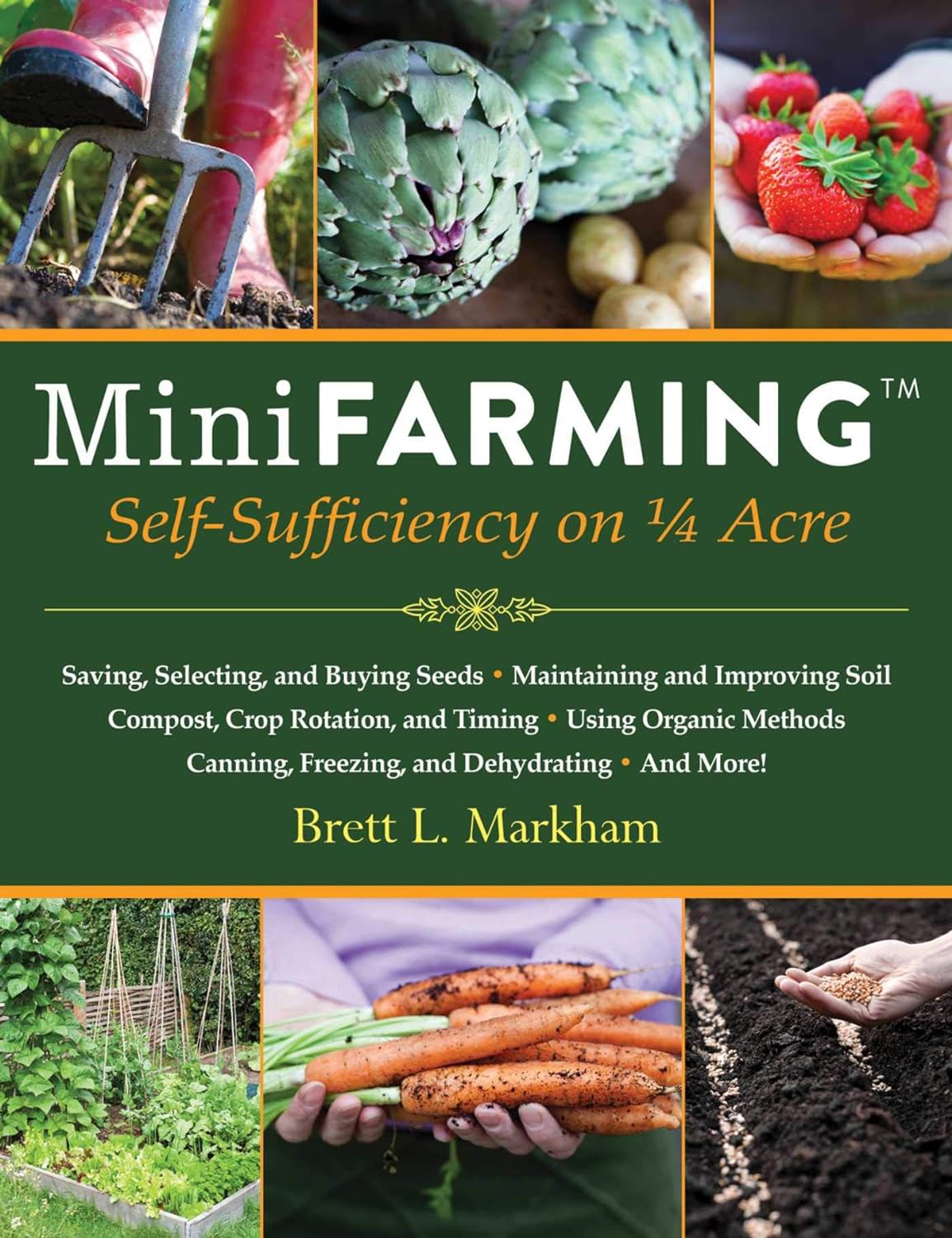
Mini Farming: Self-Sufficiency on 1/4 Acre

Description:

Go back to basics—compost, raising chickens, water and irrigation, dealing with pests, and much more—with this unique, full color bestseller (over 400,000 sold).

Mini Farming describes a holistic approach to small-area farming that will show you how to produce 85 percent of an average family’s food on just a quarter acre—and earn $10,000 in cash annually while spending less than half the time that an ordinary job would require.

Even if you have never been a farmer or a gardener, this book covers everything you need to know to get started:
  • Buying and saving seeds
  • Starting seedlings
  • Establishing raised beds
  • Soil fertility practices
  • Composting
  • Dealing with pest and disease problems
  • Crop rotation
  • Selling your produce arm planning, and much more.

Because self-sufficiency is the objective, subjects such as raising backyard chickens and home canning are also covered along with numerous methods for keeping costs down and production high. Materials, tools, and techniques are detailed with photographs, tables, diagrams, and illustrations.


Editorial Reviews

Review

“A concept destined to appeal to that intrepid individual whose independent nature finds the idea of abandoning the grocery store alluring.” (Carol Haggas - Booklist)

“A helpful addition, alongside Bartholomew and Jeavons, for the serious DIY gardener.” (Margaret Heller - Library Journal)

About the Author

Brett L. Markham is an engineer, third-generation farmer, and polymath. The author of the bestselling Mini Farming series, he runs a profitable, Certified Naturally Grown mini farm on less than half an acre. Brett works full time as an engineer for a broadband ISP and farms in his spare time. He lives in New Ipswich, New Hampshire.

Reviews:

5.0 out of 5 stars Excellent, well-organized guide on moving from casual gardener to self-sufficient gardener

M.M. · January 1, 2019

While I've maintained small gardens and potted plants for years, for 5+ years I've casually kept a 1,000 square foot garden. I've mostly winged it... sometimes impressively, other times with dismally. But, never consistent year over year results.I picked up this book to take my gardening to the next level and broaden my horizons.In short, I'm very satisfied with the insights and guidance I've gleaned from this book. I'd go so far as to say that while you don't need a background in gardening to benefit from this book, this book is a perfect fit for people in my situation.Here are the pros and cons from my perspective.Pros:- The content of each chapter is very well organized, with concepts building onto one another very neatly.- The broader subject matter of the chapters takes one through the process of planning, preparing, selecting, timing, managing, etc. most everything one would need to successfully grow a garden.- This book strikes a good balance between giving you the key information you need for any one aspect of self-sufficient gardening, but not inundating you with too much detail. (In other words, this book threads the needle on delivering a lot of helpful information, while still feeling like an easy read.)- I've seen other reviews for this book that complain that the author 'rips off' others' ideas and re-packages them for profit. I read quite a bit and have over the years seen serious examples of what these other reviewers are claiming. But, in the case of this book, while the author informs on alternative (and even competing models) for gardening, the author always informs the user on what, in his experience, has or has NOT worked from various models; how he has modified some of those ideas to work in his growing climate; and where he completely parts ways from others' techniques and espouses his own approach (including very clear instruction on how to use his modified or totally unique processes).- Finally, where possible, the author provides the equivalent of 'modified workouts' for those 'less fit' (MY WORDS, NOT HIS) in their gardening abilities. In other words, the author provides sufficient detail on what might be the most efficient and beneficial approach to say irrigation or composting, but then across the various subjects covered in the book, he provides a less expensive/quicker/initially easier alternative for those lacking the time, resources, space, skills, etc. to fully implement the best possible approach for one aspect or another of gardening. For example, as I'll be looking to expand my garden this next spring, I fully intend to utilize some of the quicker soil prep techniques offered up in this book for use in a pinch while I build up my long-term composting and soil amendment routines.Cons:- While some of the chapters really cover all the bases for the targeted subject matter (i.e. plant spacing, soil prep, etc.). Others give you just enough to run with but leave you wanting more. A good example of this would be Chapter 7 ("Time and Yield"). While the author gives a good and broad overview of timing techniques (i.e. succession planting, timed planting, interplanting etc.), for such an important subject matter, I was disappointed by just how short this chapter was. I live in Michigan, with a shorter growing season. I see this topic as critical for people in shorter growing zones like mine, and apart from a quick overview of each of the techniques used to maximize productivity, and a handful of real-world examples of plant groups that work well for things like succession planting (taking into consideration their hardiness in colder climates), this chapter really leaves readers wanting.- While this book is beautifully illustrated, there's no doubting that the abundance of pretty pictures of garden produce, chickens, tools, etc. serve as fill to make the book feel a bit more substantial in size than it need be. I don't want to over play this point, as A LOT of the illustrations (pictures/graphics/tables) are pertinent to the content of the book (and in any event, some amount of artwork is always nice to have), BUT... I think you could produce this book, still with plenty of beautiful illustrations, and reduce it from its current 227 pages (including the index and notes pages) down to 175 pages.

5.0 out of 5 stars Outstanding book for any gardener

C.i.M. · June 17, 2025

I will have to admit when it comes to these type of books I generally see myself as a book browser. Rarely do I find a book that holds my attention to the end but I just finished this book this morning from end to end! I started marking things of interest and good info for others that look at it after me and it is packed with great information, detailed illustrations, resource suggestions etc. now in my late 50s I can say I have been gardening for a pretty long time but an old dog can always learn new tricks or ways of thinking about things and what is nice about this book is it is not overwhelming. Applying the methods to mini farming even if you have more than 1/4 acre just means you will be able to better grow rotate and manage your food production. It also has great details on pests and diseases. All in all I don’t usually write many reviews but I stopped immediately this morning and wrote this one because the book is just well put together. Oh I almost forgot they have some good information on raising chickens as well which I have started doing recently. Most of all have fun with it gardening and farming is supposed to be rewarding in more ways than just food output. I find plucking weeds and such a therapeutic exercise and good distraction in such a chaotic world we find ourselves in these days.

5.0 out of 5 stars Good info and techniques

A.L. · October 10, 2025

This book is informative and helped me with my garden this past growing season. I highly recommend it

4.0 out of 5 stars This is a definite must have book if you want to explore the possibility of becoming a self-sufficient farmer ...

D.F. · February 7, 2012

When I ordered this book I was expecting something more in line with simple crop farming, but was pleasantly surprised to find an all around guide to small farming. On one level the contents reminded me of what I might find in the magazine, Countryside & Small Stock Journal. Farming can mean more than simply throwing a few seeds in the ground or creating raised beds. This book is about the ability to live off the grid and create a self-sustaining lifestyle for your family.There is a wide array of basic information in this book, but if I were going to seriously attempt a mini farm, I'd add a few other books along with it. For example, I'd add Stocking Up, an essential canning book that I've had on my shelves for years. I love the guidance this book has to offer, but a bit more in specific areas will be of enormous help to anyone who wants to seriously attempt to live beyond the sidewalks.This is a definite must have book if you want to explore the possibility of becoming a self-sufficient farmer. There is everything in here from dehydrating vegetables, intensive gardening, growing crops for sales, to raising chickens for eggs or meat. It's definitely not an in depth encyclopedic tome, but it is a great start and will help people make up their minds as to how they'd like to farm and what they'd like to raise. Not perfect, but definitely a book you should consider.

Great book for us beginners

K. · December 27, 2024

Really love how this author explains how to do raised beds, including placement of trellis. Have not read the whole book yet but plan to. I like to know the “ how to’s” before I start. I only want to build once and so far this book tells you what you need to know.

Very practical introduction

P.H. · September 23, 2013

This book is a thoroughly good read to introduce you to the idea of efficient food production on a small plot, and effectively bypasses the more traditional folklore-based practices of traditional home veg growers. Various named theories of intensive growing are explained and appraised.There is good science here, explained clearly, and with sufficient information and references to explore further. Although the writer's experience is in New England, the book makes it very simple to convert everything to a place with different climate.I read the book through in a couple of days. It was something of a page turner! I am now using it as a reference for development of my own far-from-perfect plot.

Thanks

E. · April 17, 2024

Good

Good but not best.

N. · December 22, 2016

Good but not best.'' All new square foot gardening'' is much better.

Tolle Anregungen

A.K. · August 4, 2014

Das Buch ist für Anfänger geschrieben. Sehr viele interessante Denkansätze und eine solide Einführung In den modernen Mini-Garten. Mit einer Tabelle über Fruchtfolgen und sich Gegenseitig fördernde Pflanzen wäre das Buch perfekt.

Mini Farming: Self-Sufficiency on 1/4 Acre

Product ID: U1602399840
Condition: New

4.6

AED9711

Price includes VAT & Import Duties
Type: Paperback
Availability: In Stock

Quantity:

|

Order today to get by 7-14 business days

Delivery fee of AED 20. Free for orders above AED 200.

Returns & Warranty policies

Imported From: United States

At BOLO, we work hard to ensure the products you receive are new, genuine, and sourced from reputable suppliers.

BOLO is not an authorized or official retailer for most brands, nor are we affiliated with manufacturers unless specifically stated on a product page. Instead, we source verified sellers, authorized distributors or directly from the manufacturer.

Each product undergoes thorough inspection and verification at our consolidation and fulfilment centers to ensure it meets our strict authenticity and quality standards before being shipped and delivered to you.

If you ever have concerns regarding the authenticity of a product purchased from us, please contact Bolo Support. We will review your inquiry promptly and, if necessary, provide documentation verifying authenticity or offer a suitable resolution.

Your trust is our top priority, and we are committed to maintaining transparency and integrity in every transaction.

All product information, images, descriptions, and reviews originate from the manufacturer or from trusted sellers overseas. BOLO is not affiliated with, endorsed by, or an authorized retailer for most brands listed on our website unless stated otherwise.

While we strive to display accurate information, variations in packaging, labeling, instructions, or formulation may occasionally occur due to regional differences or supplier updates. For detailed or manufacturer-specific information, please contact the brand directly or reach out to BOLO Support for assistance.

Unless otherwise stated, all prices displayed on the product page include applicable taxes and import duties.

BOLO operates in accordance with the laws and regulations of United Arab Emirates. Any items found to be restricted or prohibited for sale within the UAE will be cancelled prior to shipment. We take proactive measures to ensure that only products permitted for sale in United Arab Emirates are listed on our website.

All items are shipped by air, and any products classified as “Dangerous Goods (DG)” under IATA regulations will be removed from the order and cancelled.

All orders are processed manually, and we make every effort to process them promptly once confirmed. Products cancelled due to the above reasons will be permanently removed from listings across the website.

Similar suggestions by Bolo

More from this brand

Similar items from “Organic & Sustainable”

Mini Farming: Self-Sufficiency on 1/4 Acre

Product ID: U1602399840
Condition: New

4.6

Mini Farming: Self-Sufficiency on 1/4 Acre-0
Type: Paperback

AED9711

Price includes VAT & Import Duties
Availability: In Stock

Quantity:

|

Order today to get by 7-14 business days

Delivery fee of AED 20. Free for orders above AED 200.

Returns & Warranty policies

Imported From: United States

At BOLO, we work hard to ensure the products you receive are new, genuine, and sourced from reputable suppliers.

BOLO is not an authorized or official retailer for most brands, nor are we affiliated with manufacturers unless specifically stated on a product page. Instead, we source verified sellers, authorized distributors or directly from the manufacturer.

Each product undergoes thorough inspection and verification at our consolidation and fulfilment centers to ensure it meets our strict authenticity and quality standards before being shipped and delivered to you.

If you ever have concerns regarding the authenticity of a product purchased from us, please contact Bolo Support. We will review your inquiry promptly and, if necessary, provide documentation verifying authenticity or offer a suitable resolution.

Your trust is our top priority, and we are committed to maintaining transparency and integrity in every transaction.

All product information, images, descriptions, and reviews originate from the manufacturer or from trusted sellers overseas. BOLO is not affiliated with, endorsed by, or an authorized retailer for most brands listed on our website unless stated otherwise.

While we strive to display accurate information, variations in packaging, labeling, instructions, or formulation may occasionally occur due to regional differences or supplier updates. For detailed or manufacturer-specific information, please contact the brand directly or reach out to BOLO Support for assistance.

Unless otherwise stated, all prices displayed on the product page include applicable taxes and import duties.

BOLO operates in accordance with the laws and regulations of United Arab Emirates. Any items found to be restricted or prohibited for sale within the UAE will be cancelled prior to shipment. We take proactive measures to ensure that only products permitted for sale in United Arab Emirates are listed on our website.

All items are shipped by air, and any products classified as “Dangerous Goods (DG)” under IATA regulations will be removed from the order and cancelled.

All orders are processed manually, and we make every effort to process them promptly once confirmed. Products cancelled due to the above reasons will be permanently removed from listings across the website.

Description:

Go back to basics—compost, raising chickens, water and irrigation, dealing with pests, and much more—with this unique, full color bestseller (over 400,000 sold).

Mini Farming describes a holistic approach to small-area farming that will show you how to produce 85 percent of an average family’s food on just a quarter acre—and earn $10,000 in cash annually while spending less than half the time that an ordinary job would require.

Even if you have never been a farmer or a gardener, this book covers everything you need to know to get started:
  • Buying and saving seeds
  • Starting seedlings
  • Establishing raised beds
  • Soil fertility practices
  • Composting
  • Dealing with pest and disease problems
  • Crop rotation
  • Selling your produce arm planning, and much more.

Because self-sufficiency is the objective, subjects such as raising backyard chickens and home canning are also covered along with numerous methods for keeping costs down and production high. Materials, tools, and techniques are detailed with photographs, tables, diagrams, and illustrations.


Editorial Reviews

Review

“A concept destined to appeal to that intrepid individual whose independent nature finds the idea of abandoning the grocery store alluring.” (Carol Haggas - Booklist)

“A helpful addition, alongside Bartholomew and Jeavons, for the serious DIY gardener.” (Margaret Heller - Library Journal)

About the Author

Brett L. Markham is an engineer, third-generation farmer, and polymath. The author of the bestselling Mini Farming series, he runs a profitable, Certified Naturally Grown mini farm on less than half an acre. Brett works full time as an engineer for a broadband ISP and farms in his spare time. He lives in New Ipswich, New Hampshire.

Reviews:

5.0 out of 5 stars Excellent, well-organized guide on moving from casual gardener to self-sufficient gardener

M.M. · January 1, 2019

While I've maintained small gardens and potted plants for years, for 5+ years I've casually kept a 1,000 square foot garden. I've mostly winged it... sometimes impressively, other times with dismally. But, never consistent year over year results.I picked up this book to take my gardening to the next level and broaden my horizons.In short, I'm very satisfied with the insights and guidance I've gleaned from this book. I'd go so far as to say that while you don't need a background in gardening to benefit from this book, this book is a perfect fit for people in my situation.Here are the pros and cons from my perspective.Pros:- The content of each chapter is very well organized, with concepts building onto one another very neatly.- The broader subject matter of the chapters takes one through the process of planning, preparing, selecting, timing, managing, etc. most everything one would need to successfully grow a garden.- This book strikes a good balance between giving you the key information you need for any one aspect of self-sufficient gardening, but not inundating you with too much detail. (In other words, this book threads the needle on delivering a lot of helpful information, while still feeling like an easy read.)- I've seen other reviews for this book that complain that the author 'rips off' others' ideas and re-packages them for profit. I read quite a bit and have over the years seen serious examples of what these other reviewers are claiming. But, in the case of this book, while the author informs on alternative (and even competing models) for gardening, the author always informs the user on what, in his experience, has or has NOT worked from various models; how he has modified some of those ideas to work in his growing climate; and where he completely parts ways from others' techniques and espouses his own approach (including very clear instruction on how to use his modified or totally unique processes).- Finally, where possible, the author provides the equivalent of 'modified workouts' for those 'less fit' (MY WORDS, NOT HIS) in their gardening abilities. In other words, the author provides sufficient detail on what might be the most efficient and beneficial approach to say irrigation or composting, but then across the various subjects covered in the book, he provides a less expensive/quicker/initially easier alternative for those lacking the time, resources, space, skills, etc. to fully implement the best possible approach for one aspect or another of gardening. For example, as I'll be looking to expand my garden this next spring, I fully intend to utilize some of the quicker soil prep techniques offered up in this book for use in a pinch while I build up my long-term composting and soil amendment routines.Cons:- While some of the chapters really cover all the bases for the targeted subject matter (i.e. plant spacing, soil prep, etc.). Others give you just enough to run with but leave you wanting more. A good example of this would be Chapter 7 ("Time and Yield"). While the author gives a good and broad overview of timing techniques (i.e. succession planting, timed planting, interplanting etc.), for such an important subject matter, I was disappointed by just how short this chapter was. I live in Michigan, with a shorter growing season. I see this topic as critical for people in shorter growing zones like mine, and apart from a quick overview of each of the techniques used to maximize productivity, and a handful of real-world examples of plant groups that work well for things like succession planting (taking into consideration their hardiness in colder climates), this chapter really leaves readers wanting.- While this book is beautifully illustrated, there's no doubting that the abundance of pretty pictures of garden produce, chickens, tools, etc. serve as fill to make the book feel a bit more substantial in size than it need be. I don't want to over play this point, as A LOT of the illustrations (pictures/graphics/tables) are pertinent to the content of the book (and in any event, some amount of artwork is always nice to have), BUT... I think you could produce this book, still with plenty of beautiful illustrations, and reduce it from its current 227 pages (including the index and notes pages) down to 175 pages.

5.0 out of 5 stars Outstanding book for any gardener

C.i.M. · June 17, 2025

I will have to admit when it comes to these type of books I generally see myself as a book browser. Rarely do I find a book that holds my attention to the end but I just finished this book this morning from end to end! I started marking things of interest and good info for others that look at it after me and it is packed with great information, detailed illustrations, resource suggestions etc. now in my late 50s I can say I have been gardening for a pretty long time but an old dog can always learn new tricks or ways of thinking about things and what is nice about this book is it is not overwhelming. Applying the methods to mini farming even if you have more than 1/4 acre just means you will be able to better grow rotate and manage your food production. It also has great details on pests and diseases. All in all I don’t usually write many reviews but I stopped immediately this morning and wrote this one because the book is just well put together. Oh I almost forgot they have some good information on raising chickens as well which I have started doing recently. Most of all have fun with it gardening and farming is supposed to be rewarding in more ways than just food output. I find plucking weeds and such a therapeutic exercise and good distraction in such a chaotic world we find ourselves in these days.

5.0 out of 5 stars Good info and techniques

A.L. · October 10, 2025

This book is informative and helped me with my garden this past growing season. I highly recommend it

4.0 out of 5 stars This is a definite must have book if you want to explore the possibility of becoming a self-sufficient farmer ...

D.F. · February 7, 2012

When I ordered this book I was expecting something more in line with simple crop farming, but was pleasantly surprised to find an all around guide to small farming. On one level the contents reminded me of what I might find in the magazine, Countryside & Small Stock Journal. Farming can mean more than simply throwing a few seeds in the ground or creating raised beds. This book is about the ability to live off the grid and create a self-sustaining lifestyle for your family.There is a wide array of basic information in this book, but if I were going to seriously attempt a mini farm, I'd add a few other books along with it. For example, I'd add Stocking Up, an essential canning book that I've had on my shelves for years. I love the guidance this book has to offer, but a bit more in specific areas will be of enormous help to anyone who wants to seriously attempt to live beyond the sidewalks.This is a definite must have book if you want to explore the possibility of becoming a self-sufficient farmer. There is everything in here from dehydrating vegetables, intensive gardening, growing crops for sales, to raising chickens for eggs or meat. It's definitely not an in depth encyclopedic tome, but it is a great start and will help people make up their minds as to how they'd like to farm and what they'd like to raise. Not perfect, but definitely a book you should consider.

Great book for us beginners

K. · December 27, 2024

Really love how this author explains how to do raised beds, including placement of trellis. Have not read the whole book yet but plan to. I like to know the “ how to’s” before I start. I only want to build once and so far this book tells you what you need to know.

Very practical introduction

P.H. · September 23, 2013

This book is a thoroughly good read to introduce you to the idea of efficient food production on a small plot, and effectively bypasses the more traditional folklore-based practices of traditional home veg growers. Various named theories of intensive growing are explained and appraised.There is good science here, explained clearly, and with sufficient information and references to explore further. Although the writer's experience is in New England, the book makes it very simple to convert everything to a place with different climate.I read the book through in a couple of days. It was something of a page turner! I am now using it as a reference for development of my own far-from-perfect plot.

Thanks

E. · April 17, 2024

Good

Good but not best.

N. · December 22, 2016

Good but not best.'' All new square foot gardening'' is much better.

Tolle Anregungen

A.K. · August 4, 2014

Das Buch ist für Anfänger geschrieben. Sehr viele interessante Denkansätze und eine solide Einführung In den modernen Mini-Garten. Mit einer Tabelle über Fruchtfolgen und sich Gegenseitig fördernde Pflanzen wäre das Buch perfekt.

Similar suggestions by Bolo

More from this brand

Similar items from “Organic & Sustainable”