Deliver toUnited Arab Emirates
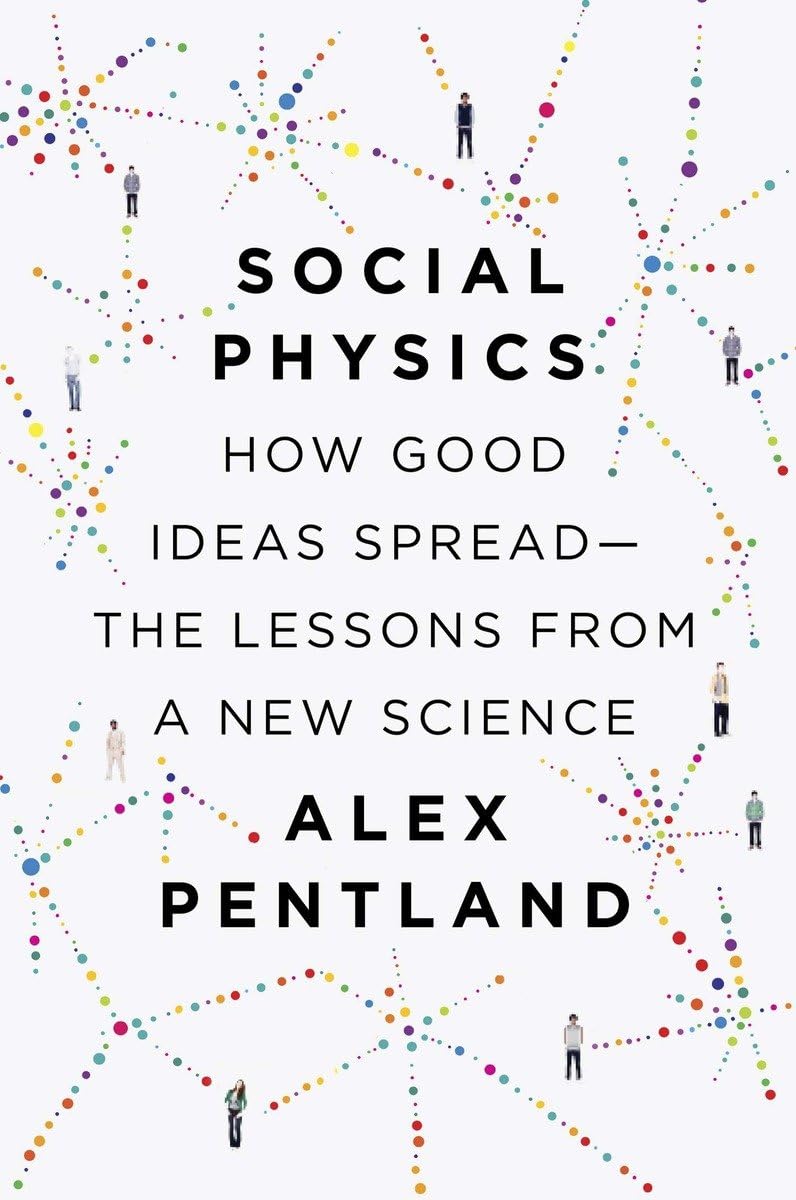
Social Physics: How Good Ideas Spread-The Lessons from a New Science

Description:

From one of the world’s leading data scientists, a landmark tour of the new science of idea flow, offering revolutionary insights into the mysteries of collective intelligence and social influence

If the Big Data revolution has a presiding genius, it is MIT’s Alex “Sandy” Pentland. Over years of groundbreaking experiments, he has distilled remarkable discoveries significant enough to become the bedrock of a whole new scientific field: social physics. Humans have more in common with bees than we like to admit: We’re social creatures first and foremost. Our most important habits of action—and most basic notions of common sense—are wired into us through our coordination in social groups. Social physics is about
idea flow, the way human social networks spread ideas and transform those ideas into behaviors.

Thanks to the millions of digital bread crumbs people leave behind via smartphones, GPS devices, and the Internet, the amount of new information we have about human activity is truly profound. Until now, sociologists have depended on limited data sets and surveys that tell us how people
say they think and behave, rather than what they actually do. As a result, we’ve been stuck with the same stale social structures—classes, markets—and a focus on individual actors, data snapshots, and steady states. Pentland shows that, in fact, humans respond much more powerfully to social incentives that involve rewarding others and strengthening the ties that bind than incentives that involve only their own economic self-interest.

Pentland and his teams have found that they can study
patterns of information exchange in a social network without any knowledge of the actual content of the information and predict with stunning accuracy how productive and effective that network is, whether it’s a business or an entire city. We can maximize a group’s collective intelligence to improve performance and use social incentives to create new organizations and guide them through disruptive change in a way that maximizes the good. At every level of interaction, from small groups to large cities, social networks can be tuned to increase exploration and engagement, thus vastly improving idea flow. 

Social Physics will change the way we think about how we learn and how our social groups work—and can be made to work better, at every level of society. Pentland leads readers to the edge of the most important revolution in the study of social behavior in a generation, an entirely new way to look at life itself.


Editorial Reviews

Review

The Economist:
Social Physics is filled with rich findings about what makes people tick. Using millions of data points measured over a long period of time in real settings, which Pentland calls ‘living laboratories,’ the author has monitored human behavior on an unprecedented scale…Pentland’s research also offers lessons for policymakers and business people. He advances a new way to protect privacy by creating something of a property right for personal information…Social Physics is a fascinating look at a new field by one of its principal geeks.”

John Abele, Co-Founder, Boston Scientific:
“Understanding, predicting and influencing human behavior has been the goal of social scientists (and leaders anywhere) since the beginning of time. Pentland’s
Social Physics is a major contribution to this field. By using communication tracking analysis and occasionally human sensors along with big data, he and his team are evolving a new discipline with a unique taxonomy and ontology that brings a higher level of quantification and rigor to a challenging and inherently complex field. Like Surowiecki’s The Wisdom of Crowds it will spawn further work and research in a rapidly expanding new body of knowledge.”

John Seely Brown, Former Chief Scientist, Xerox Corporation and director of Xerox Palo Alto Research Center (PARC):
“Read this book and you will look at tomorrow differently. Reality mining is just the first step on an exciting new journey.
Social Physics opens up the imagination to what might now be measurable and modifiable. It also hints at what may lie beyond Adam Smith’s invisible hand in helping groups, organizations and societies reach new levels of meaning creation. This is not just social analytics. It also offers pragmatic ways forward.”

Reed E. Hundt, former chairman of the Federal Communications Commission, CEO of the Coalition for Green Capital:
“From his MIT aerie, eagle-eyed Alex Pentland has seen the future. His wise and stimulating book teaches us how ideas spring up, flow, and spread. Applying his lessons, we can act collectively to solve previously intractable social, economic and political problems. We can make organizations more productive. We can even have government achieve its proper purposes, with greater fairness and less cost. As challenges like widening inequality and runaway climate change seem to exceed our ability to design solutions, Pentland’s data-driven, reality-based, yet sunny optimism about tomorrow should be eagerly welcomed by all readers.”

Stephen M. Kosslyn, Former Dean of Social Science, Harvard University; Former Director, Center for Advanced Study in the Behavioral Sciences, Stanford University; Founding Dean, Minerva Schools at KGI:
“Sandy Pentland lives in the future—and it shows. This book will not only whisk you up to speed on cutting-edge research at the interface of technology, behavioral science, and the social world, but it will also give you a good sense of what could be next. Professor Pentland brilliantly analyzes how new ideas flow and how, with the emergence of the ‘data-driven society,’ they will increasingly influence every aspect of our lives.”

About the Author

Alex "Sandy" Pentland directs MIT’s Human Dynamics Laboratory and the MIT Media Lab Entrepreneurship Program and co-leads the World Economic Forum Big Data and Personal Data initiatives. He helped create and direct MIT’s Media Laboratory, the Media Lab Asia laboratories at the Indian Institutes of Technology, and Strong Hospital’s Center for Future Health. His research group and entrepreneurship program have spun off more than thirty companies to date. In 2012 Forbes named Pentland one of the seven most powerful data scientists in the world. His research has been featured in Nature, Science, and Harvard Business Review.

Reviews:

5.0 out of 5 stars A Facinating Realization

T.G. · March 19, 2014

The book is about behaviors and people communicating very fast. It's about social media and specific personalities. It's about social groups and good ideas flowing like speed lava throughout a whole city. It's about predicting how effective a network is, and how it could be even better. It's a fascinating look at group behavior and how it uses social media. It's about how the spreading of ideas lead to predictive behaviors. It's about the new world we live in, on the go, in the home, and on the job. It's about a communication party that generates new ideas constantly, don't miss it !! It's about technology and a new way of life. It's about our automatic nature of social chattering. It's about data, behavior, and actions stemming from the flow of ideas. It's about scientific research explaining the impressive organization of a colony of ants, our data-driven society, and what the future could look like. The book is better than what I'm telling you here, I would buy it just for the expert explanation.

4.0 out of 5 stars an overview of the new field of "social physics" and its utility in the new digital age

A.M. · April 4, 2014

Social Physics is a field that seems to be emerging with the growth of big data and the smart phone revolution. The author Alex Pentland is a leader in the field of big data and discusses the ideas of social influence and idea generation from the new lense the author has pioneered. The author discusses some of the quantitative experiments he and his students have engaged in to give credence to this new field as well as then try to discuss what he believes the future holds for both the field as well as the world if we incorporate the ideas of social physics.The book is split into four parts. The first starts by discussing how ideas are generated and how we can improve our decision making. The author discusses his ideas about the flow of ideas and the need to learn from others but be weary of ideas which echo one another too much. He uses real world examples from trading site etoro to discuss the benefits of idea sharing but the dangers of too much idea overlap. The author discusses how habits and ideas are developed using results from behavioural science and tries to distinguish between the ways in which we are influenced and how social pressures can strongly influence us. The author then moves on to the second part named idea machines. The author discusses how the way we interact with one another have strong influence on productivity and creativity and that group dynamics are more important than individual intelligence. The author constantly sites experiments he and his students have done to reinforce these hypothesis put forward. The author discusses how incentivizing people to be engaged in their social networks can help adapt to change and make us more robust to the unexpected situations we will face. The author then moves on to the hypothetical potentials he sees for the future. He thinks about the ways in which smart cities will have the right mix of idea sharing but not too much exploration which increase crime as people lose familiarity and interaction which leads to loss of trust. He discusses ways in which sociometric devices will prepare us to better weather epidemics and inequality. The author then moves on to the future with a society in which people have access to large amounts of data about society at large. He discusses the need for privacy standards but with those in place, the utility of big data. The author addresses some relatively untied concepts like free will and how social influence and free will are distinct ideas but tries to reinforce that this new field of social physics can facilitate more egalitarian society with greater human potential and greater economic efficiency.Social physics is interesting and the ideas make sense. Idea generation as being a consequence of recombining old ideas and therefore immersion to various independent ideas is a productive exercise for the individual is not this authors idea, it was discussed a long time ago in economics. There is a lot of self promotion and the conclusiveness of the author's work must be taken with a grain of salt. That being said, the ideas are definitely interesting and important food for thought, i think there is much that is beneficial about the path the author is focused on and the solution his group used in the DARPA challenge presented in the book was ingenious (though a little bit contrary to a conclusion claimed earlier that economic incentives are not effective relative to social influence ones, i encourage the review reader to read the book so that this commentary makes more sense!). All in all I recommend this and it is a look into a potential future that might be soon upon us.

5.0 out of 5 stars Definitely thought provoking & potentially very valuable

K. · March 28, 2014

Pentland is in some ways the classic geek, whose belief in technology as the solution for social challenges is likely to turn out to be overstated. After all, the man is imbedded at MIT! Still, there is more here than just that. Pentland has found some very new and potentially very valuable ways to leverage "Big Data" to serve the needs of smaller, more intimate groups. His insights about how ideas grow and develop within work groups, communities and other social settings are actually independent of the technology he espouses. Pentland is convincing that there really is a genuine science of Social Physics. Properly balanced with older social science techniques, this could be a major contribution to facilitating meetings and groups in far more effective and productive ways. Very thought provoking, overall.

3.0 out of 5 stars interesting stuff, but not scholarly

L. · June 8, 2014

I liked the concepts and ideas presented. This is an exciting field. Unfortunately, this book doesn't provide the detail necessary for those of us wanting to become practitioners or apply this emerging science. Pentland mentions "research done" but does not spend time detailing the research that has gone into the concepts presented. (Surely the research is mixed, having some contradictory findings.) We are left to trust that the work has been doneIts a broad, non-academic introduction, and at times almost comes across an infomercial, an opportunity for the author to tout his many start-ups. That's OK if you want to hire Pentland or MIT, but if you're looking for a thorough introduction to the field, I'm afraid you'll have to look elsewhere.

5.0 out of 5 stars An Academic View

D.R.D.B.L. · June 29, 2014

Alex "Sandy" Pentland is an academic star, and his work at MIT's Media Lab produces many grand things. This book is fine, yet I prefer a previous book on Big Data by Viktor Mayer-Schonberger and Keneth Cukier, simply because I not a first-rate math type and the authors of this book are, in my opinion better writers than Prof. Pentland. Nevertheless, Pentland's book is another step toward showing what "big data" is doing and can do. This is a must read for students just starting to explore this amazing field. I would highly recommend his effort .

Les Big Data appliquées aux relations humaines

M. · August 18, 2015

A l'aide de senseurs, l'auteur a capté les interactions de différentes équipes (équipe projet, centre de services téléphonique ou groupe d'étudiants) : sur plusieurs jours, il a pu suivre les conversations, les gestuelles, le ton de la voix, etc. En analysant ces milliards de données, il a pu démontrer que plus nos interactions sont variées et nombreuses, plus nous sommes productifs et créatifs. Pas d'idées réellement neuves, mais la confirmation d'intuitions sur l'importance de favoriser les échanges au sein des équipes et entre elles.

Bueno

H.B. · February 25, 2017

Buen libro. Vale la pena leerlo para descubrir las técnicas más modernas de relaciones con la gente. Además que son técnicas sustentadas en datos del MIT.

Social Physics is a fascinating new branch of science with direct impact on our lives

D.U.H. · August 9, 2014

I happened to read the interview that Alex Pentland gave to DER SPIEGEL some months ago. After that I was very curious to learn more about social physics. Thus, I have ordered a copy of the book and started reading. This book is written for the public and I found it to be a real turnpager. The author describes his fascinating ideas in a very comprehensible way.Nearly all of us are working in teams together with very different people and many of us have asked ourselves why some projects succeed and some become a complete desaster. In my opinion, often the so-called "chemistry" between the co-workers is a crucial aspect for success (unless the project is useless from the very first moment). So far, this might just have been a suspicion and no one was able to really measure the quantity and quality of cooperation (of course you can look at the result, but by then it might be too late) .Alex Pentland has developed the software tools to measure and analyse the chemistry or better say the physics between people that work together or even live together in larger groups, villages or cities. Alex Pentland's working horse is the smartphone. He uses it as an intelligent sensor to monitor whom people meet, how they talk, how active they are and so on. In his book there are instructive examples that show how his analyses help to improve work-flow and outcome. Thus, social science becomes to a large extent computer science on big data.I know that many people (especially in Germany) see much potential for misuse of the sensitive data that have to be collected for such a social physics survey. Certainly, this is a serious concern, but Alex Pentland proposes a software solution for this problem (it would lead too far to explain his idea here, you better read it in the book).As a physicist I might be called naive in topics related to social science. But, in my opinion, this social physics ansatz is a great chance for the social sciences to achieve better results in terms of accuracy and reliability.As a consequence of my enthusiasm I ordered more copies of the book and gave it to some of my colleagues. I am pretty optimistic that this will lead to a different view on our collaborating. Let's see what will happen ...

Good discovery

T. · June 4, 2014

MOOC learning has this distinct advantage of being introduced to topics or subjects which I wouldn't otherwise have known existed

Eccellente lettura

S.R. · January 23, 2019

Sono sempre stato molto scettico sulle scienze umane e sui metodi scientifici applicati all'essere umano. La lettura di questo libro mi ha fatto toccare con mano la rivoluzione che i big data producono con riferimento all'analisi dei comportamenti umani. Si aprono frontiere inimmaginabili, e anche inquietanti.Ben scritto, chiaro e mai noioso o ripetitivo.

Social Physics: How Good Ideas Spread-The Lessons from a New Science

Product ID: U1594205655
Condition: New

4.1

AED19053

Price includes VAT & Import Duties
Type: Hardcover
Availability: In Stock

Quantity:

|

Order today to get by 7-14 business days

Delivery fee of AED 20. Free for orders above AED 200.

Returns & Warranty policies

Imported From: United States

At BOLO, we work hard to ensure the products you receive are new, genuine, and sourced from reputable suppliers.

BOLO is not an authorized or official retailer for most brands, nor are we affiliated with manufacturers unless specifically stated on a product page. Instead, we source verified sellers, authorized distributors or directly from the manufacturer.

Each product undergoes thorough inspection and verification at our consolidation and fulfilment centers to ensure it meets our strict authenticity and quality standards before being shipped and delivered to you.

If you ever have concerns regarding the authenticity of a product purchased from us, please contact Bolo Support. We will review your inquiry promptly and, if necessary, provide documentation verifying authenticity or offer a suitable resolution.

Your trust is our top priority, and we are committed to maintaining transparency and integrity in every transaction.

All product information, images, descriptions, and reviews originate from the manufacturer or from trusted sellers overseas. BOLO is not affiliated with, endorsed by, or an authorized retailer for most brands listed on our website unless stated otherwise.

While we strive to display accurate information, variations in packaging, labeling, instructions, or formulation may occasionally occur due to regional differences or supplier updates. For detailed or manufacturer-specific information, please contact the brand directly or reach out to BOLO Support for assistance.

Unless otherwise stated, all prices displayed on the product page include applicable taxes and import duties.

BOLO operates in accordance with the laws and regulations of United Arab Emirates. Any items found to be restricted or prohibited for sale within the UAE will be cancelled prior to shipment. We take proactive measures to ensure that only products permitted for sale in United Arab Emirates are listed on our website.

All items are shipped by air, and any products classified as “Dangerous Goods (DG)” under IATA regulations will be removed from the order and cancelled.

All orders are processed manually, and we make every effort to process them promptly once confirmed. Products cancelled due to the above reasons will be permanently removed from listings across the website.

Similar suggestions by Bolo

More from this brand

Similar items from “Social Aspects”

Social Physics: How Good Ideas Spread-The Lessons from a New Science

Product ID: U1594205655
Condition: New

4.1

Social Physics: How Good Ideas Spread-The Lessons from a New Science-0
Type: Hardcover

AED19053

Price includes VAT & Import Duties
Availability: In Stock

Quantity:

|

Order today to get by 7-14 business days

Delivery fee of AED 20. Free for orders above AED 200.

Returns & Warranty policies

Imported From: United States

At BOLO, we work hard to ensure the products you receive are new, genuine, and sourced from reputable suppliers.

BOLO is not an authorized or official retailer for most brands, nor are we affiliated with manufacturers unless specifically stated on a product page. Instead, we source verified sellers, authorized distributors or directly from the manufacturer.

Each product undergoes thorough inspection and verification at our consolidation and fulfilment centers to ensure it meets our strict authenticity and quality standards before being shipped and delivered to you.

If you ever have concerns regarding the authenticity of a product purchased from us, please contact Bolo Support. We will review your inquiry promptly and, if necessary, provide documentation verifying authenticity or offer a suitable resolution.

Your trust is our top priority, and we are committed to maintaining transparency and integrity in every transaction.

All product information, images, descriptions, and reviews originate from the manufacturer or from trusted sellers overseas. BOLO is not affiliated with, endorsed by, or an authorized retailer for most brands listed on our website unless stated otherwise.

While we strive to display accurate information, variations in packaging, labeling, instructions, or formulation may occasionally occur due to regional differences or supplier updates. For detailed or manufacturer-specific information, please contact the brand directly or reach out to BOLO Support for assistance.

Unless otherwise stated, all prices displayed on the product page include applicable taxes and import duties.

BOLO operates in accordance with the laws and regulations of United Arab Emirates. Any items found to be restricted or prohibited for sale within the UAE will be cancelled prior to shipment. We take proactive measures to ensure that only products permitted for sale in United Arab Emirates are listed on our website.

All items are shipped by air, and any products classified as “Dangerous Goods (DG)” under IATA regulations will be removed from the order and cancelled.

All orders are processed manually, and we make every effort to process them promptly once confirmed. Products cancelled due to the above reasons will be permanently removed from listings across the website.

Description:

From one of the world’s leading data scientists, a landmark tour of the new science of idea flow, offering revolutionary insights into the mysteries of collective intelligence and social influence

If the Big Data revolution has a presiding genius, it is MIT’s Alex “Sandy” Pentland. Over years of groundbreaking experiments, he has distilled remarkable discoveries significant enough to become the bedrock of a whole new scientific field: social physics. Humans have more in common with bees than we like to admit: We’re social creatures first and foremost. Our most important habits of action—and most basic notions of common sense—are wired into us through our coordination in social groups. Social physics is about
idea flow, the way human social networks spread ideas and transform those ideas into behaviors.

Thanks to the millions of digital bread crumbs people leave behind via smartphones, GPS devices, and the Internet, the amount of new information we have about human activity is truly profound. Until now, sociologists have depended on limited data sets and surveys that tell us how people
say they think and behave, rather than what they actually do. As a result, we’ve been stuck with the same stale social structures—classes, markets—and a focus on individual actors, data snapshots, and steady states. Pentland shows that, in fact, humans respond much more powerfully to social incentives that involve rewarding others and strengthening the ties that bind than incentives that involve only their own economic self-interest.

Pentland and his teams have found that they can study
patterns of information exchange in a social network without any knowledge of the actual content of the information and predict with stunning accuracy how productive and effective that network is, whether it’s a business or an entire city. We can maximize a group’s collective intelligence to improve performance and use social incentives to create new organizations and guide them through disruptive change in a way that maximizes the good. At every level of interaction, from small groups to large cities, social networks can be tuned to increase exploration and engagement, thus vastly improving idea flow. 

Social Physics will change the way we think about how we learn and how our social groups work—and can be made to work better, at every level of society. Pentland leads readers to the edge of the most important revolution in the study of social behavior in a generation, an entirely new way to look at life itself.


Editorial Reviews

Review

The Economist:
Social Physics is filled with rich findings about what makes people tick. Using millions of data points measured over a long period of time in real settings, which Pentland calls ‘living laboratories,’ the author has monitored human behavior on an unprecedented scale…Pentland’s research also offers lessons for policymakers and business people. He advances a new way to protect privacy by creating something of a property right for personal information…Social Physics is a fascinating look at a new field by one of its principal geeks.”

John Abele, Co-Founder, Boston Scientific:
“Understanding, predicting and influencing human behavior has been the goal of social scientists (and leaders anywhere) since the beginning of time. Pentland’s
Social Physics is a major contribution to this field. By using communication tracking analysis and occasionally human sensors along with big data, he and his team are evolving a new discipline with a unique taxonomy and ontology that brings a higher level of quantification and rigor to a challenging and inherently complex field. Like Surowiecki’s The Wisdom of Crowds it will spawn further work and research in a rapidly expanding new body of knowledge.”

John Seely Brown, Former Chief Scientist, Xerox Corporation and director of Xerox Palo Alto Research Center (PARC):
“Read this book and you will look at tomorrow differently. Reality mining is just the first step on an exciting new journey.
Social Physics opens up the imagination to what might now be measurable and modifiable. It also hints at what may lie beyond Adam Smith’s invisible hand in helping groups, organizations and societies reach new levels of meaning creation. This is not just social analytics. It also offers pragmatic ways forward.”

Reed E. Hundt, former chairman of the Federal Communications Commission, CEO of the Coalition for Green Capital:
“From his MIT aerie, eagle-eyed Alex Pentland has seen the future. His wise and stimulating book teaches us how ideas spring up, flow, and spread. Applying his lessons, we can act collectively to solve previously intractable social, economic and political problems. We can make organizations more productive. We can even have government achieve its proper purposes, with greater fairness and less cost. As challenges like widening inequality and runaway climate change seem to exceed our ability to design solutions, Pentland’s data-driven, reality-based, yet sunny optimism about tomorrow should be eagerly welcomed by all readers.”

Stephen M. Kosslyn, Former Dean of Social Science, Harvard University; Former Director, Center for Advanced Study in the Behavioral Sciences, Stanford University; Founding Dean, Minerva Schools at KGI:
“Sandy Pentland lives in the future—and it shows. This book will not only whisk you up to speed on cutting-edge research at the interface of technology, behavioral science, and the social world, but it will also give you a good sense of what could be next. Professor Pentland brilliantly analyzes how new ideas flow and how, with the emergence of the ‘data-driven society,’ they will increasingly influence every aspect of our lives.”

About the Author

Alex "Sandy" Pentland directs MIT’s Human Dynamics Laboratory and the MIT Media Lab Entrepreneurship Program and co-leads the World Economic Forum Big Data and Personal Data initiatives. He helped create and direct MIT’s Media Laboratory, the Media Lab Asia laboratories at the Indian Institutes of Technology, and Strong Hospital’s Center for Future Health. His research group and entrepreneurship program have spun off more than thirty companies to date. In 2012 Forbes named Pentland one of the seven most powerful data scientists in the world. His research has been featured in Nature, Science, and Harvard Business Review.

Reviews:

5.0 out of 5 stars A Facinating Realization

T.G. · March 19, 2014

The book is about behaviors and people communicating very fast. It's about social media and specific personalities. It's about social groups and good ideas flowing like speed lava throughout a whole city. It's about predicting how effective a network is, and how it could be even better. It's a fascinating look at group behavior and how it uses social media. It's about how the spreading of ideas lead to predictive behaviors. It's about the new world we live in, on the go, in the home, and on the job. It's about a communication party that generates new ideas constantly, don't miss it !! It's about technology and a new way of life. It's about our automatic nature of social chattering. It's about data, behavior, and actions stemming from the flow of ideas. It's about scientific research explaining the impressive organization of a colony of ants, our data-driven society, and what the future could look like. The book is better than what I'm telling you here, I would buy it just for the expert explanation.

4.0 out of 5 stars an overview of the new field of "social physics" and its utility in the new digital age

A.M. · April 4, 2014

Social Physics is a field that seems to be emerging with the growth of big data and the smart phone revolution. The author Alex Pentland is a leader in the field of big data and discusses the ideas of social influence and idea generation from the new lense the author has pioneered. The author discusses some of the quantitative experiments he and his students have engaged in to give credence to this new field as well as then try to discuss what he believes the future holds for both the field as well as the world if we incorporate the ideas of social physics.The book is split into four parts. The first starts by discussing how ideas are generated and how we can improve our decision making. The author discusses his ideas about the flow of ideas and the need to learn from others but be weary of ideas which echo one another too much. He uses real world examples from trading site etoro to discuss the benefits of idea sharing but the dangers of too much idea overlap. The author discusses how habits and ideas are developed using results from behavioural science and tries to distinguish between the ways in which we are influenced and how social pressures can strongly influence us. The author then moves on to the second part named idea machines. The author discusses how the way we interact with one another have strong influence on productivity and creativity and that group dynamics are more important than individual intelligence. The author constantly sites experiments he and his students have done to reinforce these hypothesis put forward. The author discusses how incentivizing people to be engaged in their social networks can help adapt to change and make us more robust to the unexpected situations we will face. The author then moves on to the hypothetical potentials he sees for the future. He thinks about the ways in which smart cities will have the right mix of idea sharing but not too much exploration which increase crime as people lose familiarity and interaction which leads to loss of trust. He discusses ways in which sociometric devices will prepare us to better weather epidemics and inequality. The author then moves on to the future with a society in which people have access to large amounts of data about society at large. He discusses the need for privacy standards but with those in place, the utility of big data. The author addresses some relatively untied concepts like free will and how social influence and free will are distinct ideas but tries to reinforce that this new field of social physics can facilitate more egalitarian society with greater human potential and greater economic efficiency.Social physics is interesting and the ideas make sense. Idea generation as being a consequence of recombining old ideas and therefore immersion to various independent ideas is a productive exercise for the individual is not this authors idea, it was discussed a long time ago in economics. There is a lot of self promotion and the conclusiveness of the author's work must be taken with a grain of salt. That being said, the ideas are definitely interesting and important food for thought, i think there is much that is beneficial about the path the author is focused on and the solution his group used in the DARPA challenge presented in the book was ingenious (though a little bit contrary to a conclusion claimed earlier that economic incentives are not effective relative to social influence ones, i encourage the review reader to read the book so that this commentary makes more sense!). All in all I recommend this and it is a look into a potential future that might be soon upon us.

5.0 out of 5 stars Definitely thought provoking & potentially very valuable

K. · March 28, 2014

Pentland is in some ways the classic geek, whose belief in technology as the solution for social challenges is likely to turn out to be overstated. After all, the man is imbedded at MIT! Still, there is more here than just that. Pentland has found some very new and potentially very valuable ways to leverage "Big Data" to serve the needs of smaller, more intimate groups. His insights about how ideas grow and develop within work groups, communities and other social settings are actually independent of the technology he espouses. Pentland is convincing that there really is a genuine science of Social Physics. Properly balanced with older social science techniques, this could be a major contribution to facilitating meetings and groups in far more effective and productive ways. Very thought provoking, overall.

3.0 out of 5 stars interesting stuff, but not scholarly

L. · June 8, 2014

I liked the concepts and ideas presented. This is an exciting field. Unfortunately, this book doesn't provide the detail necessary for those of us wanting to become practitioners or apply this emerging science. Pentland mentions "research done" but does not spend time detailing the research that has gone into the concepts presented. (Surely the research is mixed, having some contradictory findings.) We are left to trust that the work has been doneIts a broad, non-academic introduction, and at times almost comes across an infomercial, an opportunity for the author to tout his many start-ups. That's OK if you want to hire Pentland or MIT, but if you're looking for a thorough introduction to the field, I'm afraid you'll have to look elsewhere.

5.0 out of 5 stars An Academic View

D.R.D.B.L. · June 29, 2014

Alex "Sandy" Pentland is an academic star, and his work at MIT's Media Lab produces many grand things. This book is fine, yet I prefer a previous book on Big Data by Viktor Mayer-Schonberger and Keneth Cukier, simply because I not a first-rate math type and the authors of this book are, in my opinion better writers than Prof. Pentland. Nevertheless, Pentland's book is another step toward showing what "big data" is doing and can do. This is a must read for students just starting to explore this amazing field. I would highly recommend his effort .

Les Big Data appliquées aux relations humaines

M. · August 18, 2015

A l'aide de senseurs, l'auteur a capté les interactions de différentes équipes (équipe projet, centre de services téléphonique ou groupe d'étudiants) : sur plusieurs jours, il a pu suivre les conversations, les gestuelles, le ton de la voix, etc. En analysant ces milliards de données, il a pu démontrer que plus nos interactions sont variées et nombreuses, plus nous sommes productifs et créatifs. Pas d'idées réellement neuves, mais la confirmation d'intuitions sur l'importance de favoriser les échanges au sein des équipes et entre elles.

Bueno

H.B. · February 25, 2017

Buen libro. Vale la pena leerlo para descubrir las técnicas más modernas de relaciones con la gente. Además que son técnicas sustentadas en datos del MIT.

Social Physics is a fascinating new branch of science with direct impact on our lives

D.U.H. · August 9, 2014

I happened to read the interview that Alex Pentland gave to DER SPIEGEL some months ago. After that I was very curious to learn more about social physics. Thus, I have ordered a copy of the book and started reading. This book is written for the public and I found it to be a real turnpager. The author describes his fascinating ideas in a very comprehensible way.Nearly all of us are working in teams together with very different people and many of us have asked ourselves why some projects succeed and some become a complete desaster. In my opinion, often the so-called "chemistry" between the co-workers is a crucial aspect for success (unless the project is useless from the very first moment). So far, this might just have been a suspicion and no one was able to really measure the quantity and quality of cooperation (of course you can look at the result, but by then it might be too late) .Alex Pentland has developed the software tools to measure and analyse the chemistry or better say the physics between people that work together or even live together in larger groups, villages or cities. Alex Pentland's working horse is the smartphone. He uses it as an intelligent sensor to monitor whom people meet, how they talk, how active they are and so on. In his book there are instructive examples that show how his analyses help to improve work-flow and outcome. Thus, social science becomes to a large extent computer science on big data.I know that many people (especially in Germany) see much potential for misuse of the sensitive data that have to be collected for such a social physics survey. Certainly, this is a serious concern, but Alex Pentland proposes a software solution for this problem (it would lead too far to explain his idea here, you better read it in the book).As a physicist I might be called naive in topics related to social science. But, in my opinion, this social physics ansatz is a great chance for the social sciences to achieve better results in terms of accuracy and reliability.As a consequence of my enthusiasm I ordered more copies of the book and gave it to some of my colleagues. I am pretty optimistic that this will lead to a different view on our collaborating. Let's see what will happen ...

Good discovery

T. · June 4, 2014

MOOC learning has this distinct advantage of being introduced to topics or subjects which I wouldn't otherwise have known existed

Eccellente lettura

S.R. · January 23, 2019

Sono sempre stato molto scettico sulle scienze umane e sui metodi scientifici applicati all'essere umano. La lettura di questo libro mi ha fatto toccare con mano la rivoluzione che i big data producono con riferimento all'analisi dei comportamenti umani. Si aprono frontiere inimmaginabili, e anche inquietanti.Ben scritto, chiaro e mai noioso o ripetitivo.

Similar suggestions by Bolo

More from this brand

Similar items from “Social Aspects”