Description:
Imagine a world where almost everyone wakes up inspired to go to work, feels trusted and valued during the day, then returns home feeling fulfilled. This is not a crazy, idealized notion. Today, in many successful organizations, great leaders create environments in which people naturally work together to do remarkable things.
In his work with organizations around the world, Simon Sinek noticed that some teams trust each other so deeply that they would literally put their lives on the line for each other. Other teams, no matter what incentives are offered, are doomed to infighting, fragmentation and failure. Why?
The answer became clear during a conversation with a Marine Corps general. "Officers eat last," he said. Sinek watched as the most junior Marines ate first while the most senior Marines took their place at the back of the line. What's symbolic in the chow hall is deadly serious on the battlefield: Great leaders sacrifice their own comfort--even their own survival--for the good of those in their care.
Too many workplaces are driven by cynicism, paranoia, and self-interest. But the best ones foster trust and cooperation because their leaders build what Sinek calls a "Circle of Safety" that separates the security inside the team from the challenges outside.
Sinek illustrates his ideas with fascinating true stories that range from the military to big business, from government to investment banking.
About the Author
Excerpt. © Reprinted by permission. All rights reserved.
Protection from Above
A thick layer of clouds blocked out any light. There were no stars and there was no moon. Just black. The team slowly made its way through the valley, the rocky terrain making it impossible to go any faster than a snail's pace. Worse, they knew they were being watched. Every one of them was on edge.
A year hadn't yet passed since the attacks of September 11. The Taliban government had only recently fallen after taking a pounding from U.S. forces for their refusal to turn over the Al Qaeda leader, Osama bin Laden. There were a lot of Special Operations Forces in the area performing missions that, to this day, are still classified. This was one of those teams and this was one of those missions.
All we know is that the team of twenty-two men was operating deep inside enemy territory and had recently captured what the government calls a "high-value target." They were now working their way through a deep valley in a mountainous part of Afghanistan, escorting their high-value target to a safe house.
Flying over the thick clouds that night was Captain Mike Drowley, or Johnny Bravo, as he is known by his call sign or nickname. Except for the whir of his engines, it was perfectly peaceful up there. Thousands of stars speckled the sky, and the moon lit up the top of the clouds so brightly it looked like a fresh layer of snow had fallen. It was beautiful.
Johnny Bravo and his wingman were circling above in their A-10 aircraft, waiting should they be needed below. Affectionately known as the Warthog, the A-10 is not technically a fighter jet; it's an attack aircraft. A relatively slow-flying, single-seat armored plane designed to provide close air support for troops on the ground. Unlike other fighter jets, it is not fast or sexy (hence the nickname), but it gets the job done.
Ideally, both the A-10 pilots in the air and the troops on the ground would prefer to see each other with their eyes. Seeing the plane above, knowing someone is looking out for them, gives the troops below a greater sense of confidence. And seeing the troops below gives the pilots a greater sense of assurance that they will be able to help if needed. But given the thick cloud cover and the mountainous terrain that night in Afghanistan, the only way either knew the other was there was through the occasional radio contact they kept. Without a line of sight, Johnny Bravo couldn't see what the troops saw, but he could sense how the troops felt from what he heard over the radio. And this was enough to spur him to act.
Following his gut, Johnny Bravo decided he needed to execute a weather letdown, to drop down below the clouds so he could take a look at what was happening on the ground. It was a daring move. With the thick, low-hanging clouds, scattered storms in the area and the fact that Johnny Bravo would have to fly into a valley with his field of vision reduced by the night-vision goggles, performing the weather letdown under these conditions was extremely treacherous for even the most experienced of pilots.
Johnny Bravo was not told to perform the risky maneuver. If anything, he probably would have been told to hang tight and wait until he got the call to help. But Johnny Bravo is not like most pilots. Even though he was thousands of feet above in the safe cocoon of his cockpit, he could sense the anxiety of the men below. Regardless of the dangers, he knew that performing the weather letdown was the right thing to do. And for Johnny Bravo, that meant there was no other choice.
Then, just as he was preparing to head down through the clouds into the valley, his instincts were confirmed. Three words came across the radio. Three little words that can send shivers down a pilot's neck: "Troops in contact."
"Troops in contact" means someone on the ground is in trouble. It is the call that ground forces use to let others know they are under attack. Though Johnny Bravo had heard those words many times before during training, it was on this night, August 16, 2002, that he heard the words "troops in contact" for the first time in a combat situation.
Johnny Bravo had developed a way to help him relate to the men on the ground. To feel what they feel. During every training exercise, while flying above the battlefield, he would always replay in his mind the scene from the movie Saving Private Ryan when the Allies stormed the beaches of Normandy. He would picture the ramp of a Higgins boat dropping down, the men running onto the beach into a wall of German gunfire. The bullets whizzing past them. The pings of stray shots hitting the steel hulls of the boats. The cries of men hit. Johnny Bravo had trained himself to imagine that that was the scene playing out below every time he heard "Troops in contact." With those images vividly embossed in his mind, Johnny Bravo reacted to the call for assistance.
He told his wingman to hang tight above the clouds, announced his intentions to the flight controllers and the troops below and pointed his aircraft down into the darkness. As he passed through the clouds, the turbulence thrashed him and his aircraft about. A hard push to the left. A sudden drop. A jolt to the right. Unlike the commercial jets in which we fly, the A-10 is not designed for passenger comfort, and his plane bounced and shook hard as he passed through the layer of cloud.
Flying into the unknown with no idea what to expect, Johnny Bravo focused his attention on his instruments, trying to take in as much information as he could. His eyes moved from one dial to the next followed by a quick glance out the front window. Altitude, speed, heading, window. Altitude, speed, heading, window. "Please. Let. This. Work. Please. Let. This. Work," he said to himself under his breath.
When he finally broke through the clouds, he was less than a thousand feet off the ground, flying in a valley. The sight that greeted him was nothing like he had ever seen before, not in training or in the movies. There was enemy fire coming from both sides of the valley. Massive amounts of it. There was so much that the tracer fire-the streaks of light that follow the bullets-lit up the whole area. Bullets and rockets all aimed at the middle, all aimed squarely at the Special Operations Forces pinned down below.
In 2002 the avionics in the aircraft were not as sophisticated as they are today. The instruments Johnny Bravo had couldn't prevent him from hitting the mountain walls. Worse, he was flying with old Soviet maps left over from the invasion of Afghanistan in the 1980s. But there was no way he was going to let down those troops. "There are fates worse than death," he will tell you. "One fate worse than death is accidentally killing your own men. Another fate worse than death is going home alive when twenty-two others don't."
And so, on that dark night in August, Johnny Bravo started counting. He knew his speed and he knew his distance from the mountains. He did some quick calculations in his head and counted out loud the seconds he had before he would hit the valley walls. "One one thousand, two one thousand, three one thousand . . ." He locked his guns onto a position from which he could see a lot of enemy fire originating and held down the trigger of his Gatling gun. "Four one thousand, five one thousand, six one thousand . . ." At the point he ran out of room, he pulled back on the stick and pulled a sharp turn. His plane roared as he pulled back into the cloud above, his only option to avoid smacking into the mountain. His body pressed hard into his seat from the pressure of the G-forces as he set to go around again.
But there was no sound on the radio. The silence was deafening. Did the radio silence mean his shots were useless? Did it mean the guy on the radio was down? Or worse, did it mean the whole team was down?
Then the call came. "Good hits! Good hits! Keep it coming!" And keep it coming he did. He took another pass, counting again to avoid hitting the mountains. "One one thousand, two one thousand, three one thousand . . ." And another sharp turn and another run. And another. And another. He was making good hits and he had plenty of fuel; the problem now was, he was out of ammo.
He pointed his plane up to the clouds to fly and meet his wingman, who was still circling above. Johnny Bravo quickly briefed his partner on the situation and told him to do one thing, "Follow me." The two A-10s, flying three feet apart from each other, wing to wing, disappeared together into the clouds.
When they popped out, both less than a thousand feet above the ground, they began their runs together. Johnny Bravo did the counting and his wingman followed his lead and laid down the fire. "One one thousand. Two one thousand. Three one thousand. Four one thousand . . ." On cue, the two planes pulled high-G turns together and went around again and again and again. "One one thousand. Two one thousand. Three one thousand. Four one thousand."
That night, twenty-two men went home alive. There were no American casualties.
The Value of Empathy
That August night over Afghanistan, Johnny Bravo risked his life so that others might survive. He received no performance bonus. He didn't get a promotion or an award at the company off-site. He wasn't looking for any undue attention or reality TV show for his efforts. For Johnny Bravo, it was just part of the "J.O.B." as he puts it. And the greatest reward he received for his service was meeting the forces for whom he provided top cover that night. Though they had never met before, when they finally did meet, they hugged like old friends.
In the linear hierarchies in which we work, we want the folks at the top to see what we did. We raise our hands for recognition and reward. For most of us, the more recognition we get for our efforts from those in charge, the more successful we think we are. It is a system that works so long as that one person who supervises us stays at the company and feels no undue pressure from above-a nearly impossible standard to maintain. For Johnny Bravo and those like him, the will to succeed and the desire to do things that advance the interests of the organization aren't just motivated by recognition from above; they are integral to a culture of sacrifice and service, in which protection comes from all levels of the organization.
There is one thing that Johnny Bravo credits for giving him the courage to cross into the darkness of the unknown, sometimes with the knowledge that he might not come back. And it's not necessarily what you would expect. As valuable as it was, it isn't his training. And for all the advanced schooling he has received, it isn't his education. And as remarkable as the tools are that he has been given, it isn't his aircraft or any of its sophisticated systems. For all the technology he has at his disposal, empathy, Johnny Bravo says, is the single greatest asset he has to do his job. Ask any of the remarkable men and women in uniform who risk themselves for the benefit of others why they do it and they will tell you the same thing: "Because they would have done it for me."
Where do people like Johnny Bravo come from? Are they just born that way? Some perhaps are. But if the conditions in which we work meet a particular standard, every single one of us is capable of the courage and sacrifice of a Johnny Bravo. Though we may not be asked to risk our lives or to save anybody else's, we would gladly share our glory and help those with whom we work succeed. More important, in the right conditions, the people with whom we work would choose to do those things for us. And when that happens, when those kinds of bonds are formed, a strong foundation is laid for the kind of success and fulfillment that no amount of money, fame or awards can buy. This is what it means to work in a place in which the leaders prioritize the well-being of their people and, in return, their people give everything they've got to protect and advance the well-being of one another and the organization.
I use the military to illustrate the example because the lessons are so much more exaggerated when it is a matter of life and death. There is a pattern that exists in the organizations that achieve the greatest success, the ones that outmaneuver and outinnovate their competitors, the ones that command the greatest respect from inside and outside their organizations, the ones with the highest loyalty and lowest churn and the ability to weather nearly every storm or challenge. These exceptional organizations all have cultures in which the leaders provide cover from above and the people on the ground look out for each other. This is the reason they are willing to push hard and take the kinds of risks they do. And the way any organization can achieve this is with empathy.
Chapter 2
Employees Are People Too
Before there was empathy at the company, going to work felt like, well, work. On any given morning, the factory employees would stand at their machines waiting to start at the sound of the bell. And when it rang, on cue they would flip the switches and power up the machines in front of them. Within a few seconds, the whir of the machinery drowned out the sound of their voices. The workday had begun.
About two hours into the day, another bell would ring, announcing the time the workers could take a break. The machines would stop and nearly every worker would leave their post. Some went to the bathroom. Some went to grab another cup of coffee. And some just sat by their machines, resting until the bell told them to start work again. A few hours later, the bell would sound again, this time to let them know they were now allowed to leave the building for lunch. This was the way it had always been done.
Details:
Visit the Portfolio Store
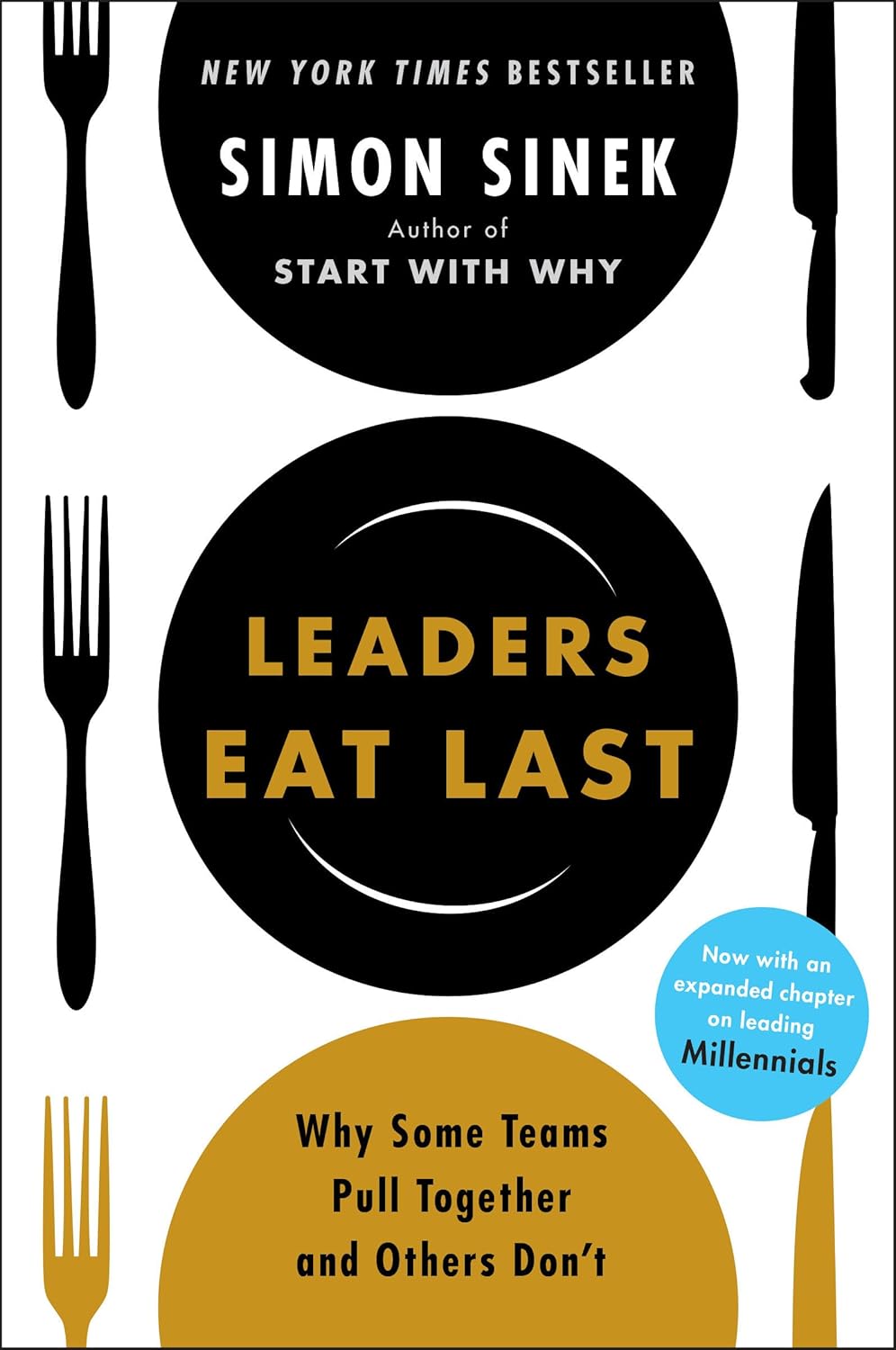
Leaders Eat Last: Why Some Teams Pull Together and Others Don't
AED10226
Quantity:
Order today to get by 7-14 business days
Delivery fee of AED 20. Free for orders above AED 200.
 Imported From: United States
At BOLO, we work hard to ensure the products you receive are new, genuine, and sourced from reputable suppliers.
Every product in the BOLO catalogue is sourced through our Verified Global Supply Network of verified sellers, authorized distributors or directly from the manufacturer.
Each product undergoes thorough inspection and verification at our consolidation and fulfilment centers to ensure it meets our strict authenticity and quality standards before being shipped and delivered to you.
If you ever have concerns regarding the authenticity of a product purchased from us, please contact Bolo Support. We will review your inquiry promptly and, if necessary, provide documentation verifying authenticity or offer a suitable resolution.
Your trust is our top priority, and we are committed to maintaining transparency and integrity in every transaction.
While we strive to display accurate information, variations in packaging, labeling, instructions, or formulation may occasionally occur due to regional differences or supplier updates. For detailed or manufacturer-specific information, please contact the brand directly or reach out to BOLO Support for assistance.
Unless otherwise stated, all prices displayed on the product page include applicable taxes and import duties.
BOLO operates in accordance with the laws and regulations of United Arab Emirates. Any items found to be restricted or prohibited for sale within the United Arab Emirates will be cancelled prior to shipment. We take proactive measures to ensure that only products permitted for sale in United Arab Emirates are listed on our website.
All items are shipped by air, and any products classified as “Dangerous Goods (DG)” under IATA regulations will be removed from the order and cancelled.
All orders are processed manually, and we make every effort to process them promptly once confirmed. Products cancelled due to the above reasons will be permanently removed from listings across the website.
More from this brand
Similar items from “Workplace Culture”
Share with
Or share with link
https://www.bolo.ae/products/U1591848016
Visit the Portfolio Store
Leaders Eat Last: Why Some Teams Pull Together and Others Don't
AED10226
Quantity:
Order today to get by 7-14 business days
Delivery fee of AED 20. Free for orders above AED 200.
Imported From: United States
At BOLO, we work hard to ensure the products you receive are new, genuine, and sourced from reputable suppliers.
Every product in the BOLO catalogue is sourced through our Verified Global Supply Network of verified sellers, authorized distributors or directly from the manufacturer.
Each product undergoes thorough inspection and verification at our consolidation and fulfilment centers to ensure it meets our strict authenticity and quality standards before being shipped and delivered to you.
If you ever have concerns regarding the authenticity of a product purchased from us, please contact Bolo Support. We will review your inquiry promptly and, if necessary, provide documentation verifying authenticity or offer a suitable resolution.
Your trust is our top priority, and we are committed to maintaining transparency and integrity in every transaction.
While we strive to display accurate information, variations in packaging, labeling, instructions, or formulation may occasionally occur due to regional differences or supplier updates. For detailed or manufacturer-specific information, please contact the brand directly or reach out to BOLO Support for assistance.
Unless otherwise stated, all prices displayed on the product page include applicable taxes and import duties.
BOLO operates in accordance with the laws and regulations of United Arab Emirates. Any items found to be restricted or prohibited for sale within the United Arab Emirates will be cancelled prior to shipment. We take proactive measures to ensure that only products permitted for sale in United Arab Emirates are listed on our website.
All items are shipped by air, and any products classified as “Dangerous Goods (DG)” under IATA regulations will be removed from the order and cancelled.
All orders are processed manually, and we make every effort to process them promptly once confirmed. Products cancelled due to the above reasons will be permanently removed from listings across the website.
Description:
Imagine a world where almost everyone wakes up inspired to go to work, feels trusted and valued during the day, then returns home feeling fulfilled. This is not a crazy, idealized notion. Today, in many successful organizations, great leaders create environments in which people naturally work together to do remarkable things.
In his work with organizations around the world, Simon Sinek noticed that some teams trust each other so deeply that they would literally put their lives on the line for each other. Other teams, no matter what incentives are offered, are doomed to infighting, fragmentation and failure. Why?
The answer became clear during a conversation with a Marine Corps general. "Officers eat last," he said. Sinek watched as the most junior Marines ate first while the most senior Marines took their place at the back of the line. What's symbolic in the chow hall is deadly serious on the battlefield: Great leaders sacrifice their own comfort--even their own survival--for the good of those in their care.
Too many workplaces are driven by cynicism, paranoia, and self-interest. But the best ones foster trust and cooperation because their leaders build what Sinek calls a "Circle of Safety" that separates the security inside the team from the challenges outside.
Sinek illustrates his ideas with fascinating true stories that range from the military to big business, from government to investment banking.
About the Author
Excerpt. © Reprinted by permission. All rights reserved.
Protection from Above
A thick layer of clouds blocked out any light. There were no stars and there was no moon. Just black. The team slowly made its way through the valley, the rocky terrain making it impossible to go any faster than a snail's pace. Worse, they knew they were being watched. Every one of them was on edge.
A year hadn't yet passed since the attacks of September 11. The Taliban government had only recently fallen after taking a pounding from U.S. forces for their refusal to turn over the Al Qaeda leader, Osama bin Laden. There were a lot of Special Operations Forces in the area performing missions that, to this day, are still classified. This was one of those teams and this was one of those missions.
All we know is that the team of twenty-two men was operating deep inside enemy territory and had recently captured what the government calls a "high-value target." They were now working their way through a deep valley in a mountainous part of Afghanistan, escorting their high-value target to a safe house.
Flying over the thick clouds that night was Captain Mike Drowley, or Johnny Bravo, as he is known by his call sign or nickname. Except for the whir of his engines, it was perfectly peaceful up there. Thousands of stars speckled the sky, and the moon lit up the top of the clouds so brightly it looked like a fresh layer of snow had fallen. It was beautiful.
Johnny Bravo and his wingman were circling above in their A-10 aircraft, waiting should they be needed below. Affectionately known as the Warthog, the A-10 is not technically a fighter jet; it's an attack aircraft. A relatively slow-flying, single-seat armored plane designed to provide close air support for troops on the ground. Unlike other fighter jets, it is not fast or sexy (hence the nickname), but it gets the job done.
Ideally, both the A-10 pilots in the air and the troops on the ground would prefer to see each other with their eyes. Seeing the plane above, knowing someone is looking out for them, gives the troops below a greater sense of confidence. And seeing the troops below gives the pilots a greater sense of assurance that they will be able to help if needed. But given the thick cloud cover and the mountainous terrain that night in Afghanistan, the only way either knew the other was there was through the occasional radio contact they kept. Without a line of sight, Johnny Bravo couldn't see what the troops saw, but he could sense how the troops felt from what he heard over the radio. And this was enough to spur him to act.
Following his gut, Johnny Bravo decided he needed to execute a weather letdown, to drop down below the clouds so he could take a look at what was happening on the ground. It was a daring move. With the thick, low-hanging clouds, scattered storms in the area and the fact that Johnny Bravo would have to fly into a valley with his field of vision reduced by the night-vision goggles, performing the weather letdown under these conditions was extremely treacherous for even the most experienced of pilots.
Johnny Bravo was not told to perform the risky maneuver. If anything, he probably would have been told to hang tight and wait until he got the call to help. But Johnny Bravo is not like most pilots. Even though he was thousands of feet above in the safe cocoon of his cockpit, he could sense the anxiety of the men below. Regardless of the dangers, he knew that performing the weather letdown was the right thing to do. And for Johnny Bravo, that meant there was no other choice.
Then, just as he was preparing to head down through the clouds into the valley, his instincts were confirmed. Three words came across the radio. Three little words that can send shivers down a pilot's neck: "Troops in contact."
"Troops in contact" means someone on the ground is in trouble. It is the call that ground forces use to let others know they are under attack. Though Johnny Bravo had heard those words many times before during training, it was on this night, August 16, 2002, that he heard the words "troops in contact" for the first time in a combat situation.
Johnny Bravo had developed a way to help him relate to the men on the ground. To feel what they feel. During every training exercise, while flying above the battlefield, he would always replay in his mind the scene from the movie Saving Private Ryan when the Allies stormed the beaches of Normandy. He would picture the ramp of a Higgins boat dropping down, the men running onto the beach into a wall of German gunfire. The bullets whizzing past them. The pings of stray shots hitting the steel hulls of the boats. The cries of men hit. Johnny Bravo had trained himself to imagine that that was the scene playing out below every time he heard "Troops in contact." With those images vividly embossed in his mind, Johnny Bravo reacted to the call for assistance.
He told his wingman to hang tight above the clouds, announced his intentions to the flight controllers and the troops below and pointed his aircraft down into the darkness. As he passed through the clouds, the turbulence thrashed him and his aircraft about. A hard push to the left. A sudden drop. A jolt to the right. Unlike the commercial jets in which we fly, the A-10 is not designed for passenger comfort, and his plane bounced and shook hard as he passed through the layer of cloud.
Flying into the unknown with no idea what to expect, Johnny Bravo focused his attention on his instruments, trying to take in as much information as he could. His eyes moved from one dial to the next followed by a quick glance out the front window. Altitude, speed, heading, window. Altitude, speed, heading, window. "Please. Let. This. Work. Please. Let. This. Work," he said to himself under his breath.
When he finally broke through the clouds, he was less than a thousand feet off the ground, flying in a valley. The sight that greeted him was nothing like he had ever seen before, not in training or in the movies. There was enemy fire coming from both sides of the valley. Massive amounts of it. There was so much that the tracer fire-the streaks of light that follow the bullets-lit up the whole area. Bullets and rockets all aimed at the middle, all aimed squarely at the Special Operations Forces pinned down below.
In 2002 the avionics in the aircraft were not as sophisticated as they are today. The instruments Johnny Bravo had couldn't prevent him from hitting the mountain walls. Worse, he was flying with old Soviet maps left over from the invasion of Afghanistan in the 1980s. But there was no way he was going to let down those troops. "There are fates worse than death," he will tell you. "One fate worse than death is accidentally killing your own men. Another fate worse than death is going home alive when twenty-two others don't."
And so, on that dark night in August, Johnny Bravo started counting. He knew his speed and he knew his distance from the mountains. He did some quick calculations in his head and counted out loud the seconds he had before he would hit the valley walls. "One one thousand, two one thousand, three one thousand . . ." He locked his guns onto a position from which he could see a lot of enemy fire originating and held down the trigger of his Gatling gun. "Four one thousand, five one thousand, six one thousand . . ." At the point he ran out of room, he pulled back on the stick and pulled a sharp turn. His plane roared as he pulled back into the cloud above, his only option to avoid smacking into the mountain. His body pressed hard into his seat from the pressure of the G-forces as he set to go around again.
But there was no sound on the radio. The silence was deafening. Did the radio silence mean his shots were useless? Did it mean the guy on the radio was down? Or worse, did it mean the whole team was down?
Then the call came. "Good hits! Good hits! Keep it coming!" And keep it coming he did. He took another pass, counting again to avoid hitting the mountains. "One one thousand, two one thousand, three one thousand . . ." And another sharp turn and another run. And another. And another. He was making good hits and he had plenty of fuel; the problem now was, he was out of ammo.
He pointed his plane up to the clouds to fly and meet his wingman, who was still circling above. Johnny Bravo quickly briefed his partner on the situation and told him to do one thing, "Follow me." The two A-10s, flying three feet apart from each other, wing to wing, disappeared together into the clouds.
When they popped out, both less than a thousand feet above the ground, they began their runs together. Johnny Bravo did the counting and his wingman followed his lead and laid down the fire. "One one thousand. Two one thousand. Three one thousand. Four one thousand . . ." On cue, the two planes pulled high-G turns together and went around again and again and again. "One one thousand. Two one thousand. Three one thousand. Four one thousand."
That night, twenty-two men went home alive. There were no American casualties.
The Value of Empathy
That August night over Afghanistan, Johnny Bravo risked his life so that others might survive. He received no performance bonus. He didn't get a promotion or an award at the company off-site. He wasn't looking for any undue attention or reality TV show for his efforts. For Johnny Bravo, it was just part of the "J.O.B." as he puts it. And the greatest reward he received for his service was meeting the forces for whom he provided top cover that night. Though they had never met before, when they finally did meet, they hugged like old friends.
In the linear hierarchies in which we work, we want the folks at the top to see what we did. We raise our hands for recognition and reward. For most of us, the more recognition we get for our efforts from those in charge, the more successful we think we are. It is a system that works so long as that one person who supervises us stays at the company and feels no undue pressure from above-a nearly impossible standard to maintain. For Johnny Bravo and those like him, the will to succeed and the desire to do things that advance the interests of the organization aren't just motivated by recognition from above; they are integral to a culture of sacrifice and service, in which protection comes from all levels of the organization.
There is one thing that Johnny Bravo credits for giving him the courage to cross into the darkness of the unknown, sometimes with the knowledge that he might not come back. And it's not necessarily what you would expect. As valuable as it was, it isn't his training. And for all the advanced schooling he has received, it isn't his education. And as remarkable as the tools are that he has been given, it isn't his aircraft or any of its sophisticated systems. For all the technology he has at his disposal, empathy, Johnny Bravo says, is the single greatest asset he has to do his job. Ask any of the remarkable men and women in uniform who risk themselves for the benefit of others why they do it and they will tell you the same thing: "Because they would have done it for me."
Where do people like Johnny Bravo come from? Are they just born that way? Some perhaps are. But if the conditions in which we work meet a particular standard, every single one of us is capable of the courage and sacrifice of a Johnny Bravo. Though we may not be asked to risk our lives or to save anybody else's, we would gladly share our glory and help those with whom we work succeed. More important, in the right conditions, the people with whom we work would choose to do those things for us. And when that happens, when those kinds of bonds are formed, a strong foundation is laid for the kind of success and fulfillment that no amount of money, fame or awards can buy. This is what it means to work in a place in which the leaders prioritize the well-being of their people and, in return, their people give everything they've got to protect and advance the well-being of one another and the organization.
I use the military to illustrate the example because the lessons are so much more exaggerated when it is a matter of life and death. There is a pattern that exists in the organizations that achieve the greatest success, the ones that outmaneuver and outinnovate their competitors, the ones that command the greatest respect from inside and outside their organizations, the ones with the highest loyalty and lowest churn and the ability to weather nearly every storm or challenge. These exceptional organizations all have cultures in which the leaders provide cover from above and the people on the ground look out for each other. This is the reason they are willing to push hard and take the kinds of risks they do. And the way any organization can achieve this is with empathy.
Chapter 2
Employees Are People Too
Before there was empathy at the company, going to work felt like, well, work. On any given morning, the factory employees would stand at their machines waiting to start at the sound of the bell. And when it rang, on cue they would flip the switches and power up the machines in front of them. Within a few seconds, the whir of the machinery drowned out the sound of their voices. The workday had begun.
About two hours into the day, another bell would ring, announcing the time the workers could take a break. The machines would stop and nearly every worker would leave their post. Some went to the bathroom. Some went to grab another cup of coffee. And some just sat by their machines, resting until the bell told them to start work again. A few hours later, the bell would sound again, this time to let them know they were now allowed to leave the building for lunch. This was the way it had always been done.
Details:
More from this brand
Similar items from “Workplace Culture”
Share with
Or share with link
https://www.bolo.ae/products/U1591848016