Deliver toUnited Arab Emirates
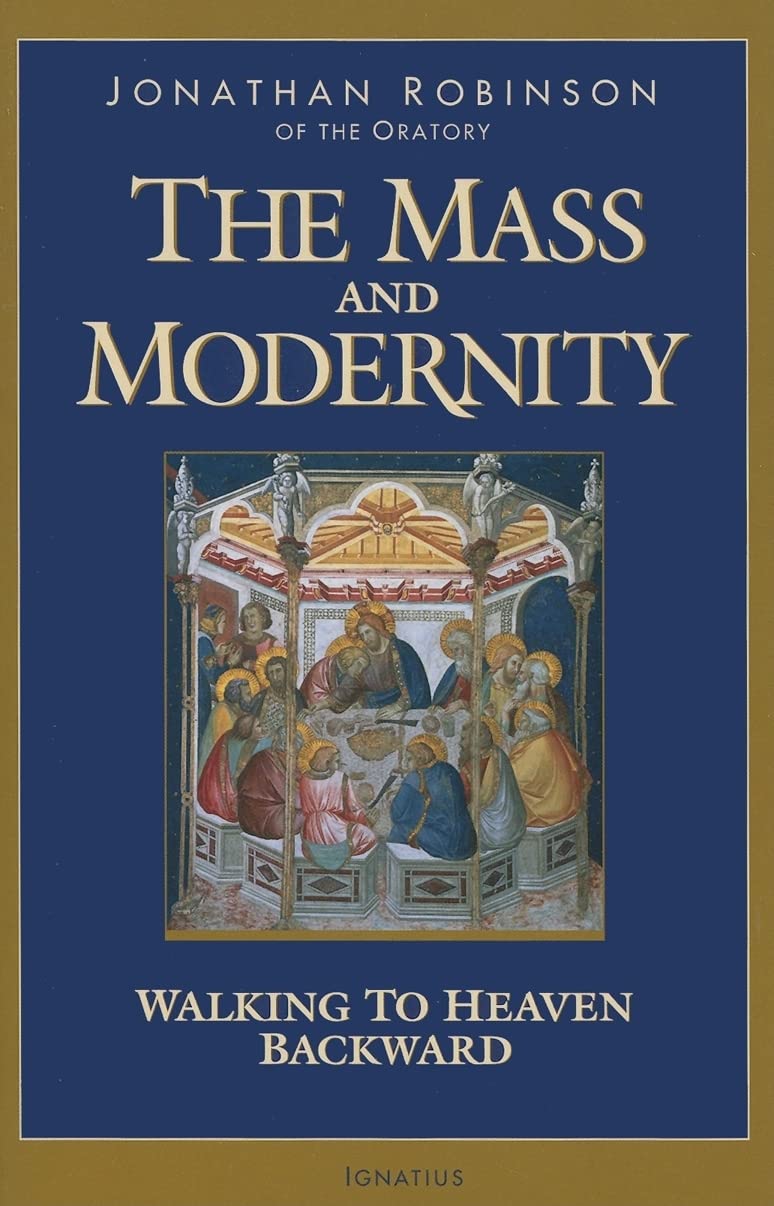
The Mass and Modernity: Walking to Heaven Backward

Description:

Many in the Church have accepted modernity in their effort to speak to the modern world, and not nearly enough attention has been given to trying to disentangle the complex of ideas and half-formulated convictions that constitute this mind-set which is in fact contrary to Christianity.
The first aim of this book is to examine the origins and present day influence of modernity, and then to argue that there is nothing in the Christian's concern for the modern world that requires accepting this damaging mind-set in connection with the highest form of worship, the Mass.
The second aim of the book is to show that that the sources of a genuine liturgical renewal are to be found in a heightened sense of the centrality of the Mass and a return to a theology compatible with the Catechism of the Catholic Church.

"Fr. Robinson's book is a philosopher's gift to the Catholic liturgy. He provides a thoroughly lucid account of the climate of ideas which handicaps the celebration of Catholic worship in the modern world. This is a diagnosis which shows just how far reaching must be the cure."
―Fr. Aidan Nichols, Author, Looking at the Liturgy


Editorial Reviews

About the Author

Fr. Jonathan Robinson is the founder of the Oratory of St. Philip Neri in Canada. He holds a Ph.D. from the University of Edinburgh, and a License in Theology from the Gregorian University in Rome.

Reviews:

5.0 out of 5 stars The Mass and Modernity: Walking to Heaven Backward

B.V.H. · October 19, 2011

The Mass and Modernity: Walking to Heaven Backwardby Jonathan Robinson of the OratorySan Francisco: Ignatius Press, 2005Pp. 377Paper edition $17.95ISBN: 1586170694Reviewed by Reverend Brian Van Hove, S.J.Alma, MichiganPublished in Antiphon: A Journal for Liturgical Renewal, vol. 10, no 1 (2006): 117-119Posted on Ignatius Insight, 11 September 2010Readers who enjoyed Jonathan Robinson's Spiritual Combat Revisited in 2003, surely thrilled to The Mass and Modernity in 2005. This treatment of liturgical landscape is what we needed forty years ago, when the implementation of the reform was just beginning. On the other hand, it took us these forty years finally to understand certain factors related to the reform's failure. Not even Father Robinson could have written this book in 1965 when the Council ended. Only now do we have enough data and the pleasure of hindsight.Robinson explains what he is doing. He is completing the historical work of Aidan Nichols, O.P., especially in Looking at the Liturgy. The two books go together. Both Robinson and Nichols orient us toward a grasp of the crisis in Catholic liturgy, and of the fitful, unfulfilled reform attempted since the Second Vatican Council.These studies also give notes of hope amidst the bleakness, the chief of which is understanding itself. Nothing like light to cheer us. But on the political, practical, and pastoral levels, there is very little to hope for. Robinson says candidly: "The present state of the liturgy reflects the alienation of modern Catholic thought and practice from the tradition of the Church; but now it also contributes to it."Robinson gives us a philosophical assessment. Ideas come from somewhere, and all ideas have a history. Ideas born in the eighteenth century Enlightenment, and especially the ideas of German philosophers later in the nineteenth century, influenced our world pervasively. The Old Liturgical Movement before the Council seemed blissfully unaware of the climate created by modernity. The way we think and feel about community comes from these sources to a greater degree than the liturgical reformers, and the ecclesiastical authorities who supported them, were aware of. Once Alexander Schmemann was reported to have said that the Catholic Church, which valiantly held out for so long, succumbed to modernity just as this modernity itself was about to collapse. This is the position Robinson takes in a 377-page explanation. He relies for insights on Iris Murdoch and Charles Taylor, both critics of modernity. He also mentions that some of the secondary followers of Karl Rahner and Bernard Longergan are to blame for part of the current catastrophe.A search for creativity and community were dominant projects in "reform-minded" Catholic circles in the 1960s and beyond. In itself, this might not have been bad. But Robinson shows that a major reflection on community had already gone on in the century before. It came from a decidedly non-Christian source, namely G.W.F. Hegel, who taught that the community was god, and that "God" was not fully "God" without the community. Robinson calls Hegel "the source of the ideas that have done most damage to the Church." This secular notion of community made its way into the Church, perhaps unconsciously, and today we do not seem able to interpret the consequences. Those lacking the philosophical erudition of Robinson still do not recognize the problem that has been generated. In some cases, they deliberately insert modernity to supplant the inherited Christian tradition.Writers who exclaim that "we are the Body of Christ" such that they compromise or downgrade transubstantiation and the tradition of sacramental realism, are influenced by Hegel whether they acknowledge it or not. Robinson points to German Martinez as an author in whom the success of the Enlightenment project is complete. He says Martinez's account of the Paschal Mystery has nothing to do with the understanding of the Paschal Mystery found in the Catechism of the Catholic Church.Frequently, contemporary seminarians desire a complete return of the Old Rite--a return to that point "before everything went wrong". Their instincts are laudable, and they speak up because they have been deprived of their rightful heritage. But once again Robinson provides needed wisdom, and he speaks as a parish priest as well as a scholar.He believes the Old Liturgical Movement had some salutary goals. Robinson would keep the Mass readings in the vernacular, and read them facing the people. In short, with some adjustment, the New Rite (1969) should and can look much like the Old Rite (1962). The Eucharistic Prayers should be in Latin, and both people and priest should face together "Ad Dominum". This is the Mass as it is celebrated today by the pope in his household chapel, and Robinson would merely universalize it. The depth, focus, theology, and transcendence of the Old Rite can be maintained while preserving some of the secondary gains of the New Rite's structure which has enjoyed the approbation of the highest ecclesiastical authorities. This way we can say that newer forms evolve organically (and gently!) from older forms. We could also become proud to say that we are sticking to a stricter and more faithful interpretation of Sacrosanctum concilium.We need a liturgy to satisfy the soul, to point us beyond the pain of the world, and to unite us more intimately to Christ's sacrifice. This is what the new crop of seminarians is trying to say by advocating a return to the Old Rite. They do not want to be priests who must perform as if on stage, who "get in the way" of the congregation's worship. The Holy Sacrifice of the Mass is a doctrinal reality in history. It exists in the documents of the Council, in our liturgical books and in our implementing documents, and in the Catechism, if only we rectify our ways of interpreting them. The ambiguities in the law itself can easily be corrected by a critical rethinking of the principles which are at stake in liturgy. This is what the Nichols-Robinson books help us to do.Robinson also recommends a re-reading of Dionysius the Areopagite for some indications of timeless liturgical principles. Obviously, the spate of books on the liturgy by Cardinal Joseph Ratzinger in the 1990s also help, and they are all available in translation.The very existence of any notion of "creativity" in liturgy shows a problem. The idea of "creativity" only reinforces the thought that the liturgy is something "we create" rather than something given to us to lift us aloft into a mystery too sublime for words. In his reference to the Old versus the New Rite, Robinson says that "What the Old Rite possessed was a clear lesson in the transcendence of God; while the way the Novus Ordo is often celebrated puts the community in the place of this reference to God."Jonathan Robinson states that "Modern liturgical practices are defective, and they are in place, and they reinforce people's understanding both of their faith and of how the faith should relate to the modern world. This means that the `reform of the reform' will be a long, hard business. How it will happen is at best opaque."One way in which `the reform of the reform' will happen is if more people read the works of Aidan Nichols and Jonathan Robinson. The new reform will not happen until as many people as possible see the real problems.

3.0 out of 5 stars Important piece of the puzzle!

T.E.G. · September 11, 2014

Overall the book is well done and worth the read. Part Three is however dated. I would recommend it for parts one and two.

5.0 out of 5 stars An incisive contribution to the reassesment of the liturgical reform

A.R. · November 19, 2006

"The present condition of Catholic worship has come about because it has been shaped by principles and attitudes of secular modernity. The result is that the Liturgy, instead of providing an alternative vision of life to that provided by secular modernity, now cooperates with and disseminates principles that are distructive of Catholicism.""Modern liturgical practices are defective, and they are in place, and they reinforce people's understanding both of their faith and of how the faith should relate to the modern world."Strong words, but true. Father Jonathan Robinson doesn't avoid the grim reality of the state of the Liturgy in the modern world. Rather, he subjects it to the scrutiny of a Catholic philosopher (himself), and comes up with a detailed if disturbing diagnosis.However a correct diagnosis is the necessary prerequisite for a cure, and whilst it may be unpleasant, we are indebted to Father Robinson for his inscisive work. This book should form part of the liturgical formation programme of all clergy and religious and be studied by any laity seeking a qualification in the Sacred Liturgy. It is philosophically demanding, but all that more important for so being.Whether or not one agrees with Father Robinson's practical suggestions - and with these there is scope for much discussion - his cry of alarm is prophetic.

4.0 out of 5 stars Very thorough explanation

J.G. · January 8, 2006

A very good resource for your library if you're passionate about good liturgy and lament the current state of the Catholic Mass. If you want to know, philosophically, how we got where we are, and some suggestions for how to get out, this is the book for you. This isn't a spy thriller, it requires close reading. But its worth the effort.

... finsihing which I suppose indicates that it is a good book indeed

P. · May 21, 2015

Wanted to read a lot more after finsihing which I suppose indicates that it is a good book indeed.

Good, solid background

C.C. · September 6, 2012

Although a few years old now it is still relevant and leads to a number of questions that contemporary Catholics should be asking about the direction of the Church today. It is a relief that the author does not favour a wholesale "return to the past" with a Tridentine Mass. Rather, he sees the benefit of many of the changes introduced by Vatican II but also sees areas that are in need of further reform. He also provides a very good background to the development of the changes that were introduced by Vatican II. It clearly points the finger not at the generation of Vatican II, i.e. children who were still in grade school in the mid-1960s when the Council finished and the changes were introduced. But he shows how it was the generation or two before this time that had done the most to bring about and force through changes that were not necessarily clearly thought through beforehand.For those with no memory of the Council years it is a very good "reality check". Not everything before Vatican II was perfect in the Church or in the Liturgy, hence it would not be wise to simply try to turn back the clocks. But the Church does need to respond to some valid criticisms and involve the laity in future planning. Of course, many committed lay Catholics have already begun to introduce more appropriate music for the liturgy. See, for example Adam Bartletts' Simple English Propersand also the new Parish Book of Psalms which is available from Bolo USA. Plus the brilliant work of Corpus Christi Watershed which makes all its material available online for free.A very good book. Read in combination with Alcuin Reid's book The Organic Development of the Liturgy: The Principles of Liturgical Reform and Their Relation to the Twenthieth-Century Liturgical Movement Prior to the Second Vatican Council you have a complete history of how the liturgy got to be where it is today.

The Mass and Modernity: Walking to Heaven Backward

Product ID: U1586170694
Condition: New

4.4

AED13324

Price includes VAT & Import Duties
Type: Paperback
Availability: In Stock

Quantity:

|

Order today to get by 7-14 business days

Delivery fee of AED 20. Free for orders above AED 200.

Returns & Warranty policies

Imported From: United States

At BOLO, we work hard to ensure the products you receive are new, genuine, and sourced from reputable suppliers.

BOLO is not an authorized or official retailer for most brands, nor are we affiliated with manufacturers unless specifically stated on a product page. Instead, we source verified sellers, authorized distributors or directly from the manufacturer.

Each product undergoes thorough inspection and verification at our consolidation and fulfilment centers to ensure it meets our strict authenticity and quality standards before being shipped and delivered to you.

If you ever have concerns regarding the authenticity of a product purchased from us, please contact Bolo Support. We will review your inquiry promptly and, if necessary, provide documentation verifying authenticity or offer a suitable resolution.

Your trust is our top priority, and we are committed to maintaining transparency and integrity in every transaction.

All product information, images, descriptions, and reviews originate from the manufacturer or from trusted sellers overseas. BOLO is not affiliated with, endorsed by, or an authorized retailer for most brands listed on our website unless stated otherwise.

While we strive to display accurate information, variations in packaging, labeling, instructions, or formulation may occasionally occur due to regional differences or supplier updates. For detailed or manufacturer-specific information, please contact the brand directly or reach out to BOLO Support for assistance.

Unless otherwise stated, all prices displayed on the product page include applicable taxes and import duties.

BOLO operates in accordance with the laws and regulations of United Arab Emirates. Any items found to be restricted or prohibited for sale within the UAE will be cancelled prior to shipment. We take proactive measures to ensure that only products permitted for sale in United Arab Emirates are listed on our website.

All items are shipped by air, and any products classified as “Dangerous Goods (DG)” under IATA regulations will be removed from the order and cancelled.

All orders are processed manually, and we make every effort to process them promptly once confirmed. Products cancelled due to the above reasons will be permanently removed from listings across the website.

Similar suggestions by Bolo

More from this brand

Similar items from “Sacraments”

The Mass and Modernity: Walking to Heaven Backward

Product ID: U1586170694
Condition: New

4.4

The Mass and Modernity: Walking to Heaven Backward-0
Type: Paperback

AED13324

Price includes VAT & Import Duties
Availability: In Stock

Quantity:

|

Order today to get by 7-14 business days

Delivery fee of AED 20. Free for orders above AED 200.

Returns & Warranty policies

Imported From: United States

At BOLO, we work hard to ensure the products you receive are new, genuine, and sourced from reputable suppliers.

BOLO is not an authorized or official retailer for most brands, nor are we affiliated with manufacturers unless specifically stated on a product page. Instead, we source verified sellers, authorized distributors or directly from the manufacturer.

Each product undergoes thorough inspection and verification at our consolidation and fulfilment centers to ensure it meets our strict authenticity and quality standards before being shipped and delivered to you.

If you ever have concerns regarding the authenticity of a product purchased from us, please contact Bolo Support. We will review your inquiry promptly and, if necessary, provide documentation verifying authenticity or offer a suitable resolution.

Your trust is our top priority, and we are committed to maintaining transparency and integrity in every transaction.

All product information, images, descriptions, and reviews originate from the manufacturer or from trusted sellers overseas. BOLO is not affiliated with, endorsed by, or an authorized retailer for most brands listed on our website unless stated otherwise.

While we strive to display accurate information, variations in packaging, labeling, instructions, or formulation may occasionally occur due to regional differences or supplier updates. For detailed or manufacturer-specific information, please contact the brand directly or reach out to BOLO Support for assistance.

Unless otherwise stated, all prices displayed on the product page include applicable taxes and import duties.

BOLO operates in accordance with the laws and regulations of United Arab Emirates. Any items found to be restricted or prohibited for sale within the UAE will be cancelled prior to shipment. We take proactive measures to ensure that only products permitted for sale in United Arab Emirates are listed on our website.

All items are shipped by air, and any products classified as “Dangerous Goods (DG)” under IATA regulations will be removed from the order and cancelled.

All orders are processed manually, and we make every effort to process them promptly once confirmed. Products cancelled due to the above reasons will be permanently removed from listings across the website.

Description:

Many in the Church have accepted modernity in their effort to speak to the modern world, and not nearly enough attention has been given to trying to disentangle the complex of ideas and half-formulated convictions that constitute this mind-set which is in fact contrary to Christianity.
The first aim of this book is to examine the origins and present day influence of modernity, and then to argue that there is nothing in the Christian's concern for the modern world that requires accepting this damaging mind-set in connection with the highest form of worship, the Mass.
The second aim of the book is to show that that the sources of a genuine liturgical renewal are to be found in a heightened sense of the centrality of the Mass and a return to a theology compatible with the Catechism of the Catholic Church.

"Fr. Robinson's book is a philosopher's gift to the Catholic liturgy. He provides a thoroughly lucid account of the climate of ideas which handicaps the celebration of Catholic worship in the modern world. This is a diagnosis which shows just how far reaching must be the cure."
―Fr. Aidan Nichols, Author, Looking at the Liturgy


Editorial Reviews

About the Author

Fr. Jonathan Robinson is the founder of the Oratory of St. Philip Neri in Canada. He holds a Ph.D. from the University of Edinburgh, and a License in Theology from the Gregorian University in Rome.

Reviews:

5.0 out of 5 stars The Mass and Modernity: Walking to Heaven Backward

B.V.H. · October 19, 2011

The Mass and Modernity: Walking to Heaven Backwardby Jonathan Robinson of the OratorySan Francisco: Ignatius Press, 2005Pp. 377Paper edition $17.95ISBN: 1586170694Reviewed by Reverend Brian Van Hove, S.J.Alma, MichiganPublished in Antiphon: A Journal for Liturgical Renewal, vol. 10, no 1 (2006): 117-119Posted on Ignatius Insight, 11 September 2010Readers who enjoyed Jonathan Robinson's Spiritual Combat Revisited in 2003, surely thrilled to The Mass and Modernity in 2005. This treatment of liturgical landscape is what we needed forty years ago, when the implementation of the reform was just beginning. On the other hand, it took us these forty years finally to understand certain factors related to the reform's failure. Not even Father Robinson could have written this book in 1965 when the Council ended. Only now do we have enough data and the pleasure of hindsight.Robinson explains what he is doing. He is completing the historical work of Aidan Nichols, O.P., especially in Looking at the Liturgy. The two books go together. Both Robinson and Nichols orient us toward a grasp of the crisis in Catholic liturgy, and of the fitful, unfulfilled reform attempted since the Second Vatican Council.These studies also give notes of hope amidst the bleakness, the chief of which is understanding itself. Nothing like light to cheer us. But on the political, practical, and pastoral levels, there is very little to hope for. Robinson says candidly: "The present state of the liturgy reflects the alienation of modern Catholic thought and practice from the tradition of the Church; but now it also contributes to it."Robinson gives us a philosophical assessment. Ideas come from somewhere, and all ideas have a history. Ideas born in the eighteenth century Enlightenment, and especially the ideas of German philosophers later in the nineteenth century, influenced our world pervasively. The Old Liturgical Movement before the Council seemed blissfully unaware of the climate created by modernity. The way we think and feel about community comes from these sources to a greater degree than the liturgical reformers, and the ecclesiastical authorities who supported them, were aware of. Once Alexander Schmemann was reported to have said that the Catholic Church, which valiantly held out for so long, succumbed to modernity just as this modernity itself was about to collapse. This is the position Robinson takes in a 377-page explanation. He relies for insights on Iris Murdoch and Charles Taylor, both critics of modernity. He also mentions that some of the secondary followers of Karl Rahner and Bernard Longergan are to blame for part of the current catastrophe.A search for creativity and community were dominant projects in "reform-minded" Catholic circles in the 1960s and beyond. In itself, this might not have been bad. But Robinson shows that a major reflection on community had already gone on in the century before. It came from a decidedly non-Christian source, namely G.W.F. Hegel, who taught that the community was god, and that "God" was not fully "God" without the community. Robinson calls Hegel "the source of the ideas that have done most damage to the Church." This secular notion of community made its way into the Church, perhaps unconsciously, and today we do not seem able to interpret the consequences. Those lacking the philosophical erudition of Robinson still do not recognize the problem that has been generated. In some cases, they deliberately insert modernity to supplant the inherited Christian tradition.Writers who exclaim that "we are the Body of Christ" such that they compromise or downgrade transubstantiation and the tradition of sacramental realism, are influenced by Hegel whether they acknowledge it or not. Robinson points to German Martinez as an author in whom the success of the Enlightenment project is complete. He says Martinez's account of the Paschal Mystery has nothing to do with the understanding of the Paschal Mystery found in the Catechism of the Catholic Church.Frequently, contemporary seminarians desire a complete return of the Old Rite--a return to that point "before everything went wrong". Their instincts are laudable, and they speak up because they have been deprived of their rightful heritage. But once again Robinson provides needed wisdom, and he speaks as a parish priest as well as a scholar.He believes the Old Liturgical Movement had some salutary goals. Robinson would keep the Mass readings in the vernacular, and read them facing the people. In short, with some adjustment, the New Rite (1969) should and can look much like the Old Rite (1962). The Eucharistic Prayers should be in Latin, and both people and priest should face together "Ad Dominum". This is the Mass as it is celebrated today by the pope in his household chapel, and Robinson would merely universalize it. The depth, focus, theology, and transcendence of the Old Rite can be maintained while preserving some of the secondary gains of the New Rite's structure which has enjoyed the approbation of the highest ecclesiastical authorities. This way we can say that newer forms evolve organically (and gently!) from older forms. We could also become proud to say that we are sticking to a stricter and more faithful interpretation of Sacrosanctum concilium.We need a liturgy to satisfy the soul, to point us beyond the pain of the world, and to unite us more intimately to Christ's sacrifice. This is what the new crop of seminarians is trying to say by advocating a return to the Old Rite. They do not want to be priests who must perform as if on stage, who "get in the way" of the congregation's worship. The Holy Sacrifice of the Mass is a doctrinal reality in history. It exists in the documents of the Council, in our liturgical books and in our implementing documents, and in the Catechism, if only we rectify our ways of interpreting them. The ambiguities in the law itself can easily be corrected by a critical rethinking of the principles which are at stake in liturgy. This is what the Nichols-Robinson books help us to do.Robinson also recommends a re-reading of Dionysius the Areopagite for some indications of timeless liturgical principles. Obviously, the spate of books on the liturgy by Cardinal Joseph Ratzinger in the 1990s also help, and they are all available in translation.The very existence of any notion of "creativity" in liturgy shows a problem. The idea of "creativity" only reinforces the thought that the liturgy is something "we create" rather than something given to us to lift us aloft into a mystery too sublime for words. In his reference to the Old versus the New Rite, Robinson says that "What the Old Rite possessed was a clear lesson in the transcendence of God; while the way the Novus Ordo is often celebrated puts the community in the place of this reference to God."Jonathan Robinson states that "Modern liturgical practices are defective, and they are in place, and they reinforce people's understanding both of their faith and of how the faith should relate to the modern world. This means that the `reform of the reform' will be a long, hard business. How it will happen is at best opaque."One way in which `the reform of the reform' will happen is if more people read the works of Aidan Nichols and Jonathan Robinson. The new reform will not happen until as many people as possible see the real problems.

3.0 out of 5 stars Important piece of the puzzle!

T.E.G. · September 11, 2014

Overall the book is well done and worth the read. Part Three is however dated. I would recommend it for parts one and two.

5.0 out of 5 stars An incisive contribution to the reassesment of the liturgical reform

A.R. · November 19, 2006

"The present condition of Catholic worship has come about because it has been shaped by principles and attitudes of secular modernity. The result is that the Liturgy, instead of providing an alternative vision of life to that provided by secular modernity, now cooperates with and disseminates principles that are distructive of Catholicism.""Modern liturgical practices are defective, and they are in place, and they reinforce people's understanding both of their faith and of how the faith should relate to the modern world."Strong words, but true. Father Jonathan Robinson doesn't avoid the grim reality of the state of the Liturgy in the modern world. Rather, he subjects it to the scrutiny of a Catholic philosopher (himself), and comes up with a detailed if disturbing diagnosis.However a correct diagnosis is the necessary prerequisite for a cure, and whilst it may be unpleasant, we are indebted to Father Robinson for his inscisive work. This book should form part of the liturgical formation programme of all clergy and religious and be studied by any laity seeking a qualification in the Sacred Liturgy. It is philosophically demanding, but all that more important for so being.Whether or not one agrees with Father Robinson's practical suggestions - and with these there is scope for much discussion - his cry of alarm is prophetic.

4.0 out of 5 stars Very thorough explanation

J.G. · January 8, 2006

A very good resource for your library if you're passionate about good liturgy and lament the current state of the Catholic Mass. If you want to know, philosophically, how we got where we are, and some suggestions for how to get out, this is the book for you. This isn't a spy thriller, it requires close reading. But its worth the effort.

... finsihing which I suppose indicates that it is a good book indeed

P. · May 21, 2015

Wanted to read a lot more after finsihing which I suppose indicates that it is a good book indeed.

Good, solid background

C.C. · September 6, 2012

Although a few years old now it is still relevant and leads to a number of questions that contemporary Catholics should be asking about the direction of the Church today. It is a relief that the author does not favour a wholesale "return to the past" with a Tridentine Mass. Rather, he sees the benefit of many of the changes introduced by Vatican II but also sees areas that are in need of further reform. He also provides a very good background to the development of the changes that were introduced by Vatican II. It clearly points the finger not at the generation of Vatican II, i.e. children who were still in grade school in the mid-1960s when the Council finished and the changes were introduced. But he shows how it was the generation or two before this time that had done the most to bring about and force through changes that were not necessarily clearly thought through beforehand.For those with no memory of the Council years it is a very good "reality check". Not everything before Vatican II was perfect in the Church or in the Liturgy, hence it would not be wise to simply try to turn back the clocks. But the Church does need to respond to some valid criticisms and involve the laity in future planning. Of course, many committed lay Catholics have already begun to introduce more appropriate music for the liturgy. See, for example Adam Bartletts' Simple English Propersand also the new Parish Book of Psalms which is available from Bolo USA. Plus the brilliant work of Corpus Christi Watershed which makes all its material available online for free.A very good book. Read in combination with Alcuin Reid's book The Organic Development of the Liturgy: The Principles of Liturgical Reform and Their Relation to the Twenthieth-Century Liturgical Movement Prior to the Second Vatican Council you have a complete history of how the liturgy got to be where it is today.

Similar suggestions by Bolo

More from this brand

Similar items from “Sacraments”