Deliver toUnited Arab Emirates
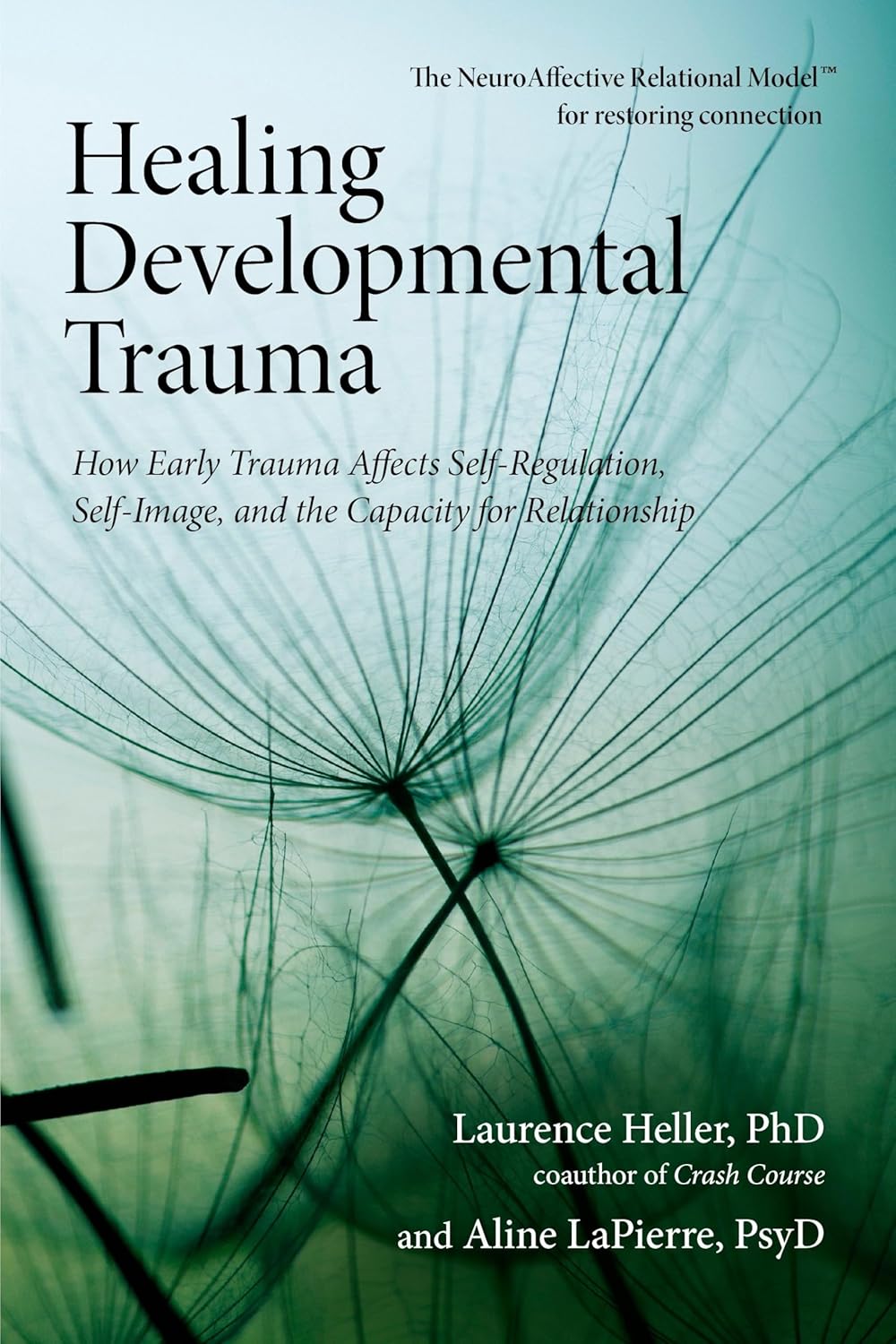
Healing Developmental Trauma: How Early Trauma Affects Self-Regulation, Self-Image, and the Capacity for Relationship

Description:

This “well-organized, valuable” guide draws from somatic-based psychotherapy and neuroscience to offer “clear guidance” for coping with childhood trauma (Peter Levine, author of Waking the Tiger and In an Unspoken Voice).
 
Although it may seem that people suffer from an endless number of emotional problems and challenges, Laurence Heller and Aline LaPierre maintain that most of these can be traced to five biologically based organizing principles: the need for connection, attunement, trust, autonomy, and love-sexuality. They describe how early trauma impairs the capacity for connection to self and others and how the ensuing diminished aliveness is the hidden dimension that underlies most psychological and many physiological problems.
 
Heller and LaPierre introduce the NeuroAffective Relational Model
® (NARM), a method that integrates bottom-up and top-down approaches to regulate the nervous system and resolve distortions of identity such as low self-esteem, shame, and chronic self-judgment that are the outcome of developmental and relational trauma. While not ignoring a person’s past, NARM emphasizes working in the present moment to focus on clients’ strengths, resources, and resiliency in order to integrate the experience of connection that sustains our physiology, psychology, and capacity for relationship.


Editorial Reviews

Review

Healing Developmental Trauma presents a comprehensive exploration of our deepest human urge. Seasoned clinicians Larry Heller and Aline LaPierre weave a rich and coherent synthesis of childhood development in the pioneering tradition of Wilhelm Reich, Erik Erikson, and Alexander Lowen. This well-organized, valuable book offers easy-to-understand tools for all of us who are seeking a better understanding of our fundamental conflicts between oneness and separateness, dependence and autonomy. Healing Developmental Trauma provides clear guidance to help us hold, with knowledge and self-compassion, those seemingly irreconcilable opposites and is a vital and accessible map supporting emotional maturity and psycho-spiritual growth.”
—Peter A Levine, PhD, author of
In an Unspoken Voice: How the Body Releases Trauma and Restores Goodness and Waking the Tiger: Healing Trauma

“Laurence Heller, PhD and Aline LaPierre, PsyD's
Healing Developmental Trauma provides a method that blends bottom-up and top-down approaches to regulating the nervous system, and provides the NeuroAffective Relational Model which focuses on maximizing client strengths and resiliency to integrate physical and emotional connections in the body.”
Midwest Book Review
 

About the Author

Laurence Heller, PhD, is the originator of the NeuroAffective Relational Model©, a unified approach to developmental, attachment, and shock trauma. He co-founded the Gestalt Institute of Denver and is a senior faculty member for the Somatic Experiencing Training Institute.

Aline LaPierre, PSYD, is founder and director of the NeuroAffective Touch® Institute and developer of NeuroAffective Touch® specializing in teaching the integration of therapeutic touch and psychotherapy. Dr. LaPierre is a graduate of Pacifica Graduate Institute, Santa Barbara, and The New Center for Psychoanalysis in Los Angeles, and is trained in many body-centered modalities, including Somatic Experiencing®, Continuum, Body-Mind Centering, acupressure, as well as craniosacral, deep tissue, and neuromuscular bodywork. Past faculty in the Somatic Doctoral Program at Santa Barbara Graduate Institute (2000–2010), she is deputy editor of the
International Body Psychotherapy Journal and vice president of the United States Association for Body Psychotherapy (USABP). A clinician, author, artist, and teacher, she maintains a private practice in West Los Angeles. For further information on NeuroAffective Touch®, please visit www.NeuroAffectiveTouch.com.

Reviews:

5.0 out of 5 stars Very amazing book - learned so much about myself

M.T. · August 9, 2021

This books is an amazing book that is not expresses the ideas very crisp but also offers a completely different perspective to look at life. It cuts across other models of how mental health and human interaction works to show that maybe the underlying principle of how everything works is different.The title suggests that the book is about developmental trauma. Yet it's not limited to people dealing with severe trauma. It provides insight in how most of us work and how our childhood affects our adult relationships.The book identifies five different attachment styles: trust attachment, love/sexuality attachment, independence, etc. It suggests that during human development each attachment develops at a different point of growing up. For example at six months old, our connection with a parent is that they are holding us in their arms and looking at us. A couple years later, we may be developing trust with our parents. Can we trust them that our needs will be met.If there are problems with one of the attachment styles, children will usually progress through a healthy range of calling attention to their needs - starting with "hey mommy, I'm hungry" to using healthy aggression. The concept of "health aggression" caught me eyes. The book is full of terms where simply hearing the term was a huge insight in and off itself. In this case, the idea that aggression can be healthy was intriguing. If that doesn't work, the child's sympathetic nervous system gets activated (fight/flight). If that doesn't work, the parasympathetic nervous system gets activated (e.g. shutting down).Simply these ideas of the different nervous systems are a fascinating concept. The sympathetic and parasympathetic nervous system can be triggered at the same time (stepping on the gas and break at the same time). That's for example, when we panic and try to suppress the panic.The books proposed remedy is to pay attention to what we are feeling in our bodies because that's how we find out about our needs. In the ideal world that the book paints, we can freely express our needs in our relationships and (as adults) also deal with when people don't necessarily tend to our needs. (E.g., because I'm a hungry adult doesn't mean the other person has to feed me. They could be full and not interested in going to a restaurant with me. Yet, that I am aware of my hunger and can express it appropriately - without fear, panic or not at all -, that's the goal.)Most people I know are functioning adults, yet I often find that what the book describes affects me. Often when I'm with people, I'm very focused on making sure that they feel entertained and comfortable. (That might be a good host's job.) Yet the book's idea is that I should scan my body to realize what's going on with me and express my needs, e.g. "I feel a bit bored, let's check out the other pool." The book shifted my thought of what a good relationship looks like: Both people should feel comfortable to express their needs and the other person responds to that. (And needs don't have to be monumental things like needing help to move, but a need for comfort at the end of a tiring hike, a need for play in a conversation that turned dry, etc.)The book opens up many interesting topics. For example, it suggests that based on unmet childhood needs, people may develop pride. E.g., if they were ignored as a child, they may pride themselves as easy going. The book suggests that for each pride, there is usually an opposite shame. That example person may have shame around being too needy. That concept alone is very interesting. Now when I hear people making prideful statements, I wonder if there is an opposite shame in place as well. (The pride essentially is trying to make us feel good about a place where we are hurting.)I've written many quotes from the book into my notebook. It was a real page turner because each page offered so many intriguing insights to how life works.

5.0 out of 5 stars Profound and Potentially Life-Changing

I. · February 25, 2013

Briefly put, this is one of the most important and profound works in the whole trauma literature. The authors' thesis holds that developmental trauma is very different than PTSD. Developmental trauma is radically far-reaching and colors the entire life of those affected by it. The athorrs outline five different adaptive survival styles used by infants to cope with trauma. The five styles are chronological in order. The first, connective survival style, is the earliest and most impactful. It takes place between birth and about a year. Where the child receives inadequate nurturing or abuse, this style becomes dominant. Other styles come in different times and have their own but less catastrophic impact. In the connection survival style the child adapts by disconnecting from his(or her) physical and emotional self. As a result, the child experiences great difficulty in relating to others and is often isolated without knowing how to address the problem.The other survival styles flow in later stages of infant development progression : attachment (difficulty knowing what we need and feeling that our needs deserve do not deserve to be met), trust (feeling that one cannot depend on anyone but themselves and feeling a need to be in control), autonomy (feeling burdened and pressured with difficulty setting limits and saying no directly), and love-sexuality (difficulty integrating heart and sexuality).The book focuses almost exclusively on the connective survival style. The two authors spend a great deal of time describing the conditions that cause this style and the difficulty that those who use it have with even recognizing it. They also spend several chapters outlining how to address the connective survival style therapeutically. In fact, those chapters are a superior description of how to operate therapeutically. Anyone in a helping profession could profit by reading them.Yours truly is one of the connective survival products. Reading the book felt like seeing myself for the first time and knowing why I was this way. The book well shows the disastrous consequences for a combination of abuse and neglect. I’m not sure what to do with all this yet but do something I will.

5.0 out of 5 stars Really excellent book

C. · March 17, 2025

Very very good book. It’s a little above my head and I will definitely read again to understand better, but the thoughtfulness and kindness and everything in this book is revelatory and healing. I highly recommend for the average person and definitely for therapists.

4.0 out of 5 stars Great information written by a robot

f.g. · February 23, 2014

I really wanted to love this book. It's got great information that I've never found anywhere else on how trauma affects self regulation. My problem is that I find the book incredibly hard to read. Sequences of word are repeated over and over. It feels distant, as if a robot wrote it. This makes it hard for me to believe that their therapy works.They put down transference. Which means they take living being of the therapist out of the therapeutic relationship. Yet, they talk about the importance of human connection. That makes it sound as if their therapy is as cold as this book.What I also find objectionable is how much time they take to describe and indirectly put down other therapeutic approaches. They also want their cake and eat it too. I get it, you guys are different. But, tell me what you do actually believe. Here's an example of how abstract they can be, "Initially, it may not be possible for traumatized individuals to access their somatic awareness; in such cases any experience of self-reference can serve as a starting point." What kind of experience of self-reference?They say the past is not important, yet they say the past is where all this started. Which is it?If you write a new edition with a heart, let me know.

one of the best books I have ever read

N. · May 19, 2013

There has to be a sixth star for this book! This book presents the context of developmental trauma and its ways of healing in an easily understandable way and with a language that a non-professionell can understand perfectly. This is a book written for really everyone. The clear structure, the graphics and scales add to an understanding on a very deep level. The authors present their profound knowledge and experience and connect all of that to a new method that is more than fitting for our age, because old boundaries and frameworks, that have never been appropriate in the understanding of the complexity of human being over all, fall away. Here a person is supported in becoming whole in a appreciative and loving way. I love this book, and I think, one can feel by reading it with how much love this work and method for healing developmental trauma is originated and presented. A must read!

24K pure gold dust

J.A. · April 6, 2019

Pure goldStupendously readable, a book hard to put down - successfully merges the worlds of psychotherapy, neuroscience, NLP (my insight) and somatic awareness into a truly innovative 21st century healing science which describes early developmental trauma to a great extent; a subject closely affiliated to Complex-PTSD: “a psychological disorder through prolonged, repeated experience of interpersonal trauma in a context of little or no chance of escape (entrapment) resulting in a pervasive disorganised-type attachment insecurity and distortion of one’s core identity.”C-PTSD is currently not included in the latest Diagnostic and Statistical Manual of Mental Disorders and for a number of years experts in the field of childhood trauma have suggested it may not be a useful category for diagnosis and treatment of children. Instead it is proposed Developmental Trauma Disorder (DTD: van der Kolk) becomes a diagnosis for “early life developmentally adverse interpersonal trauma as a result of a significant disruption or betrayal in the relationships with primary caregivers.”The ‘R’ in the NARM method stands for ‘relational’ which points to the fact “that the most important information for the development of the brain is conveyed by the social rather than physical environment.” The dominant symptoms of traumatised children can therefore be best understood, as efforts to minimise objective threat and regulate emotional distress; and “reenactments of oppositional, rebellious, unmotivated or antisocial behaviours in adulthood” can thus be viewed through the prism of ‘trauma-related triggers’ rooted in past behaviours once meant to ensure survival and minimise attachment loss, i.e. fear of abandonment. This is charted in NARM through the concept of the ‘distress cycle’: the caregiver misattunes - child protests - child senses self as bad - misattunement continues - disconnection continues - loss of capacity to self-regulate - pride based counter-identifications develop - leading to morbid nervous system dysregulation of high arousal.NARM ultimately has been designed to help those diagnosed with developmental trauma acquire the skills of coping by mastering new connections between their experiences, emotions and physical sensations to reprogram the damage done in early childhood when a distortion of ‘proception’ - the development of experience in order to anticipate social responses - created a confused internal schemata of the affective and cognitive characteristics of primary relationships.The main tools in NARM’s locker appear to be derived from Gestalt therapy’s in-the-moment framework and the principle “that the mind forms a global whole with self-organising tendencies.” A set of five powerful neuro-affective techniques are offered consisting of containment, grounding, orienting, titration and pendulation. These can be easily recognised as having parallels in other therapeutic approaches that repair the capacity for a healthy differentiation of self and connection to others. However, it is the sub-cellular (quantum array network) bottom-up processing interventions based on the work of Levine (Somatic Experiencing) which is the game changer and creates the conditions for discharging shock states through increasing contact with the body; and successfully integrates the neuroaxonal top-down processing of enquiry into issues of shame-based identification and the uncovering of core needs and capacities.The only other book I have yet read on the same topic is Steven Kessler’s 5 Personality Patterns (see review) which also delves into the bioenergetics of Lowen (1975) - ‘The Revolutionary Therapy That Uses the Language of the Body to Heal Problems of the Mind’. I found Heller’s approach more easily comprehensible in half the word count partly due to its overtly expressed clinical underpinnings in a technical format I happen to prefer, and in its supporting diagrams. In fact it is my truest contention the Neuro Affective Relational Touch Model could be marketed for the best seller list, possibly something akin to the once phenomenal popularity of The Roadless Traveled (1978) - such is the potential of this book “to anyone on a path of self-discovery seeking new tools for self-awareness, growth, and healing.”Finally, it must be the saddest truth of all that unless we have been vastly fortunate not to have suffered some kind of early trauma - “when in a world the vast majority of those responsible for child maltreatment are the children’s own parents” - then the tendency for many of us to grow up and repeat the sins of our perpetrators is a hidden statistic that is waiting to be acted upon, and would account for so much social disruption in literally ‘all’ walks of life.

Somatic treatment is interesting but the book is poorly written

l. · February 17, 2016

The book claims that CPTSD clients could access their numbed emotions through bodily sensations, and they could develop attachment with the therapist through bodily touches. It is persuasive.It's just that the book is so repetitive. It feels often like "You just said that two sentences ago!! And you said that in the beginning of this chapter and also in the previous chapter and also in the chapter before the previous chapter, and four sentences ago also!!" to the extent that in the end made me feel physically sick. I did not feel the authors' effort in trying to communicate the message in an effective way. The book probably didn't have to be this long if they did.The Affective Touch case study is descriptive and practical, but for the rest, I did not enjoy the reading.

Wow! What an eye opening read into trauma. Full of nuggets of wisdom.

J. · March 21, 2021

I read this book from the perspective of a survivor of developmental trauma. It has made my journey make sense. I will continue working to heal this trauma. Thank you for a great list of resources as well for continued reading. And I imagine therapists would gain so much insight into understanding their clients' early childhood trauma. Highly recommend.

Clarified my life's challenges

G.C. · December 3, 2022

This book explained why I am the way I am. All my symptoms which started at a young age and have endured throughout my adult life is explained in this book. Once I finished the book I contacted a NARM therapist (on-line) and I'm receiving treatment now. I've started to sleep better after my second session. Time will tell if the NARM sessions eliminates most of my symptoms or not, I am hopeful however.I found this book contains a wealth of information. Yes, there were a few concepts I didn't understand but don't let that stop you, just plow through like I did. Good luck.

Healing Developmental Trauma: How Early Trauma Affects Self-Regulation, Self-Image, and the Capacity for Relationship

Product ID: U1583944893
Condition: New

4.7

AED9781

Price includes VAT & Import Duties
Type: Paperback
Availability: In Stock

Quantity:

|

Order today to get by 7-14 business days

Delivery fee of AED 20. Free for orders above AED 200.

Returns & Warranty policies

Imported From: United States

At BOLO, we work hard to ensure the products you receive are new, genuine, and sourced from reputable suppliers.

BOLO is not an authorized or official retailer for most brands, nor are we affiliated with manufacturers unless specifically stated on a product page. Instead, we source verified sellers, authorized distributors or directly from the manufacturer.

Each product undergoes thorough inspection and verification at our consolidation and fulfilment centers to ensure it meets our strict authenticity and quality standards before being shipped and delivered to you.

If you ever have concerns regarding the authenticity of a product purchased from us, please contact Bolo Support. We will review your inquiry promptly and, if necessary, provide documentation verifying authenticity or offer a suitable resolution.

Your trust is our top priority, and we are committed to maintaining transparency and integrity in every transaction.

All product information, images, descriptions, and reviews originate from the manufacturer or from trusted sellers overseas. BOLO is not affiliated with, endorsed by, or an authorized retailer for most brands listed on our website unless stated otherwise.

While we strive to display accurate information, variations in packaging, labeling, instructions, or formulation may occasionally occur due to regional differences or supplier updates. For detailed or manufacturer-specific information, please contact the brand directly or reach out to BOLO Support for assistance.

Unless otherwise stated, all prices displayed on the product page include applicable taxes and import duties.

BOLO operates in accordance with the laws and regulations of United Arab Emirates. Any items found to be restricted or prohibited for sale within the UAE will be cancelled prior to shipment. We take proactive measures to ensure that only products permitted for sale in United Arab Emirates are listed on our website.

All items are shipped by air, and any products classified as “Dangerous Goods (DG)” under IATA regulations will be removed from the order and cancelled.

All orders are processed manually, and we make every effort to process them promptly once confirmed. Products cancelled due to the above reasons will be permanently removed from listings across the website.

Similar suggestions by Bolo

More from this brand

Similar items from “Post-Traumatic Stress”

Healing Developmental Trauma: How Early Trauma Affects Self-Regulation, Self-Image, and the Capacity for Relationship

Product ID: U1583944893
Condition: New

4.7

Healing Developmental Trauma: How Early Trauma Affects Self-Regulation, Self-Image, and the Capacity for Relationship-0
Type: Paperback

AED9781

Price includes VAT & Import Duties
Availability: In Stock

Quantity:

|

Order today to get by 7-14 business days

Delivery fee of AED 20. Free for orders above AED 200.

Returns & Warranty policies

Imported From: United States

At BOLO, we work hard to ensure the products you receive are new, genuine, and sourced from reputable suppliers.

BOLO is not an authorized or official retailer for most brands, nor are we affiliated with manufacturers unless specifically stated on a product page. Instead, we source verified sellers, authorized distributors or directly from the manufacturer.

Each product undergoes thorough inspection and verification at our consolidation and fulfilment centers to ensure it meets our strict authenticity and quality standards before being shipped and delivered to you.

If you ever have concerns regarding the authenticity of a product purchased from us, please contact Bolo Support. We will review your inquiry promptly and, if necessary, provide documentation verifying authenticity or offer a suitable resolution.

Your trust is our top priority, and we are committed to maintaining transparency and integrity in every transaction.

All product information, images, descriptions, and reviews originate from the manufacturer or from trusted sellers overseas. BOLO is not affiliated with, endorsed by, or an authorized retailer for most brands listed on our website unless stated otherwise.

While we strive to display accurate information, variations in packaging, labeling, instructions, or formulation may occasionally occur due to regional differences or supplier updates. For detailed or manufacturer-specific information, please contact the brand directly or reach out to BOLO Support for assistance.

Unless otherwise stated, all prices displayed on the product page include applicable taxes and import duties.

BOLO operates in accordance with the laws and regulations of United Arab Emirates. Any items found to be restricted or prohibited for sale within the UAE will be cancelled prior to shipment. We take proactive measures to ensure that only products permitted for sale in United Arab Emirates are listed on our website.

All items are shipped by air, and any products classified as “Dangerous Goods (DG)” under IATA regulations will be removed from the order and cancelled.

All orders are processed manually, and we make every effort to process them promptly once confirmed. Products cancelled due to the above reasons will be permanently removed from listings across the website.

Description:

This “well-organized, valuable” guide draws from somatic-based psychotherapy and neuroscience to offer “clear guidance” for coping with childhood trauma (Peter Levine, author of Waking the Tiger and In an Unspoken Voice).
 
Although it may seem that people suffer from an endless number of emotional problems and challenges, Laurence Heller and Aline LaPierre maintain that most of these can be traced to five biologically based organizing principles: the need for connection, attunement, trust, autonomy, and love-sexuality. They describe how early trauma impairs the capacity for connection to self and others and how the ensuing diminished aliveness is the hidden dimension that underlies most psychological and many physiological problems.
 
Heller and LaPierre introduce the NeuroAffective Relational Model
® (NARM), a method that integrates bottom-up and top-down approaches to regulate the nervous system and resolve distortions of identity such as low self-esteem, shame, and chronic self-judgment that are the outcome of developmental and relational trauma. While not ignoring a person’s past, NARM emphasizes working in the present moment to focus on clients’ strengths, resources, and resiliency in order to integrate the experience of connection that sustains our physiology, psychology, and capacity for relationship.


Editorial Reviews

Review

Healing Developmental Trauma presents a comprehensive exploration of our deepest human urge. Seasoned clinicians Larry Heller and Aline LaPierre weave a rich and coherent synthesis of childhood development in the pioneering tradition of Wilhelm Reich, Erik Erikson, and Alexander Lowen. This well-organized, valuable book offers easy-to-understand tools for all of us who are seeking a better understanding of our fundamental conflicts between oneness and separateness, dependence and autonomy. Healing Developmental Trauma provides clear guidance to help us hold, with knowledge and self-compassion, those seemingly irreconcilable opposites and is a vital and accessible map supporting emotional maturity and psycho-spiritual growth.”
—Peter A Levine, PhD, author of
In an Unspoken Voice: How the Body Releases Trauma and Restores Goodness and Waking the Tiger: Healing Trauma

“Laurence Heller, PhD and Aline LaPierre, PsyD's
Healing Developmental Trauma provides a method that blends bottom-up and top-down approaches to regulating the nervous system, and provides the NeuroAffective Relational Model which focuses on maximizing client strengths and resiliency to integrate physical and emotional connections in the body.”
Midwest Book Review
 

About the Author

Laurence Heller, PhD, is the originator of the NeuroAffective Relational Model©, a unified approach to developmental, attachment, and shock trauma. He co-founded the Gestalt Institute of Denver and is a senior faculty member for the Somatic Experiencing Training Institute.

Aline LaPierre, PSYD, is founder and director of the NeuroAffective Touch® Institute and developer of NeuroAffective Touch® specializing in teaching the integration of therapeutic touch and psychotherapy. Dr. LaPierre is a graduate of Pacifica Graduate Institute, Santa Barbara, and The New Center for Psychoanalysis in Los Angeles, and is trained in many body-centered modalities, including Somatic Experiencing®, Continuum, Body-Mind Centering, acupressure, as well as craniosacral, deep tissue, and neuromuscular bodywork. Past faculty in the Somatic Doctoral Program at Santa Barbara Graduate Institute (2000–2010), she is deputy editor of the
International Body Psychotherapy Journal and vice president of the United States Association for Body Psychotherapy (USABP). A clinician, author, artist, and teacher, she maintains a private practice in West Los Angeles. For further information on NeuroAffective Touch®, please visit www.NeuroAffectiveTouch.com.

Reviews:

5.0 out of 5 stars Very amazing book - learned so much about myself

M.T. · August 9, 2021

This books is an amazing book that is not expresses the ideas very crisp but also offers a completely different perspective to look at life. It cuts across other models of how mental health and human interaction works to show that maybe the underlying principle of how everything works is different.The title suggests that the book is about developmental trauma. Yet it's not limited to people dealing with severe trauma. It provides insight in how most of us work and how our childhood affects our adult relationships.The book identifies five different attachment styles: trust attachment, love/sexuality attachment, independence, etc. It suggests that during human development each attachment develops at a different point of growing up. For example at six months old, our connection with a parent is that they are holding us in their arms and looking at us. A couple years later, we may be developing trust with our parents. Can we trust them that our needs will be met.If there are problems with one of the attachment styles, children will usually progress through a healthy range of calling attention to their needs - starting with "hey mommy, I'm hungry" to using healthy aggression. The concept of "health aggression" caught me eyes. The book is full of terms where simply hearing the term was a huge insight in and off itself. In this case, the idea that aggression can be healthy was intriguing. If that doesn't work, the child's sympathetic nervous system gets activated (fight/flight). If that doesn't work, the parasympathetic nervous system gets activated (e.g. shutting down).Simply these ideas of the different nervous systems are a fascinating concept. The sympathetic and parasympathetic nervous system can be triggered at the same time (stepping on the gas and break at the same time). That's for example, when we panic and try to suppress the panic.The books proposed remedy is to pay attention to what we are feeling in our bodies because that's how we find out about our needs. In the ideal world that the book paints, we can freely express our needs in our relationships and (as adults) also deal with when people don't necessarily tend to our needs. (E.g., because I'm a hungry adult doesn't mean the other person has to feed me. They could be full and not interested in going to a restaurant with me. Yet, that I am aware of my hunger and can express it appropriately - without fear, panic or not at all -, that's the goal.)Most people I know are functioning adults, yet I often find that what the book describes affects me. Often when I'm with people, I'm very focused on making sure that they feel entertained and comfortable. (That might be a good host's job.) Yet the book's idea is that I should scan my body to realize what's going on with me and express my needs, e.g. "I feel a bit bored, let's check out the other pool." The book shifted my thought of what a good relationship looks like: Both people should feel comfortable to express their needs and the other person responds to that. (And needs don't have to be monumental things like needing help to move, but a need for comfort at the end of a tiring hike, a need for play in a conversation that turned dry, etc.)The book opens up many interesting topics. For example, it suggests that based on unmet childhood needs, people may develop pride. E.g., if they were ignored as a child, they may pride themselves as easy going. The book suggests that for each pride, there is usually an opposite shame. That example person may have shame around being too needy. That concept alone is very interesting. Now when I hear people making prideful statements, I wonder if there is an opposite shame in place as well. (The pride essentially is trying to make us feel good about a place where we are hurting.)I've written many quotes from the book into my notebook. It was a real page turner because each page offered so many intriguing insights to how life works.

5.0 out of 5 stars Profound and Potentially Life-Changing

I. · February 25, 2013

Briefly put, this is one of the most important and profound works in the whole trauma literature. The authors' thesis holds that developmental trauma is very different than PTSD. Developmental trauma is radically far-reaching and colors the entire life of those affected by it. The athorrs outline five different adaptive survival styles used by infants to cope with trauma. The five styles are chronological in order. The first, connective survival style, is the earliest and most impactful. It takes place between birth and about a year. Where the child receives inadequate nurturing or abuse, this style becomes dominant. Other styles come in different times and have their own but less catastrophic impact. In the connection survival style the child adapts by disconnecting from his(or her) physical and emotional self. As a result, the child experiences great difficulty in relating to others and is often isolated without knowing how to address the problem.The other survival styles flow in later stages of infant development progression : attachment (difficulty knowing what we need and feeling that our needs deserve do not deserve to be met), trust (feeling that one cannot depend on anyone but themselves and feeling a need to be in control), autonomy (feeling burdened and pressured with difficulty setting limits and saying no directly), and love-sexuality (difficulty integrating heart and sexuality).The book focuses almost exclusively on the connective survival style. The two authors spend a great deal of time describing the conditions that cause this style and the difficulty that those who use it have with even recognizing it. They also spend several chapters outlining how to address the connective survival style therapeutically. In fact, those chapters are a superior description of how to operate therapeutically. Anyone in a helping profession could profit by reading them.Yours truly is one of the connective survival products. Reading the book felt like seeing myself for the first time and knowing why I was this way. The book well shows the disastrous consequences for a combination of abuse and neglect. I’m not sure what to do with all this yet but do something I will.

5.0 out of 5 stars Really excellent book

C. · March 17, 2025

Very very good book. It’s a little above my head and I will definitely read again to understand better, but the thoughtfulness and kindness and everything in this book is revelatory and healing. I highly recommend for the average person and definitely for therapists.

4.0 out of 5 stars Great information written by a robot

f.g. · February 23, 2014

I really wanted to love this book. It's got great information that I've never found anywhere else on how trauma affects self regulation. My problem is that I find the book incredibly hard to read. Sequences of word are repeated over and over. It feels distant, as if a robot wrote it. This makes it hard for me to believe that their therapy works.They put down transference. Which means they take living being of the therapist out of the therapeutic relationship. Yet, they talk about the importance of human connection. That makes it sound as if their therapy is as cold as this book.What I also find objectionable is how much time they take to describe and indirectly put down other therapeutic approaches. They also want their cake and eat it too. I get it, you guys are different. But, tell me what you do actually believe. Here's an example of how abstract they can be, "Initially, it may not be possible for traumatized individuals to access their somatic awareness; in such cases any experience of self-reference can serve as a starting point." What kind of experience of self-reference?They say the past is not important, yet they say the past is where all this started. Which is it?If you write a new edition with a heart, let me know.

one of the best books I have ever read

N. · May 19, 2013

There has to be a sixth star for this book! This book presents the context of developmental trauma and its ways of healing in an easily understandable way and with a language that a non-professionell can understand perfectly. This is a book written for really everyone. The clear structure, the graphics and scales add to an understanding on a very deep level. The authors present their profound knowledge and experience and connect all of that to a new method that is more than fitting for our age, because old boundaries and frameworks, that have never been appropriate in the understanding of the complexity of human being over all, fall away. Here a person is supported in becoming whole in a appreciative and loving way. I love this book, and I think, one can feel by reading it with how much love this work and method for healing developmental trauma is originated and presented. A must read!

24K pure gold dust

J.A. · April 6, 2019

Pure goldStupendously readable, a book hard to put down - successfully merges the worlds of psychotherapy, neuroscience, NLP (my insight) and somatic awareness into a truly innovative 21st century healing science which describes early developmental trauma to a great extent; a subject closely affiliated to Complex-PTSD: “a psychological disorder through prolonged, repeated experience of interpersonal trauma in a context of little or no chance of escape (entrapment) resulting in a pervasive disorganised-type attachment insecurity and distortion of one’s core identity.”C-PTSD is currently not included in the latest Diagnostic and Statistical Manual of Mental Disorders and for a number of years experts in the field of childhood trauma have suggested it may not be a useful category for diagnosis and treatment of children. Instead it is proposed Developmental Trauma Disorder (DTD: van der Kolk) becomes a diagnosis for “early life developmentally adverse interpersonal trauma as a result of a significant disruption or betrayal in the relationships with primary caregivers.”The ‘R’ in the NARM method stands for ‘relational’ which points to the fact “that the most important information for the development of the brain is conveyed by the social rather than physical environment.” The dominant symptoms of traumatised children can therefore be best understood, as efforts to minimise objective threat and regulate emotional distress; and “reenactments of oppositional, rebellious, unmotivated or antisocial behaviours in adulthood” can thus be viewed through the prism of ‘trauma-related triggers’ rooted in past behaviours once meant to ensure survival and minimise attachment loss, i.e. fear of abandonment. This is charted in NARM through the concept of the ‘distress cycle’: the caregiver misattunes - child protests - child senses self as bad - misattunement continues - disconnection continues - loss of capacity to self-regulate - pride based counter-identifications develop - leading to morbid nervous system dysregulation of high arousal.NARM ultimately has been designed to help those diagnosed with developmental trauma acquire the skills of coping by mastering new connections between their experiences, emotions and physical sensations to reprogram the damage done in early childhood when a distortion of ‘proception’ - the development of experience in order to anticipate social responses - created a confused internal schemata of the affective and cognitive characteristics of primary relationships.The main tools in NARM’s locker appear to be derived from Gestalt therapy’s in-the-moment framework and the principle “that the mind forms a global whole with self-organising tendencies.” A set of five powerful neuro-affective techniques are offered consisting of containment, grounding, orienting, titration and pendulation. These can be easily recognised as having parallels in other therapeutic approaches that repair the capacity for a healthy differentiation of self and connection to others. However, it is the sub-cellular (quantum array network) bottom-up processing interventions based on the work of Levine (Somatic Experiencing) which is the game changer and creates the conditions for discharging shock states through increasing contact with the body; and successfully integrates the neuroaxonal top-down processing of enquiry into issues of shame-based identification and the uncovering of core needs and capacities.The only other book I have yet read on the same topic is Steven Kessler’s 5 Personality Patterns (see review) which also delves into the bioenergetics of Lowen (1975) - ‘The Revolutionary Therapy That Uses the Language of the Body to Heal Problems of the Mind’. I found Heller’s approach more easily comprehensible in half the word count partly due to its overtly expressed clinical underpinnings in a technical format I happen to prefer, and in its supporting diagrams. In fact it is my truest contention the Neuro Affective Relational Touch Model could be marketed for the best seller list, possibly something akin to the once phenomenal popularity of The Roadless Traveled (1978) - such is the potential of this book “to anyone on a path of self-discovery seeking new tools for self-awareness, growth, and healing.”Finally, it must be the saddest truth of all that unless we have been vastly fortunate not to have suffered some kind of early trauma - “when in a world the vast majority of those responsible for child maltreatment are the children’s own parents” - then the tendency for many of us to grow up and repeat the sins of our perpetrators is a hidden statistic that is waiting to be acted upon, and would account for so much social disruption in literally ‘all’ walks of life.

Somatic treatment is interesting but the book is poorly written

l. · February 17, 2016

The book claims that CPTSD clients could access their numbed emotions through bodily sensations, and they could develop attachment with the therapist through bodily touches. It is persuasive.It's just that the book is so repetitive. It feels often like "You just said that two sentences ago!! And you said that in the beginning of this chapter and also in the previous chapter and also in the chapter before the previous chapter, and four sentences ago also!!" to the extent that in the end made me feel physically sick. I did not feel the authors' effort in trying to communicate the message in an effective way. The book probably didn't have to be this long if they did.The Affective Touch case study is descriptive and practical, but for the rest, I did not enjoy the reading.

Wow! What an eye opening read into trauma. Full of nuggets of wisdom.

J. · March 21, 2021

I read this book from the perspective of a survivor of developmental trauma. It has made my journey make sense. I will continue working to heal this trauma. Thank you for a great list of resources as well for continued reading. And I imagine therapists would gain so much insight into understanding their clients' early childhood trauma. Highly recommend.

Clarified my life's challenges

G.C. · December 3, 2022

This book explained why I am the way I am. All my symptoms which started at a young age and have endured throughout my adult life is explained in this book. Once I finished the book I contacted a NARM therapist (on-line) and I'm receiving treatment now. I've started to sleep better after my second session. Time will tell if the NARM sessions eliminates most of my symptoms or not, I am hopeful however.I found this book contains a wealth of information. Yes, there were a few concepts I didn't understand but don't let that stop you, just plow through like I did. Good luck.

Similar suggestions by Bolo

More from this brand

Similar items from “Post-Traumatic Stress”