Deliver toUnited Arab Emirates
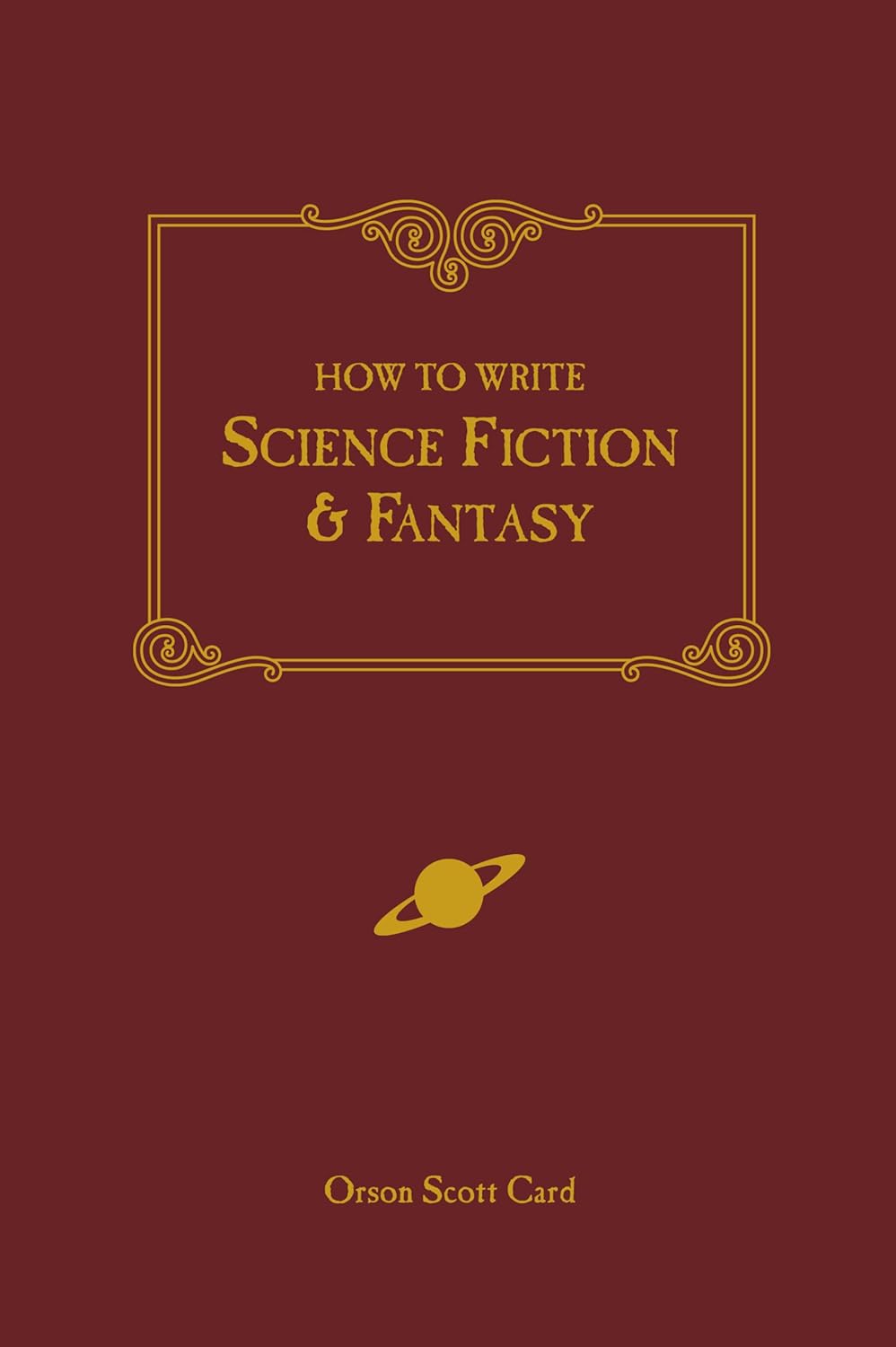
How to Write Science Fiction & Fantasy

Description:

Learn to write science fiction and fantasy from a master

You've always dreamed of writing science fiction and fantasy tales that pull readers into extraordinary new worlds and fantastic conflicts. Best-selling author
Orson Scott Card shows you how it's done, distilling years of writing experience and publishing success into concise, no-nonsense advice. You'll learn how to:

   • utilize story elements that define the science fiction and fantasy genres
   • build, populate, and dramatize a credible, inviting world your readers will want to explore
   • develop the "rules" of time, space and magic that affect your world and its inhabitants
   • construct a compelling story by developing ideas, characters, and events that keep readers turning pages
   • find the markets for speculative fiction, reach them, and get published
   • submit queries, write cover letters, find an agent, and live the life of a writer


The boundaries of your imagination are infinite. Explore them with Orson Scott Card and create fiction that casts a spell over agents, publishers, and readers from every world.


Editorial Reviews

About the Author

Orson Scott Card is one of the biggest names in science fiction and fantasy. He won both the Hugo and Nebula science fiction awards for best novel for two consecutive years--something no other writer has ever done. In addition, he was the first writer to ever win a Nebula and a Hugo for both a book and its sequel, Ender's Game and Speaker for the Dead. His current best-seller is Shadow of Hegemon. He lives in North Carolina.

Reviews:

5.0 out of 5 stars top resource for writing speculative fiction, particularly sf

T.L.W. · December 27, 2008

(function() { P.when('cr-A', 'ready').execute(function(A) { if(typeof A.toggleExpanderAriaLabel === 'function') { A.toggleExpanderAriaLabel('review_text_read_more', 'Read more of this review', 'Read less of this review'); } }); })(); .review-text-read-more-expander:focus-visible { outline: 2px solid #2162a1; outline-offset: 2px; border-radius: 5px; } Orson Scott Card (well known to sf circles as the author of Ender's Game) presents his advice on writing science fiction and fantasy. The book has a specific and limited scope: rather than trying to teach everything one needs to know to write fiction, Card addresses only those areas where speculative fiction differs from other types. Consequently, this is not a stand-alone writing book. If you are unacquainted with the craft of plotting, character development, dialog, etc., you will need to fill those gaps in some other way.Within the scope the book sets for itself, however, it is top notch. Card really knows his stuff, and has a knack for articulating what he knows in a helpful and memorable way. Particularly valuable is the section on exposition. While most books on fiction writing preach minimizing exposition, Card understands that speculative fiction requires it. The imaginative worlds of speculative fiction are not familiar to readers; they need explaining, and readers expect satisfying explanations. Card explains the conventions of the genre that are used to present exposition without stalling the story. He uses Wild Seed by Octavia Butler to illustrate the ideas, so the reader can see tangible examples of the principles he describes.I also enjoyed his breakdown of stories into four categories (MICE, for milieu, idea, character, and event). He deftly summarizes how each type of story needs to work, and the problems that can result if you don't know what type of story you are writing. This was illuminating and refreshing, since most books on writing do not even acknowledge that fiction can be driven by anything other than character development. In speculative fiction, however, milieu and idea driven stories are part of the landscape, and the aspiring writer needs to understand how they work.Card also offers excellent advice about the business of writing, covering subjects beyond manuscript preparation and agents, such as writer's workshops and classes, sf conventions, and so on. Once again, his familiarity with the world of sf writing comes through strong and clear; he's not merely repeating standard bits of advice, but is writing from experience.A few words of caution: The book was published in 1990, and so is a bit dated in places (there is a bigger market for fantasy short stories than when Card was writing, for example), and the book emphasizes sf more than fantasy. (One notable disappointment in this regard: In one section, there is a discussion of the mechanics of interstellar travel, time travel, and magic. The first two topics receive well-thought-out lists of the different approaches used in sf, and their story implications. Magic, instead of receiving a similar treatment, gets a digression riffing off the idea that magicians sacrifice body parts to cast spells. It's an interesting train of thought, but something less narrow and idiosyncratic would have been appreciated.)On balance, this is the very best book I have found on the special issues that arise when writing science fiction and fantasy. Paired with something like The Complete Handbook of Novel Writing, it will answer most questions an aspiring writer in these genres is likely to face.

5.0 out of 5 stars Short, sweet, to the point

C.B. · October 7, 2007

This is an awesome little book that delves into the basics of writing speculative fiction from world building to publishing to dealing with family members who don't understand your need to write. I read one Amazon reviewer who didn't care for this book because everything in it is intuitive. Yes, most of what's in here makes perfect sense in a "Well, duh!" kind of way, but sometimes intuitive things need to be spelled out clearly. You may kind of know something at the back of your brain, but unless you can bring it to the front of your mind, it's not going to work for you. This book brings these things to the front of your mind, simply, clearly, and effectively.For example, Mr. Card writes that you should know why things are the way they are in your world. (Well duh, right?) Of course you should know why things work the way they do in your world, whether it's how spaceships manage to travel faster than light, or what the price of magic is. But the important thing is to know how all this stuff works before you really start, as opposed to making it up as you go. If you know what the rules are, then you can make your world believable. (Also, you don't have to keep going back and forth trying to find what you wrote before so that you don't contradict yourself.) What your characters do within those rules can happen spur of the moment, but the world they live in must be pretty well defined in your own mind before they start living there.The last section (The Life and Business of Writing) was the least intuitive of all, but so necessary. Getting published doens't mean quitting your day job (OK, that part was intuitive). Some of what he says is almost disheartening, but my feeling is, being prepared is better than being surprised. Knowing about the pitfalls can help you avoid them.I could go on and on about how helpful this book is, but I have a future bestseller calling to me, demanding that I plug a few holes and flesh out some of those pesky middle parts. So get this book if you like to write sci-fi or fantasy and your intuition is being a bit non-specific. It's good, plain and simple.

4.0 out of 5 stars Extremely Good

N.T. · March 3, 2008

Well written, with lots of great insights and real confidence builder. Card also give a lot of resources for further study. At one point (from memory) he says that you must simultaneously believe that the story you are working on today is the greatest story ever written ... so that you have the confidence to move forward. And that the current story you are working on is drivel (my word), so you can take the criticisms and rejection and move on.The advice he gives on how to query magazines and publishers is worth it's weight in gold, and the section on being careful not to get "pegged" in a specific genre is pretty good too.The only reason this book doesn't currently rate 5 stars is because some of the information is outdated. I simply have to wonder if, other than certain magazines being out of print, if anything else in the Sci Fi & Fantasy realms have changed since the book was written?Maybe it's time to spend a day or two updating the content, and releasing a new edition.

muy útil y sensato

w.a.b. · February 15, 2021

(function() { P.when('cr-A', 'ready').execute(function(A) { if(typeof A.toggleExpanderAriaLabel === 'function') { A.toggleExpanderAriaLabel('review_text_read_more', 'Read more of this review', 'Read less of this review'); } }); })(); .review-text-read-more-expander:focus-visible { outline: 2px solid #2162a1; outline-offset: 2px; border-radius: 5px; } bien planteado y sencillo de seguir. algunos comentarios realmente muy útiles. gracias

Gives insights to the world of writing genre in America

A.K. · October 5, 2018

How publishing of Science Fiction and Fantasy developed is very interesting to read. Besides it tells how to write in these genres and how to decide what type of story you wrote.

SF&ファンタジーファン必見!!

慶. · January 16, 2007

『エンダーのゲーム』で有名なオースン・スコット・カードが書いた所謂“SFの書き方”です。内容は、SFとファンタジー特有のジャンルの境界,世界設定の作り方,物語の構成方法,SFならではの書き方,作家になる方法についてです。それぞれについて具体的な例を挙げて分かりやすく書かれていて、特に『エンダーのゲーム』が出来上がるまでのエピソードはファンならずとも興味深い話です。和書でSFの書き方についての本はほとんどないので、英語能力が心もとないにもかかわらず、この本を購入してみましたが、英語も分かりやすく、内容も面白く、なんとか無事読み終えました。作者のファンは勿論のこと、SFについて詳しく知りたい人、SFを書いてみたい人には、この本は必読だと思います。

Actually, value for money in a very crowded topic...

M.L. · January 13, 2014

At last I found something useful in this 'helping yourself to write' category, after several ununseful books that promise one thing and deliver 'copy & paste' wikipedia material. Anyway, Orson Scott Card is quite an opinionated guy, and therefore you will find some useful things here, different from other 'how-to' books.

An amazing self help book.

M. · September 18, 2013

Really, very, very informative. A few mentions of his own works that might be accused of product placement, but levelled out by mentions of other books by other authors, to make examples of points.Really, Really advise that if your unsure what to do or what your doing, buy this.

How to Write Science Fiction & Fantasy

Product ID: U158297103K
Condition: New

4.5

AED15953

Price includes VAT & Import Duties
Type: Paperback
Availability: In Stock

Quantity:

|

Order today to get by 7-14 business days

Delivery fee of AED 20. Free for orders above AED 200.

Returns & Warranty policies

Imported From: United States

At BOLO, we work hard to ensure the products you receive are new, genuine, and sourced from reputable suppliers.

BOLO is not an authorized or official retailer for most brands, nor are we affiliated with manufacturers unless specifically stated on a product page. Instead, we source verified sellers, authorized distributors or directly from the manufacturer.

Each product undergoes thorough inspection and verification at our consolidation and fulfilment centers to ensure it meets our strict authenticity and quality standards before being shipped and delivered to you.

If you ever have concerns regarding the authenticity of a product purchased from us, please contact Bolo Support. We will review your inquiry promptly and, if necessary, provide documentation verifying authenticity or offer a suitable resolution.

Your trust is our top priority, and we are committed to maintaining transparency and integrity in every transaction.

All product information, images, descriptions, and reviews originate from the manufacturer or from trusted sellers overseas. BOLO is not affiliated with, endorsed by, or an authorized retailer for most brands listed on our website unless stated otherwise.

While we strive to display accurate information, variations in packaging, labeling, instructions, or formulation may occasionally occur due to regional differences or supplier updates. For detailed or manufacturer-specific information, please contact the brand directly or reach out to BOLO Support for assistance.

Unless otherwise stated, all prices displayed on the product page include applicable taxes and import duties.

BOLO operates in accordance with the laws and regulations of United Arab Emirates. Any items found to be restricted or prohibited for sale within the UAE will be cancelled prior to shipment. We take proactive measures to ensure that only products permitted for sale in United Arab Emirates are listed on our website.

All items are shipped by air, and any products classified as “Dangerous Goods (DG)” under IATA regulations will be removed from the order and cancelled.

All orders are processed manually, and we make every effort to process them promptly once confirmed. Products cancelled due to the above reasons will be permanently removed from listings across the website.

More from this brand

Similar items from “Travel”

How to Write Science Fiction & Fantasy

Product ID: U158297103K
Condition: New

4.5

How to Write Science Fiction & Fantasy-0
Type: Paperback

AED15953

Price includes VAT & Import Duties
Availability: In Stock

Quantity:

|

Order today to get by 7-14 business days

Delivery fee of AED 20. Free for orders above AED 200.

Returns & Warranty policies

Imported From: United States

At BOLO, we work hard to ensure the products you receive are new, genuine, and sourced from reputable suppliers.

BOLO is not an authorized or official retailer for most brands, nor are we affiliated with manufacturers unless specifically stated on a product page. Instead, we source verified sellers, authorized distributors or directly from the manufacturer.

Each product undergoes thorough inspection and verification at our consolidation and fulfilment centers to ensure it meets our strict authenticity and quality standards before being shipped and delivered to you.

If you ever have concerns regarding the authenticity of a product purchased from us, please contact Bolo Support. We will review your inquiry promptly and, if necessary, provide documentation verifying authenticity or offer a suitable resolution.

Your trust is our top priority, and we are committed to maintaining transparency and integrity in every transaction.

All product information, images, descriptions, and reviews originate from the manufacturer or from trusted sellers overseas. BOLO is not affiliated with, endorsed by, or an authorized retailer for most brands listed on our website unless stated otherwise.

While we strive to display accurate information, variations in packaging, labeling, instructions, or formulation may occasionally occur due to regional differences or supplier updates. For detailed or manufacturer-specific information, please contact the brand directly or reach out to BOLO Support for assistance.

Unless otherwise stated, all prices displayed on the product page include applicable taxes and import duties.

BOLO operates in accordance with the laws and regulations of United Arab Emirates. Any items found to be restricted or prohibited for sale within the UAE will be cancelled prior to shipment. We take proactive measures to ensure that only products permitted for sale in United Arab Emirates are listed on our website.

All items are shipped by air, and any products classified as “Dangerous Goods (DG)” under IATA regulations will be removed from the order and cancelled.

All orders are processed manually, and we make every effort to process them promptly once confirmed. Products cancelled due to the above reasons will be permanently removed from listings across the website.

Description:

Learn to write science fiction and fantasy from a master

You've always dreamed of writing science fiction and fantasy tales that pull readers into extraordinary new worlds and fantastic conflicts. Best-selling author
Orson Scott Card shows you how it's done, distilling years of writing experience and publishing success into concise, no-nonsense advice. You'll learn how to:

   • utilize story elements that define the science fiction and fantasy genres
   • build, populate, and dramatize a credible, inviting world your readers will want to explore
   • develop the "rules" of time, space and magic that affect your world and its inhabitants
   • construct a compelling story by developing ideas, characters, and events that keep readers turning pages
   • find the markets for speculative fiction, reach them, and get published
   • submit queries, write cover letters, find an agent, and live the life of a writer


The boundaries of your imagination are infinite. Explore them with Orson Scott Card and create fiction that casts a spell over agents, publishers, and readers from every world.


Editorial Reviews

About the Author

Orson Scott Card is one of the biggest names in science fiction and fantasy. He won both the Hugo and Nebula science fiction awards for best novel for two consecutive years--something no other writer has ever done. In addition, he was the first writer to ever win a Nebula and a Hugo for both a book and its sequel, Ender's Game and Speaker for the Dead. His current best-seller is Shadow of Hegemon. He lives in North Carolina.

Reviews:

5.0 out of 5 stars top resource for writing speculative fiction, particularly sf

T.L.W. · December 27, 2008

(function() { P.when('cr-A', 'ready').execute(function(A) { if(typeof A.toggleExpanderAriaLabel === 'function') { A.toggleExpanderAriaLabel('review_text_read_more', 'Read more of this review', 'Read less of this review'); } }); })(); .review-text-read-more-expander:focus-visible { outline: 2px solid #2162a1; outline-offset: 2px; border-radius: 5px; } Orson Scott Card (well known to sf circles as the author of Ender's Game) presents his advice on writing science fiction and fantasy. The book has a specific and limited scope: rather than trying to teach everything one needs to know to write fiction, Card addresses only those areas where speculative fiction differs from other types. Consequently, this is not a stand-alone writing book. If you are unacquainted with the craft of plotting, character development, dialog, etc., you will need to fill those gaps in some other way.Within the scope the book sets for itself, however, it is top notch. Card really knows his stuff, and has a knack for articulating what he knows in a helpful and memorable way. Particularly valuable is the section on exposition. While most books on fiction writing preach minimizing exposition, Card understands that speculative fiction requires it. The imaginative worlds of speculative fiction are not familiar to readers; they need explaining, and readers expect satisfying explanations. Card explains the conventions of the genre that are used to present exposition without stalling the story. He uses Wild Seed by Octavia Butler to illustrate the ideas, so the reader can see tangible examples of the principles he describes.I also enjoyed his breakdown of stories into four categories (MICE, for milieu, idea, character, and event). He deftly summarizes how each type of story needs to work, and the problems that can result if you don't know what type of story you are writing. This was illuminating and refreshing, since most books on writing do not even acknowledge that fiction can be driven by anything other than character development. In speculative fiction, however, milieu and idea driven stories are part of the landscape, and the aspiring writer needs to understand how they work.Card also offers excellent advice about the business of writing, covering subjects beyond manuscript preparation and agents, such as writer's workshops and classes, sf conventions, and so on. Once again, his familiarity with the world of sf writing comes through strong and clear; he's not merely repeating standard bits of advice, but is writing from experience.A few words of caution: The book was published in 1990, and so is a bit dated in places (there is a bigger market for fantasy short stories than when Card was writing, for example), and the book emphasizes sf more than fantasy. (One notable disappointment in this regard: In one section, there is a discussion of the mechanics of interstellar travel, time travel, and magic. The first two topics receive well-thought-out lists of the different approaches used in sf, and their story implications. Magic, instead of receiving a similar treatment, gets a digression riffing off the idea that magicians sacrifice body parts to cast spells. It's an interesting train of thought, but something less narrow and idiosyncratic would have been appreciated.)On balance, this is the very best book I have found on the special issues that arise when writing science fiction and fantasy. Paired with something like The Complete Handbook of Novel Writing, it will answer most questions an aspiring writer in these genres is likely to face.

5.0 out of 5 stars Short, sweet, to the point

C.B. · October 7, 2007

This is an awesome little book that delves into the basics of writing speculative fiction from world building to publishing to dealing with family members who don't understand your need to write. I read one Amazon reviewer who didn't care for this book because everything in it is intuitive. Yes, most of what's in here makes perfect sense in a "Well, duh!" kind of way, but sometimes intuitive things need to be spelled out clearly. You may kind of know something at the back of your brain, but unless you can bring it to the front of your mind, it's not going to work for you. This book brings these things to the front of your mind, simply, clearly, and effectively.For example, Mr. Card writes that you should know why things are the way they are in your world. (Well duh, right?) Of course you should know why things work the way they do in your world, whether it's how spaceships manage to travel faster than light, or what the price of magic is. But the important thing is to know how all this stuff works before you really start, as opposed to making it up as you go. If you know what the rules are, then you can make your world believable. (Also, you don't have to keep going back and forth trying to find what you wrote before so that you don't contradict yourself.) What your characters do within those rules can happen spur of the moment, but the world they live in must be pretty well defined in your own mind before they start living there.The last section (The Life and Business of Writing) was the least intuitive of all, but so necessary. Getting published doens't mean quitting your day job (OK, that part was intuitive). Some of what he says is almost disheartening, but my feeling is, being prepared is better than being surprised. Knowing about the pitfalls can help you avoid them.I could go on and on about how helpful this book is, but I have a future bestseller calling to me, demanding that I plug a few holes and flesh out some of those pesky middle parts. So get this book if you like to write sci-fi or fantasy and your intuition is being a bit non-specific. It's good, plain and simple.

4.0 out of 5 stars Extremely Good

N.T. · March 3, 2008

Well written, with lots of great insights and real confidence builder. Card also give a lot of resources for further study. At one point (from memory) he says that you must simultaneously believe that the story you are working on today is the greatest story ever written ... so that you have the confidence to move forward. And that the current story you are working on is drivel (my word), so you can take the criticisms and rejection and move on.The advice he gives on how to query magazines and publishers is worth it's weight in gold, and the section on being careful not to get "pegged" in a specific genre is pretty good too.The only reason this book doesn't currently rate 5 stars is because some of the information is outdated. I simply have to wonder if, other than certain magazines being out of print, if anything else in the Sci Fi & Fantasy realms have changed since the book was written?Maybe it's time to spend a day or two updating the content, and releasing a new edition.

muy útil y sensato

w.a.b. · February 15, 2021

(function() { P.when('cr-A', 'ready').execute(function(A) { if(typeof A.toggleExpanderAriaLabel === 'function') { A.toggleExpanderAriaLabel('review_text_read_more', 'Read more of this review', 'Read less of this review'); } }); })(); .review-text-read-more-expander:focus-visible { outline: 2px solid #2162a1; outline-offset: 2px; border-radius: 5px; } bien planteado y sencillo de seguir. algunos comentarios realmente muy útiles. gracias

Gives insights to the world of writing genre in America

A.K. · October 5, 2018

How publishing of Science Fiction and Fantasy developed is very interesting to read. Besides it tells how to write in these genres and how to decide what type of story you wrote.

SF&ファンタジーファン必見!!

慶. · January 16, 2007

『エンダーのゲーム』で有名なオースン・スコット・カードが書いた所謂“SFの書き方”です。内容は、SFとファンタジー特有のジャンルの境界,世界設定の作り方,物語の構成方法,SFならではの書き方,作家になる方法についてです。それぞれについて具体的な例を挙げて分かりやすく書かれていて、特に『エンダーのゲーム』が出来上がるまでのエピソードはファンならずとも興味深い話です。和書でSFの書き方についての本はほとんどないので、英語能力が心もとないにもかかわらず、この本を購入してみましたが、英語も分かりやすく、内容も面白く、なんとか無事読み終えました。作者のファンは勿論のこと、SFについて詳しく知りたい人、SFを書いてみたい人には、この本は必読だと思います。

Actually, value for money in a very crowded topic...

M.L. · January 13, 2014

At last I found something useful in this 'helping yourself to write' category, after several ununseful books that promise one thing and deliver 'copy & paste' wikipedia material. Anyway, Orson Scott Card is quite an opinionated guy, and therefore you will find some useful things here, different from other 'how-to' books.

An amazing self help book.

M. · September 18, 2013

Really, very, very informative. A few mentions of his own works that might be accused of product placement, but levelled out by mentions of other books by other authors, to make examples of points.Really, Really advise that if your unsure what to do or what your doing, buy this.

More from this brand

Similar items from “Travel”