Description:
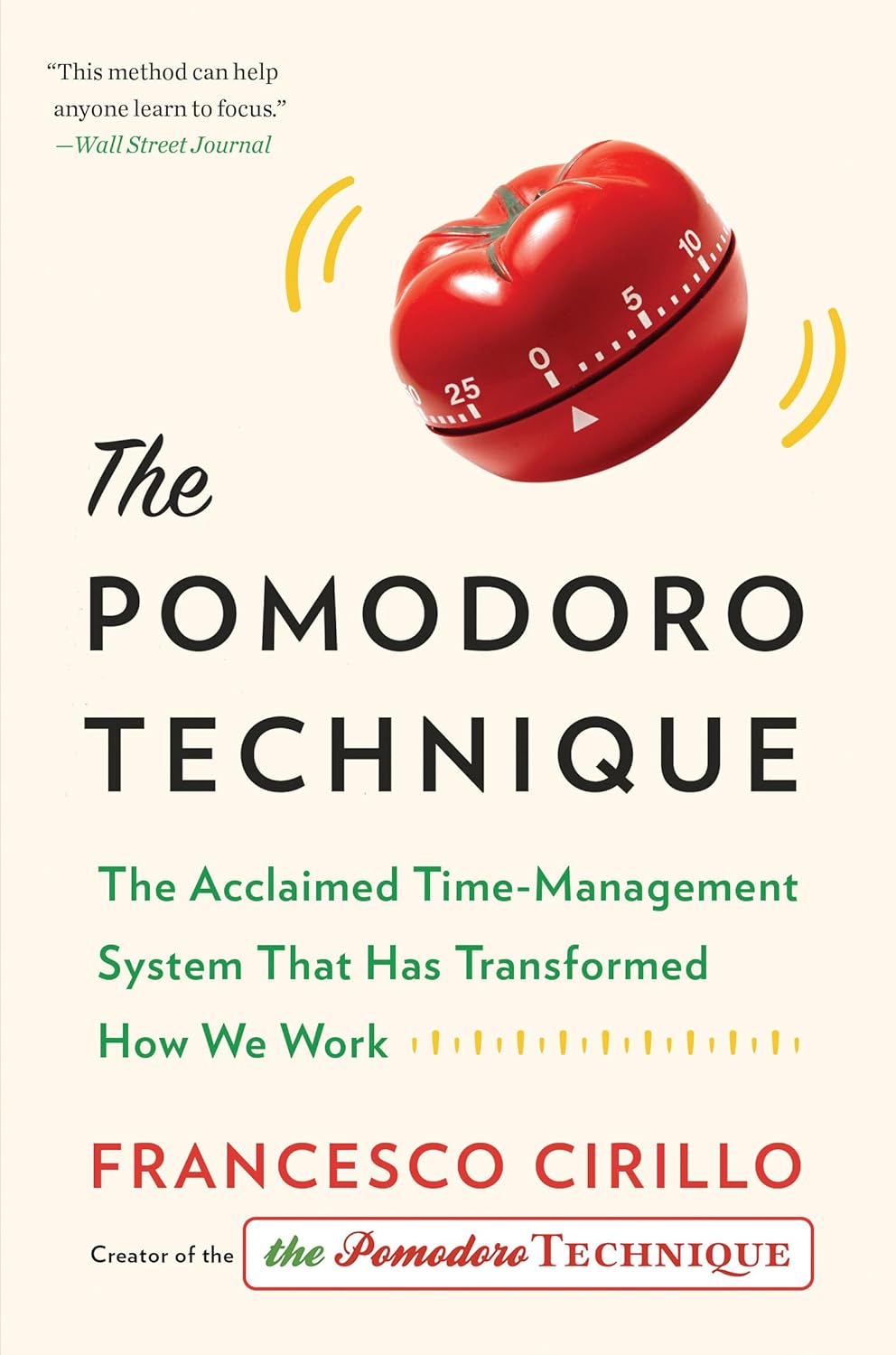
Francesco Cirillo developed his famed system for improving productivity as a college student thirty years ago. Using a kitchen timer shaped like a pomodoro (Italian for tomato), Cirillo divided the time he spent working on a project into 25-minute intervals, with 5-minute breaks in between, in order to get more done, without interruptions. By grouping a number of pomodoros together, users can tackle a project of any length, and drastically improve their productivity, enhance their focus, and better achieve their goals.
Originally self-published, and shared virally online, this new publication of The Pomodoro Technique includes several new chapters on how teams can use the pomodoro method to save time and increase productivity. The process underlying Cirillo’s technique includes five stages: planning the day’s tasks, tracking your efforts, recording your daily activities, processing what you have done, and visualizing areas for improvement. With this tried and tested method, readers can simplify their work, find out how much time and effort a task really requires, and improve their focus so they can get more done in the same amount of time each day.
About the Author
Excerpt. © Reprinted by permission. All rights reserved.
Who hasn’t experienced anxiety when faced with a task that has to be finished by a deadline? In these circumstances, who hasn’t felt the need to put off that task or fallen behind schedule or procrastinated? Who hasn’t had that unpleasant sensation of depending on time, chasing after appointments, giving up what one loves to do for lack of time?
“Remember, Time is a greedy player who wins without cheating, every round!” Baudelaire wrote in his poem “The Clock.” Is this the true nature of time? Or is it only one of the possible ways to consider time? More generally, why do people have such a problem in the way they relate to time? Where does it come from, this anxiety that we’ve all experienced at the thought that time is slipping away?
Thinkers, philosophers, scientists—anyone who’s taken on the challenge of attempting to define time and the relationship between people and time—always have been forced to admit defeat. Such an inquiry, in fact, is inevitably limited and never complete. Few have provided any truly insightful perspectives. Two profoundly interrelated aspects seem to coexist in regard to time:
• Becoming. An abstract, dimensional aspect of time that gives rise to the habit of measuring time (seconds, minutes, hours); the idea of representing time on an axis, as we would spatial dimensions; the concept of the duration of an event (the distance between two points on the temporal axis); the idea of being late (again the distance between two points on the temporal axis).
• The Succession of Events. A concrete aspect of temporal order: We wake up, we shower, we have breakfast, we study, we have lunch, we have a nap, we play, we eat, and we go to bed. Children come to have this notion of time before they develop the idea of abstract time that passes regardless of the events that take place.
Of these two aspects, it is becoming that generates anxiety. It is by nature elusive, indefinite, infinite: Time passes, slips away, moves toward the future. If we try to measure ourselves against the passage of time, we feel inadequate, oppressed, enslaved, and defeated more and more with every second that goes by. We lose our élan vital, the life force that enables us to accomplish things: “Two hours have gone by and I’m still not done; two days have gone by and I’m still not done.” In moments of weakness, the purpose of the activity at hand is no longer clear. The succession of events seems to be the less anxiety-ridden aspect of time. At times it may even represent the regular succession of activity, a calm-inducing rhythm.
Goals of the Pomodoro Technique
The aim of the Pomodoro Technique is to provide a simple tool/process for improving productivity (your own and that of your team). It can do the following:
• Alleviate anxiety linked to becoming
• Enhance focus and concentration by cutting down on interruptions
• Increase awareness of one’s decisions
• Boost motivation and keep it constant
• Bolster the determination to achieve one’s goals
• Refine the estimation process in both qualitative and quantitative terms
• Improve one’s work or study process
• Strengthen one’s determination to keep applying oneself in complex situations
Basic Assumptions
The Pomodoro Technique is founded on three key elements:
• A different way of seeing time that no longer is focused on the concept of becoming. This alleviates anxiety and thus leads to enhanced personal effectiveness.
• Better use of the mind. This enables us to achieve greater clarity of thought, higher consciousness, and sharper focus while facilitating learning.
• The employment of easy-to-use, unobtrusive tools. This reduces the complexity of applying the technique while favoring continuity and allows us to concentrate our efforts on the goals we want to accomplish. Many time-management techniques fail because they add another level of complexity to the intrinsic complexity of the task at hand.
The primary inspiration for the Pomodoro Technique came from the following ideas: time-boxing; the cognitive techniques described by Buzan, among others, relating to the way the mind works; and the dynamics of play outlined by Gadamer. Notions relating to structuring objectives and activities incrementally are detailed in Gilb.
Reaching Your Individual Goals
Material and Method
The process underlying the Pomodoro Technique consists of five stages:
WHAT – WHEN – WHY
Planning – At the start of the day – To decide on the day’s activities
Tracking – Throughout the day – To gather raw data on the effort expended and other metrics of interest
Recording – At the end of the day – To compile an archive of daily observations
Processing – At the end of the day – To transform raw data into information
Visualizing – At the end of the day – To present the information in a format that facilitates understanding and clarifies paths to improvement
This basic procedure lasts one day but could take less time. In that case, the five stages would take place more frequently.
To implement the Pomodoro Technique, all you need is the following:
• A Pomodoro: a kitchen timer (Figure 1).
• A To Do Today Sheet filled in at the start of each day with the following:
• A heading with place, date, and author.
• A list of the things to do during the day in order of priority.
• A section labeled “Unplanned & Urgent Activities” in which any unexpected tasks that have to be dealt with should be listed as they come up. These activities could modify the day’s plan.
• An Activity Inventory Sheet consisting of the following:
• A heading with the name of the author.
• A number of lines in which various activities are written down as they come up. At the end of the day, the ones that have been completed are checked off.
• A Records Sheet. This is the set of raw data needed to produce pertinent reports and graphics. Depending on the objectives, this contains different sets of boxes. Normally, this sheet would include the date, the description, and the number of Pomodoros of effort needed to accomplish a task. This sheet is updated at least once a day, usually at the end of the day.
In the simple examples shown in this book, the Recording, Processing, and Visualizing stages are done directly on the Records Sheet.
Because of typographical constraints, the sheets used in this book show only the entries relating to the topic in question. Simple models of the sheets described here are provided at the end of the book and can be used to practice the technique.
An evolutionary approach to the use of the Pomodoro Technique is provided in the following chapters, oriented to a progressive experimentation with the technique. Clearly, the incremental nature of the technique means that the objectives should be achieved in the order in which they are given here.
Objective I: Find Out How Much Effort an Activity Requires
The traditional Pomodoro is 30 minutes long: 25 minutes of work plus a 5-minute break. At the beginning of each day, choose the tasks you want to tackle from the Activity Inventory Sheet, prioritize them, and write them down in the To Do Today Sheet (Figure 2).
Start the First Pomodoro
Set the Pomodoro for 25 minutes and start the first activity on the To Do Today Sheet. Whoever is using the Pomodoro, whether one person or more, should always be able to see clearly how much time is left (Figure 3).
A Pomodoro can’t be interrupted: It marks 25 minutes of pure work. A Pomodoro can’t be split up: There is no such thing as half a Pomodoro or a quarter of a Pomodoro. The atomic unit of time is a Pomodoro. (Rule: A Pomodoro is indivisible.) If a Pomodoro is interrupted by someone or something, that Pomodoro should be considered void, as if it had never been set; then you should make a fresh start with a new Pomodoro. When the Pomodoro rings, mark an “X” next to the activity you’ve been working on and take a break for 3 to 5 minutes. When the Pomodoro rings, this signals that the current activity is definitely (though temporarily) finished. You’re not allowed to keep on working “for just a few more minutes” even if you’re convinced that in those few minutes you could complete the task at hand.
The 3- to 5-minute break gives you the time you need to disconnect from your work. This allows your mind to assimilate what’s been learned in the last 25 minutes and also gives you a chance to do something good for your health, which will help you do your best during the next Pomodoro. During this break you can stand up and walk around the room, have a drink of water, or fantasize about where you’ll go on your next vacation. You can do deep breathing or stretching exercises. If you work with other people, you can swap a joke or two.
During this quick break it’s not a good idea to engage in activities that require significant mental effort. For example, don’t talk about work-related issues with a colleague, don’t write important e-mails or make urgent phone calls, and so on. Doing these kinds of things would block the constructive mental integration that you need to feel alert and ready for the start of the next Pomodoro. You should include these activities in your Activity Inventory and earmark specific Pomodoros for doing them. Clearly, during this break you shouldn’t continue thinking about what you’ve done during the last Pomodoros. Once the break is over, set the Pomodoro to 25 minutes and continue the activity at hand until the next time it rings. Then mark another “X” on the To Do Today Sheet (Figure 5).
Take a 3- to 5-minute break and then start a new Pomodoro.
Every Four Pomodoros
Every four Pomodoros, stop the activity you’re working on and take a longer break, from 15 to 30 minutes.
The 15- to 30-minute break provides an ideal opportunity to tidy your desk, take a trip to the coffee machine, listen to voice mail, check incoming e-mails, or simply rest and do breathing exercises or take a walk. The important thing is not to do anything complex; otherwise your mind won’t be able to reorganize and integrate what you’ve learned, and as a result you won’t be able to give the next Pomodoro your best effort. Obviously, during this break you need to stop thinking about what you did during the last Pomodoros.
Completing an Activity
Keep on working, Pomodoro after Pomodoro, until the task is finished and then cross it out on the To Do Today Sheet (Figure 7).
Specific cases should be handled with common sense:
• If you finish a task while the Pomodoro is still ticking, the following rule applies: If a Pomodoro begins, it has to ring. It’s a good idea to take advantage of the opportunity for overlearning, using the remaining portion of the Pomodoro to review or repeat what you’ve done, make small improvements, and note what you’ve learned until the Pomodoro rings.
• If you finish an activity in the first 5 minutes of the Pomodoro and feel the task actually was finished during the previous Pomodoro and revision wouldn’t be worthwhile, as an exception to the rule, the current Pomodoro doesn’t have to be included in the Pomodoro count.
Once the current activity has been completed, move on to the next one on the list and then the next, taking breaks after every Pomodoro and every four Pomodoros (Figure 8).
Recording
At the end of every day, the completed Pomodoros can be transferred to a hard-copy archive. As an alternative, it may be more convenient to use an electronic spreadsheet or a database and delete the completed activities from the Activity Inventory Sheet. What you track and record depends on what you want to observe and the kinds of reports you want to generate. The initial aim of tracking and later recording could be simply to present a report with the number of Pomodoros completed per task. In other words, you may want to show the effort expended to accomplish each activity. To do that, you can use the following boxes: the date, the start time, the type of activity, a description of the activity, the actual number of Pomodoros, a short note on the results achieved, and possible room for improvement or problems that may have come up (Figure 9). This initial recording model actually represents the report you want. It’s easy to draw it up even on paper.
How did Mark fill in the time he began an activity if he didn’t track it? With the Pomodoro Technique, it’s not essential to track the start time for an activity (or for every Pomodoro). What’s important is to track the number of Pomodoros actually completed: the real effort. This point is the key to understanding the Pomodoro Technique. Since tracking is done at least once a day, remembering and reconstructing the start times for activities isn’t difficult; in fact, this kind of recall is a beneficial mental exercise.
A useful technique for remembering start times is to do a rundown of the day beginning with the most recent activity and moving backward to the first one.
Improvement
Recording provides an effective tool for people who apply the Pomodoro Technique in terms of self-observation and decision making aimed at process improvement. For example, you can ask yourself how many Pomodoros a week you spend on work activities and on explorative activities, how many Pomodoros you do on an average day of the week, and so on. You also can determine whether the stages in the process are all effective or whether one could be eliminated while you achieve the same results.
For instance, we can see in Figure 9 that it took Mark 10 Pomodoros to write, fine-tune, and condense the article “How to Learn Music.” That seems like too many. Mark would like to get the same result with nine Pomodoros or less. Then he would have one or more Pomodoros of free time for other activities. “I’d like to try to write the next article with the same quality and less effort. How? What should I cut out? What activities are really useful? How can I reorganize them to be more effective?”
These are the types of questions that enable people to improve, or at least try to improve, their work or study processes. At the end of the day, the activity of recording (and later looking for ways to improve) should not take more than one Pomodoro.
The Nature of the Pomodoro
The Pomodoro marks the passage of time, and so it is a measure of the dimension of time. It becomes a measure of the dimension of effort when it is combined with the number of people involved in an activity. Depending on this number, we can say that a task was accomplished with a certain number of Person Pomodoros or Pair Pomodoros or Team Pomodoros, where these units measure effort. The quantities of effort relative to different numbers of people are not homogeneous; they can’t be added together or compared with one another.
The work of an individual, a pair, or a group represents a different way of combining production factors and implies diverse means of communication. There are no formulas for converting Person Pomodoros to Pair Pomodoros or Team Pomodoros.
Details:
Visit the Crown Currency Store
The Pomodoro Technique: The Acclaimed Time-Management System That Has Transformed How We Work
AED12959
Quantity:
Order today to get by 7-14 business days
Delivery fee of AED 20. Free for orders above AED 200.
 Imported From: United States
At BOLO, we work hard to ensure the products you receive are new, genuine, and sourced from reputable suppliers.
Every product in the BOLO catalogue is sourced through our Verified Global Supply Network of verified sellers, authorized distributors or directly from the manufacturer.
Each product undergoes thorough inspection and verification at our consolidation and fulfilment centers to ensure it meets our strict authenticity and quality standards before being shipped and delivered to you.
If you ever have concerns regarding the authenticity of a product purchased from us, please contact Bolo Support. We will review your inquiry promptly and, if necessary, provide documentation verifying authenticity or offer a suitable resolution.
Your trust is our top priority, and we are committed to maintaining transparency and integrity in every transaction.
While we strive to display accurate information, variations in packaging, labeling, instructions, or formulation may occasionally occur due to regional differences or supplier updates. For detailed or manufacturer-specific information, please contact the brand directly or reach out to BOLO Support for assistance.
Unless otherwise stated, all prices displayed on the product page include applicable taxes and import duties.
BOLO operates in accordance with the laws and regulations of United Arab Emirates. Any items found to be restricted or prohibited for sale within the United Arab Emirates will be cancelled prior to shipment. We take proactive measures to ensure that only products permitted for sale in United Arab Emirates are listed on our website.
All items are shipped by air, and any products classified as “Dangerous Goods (DG)” under IATA regulations will be removed from the order and cancelled.
All orders are processed manually, and we make every effort to process them promptly once confirmed. Products cancelled due to the above reasons will be permanently removed from listings across the website.

Similar suggestions by Bolo
More from this brand
Similar items from “Time Management”
Share with
Or share with link
https://www.bolo.ae/products/U1524760706
Visit the Crown Currency Store
The Pomodoro Technique: The Acclaimed Time-Management System That Has Transformed How We Work
AED12959
Quantity:
Order today to get by 7-14 business days
Delivery fee of AED 20. Free for orders above AED 200.
Imported From: United States
At BOLO, we work hard to ensure the products you receive are new, genuine, and sourced from reputable suppliers.
Every product in the BOLO catalogue is sourced through our Verified Global Supply Network of verified sellers, authorized distributors or directly from the manufacturer.
Each product undergoes thorough inspection and verification at our consolidation and fulfilment centers to ensure it meets our strict authenticity and quality standards before being shipped and delivered to you.
If you ever have concerns regarding the authenticity of a product purchased from us, please contact Bolo Support. We will review your inquiry promptly and, if necessary, provide documentation verifying authenticity or offer a suitable resolution.
Your trust is our top priority, and we are committed to maintaining transparency and integrity in every transaction.
While we strive to display accurate information, variations in packaging, labeling, instructions, or formulation may occasionally occur due to regional differences or supplier updates. For detailed or manufacturer-specific information, please contact the brand directly or reach out to BOLO Support for assistance.
Unless otherwise stated, all prices displayed on the product page include applicable taxes and import duties.
BOLO operates in accordance with the laws and regulations of United Arab Emirates. Any items found to be restricted or prohibited for sale within the United Arab Emirates will be cancelled prior to shipment. We take proactive measures to ensure that only products permitted for sale in United Arab Emirates are listed on our website.
All items are shipped by air, and any products classified as “Dangerous Goods (DG)” under IATA regulations will be removed from the order and cancelled.
All orders are processed manually, and we make every effort to process them promptly once confirmed. Products cancelled due to the above reasons will be permanently removed from listings across the website.
Description:
Francesco Cirillo developed his famed system for improving productivity as a college student thirty years ago. Using a kitchen timer shaped like a pomodoro (Italian for tomato), Cirillo divided the time he spent working on a project into 25-minute intervals, with 5-minute breaks in between, in order to get more done, without interruptions. By grouping a number of pomodoros together, users can tackle a project of any length, and drastically improve their productivity, enhance their focus, and better achieve their goals.
Originally self-published, and shared virally online, this new publication of The Pomodoro Technique includes several new chapters on how teams can use the pomodoro method to save time and increase productivity. The process underlying Cirillo’s technique includes five stages: planning the day’s tasks, tracking your efforts, recording your daily activities, processing what you have done, and visualizing areas for improvement. With this tried and tested method, readers can simplify their work, find out how much time and effort a task really requires, and improve their focus so they can get more done in the same amount of time each day.
About the Author
Excerpt. © Reprinted by permission. All rights reserved.
Who hasn’t experienced anxiety when faced with a task that has to be finished by a deadline? In these circumstances, who hasn’t felt the need to put off that task or fallen behind schedule or procrastinated? Who hasn’t had that unpleasant sensation of depending on time, chasing after appointments, giving up what one loves to do for lack of time?
“Remember, Time is a greedy player who wins without cheating, every round!” Baudelaire wrote in his poem “The Clock.” Is this the true nature of time? Or is it only one of the possible ways to consider time? More generally, why do people have such a problem in the way they relate to time? Where does it come from, this anxiety that we’ve all experienced at the thought that time is slipping away?
Thinkers, philosophers, scientists—anyone who’s taken on the challenge of attempting to define time and the relationship between people and time—always have been forced to admit defeat. Such an inquiry, in fact, is inevitably limited and never complete. Few have provided any truly insightful perspectives. Two profoundly interrelated aspects seem to coexist in regard to time:
• Becoming. An abstract, dimensional aspect of time that gives rise to the habit of measuring time (seconds, minutes, hours); the idea of representing time on an axis, as we would spatial dimensions; the concept of the duration of an event (the distance between two points on the temporal axis); the idea of being late (again the distance between two points on the temporal axis).
• The Succession of Events. A concrete aspect of temporal order: We wake up, we shower, we have breakfast, we study, we have lunch, we have a nap, we play, we eat, and we go to bed. Children come to have this notion of time before they develop the idea of abstract time that passes regardless of the events that take place.
Of these two aspects, it is becoming that generates anxiety. It is by nature elusive, indefinite, infinite: Time passes, slips away, moves toward the future. If we try to measure ourselves against the passage of time, we feel inadequate, oppressed, enslaved, and defeated more and more with every second that goes by. We lose our élan vital, the life force that enables us to accomplish things: “Two hours have gone by and I’m still not done; two days have gone by and I’m still not done.” In moments of weakness, the purpose of the activity at hand is no longer clear. The succession of events seems to be the less anxiety-ridden aspect of time. At times it may even represent the regular succession of activity, a calm-inducing rhythm.
Goals of the Pomodoro Technique
The aim of the Pomodoro Technique is to provide a simple tool/process for improving productivity (your own and that of your team). It can do the following:
• Alleviate anxiety linked to becoming
• Enhance focus and concentration by cutting down on interruptions
• Increase awareness of one’s decisions
• Boost motivation and keep it constant
• Bolster the determination to achieve one’s goals
• Refine the estimation process in both qualitative and quantitative terms
• Improve one’s work or study process
• Strengthen one’s determination to keep applying oneself in complex situations
Basic Assumptions
The Pomodoro Technique is founded on three key elements:
• A different way of seeing time that no longer is focused on the concept of becoming. This alleviates anxiety and thus leads to enhanced personal effectiveness.
• Better use of the mind. This enables us to achieve greater clarity of thought, higher consciousness, and sharper focus while facilitating learning.
• The employment of easy-to-use, unobtrusive tools. This reduces the complexity of applying the technique while favoring continuity and allows us to concentrate our efforts on the goals we want to accomplish. Many time-management techniques fail because they add another level of complexity to the intrinsic complexity of the task at hand.
The primary inspiration for the Pomodoro Technique came from the following ideas: time-boxing; the cognitive techniques described by Buzan, among others, relating to the way the mind works; and the dynamics of play outlined by Gadamer. Notions relating to structuring objectives and activities incrementally are detailed in Gilb.
Reaching Your Individual Goals
Material and Method
The process underlying the Pomodoro Technique consists of five stages:
WHAT – WHEN – WHY
Planning – At the start of the day – To decide on the day’s activities
Tracking – Throughout the day – To gather raw data on the effort expended and other metrics of interest
Recording – At the end of the day – To compile an archive of daily observations
Processing – At the end of the day – To transform raw data into information
Visualizing – At the end of the day – To present the information in a format that facilitates understanding and clarifies paths to improvement
This basic procedure lasts one day but could take less time. In that case, the five stages would take place more frequently.
To implement the Pomodoro Technique, all you need is the following:
• A Pomodoro: a kitchen timer (Figure 1).
• A To Do Today Sheet filled in at the start of each day with the following:
• A heading with place, date, and author.
• A list of the things to do during the day in order of priority.
• A section labeled “Unplanned & Urgent Activities” in which any unexpected tasks that have to be dealt with should be listed as they come up. These activities could modify the day’s plan.
• An Activity Inventory Sheet consisting of the following:
• A heading with the name of the author.
• A number of lines in which various activities are written down as they come up. At the end of the day, the ones that have been completed are checked off.
• A Records Sheet. This is the set of raw data needed to produce pertinent reports and graphics. Depending on the objectives, this contains different sets of boxes. Normally, this sheet would include the date, the description, and the number of Pomodoros of effort needed to accomplish a task. This sheet is updated at least once a day, usually at the end of the day.
In the simple examples shown in this book, the Recording, Processing, and Visualizing stages are done directly on the Records Sheet.
Because of typographical constraints, the sheets used in this book show only the entries relating to the topic in question. Simple models of the sheets described here are provided at the end of the book and can be used to practice the technique.
An evolutionary approach to the use of the Pomodoro Technique is provided in the following chapters, oriented to a progressive experimentation with the technique. Clearly, the incremental nature of the technique means that the objectives should be achieved in the order in which they are given here.
Objective I: Find Out How Much Effort an Activity Requires
The traditional Pomodoro is 30 minutes long: 25 minutes of work plus a 5-minute break. At the beginning of each day, choose the tasks you want to tackle from the Activity Inventory Sheet, prioritize them, and write them down in the To Do Today Sheet (Figure 2).
Start the First Pomodoro
Set the Pomodoro for 25 minutes and start the first activity on the To Do Today Sheet. Whoever is using the Pomodoro, whether one person or more, should always be able to see clearly how much time is left (Figure 3).
A Pomodoro can’t be interrupted: It marks 25 minutes of pure work. A Pomodoro can’t be split up: There is no such thing as half a Pomodoro or a quarter of a Pomodoro. The atomic unit of time is a Pomodoro. (Rule: A Pomodoro is indivisible.) If a Pomodoro is interrupted by someone or something, that Pomodoro should be considered void, as if it had never been set; then you should make a fresh start with a new Pomodoro. When the Pomodoro rings, mark an “X” next to the activity you’ve been working on and take a break for 3 to 5 minutes. When the Pomodoro rings, this signals that the current activity is definitely (though temporarily) finished. You’re not allowed to keep on working “for just a few more minutes” even if you’re convinced that in those few minutes you could complete the task at hand.
The 3- to 5-minute break gives you the time you need to disconnect from your work. This allows your mind to assimilate what’s been learned in the last 25 minutes and also gives you a chance to do something good for your health, which will help you do your best during the next Pomodoro. During this break you can stand up and walk around the room, have a drink of water, or fantasize about where you’ll go on your next vacation. You can do deep breathing or stretching exercises. If you work with other people, you can swap a joke or two.
During this quick break it’s not a good idea to engage in activities that require significant mental effort. For example, don’t talk about work-related issues with a colleague, don’t write important e-mails or make urgent phone calls, and so on. Doing these kinds of things would block the constructive mental integration that you need to feel alert and ready for the start of the next Pomodoro. You should include these activities in your Activity Inventory and earmark specific Pomodoros for doing them. Clearly, during this break you shouldn’t continue thinking about what you’ve done during the last Pomodoros. Once the break is over, set the Pomodoro to 25 minutes and continue the activity at hand until the next time it rings. Then mark another “X” on the To Do Today Sheet (Figure 5).
Take a 3- to 5-minute break and then start a new Pomodoro.
Every Four Pomodoros
Every four Pomodoros, stop the activity you’re working on and take a longer break, from 15 to 30 minutes.
The 15- to 30-minute break provides an ideal opportunity to tidy your desk, take a trip to the coffee machine, listen to voice mail, check incoming e-mails, or simply rest and do breathing exercises or take a walk. The important thing is not to do anything complex; otherwise your mind won’t be able to reorganize and integrate what you’ve learned, and as a result you won’t be able to give the next Pomodoro your best effort. Obviously, during this break you need to stop thinking about what you did during the last Pomodoros.
Completing an Activity
Keep on working, Pomodoro after Pomodoro, until the task is finished and then cross it out on the To Do Today Sheet (Figure 7).
Specific cases should be handled with common sense:
• If you finish a task while the Pomodoro is still ticking, the following rule applies: If a Pomodoro begins, it has to ring. It’s a good idea to take advantage of the opportunity for overlearning, using the remaining portion of the Pomodoro to review or repeat what you’ve done, make small improvements, and note what you’ve learned until the Pomodoro rings.
• If you finish an activity in the first 5 minutes of the Pomodoro and feel the task actually was finished during the previous Pomodoro and revision wouldn’t be worthwhile, as an exception to the rule, the current Pomodoro doesn’t have to be included in the Pomodoro count.
Once the current activity has been completed, move on to the next one on the list and then the next, taking breaks after every Pomodoro and every four Pomodoros (Figure 8).
Recording
At the end of every day, the completed Pomodoros can be transferred to a hard-copy archive. As an alternative, it may be more convenient to use an electronic spreadsheet or a database and delete the completed activities from the Activity Inventory Sheet. What you track and record depends on what you want to observe and the kinds of reports you want to generate. The initial aim of tracking and later recording could be simply to present a report with the number of Pomodoros completed per task. In other words, you may want to show the effort expended to accomplish each activity. To do that, you can use the following boxes: the date, the start time, the type of activity, a description of the activity, the actual number of Pomodoros, a short note on the results achieved, and possible room for improvement or problems that may have come up (Figure 9). This initial recording model actually represents the report you want. It’s easy to draw it up even on paper.
How did Mark fill in the time he began an activity if he didn’t track it? With the Pomodoro Technique, it’s not essential to track the start time for an activity (or for every Pomodoro). What’s important is to track the number of Pomodoros actually completed: the real effort. This point is the key to understanding the Pomodoro Technique. Since tracking is done at least once a day, remembering and reconstructing the start times for activities isn’t difficult; in fact, this kind of recall is a beneficial mental exercise.
A useful technique for remembering start times is to do a rundown of the day beginning with the most recent activity and moving backward to the first one.
Improvement
Recording provides an effective tool for people who apply the Pomodoro Technique in terms of self-observation and decision making aimed at process improvement. For example, you can ask yourself how many Pomodoros a week you spend on work activities and on explorative activities, how many Pomodoros you do on an average day of the week, and so on. You also can determine whether the stages in the process are all effective or whether one could be eliminated while you achieve the same results.
For instance, we can see in Figure 9 that it took Mark 10 Pomodoros to write, fine-tune, and condense the article “How to Learn Music.” That seems like too many. Mark would like to get the same result with nine Pomodoros or less. Then he would have one or more Pomodoros of free time for other activities. “I’d like to try to write the next article with the same quality and less effort. How? What should I cut out? What activities are really useful? How can I reorganize them to be more effective?”
These are the types of questions that enable people to improve, or at least try to improve, their work or study processes. At the end of the day, the activity of recording (and later looking for ways to improve) should not take more than one Pomodoro.
The Nature of the Pomodoro
The Pomodoro marks the passage of time, and so it is a measure of the dimension of time. It becomes a measure of the dimension of effort when it is combined with the number of people involved in an activity. Depending on this number, we can say that a task was accomplished with a certain number of Person Pomodoros or Pair Pomodoros or Team Pomodoros, where these units measure effort. The quantities of effort relative to different numbers of people are not homogeneous; they can’t be added together or compared with one another.
The work of an individual, a pair, or a group represents a different way of combining production factors and implies diverse means of communication. There are no formulas for converting Person Pomodoros to Pair Pomodoros or Team Pomodoros.
Details:
Similar suggestions by Bolo
More from this brand
Similar items from “Time Management”
Share with
Or share with link
https://www.bolo.ae/products/U1524760706