Deliver toUnited Arab Emirates
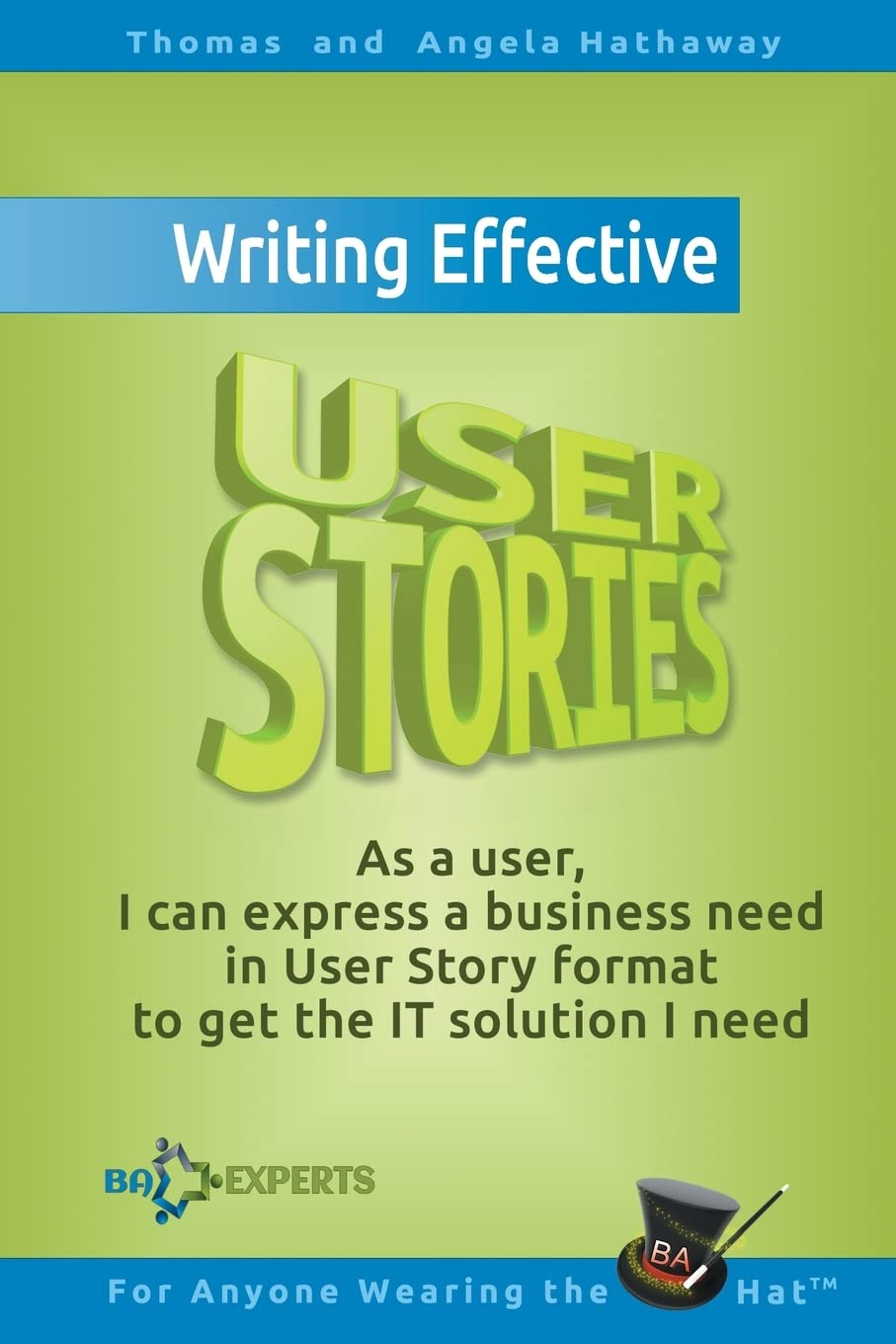
Writing Effective User Stories: As a User, I Can Express a Business Need in User Story Format To Get the IT Solution I Need (Business Analysis Fundamentals - Simply Put!)

Description:

User Stories are a great method for expressing stakeholder requirements, whether your projects follow an Agile, Iterative, or a Waterfall methodology. They are the basis for developers to deliver a suitable information technology (IT) app or application. Well-structured user stories express a single action to achieve a specific goal from the perspective of a single role. When writing user stories, stakeholders knowledgeable about the role should focus on the business result that the IT solution will enable while leaving technology decisions up to the developers. Good user stories are relevant to the project, unambiguous, and understandable to knowledge peers. The best user stories also contain crucial non-functional (quality) requirements, which are the best weapon in the war against unsatisfactory performance in IT solutions.

This book presents two common User Story structures to help you ensure that your User Stories have all the required components and that they express the true business need as succinctly as possible. It offers 5 simple rules to ensure that your User Stories are the best that they can be. That, in turn, will reduce the amount of time needed in User Story elaboration and discussion with the development team.

After reading this book you will be able to:

  • Translate business needs into well-structured User Stories
  • Write User Stories that express the what and avoid the how
  • Apply five simple rules for writing effective User Stories
  • Clarify assumptions in User Stories by adding context
  • Identify and remove ambiguous and subjective terms and phrases in User Stories
  • Select the appropriate format for expressing User Stories for Agile Projects
  • Write stakeholder requirements in User Story format that solve business problems

Elaborate User Stories to identify measurable non-functional requirements

AUTHOR'S NOTE:

The term “User Story” is a relative new addition to our language and its definition is evolving. In today’s parlance, a complete User Story has three primary components, namely the "Card", the "Conversation", and the "Criteria". Different roles are responsible for creating each component.

The “Card” expresses a business need. A representative of the business community is responsible for expressing the business need. Historically (and for practical reasons) the “Card” is the User Story from the perspective of the business community. Since we wrote this book specifically to address that audience, we use the term “User Story” in that context throughout.

The “Conversation” is an ongoing discussion between a developer responsible for creating software that meets the business need and the domain expert(s) who defined it (e.g., the original author of the “Card”). The developer initiates the “Conversation” with the domain expert(s) to define the “Criteria” and any additional information the developer needs to create the application. There is much to be written about both the “Conversation” and the “Criteria”, but neither component is dealt with in any detail in this publication.

A well-written User Story (“Card”) can drastically reduce the time needed for the “Conversation”. It reduces misinterpretations, misunderstandings, and false starts, thereby paving the way for faster delivery of working software. We chose to limit the content of this publication to the “User Story” as understood by the business community to keep the book focused and address the widest possible audience.


Reviews:

5.0 out of 5 stars Worth a read!

B. · April 20, 2014

I write user stories as part of my job and have done much research into what makes them most effective. This book does a wonderful job of providing specific examples and tips. I applied this book immediately and feel like anyone who writes user stories can immediately benefit from the advice in this book.

4.0 out of 5 stars Inexpensive, worthwhile, quick read

A.C. · February 28, 2018

Perfect for anyone just getting started with user stories. It provides simple step by step rules to think about as you are writing stories to create the clarity needed to get the best result from the developers for the business users.

5.0 out of 5 stars Gives great perspective

J.F.S. · April 4, 2014

it gives insights on how we can understand stakeholder needs. This applies regardless of technical development approach used. BA's and PM's need a tool box rather than the promise of a silver bullet. User Stories represent a good tool and this book gives you good insights.

3.0 out of 5 stars Fine for absolute beginners

S.L. · February 12, 2020

I guess I was hoping for more, but this book didn't tell me a lot more than what I already know about user stories. However, it is is good for complete beginners looking to create good user stories.

4.0 out of 5 stars Good expansion on the concept of User Stories

J.E.L. · February 3, 2014

I am in the process of developing my skills in writing user stories for project management purposes. I found this book to provide a good amount of information related to the purpose of User Stories, and how to think about approaching User Stories. I adopted many of the concepts introduced in this book into my work flow almost immediately.

5.0 out of 5 stars Stated simply

S. · January 2, 2020

Easy to understand and get the concept.

4.0 out of 5 stars Four Stars

H.S. · August 6, 2017

Good information on user stories, but doesn't go into acceptance criteria.

5.0 out of 5 stars Practical Guide

L.T. · April 23, 2014

Fantastic! This book shows us simple and practical guidance for writing User stories.I'd like to recommend this book to the engineer who carried a waterfall project.It's the best way to communicate with your users or customers when you're defining system requirements.

Good explanations on how to write efficient user stories

E.L. · February 13, 2021

Easy to read with good samples. I can recommend it to people who like to learn more about how to write user stories

Excellent and Concise

J.W.A. · April 13, 2016

I am new to user stories, and this book gave me everything I need to know in a very reader friendly and concise manner, with just the right amount of examples. There are also useful and relevant links in each chapter for you to advance your knowledge. This book is recommended for anyone involved in specifying business needs, including software end users, business analysts, and software developers. I can even see how this would benefit people developing non-IT business solutions in different business sectors.

Four Stars

A.C. · November 10, 2014

Great intro and rules to follow

Concise, pragmatic, useful

S.M. · September 1, 2014

This small ebook presents the "best of" Business Analysis for User Stories. If you think User Stories carefully elaborated by the author before the discussion could save the team some time, this book is for you. The authors did an excellent job in boiling their advice down to the essence for the hurried reader, with many pointers to further reading in each chapter for those who want to dive in deeper. The real-life examples are simple yet meaningful enough to illustrate the difference between a first draft and an effective User Story. 5 rules anyone writing User Stories can start applying tomorrow.

Bom

C.A. · August 30, 2016

muito bom para quem está começando a escrever estórias utilizando o framework scrum, se você quer ser Product Owner, vale a pena a leitura.

Writing Effective User Stories: As a User, I Can Express a Business Need in User Story Format To Get the IT Solution I Need (Business Analysis Fundamentals - Simply Put!)

Product ID: U1519100493
Condition: New

4.1

AED5903

Price includes VAT & Import Duties
Type: Paperback
Availability: In Stock

Quantity:

|

Order today to get by 7-14 business days

Delivery fee of AED 20. Free for orders above AED 200.

Returns & Warranty policies

Imported From: United States

At BOLO, we work hard to ensure the products you receive are new, genuine, and sourced from reputable suppliers.

BOLO is not an authorized or official retailer for most brands, nor are we affiliated with manufacturers unless specifically stated on a product page. Instead, we source verified sellers, authorized distributors or directly from the manufacturer.

Each product undergoes thorough inspection and verification at our consolidation and fulfilment centers to ensure it meets our strict authenticity and quality standards before being shipped and delivered to you.

If you ever have concerns regarding the authenticity of a product purchased from us, please contact Bolo Support. We will review your inquiry promptly and, if necessary, provide documentation verifying authenticity or offer a suitable resolution.

Your trust is our top priority, and we are committed to maintaining transparency and integrity in every transaction.

All product information, images, descriptions, and reviews originate from the manufacturer or from trusted sellers overseas. BOLO is not affiliated with, endorsed by, or an authorized retailer for most brands listed on our website unless stated otherwise.

While we strive to display accurate information, variations in packaging, labeling, instructions, or formulation may occasionally occur due to regional differences or supplier updates. For detailed or manufacturer-specific information, please contact the brand directly or reach out to BOLO Support for assistance.

Unless otherwise stated, all prices displayed on the product page include applicable taxes and import duties.

BOLO operates in accordance with the laws and regulations of United Arab Emirates. Any items found to be restricted or prohibited for sale within the UAE will be cancelled prior to shipment. We take proactive measures to ensure that only products permitted for sale in United Arab Emirates are listed on our website.

All items are shipped by air, and any products classified as “Dangerous Goods (DG)” under IATA regulations will be removed from the order and cancelled.

All orders are processed manually, and we make every effort to process them promptly once confirmed. Products cancelled due to the above reasons will be permanently removed from listings across the website.

Similar suggestions by Bolo

More from this brand

Similar items from “Information Management”

Writing Effective User Stories: As a User, I Can Express a Business Need in User Story Format To Get the IT Solution I Need (Business Analysis Fundamentals - Simply Put!)

Product ID: U1519100493
Condition: New

4.1

Writing Effective User Stories: As a User, I Can Express a Business Need in User Story Format To Get the IT Solution I Need (Business Analysis Fundamentals - Simply Put!)-0
Type: Paperback

AED5903

Price includes VAT & Import Duties
Availability: In Stock

Quantity:

|

Order today to get by 7-14 business days

Delivery fee of AED 20. Free for orders above AED 200.

Returns & Warranty policies

Imported From: United States

At BOLO, we work hard to ensure the products you receive are new, genuine, and sourced from reputable suppliers.

BOLO is not an authorized or official retailer for most brands, nor are we affiliated with manufacturers unless specifically stated on a product page. Instead, we source verified sellers, authorized distributors or directly from the manufacturer.

Each product undergoes thorough inspection and verification at our consolidation and fulfilment centers to ensure it meets our strict authenticity and quality standards before being shipped and delivered to you.

If you ever have concerns regarding the authenticity of a product purchased from us, please contact Bolo Support. We will review your inquiry promptly and, if necessary, provide documentation verifying authenticity or offer a suitable resolution.

Your trust is our top priority, and we are committed to maintaining transparency and integrity in every transaction.

All product information, images, descriptions, and reviews originate from the manufacturer or from trusted sellers overseas. BOLO is not affiliated with, endorsed by, or an authorized retailer for most brands listed on our website unless stated otherwise.

While we strive to display accurate information, variations in packaging, labeling, instructions, or formulation may occasionally occur due to regional differences or supplier updates. For detailed or manufacturer-specific information, please contact the brand directly or reach out to BOLO Support for assistance.

Unless otherwise stated, all prices displayed on the product page include applicable taxes and import duties.

BOLO operates in accordance with the laws and regulations of United Arab Emirates. Any items found to be restricted or prohibited for sale within the UAE will be cancelled prior to shipment. We take proactive measures to ensure that only products permitted for sale in United Arab Emirates are listed on our website.

All items are shipped by air, and any products classified as “Dangerous Goods (DG)” under IATA regulations will be removed from the order and cancelled.

All orders are processed manually, and we make every effort to process them promptly once confirmed. Products cancelled due to the above reasons will be permanently removed from listings across the website.

Description:

User Stories are a great method for expressing stakeholder requirements, whether your projects follow an Agile, Iterative, or a Waterfall methodology. They are the basis for developers to deliver a suitable information technology (IT) app or application. Well-structured user stories express a single action to achieve a specific goal from the perspective of a single role. When writing user stories, stakeholders knowledgeable about the role should focus on the business result that the IT solution will enable while leaving technology decisions up to the developers. Good user stories are relevant to the project, unambiguous, and understandable to knowledge peers. The best user stories also contain crucial non-functional (quality) requirements, which are the best weapon in the war against unsatisfactory performance in IT solutions.

This book presents two common User Story structures to help you ensure that your User Stories have all the required components and that they express the true business need as succinctly as possible. It offers 5 simple rules to ensure that your User Stories are the best that they can be. That, in turn, will reduce the amount of time needed in User Story elaboration and discussion with the development team.

After reading this book you will be able to:

  • Translate business needs into well-structured User Stories
  • Write User Stories that express the what and avoid the how
  • Apply five simple rules for writing effective User Stories
  • Clarify assumptions in User Stories by adding context
  • Identify and remove ambiguous and subjective terms and phrases in User Stories
  • Select the appropriate format for expressing User Stories for Agile Projects
  • Write stakeholder requirements in User Story format that solve business problems

Elaborate User Stories to identify measurable non-functional requirements

AUTHOR'S NOTE:

The term “User Story” is a relative new addition to our language and its definition is evolving. In today’s parlance, a complete User Story has three primary components, namely the "Card", the "Conversation", and the "Criteria". Different roles are responsible for creating each component.

The “Card” expresses a business need. A representative of the business community is responsible for expressing the business need. Historically (and for practical reasons) the “Card” is the User Story from the perspective of the business community. Since we wrote this book specifically to address that audience, we use the term “User Story” in that context throughout.

The “Conversation” is an ongoing discussion between a developer responsible for creating software that meets the business need and the domain expert(s) who defined it (e.g., the original author of the “Card”). The developer initiates the “Conversation” with the domain expert(s) to define the “Criteria” and any additional information the developer needs to create the application. There is much to be written about both the “Conversation” and the “Criteria”, but neither component is dealt with in any detail in this publication.

A well-written User Story (“Card”) can drastically reduce the time needed for the “Conversation”. It reduces misinterpretations, misunderstandings, and false starts, thereby paving the way for faster delivery of working software. We chose to limit the content of this publication to the “User Story” as understood by the business community to keep the book focused and address the widest possible audience.


Reviews:

5.0 out of 5 stars Worth a read!

B. · April 20, 2014

I write user stories as part of my job and have done much research into what makes them most effective. This book does a wonderful job of providing specific examples and tips. I applied this book immediately and feel like anyone who writes user stories can immediately benefit from the advice in this book.

4.0 out of 5 stars Inexpensive, worthwhile, quick read

A.C. · February 28, 2018

Perfect for anyone just getting started with user stories. It provides simple step by step rules to think about as you are writing stories to create the clarity needed to get the best result from the developers for the business users.

5.0 out of 5 stars Gives great perspective

J.F.S. · April 4, 2014

it gives insights on how we can understand stakeholder needs. This applies regardless of technical development approach used. BA's and PM's need a tool box rather than the promise of a silver bullet. User Stories represent a good tool and this book gives you good insights.

3.0 out of 5 stars Fine for absolute beginners

S.L. · February 12, 2020

I guess I was hoping for more, but this book didn't tell me a lot more than what I already know about user stories. However, it is is good for complete beginners looking to create good user stories.

4.0 out of 5 stars Good expansion on the concept of User Stories

J.E.L. · February 3, 2014

I am in the process of developing my skills in writing user stories for project management purposes. I found this book to provide a good amount of information related to the purpose of User Stories, and how to think about approaching User Stories. I adopted many of the concepts introduced in this book into my work flow almost immediately.

5.0 out of 5 stars Stated simply

S. · January 2, 2020

Easy to understand and get the concept.

4.0 out of 5 stars Four Stars

H.S. · August 6, 2017

Good information on user stories, but doesn't go into acceptance criteria.

5.0 out of 5 stars Practical Guide

L.T. · April 23, 2014

Fantastic! This book shows us simple and practical guidance for writing User stories.I'd like to recommend this book to the engineer who carried a waterfall project.It's the best way to communicate with your users or customers when you're defining system requirements.

Good explanations on how to write efficient user stories

E.L. · February 13, 2021

Easy to read with good samples. I can recommend it to people who like to learn more about how to write user stories

Excellent and Concise

J.W.A. · April 13, 2016

I am new to user stories, and this book gave me everything I need to know in a very reader friendly and concise manner, with just the right amount of examples. There are also useful and relevant links in each chapter for you to advance your knowledge. This book is recommended for anyone involved in specifying business needs, including software end users, business analysts, and software developers. I can even see how this would benefit people developing non-IT business solutions in different business sectors.

Four Stars

A.C. · November 10, 2014

Great intro and rules to follow

Concise, pragmatic, useful

S.M. · September 1, 2014

This small ebook presents the "best of" Business Analysis for User Stories. If you think User Stories carefully elaborated by the author before the discussion could save the team some time, this book is for you. The authors did an excellent job in boiling their advice down to the essence for the hurried reader, with many pointers to further reading in each chapter for those who want to dive in deeper. The real-life examples are simple yet meaningful enough to illustrate the difference between a first draft and an effective User Story. 5 rules anyone writing User Stories can start applying tomorrow.

Bom

C.A. · August 30, 2016

muito bom para quem está começando a escrever estórias utilizando o framework scrum, se você quer ser Product Owner, vale a pena a leitura.

Similar suggestions by Bolo

More from this brand

Similar items from “Information Management”