Deliver toUnited Arab Emirates
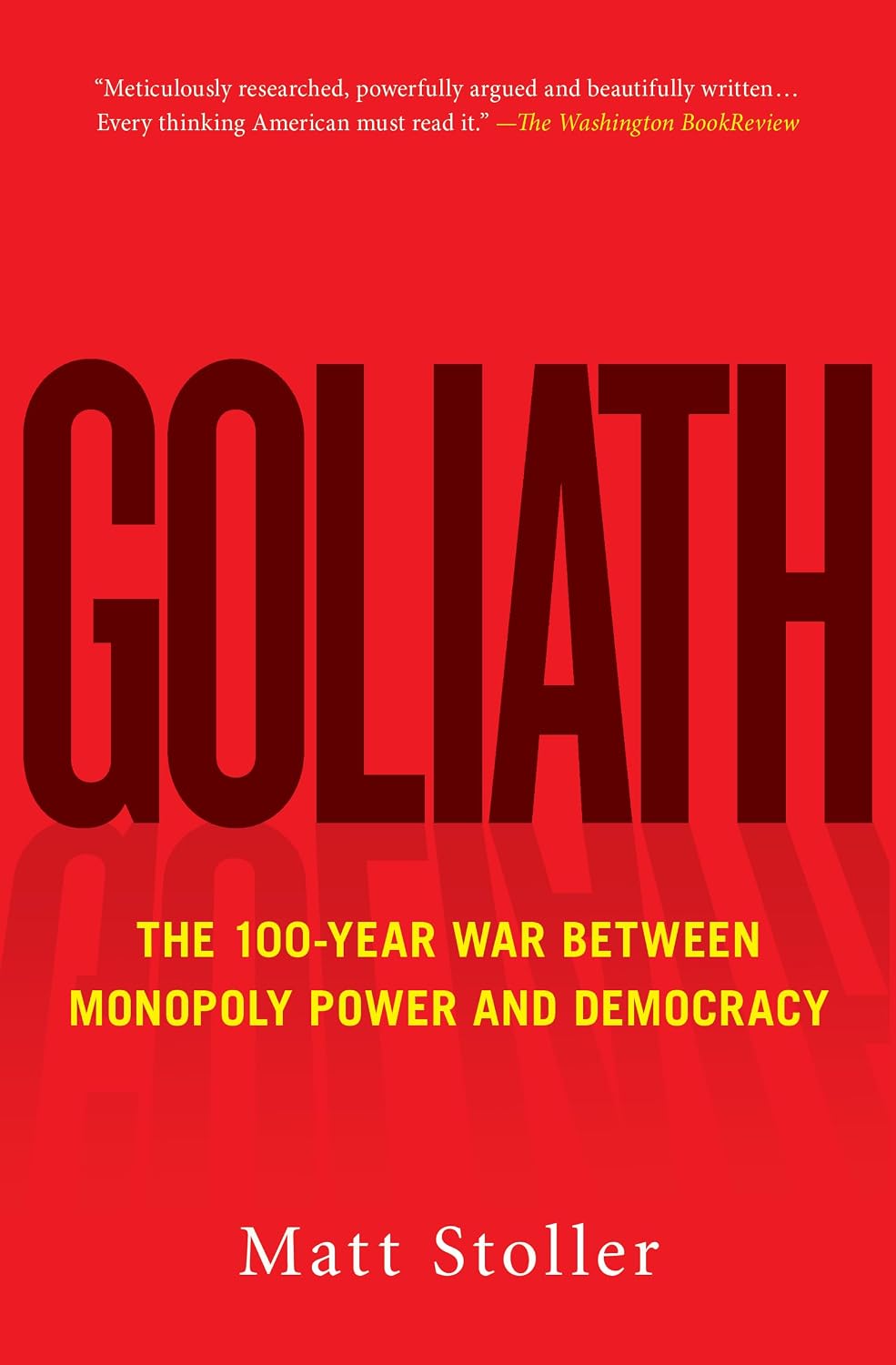
Goliath: The 100-Year War Between Monopoly Power and Democracy (Must-Read American History)

Description:

“Every thinking American must read” (The Washington Book Review) this startling and “insightful” (The New York Times) look at how concentrated financial power and consumerism has transformed American politics, and business.

Going back to our country’s founding, Americans once had a coherent and clear understanding of political tyranny, one crafted by Thomas Jefferson and updated for the industrial age by Louis Brandeis. A concentration of power—whether by government or banks—was understood as autocratic and dangerous to individual liberty and democracy. In the 1930s, people observed that the Great Depression was caused by financial concentration in the hands of a few whose misuse of their power induced a financial collapse. They drew on this tradition to craft the New Deal.

In
Goliath, Matt Stoller explains how authoritarianism and populism have returned to American politics for the first time in eighty years, as the outcome of the 2016 election shook our faith in democratic institutions. It has brought to the fore dangerous forces that many modern Americans never even knew existed. Today’s bitter recriminations and panic represent more than just fear of the future, they reflect a basic confusion about what is happening and the historical backstory that brought us to this moment.

The true effects of populism, a shrinking middle class, and concentrated financial wealth are only just beginning to manifest themselves under the current administrations. The lessons of Stoller’s study will only grow more relevant as time passes. “An engaging call to arms,” (
Kirkus Reviews) Stoller illustrates here in rich detail how we arrived at this tenuous moment, and the steps we must take to create a new democracy.


Editorial Reviews

Review

"Goliath is a meticulously researched, powerfully argued and beautifully written book. Every thinking American must read it." The Washington Book Review

"Deeply researched . . . Insightful."
—Farhad Manjoo, The New York Times

"An engaging call to arms at a time when corporate power is increasing and that of the middle class evaporating."
—Kirkus

"
Goliath shows that a history of antitrust in the United States is ultimately a story about who we are as Americans, the limits we can place on private power, and government's ability to be a force for fairness and justice. The breadth and depth contained in this book is unlike any book written on the topic in recent memory—it is the kind of big economic history that the moment needs." —Chris Hughes, co-founder of Facebook and co-chairman of the Economic Security Project

"Here is the secret history of economic democracy in America. 'Secret' because it’s a story that will trouble everyone: conservatives and liberals, Silicon Valley and Big Oil. But it’s also a story that gets at the heart of who we were and who we might be again. What Matt Stoller reminds us, in his perceptive and brilliant and at times startling way, is that the desire for economic equality is utterly American; that it is one of the oldest of American political traditions; and that in a slightly altered context, the people we love to scorn as “populists” might have proven even more radical than the wokest activist in the #Resistance."
—Thomas Frank, author of What’s the Matter with Kansas?

Goliath is an impressive and fun book telling the long-forgotten but critical history of how freedom, not just from coercive government but from coercive corporate monopolies, is an essential part of American business.” —Jeremy Stoppelman, CEO of Yelp

“Imaginatively researched, cogently argued, and consistently engaging, Matt Stoller’s
Goliath persuasively restores the antimonopoly tradition to its rightful place in the twentieth-century moral imagination. If you are concerned about the enormous power politically unaccountable corporations wield in everyday life, this book will help explain how we got to the fix we are in—and what we can do about it.” —Richard R. John, Columbia University and author of Network Nation: Inventing American Telecommunications

"Matt Stoller's
Goliath is a remarkable and fun story about corporate power in America. Stoller brings to life pivotal political fights over banks and monopolies, fights that took place in board rooms, in hearing rooms, and in mass protests. Highly recommended." —Henry Waxman, former United States congressman

"
Goliath deftly traces the last century of anti-monopoly politics, identifying the key figures and policy fights that have shaped how America organized its political economy. At a moment when Americans are once again questioning and pushing back against extreme concentrations of private power, Goliath illuminates a history that is critical for understanding how we got here. It couldn't be timelier or more relevant for current debates around the dangers of unchecked corporate power and the future of the Democratic party." —Lina Khan, author of "Amazon's Antitrust Paradox"

“Matt Stoller has written a fascinating, deeply researched and almost hypnotic tale of the often tense relationship between corporate power and democracy. It has obvious parallels to where we are today, and lessons to be learned as we work to once again make democracy work for the people. Stoller’s documentation of this lost history is more important than ever as we deal with the effects of the financial crisis and deep-seeded poverty, the growing power of technology companies and the extraordinary gap that exists today between the richest few and everybody else."
Pramila Jayapal, United States congresswoman

“Democrats who seek to revitalize their party would do well to study Matt Stoller’s
Goliath and incorporate—in a complex and thoughtful manner—its central teachings.” The American Prospect

“Though anti-monopolism has been dormant for decades, the corporate consolidation of this century has given Americans on both sides of the political spectrum reason to wonder if it should be awakened. And Stoller’s treatise is a good place to start in thinking through that question.”
National Review

About the Author

Matt Stoller is a Fellow at the Open Markets Institute. Previously, he was a Senior Policy Advisor and Budget Analyst to the Senate Budget Committee. He also worked in the US House of Representatives on financial services policy, including Dodd-Frank, the Federal Reserve, and the foreclosure crisis. He has written for The New York Times, The Washington Post, The New Republic, Vice, and Salon. He lives in Washington, DC. Goliath is his first book.

Reviews:

5.0 out of 5 stars Phenomenal text on Monopolies in American History I’ve Ever

S. · August 15, 2025

(function() { P.when('cr-A', 'ready').execute(function(A) { if(typeof A.toggleExpanderAriaLabel === 'function') { A.toggleExpanderAriaLabel('review_text_read_more', 'Read more of this review', 'Read less of this review'); } }); })(); .review-text-read-more-expander:focus-visible { outline: 2px solid #2162a1; outline-offset: 2px; border-radius: 5px; } Great book. I thought I knew a decent amount of American history but Stoller is so specialized in this area that I could barely keep up with all the info. If you’re a populist or just dont like all of the corruption between politics and business, this book can be inspiring at best and even the depressing parts are informative.

5.0 out of 5 stars David's got his work cut out

A. · November 22, 2019

This is a five-star book. I say that upfront, because I need to vent first. My expectations from Goliath were super-high and were, in the main, unmet:I thought this would become the source for people like me who want a list of all businesses, from Airlines and Beer and Chewing gum, all the way to Zippers, that are today quasi-monopolies.It isn’t.I thought this would become the bank of arguments I’d come back to consult every time I knew I might bump into my friend Doug, who thinks business is over-regulated.It isn’t.I thought this would be the book that fuses Jean Tirole’s wisdom with Robert Reich’s call to arms to lay out the economic (as opposed to the political) argument against Facebook, Amazon, Netflix and Google.That, it most definitely isn’t. No economics to be found in Goliath. And Bob Reich is a bad guy here!But fret not if you’ve already placed your order for Matt Stoller’s magnum opus, because you are about to be treated to the definitive 500-page history of the rise and the fall (and the potential for re-birth) of the populist movement in America.As a society, Stoller argues, we are called today to face down one more time the biggest modern enemy of the American people: monopoly power. His main goal is to address a single part of this puzzle; to set us straight on the historical record:“You are here and let me tell you how you ended up here,” he says. His clear intention is that(i) if we know the history of how we conquered monopoly once(ii) if we understand that this is one and the same as the people’s strugglethen we will have a clear path past the modern-era monopolists and the bought-and-paid-for politicians who do their bidding from both sides of the aisle.The book starts in medias res, with the funeral of Senator Wright Patman, populist anti-monopoly crusader, in March of 1976. A poignant historical event, because it marked the end of an era, a fifty-year golden age when America was comfortable restricting monopoly without having to make any excuses.Stoller’s perspective of the struggle is best understood by considering the four-way dilemma voters faced in the 1912 election, when Americans were called to decide the fate of the main scourge of their times: the trusts. Eugene Debs, a socialist, simply proposed that they be nationalized. Republican incumbent, and laissez-faire proponent, Taft did not find there was any problem whatsoever with the legacy of Carnegie, Frick, the Rockefellers or the Morgans. Woodrow Wilson, the eventual winner, ran on the premise that behemoths should be broken up via very aggressive antitrust legislation. And independent candidate, former Republican President and original populist Theodore Roosevelt, finally, proposed a more nuanced view: he recognized that, provided they did not challenge the government’s powers, large companies were often necessary, but ought to be reined in via regulation.The question was not answered by the election, the author argues, because Wilson decided to enter WWI, in the process sticking Eugene Debs in jail, reneging on his promises to break up monopolies and forging a tight alliance between big money, big business and government, of the kind that probably would have come out of another Roosevelt administration.When the war ended, bringing about a very sharp correction in arable land prices, agricultural products, commodities and industrials, the opposition party that picked up the pieces was very much in hock to the moneyed interests of the trusts and personified in Andrew Mellon, the industrialist and Morgan associate who, among other assets, owned the absolute US monopoly in aluminium (Alcoa) and “under whom three presidents served.” His era ended, famously, with the Great Depression, and not before fully demonstrating to all Americans the perils of allowing market power to evolve into absolute power.With particular relish, Stoller recounts how FDR next took the reins and, over three terms in government, put in place the plan, the process and the people to turn the country around. Starring roles are reserved for Wright Patman, who personally pursued Andrew Mellon, for Ferdinand Pecora, Henry Morgenthau and Robert Jackson’s pursuit of the monopolist Goliath in general and for Marriner Eccles’ firm hand at the Fed, with the eventual outcome that (p. 140) “every part of the economy began growing again, except Wall St.” On the legal front, not only was the Sherman Act back to being applied according to its original purpose, but the Robinson-Patman act of 1936 made both predatory pricing and price discrimination illegal. In other words, a large corporation could no longer lawfully discount to drive new competitors out of business, while a railroad could no longer charge a big shipper a lower price than a small shipper for the same freight. And the Glass-Steagall Act carved the corporate financiers and traders out of the banks. The New Deal itself Stoller does not really go into, you can find about that in other books, I suppose.The legacy of the New Deal was a period that celebrated the small businessman, when vertical integration was verboten every bit as much as market share, when corporate leaders were genuinely afraid of the FTC, the ICC, the SEC, and the Senate Banking Committee, when Presidents Truman and Eisenhower alike celebrated small business and when the notorious “Military Industrial Complex” itself was composed of scores of fierce competitors.What happened right next is described with 100% historical accuracy, but perhaps with inadequate sympathy for the position the liberals found themselves in who led the agenda, inadvertently cracking the door open for the unfettered, unapologetic capitalists to sneak back in.The heart of the intellectual leaders of the Kennedy administration was in the right place (and Stoller does have praise for the anti-McCarthyist stance of John Kenneth Galbraith) but they could not help but keep an eye on the seeming progress of the Soviet Union and conclude that there were growth-related merits to the statist approach.Not unlike today’s experts singing the praises of the Chinese approach to growth, but in a way turbocharged by the Soviet’s successes with their space program, mainstream economists of the era, Galbraith and Hofstadter included, came to believe that if growth was your thing, the state was your friend. The standard university textbook in economics, Paul Samuelson’s “Economics,” openly predicted the coming economic dominance of the Soviet Union.On the other hand, there was very little denying that we in the West had it good. When Nikita Khrushchev visited a US supermarket, he thought it was some sort of western version of the Potemkin village, that’s how stark the difference was between East and West. So I, for one, have great sympathy for the argument made by Galbraith and the Kennedy “liberals” he stood for, saying that we in the West lived in a world of “Affluence.”From there, of course, it was a small, but very wrong, step to say that since we lived in a world of affluence, our problem was not to protect affluent citizens from colluding businesses. Rather, it was to get the state itself to coordinate these businesses so we would could keep the Soviets in our rear-view mirror.And since the main premise had to be that we were doing things right and since we were indeed taking a dirigiste approach and since FDR had gifted us powerful unions, it was only natural that a theory of “countervailing power” that would contain excess would arise. Little did they know that, a short fifty years later, monopoly apologists like Peter Thiel would use a very similar argument to tell us every Microsoft will find its Google and all is for the best in this best of all possible worlds.Suddenly, the defenders of the plain people were no longer in the ramparts to protect them. Significantly, in abandoning their populist principles, the representatives of the liberal side were not only elitist and statist, they became convenient villains, bogeymen for an angry movement that made some intellectually powerful points!Enter Friedrich Hayek. Hayek correctly identified that the Soviets and those in the free world who were content to “cover” them were making a grave error: people work better when they are free to make mistakes. Away from the centers of power in DC and away from the ivory towers of the Ivy League, a movement came about that started its life very much on the margins, but, centered around Chicago developed a hard core of convictions.Stoller credits a single man, Hayek’s prophet Aaron Director, with picking up where Hayek left off and1. establishing on the economic firmament the eventual giants of the Chicago School such as George Stigler and Milton Friedman2. creating out of thin air the field of “Law and Economics,” that gave us Ronald Coase, Gary Becker, Robert Bork and (Judge) Richard PosnerContrary to conventional wisdom (except perhaps for Bork, whose name I first even came across in college during the “block Bork” campaign), Stoller is highly contemptuous of these men.The field of “Law and Economics” he dismisses as pure bogus. As a onetime student of Keith Hylton, I must say I remember very fondly all the relevant teachings and I remember equally clearly how far out of their way my teachers always went to explain that in the real world it actually wasn’t enough to establish who had the right to pollute, for example, because markets are incomplete. This was never presented to me as anything more than a stylized way to look at the world. And as an avid former reader of the Becker-Posner blog, I must say I really miss it now Professor Becker is no longer with us. Even the early, hyper-combative writings of these authors need to be understood in the context of the sixties and seventies, when to be heard they had to scream.On the other hand, that is not to say that Stoller’s got it wrong. The essence he’s got 100% right. These academics’ ideas were eventually hijacked by malevolent actors who sought intellectual justification for what amounts to a restoration of market power and monopoly, all in the name of freedom.Not that anybody would listen to Milton Friedman when the going was good, of course. But come the Vietnam War, the fall in American competitiveness versus a re-building Europe, the end of the Gold Standard, the ensuing oil embargo (that Stoller conventionally attributes to the Arab-Israeli conflict) and the stagflation of the seventies, it was to his theories that everybody turned for the economy (rather than, say, Minksy’s or Olson’s) and to Bork’s for antitrust. If the old order was not delivering, that’s what was on the chop.With no doubt, that was a tragedy, because Bork’s lifetime was dedicated to proving there’s nothing wrong with market power or even monopoly, so long as the consumer is not left worse off. Even the definition for what leaves the consumer worse off was defined hyper-narrowly as “low price.” Bork, described here as an ardent climber, earned tenure at Yale, from where he cultivated none other than Goldwater. Even though Goldwater was trounced at the polls, Bork now had enjoyed enough time near the halls of power that he could be ready to pounce.Stoller pauses his account of how antitrust was defeated to introduce two more important components of the story: the emerging conglomerates and the re-emerging banks that enabled them. While lending inside the US was constrained by laws passed as part of the New Deal, American banks could carry on lending to foreigners. The “public face” of this new development, a young Walter Wriston, made his name lending to a young Greek shipowner by the name of Aristotle Onassis, with the profits from this one account probably all he needed to ascend to the top of the world’s biggest bank, Citibank.Emboldened by their international profitability, US banks found a loophole that allowed them to lend in more than one state: they lent money to large conglomerates. The conglomerates were the big fashion of the late sixties American stock market. With vertical and horizontal integration stymied by still-enforced, strong anti-monopoly laws, conglomerates borrowed from the banks to buy completely disconnected businesses that were unwise enough to maintain a neat, unlevered balance sheet, lever them up and distribute large dividends to their own shareholders. As early as January, 1969, incidentally, Wriston tried (but failed) to drive through the Glass-Steagall act, by attempting to merge Chubb Corporation under his Citigroup. (The world would have to wait 30 more years for that)And that’s for example, how, enabled by the money center banks themselves, a 29-year-old upstart, Saul Steinberg, almost succeeded in buying Chemical Bank in February of 1969. He failed, but other, less outrageous operators succeeded. Most egregiously so, Penn Central, the country’s biggest railway operator, a proper “train wreck” of a conglomerate that used debt to buy every company it could get its hands on and almost brought down the American economy itself when its debts finally caught up with it.The agitators for the plain man come in for criticism next, with Stoller painting Ralph Nader as nothing more than a useful idiot for the establishment, a man who deflected the ire of the people away from the re-emerging nexus of banks and corporations toward their regulators. In expending all their energy to defend the rights of the consumer, rather than the citizen, the author’s claims, “Nader’s raiders” actually paved the way for Bork to sound entirely reasonable when in his “Antitrust Paradox” he took the side of corporations that could deliver lower prices, with little regard to the fact that this achievement may have been enabled through market power, predatory pricing or discriminatory pricing.The watershed moment when populism in America died was when the “Watergate Babies” swept into DC in 1974. In their zeal to upend all existing institutions, to defeat stagnation, and “oriented by the politics of affluence rather than the memory of Mellon, they ignored antimonopolist elders and did not fully understand the danger of concentrated financial power.” (p. 330, actually discussing a 1970 article written in the Washington Monthly about the aftermath of Penn Central)The 49 seats Democrats picked up in the House were filled by anti-war youths who teamed up with some more senior liberals to strike a blow against the seniority system and overthrew committee chairmen whom they viewed as too conservative and/or too old.With the old guard, tainted by not having ended the Vietnam War, in the defensive, the Watergate Babies chucked out the baby with the bathwater, Stoller persuasively argues. Inflation being on the rampage, moreover, there was strong support for any measures that could hold prices down, hard-won fights against market power be damned.From that moment onward, the Democratic Party has become a party of identity politics rather than a defendant of the poor. Bork had no problem single-handedly changing American antitrust.From there, the book carves a straight line to Michael Milken and Bob Rubin, from Bob Rubin to Clinton’s deregulatory bonanza, the tech bust of 2000, the housing / banking meltdown of 2008 and today’s cocktail of Trump, private equity and FANGS, with stops to take in the pyrrhic victories of the IBM trial and the Microsoft trial.Nobody is spared, including Saint Jimmy Carter, to say nothing of Barack Obama, or Reagan.You and I may disagree about the detail but Stoller has accomplished a Herculean task here: first he succeeds in defining populism in America as the struggle against market power; next in writing the definitive history of American populism in the 20th century.

5.0 out of 5 stars Goliath Is a MUST Read for All Americans

B.P. · March 23, 2023

Matt Stoller's knowledge of America's financial history is reason enough to read Goliath. But it is his insights, wisdom and honesty that make this book one that must be read. Everyone is aware that our free republic is being seized by elite bankers, globalist monopolies and crooked politicians. We all are watching in real time as the US government terrorizes and censors its citizens. Stoller's book shows that the country has been thorough all this before. He shows that this 21st century concentration of power and wielding of terror happened in the early 20th century too. If you want to know how to defend against the current tyranny coming down on us at the hands of today's power-mad monopolists and global financial elites, READ THIS BOOK.

4.0 out of 5 stars Insightful!

L.Y. · February 9, 2025

Buckle up! Stoller takes you on a historical journey through the post Industrial Revolution business and regulatory landscape providing excellent detail on the events and evolution of our current U.S. economy with special attention to corrupt anti-competitive monopolistic business practices, conflicts of interests in academic institutions to support these business practices and regulatory philosophy over the years that shaped the economy. Provides an excellent the reader a great understanding of corporate consolidation and harmful affects on middle and lower class citizens. A must read to understand a history of the American economy. Didn’t give him 5 stars because he doesn’t provide a rebuttal to any counter arguments or other lines of thinking. For example, if a company becomes a monopoly because of merit and substantial long term value it should be broken up just as a monopoly with anti competitive business practices. Did enjoy the end of the book on corporate raiders and Jack Welch I see this in the current business environment of 2025

5.0 out of 5 stars Must read!

M. · December 9, 2019

Cannot find word to describe it better than breathtaking! The depth and scope of historical research, the quality of writing, and the amount of sources are astonishing.This is must to read book for understanding how we got to the current nasty situation and the very internals of the political and intellectual mechanisms of building and maintaining the monopolistic powers.One thing that I’d mention and that are not critics but just a contemplation: there is still lack of a theoretical (economical and philosophical) framework that can analyze the deep mechanisms how the monopolistic and financial capitalism destroys human well-being and liberty, something like Hayek’s “The Road to Serfdom” and, on the other side, the manifest that can show how to get out of this. You book comes very close to this ultimate goal.

5.0 out of 5 stars Great book

L. · December 1, 2019

Goliath is not an easy book, and that's awesome because - according to Matt Stoller's interview on the Rising - this book is intended to be an economic guide for the next president.Before the next president (hopefully Bernie) reads it, I'm going to use it as a tool for my hobby novel :)To the other reviewer who doesn't the author's populist bias - IMHO this is a virtue. It simply means he has a heart. The working people have been struggling for too long - the housing crisis, the opioid crisis, the Flint water crisis, etc... The regular people don't know how to talk about their struggles. That's why some of them got behind the far-right ideas. The neoliberal wing lie to the working people and pretend that everything is ok. Trump at least says that something is wrong.The progressives' theory will be proven very soon. Let's see if Obama will speak up against Bernie to defend his legacy.

Inspiring book, excellent author

F. · February 5, 2020

(function() { P.when('cr-A', 'ready').execute(function(A) { if(typeof A.toggleExpanderAriaLabel === 'function') { A.toggleExpanderAriaLabel('review_text_read_more', 'Read more of this review', 'Read less of this review'); } }); })(); .review-text-read-more-expander:focus-visible { outline: 2px solid #2162a1; outline-offset: 2px; border-radius: 5px; } Wonderful read, very detailed and well written. Stoller is one of the most interesting researchers on monopoly and democracy. His newsletter, BIG, is truly inspiring. I had no doubt this book would have been excellent as well.

Monopolistic practices persist

G. · August 26, 2024

Excellent recounting of the events that have led to the many problems manifesting in today's politics and economics. Highly recommended.

Excellent read.

T.P. · January 2, 2020

Fantastic book, very well written and thought provoking. Would recommend to anyone interested in the relationship between government and big business.

Etwas schwerfällig aber extrem wichtige Lektüre

M.M. · December 5, 2020

In Zeiten wo Menschen wie Trump zum Präsidenten werden und Firmen wie diese Plattform quasi Monopolstellung haben, führt Matt Stoler durch die amerikanische Geschichte von Firmen und Monopolen. Er errinert an eine andere amerikanische Poltik welche heute mehr denn je gebraucht wird.Absolut lesenwert.

A must read

j.d. · November 21, 2020

A great book. One of the most important book of the year. A must read to better understand what is happening around us in these troubled times.

Goliath: The 100-Year War Between Monopoly Power and Democracy (Must-Read American History)

Product ID: U1501182897
Condition: New

4.6

AED9513

Price includes VAT & Import Duties
Type: Paperback
Availability: In Stock

Quantity:

|

Order today to get by 7-14 business days

Delivery fee of AED 20. Free for orders above AED 200.

Returns & Warranty policies

Imported From: United States

At BOLO, we work hard to ensure the products you receive are new, genuine, and sourced from reputable suppliers.

BOLO is not an authorized or official retailer for most brands, nor are we affiliated with manufacturers unless specifically stated on a product page. Instead, we source verified sellers, authorized distributors or directly from the manufacturer.

Each product undergoes thorough inspection and verification at our consolidation and fulfilment centers to ensure it meets our strict authenticity and quality standards before being shipped and delivered to you.

If you ever have concerns regarding the authenticity of a product purchased from us, please contact Bolo Support. We will review your inquiry promptly and, if necessary, provide documentation verifying authenticity or offer a suitable resolution.

Your trust is our top priority, and we are committed to maintaining transparency and integrity in every transaction.

All product information, images, descriptions, and reviews originate from the manufacturer or from trusted sellers overseas. BOLO is not affiliated with, endorsed by, or an authorized retailer for most brands listed on our website unless stated otherwise.

While we strive to display accurate information, variations in packaging, labeling, instructions, or formulation may occasionally occur due to regional differences or supplier updates. For detailed or manufacturer-specific information, please contact the brand directly or reach out to BOLO Support for assistance.

Unless otherwise stated, all prices displayed on the product page include applicable taxes and import duties.

BOLO operates in accordance with the laws and regulations of United Arab Emirates. Any items found to be restricted or prohibited for sale within the UAE will be cancelled prior to shipment. We take proactive measures to ensure that only products permitted for sale in United Arab Emirates are listed on our website.

All items are shipped by air, and any products classified as “Dangerous Goods (DG)” under IATA regulations will be removed from the order and cancelled.

All orders are processed manually, and we make every effort to process them promptly once confirmed. Products cancelled due to the above reasons will be permanently removed from listings across the website.

Similar suggestions by Bolo

More from this brand

Similar items from “National”

Goliath: The 100-Year War Between Monopoly Power and Democracy (Must-Read American History)

Product ID: U1501182897
Condition: New

4.6

Goliath: The 100-Year War Between Monopoly Power and Democracy (Must-Read American History)-0
Type: Paperback

AED9513

Price includes VAT & Import Duties
Availability: In Stock

Quantity:

|

Order today to get by 7-14 business days

Delivery fee of AED 20. Free for orders above AED 200.

Returns & Warranty policies

Imported From: United States

At BOLO, we work hard to ensure the products you receive are new, genuine, and sourced from reputable suppliers.

BOLO is not an authorized or official retailer for most brands, nor are we affiliated with manufacturers unless specifically stated on a product page. Instead, we source verified sellers, authorized distributors or directly from the manufacturer.

Each product undergoes thorough inspection and verification at our consolidation and fulfilment centers to ensure it meets our strict authenticity and quality standards before being shipped and delivered to you.

If you ever have concerns regarding the authenticity of a product purchased from us, please contact Bolo Support. We will review your inquiry promptly and, if necessary, provide documentation verifying authenticity or offer a suitable resolution.

Your trust is our top priority, and we are committed to maintaining transparency and integrity in every transaction.

All product information, images, descriptions, and reviews originate from the manufacturer or from trusted sellers overseas. BOLO is not affiliated with, endorsed by, or an authorized retailer for most brands listed on our website unless stated otherwise.

While we strive to display accurate information, variations in packaging, labeling, instructions, or formulation may occasionally occur due to regional differences or supplier updates. For detailed or manufacturer-specific information, please contact the brand directly or reach out to BOLO Support for assistance.

Unless otherwise stated, all prices displayed on the product page include applicable taxes and import duties.

BOLO operates in accordance with the laws and regulations of United Arab Emirates. Any items found to be restricted or prohibited for sale within the UAE will be cancelled prior to shipment. We take proactive measures to ensure that only products permitted for sale in United Arab Emirates are listed on our website.

All items are shipped by air, and any products classified as “Dangerous Goods (DG)” under IATA regulations will be removed from the order and cancelled.

All orders are processed manually, and we make every effort to process them promptly once confirmed. Products cancelled due to the above reasons will be permanently removed from listings across the website.

Description:

“Every thinking American must read” (The Washington Book Review) this startling and “insightful” (The New York Times) look at how concentrated financial power and consumerism has transformed American politics, and business.

Going back to our country’s founding, Americans once had a coherent and clear understanding of political tyranny, one crafted by Thomas Jefferson and updated for the industrial age by Louis Brandeis. A concentration of power—whether by government or banks—was understood as autocratic and dangerous to individual liberty and democracy. In the 1930s, people observed that the Great Depression was caused by financial concentration in the hands of a few whose misuse of their power induced a financial collapse. They drew on this tradition to craft the New Deal.

In
Goliath, Matt Stoller explains how authoritarianism and populism have returned to American politics for the first time in eighty years, as the outcome of the 2016 election shook our faith in democratic institutions. It has brought to the fore dangerous forces that many modern Americans never even knew existed. Today’s bitter recriminations and panic represent more than just fear of the future, they reflect a basic confusion about what is happening and the historical backstory that brought us to this moment.

The true effects of populism, a shrinking middle class, and concentrated financial wealth are only just beginning to manifest themselves under the current administrations. The lessons of Stoller’s study will only grow more relevant as time passes. “An engaging call to arms,” (
Kirkus Reviews) Stoller illustrates here in rich detail how we arrived at this tenuous moment, and the steps we must take to create a new democracy.


Editorial Reviews

Review

"Goliath is a meticulously researched, powerfully argued and beautifully written book. Every thinking American must read it." The Washington Book Review

"Deeply researched . . . Insightful."
—Farhad Manjoo, The New York Times

"An engaging call to arms at a time when corporate power is increasing and that of the middle class evaporating."
—Kirkus

"
Goliath shows that a history of antitrust in the United States is ultimately a story about who we are as Americans, the limits we can place on private power, and government's ability to be a force for fairness and justice. The breadth and depth contained in this book is unlike any book written on the topic in recent memory—it is the kind of big economic history that the moment needs." —Chris Hughes, co-founder of Facebook and co-chairman of the Economic Security Project

"Here is the secret history of economic democracy in America. 'Secret' because it’s a story that will trouble everyone: conservatives and liberals, Silicon Valley and Big Oil. But it’s also a story that gets at the heart of who we were and who we might be again. What Matt Stoller reminds us, in his perceptive and brilliant and at times startling way, is that the desire for economic equality is utterly American; that it is one of the oldest of American political traditions; and that in a slightly altered context, the people we love to scorn as “populists” might have proven even more radical than the wokest activist in the #Resistance."
—Thomas Frank, author of What’s the Matter with Kansas?

Goliath is an impressive and fun book telling the long-forgotten but critical history of how freedom, not just from coercive government but from coercive corporate monopolies, is an essential part of American business.” —Jeremy Stoppelman, CEO of Yelp

“Imaginatively researched, cogently argued, and consistently engaging, Matt Stoller’s
Goliath persuasively restores the antimonopoly tradition to its rightful place in the twentieth-century moral imagination. If you are concerned about the enormous power politically unaccountable corporations wield in everyday life, this book will help explain how we got to the fix we are in—and what we can do about it.” —Richard R. John, Columbia University and author of Network Nation: Inventing American Telecommunications

"Matt Stoller's
Goliath is a remarkable and fun story about corporate power in America. Stoller brings to life pivotal political fights over banks and monopolies, fights that took place in board rooms, in hearing rooms, and in mass protests. Highly recommended." —Henry Waxman, former United States congressman

"
Goliath deftly traces the last century of anti-monopoly politics, identifying the key figures and policy fights that have shaped how America organized its political economy. At a moment when Americans are once again questioning and pushing back against extreme concentrations of private power, Goliath illuminates a history that is critical for understanding how we got here. It couldn't be timelier or more relevant for current debates around the dangers of unchecked corporate power and the future of the Democratic party." —Lina Khan, author of "Amazon's Antitrust Paradox"

“Matt Stoller has written a fascinating, deeply researched and almost hypnotic tale of the often tense relationship between corporate power and democracy. It has obvious parallels to where we are today, and lessons to be learned as we work to once again make democracy work for the people. Stoller’s documentation of this lost history is more important than ever as we deal with the effects of the financial crisis and deep-seeded poverty, the growing power of technology companies and the extraordinary gap that exists today between the richest few and everybody else."
Pramila Jayapal, United States congresswoman

“Democrats who seek to revitalize their party would do well to study Matt Stoller’s
Goliath and incorporate—in a complex and thoughtful manner—its central teachings.” The American Prospect

“Though anti-monopolism has been dormant for decades, the corporate consolidation of this century has given Americans on both sides of the political spectrum reason to wonder if it should be awakened. And Stoller’s treatise is a good place to start in thinking through that question.”
National Review

About the Author

Matt Stoller is a Fellow at the Open Markets Institute. Previously, he was a Senior Policy Advisor and Budget Analyst to the Senate Budget Committee. He also worked in the US House of Representatives on financial services policy, including Dodd-Frank, the Federal Reserve, and the foreclosure crisis. He has written for The New York Times, The Washington Post, The New Republic, Vice, and Salon. He lives in Washington, DC. Goliath is his first book.

Reviews:

5.0 out of 5 stars Phenomenal text on Monopolies in American History I’ve Ever

S. · August 15, 2025

(function() { P.when('cr-A', 'ready').execute(function(A) { if(typeof A.toggleExpanderAriaLabel === 'function') { A.toggleExpanderAriaLabel('review_text_read_more', 'Read more of this review', 'Read less of this review'); } }); })(); .review-text-read-more-expander:focus-visible { outline: 2px solid #2162a1; outline-offset: 2px; border-radius: 5px; } Great book. I thought I knew a decent amount of American history but Stoller is so specialized in this area that I could barely keep up with all the info. If you’re a populist or just dont like all of the corruption between politics and business, this book can be inspiring at best and even the depressing parts are informative.

5.0 out of 5 stars David's got his work cut out

A. · November 22, 2019

This is a five-star book. I say that upfront, because I need to vent first. My expectations from Goliath were super-high and were, in the main, unmet:I thought this would become the source for people like me who want a list of all businesses, from Airlines and Beer and Chewing gum, all the way to Zippers, that are today quasi-monopolies.It isn’t.I thought this would become the bank of arguments I’d come back to consult every time I knew I might bump into my friend Doug, who thinks business is over-regulated.It isn’t.I thought this would be the book that fuses Jean Tirole’s wisdom with Robert Reich’s call to arms to lay out the economic (as opposed to the political) argument against Facebook, Amazon, Netflix and Google.That, it most definitely isn’t. No economics to be found in Goliath. And Bob Reich is a bad guy here!But fret not if you’ve already placed your order for Matt Stoller’s magnum opus, because you are about to be treated to the definitive 500-page history of the rise and the fall (and the potential for re-birth) of the populist movement in America.As a society, Stoller argues, we are called today to face down one more time the biggest modern enemy of the American people: monopoly power. His main goal is to address a single part of this puzzle; to set us straight on the historical record:“You are here and let me tell you how you ended up here,” he says. His clear intention is that(i) if we know the history of how we conquered monopoly once(ii) if we understand that this is one and the same as the people’s strugglethen we will have a clear path past the modern-era monopolists and the bought-and-paid-for politicians who do their bidding from both sides of the aisle.The book starts in medias res, with the funeral of Senator Wright Patman, populist anti-monopoly crusader, in March of 1976. A poignant historical event, because it marked the end of an era, a fifty-year golden age when America was comfortable restricting monopoly without having to make any excuses.Stoller’s perspective of the struggle is best understood by considering the four-way dilemma voters faced in the 1912 election, when Americans were called to decide the fate of the main scourge of their times: the trusts. Eugene Debs, a socialist, simply proposed that they be nationalized. Republican incumbent, and laissez-faire proponent, Taft did not find there was any problem whatsoever with the legacy of Carnegie, Frick, the Rockefellers or the Morgans. Woodrow Wilson, the eventual winner, ran on the premise that behemoths should be broken up via very aggressive antitrust legislation. And independent candidate, former Republican President and original populist Theodore Roosevelt, finally, proposed a more nuanced view: he recognized that, provided they did not challenge the government’s powers, large companies were often necessary, but ought to be reined in via regulation.The question was not answered by the election, the author argues, because Wilson decided to enter WWI, in the process sticking Eugene Debs in jail, reneging on his promises to break up monopolies and forging a tight alliance between big money, big business and government, of the kind that probably would have come out of another Roosevelt administration.When the war ended, bringing about a very sharp correction in arable land prices, agricultural products, commodities and industrials, the opposition party that picked up the pieces was very much in hock to the moneyed interests of the trusts and personified in Andrew Mellon, the industrialist and Morgan associate who, among other assets, owned the absolute US monopoly in aluminium (Alcoa) and “under whom three presidents served.” His era ended, famously, with the Great Depression, and not before fully demonstrating to all Americans the perils of allowing market power to evolve into absolute power.With particular relish, Stoller recounts how FDR next took the reins and, over three terms in government, put in place the plan, the process and the people to turn the country around. Starring roles are reserved for Wright Patman, who personally pursued Andrew Mellon, for Ferdinand Pecora, Henry Morgenthau and Robert Jackson’s pursuit of the monopolist Goliath in general and for Marriner Eccles’ firm hand at the Fed, with the eventual outcome that (p. 140) “every part of the economy began growing again, except Wall St.” On the legal front, not only was the Sherman Act back to being applied according to its original purpose, but the Robinson-Patman act of 1936 made both predatory pricing and price discrimination illegal. In other words, a large corporation could no longer lawfully discount to drive new competitors out of business, while a railroad could no longer charge a big shipper a lower price than a small shipper for the same freight. And the Glass-Steagall Act carved the corporate financiers and traders out of the banks. The New Deal itself Stoller does not really go into, you can find about that in other books, I suppose.The legacy of the New Deal was a period that celebrated the small businessman, when vertical integration was verboten every bit as much as market share, when corporate leaders were genuinely afraid of the FTC, the ICC, the SEC, and the Senate Banking Committee, when Presidents Truman and Eisenhower alike celebrated small business and when the notorious “Military Industrial Complex” itself was composed of scores of fierce competitors.What happened right next is described with 100% historical accuracy, but perhaps with inadequate sympathy for the position the liberals found themselves in who led the agenda, inadvertently cracking the door open for the unfettered, unapologetic capitalists to sneak back in.The heart of the intellectual leaders of the Kennedy administration was in the right place (and Stoller does have praise for the anti-McCarthyist stance of John Kenneth Galbraith) but they could not help but keep an eye on the seeming progress of the Soviet Union and conclude that there were growth-related merits to the statist approach.Not unlike today’s experts singing the praises of the Chinese approach to growth, but in a way turbocharged by the Soviet’s successes with their space program, mainstream economists of the era, Galbraith and Hofstadter included, came to believe that if growth was your thing, the state was your friend. The standard university textbook in economics, Paul Samuelson’s “Economics,” openly predicted the coming economic dominance of the Soviet Union.On the other hand, there was very little denying that we in the West had it good. When Nikita Khrushchev visited a US supermarket, he thought it was some sort of western version of the Potemkin village, that’s how stark the difference was between East and West. So I, for one, have great sympathy for the argument made by Galbraith and the Kennedy “liberals” he stood for, saying that we in the West lived in a world of “Affluence.”From there, of course, it was a small, but very wrong, step to say that since we lived in a world of affluence, our problem was not to protect affluent citizens from colluding businesses. Rather, it was to get the state itself to coordinate these businesses so we would could keep the Soviets in our rear-view mirror.And since the main premise had to be that we were doing things right and since we were indeed taking a dirigiste approach and since FDR had gifted us powerful unions, it was only natural that a theory of “countervailing power” that would contain excess would arise. Little did they know that, a short fifty years later, monopoly apologists like Peter Thiel would use a very similar argument to tell us every Microsoft will find its Google and all is for the best in this best of all possible worlds.Suddenly, the defenders of the plain people were no longer in the ramparts to protect them. Significantly, in abandoning their populist principles, the representatives of the liberal side were not only elitist and statist, they became convenient villains, bogeymen for an angry movement that made some intellectually powerful points!Enter Friedrich Hayek. Hayek correctly identified that the Soviets and those in the free world who were content to “cover” them were making a grave error: people work better when they are free to make mistakes. Away from the centers of power in DC and away from the ivory towers of the Ivy League, a movement came about that started its life very much on the margins, but, centered around Chicago developed a hard core of convictions.Stoller credits a single man, Hayek’s prophet Aaron Director, with picking up where Hayek left off and1. establishing on the economic firmament the eventual giants of the Chicago School such as George Stigler and Milton Friedman2. creating out of thin air the field of “Law and Economics,” that gave us Ronald Coase, Gary Becker, Robert Bork and (Judge) Richard PosnerContrary to conventional wisdom (except perhaps for Bork, whose name I first even came across in college during the “block Bork” campaign), Stoller is highly contemptuous of these men.The field of “Law and Economics” he dismisses as pure bogus. As a onetime student of Keith Hylton, I must say I remember very fondly all the relevant teachings and I remember equally clearly how far out of their way my teachers always went to explain that in the real world it actually wasn’t enough to establish who had the right to pollute, for example, because markets are incomplete. This was never presented to me as anything more than a stylized way to look at the world. And as an avid former reader of the Becker-Posner blog, I must say I really miss it now Professor Becker is no longer with us. Even the early, hyper-combative writings of these authors need to be understood in the context of the sixties and seventies, when to be heard they had to scream.On the other hand, that is not to say that Stoller’s got it wrong. The essence he’s got 100% right. These academics’ ideas were eventually hijacked by malevolent actors who sought intellectual justification for what amounts to a restoration of market power and monopoly, all in the name of freedom.Not that anybody would listen to Milton Friedman when the going was good, of course. But come the Vietnam War, the fall in American competitiveness versus a re-building Europe, the end of the Gold Standard, the ensuing oil embargo (that Stoller conventionally attributes to the Arab-Israeli conflict) and the stagflation of the seventies, it was to his theories that everybody turned for the economy (rather than, say, Minksy’s or Olson’s) and to Bork’s for antitrust. If the old order was not delivering, that’s what was on the chop.With no doubt, that was a tragedy, because Bork’s lifetime was dedicated to proving there’s nothing wrong with market power or even monopoly, so long as the consumer is not left worse off. Even the definition for what leaves the consumer worse off was defined hyper-narrowly as “low price.” Bork, described here as an ardent climber, earned tenure at Yale, from where he cultivated none other than Goldwater. Even though Goldwater was trounced at the polls, Bork now had enjoyed enough time near the halls of power that he could be ready to pounce.Stoller pauses his account of how antitrust was defeated to introduce two more important components of the story: the emerging conglomerates and the re-emerging banks that enabled them. While lending inside the US was constrained by laws passed as part of the New Deal, American banks could carry on lending to foreigners. The “public face” of this new development, a young Walter Wriston, made his name lending to a young Greek shipowner by the name of Aristotle Onassis, with the profits from this one account probably all he needed to ascend to the top of the world’s biggest bank, Citibank.Emboldened by their international profitability, US banks found a loophole that allowed them to lend in more than one state: they lent money to large conglomerates. The conglomerates were the big fashion of the late sixties American stock market. With vertical and horizontal integration stymied by still-enforced, strong anti-monopoly laws, conglomerates borrowed from the banks to buy completely disconnected businesses that were unwise enough to maintain a neat, unlevered balance sheet, lever them up and distribute large dividends to their own shareholders. As early as January, 1969, incidentally, Wriston tried (but failed) to drive through the Glass-Steagall act, by attempting to merge Chubb Corporation under his Citigroup. (The world would have to wait 30 more years for that)And that’s for example, how, enabled by the money center banks themselves, a 29-year-old upstart, Saul Steinberg, almost succeeded in buying Chemical Bank in February of 1969. He failed, but other, less outrageous operators succeeded. Most egregiously so, Penn Central, the country’s biggest railway operator, a proper “train wreck” of a conglomerate that used debt to buy every company it could get its hands on and almost brought down the American economy itself when its debts finally caught up with it.The agitators for the plain man come in for criticism next, with Stoller painting Ralph Nader as nothing more than a useful idiot for the establishment, a man who deflected the ire of the people away from the re-emerging nexus of banks and corporations toward their regulators. In expending all their energy to defend the rights of the consumer, rather than the citizen, the author’s claims, “Nader’s raiders” actually paved the way for Bork to sound entirely reasonable when in his “Antitrust Paradox” he took the side of corporations that could deliver lower prices, with little regard to the fact that this achievement may have been enabled through market power, predatory pricing or discriminatory pricing.The watershed moment when populism in America died was when the “Watergate Babies” swept into DC in 1974. In their zeal to upend all existing institutions, to defeat stagnation, and “oriented by the politics of affluence rather than the memory of Mellon, they ignored antimonopolist elders and did not fully understand the danger of concentrated financial power.” (p. 330, actually discussing a 1970 article written in the Washington Monthly about the aftermath of Penn Central)The 49 seats Democrats picked up in the House were filled by anti-war youths who teamed up with some more senior liberals to strike a blow against the seniority system and overthrew committee chairmen whom they viewed as too conservative and/or too old.With the old guard, tainted by not having ended the Vietnam War, in the defensive, the Watergate Babies chucked out the baby with the bathwater, Stoller persuasively argues. Inflation being on the rampage, moreover, there was strong support for any measures that could hold prices down, hard-won fights against market power be damned.From that moment onward, the Democratic Party has become a party of identity politics rather than a defendant of the poor. Bork had no problem single-handedly changing American antitrust.From there, the book carves a straight line to Michael Milken and Bob Rubin, from Bob Rubin to Clinton’s deregulatory bonanza, the tech bust of 2000, the housing / banking meltdown of 2008 and today’s cocktail of Trump, private equity and FANGS, with stops to take in the pyrrhic victories of the IBM trial and the Microsoft trial.Nobody is spared, including Saint Jimmy Carter, to say nothing of Barack Obama, or Reagan.You and I may disagree about the detail but Stoller has accomplished a Herculean task here: first he succeeds in defining populism in America as the struggle against market power; next in writing the definitive history of American populism in the 20th century.

5.0 out of 5 stars Goliath Is a MUST Read for All Americans

B.P. · March 23, 2023

Matt Stoller's knowledge of America's financial history is reason enough to read Goliath. But it is his insights, wisdom and honesty that make this book one that must be read. Everyone is aware that our free republic is being seized by elite bankers, globalist monopolies and crooked politicians. We all are watching in real time as the US government terrorizes and censors its citizens. Stoller's book shows that the country has been thorough all this before. He shows that this 21st century concentration of power and wielding of terror happened in the early 20th century too. If you want to know how to defend against the current tyranny coming down on us at the hands of today's power-mad monopolists and global financial elites, READ THIS BOOK.

4.0 out of 5 stars Insightful!

L.Y. · February 9, 2025

Buckle up! Stoller takes you on a historical journey through the post Industrial Revolution business and regulatory landscape providing excellent detail on the events and evolution of our current U.S. economy with special attention to corrupt anti-competitive monopolistic business practices, conflicts of interests in academic institutions to support these business practices and regulatory philosophy over the years that shaped the economy. Provides an excellent the reader a great understanding of corporate consolidation and harmful affects on middle and lower class citizens. A must read to understand a history of the American economy. Didn’t give him 5 stars because he doesn’t provide a rebuttal to any counter arguments or other lines of thinking. For example, if a company becomes a monopoly because of merit and substantial long term value it should be broken up just as a monopoly with anti competitive business practices. Did enjoy the end of the book on corporate raiders and Jack Welch I see this in the current business environment of 2025

5.0 out of 5 stars Must read!

M. · December 9, 2019

Cannot find word to describe it better than breathtaking! The depth and scope of historical research, the quality of writing, and the amount of sources are astonishing.This is must to read book for understanding how we got to the current nasty situation and the very internals of the political and intellectual mechanisms of building and maintaining the monopolistic powers.One thing that I’d mention and that are not critics but just a contemplation: there is still lack of a theoretical (economical and philosophical) framework that can analyze the deep mechanisms how the monopolistic and financial capitalism destroys human well-being and liberty, something like Hayek’s “The Road to Serfdom” and, on the other side, the manifest that can show how to get out of this. You book comes very close to this ultimate goal.

5.0 out of 5 stars Great book

L. · December 1, 2019

Goliath is not an easy book, and that's awesome because - according to Matt Stoller's interview on the Rising - this book is intended to be an economic guide for the next president.Before the next president (hopefully Bernie) reads it, I'm going to use it as a tool for my hobby novel :)To the other reviewer who doesn't the author's populist bias - IMHO this is a virtue. It simply means he has a heart. The working people have been struggling for too long - the housing crisis, the opioid crisis, the Flint water crisis, etc... The regular people don't know how to talk about their struggles. That's why some of them got behind the far-right ideas. The neoliberal wing lie to the working people and pretend that everything is ok. Trump at least says that something is wrong.The progressives' theory will be proven very soon. Let's see if Obama will speak up against Bernie to defend his legacy.

Inspiring book, excellent author

F. · February 5, 2020

(function() { P.when('cr-A', 'ready').execute(function(A) { if(typeof A.toggleExpanderAriaLabel === 'function') { A.toggleExpanderAriaLabel('review_text_read_more', 'Read more of this review', 'Read less of this review'); } }); })(); .review-text-read-more-expander:focus-visible { outline: 2px solid #2162a1; outline-offset: 2px; border-radius: 5px; } Wonderful read, very detailed and well written. Stoller is one of the most interesting researchers on monopoly and democracy. His newsletter, BIG, is truly inspiring. I had no doubt this book would have been excellent as well.

Monopolistic practices persist

G. · August 26, 2024

Excellent recounting of the events that have led to the many problems manifesting in today's politics and economics. Highly recommended.

Excellent read.

T.P. · January 2, 2020

Fantastic book, very well written and thought provoking. Would recommend to anyone interested in the relationship between government and big business.

Etwas schwerfällig aber extrem wichtige Lektüre

M.M. · December 5, 2020

In Zeiten wo Menschen wie Trump zum Präsidenten werden und Firmen wie diese Plattform quasi Monopolstellung haben, führt Matt Stoler durch die amerikanische Geschichte von Firmen und Monopolen. Er errinert an eine andere amerikanische Poltik welche heute mehr denn je gebraucht wird.Absolut lesenwert.

A must read

j.d. · November 21, 2020

A great book. One of the most important book of the year. A must read to better understand what is happening around us in these troubled times.

Similar suggestions by Bolo

More from this brand

Similar items from “National”