Description:
Before they begin their university studies, most students have experience with traffic signals, as drivers, pedestrians and bicycle riders. One of the tasks of the introductory course in transportation engineering is to portray the traffic signal control system in a way that connects with these experiences. The challenge is to reveal the system in a simple enough way to allow the student “in the door,” but to include enough complexity so that this process of learning about signalized intersections is both challenging and rewarding.
We have approached the process of developing this module with the following guidelines:
•Focusing on the automobile user and pretimed signal operation allows the student to learn about fundamental principles of a signalized intersection, while laying the foundation for future courses that address other users (pedestrians, bicycle riders, public transit operators) and more advanced traffic control schemes such as actuated control, coordinated signal systems, and adaptive control.
•Queuing models are presented as a way of learning about the fundamentals of traffic flow at a signalized intersection. A graphical approach is taken so that students can see how flow profile diagrams, cumulative vehicle diagrams, and queue accumulation polygons are powerful representations of the operation and performance of a signalized intersection.
•Only those equations that students can apply with some degree of understanding are presented. For example, the uniform delay equation is developed and used as a means of representing intersection performance. However, the second and third terms of the Highway Capacity Manual delay equation are not included, as students will have no basis for understanding the foundation of these terms.
•Learning objectives are clearly stated at the beginning of each section so that the student knows what is to come. At the end of each section, the learning objectives are reiterated along with a set of concepts that students should understand once they complete the work in the section.
•Over 70 figures are included in the module. We believe that graphically illustrating basic concepts is an important way for students to learn, particularly for queuing model concepts and the development of the change and clearance timing intervals.
•Over 50 computational problems and two field exercises are provided to give students the chance to test their understanding of the material.
The sequence in which concepts are presented in this module, and the way in which more complex ideas build on the more fundamental ones, was based on our study of student learning in the introductory course. The development of each concept leads to an element in the culminating activity: the design and evaluation of a signal timing plan in section 9. For example, to complete step 1 of the design process, the student must learn about the sequencing and control of movements, presented in section 3 of this module. But to determine split times, step 6 of the design process, four concepts must be learned including flow (section 2), sequencing and control of movements (section 3), sufficiency of capacity (section 6), and cycle length and splits (section 8). Depending on the pace desired by the instructor, this material can be covered in 9 to 12 class periods.
Details:
Visit the CreateSpace Independent Publishing Platform Store
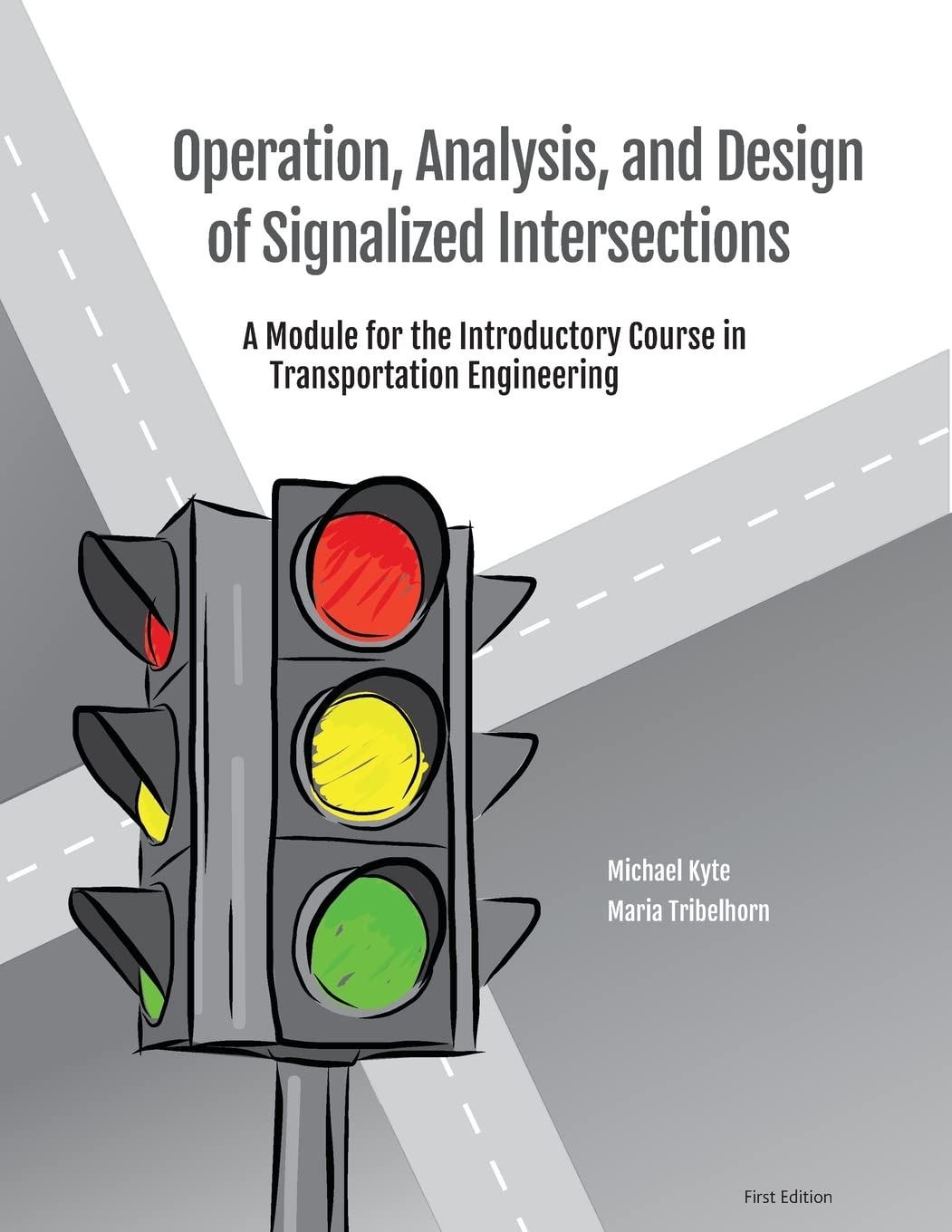
Operation, Analysis, and Design of Signalized Intersections: A Module for the Introductory Course in Transportation Engineering
AED19225
Quantity:
Order today to get by 7-14 business days
Delivery fee of AED 20. Free for orders above AED 200.
 Imported From: United States
At BOLO, we work hard to ensure the products you receive are new, genuine, and sourced from reputable suppliers.
Every product in the BOLO catalogue is sourced through our Verified Global Supply Network of verified sellers, authorized distributors or directly from the manufacturer.
Each product undergoes thorough inspection and verification at our consolidation and fulfilment centers to ensure it meets our strict authenticity and quality standards before being shipped and delivered to you.
If you ever have concerns regarding the authenticity of a product purchased from us, please contact Bolo Support. We will review your inquiry promptly and, if necessary, provide documentation verifying authenticity or offer a suitable resolution.
Your trust is our top priority, and we are committed to maintaining transparency and integrity in every transaction.
While we strive to display accurate information, variations in packaging, labeling, instructions, or formulation may occasionally occur due to regional differences or supplier updates. For detailed or manufacturer-specific information, please contact the brand directly or reach out to BOLO Support for assistance.
Unless otherwise stated, all prices displayed on the product page include applicable taxes and import duties.
BOLO operates in accordance with the laws and regulations of United Arab Emirates. Any items found to be restricted or prohibited for sale within the United Arab Emirates will be cancelled prior to shipment. We take proactive measures to ensure that only products permitted for sale in United Arab Emirates are listed on our website.
All items are shipped by air, and any products classified as “Dangerous Goods (DG)” under IATA regulations will be removed from the order and cancelled.
All orders are processed manually, and we make every effort to process them promptly once confirmed. Products cancelled due to the above reasons will be permanently removed from listings across the website.
Similar suggestions by Bolo
More from this brand
Similar items from “Highway & Traffic”
Share with
Or share with link
https://www.bolo.ae/products/U1500204366
Visit the CreateSpace Independent Publishing Platform Store
Operation, Analysis, and Design of Signalized Intersections: A Module for the Introductory Course in Transportation Engineering
AED19225
Quantity:
Order today to get by 7-14 business days
Delivery fee of AED 20. Free for orders above AED 200.
Imported From: United States
At BOLO, we work hard to ensure the products you receive are new, genuine, and sourced from reputable suppliers.
Every product in the BOLO catalogue is sourced through our Verified Global Supply Network of verified sellers, authorized distributors or directly from the manufacturer.
Each product undergoes thorough inspection and verification at our consolidation and fulfilment centers to ensure it meets our strict authenticity and quality standards before being shipped and delivered to you.
If you ever have concerns regarding the authenticity of a product purchased from us, please contact Bolo Support. We will review your inquiry promptly and, if necessary, provide documentation verifying authenticity or offer a suitable resolution.
Your trust is our top priority, and we are committed to maintaining transparency and integrity in every transaction.
While we strive to display accurate information, variations in packaging, labeling, instructions, or formulation may occasionally occur due to regional differences or supplier updates. For detailed or manufacturer-specific information, please contact the brand directly or reach out to BOLO Support for assistance.
Unless otherwise stated, all prices displayed on the product page include applicable taxes and import duties.
BOLO operates in accordance with the laws and regulations of United Arab Emirates. Any items found to be restricted or prohibited for sale within the United Arab Emirates will be cancelled prior to shipment. We take proactive measures to ensure that only products permitted for sale in United Arab Emirates are listed on our website.
All items are shipped by air, and any products classified as “Dangerous Goods (DG)” under IATA regulations will be removed from the order and cancelled.
All orders are processed manually, and we make every effort to process them promptly once confirmed. Products cancelled due to the above reasons will be permanently removed from listings across the website.
Description:
Before they begin their university studies, most students have experience with traffic signals, as drivers, pedestrians and bicycle riders. One of the tasks of the introductory course in transportation engineering is to portray the traffic signal control system in a way that connects with these experiences. The challenge is to reveal the system in a simple enough way to allow the student “in the door,” but to include enough complexity so that this process of learning about signalized intersections is both challenging and rewarding.
We have approached the process of developing this module with the following guidelines:
•Focusing on the automobile user and pretimed signal operation allows the student to learn about fundamental principles of a signalized intersection, while laying the foundation for future courses that address other users (pedestrians, bicycle riders, public transit operators) and more advanced traffic control schemes such as actuated control, coordinated signal systems, and adaptive control.
•Queuing models are presented as a way of learning about the fundamentals of traffic flow at a signalized intersection. A graphical approach is taken so that students can see how flow profile diagrams, cumulative vehicle diagrams, and queue accumulation polygons are powerful representations of the operation and performance of a signalized intersection.
•Only those equations that students can apply with some degree of understanding are presented. For example, the uniform delay equation is developed and used as a means of representing intersection performance. However, the second and third terms of the Highway Capacity Manual delay equation are not included, as students will have no basis for understanding the foundation of these terms.
•Learning objectives are clearly stated at the beginning of each section so that the student knows what is to come. At the end of each section, the learning objectives are reiterated along with a set of concepts that students should understand once they complete the work in the section.
•Over 70 figures are included in the module. We believe that graphically illustrating basic concepts is an important way for students to learn, particularly for queuing model concepts and the development of the change and clearance timing intervals.
•Over 50 computational problems and two field exercises are provided to give students the chance to test their understanding of the material.
The sequence in which concepts are presented in this module, and the way in which more complex ideas build on the more fundamental ones, was based on our study of student learning in the introductory course. The development of each concept leads to an element in the culminating activity: the design and evaluation of a signal timing plan in section 9. For example, to complete step 1 of the design process, the student must learn about the sequencing and control of movements, presented in section 3 of this module. But to determine split times, step 6 of the design process, four concepts must be learned including flow (section 2), sequencing and control of movements (section 3), sufficiency of capacity (section 6), and cycle length and splits (section 8). Depending on the pace desired by the instructor, this material can be covered in 9 to 12 class periods.
Details:
Similar suggestions by Bolo
More from this brand
Similar items from “Highway & Traffic”
Share with
Or share with link
https://www.bolo.ae/products/U1500204366