Deliver toUnited Arab Emirates
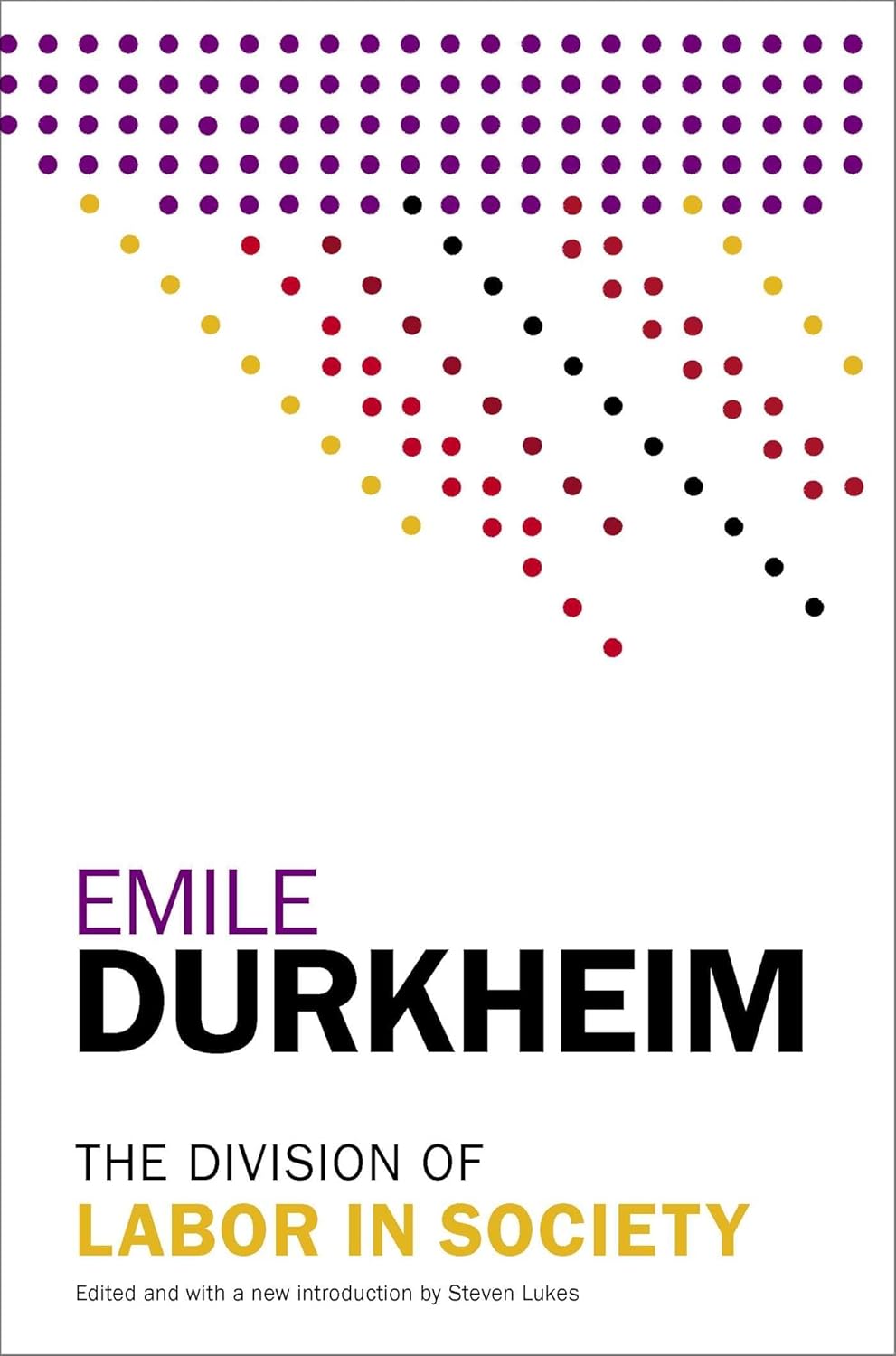
The Division of Labor in Society

Description:

Revised for the first time in over thirty years, this edition of Emile Durkheim’s masterful work on the nature and scope of sociology is updated with a new introduction and improved translation by leading scholar Steven Lukes that puts Durkheim’s work into context for the twenty-first century reader.

When it was originally published,
The Division of Labor in Society was an entirely original work on the nature of labor and production as they were being shaped by the industrial revolution. Emile Durkheim’s seminal workstudies the nature of social solidarity and explores the ties that bind one person to the next in order to hold society together.

This revised and updated second edition fluently conveys Durkheim’s arguments for contemporary readers. Leading Durkheim scholar Steve Lukes’s new introduction builds upon Lewis Coser’s original—which places the work in its intellectual and historical context and pinpoints its central ideas and arguments. Lukes explains the text’s continued significance as a tool to think about and deal with problems that face us today. The original translation has been revised and reworked in order to make Durkheim’s arguments clearer and easier to read.

The Division of Labor in Society is an essential resource for students and scholars hoping to deepen their understanding of one of the pioneering voices in modern sociology and twentieth-century social thought.


Editorial Reviews

Review

"If one had to choose one foundational text in sociology--this has to be it. Its critique of market society as well as its radical treatment of capitalism's diseases are even more pertinent today than they were a century ago." -- Michael Burawoy ― Department of Sociology, University of California, Berkeley

About the Author

Emile Durkheim (1858–1917) was a French sociologist who formally established the academic discipline and, with Karl Marx and Max Weber, is commonly cited as the principal architect of modern social science.

Steve Lukes
is a professor of sociology at New York University. An emeritus Fellow of the British Academy and an editor of the European Journal of Sociology, he is the author of Emile Durkheim: His Life and Work and, most recently, Moral Relativism.

Reviews:

5.0 out of 5 stars The classical social theorists were the best

n.a.n. · May 26, 2009

Durkheim is sometimes characterized as "the sociologist of constraint," meaning that, as he saw it, an unregulated life is devoid of meaning and a source of misery. In a very limited way, one might argue that Durkheim, in contrast to Marx, held that man does have a rudimentary nature, at least in terms of social and cultural needs. People need norms, standards, and social ties to provide them with direction, purpose, knowledge of realistic limits, and a sense of belonging. This is one reason for Durkheim's life-long interest in religion as a social phenomenon. His emphasis on constraint and stability also helps explain why he is commonly regarded as a conservative.Durkheim was less optimistic than Marx with regard to prospects for the variegated development of human potential. While Marx envisioned opportunities for people to develop a broad range of talents in a self-actualizing way, Durkheim was more cautious. His emphasis on an evermore complex division of labor characterized by increasingly narrow specialization held his expectations in check.At the same time, however, Durkheim was convinced that a more complex division of labor and the organic solidarity it occasioned enabled individuals to become more independent and self-determining. As with Marx, however, Durkheim was aware that increasing specialization did not serve all interests equally well.While Durkheim and Marx have more in common than is typically acknowledged, Durkheim did not view the antagonistic character of the capital-labor relationship as inevitable or basic to the structure of capitalist society. In Durkheim's judgment, increasing social and cultural complexity, along with the rise of modern industry and an attendant ethos of reciprocity and complementarity, were more important than the emergence of mature capitalism and the capital-labor dichotomy.In my view, Durkhiem was wrong. Nevertheless, his struggle to find a basis for social solidarity for modern industrial society prompted him to develop the powerful concepts anomie (or cultural de-regulation) and egoism (or social deracination). These, in turn, led to his brilliant work on the social sources of suicide. Perhaps it's a mark of genius that failures lead to new discoveries which give important areas of intellectual endeavor an entirely new and unexpected conceptual direction.As an addendum, Steven Lukes, who wrote the recent all-caps review, edited the revision of The Division of Labor in Society to which he refers. As such, he has a vested interest in its success. Since he gives us absolutely no information as to why he judges the reviews based on an earlier edition misleading, I suggest that his admonition be ignored. I've read a lot of and about Durkheim, including the recent biography by Forunier which I reviewed on Bolo, and I see no reason to judge my review misleading.

5.0 out of 5 stars Solidarity, It’s Organic!

J. · October 14, 2022

If you’re looking for something that explains how to live in capitalism but also revolutionize the systems of oppression and cast away the evil that is keeping progress from success in our societies, Durkheim is your new friend. Just, uh, skip over his weird misogynistic remarks and a few other weird things and it’ll all be good my friend.

5.0 out of 5 stars Is increasing specialization good or bad for human society

A.S. · May 28, 2016

The Division Of Labor in Society seeks to answer a very fundamental question. That is, with increasing division of labor in society, are we losing our solidarity? Is increasing specialization good or bad for human society? To put it in few words, Durkheim shows that organic solidarity (i.e. one of mutual dependence) grows in an increasingly specializing society. This is a classic statement for sociology. The question remains ever relevant.Happy reading.Regards,Abdullah ShahidCornell University

4.0 out of 5 stars Still relevant today

S.D. · April 28, 2017

Organic solidarity pops off the page and this seminal text in political sociology proves its relevance for our contemporary challenges in a post-collective bargaining world.

5.0 out of 5 stars fantastic

J.S. · January 30, 2019

Book was in great condition!

5.0 out of 5 stars Five Stars

T. · November 25, 2017

Had to buy this for class

5.0 out of 5 stars Helpful

D.S. · January 30, 2019

Nice

4.0 out of 5 stars Four Stars

P. · December 16, 2015

Hard to read but it is a good book.

Very useful

R. · April 26, 2019

Used in education degree for referencing and guidance

Five Stars

S. · October 17, 2017

As expected, on time

Superb book

v. · October 26, 2020

Ultimate book

Enrico Bracchi

E.B.S. · October 21, 2017

Magnificent doctoral thesis. There were some boring parts, I admit. Excellent sociological book, a must read. If you have a good understanding of the classics you will have no problem whatsoever to grasp even the most subjective and complex concepts to be found in sociology.

Classic Sociological Work

M.M. · November 9, 2020

This book is one of the fundamentally important early works that provide a base for modern sociology. The version I bought is second hand but in excellent condition, exactly as described by the seller. It arrived as promised and was well packed so it is in very good alrouand condition as well as being very useful for my studies.

The Division of Labor in Society

Product ID: U1476749736
Condition: New

4.5

AED7637

Price includes VAT & Import Duties
Type: Paperback
Availability: In Stock

Quantity:

|

Order today to get by 7-14 business days

Delivery fee of AED 20. Free for orders above AED 200.

Returns & Warranty policies

Imported From: United States

At BOLO, we work hard to ensure the products you receive are new, genuine, and sourced from reputable suppliers.

BOLO is not an authorized or official retailer for most brands, nor are we affiliated with manufacturers unless specifically stated on a product page. Instead, we source verified sellers, authorized distributors or directly from the manufacturer.

Each product undergoes thorough inspection and verification at our consolidation and fulfilment centers to ensure it meets our strict authenticity and quality standards before being shipped and delivered to you.

If you ever have concerns regarding the authenticity of a product purchased from us, please contact Bolo Support. We will review your inquiry promptly and, if necessary, provide documentation verifying authenticity or offer a suitable resolution.

Your trust is our top priority, and we are committed to maintaining transparency and integrity in every transaction.

All product information, images, descriptions, and reviews originate from the manufacturer or from trusted sellers overseas. BOLO is not affiliated with, endorsed by, or an authorized retailer for most brands listed on our website unless stated otherwise.

While we strive to display accurate information, variations in packaging, labeling, instructions, or formulation may occasionally occur due to regional differences or supplier updates. For detailed or manufacturer-specific information, please contact the brand directly or reach out to BOLO Support for assistance.

Unless otherwise stated, all prices displayed on the product page include applicable taxes and import duties.

BOLO operates in accordance with the laws and regulations of United Arab Emirates. Any items found to be restricted or prohibited for sale within the UAE will be cancelled prior to shipment. We take proactive measures to ensure that only products permitted for sale in United Arab Emirates are listed on our website.

All items are shipped by air, and any products classified as “Dangerous Goods (DG)” under IATA regulations will be removed from the order and cancelled.

All orders are processed manually, and we make every effort to process them promptly once confirmed. Products cancelled due to the above reasons will be permanently removed from listings across the website.

Similar suggestions by Bolo

More from this brand

Similar items from “Social Philosophy”

The Division of Labor in Society

Product ID: U1476749736
Condition: New

4.5

The Division of Labor in Society-0
Type: Paperback

AED7637

Price includes VAT & Import Duties
Availability: In Stock

Quantity:

|

Order today to get by 7-14 business days

Delivery fee of AED 20. Free for orders above AED 200.

Returns & Warranty policies

Imported From: United States

At BOLO, we work hard to ensure the products you receive are new, genuine, and sourced from reputable suppliers.

BOLO is not an authorized or official retailer for most brands, nor are we affiliated with manufacturers unless specifically stated on a product page. Instead, we source verified sellers, authorized distributors or directly from the manufacturer.

Each product undergoes thorough inspection and verification at our consolidation and fulfilment centers to ensure it meets our strict authenticity and quality standards before being shipped and delivered to you.

If you ever have concerns regarding the authenticity of a product purchased from us, please contact Bolo Support. We will review your inquiry promptly and, if necessary, provide documentation verifying authenticity or offer a suitable resolution.

Your trust is our top priority, and we are committed to maintaining transparency and integrity in every transaction.

All product information, images, descriptions, and reviews originate from the manufacturer or from trusted sellers overseas. BOLO is not affiliated with, endorsed by, or an authorized retailer for most brands listed on our website unless stated otherwise.

While we strive to display accurate information, variations in packaging, labeling, instructions, or formulation may occasionally occur due to regional differences or supplier updates. For detailed or manufacturer-specific information, please contact the brand directly or reach out to BOLO Support for assistance.

Unless otherwise stated, all prices displayed on the product page include applicable taxes and import duties.

BOLO operates in accordance with the laws and regulations of United Arab Emirates. Any items found to be restricted or prohibited for sale within the UAE will be cancelled prior to shipment. We take proactive measures to ensure that only products permitted for sale in United Arab Emirates are listed on our website.

All items are shipped by air, and any products classified as “Dangerous Goods (DG)” under IATA regulations will be removed from the order and cancelled.

All orders are processed manually, and we make every effort to process them promptly once confirmed. Products cancelled due to the above reasons will be permanently removed from listings across the website.

Description:

Revised for the first time in over thirty years, this edition of Emile Durkheim’s masterful work on the nature and scope of sociology is updated with a new introduction and improved translation by leading scholar Steven Lukes that puts Durkheim’s work into context for the twenty-first century reader.

When it was originally published,
The Division of Labor in Society was an entirely original work on the nature of labor and production as they were being shaped by the industrial revolution. Emile Durkheim’s seminal workstudies the nature of social solidarity and explores the ties that bind one person to the next in order to hold society together.

This revised and updated second edition fluently conveys Durkheim’s arguments for contemporary readers. Leading Durkheim scholar Steve Lukes’s new introduction builds upon Lewis Coser’s original—which places the work in its intellectual and historical context and pinpoints its central ideas and arguments. Lukes explains the text’s continued significance as a tool to think about and deal with problems that face us today. The original translation has been revised and reworked in order to make Durkheim’s arguments clearer and easier to read.

The Division of Labor in Society is an essential resource for students and scholars hoping to deepen their understanding of one of the pioneering voices in modern sociology and twentieth-century social thought.


Editorial Reviews

Review

"If one had to choose one foundational text in sociology--this has to be it. Its critique of market society as well as its radical treatment of capitalism's diseases are even more pertinent today than they were a century ago." -- Michael Burawoy ― Department of Sociology, University of California, Berkeley

About the Author

Emile Durkheim (1858–1917) was a French sociologist who formally established the academic discipline and, with Karl Marx and Max Weber, is commonly cited as the principal architect of modern social science.

Steve Lukes
is a professor of sociology at New York University. An emeritus Fellow of the British Academy and an editor of the European Journal of Sociology, he is the author of Emile Durkheim: His Life and Work and, most recently, Moral Relativism.

Reviews:

5.0 out of 5 stars The classical social theorists were the best

n.a.n. · May 26, 2009

Durkheim is sometimes characterized as "the sociologist of constraint," meaning that, as he saw it, an unregulated life is devoid of meaning and a source of misery. In a very limited way, one might argue that Durkheim, in contrast to Marx, held that man does have a rudimentary nature, at least in terms of social and cultural needs. People need norms, standards, and social ties to provide them with direction, purpose, knowledge of realistic limits, and a sense of belonging. This is one reason for Durkheim's life-long interest in religion as a social phenomenon. His emphasis on constraint and stability also helps explain why he is commonly regarded as a conservative.Durkheim was less optimistic than Marx with regard to prospects for the variegated development of human potential. While Marx envisioned opportunities for people to develop a broad range of talents in a self-actualizing way, Durkheim was more cautious. His emphasis on an evermore complex division of labor characterized by increasingly narrow specialization held his expectations in check.At the same time, however, Durkheim was convinced that a more complex division of labor and the organic solidarity it occasioned enabled individuals to become more independent and self-determining. As with Marx, however, Durkheim was aware that increasing specialization did not serve all interests equally well.While Durkheim and Marx have more in common than is typically acknowledged, Durkheim did not view the antagonistic character of the capital-labor relationship as inevitable or basic to the structure of capitalist society. In Durkheim's judgment, increasing social and cultural complexity, along with the rise of modern industry and an attendant ethos of reciprocity and complementarity, were more important than the emergence of mature capitalism and the capital-labor dichotomy.In my view, Durkhiem was wrong. Nevertheless, his struggle to find a basis for social solidarity for modern industrial society prompted him to develop the powerful concepts anomie (or cultural de-regulation) and egoism (or social deracination). These, in turn, led to his brilliant work on the social sources of suicide. Perhaps it's a mark of genius that failures lead to new discoveries which give important areas of intellectual endeavor an entirely new and unexpected conceptual direction.As an addendum, Steven Lukes, who wrote the recent all-caps review, edited the revision of The Division of Labor in Society to which he refers. As such, he has a vested interest in its success. Since he gives us absolutely no information as to why he judges the reviews based on an earlier edition misleading, I suggest that his admonition be ignored. I've read a lot of and about Durkheim, including the recent biography by Forunier which I reviewed on Bolo, and I see no reason to judge my review misleading.

5.0 out of 5 stars Solidarity, It’s Organic!

J. · October 14, 2022

If you’re looking for something that explains how to live in capitalism but also revolutionize the systems of oppression and cast away the evil that is keeping progress from success in our societies, Durkheim is your new friend. Just, uh, skip over his weird misogynistic remarks and a few other weird things and it’ll all be good my friend.

5.0 out of 5 stars Is increasing specialization good or bad for human society

A.S. · May 28, 2016

The Division Of Labor in Society seeks to answer a very fundamental question. That is, with increasing division of labor in society, are we losing our solidarity? Is increasing specialization good or bad for human society? To put it in few words, Durkheim shows that organic solidarity (i.e. one of mutual dependence) grows in an increasingly specializing society. This is a classic statement for sociology. The question remains ever relevant.Happy reading.Regards,Abdullah ShahidCornell University

4.0 out of 5 stars Still relevant today

S.D. · April 28, 2017

Organic solidarity pops off the page and this seminal text in political sociology proves its relevance for our contemporary challenges in a post-collective bargaining world.

5.0 out of 5 stars fantastic

J.S. · January 30, 2019

Book was in great condition!

5.0 out of 5 stars Five Stars

T. · November 25, 2017

Had to buy this for class

5.0 out of 5 stars Helpful

D.S. · January 30, 2019

Nice

4.0 out of 5 stars Four Stars

P. · December 16, 2015

Hard to read but it is a good book.

Very useful

R. · April 26, 2019

Used in education degree for referencing and guidance

Five Stars

S. · October 17, 2017

As expected, on time

Superb book

v. · October 26, 2020

Ultimate book

Enrico Bracchi

E.B.S. · October 21, 2017

Magnificent doctoral thesis. There were some boring parts, I admit. Excellent sociological book, a must read. If you have a good understanding of the classics you will have no problem whatsoever to grasp even the most subjective and complex concepts to be found in sociology.

Classic Sociological Work

M.M. · November 9, 2020

This book is one of the fundamentally important early works that provide a base for modern sociology. The version I bought is second hand but in excellent condition, exactly as described by the seller. It arrived as promised and was well packed so it is in very good alrouand condition as well as being very useful for my studies.

Similar suggestions by Bolo

More from this brand

Similar items from “Social Philosophy”