Deliver toUnited Arab Emirates
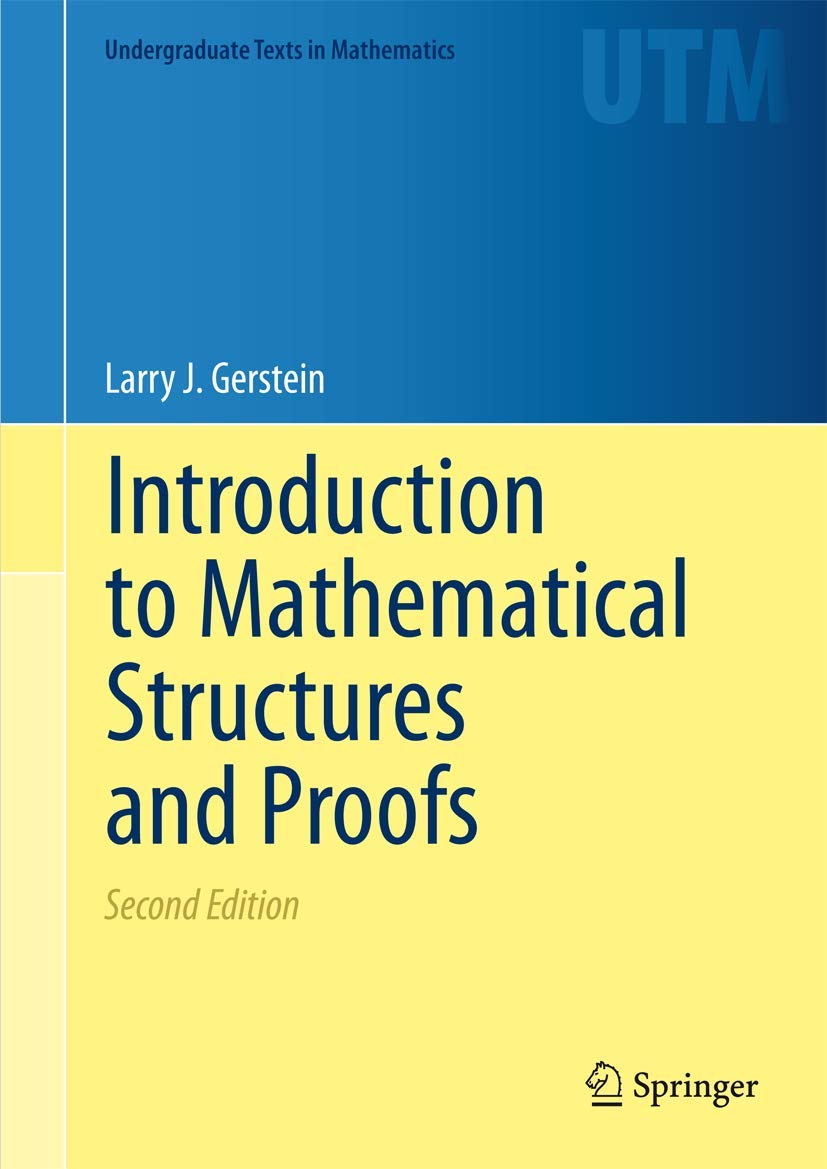
Introduction to Mathematical Structures and Proofs (Undergraduate Texts in Mathematics)

Description:

As a student moves from basic calculus courses into upper-division courses in linear and abstract algebra, real and complex analysis, number theory, topology, and so on, a "bridge" course can help ensure a smooth transition. Introduction to Mathematical Structures and Proofs is a textbook intended for such a course, or for self-study. This book introduces an array of fundamental mathematical structures. It also explores the delicate balance of intuition and rigor―and the flexible thinking―required to prove a nontrivial result. In short, this book seeks to enhance the mathematical maturity of the reader.

The new material in this second edition includes a section on graph theory, several new sections on number theory (including primitive roots, with an application to card-shuffling), and a brief introduction to the complex numbers (including a section on the arithmetic of the Gaussian integers). Solutions for even numbered exercises are available on springer.com forinstructors adopting the text for a course.


Editorial Reviews

From the Back Cover

As a student moves from basic calculus courses into upper-division courses in linear and abstract algebra, real and complex analysis, number theory, topology, and so on, a "bridge" course can help ensure a smooth transition. Introduction to Mathematical Structures and Proofs is a textbook intended for such a course, or for self-study. This book introduces an array of fundamental mathematical structures. It also explores the delicate balance of intuition and rigor―and the flexible thinking―required to prove a nontrivial result. In short, this book seeks to enhance the mathematical maturity of the reader.

The new material in this second edition includes a section on graph theory, several new sections on number theory (including primitive roots, with an application to card-shuffling), and a brief introduction to the complex numbers (including a section on the arithmetic of the Gaussian integers). Solutions for even numbered exercises are available on springer.com for instructors adopting the text for a course.

From a review of the first edition:

"...Gerstein wants―very gently―to teach his students to think. He wants to show them how to wrestle with a problem (one that is more sophisticated than "plug and chug"), how to build a solution, and ultimately he wants to teach the students to take a statement and develop a way to prove it...Gerstein writes with a certain flair that I think students will find appealing. ...I am confident that a student who works through Gerstein's book will really come away with (i) some mathematical technique, and (ii) some mathematical knowledge….

Gerstein’s book states quite plainly that the text is designed for use in a transitions course. Nothing benefits a textbook author more than having his goals clearly in mind, and Gerstein’s book achieves its goals. I would be happy to use it in a transitions course.”

―Steven Krantz, American Mathematical Monthly

About the Author

Larry Gerstein's primary areas of research have been in quadratic forms and number theory and he has published extensively in these areas. The author's first edition of "Introduction to Mathematical Structures and Proofs" has sold to date (8/2/2010) over 6000 copies and has gone through 5 printings. Gerstein himself has a transition course at UC, Santa Barbara (Math 8-A transition to higher mathematics) from his book since its first publication date. The first edition also received 2 glowing reviews by Steve Krantz for the American Mathematical Monthly, and S. Gottwald for Zentralblatt.

Reviews:

5.0 out of 5 stars A delightful book

G. · April 26, 2020

This is a delightful book. It is well written, clear and even funny in places. Dr. Gerstein has done an excellent job of making his subject appealing. The only flaws I can find are a few misprints of Teeorem numbers when referring to topics covered elsewhere in the text, an error certainly not worth the subtraction of even half a star.Dr. Gersten begins by discussing logic, then set theory. He then teaches topics in Functions, finite and infinite sets, combinatorics and number theory as a way to teach the art of writing clear proofs. Toward the last half of the book, there is more emphasis on the mathematics than teaching how to write proofs, but the real purpose is to lead the reader onto the path to becoming a mathematician. He succeeds beautifully.The competition for the undergraduate’s purchase would probably be Hammack’s Book of Proof, another excellent text. Hammack takes a different approach, using the construction of proofs as a way to introduce the student to mathematical concepts. This book is briefer and written at a more basic level than Gerstein’s book. If you are self-assured in math, proceed directly to Gersteins book. However, why deny yourself the pleasure of reading either of these books? They give different looks at their subjects, and I doubt that many will regret buying and reading both books, starting with Hammack. I certainly don’t.

5.0 out of 5 stars Comprehensive, tightly written and edited. Broad. Difficult at the end.

A.N. · September 21, 2020

This book had a huge amount of material covering a wide range of topics. The treatments of the diverse areas are well integrated. The exercises are difficult but manageable based on the discussion. I would recommend it to others who, like me, have a background in an application of math (physics in my case) but have never surveyed math rigorously.Few or no errors found despite painstaking study.The chapter on number theory seemed overly ambitious and I had to skip over the last part of it.

4.0 out of 5 stars Good Textbook, Need's more Exercise Questions

J.M. · September 30, 2016

It's a good book for a hard subject, it's a very readable textbook and the author's wit adds a personality to the text. The only fault is that there aren't a lot of practice problems for some sections, and only the odd answers have solutions in the back of the book.

5.0 out of 5 stars An easy read

N. · October 31, 2013

We are using this book in my Foundations of Math class, which deals a lot with graph and set theory, as well as proofs. The professor chose the book after listening to the author speak at a conference, and I'd say it was a good choice. The book reads very easily, and the problems do well at not being overly complex, while still being challenging enough to conduce learning.

5.0 out of 5 stars 5 stars

B.A. · December 28, 2019

That’s all - 5 stars

5.0 out of 5 stars Math Structures and Proofs

J.J.G. · February 15, 2014

Dr. Gerstein is now a friend of mine. I highly recommend this textbook in the Field of Logic and Mathematics.

4.0 out of 5 stars Good content, but might be difficult for self study

C.W. · December 17, 2022

This is a pretty good introductory book for students new to proof-based mathematics, but there are better options out there if you are new to proofs and/or self-studying. I would probably give this 3.5 stars but rounded up because the content really is quite good. However, I *do not* think this book is suitable for "learning proofs" in and of itself.The very first example in the book is a very interesting example of an abstract axiom system, with a single axiom and two logic rules. While it is just a toy example, and may not add much to the text, it made me think differently than other proof-learning books I've read. (I am not sure if this kind of thing is standard in mathematical logic courses/texts.)Most of the content in Chapters 1-4 are also presented in other texts. For example, a lot of this material is in Velleman's well-known text "How to Prove It", but I actually prefer this book to that one. The author here clearly put a lot of effort in making these concepts explainable.I was most interested in the long chapter on Combinatorics (Chapter 5), which is relevant to my interests (probability & statistics). While the content is very good, and he explains the concepts well, the chapter did seem to drag on and I think could have been improved if the abstract material was better connected toapplications (e.g., discrete math or probability).Some of the drawbacks/complaints I have include:1) The major disadvantage, especially for someone using this for self-study, is that the book includes solutions for only approximately half the exercises (and in multi-part questions, only up to half of those). Furthermore, nearly all of the included solutions are incomplete, hints, or just outlines. For such a "transition" course (i.e., a first proof-based course), people such as myself will struggle when you're not sure if you've taken the correct approach.2) Some of the more important concepts (e.g., theorems or corollaries) are presented in the exercises. And, as mentioned above, these exercises might not have (full) solutions. So in a few cases in which the exercise asks you to "prove or disprove", students who can't complete the exercise won't know whether it is a correct theorem.3) There are some very minor typos throughout, although from what I've seen so far they do not impede understanding. For example, when referring back to an Example or Definition, the number might be off by one. There are also some spelling typos here and there.4) One very minor complaint I have is the size of the book. My hardcover copy is quite a bit larger than my other Springer *Undergraduate Texts in Mathematics* books. As a result, the font appears larger than it needs to be. However, this didn't bother me enough to give the text a lower rating, but perhaps others would be interested to know this if they prefer uniformity.Overall, I liked this book and I think it has helped improved my understanding of basic abstract math concepts. I would still recommend other texts over this one, but it would not be a bad addition. If you want to actually learn proof methods, my first recommendation would be Solow's How to Read and Do Proofs for beginners and "How to Prove It" otherwise. Another really excellent choice would be Reading, Writing, and Proving by Daepp and Gorkin; there are detailed solutions to the problems in this one, and (so far) it seems much better-suited for beginners or those who are doing self study.

Imprescindible para adquirir una sólida base matemática

S.L. · January 29, 2016

Un libro excepcional, tanto por los ejemplos elegidos para introducir los conceptos fundamentales, como por el mantenimiento del rigor, aunque exento de una excesiva aridez formal. Muy recomendable para lectores interesados en adquirir una buena base para poder abordar, con la preparación suficiente, temas más complejos de análisis matemático.

Introduction to Mathematical Structures and Proofs (Undergraduate Texts in Mathematics)

Product ID: U1461442648
Condition: New

4.7

AED31680

Price includes VAT & Import Duties
Type: Hardcover
Availability: In Stock

Quantity:

|

Order today to get by 7-14 business days

This item qualifies for free delivery

Returns & Warranty policies

Imported From: United States

At BOLO, we work hard to ensure the products you receive are new, genuine, and sourced from reputable suppliers.

BOLO is not an authorized or official retailer for most brands, nor are we affiliated with manufacturers unless specifically stated on a product page. Instead, we source verified sellers, authorized distributors or directly from the manufacturer.

Each product undergoes thorough inspection and verification at our consolidation and fulfilment centers to ensure it meets our strict authenticity and quality standards before being shipped and delivered to you.

If you ever have concerns regarding the authenticity of a product purchased from us, please contact Bolo Support. We will review your inquiry promptly and, if necessary, provide documentation verifying authenticity or offer a suitable resolution.

Your trust is our top priority, and we are committed to maintaining transparency and integrity in every transaction.

All product information, images, descriptions, and reviews originate from the manufacturer or from trusted sellers overseas. BOLO is not affiliated with, endorsed by, or an authorized retailer for most brands listed on our website unless stated otherwise.

While we strive to display accurate information, variations in packaging, labeling, instructions, or formulation may occasionally occur due to regional differences or supplier updates. For detailed or manufacturer-specific information, please contact the brand directly or reach out to BOLO Support for assistance.

Unless otherwise stated, all prices displayed on the product page include applicable taxes and import duties.

BOLO operates in accordance with the laws and regulations of United Arab Emirates. Any items found to be restricted or prohibited for sale within the UAE will be cancelled prior to shipment. We take proactive measures to ensure that only products permitted for sale in United Arab Emirates are listed on our website.

All items are shipped by air, and any products classified as “Dangerous Goods (DG)” under IATA regulations will be removed from the order and cancelled.

All orders are processed manually, and we make every effort to process them promptly once confirmed. Products cancelled due to the above reasons will be permanently removed from listings across the website.

Similar suggestions by Bolo

More from this brand

Similar items from “Combinatorics”

Introduction to Mathematical Structures and Proofs (Undergraduate Texts in Mathematics)

Product ID: U1461442648
Condition: New

4.7

Introduction to Mathematical Structures and Proofs (Undergraduate Texts in Mathematics)-0
Type: Hardcover

AED31680

Price includes VAT & Import Duties
Availability: In Stock

Quantity:

|

Order today to get by 7-14 business days

This item qualifies for free delivery

Returns & Warranty policies

Imported From: United States

At BOLO, we work hard to ensure the products you receive are new, genuine, and sourced from reputable suppliers.

BOLO is not an authorized or official retailer for most brands, nor are we affiliated with manufacturers unless specifically stated on a product page. Instead, we source verified sellers, authorized distributors or directly from the manufacturer.

Each product undergoes thorough inspection and verification at our consolidation and fulfilment centers to ensure it meets our strict authenticity and quality standards before being shipped and delivered to you.

If you ever have concerns regarding the authenticity of a product purchased from us, please contact Bolo Support. We will review your inquiry promptly and, if necessary, provide documentation verifying authenticity or offer a suitable resolution.

Your trust is our top priority, and we are committed to maintaining transparency and integrity in every transaction.

All product information, images, descriptions, and reviews originate from the manufacturer or from trusted sellers overseas. BOLO is not affiliated with, endorsed by, or an authorized retailer for most brands listed on our website unless stated otherwise.

While we strive to display accurate information, variations in packaging, labeling, instructions, or formulation may occasionally occur due to regional differences or supplier updates. For detailed or manufacturer-specific information, please contact the brand directly or reach out to BOLO Support for assistance.

Unless otherwise stated, all prices displayed on the product page include applicable taxes and import duties.

BOLO operates in accordance with the laws and regulations of United Arab Emirates. Any items found to be restricted or prohibited for sale within the UAE will be cancelled prior to shipment. We take proactive measures to ensure that only products permitted for sale in United Arab Emirates are listed on our website.

All items are shipped by air, and any products classified as “Dangerous Goods (DG)” under IATA regulations will be removed from the order and cancelled.

All orders are processed manually, and we make every effort to process them promptly once confirmed. Products cancelled due to the above reasons will be permanently removed from listings across the website.

Description:

As a student moves from basic calculus courses into upper-division courses in linear and abstract algebra, real and complex analysis, number theory, topology, and so on, a "bridge" course can help ensure a smooth transition. Introduction to Mathematical Structures and Proofs is a textbook intended for such a course, or for self-study. This book introduces an array of fundamental mathematical structures. It also explores the delicate balance of intuition and rigor―and the flexible thinking―required to prove a nontrivial result. In short, this book seeks to enhance the mathematical maturity of the reader.

The new material in this second edition includes a section on graph theory, several new sections on number theory (including primitive roots, with an application to card-shuffling), and a brief introduction to the complex numbers (including a section on the arithmetic of the Gaussian integers). Solutions for even numbered exercises are available on springer.com forinstructors adopting the text for a course.


Editorial Reviews

From the Back Cover

As a student moves from basic calculus courses into upper-division courses in linear and abstract algebra, real and complex analysis, number theory, topology, and so on, a "bridge" course can help ensure a smooth transition. Introduction to Mathematical Structures and Proofs is a textbook intended for such a course, or for self-study. This book introduces an array of fundamental mathematical structures. It also explores the delicate balance of intuition and rigor―and the flexible thinking―required to prove a nontrivial result. In short, this book seeks to enhance the mathematical maturity of the reader.

The new material in this second edition includes a section on graph theory, several new sections on number theory (including primitive roots, with an application to card-shuffling), and a brief introduction to the complex numbers (including a section on the arithmetic of the Gaussian integers). Solutions for even numbered exercises are available on springer.com for instructors adopting the text for a course.

From a review of the first edition:

"...Gerstein wants―very gently―to teach his students to think. He wants to show them how to wrestle with a problem (one that is more sophisticated than "plug and chug"), how to build a solution, and ultimately he wants to teach the students to take a statement and develop a way to prove it...Gerstein writes with a certain flair that I think students will find appealing. ...I am confident that a student who works through Gerstein's book will really come away with (i) some mathematical technique, and (ii) some mathematical knowledge….

Gerstein’s book states quite plainly that the text is designed for use in a transitions course. Nothing benefits a textbook author more than having his goals clearly in mind, and Gerstein’s book achieves its goals. I would be happy to use it in a transitions course.”

―Steven Krantz, American Mathematical Monthly

About the Author

Larry Gerstein's primary areas of research have been in quadratic forms and number theory and he has published extensively in these areas. The author's first edition of "Introduction to Mathematical Structures and Proofs" has sold to date (8/2/2010) over 6000 copies and has gone through 5 printings. Gerstein himself has a transition course at UC, Santa Barbara (Math 8-A transition to higher mathematics) from his book since its first publication date. The first edition also received 2 glowing reviews by Steve Krantz for the American Mathematical Monthly, and S. Gottwald for Zentralblatt.

Reviews:

5.0 out of 5 stars A delightful book

G. · April 26, 2020

This is a delightful book. It is well written, clear and even funny in places. Dr. Gerstein has done an excellent job of making his subject appealing. The only flaws I can find are a few misprints of Teeorem numbers when referring to topics covered elsewhere in the text, an error certainly not worth the subtraction of even half a star.Dr. Gersten begins by discussing logic, then set theory. He then teaches topics in Functions, finite and infinite sets, combinatorics and number theory as a way to teach the art of writing clear proofs. Toward the last half of the book, there is more emphasis on the mathematics than teaching how to write proofs, but the real purpose is to lead the reader onto the path to becoming a mathematician. He succeeds beautifully.The competition for the undergraduate’s purchase would probably be Hammack’s Book of Proof, another excellent text. Hammack takes a different approach, using the construction of proofs as a way to introduce the student to mathematical concepts. This book is briefer and written at a more basic level than Gerstein’s book. If you are self-assured in math, proceed directly to Gersteins book. However, why deny yourself the pleasure of reading either of these books? They give different looks at their subjects, and I doubt that many will regret buying and reading both books, starting with Hammack. I certainly don’t.

5.0 out of 5 stars Comprehensive, tightly written and edited. Broad. Difficult at the end.

A.N. · September 21, 2020

This book had a huge amount of material covering a wide range of topics. The treatments of the diverse areas are well integrated. The exercises are difficult but manageable based on the discussion. I would recommend it to others who, like me, have a background in an application of math (physics in my case) but have never surveyed math rigorously.Few or no errors found despite painstaking study.The chapter on number theory seemed overly ambitious and I had to skip over the last part of it.

4.0 out of 5 stars Good Textbook, Need's more Exercise Questions

J.M. · September 30, 2016

It's a good book for a hard subject, it's a very readable textbook and the author's wit adds a personality to the text. The only fault is that there aren't a lot of practice problems for some sections, and only the odd answers have solutions in the back of the book.

5.0 out of 5 stars An easy read

N. · October 31, 2013

We are using this book in my Foundations of Math class, which deals a lot with graph and set theory, as well as proofs. The professor chose the book after listening to the author speak at a conference, and I'd say it was a good choice. The book reads very easily, and the problems do well at not being overly complex, while still being challenging enough to conduce learning.

5.0 out of 5 stars 5 stars

B.A. · December 28, 2019

That’s all - 5 stars

5.0 out of 5 stars Math Structures and Proofs

J.J.G. · February 15, 2014

Dr. Gerstein is now a friend of mine. I highly recommend this textbook in the Field of Logic and Mathematics.

4.0 out of 5 stars Good content, but might be difficult for self study

C.W. · December 17, 2022

This is a pretty good introductory book for students new to proof-based mathematics, but there are better options out there if you are new to proofs and/or self-studying. I would probably give this 3.5 stars but rounded up because the content really is quite good. However, I *do not* think this book is suitable for "learning proofs" in and of itself.The very first example in the book is a very interesting example of an abstract axiom system, with a single axiom and two logic rules. While it is just a toy example, and may not add much to the text, it made me think differently than other proof-learning books I've read. (I am not sure if this kind of thing is standard in mathematical logic courses/texts.)Most of the content in Chapters 1-4 are also presented in other texts. For example, a lot of this material is in Velleman's well-known text "How to Prove It", but I actually prefer this book to that one. The author here clearly put a lot of effort in making these concepts explainable.I was most interested in the long chapter on Combinatorics (Chapter 5), which is relevant to my interests (probability & statistics). While the content is very good, and he explains the concepts well, the chapter did seem to drag on and I think could have been improved if the abstract material was better connected toapplications (e.g., discrete math or probability).Some of the drawbacks/complaints I have include:1) The major disadvantage, especially for someone using this for self-study, is that the book includes solutions for only approximately half the exercises (and in multi-part questions, only up to half of those). Furthermore, nearly all of the included solutions are incomplete, hints, or just outlines. For such a "transition" course (i.e., a first proof-based course), people such as myself will struggle when you're not sure if you've taken the correct approach.2) Some of the more important concepts (e.g., theorems or corollaries) are presented in the exercises. And, as mentioned above, these exercises might not have (full) solutions. So in a few cases in which the exercise asks you to "prove or disprove", students who can't complete the exercise won't know whether it is a correct theorem.3) There are some very minor typos throughout, although from what I've seen so far they do not impede understanding. For example, when referring back to an Example or Definition, the number might be off by one. There are also some spelling typos here and there.4) One very minor complaint I have is the size of the book. My hardcover copy is quite a bit larger than my other Springer *Undergraduate Texts in Mathematics* books. As a result, the font appears larger than it needs to be. However, this didn't bother me enough to give the text a lower rating, but perhaps others would be interested to know this if they prefer uniformity.Overall, I liked this book and I think it has helped improved my understanding of basic abstract math concepts. I would still recommend other texts over this one, but it would not be a bad addition. If you want to actually learn proof methods, my first recommendation would be Solow's How to Read and Do Proofs for beginners and "How to Prove It" otherwise. Another really excellent choice would be Reading, Writing, and Proving by Daepp and Gorkin; there are detailed solutions to the problems in this one, and (so far) it seems much better-suited for beginners or those who are doing self study.

Imprescindible para adquirir una sólida base matemática

S.L. · January 29, 2016

Un libro excepcional, tanto por los ejemplos elegidos para introducir los conceptos fundamentales, como por el mantenimiento del rigor, aunque exento de una excesiva aridez formal. Muy recomendable para lectores interesados en adquirir una buena base para poder abordar, con la preparación suficiente, temas más complejos de análisis matemático.

Similar suggestions by Bolo

More from this brand

Similar items from “Combinatorics”