Deliver toUnited Arab Emirates
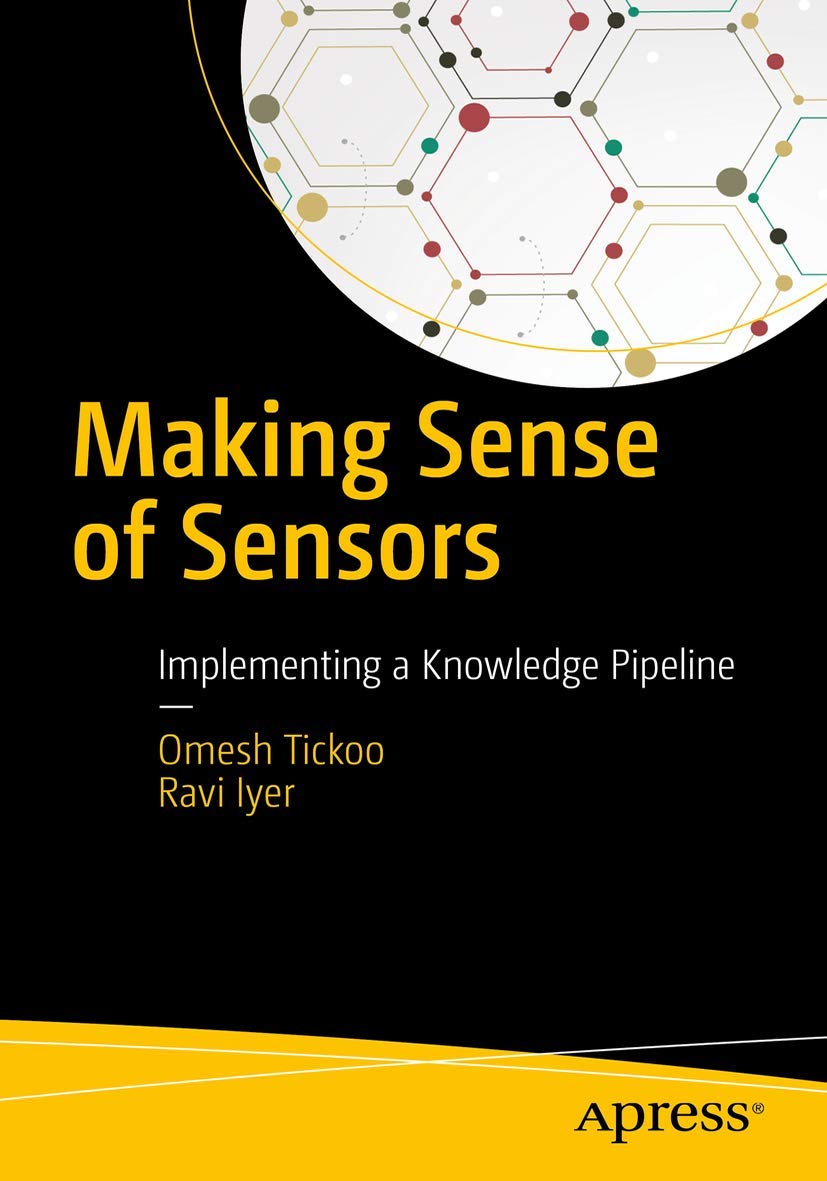
Making Sense of Sensors: End-to-End Algorithms and Infrastructure Design from Wearable-Devices to Data Centers

Description:

Make the most of the common architectures used for deriving meaningful data from sensors. This book provides you with the tools to understand how sensor data is converted into actionable knowledge and provides tips for in-depth work in this field.

Making Sense of Sensors starts with an overview of the general pipeline to extract meaningful data from sensors. It then dives deeper into some commonly used sensors and algorithms designed for knowledge extraction. Practical examples and pointers to more information are used to outline the key aspects of Multimodal recognition. The book concludes with a discussion on relationship extraction, knowledge representation, and management.

In today’s world we are surrounded by sensors collecting various types of data about us and our environments. These sensors are the primary input devices for wearable computers, IoT, and other mobile devices. The information is presented in way that allows readers to associate theexamples with their daily lives for better understanding of the concepts.

What You'll Learn

  • Look at the general architecture for sensor based data
  • Understand how data from common domains such as inertial, visual and audio is processed
  • Master multi-modal recognition using multiple heterogeneous sensors
  • Transition from recognition to knowledge through relationship understanding between entities
  • Leverage different methods and tools for knowledge representation and management

Who This Book Is For

New college graduates and professionals interested in acquiring knowledge and the skills to develop innovative solutions around today's sensor-rich devices.


Editorial Reviews

From the Back Cover

This book outlines the common architectures used for deriving meaningful data from sensors. In today’s world we are surrounded by sensors collecting various types of data about us and our environments. These sensors are the primary input devices for wearable computers, internet-of-things, and other mobile devices. This book provides the reader with the tools to understand how sensor data is converted into actionable knowledge and provides tips for in-depth work in this field. The information is presented in way that allows readers to associate the examples with their daily lives for better understanding of the concepts.Making Sense of Sensors starts with an overview of the general pipeline to extract meaningful data from sensors. It then dives deeper into some commonly used sensors and algorithms designed for knowledge extraction. Practical examples and pointers to more information are used to outline the key aspects of Multimodal recognition. The book concludes with adiscussion on relationship extraction, knowledge representation, and management.

About the Author

Omesh Tickoo is a research manager at Intel Labs. His team is currently active in the area of knowledge extraction from multi-modal sensor data centered around vision and speech. In his research career Omesh has made contributions to computer systems evolution in areas like wireless networks, platform partitioning and QoS, SoC architecture, Virtualization and Machine Learning. Omesh is also very active in fostering academic research with contributions toward organizing conferences, academic project mentoring and joint industry-academic research projects. He has authored 30+ conference and journal papers and filed 15+ patent applications. Omesh received his PhD from Rensselaer Polytechnic Institute in 2015.

No Customer Reviews

Making Sense of Sensors: End-to-End Algorithms and Infrastructure Design from Wearable-Devices to Data Centers

Product ID: U1430265922
Condition: New

5

AED34503

Price includes VAT & Import Duties
Type: Paperback
Availability: In Stock

Quantity:

|

Order today to get by 7-14 business days

This item qualifies for free delivery

Returns & Warranty policies

Imported From: United States

At BOLO, we work hard to ensure the products you receive are new, genuine, and sourced from reputable suppliers.

BOLO is not an authorized or official retailer for most brands, nor are we affiliated with manufacturers unless specifically stated on a product page. Instead, we source verified sellers, authorized distributors or directly from the manufacturer.

Each product undergoes thorough inspection and verification at our consolidation and fulfilment centers to ensure it meets our strict authenticity and quality standards before being shipped and delivered to you.

If you ever have concerns regarding the authenticity of a product purchased from us, please contact Bolo Support. We will review your inquiry promptly and, if necessary, provide documentation verifying authenticity or offer a suitable resolution.

Your trust is our top priority, and we are committed to maintaining transparency and integrity in every transaction.

All product information, images, descriptions, and reviews originate from the manufacturer or from trusted sellers overseas. BOLO is not affiliated with, endorsed by, or an authorized retailer for most brands listed on our website unless stated otherwise.

While we strive to display accurate information, variations in packaging, labeling, instructions, or formulation may occasionally occur due to regional differences or supplier updates. For detailed or manufacturer-specific information, please contact the brand directly or reach out to BOLO Support for assistance.

Unless otherwise stated, all prices displayed on the product page include applicable taxes and import duties.

BOLO operates in accordance with the laws and regulations of United Arab Emirates. Any items found to be restricted or prohibited for sale within the UAE will be cancelled prior to shipment. We take proactive measures to ensure that only products permitted for sale in United Arab Emirates are listed on our website.

All items are shipped by air, and any products classified as “Dangerous Goods (DG)” under IATA regulations will be removed from the order and cancelled.

All orders are processed manually, and we make every effort to process them promptly once confirmed. Products cancelled due to the above reasons will be permanently removed from listings across the website.

More from this brand

Similar items from “Microsoft Programming”

Making Sense of Sensors: End-to-End Algorithms and Infrastructure Design from Wearable-Devices to Data Centers

Product ID: U1430265922
Condition: New

5

Making Sense of Sensors: End-to-End Algorithms and Infrastructure Design from Wearable-Devices to Data Centers-0
Type: Paperback

AED34503

Price includes VAT & Import Duties
Availability: In Stock

Quantity:

|

Order today to get by 7-14 business days

This item qualifies for free delivery

Returns & Warranty policies

Imported From: United States

At BOLO, we work hard to ensure the products you receive are new, genuine, and sourced from reputable suppliers.

BOLO is not an authorized or official retailer for most brands, nor are we affiliated with manufacturers unless specifically stated on a product page. Instead, we source verified sellers, authorized distributors or directly from the manufacturer.

Each product undergoes thorough inspection and verification at our consolidation and fulfilment centers to ensure it meets our strict authenticity and quality standards before being shipped and delivered to you.

If you ever have concerns regarding the authenticity of a product purchased from us, please contact Bolo Support. We will review your inquiry promptly and, if necessary, provide documentation verifying authenticity or offer a suitable resolution.

Your trust is our top priority, and we are committed to maintaining transparency and integrity in every transaction.

All product information, images, descriptions, and reviews originate from the manufacturer or from trusted sellers overseas. BOLO is not affiliated with, endorsed by, or an authorized retailer for most brands listed on our website unless stated otherwise.

While we strive to display accurate information, variations in packaging, labeling, instructions, or formulation may occasionally occur due to regional differences or supplier updates. For detailed or manufacturer-specific information, please contact the brand directly or reach out to BOLO Support for assistance.

Unless otherwise stated, all prices displayed on the product page include applicable taxes and import duties.

BOLO operates in accordance with the laws and regulations of United Arab Emirates. Any items found to be restricted or prohibited for sale within the UAE will be cancelled prior to shipment. We take proactive measures to ensure that only products permitted for sale in United Arab Emirates are listed on our website.

All items are shipped by air, and any products classified as “Dangerous Goods (DG)” under IATA regulations will be removed from the order and cancelled.

All orders are processed manually, and we make every effort to process them promptly once confirmed. Products cancelled due to the above reasons will be permanently removed from listings across the website.

Description:

Make the most of the common architectures used for deriving meaningful data from sensors. This book provides you with the tools to understand how sensor data is converted into actionable knowledge and provides tips for in-depth work in this field.

Making Sense of Sensors starts with an overview of the general pipeline to extract meaningful data from sensors. It then dives deeper into some commonly used sensors and algorithms designed for knowledge extraction. Practical examples and pointers to more information are used to outline the key aspects of Multimodal recognition. The book concludes with a discussion on relationship extraction, knowledge representation, and management.

In today’s world we are surrounded by sensors collecting various types of data about us and our environments. These sensors are the primary input devices for wearable computers, IoT, and other mobile devices. The information is presented in way that allows readers to associate theexamples with their daily lives for better understanding of the concepts.

What You'll Learn

  • Look at the general architecture for sensor based data
  • Understand how data from common domains such as inertial, visual and audio is processed
  • Master multi-modal recognition using multiple heterogeneous sensors
  • Transition from recognition to knowledge through relationship understanding between entities
  • Leverage different methods and tools for knowledge representation and management

Who This Book Is For

New college graduates and professionals interested in acquiring knowledge and the skills to develop innovative solutions around today's sensor-rich devices.


Editorial Reviews

From the Back Cover

This book outlines the common architectures used for deriving meaningful data from sensors. In today’s world we are surrounded by sensors collecting various types of data about us and our environments. These sensors are the primary input devices for wearable computers, internet-of-things, and other mobile devices. This book provides the reader with the tools to understand how sensor data is converted into actionable knowledge and provides tips for in-depth work in this field. The information is presented in way that allows readers to associate the examples with their daily lives for better understanding of the concepts.Making Sense of Sensors starts with an overview of the general pipeline to extract meaningful data from sensors. It then dives deeper into some commonly used sensors and algorithms designed for knowledge extraction. Practical examples and pointers to more information are used to outline the key aspects of Multimodal recognition. The book concludes with adiscussion on relationship extraction, knowledge representation, and management.

About the Author

Omesh Tickoo is a research manager at Intel Labs. His team is currently active in the area of knowledge extraction from multi-modal sensor data centered around vision and speech. In his research career Omesh has made contributions to computer systems evolution in areas like wireless networks, platform partitioning and QoS, SoC architecture, Virtualization and Machine Learning. Omesh is also very active in fostering academic research with contributions toward organizing conferences, academic project mentoring and joint industry-academic research projects. He has authored 30+ conference and journal papers and filed 15+ patent applications. Omesh received his PhD from Rensselaer Polytechnic Institute in 2015.

No Customer Reviews

More from this brand

Similar items from “Microsoft Programming”