Description:
Editorial Reviews
Reviews:
5.0 out of 5 stars Important knowledge contained within
Am supervising a thesis so we added this to the reading list. Has been very insightful and thoughtful reading.
5.0 out of 5 stars Perspectives on trauma
Caruth speaks to the reader in broad terms and skillfully weaves Freudian concepts to frame the experience of trauma. Time is a pesky construct in this reality. A reverberating sentence is, "the threat is recognized one moment too late." The surprise of trauma is when one survives and doesn't know it. One claims their own survival. These perspectives added a richness to my nursing research on trauma patients.
5.0 out of 5 stars A brilliant Must-Read
The best book on trauma in existence--brilliant theory anchored in a series of concrete, eloquent, insightfully demonstrative, illuminating and compelling literary analyses. Pathbreaking book, foundational for the field of Trauma Studies as well as literature and literary theory, in their relation to psychoanalysis on the one hand, and to philosophy on the other.
4.0 out of 5 stars My First Exposure to Understanding Trauma
Although the book is written with a fairly academic narrative, the theory put forward is profound. If one has ever wondered why it is that an individual who is traumatized mysteriously finds themselves traumatized again in life (different time, different circumstances), this book is for them. The phrase "history of trauma" is not a chronology of how we learned of the subject. Instead, it refers to how the "history" of a traumatic event within a person's life remains that person's "history" until it is "claimed." This book was referred to me by a professor during my UCLA journey and to this day, I think back to how it expanded my mind on trauma. I'm in the process of finishing my own book (Speaking Truths, fiction, released April 2010) wherein the prtoagonist must resolve his own trauma. There is no doubt this book contributed significantly to how I outlined my character's journey.
5.0 out of 5 stars Essential reading for Trauma Studies
If you want to understand the state of trauma studies in their relation to the humanities, you absolutely must be familiar with Caruth's work. This book and her collection of edited essays were in large part responsible for the work on trauma within literature, film, and cultural studies since 1990.It is important to recognize that Caruth is neither a clinician nor a psychiatrist. She is working on analyzing written and filmed texts ranging from Freud's theories in "The Interpretation of Dreams," "Beyond the Pleasure Principle" and "Moses and Monotheism" to Paul de Man's post-structuralist literary theory to Alain Resnais's film "Hiroshima Mon Amour" to understand how these texts theorize trauma. She is interested in the discourse that has developed around trauma, the written record that affects how we--as literary scholars AND as psychologists, psychiatrists, and physicians--currently conceive of trauma.
3.0 out of 5 stars Comment on Feb. review
The previous reviewer lists three psychiatrists/neuroscientists, Daniel Schacter, Joseph Ledoux, and Richard McNally, that are very important to trauma studies; however, his or her claim that Caruth "ignored" the work of these scientists is misleading and unfair.Her book was published in 1996, while the majority of these men's work on trauma appeared in the late 1990s and the 2000s. Schacter, who has been publishing longer that the other two, did have a book published in 1994 on memory. However, "trauma" does not even appear in the index. While the work of pschyiatrists and neuroscientists can illuminate other, more literarially-minded trauma theorists today, most of these sources were not available to Caruth.
4.0 out of 5 stars Pretty good
While I find the read interesting and great at presenting otherwise unthought of ideas, it is not to my taste. However, the book came after about two weeks, exterior looks new, and has a few easily erasable pencil marks in it.
1.0 out of 5 stars Canonized substandard scholarship
Were it not for the outspoken protection of Shoshana Felman (founder of "trauma studies" in the Humanities) and Caruth's own clique-ish entente with Doctors Dori Laub and Bessel Van der Kolk (trauma experts of choice among Humanistic scholars), this book would have never come to light. The book has been widely and uncritically acclaimed by literary scholars, though anyone expecting to draw any insight from it would do better reading chapter 8 of Ruth Leys's "Trauma. A Genealogy".The book blatantly misquotes Freud and Lacan for the sake of her own argumentative convenience. For example, her manipulation of the text of Freud's "Moses and Monotheism" in chapter 3 is plain ludicrous. Furthermore, it ignores the extensive body of work undertaken by psychiatrists and neuroscientists such as Daniel Schacter, Joseph Ledoux, and Richard McNally. There is not a iota in medical evidence that supports Prof. Caruth's claims, yet this book has earned her a tenured teaching position at Emory University.The book is founded on Bessel van der Kolk's claim that the traumatic event, because of its unordinary emotional intensity, fails to register itself in the cerebral cortex but is registered instead in the amygdala (this piece of psychiatric folklore has long been discredited by the statistical evidence that a vast majority of trauma victims remember consciously the traumatic event). According to Caruth, the trauma is experienced as such in its literal and veridical repetition in the psychological life of the survivor. That is to say that the trauma is a belated experience. Yet there are plenty of holes in this claim, starting with the confusion between a state of shock as such (which implies an inability to respond to an event, not to experience it). My main beef with this book is the author's quasimystical emphasis in the assumption that the survivor of trauma serves as a witness to the wound of those who have not survived, no matter how emotional it sounds, conceals many ethically problematic implications, not the least of which would be granting the charismatic status of trauma victim to the perpetrator of any lethal aggression.
review
This is a classic for the study of trauma in literatureThe author has a great styleI would highly recommend it.
On of the most helpful pieces of secondary criticism I’ve read. The book itself is very good quality and arrived on time.
Fantastic read. I relied on this heavily throughout my degree.
Visit the Johns Hopkins University Press Store
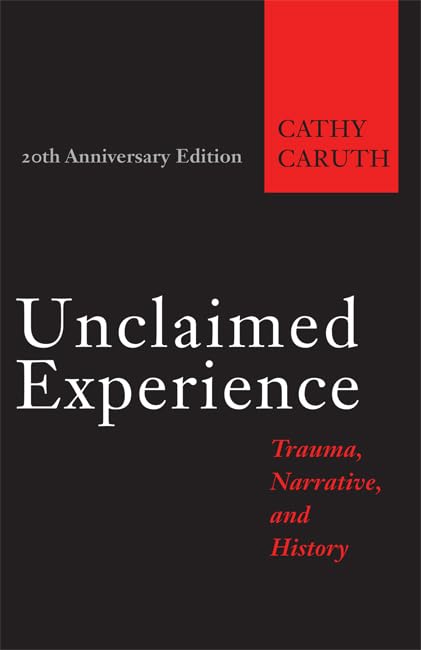
Unclaimed Experience: Trauma, Narrative, and History
AED23606
Quantity:
Order today to get by 7-14 business days
This item qualifies for free delivery
Imported From: United States
At BOLO, we work hard to ensure the products you receive are new, genuine, and sourced from reputable suppliers.
BOLO is not an authorized or official retailer for most brands, nor are we affiliated with manufacturers unless specifically stated on a product page. Instead, we source verified sellers, authorized distributors or directly from the manufacturer.
Each product undergoes thorough inspection and verification at our consolidation and fulfilment centers to ensure it meets our strict authenticity and quality standards before being shipped and delivered to you.
If you ever have concerns regarding the authenticity of a product purchased from us, please contact Bolo Support. We will review your inquiry promptly and, if necessary, provide documentation verifying authenticity or offer a suitable resolution.
Your trust is our top priority, and we are committed to maintaining transparency and integrity in every transaction.
All product information, images, descriptions, and reviews originate from the manufacturer or from trusted sellers overseas. BOLO is not affiliated with, endorsed by, or an authorized retailer for most brands listed on our website unless stated otherwise.
While we strive to display accurate information, variations in packaging, labeling, instructions, or formulation may occasionally occur due to regional differences or supplier updates. For detailed or manufacturer-specific information, please contact the brand directly or reach out to BOLO Support for assistance.
Unless otherwise stated, all prices displayed on the product page include applicable taxes and import duties.
BOLO operates in accordance with the laws and regulations of United Arab Emirates. Any items found to be restricted or prohibited for sale within the UAE will be cancelled prior to shipment. We take proactive measures to ensure that only products permitted for sale in United Arab Emirates are listed on our website.
All items are shipped by air, and any products classified as “Dangerous Goods (DG)” under IATA regulations will be removed from the order and cancelled.
All orders are processed manually, and we make every effort to process them promptly once confirmed. Products cancelled due to the above reasons will be permanently removed from listings across the website.
Similar suggestions by Bolo
More from this brand
Similar items from “United States”
Share with
Or share with link
https://www.bolo.ae/products/U1421421658
Visit the Johns Hopkins University Press Store
Unclaimed Experience: Trauma, Narrative, and History

AED23606
Quantity:
Order today to get by 7-14 business days
This item qualifies for free delivery
Imported From: United States
At BOLO, we work hard to ensure the products you receive are new, genuine, and sourced from reputable suppliers.
BOLO is not an authorized or official retailer for most brands, nor are we affiliated with manufacturers unless specifically stated on a product page. Instead, we source verified sellers, authorized distributors or directly from the manufacturer.
Each product undergoes thorough inspection and verification at our consolidation and fulfilment centers to ensure it meets our strict authenticity and quality standards before being shipped and delivered to you.
If you ever have concerns regarding the authenticity of a product purchased from us, please contact Bolo Support. We will review your inquiry promptly and, if necessary, provide documentation verifying authenticity or offer a suitable resolution.
Your trust is our top priority, and we are committed to maintaining transparency and integrity in every transaction.
All product information, images, descriptions, and reviews originate from the manufacturer or from trusted sellers overseas. BOLO is not affiliated with, endorsed by, or an authorized retailer for most brands listed on our website unless stated otherwise.
While we strive to display accurate information, variations in packaging, labeling, instructions, or formulation may occasionally occur due to regional differences or supplier updates. For detailed or manufacturer-specific information, please contact the brand directly or reach out to BOLO Support for assistance.
Unless otherwise stated, all prices displayed on the product page include applicable taxes and import duties.
BOLO operates in accordance with the laws and regulations of United Arab Emirates. Any items found to be restricted or prohibited for sale within the UAE will be cancelled prior to shipment. We take proactive measures to ensure that only products permitted for sale in United Arab Emirates are listed on our website.
All items are shipped by air, and any products classified as “Dangerous Goods (DG)” under IATA regulations will be removed from the order and cancelled.
All orders are processed manually, and we make every effort to process them promptly once confirmed. Products cancelled due to the above reasons will be permanently removed from listings across the website.
Description:
Editorial Reviews
Reviews:
5.0 out of 5 stars Important knowledge contained within
Am supervising a thesis so we added this to the reading list. Has been very insightful and thoughtful reading.
5.0 out of 5 stars Perspectives on trauma
Caruth speaks to the reader in broad terms and skillfully weaves Freudian concepts to frame the experience of trauma. Time is a pesky construct in this reality. A reverberating sentence is, "the threat is recognized one moment too late." The surprise of trauma is when one survives and doesn't know it. One claims their own survival. These perspectives added a richness to my nursing research on trauma patients.
5.0 out of 5 stars A brilliant Must-Read
The best book on trauma in existence--brilliant theory anchored in a series of concrete, eloquent, insightfully demonstrative, illuminating and compelling literary analyses. Pathbreaking book, foundational for the field of Trauma Studies as well as literature and literary theory, in their relation to psychoanalysis on the one hand, and to philosophy on the other.
4.0 out of 5 stars My First Exposure to Understanding Trauma
Although the book is written with a fairly academic narrative, the theory put forward is profound. If one has ever wondered why it is that an individual who is traumatized mysteriously finds themselves traumatized again in life (different time, different circumstances), this book is for them. The phrase "history of trauma" is not a chronology of how we learned of the subject. Instead, it refers to how the "history" of a traumatic event within a person's life remains that person's "history" until it is "claimed." This book was referred to me by a professor during my UCLA journey and to this day, I think back to how it expanded my mind on trauma. I'm in the process of finishing my own book (Speaking Truths, fiction, released April 2010) wherein the prtoagonist must resolve his own trauma. There is no doubt this book contributed significantly to how I outlined my character's journey.
5.0 out of 5 stars Essential reading for Trauma Studies
If you want to understand the state of trauma studies in their relation to the humanities, you absolutely must be familiar with Caruth's work. This book and her collection of edited essays were in large part responsible for the work on trauma within literature, film, and cultural studies since 1990.It is important to recognize that Caruth is neither a clinician nor a psychiatrist. She is working on analyzing written and filmed texts ranging from Freud's theories in "The Interpretation of Dreams," "Beyond the Pleasure Principle" and "Moses and Monotheism" to Paul de Man's post-structuralist literary theory to Alain Resnais's film "Hiroshima Mon Amour" to understand how these texts theorize trauma. She is interested in the discourse that has developed around trauma, the written record that affects how we--as literary scholars AND as psychologists, psychiatrists, and physicians--currently conceive of trauma.
3.0 out of 5 stars Comment on Feb. review
The previous reviewer lists three psychiatrists/neuroscientists, Daniel Schacter, Joseph Ledoux, and Richard McNally, that are very important to trauma studies; however, his or her claim that Caruth "ignored" the work of these scientists is misleading and unfair.Her book was published in 1996, while the majority of these men's work on trauma appeared in the late 1990s and the 2000s. Schacter, who has been publishing longer that the other two, did have a book published in 1994 on memory. However, "trauma" does not even appear in the index. While the work of pschyiatrists and neuroscientists can illuminate other, more literarially-minded trauma theorists today, most of these sources were not available to Caruth.
4.0 out of 5 stars Pretty good
While I find the read interesting and great at presenting otherwise unthought of ideas, it is not to my taste. However, the book came after about two weeks, exterior looks new, and has a few easily erasable pencil marks in it.
1.0 out of 5 stars Canonized substandard scholarship
Were it not for the outspoken protection of Shoshana Felman (founder of "trauma studies" in the Humanities) and Caruth's own clique-ish entente with Doctors Dori Laub and Bessel Van der Kolk (trauma experts of choice among Humanistic scholars), this book would have never come to light. The book has been widely and uncritically acclaimed by literary scholars, though anyone expecting to draw any insight from it would do better reading chapter 8 of Ruth Leys's "Trauma. A Genealogy".The book blatantly misquotes Freud and Lacan for the sake of her own argumentative convenience. For example, her manipulation of the text of Freud's "Moses and Monotheism" in chapter 3 is plain ludicrous. Furthermore, it ignores the extensive body of work undertaken by psychiatrists and neuroscientists such as Daniel Schacter, Joseph Ledoux, and Richard McNally. There is not a iota in medical evidence that supports Prof. Caruth's claims, yet this book has earned her a tenured teaching position at Emory University.The book is founded on Bessel van der Kolk's claim that the traumatic event, because of its unordinary emotional intensity, fails to register itself in the cerebral cortex but is registered instead in the amygdala (this piece of psychiatric folklore has long been discredited by the statistical evidence that a vast majority of trauma victims remember consciously the traumatic event). According to Caruth, the trauma is experienced as such in its literal and veridical repetition in the psychological life of the survivor. That is to say that the trauma is a belated experience. Yet there are plenty of holes in this claim, starting with the confusion between a state of shock as such (which implies an inability to respond to an event, not to experience it). My main beef with this book is the author's quasimystical emphasis in the assumption that the survivor of trauma serves as a witness to the wound of those who have not survived, no matter how emotional it sounds, conceals many ethically problematic implications, not the least of which would be granting the charismatic status of trauma victim to the perpetrator of any lethal aggression.
review
This is a classic for the study of trauma in literatureThe author has a great styleI would highly recommend it.
On of the most helpful pieces of secondary criticism I’ve read. The book itself is very good quality and arrived on time.
Fantastic read. I relied on this heavily throughout my degree.
Similar suggestions by Bolo
More from this brand
Similar items from “United States”
Share with
Or share with link
https://www.bolo.ae/products/U1421421658