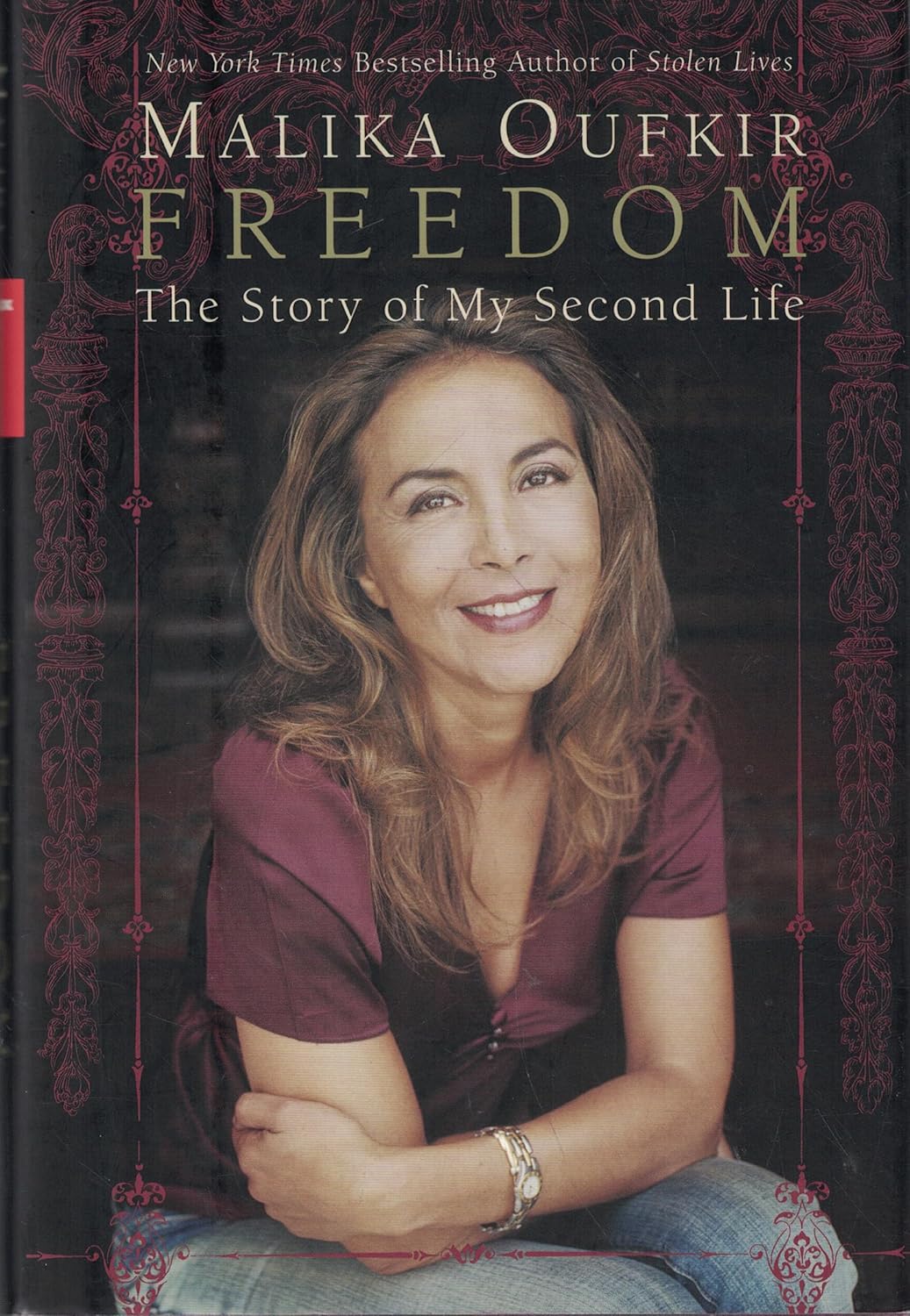
Description:
Editorial Reviews
Review
"A gripping memoir . . . the reader is left in awe." -- Washington Post
"A gripping memoir." -- Washington Post Book World
"A riveting and profoundly affecting account of survival." -- Time Out New York
"Extremely effective and graphic." -- Booklist
"Will fascinate readers with its singular tale." -- Publishers Weekly
About the Author
Reviews:
5.0 out of 5 stars A victim no more but a writer acquiring her own voice
As one reviewer has commented, this book does not recount a "story" in the sense that one might expect from the word. If Malika Oufkir's first book, "Stolen Lives," was mostly a chronological account of "facts" (as co-author Michèle Fitoussi required), "Freedom" is the retelling of an inward and intimate journey, from victimhood to the strenuous apprenticeship of a self in the "normal" world beyond prison. Although Malika Oufkir's humor, wit, and genuine warmth shine through this book, her account is not necessarily meant to be a heartwarming or comforting "story," it is the witnessing of another kind of struggle than the one we read in 2001, as the author makes her often painful and occasionally joyful way toward a renewed self.The publication of "La Prisonnière" in 1999, and subsequently of its English translation in 2001, thrust Malika Oufkir into stardom. This proved to be a mixed blessing since the media tended to package her in the confining role of a "victim," a role designed to elicit compassion and sympathy. At one point, she recounts in "Freedom", she "felt like a strange creature being exhibited for the civilized white man" (p. 217). In her second book, she attempts to free herself from this role, as she repeatedly asserts. We have to take such declarations seriously. This is a woman who managed to survive extreme adversity in great part through her ability to imagine another life and to create fictional characters or settings through which she could momentarily forget her circumstances. Now she is dipping into this pool of creativity in order to become the writer that she potentially was in prison. "Listening" to her voice, which rings with authenticity in the French original (a quality that no translation, not even a good one as in this case, can fully convey), I sense that Malika Oufkir is acquiring her own, distinct personality as a writer. Rather than living in her imagination with no product to show for such intense inner activity, she has found writing as a critical means of discovering her identity, beyond that of victim and prisoner, and of constructing herself. It is of course significant that this book represents her first achievement as a writer on her own.If at times Malika Oufkir appears to judge the "free world" in severe or condescending terms, she hardly spares herself either. Apart from a gentle form of revenge against this world for having ignored her family while they were in prison, there is great honesty in her account. Naturally drawn to the homeless in Paris and to their "desperate" way of grasping the world, for instance, she then measures her own limits when attempting to help people in distress, and she goes so far as to accuse herself of cowardice. She is aware of her own contradictions as well, even blaming herself for having participated (however indirectly) in the tyranny that plagued Morocco, her country of birth, under King Hassan II. At no time does Malika Oufkir claim to give an entirely objective account of her life or of her surroundings. Instead, she focuses on her perceptions and emotions as a way of understanding herself and her surroundings through the process of writing. After the publication of her first book in 1999, she spent years speaking in public to raise people's awareness about the atrocities that had been perpetrated in her country. The time then came for her to turn her "mission" inwards. What we take as self-evident, she has had to learn, slowly and often agonizingly. Who, never having undergone circumstances remotely similar to the ones she endured, can evaluate the laborious nature of such a renewal?Malika Oufkir accomplishes other goals in this book. By providing updates on her brothers, sisters, and mother, she responds to the concern expressed by many readers of "Stolen Lives" over the fate of her family. Through nuanced judgments, she also aims to redress the overly negative perception of Morocco that her first book precipitated. And she aims to correct mistaken perceptions of herself; though raised like a princess at the royal Moroccan court, for instance, she stresses that she comes "from the people" (p. 126).The process of literary creation surfaces in this book as well. Malika Oufkir discreetly shows that she is a reader, the precondition for being a writer, as when she describes herself reading in the (symbolic) underground world of Parisian subways. Echoes of Proustian reminiscences and mistaken perceptions, for example, infuse the hilarious account of her experience in a Parisian café washroom. Or take the opening chapter of the book, entitled "Adam." Here, the English translation loses the subtlety of the French original, for the chapter is literally entitled "The First Man of My Life" ("Le premier homme de ma vie"). This first man is Adam, Malika Oufkir's adopted son, whose name also serves as the first word of the book. This aptly chosen figure of renewal is present in other passages, reminding us of the author's purpose in writing her book: "Now that I have Adam, I know that I'm through being a victim" (p. 107-08).Provided its essential purpose remains clear in the reader's mind, this book will be of compelling interest to those who cared about "Stolen Lives," but also to those who care about survivors and their ways of coping once they are freed from the hardships that taught them to forge a defiant identity in order to resist their circumstances.
5.0 out of 5 stars Excellent Sequel
Wonderful follow up to her first book. STOLEN LIVES. Loved both of them.
5.0 out of 5 stars Wow2
I was so happy that she shared with us how her new life is. I often wondered what happened to her was she happy and how was the whole family doing . You will want to read this.This family is so strong to have survived this unfair tragedy.
5.0 out of 5 stars BEAUTIFUL FOLLOW UP
When reading the reviews I saw a few that mentioned their dislike for the fact that this book seems to be Ms. Oufkir's passing thoughts and leaves you wanting more. I must say that that is what attracted me to the book and I am glad i bought this follow up to Stolen Lives. While reading Stolen Lives I cried many times and gasped even more. I have wondered what happened to this lady and her family and was really glad to learn that they are all coping well. Each one having etched out his/her own piece of life. I also enjoyed the honesty and humor with with Ms. Oufkir described maneuvering the world after her release from prison and subsequent release from Morocco itself. I wish she and her family continued success and enjoyment of life since they truly deserve nothing less.
5.0 out of 5 stars Freedom is the follow-up of her first book.
Cried on the 3rd chapter. This is a great book just like her other one Stolen Lives.
3.0 out of 5 stars Not as good as Stolen Lives but worth the effort for Malika’s sake
Not rating the seller, the condition of the book was great and delivery timely. My rating is strictly directed at the book. Content is subpar to the preceding “Stolen Lives” book I had read some years ago which was a true page turner. I read the first book in its entirety on a flight from San Diego to Virginia. I truly wanted to see how Malika’s life had unfolded after her long awaited freedom, but the writing in this book is forced and could have used some kind editing on the part of a more seasoned writer and advisor. So glad she happy now, but this book not quite the attention grabber.
4.0 out of 5 stars Absurdities of 21st century life
Oufkir shares her struggles to catch-up with the world that left her behind for 20 yrs. With fresh eyes she points out how we too often pollute our freedom with absurdities, all told with gentle humor and disarming openness. Hope there is much more to follow -- hopefully tales of her Berber ancestry.
5.0 out of 5 stars Eye Opening
Emotional and moving. Well written of the differences in the world and society in the time she was in prison. Definitely read the first book first so that you have the proper context for what she says, but this provides a great follow-up.
I loved it!
I loved it!I found this book incredibly easy to read as the writing flow so nice, i could not put it down.The story was incredible and sad at the same time, but worth the read.
Five Stars
Good .
Good read after first book
Folĺow on from earlier book. Interesting to see how her life panned out
Follow up
The necessary follow up to "Stolen Lives". I shall never think the same way about eggs again - or cheeses for that matter.
An amazing
If you have read her first book then you need to read this as well. Such a survivor. An amazing woman/family
Visit the Miramax Store
Freedom: The Story of My Second Life
AED15857
Quantity:
Order today to get by 7-14 business days
Delivery fee of AED 20. Free for orders above AED 200.
Imported From: United States
At BOLO, we work hard to ensure the products you receive are new, genuine, and sourced from reputable suppliers.
BOLO is not an authorized or official retailer for most brands, nor are we affiliated with manufacturers unless specifically stated on a product page. Instead, we source verified sellers, authorized distributors or directly from the manufacturer.
Each product undergoes thorough inspection and verification at our consolidation and fulfilment centers to ensure it meets our strict authenticity and quality standards before being shipped and delivered to you.
If you ever have concerns regarding the authenticity of a product purchased from us, please contact Bolo Support. We will review your inquiry promptly and, if necessary, provide documentation verifying authenticity or offer a suitable resolution.
Your trust is our top priority, and we are committed to maintaining transparency and integrity in every transaction.
All product information, images, descriptions, and reviews originate from the manufacturer or from trusted sellers overseas. BOLO is not affiliated with, endorsed by, or an authorized retailer for most brands listed on our website unless stated otherwise.
While we strive to display accurate information, variations in packaging, labeling, instructions, or formulation may occasionally occur due to regional differences or supplier updates. For detailed or manufacturer-specific information, please contact the brand directly or reach out to BOLO Support for assistance.
Unless otherwise stated, all prices displayed on the product page include applicable taxes and import duties.
BOLO operates in accordance with the laws and regulations of United Arab Emirates. Any items found to be restricted or prohibited for sale within the UAE will be cancelled prior to shipment. We take proactive measures to ensure that only products permitted for sale in United Arab Emirates are listed on our website.
All items are shipped by air, and any products classified as “Dangerous Goods (DG)” under IATA regulations will be removed from the order and cancelled.
All orders are processed manually, and we make every effort to process them promptly once confirmed. Products cancelled due to the above reasons will be permanently removed from listings across the website.
Similar suggestions by Bolo
More from this brand
Similar items from “Women”
Share with
Or share with link
https://www.bolo.ae/products/U1401352065
Visit the Miramax Store
Freedom: The Story of My Second Life

AED15857
Quantity:
Order today to get by 7-14 business days
Delivery fee of AED 20. Free for orders above AED 200.
Imported From: United States
At BOLO, we work hard to ensure the products you receive are new, genuine, and sourced from reputable suppliers.
BOLO is not an authorized or official retailer for most brands, nor are we affiliated with manufacturers unless specifically stated on a product page. Instead, we source verified sellers, authorized distributors or directly from the manufacturer.
Each product undergoes thorough inspection and verification at our consolidation and fulfilment centers to ensure it meets our strict authenticity and quality standards before being shipped and delivered to you.
If you ever have concerns regarding the authenticity of a product purchased from us, please contact Bolo Support. We will review your inquiry promptly and, if necessary, provide documentation verifying authenticity or offer a suitable resolution.
Your trust is our top priority, and we are committed to maintaining transparency and integrity in every transaction.
All product information, images, descriptions, and reviews originate from the manufacturer or from trusted sellers overseas. BOLO is not affiliated with, endorsed by, or an authorized retailer for most brands listed on our website unless stated otherwise.
While we strive to display accurate information, variations in packaging, labeling, instructions, or formulation may occasionally occur due to regional differences or supplier updates. For detailed or manufacturer-specific information, please contact the brand directly or reach out to BOLO Support for assistance.
Unless otherwise stated, all prices displayed on the product page include applicable taxes and import duties.
BOLO operates in accordance with the laws and regulations of United Arab Emirates. Any items found to be restricted or prohibited for sale within the UAE will be cancelled prior to shipment. We take proactive measures to ensure that only products permitted for sale in United Arab Emirates are listed on our website.
All items are shipped by air, and any products classified as “Dangerous Goods (DG)” under IATA regulations will be removed from the order and cancelled.
All orders are processed manually, and we make every effort to process them promptly once confirmed. Products cancelled due to the above reasons will be permanently removed from listings across the website.
Description:
Editorial Reviews
Review
"A gripping memoir . . . the reader is left in awe." -- Washington Post
"A gripping memoir." -- Washington Post Book World
"A riveting and profoundly affecting account of survival." -- Time Out New York
"Extremely effective and graphic." -- Booklist
"Will fascinate readers with its singular tale." -- Publishers Weekly
About the Author
Reviews:
5.0 out of 5 stars A victim no more but a writer acquiring her own voice
As one reviewer has commented, this book does not recount a "story" in the sense that one might expect from the word. If Malika Oufkir's first book, "Stolen Lives," was mostly a chronological account of "facts" (as co-author Michèle Fitoussi required), "Freedom" is the retelling of an inward and intimate journey, from victimhood to the strenuous apprenticeship of a self in the "normal" world beyond prison. Although Malika Oufkir's humor, wit, and genuine warmth shine through this book, her account is not necessarily meant to be a heartwarming or comforting "story," it is the witnessing of another kind of struggle than the one we read in 2001, as the author makes her often painful and occasionally joyful way toward a renewed self.The publication of "La Prisonnière" in 1999, and subsequently of its English translation in 2001, thrust Malika Oufkir into stardom. This proved to be a mixed blessing since the media tended to package her in the confining role of a "victim," a role designed to elicit compassion and sympathy. At one point, she recounts in "Freedom", she "felt like a strange creature being exhibited for the civilized white man" (p. 217). In her second book, she attempts to free herself from this role, as she repeatedly asserts. We have to take such declarations seriously. This is a woman who managed to survive extreme adversity in great part through her ability to imagine another life and to create fictional characters or settings through which she could momentarily forget her circumstances. Now she is dipping into this pool of creativity in order to become the writer that she potentially was in prison. "Listening" to her voice, which rings with authenticity in the French original (a quality that no translation, not even a good one as in this case, can fully convey), I sense that Malika Oufkir is acquiring her own, distinct personality as a writer. Rather than living in her imagination with no product to show for such intense inner activity, she has found writing as a critical means of discovering her identity, beyond that of victim and prisoner, and of constructing herself. It is of course significant that this book represents her first achievement as a writer on her own.If at times Malika Oufkir appears to judge the "free world" in severe or condescending terms, she hardly spares herself either. Apart from a gentle form of revenge against this world for having ignored her family while they were in prison, there is great honesty in her account. Naturally drawn to the homeless in Paris and to their "desperate" way of grasping the world, for instance, she then measures her own limits when attempting to help people in distress, and she goes so far as to accuse herself of cowardice. She is aware of her own contradictions as well, even blaming herself for having participated (however indirectly) in the tyranny that plagued Morocco, her country of birth, under King Hassan II. At no time does Malika Oufkir claim to give an entirely objective account of her life or of her surroundings. Instead, she focuses on her perceptions and emotions as a way of understanding herself and her surroundings through the process of writing. After the publication of her first book in 1999, she spent years speaking in public to raise people's awareness about the atrocities that had been perpetrated in her country. The time then came for her to turn her "mission" inwards. What we take as self-evident, she has had to learn, slowly and often agonizingly. Who, never having undergone circumstances remotely similar to the ones she endured, can evaluate the laborious nature of such a renewal?Malika Oufkir accomplishes other goals in this book. By providing updates on her brothers, sisters, and mother, she responds to the concern expressed by many readers of "Stolen Lives" over the fate of her family. Through nuanced judgments, she also aims to redress the overly negative perception of Morocco that her first book precipitated. And she aims to correct mistaken perceptions of herself; though raised like a princess at the royal Moroccan court, for instance, she stresses that she comes "from the people" (p. 126).The process of literary creation surfaces in this book as well. Malika Oufkir discreetly shows that she is a reader, the precondition for being a writer, as when she describes herself reading in the (symbolic) underground world of Parisian subways. Echoes of Proustian reminiscences and mistaken perceptions, for example, infuse the hilarious account of her experience in a Parisian café washroom. Or take the opening chapter of the book, entitled "Adam." Here, the English translation loses the subtlety of the French original, for the chapter is literally entitled "The First Man of My Life" ("Le premier homme de ma vie"). This first man is Adam, Malika Oufkir's adopted son, whose name also serves as the first word of the book. This aptly chosen figure of renewal is present in other passages, reminding us of the author's purpose in writing her book: "Now that I have Adam, I know that I'm through being a victim" (p. 107-08).Provided its essential purpose remains clear in the reader's mind, this book will be of compelling interest to those who cared about "Stolen Lives," but also to those who care about survivors and their ways of coping once they are freed from the hardships that taught them to forge a defiant identity in order to resist their circumstances.
5.0 out of 5 stars Excellent Sequel
Wonderful follow up to her first book. STOLEN LIVES. Loved both of them.
5.0 out of 5 stars Wow2
I was so happy that she shared with us how her new life is. I often wondered what happened to her was she happy and how was the whole family doing . You will want to read this.This family is so strong to have survived this unfair tragedy.
5.0 out of 5 stars BEAUTIFUL FOLLOW UP
When reading the reviews I saw a few that mentioned their dislike for the fact that this book seems to be Ms. Oufkir's passing thoughts and leaves you wanting more. I must say that that is what attracted me to the book and I am glad i bought this follow up to Stolen Lives. While reading Stolen Lives I cried many times and gasped even more. I have wondered what happened to this lady and her family and was really glad to learn that they are all coping well. Each one having etched out his/her own piece of life. I also enjoyed the honesty and humor with with Ms. Oufkir described maneuvering the world after her release from prison and subsequent release from Morocco itself. I wish she and her family continued success and enjoyment of life since they truly deserve nothing less.
5.0 out of 5 stars Freedom is the follow-up of her first book.
Cried on the 3rd chapter. This is a great book just like her other one Stolen Lives.
3.0 out of 5 stars Not as good as Stolen Lives but worth the effort for Malika’s sake
Not rating the seller, the condition of the book was great and delivery timely. My rating is strictly directed at the book. Content is subpar to the preceding “Stolen Lives” book I had read some years ago which was a true page turner. I read the first book in its entirety on a flight from San Diego to Virginia. I truly wanted to see how Malika’s life had unfolded after her long awaited freedom, but the writing in this book is forced and could have used some kind editing on the part of a more seasoned writer and advisor. So glad she happy now, but this book not quite the attention grabber.
4.0 out of 5 stars Absurdities of 21st century life
Oufkir shares her struggles to catch-up with the world that left her behind for 20 yrs. With fresh eyes she points out how we too often pollute our freedom with absurdities, all told with gentle humor and disarming openness. Hope there is much more to follow -- hopefully tales of her Berber ancestry.
5.0 out of 5 stars Eye Opening
Emotional and moving. Well written of the differences in the world and society in the time she was in prison. Definitely read the first book first so that you have the proper context for what she says, but this provides a great follow-up.
I loved it!
I loved it!I found this book incredibly easy to read as the writing flow so nice, i could not put it down.The story was incredible and sad at the same time, but worth the read.
Five Stars
Good .
Good read after first book
Folĺow on from earlier book. Interesting to see how her life panned out
Follow up
The necessary follow up to "Stolen Lives". I shall never think the same way about eggs again - or cheeses for that matter.
An amazing
If you have read her first book then you need to read this as well. Such a survivor. An amazing woman/family
Similar suggestions by Bolo
More from this brand
Similar items from “Women”
Share with
Or share with link
https://www.bolo.ae/products/U1401352065