Description:
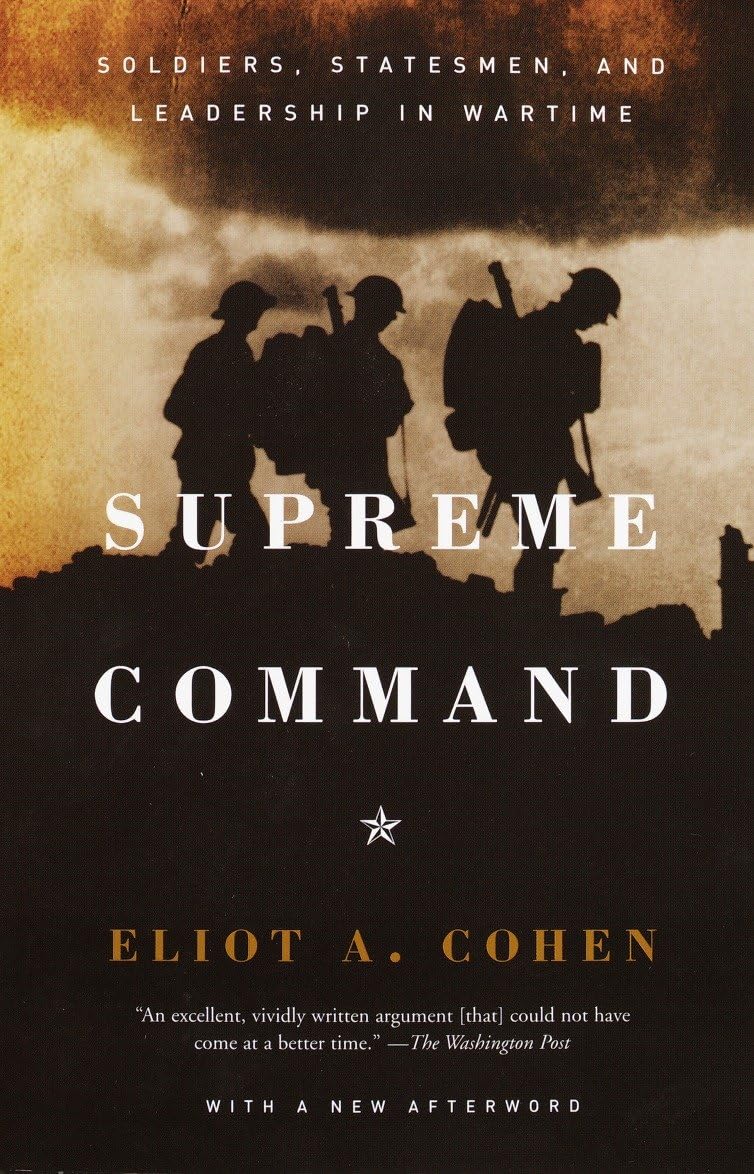
Using the leadership of Abraham Lincoln, Georges Clemenceau, Winston Churchill, and David Ben-Gurion to build his argument, Cohen offers compelling proof that, as Clemenceau put it, “War is too important to leave to the generals.” By examining the shared leadership traits of four politicians who triumphed in extraordinarily varied military campaigns, Cohen argues that active statesmen make the best wartime leaders, pushing their military subordinates to succeed where they might have failed if left to their own devices. Thought provoking and soundly argued, Cohen's Supreme Command is essential reading not only for military and political players but also for informed citizens and anyone interested in leadership.
Editorial Reviews
Review
“Brilliant. . . . Cohen argues convincingly that all great wartime leaders—Lincoln, Clemenceau, Churchill, Ben Gurion—never left the military to make its own policy, but constantly prodded, challenged, and gave it direction.” —National Review
“A brilliant account of Lincoln, Churchill, Clemenceau and Ben Gurion—how each man handled the military leaders who served him.”—The Wall Street Journal
“Fascinating.…Mr. Cohen's point is ultimately not a sentimental but a substantive one.…His elucidation of his theory is organized tightly and rendered crisply.”— The New York Times
“Superb . . . Cohen is persuasive in his argument.” —Los Angeles Times Book Review
“Every so often a book appears just at the moment when it is most needed. . . . Such a book is Supreme Command, a superb study of civilian commanders in chief in times of war by the nation's leading scholar of military-civilian relations.”–The Weekly Standard
“Cohen's well-written, absorbing critique of the normal theory is nothing short of crushing. . . . Invaluable.”–The New Leader
“It is well worth devoting some energy to stamping on the myth that soldiers should be allowed to go about their business without pesky politicians getting in the way, and an important contribution to this demolition job has been made by Eliot Cohen.”–The Economist
“Supreme Command is Cohen’s tour de force. . . . An eloquent, eminently approachable argument. . . . Essential reading.”–Choice
“Supreme Command will be read as often by the professional military and the civil servants and politicians that employ them as is Samuel Huntington’s The Soldiers and the State and Morris Janowitz’s The Professional Soldier, both of which are true classics.”–The Washington Times
“Intrinsically significant to the study of strategy and important on a practical level.”–Booklist
“Important. . . . Many senior politicians now balk at asking tough questions or challenging military judgments even as they set ambitious goals. But Cohen’s logic remains sound, and it would be a shame if it took a calamity, resulting from a combination of military misjudgment and civilian passivity, before it gets a hearing.”–Foreign Affairs
“Cohen, who writes with concision and insight, robustly argues that, far from being incompetent dunderheads, as commonly portrayed, civilian statesmen can be brilliant commanders. . . . Give[s] us much to ponder.”–Washington Monthly
“Supreme Command is a must read for the highest civilian and military leadership and should also rank high on military professional reading lists.”–Naval War College Review
“Essential reading for anyone concerned with current United States civil-military relations and national strategy. . . . It is cogent in nearly every detail–and we need all the help it can offer.”–The Journal of Military History
“Cohen’s revisionist thesis is especially timely. . . . [He] is surely right that we need to develop different — more traditional — attitudes and protocols concerning the military-civilian partnership.” –Commentary
“No one is better qualified than Cohen to write about political leadership in wartime. . . . This sustained analysis by a perceptive ‘subordinate’ who is also an outstanding historian should become required reading for statesmen and students alike.”–The National Interest
From the Inside Flap
Using the leadership of Abraham Lincoln, Georges Clemenceau, Winston Churchill, and David Ben-Gurion to build his argument, Cohen offers compelling proof that, as Clemenceau put it, ?War is too important to leave to the generals.? By examining the shared leadership traits of four politicians who triumphed in extraordinarily varied military campaigns, Cohen argues that active statesmen make the best wartime leaders, pushing their military subordinates to succeed where they might have failed if left to their own devices. Thought provoking and soundly argued, Cohen's Supreme Command is essential reading not only for military and political players but also for informed citizens and anyone interested in leadership.
From the Back Cover
Using the leadership of Abraham Lincoln, Georges Clemenceau, Winston Churchill, and David Ben-Gurion to build his argument, Cohen offers compelling proof that, as Clemenceau put it, "War is too important to leave to the generals." By examining the shared leadership traits of four politicians who triumphed in extraordinarily varied military campaigns, Cohen argues that active statesmen make the best wartime leaders, pushing their military subordinates to succeed where they might have failed if left to their own devices. Thought provoking and soundly argued, Cohen's Supreme Command is essential reading not only for military and political players but also for informed citizens and anyone interested in leadership.
About the Author
Excerpt. © Reprinted by permission. All rights reserved.
The Soldier and the Statesman
Few choices bedevil organizations as much as the selection of senior leaders. Often they look for those with high-level experience in different settings: New York City's Columbia University sought out America's most senior general, Dwight D. Eisenhower, to lead it after World War II; President Ronald Reagan made a corporate tycoon his chief of staff in 1985; in the early 1990s, Sears Roebuck, an ailing giant, looked to the chief logistician of the Gulf War to help it turn around. Frequently enough the transplant fails; the sets of skills and aptitudes that led to success in one walk of life either do not carry over or are downright dysfunctional in another. The rules of politics differ from those of business, and universities do not act the way corporations do. Even within the business world, car companies and software giants may operate very differently, and the small arms manufacturer who takes over an ice-cream company may never quite settle in to the new culture.
To be sure, leaders at the top have some roughly similar tasks: setting directions, picking subordinates, monitoring performance, handling external constituencies, and inspiring achievement. And they tend, often enough, to think that someone in a different walk of life has the answers to their dilemmas, which is why the generals study business books, and the CEOs peruse military history. But in truth the details of their work differ so much that in practice the parallels often elude them, or can only be discovered by digging more deeply than is the norm.
The relations between statesmen and soldiers in wartime offer a special case of this phenomenon. Many senior leaders in private life must manage equally senior professionals who have expertise and experience that dwarf their own, but politicians dealing with generals in wartime face exceptional difficulties. The stakes are so high, the gaps in mutual understanding so large, the differences in personality and background so stark, that the challenges exceed anything found in the civilian sector-which is why, perhaps, these relationships merit close attention not only from historians and students of policy, but from anyone interested in leadership at its most acutely difficult. To learn how statesmen manage their generals in wartime one must explore the peculiarities of the military profession and the exceptional atmospheres and values produced by war. These peculiarities and conditions are unique and extreme, and they produce relationships far more complicated and tense than either citizen or soldier may expect in peacetime, or even admit to exist in time of war.
"Let him come with me into Macedonia"
To see why, turn back to the year 168 b.c. The place is the Senate of the Roman republic, the subject the proposed resumption of war (for the third time) against Macedonia, and the speaker Consul Lucius Aemilius:
I am not, fellow-citizens, one who believes that no advice may be given to leaders; nay rather I judge him to be not a sage, but haughty, who conducts everything according to his own opinion alone. What therefore is my conclusion? Generals should receive advice, in the first place from the experts who are both specially skilled in military matters and have learned from experience; secondly, from those who are on the scene of action, who see the terrain, the enemy, the fitness of the occasion, who are sharers in the danger, as it were, aboard the same vessel. Thus, if there is anyone who is confident that he can advise me as to the best advantage of the state in this campaign which I am about to conduct, let him not refuse his services to the state, but come with me into Macedonia. I will furnish him with his sea-passage, with a horse, a tent, and even travel-funds. If anyone is reluctant to do this and prefers the leisure of the city to the hardships of campaigning, let him not steer the ship from on shore. The city itself provides enough subjects for conversation; let him confine his garrulity to these; and let him be aware that I shall be satisfied with the advice originating in camp.1
The Consul's cry for a free hand echoes that of generals throughout history-although the historian Livy records that, as a matter of fact, an unusually large number of senators decided to accompany him on campaign. Still, the notion that generals once given a mission should have near total discretion in its execution is a powerful one.
Popular interpretations of the Vietnam and Gulf wars, the one supposedly a conflict characterized by civilian interference in the details of warmaking, the other a model of benign operational and tactical neglect by an enlightened civilian leadership, seem to confirm the value of a bright line drawn between the duties of soldiers and civilians. Thus the chief of staff to General Norman Schwarzkopf, commander of US forces in Southwest Asia: "Schwarzkopf was never second-guessed by civilians, and that's the way it ought to work."2 Or more directly, then-President George Bush's declaration when he received the Association of the US Army's George Catlett Marshall Medal: "I vowed that I would never send an American soldier into combat with one hand tied behind that soldier's back. We did the politics and you superbly did the fighting."3 Small wonder, then, that the editor of the US Army War College's journal wrote to his military colleagues:
There will be instances where civilian officials with Napoleon complexes and micromanaging mentalities are prompted to seize the reins of operational control. And having taken control, there will be times when they then begin to fumble toward disaster. When this threatens to happen, the nation's top soldier . . . must summon the courage to rise and say to his civilian masters, "You can't do that!" and then stride to the focal point of decision and tell them how it must be done.4
Such a view of the roles of civilian and soldier reflects popular understandings as well. The 1996 movie Independence Day, for example, features only one notable villain (aside, that is, from the aliens who are attempting to devastate and conquer the Earth)-an overweening secretary of defense who attempts to direct the American military's counterattack against the invaders from outer space. Only after the interfering and deceitful civilian is out of the way can the president, a former Air Force combat pilot who gets back into uniform to lead the climactic aerial battle, and his military assistants (with the aid of one civilian scientist in a purely technical role) get on with the job of defeating the foe. To this comfortable consensus of capital, camp, and Hollywood one can add the weight of academic theory. Samuel Huntington, arguably the greatest American political scientist of our time, in a classic work, The Soldier and the State,5 laid out what he termed a theory of "objective control," which holds that the healthiest and most effective form of civilian control of the military is that which maximizes professionalism by isolating soldiers from politics, and giving them as free a hand as possible in military matters.
The normal theory of civil-military relations
We can call this consensus the "normal" theory of civil-military relations, which runs something like this. Officers are professionals, much like highly trained surgeons: the statesman is in the position of a patient requiring urgent care. He may freely decide whether or not to have an operation, he may choose one doctor over another, and he may even make a decision among different surgical options, although that is more rare. He may not, or at least ought not supervise a surgical procedure, select the doctor's scalpel, or rearrange the operating room to his liking. Even the patient who has medical training is well-advised not to attempt to do so, and indeed, his doctor will almost surely resent a colleague-patient's efforts along such lines. The result should be a limited degree of civilian control over military matters. To ask too many questions (let alone to give orders) about tactics, particular pieces of hardware, the design of a campaign, measures of success, or to press too closely for the promotion or dismissal of anything other than the most senior officers is meddling and interference, which is inappropriate and downright dangerous.
The difficulty is that the great war statesmen do just those improper things-and, what is more, it is because they do so that they succeed. This book looks at four indubitably great and successful war leaders, Abraham Lincoln, Georges Clemenceau, Winston Churchill, and David Ben-Gurion. The period of their tenure spans a substantial but not overwhelming period of time and different kinds of democratic polities. These four politicians have enough in common to bear comparison, yet differ enough to exhibit various features of the problem of civil-military relations in wartime. Given the dangers of thinking through these problems exclusively from an American perspective, it makes sense that only one of them should come from the pages of American history.
Lincoln, Clemenceau, Churchill, and Ben-Gurion led four very different kinds of democracies, under the most difficult circumstances imaginable. They came from different traditions of civil-military relations, had had disparate personal experiences, and confronted different arrays of subordinates and peers. The nature of each of their democracies shaped the nature of the leadership that they could exert and that was required of them. They faced much in common, however. Institutions of a more or less free press and legislative bodies constrained their powers, and they had to deal with populations whose temper and disposition could affect their behavior directly. Powerful as each of these men was, he had to consider the possibility that his conduct of the war could bring about his fall from power by constitutional-that is, civilian-means. At the same time, in their dealings with the military they did not need to fear a violent coup. However, military opposition could and did translate into a variety of forms of political opposition, sometimes with a potential to overthrow them.
The period spanned here-a bit less than a century-saw the development of a distinctive style of warfare, sometimes called "total war" but perhaps more accurately described as "industrialized warfare." Success in war depended in large measure on an ability to obtain (through production or importation) mass-manufactured weapons. At the same time, these leaders did not have to cope with one of the distinctive challenges of a later strategic era, that of weapons of mass destruction. Interestingly enough, however, it was Churchill who early on grasped the paradoxical peace-inducing nature of atomic terror, and Ben-Gurion who laid the groundwork for an Israeli nuclear program at a time when Israeli conventional strength was set on a course of prolonged improvement.
These four statesmen conducted their wars during what may come to be seen as the time of the first communications revolution, when it became possible to communicate useful quantities of information almost instantaneously and to move large quantities of men and war materiél at great speed by means of mechanical transportation. In physics, the product of velocity and mass is momentum, and the same is true of warfare. Thus, these statesmen had to conduct wars at a time when the instruments of conflict themselves were changing and gathering speed. One might suggest that a second communications revolution is now upon us, in which a further quantum increase in the amount of information that can be distributed globally has occurred, and the role played by that information in all of civilized life will again transform society and ultimately the conduct of war. Thus these four cases exhibit the problems of wartime leadership during a period of enormous change. By understanding the challenges of those times we may also understand better the nature of the changes that are upon us today, in an age that looks to be quite different. The fundamental problems of statesmanship faced by the leaders of today have not changed as much as one might think. These are matters that I will explore in the conclusion to this book.
Finally, these statesmen were separated in time but linked by deep respect. Clemenceau visited the United States after the Civil War and professed a great admiration for Lincoln; Churchill paid Clemenceau the homage of rhetorical imitation (verging on plagiarism) on more than one occasion. And Ben-Gurion paid a tribute to Churchill's leadership in a note written a few years before the latter's death: "It was not only the liberties and the honour of your own people that you saved," wrote one aged giant to another.6 Thus a thin but definite personal, not merely conceptual thread links these four men. The personal similarities and contrasts among them will bear examination. Three of them (Clemenceau, Churchill, and Ben-Gurion) assumed the reins of high command at an advanced age; two of them with very little in the way of preparation for the conduct of large-scale warfare (Lincoln and Clemenceau, although one might make a similar point about Ben-Gurion). Each exhibited in different ways similar qualities of ruthlessness, mastery of detail, and fascination with technology. All four were great learners who studied war as if it were their own profession, and in many ways they mastered it as well as did their generals. And all found themselves locked in conflict with military men. When one reads the transcripts of Ben-Gurion's furious arguments in 1948 with the de facto chief of staff of the new Israel Defense Forces-Yigal Yadin, a thirty-two-year-old archaeologist who had never served in any regular army-they do not sound very different from the tempestuous arguments between Winston Churchill and the grim Chief of the Imperial General Staff, Field Marshal Alan Brooke, twenty-five years older than Yadin and with a career spent in uniform. For all of the differences in their backgrounds the backwoods lawyer, the dueling French doctor turned journalist, the rogue aristocrat, and the impoverished Jewish socialist found themselves in similar predicaments: admiring their generals and despairing over them, driving some, dismissing others, and watching even the best with affection ever limited by wariness.
"war is not merely an act of policy,
but a true political instrument."
If these four could have had a collective military adviser, one suspects that it would have been an older figure yet, Carl von Clausewitz, the greatest theorist of war, whose On War remains a standard text for aspiring strategists to the present day. For the Prussian general, who spent most of his adult life on active service fighting against the French Revolution and Napoleon, the attempt to separate the business of politicians and soldiers was a hopeless task. For that reason, early in the nineteenth century he rejected the "normal" theory. To understand why, at the deepest level, these statesmen did not delegate war fighting to the generals, one turns to Clausewitz's famous dictum, that war is merely the continuation of politics by other means. But by this he has something far more radical in mind than is commonly thought.7
Details:
Visit the Anchor Store
Supreme Command: Soldiers, Statesmen, and Leadership in Wartime
AED12425
Quantity:
Order today to get by 7-14 business days
Delivery fee of AED 20. Free for orders above AED 200.
 Imported From: United States
At BOLO, we work hard to ensure the products you receive are new, genuine, and sourced from reputable suppliers.
Every product in the BOLO catalogue is sourced through our Verified Global Supply Network of verified sellers, authorized distributors or directly from the manufacturer.
Each product undergoes thorough inspection and verification at our consolidation and fulfilment centers to ensure it meets our strict authenticity and quality standards before being shipped and delivered to you.
If you ever have concerns regarding the authenticity of a product purchased from us, please contact Bolo Support. We will review your inquiry promptly and, if necessary, provide documentation verifying authenticity or offer a suitable resolution.
Your trust is our top priority, and we are committed to maintaining transparency and integrity in every transaction.
While we strive to display accurate information, variations in packaging, labeling, instructions, or formulation may occasionally occur due to regional differences or supplier updates. For detailed or manufacturer-specific information, please contact the brand directly or reach out to BOLO Support for assistance.
Unless otherwise stated, all prices displayed on the product page include applicable taxes and import duties.
BOLO operates in accordance with the laws and regulations of United Arab Emirates. Any items found to be restricted or prohibited for sale within the United Arab Emirates will be cancelled prior to shipment. We take proactive measures to ensure that only products permitted for sale in United Arab Emirates are listed on our website.
All items are shipped by air, and any products classified as “Dangerous Goods (DG)” under IATA regulations will be removed from the order and cancelled.
All orders are processed manually, and we make every effort to process them promptly once confirmed. Products cancelled due to the above reasons will be permanently removed from listings across the website.
Similar suggestions by Bolo
More from this brand
Similar items from “History & Theory”
Share with
Or share with link
https://www.bolo.ae/products/U1400034043
Visit the Anchor Store
Supreme Command: Soldiers, Statesmen, and Leadership in Wartime
AED12425
Quantity:
Order today to get by 7-14 business days
Delivery fee of AED 20. Free for orders above AED 200.
Imported From: United States
At BOLO, we work hard to ensure the products you receive are new, genuine, and sourced from reputable suppliers.
Every product in the BOLO catalogue is sourced through our Verified Global Supply Network of verified sellers, authorized distributors or directly from the manufacturer.
Each product undergoes thorough inspection and verification at our consolidation and fulfilment centers to ensure it meets our strict authenticity and quality standards before being shipped and delivered to you.
If you ever have concerns regarding the authenticity of a product purchased from us, please contact Bolo Support. We will review your inquiry promptly and, if necessary, provide documentation verifying authenticity or offer a suitable resolution.
Your trust is our top priority, and we are committed to maintaining transparency and integrity in every transaction.
While we strive to display accurate information, variations in packaging, labeling, instructions, or formulation may occasionally occur due to regional differences or supplier updates. For detailed or manufacturer-specific information, please contact the brand directly or reach out to BOLO Support for assistance.
Unless otherwise stated, all prices displayed on the product page include applicable taxes and import duties.
BOLO operates in accordance with the laws and regulations of United Arab Emirates. Any items found to be restricted or prohibited for sale within the United Arab Emirates will be cancelled prior to shipment. We take proactive measures to ensure that only products permitted for sale in United Arab Emirates are listed on our website.
All items are shipped by air, and any products classified as “Dangerous Goods (DG)” under IATA regulations will be removed from the order and cancelled.
All orders are processed manually, and we make every effort to process them promptly once confirmed. Products cancelled due to the above reasons will be permanently removed from listings across the website.
Description:
Using the leadership of Abraham Lincoln, Georges Clemenceau, Winston Churchill, and David Ben-Gurion to build his argument, Cohen offers compelling proof that, as Clemenceau put it, “War is too important to leave to the generals.” By examining the shared leadership traits of four politicians who triumphed in extraordinarily varied military campaigns, Cohen argues that active statesmen make the best wartime leaders, pushing their military subordinates to succeed where they might have failed if left to their own devices. Thought provoking and soundly argued, Cohen's Supreme Command is essential reading not only for military and political players but also for informed citizens and anyone interested in leadership.
Editorial Reviews
Review
“Brilliant. . . . Cohen argues convincingly that all great wartime leaders—Lincoln, Clemenceau, Churchill, Ben Gurion—never left the military to make its own policy, but constantly prodded, challenged, and gave it direction.” —National Review
“A brilliant account of Lincoln, Churchill, Clemenceau and Ben Gurion—how each man handled the military leaders who served him.”—The Wall Street Journal
“Fascinating.…Mr. Cohen's point is ultimately not a sentimental but a substantive one.…His elucidation of his theory is organized tightly and rendered crisply.”— The New York Times
“Superb . . . Cohen is persuasive in his argument.” —Los Angeles Times Book Review
“Every so often a book appears just at the moment when it is most needed. . . . Such a book is Supreme Command, a superb study of civilian commanders in chief in times of war by the nation's leading scholar of military-civilian relations.”–The Weekly Standard
“Cohen's well-written, absorbing critique of the normal theory is nothing short of crushing. . . . Invaluable.”–The New Leader
“It is well worth devoting some energy to stamping on the myth that soldiers should be allowed to go about their business without pesky politicians getting in the way, and an important contribution to this demolition job has been made by Eliot Cohen.”–The Economist
“Supreme Command is Cohen’s tour de force. . . . An eloquent, eminently approachable argument. . . . Essential reading.”–Choice
“Supreme Command will be read as often by the professional military and the civil servants and politicians that employ them as is Samuel Huntington’s The Soldiers and the State and Morris Janowitz’s The Professional Soldier, both of which are true classics.”–The Washington Times
“Intrinsically significant to the study of strategy and important on a practical level.”–Booklist
“Important. . . . Many senior politicians now balk at asking tough questions or challenging military judgments even as they set ambitious goals. But Cohen’s logic remains sound, and it would be a shame if it took a calamity, resulting from a combination of military misjudgment and civilian passivity, before it gets a hearing.”–Foreign Affairs
“Cohen, who writes with concision and insight, robustly argues that, far from being incompetent dunderheads, as commonly portrayed, civilian statesmen can be brilliant commanders. . . . Give[s] us much to ponder.”–Washington Monthly
“Supreme Command is a must read for the highest civilian and military leadership and should also rank high on military professional reading lists.”–Naval War College Review
“Essential reading for anyone concerned with current United States civil-military relations and national strategy. . . . It is cogent in nearly every detail–and we need all the help it can offer.”–The Journal of Military History
“Cohen’s revisionist thesis is especially timely. . . . [He] is surely right that we need to develop different — more traditional — attitudes and protocols concerning the military-civilian partnership.” –Commentary
“No one is better qualified than Cohen to write about political leadership in wartime. . . . This sustained analysis by a perceptive ‘subordinate’ who is also an outstanding historian should become required reading for statesmen and students alike.”–The National Interest
From the Inside Flap
Using the leadership of Abraham Lincoln, Georges Clemenceau, Winston Churchill, and David Ben-Gurion to build his argument, Cohen offers compelling proof that, as Clemenceau put it, ?War is too important to leave to the generals.? By examining the shared leadership traits of four politicians who triumphed in extraordinarily varied military campaigns, Cohen argues that active statesmen make the best wartime leaders, pushing their military subordinates to succeed where they might have failed if left to their own devices. Thought provoking and soundly argued, Cohen's Supreme Command is essential reading not only for military and political players but also for informed citizens and anyone interested in leadership.
From the Back Cover
Using the leadership of Abraham Lincoln, Georges Clemenceau, Winston Churchill, and David Ben-Gurion to build his argument, Cohen offers compelling proof that, as Clemenceau put it, "War is too important to leave to the generals." By examining the shared leadership traits of four politicians who triumphed in extraordinarily varied military campaigns, Cohen argues that active statesmen make the best wartime leaders, pushing their military subordinates to succeed where they might have failed if left to their own devices. Thought provoking and soundly argued, Cohen's Supreme Command is essential reading not only for military and political players but also for informed citizens and anyone interested in leadership.
About the Author
Excerpt. © Reprinted by permission. All rights reserved.
The Soldier and the Statesman
Few choices bedevil organizations as much as the selection of senior leaders. Often they look for those with high-level experience in different settings: New York City's Columbia University sought out America's most senior general, Dwight D. Eisenhower, to lead it after World War II; President Ronald Reagan made a corporate tycoon his chief of staff in 1985; in the early 1990s, Sears Roebuck, an ailing giant, looked to the chief logistician of the Gulf War to help it turn around. Frequently enough the transplant fails; the sets of skills and aptitudes that led to success in one walk of life either do not carry over or are downright dysfunctional in another. The rules of politics differ from those of business, and universities do not act the way corporations do. Even within the business world, car companies and software giants may operate very differently, and the small arms manufacturer who takes over an ice-cream company may never quite settle in to the new culture.
To be sure, leaders at the top have some roughly similar tasks: setting directions, picking subordinates, monitoring performance, handling external constituencies, and inspiring achievement. And they tend, often enough, to think that someone in a different walk of life has the answers to their dilemmas, which is why the generals study business books, and the CEOs peruse military history. But in truth the details of their work differ so much that in practice the parallels often elude them, or can only be discovered by digging more deeply than is the norm.
The relations between statesmen and soldiers in wartime offer a special case of this phenomenon. Many senior leaders in private life must manage equally senior professionals who have expertise and experience that dwarf their own, but politicians dealing with generals in wartime face exceptional difficulties. The stakes are so high, the gaps in mutual understanding so large, the differences in personality and background so stark, that the challenges exceed anything found in the civilian sector-which is why, perhaps, these relationships merit close attention not only from historians and students of policy, but from anyone interested in leadership at its most acutely difficult. To learn how statesmen manage their generals in wartime one must explore the peculiarities of the military profession and the exceptional atmospheres and values produced by war. These peculiarities and conditions are unique and extreme, and they produce relationships far more complicated and tense than either citizen or soldier may expect in peacetime, or even admit to exist in time of war.
"Let him come with me into Macedonia"
To see why, turn back to the year 168 b.c. The place is the Senate of the Roman republic, the subject the proposed resumption of war (for the third time) against Macedonia, and the speaker Consul Lucius Aemilius:
I am not, fellow-citizens, one who believes that no advice may be given to leaders; nay rather I judge him to be not a sage, but haughty, who conducts everything according to his own opinion alone. What therefore is my conclusion? Generals should receive advice, in the first place from the experts who are both specially skilled in military matters and have learned from experience; secondly, from those who are on the scene of action, who see the terrain, the enemy, the fitness of the occasion, who are sharers in the danger, as it were, aboard the same vessel. Thus, if there is anyone who is confident that he can advise me as to the best advantage of the state in this campaign which I am about to conduct, let him not refuse his services to the state, but come with me into Macedonia. I will furnish him with his sea-passage, with a horse, a tent, and even travel-funds. If anyone is reluctant to do this and prefers the leisure of the city to the hardships of campaigning, let him not steer the ship from on shore. The city itself provides enough subjects for conversation; let him confine his garrulity to these; and let him be aware that I shall be satisfied with the advice originating in camp.1
The Consul's cry for a free hand echoes that of generals throughout history-although the historian Livy records that, as a matter of fact, an unusually large number of senators decided to accompany him on campaign. Still, the notion that generals once given a mission should have near total discretion in its execution is a powerful one.
Popular interpretations of the Vietnam and Gulf wars, the one supposedly a conflict characterized by civilian interference in the details of warmaking, the other a model of benign operational and tactical neglect by an enlightened civilian leadership, seem to confirm the value of a bright line drawn between the duties of soldiers and civilians. Thus the chief of staff to General Norman Schwarzkopf, commander of US forces in Southwest Asia: "Schwarzkopf was never second-guessed by civilians, and that's the way it ought to work."2 Or more directly, then-President George Bush's declaration when he received the Association of the US Army's George Catlett Marshall Medal: "I vowed that I would never send an American soldier into combat with one hand tied behind that soldier's back. We did the politics and you superbly did the fighting."3 Small wonder, then, that the editor of the US Army War College's journal wrote to his military colleagues:
There will be instances where civilian officials with Napoleon complexes and micromanaging mentalities are prompted to seize the reins of operational control. And having taken control, there will be times when they then begin to fumble toward disaster. When this threatens to happen, the nation's top soldier . . . must summon the courage to rise and say to his civilian masters, "You can't do that!" and then stride to the focal point of decision and tell them how it must be done.4
Such a view of the roles of civilian and soldier reflects popular understandings as well. The 1996 movie Independence Day, for example, features only one notable villain (aside, that is, from the aliens who are attempting to devastate and conquer the Earth)-an overweening secretary of defense who attempts to direct the American military's counterattack against the invaders from outer space. Only after the interfering and deceitful civilian is out of the way can the president, a former Air Force combat pilot who gets back into uniform to lead the climactic aerial battle, and his military assistants (with the aid of one civilian scientist in a purely technical role) get on with the job of defeating the foe. To this comfortable consensus of capital, camp, and Hollywood one can add the weight of academic theory. Samuel Huntington, arguably the greatest American political scientist of our time, in a classic work, The Soldier and the State,5 laid out what he termed a theory of "objective control," which holds that the healthiest and most effective form of civilian control of the military is that which maximizes professionalism by isolating soldiers from politics, and giving them as free a hand as possible in military matters.
The normal theory of civil-military relations
We can call this consensus the "normal" theory of civil-military relations, which runs something like this. Officers are professionals, much like highly trained surgeons: the statesman is in the position of a patient requiring urgent care. He may freely decide whether or not to have an operation, he may choose one doctor over another, and he may even make a decision among different surgical options, although that is more rare. He may not, or at least ought not supervise a surgical procedure, select the doctor's scalpel, or rearrange the operating room to his liking. Even the patient who has medical training is well-advised not to attempt to do so, and indeed, his doctor will almost surely resent a colleague-patient's efforts along such lines. The result should be a limited degree of civilian control over military matters. To ask too many questions (let alone to give orders) about tactics, particular pieces of hardware, the design of a campaign, measures of success, or to press too closely for the promotion or dismissal of anything other than the most senior officers is meddling and interference, which is inappropriate and downright dangerous.
The difficulty is that the great war statesmen do just those improper things-and, what is more, it is because they do so that they succeed. This book looks at four indubitably great and successful war leaders, Abraham Lincoln, Georges Clemenceau, Winston Churchill, and David Ben-Gurion. The period of their tenure spans a substantial but not overwhelming period of time and different kinds of democratic polities. These four politicians have enough in common to bear comparison, yet differ enough to exhibit various features of the problem of civil-military relations in wartime. Given the dangers of thinking through these problems exclusively from an American perspective, it makes sense that only one of them should come from the pages of American history.
Lincoln, Clemenceau, Churchill, and Ben-Gurion led four very different kinds of democracies, under the most difficult circumstances imaginable. They came from different traditions of civil-military relations, had had disparate personal experiences, and confronted different arrays of subordinates and peers. The nature of each of their democracies shaped the nature of the leadership that they could exert and that was required of them. They faced much in common, however. Institutions of a more or less free press and legislative bodies constrained their powers, and they had to deal with populations whose temper and disposition could affect their behavior directly. Powerful as each of these men was, he had to consider the possibility that his conduct of the war could bring about his fall from power by constitutional-that is, civilian-means. At the same time, in their dealings with the military they did not need to fear a violent coup. However, military opposition could and did translate into a variety of forms of political opposition, sometimes with a potential to overthrow them.
The period spanned here-a bit less than a century-saw the development of a distinctive style of warfare, sometimes called "total war" but perhaps more accurately described as "industrialized warfare." Success in war depended in large measure on an ability to obtain (through production or importation) mass-manufactured weapons. At the same time, these leaders did not have to cope with one of the distinctive challenges of a later strategic era, that of weapons of mass destruction. Interestingly enough, however, it was Churchill who early on grasped the paradoxical peace-inducing nature of atomic terror, and Ben-Gurion who laid the groundwork for an Israeli nuclear program at a time when Israeli conventional strength was set on a course of prolonged improvement.
These four statesmen conducted their wars during what may come to be seen as the time of the first communications revolution, when it became possible to communicate useful quantities of information almost instantaneously and to move large quantities of men and war materiél at great speed by means of mechanical transportation. In physics, the product of velocity and mass is momentum, and the same is true of warfare. Thus, these statesmen had to conduct wars at a time when the instruments of conflict themselves were changing and gathering speed. One might suggest that a second communications revolution is now upon us, in which a further quantum increase in the amount of information that can be distributed globally has occurred, and the role played by that information in all of civilized life will again transform society and ultimately the conduct of war. Thus these four cases exhibit the problems of wartime leadership during a period of enormous change. By understanding the challenges of those times we may also understand better the nature of the changes that are upon us today, in an age that looks to be quite different. The fundamental problems of statesmanship faced by the leaders of today have not changed as much as one might think. These are matters that I will explore in the conclusion to this book.
Finally, these statesmen were separated in time but linked by deep respect. Clemenceau visited the United States after the Civil War and professed a great admiration for Lincoln; Churchill paid Clemenceau the homage of rhetorical imitation (verging on plagiarism) on more than one occasion. And Ben-Gurion paid a tribute to Churchill's leadership in a note written a few years before the latter's death: "It was not only the liberties and the honour of your own people that you saved," wrote one aged giant to another.6 Thus a thin but definite personal, not merely conceptual thread links these four men. The personal similarities and contrasts among them will bear examination. Three of them (Clemenceau, Churchill, and Ben-Gurion) assumed the reins of high command at an advanced age; two of them with very little in the way of preparation for the conduct of large-scale warfare (Lincoln and Clemenceau, although one might make a similar point about Ben-Gurion). Each exhibited in different ways similar qualities of ruthlessness, mastery of detail, and fascination with technology. All four were great learners who studied war as if it were their own profession, and in many ways they mastered it as well as did their generals. And all found themselves locked in conflict with military men. When one reads the transcripts of Ben-Gurion's furious arguments in 1948 with the de facto chief of staff of the new Israel Defense Forces-Yigal Yadin, a thirty-two-year-old archaeologist who had never served in any regular army-they do not sound very different from the tempestuous arguments between Winston Churchill and the grim Chief of the Imperial General Staff, Field Marshal Alan Brooke, twenty-five years older than Yadin and with a career spent in uniform. For all of the differences in their backgrounds the backwoods lawyer, the dueling French doctor turned journalist, the rogue aristocrat, and the impoverished Jewish socialist found themselves in similar predicaments: admiring their generals and despairing over them, driving some, dismissing others, and watching even the best with affection ever limited by wariness.
"war is not merely an act of policy,
but a true political instrument."
If these four could have had a collective military adviser, one suspects that it would have been an older figure yet, Carl von Clausewitz, the greatest theorist of war, whose On War remains a standard text for aspiring strategists to the present day. For the Prussian general, who spent most of his adult life on active service fighting against the French Revolution and Napoleon, the attempt to separate the business of politicians and soldiers was a hopeless task. For that reason, early in the nineteenth century he rejected the "normal" theory. To understand why, at the deepest level, these statesmen did not delegate war fighting to the generals, one turns to Clausewitz's famous dictum, that war is merely the continuation of politics by other means. But by this he has something far more radical in mind than is commonly thought.7
Details:
Similar suggestions by Bolo
More from this brand
Similar items from “History & Theory”
Share with
Or share with link
https://www.bolo.ae/products/U1400034043