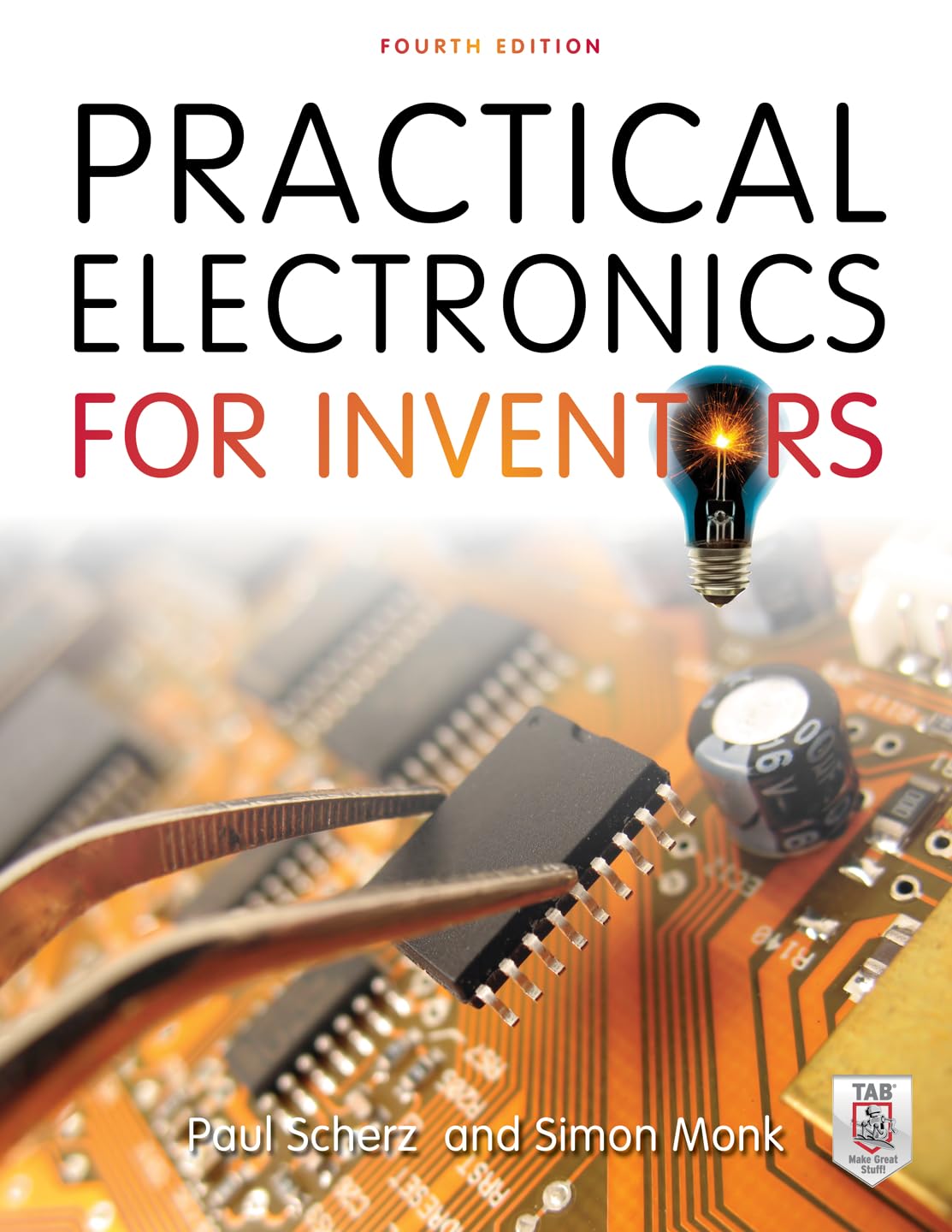
Description:
Editorial Reviews
From the Publisher
Paul Scherz is a Systems Operation Manager who received his B.S. in physics from the University of Wisconsin. He is an inventor/hobbyist in electronics, an area he grew to appreciate through his experience at the University’s Department of Nuclear Engineering and Engineering Physics and the Department of Plasma Physics.
Dr. Simon Monk has a degree in Cybernetics and Computer Science and a PhD in Software Engineering. Dr. Monk spent several years as an academic before he returned to industry, co-founding the mobile software company Momote Ltd. He has been an active electronics hobbyist since his early teens and is a full time writer on hobby electronics and open source hardware. Dr. Monk is the author of numerous electronics books, including Programming Arduino, Hacking Electronics, and Programming the Raspberry Pi.
About the Author
Paul Scherz is a Systems Operation Manager who received his B.S. in physics from the University of Wisconsin. He is an inventor/hobbyist in electronics, an area he grew to appreciate through his experience at the University’s Department of Nuclear Engineering and Engineering Physics and the Department of Plasma Physics.
Dr. Simon Monk has a degree in Cybernetics and Computer Science and a PhD in Software Engineering. Dr. Monk spent several years as an academic before he returned to industry, co-founding the mobile software company Momote Ltd. He has been an active electronics hobbyist since his early teens and is a full time writer on hobby electronics and open source hardware. Dr. Monk is the author of numerous electronics books, including Programming Arduino, Hacking Electronics, and Programming the Raspberry Pi.
Reviews:
5.0 out of 5 stars A must have for hobbyists, students, and amateurs...
This is a book that regardless of where you are on your learning path, or where you intend to go, if you are dealing with electronics in any capacity you need this book on your shelf. It doesn't matter if you are designing circuits, lighting a scale model, building custom PCs, a HAM, or figuring out an electrical glitch in your car, this is a wonderful reference to have on hand. Even if you're a student just starting out, this is still a book you want to get sooner or later, preferably sooner to act as a supplement to your studies.The book covers a tremendous amount of ground and gives a great overview from the basics through micrcontrollers. Likewise, this book does cover the laws and theorems of basic theory along with the math involved. In fact the first 1/4 of this book is spent just covering theory. From there it goes into the various components and how they work, circuit design, all sorts of references on how components are labeled, and more.So what exactly is this book then? It's somewhere between a glossary of electrical components and an encyclopedia. At least that's how I would describe it. The explanations are clear, concise, and I find the book overall easy to follow. Unfortunately there is nothing in the way of labs, quizzes, hands-on work, worksheets, etc. In other words, no way to interact with the material. It does offer good (if dated) advice on how to set up a lab, how to interpret readings on test equipment, where to go for supplies, and more along those lines.That's why I HIGHLY recommend this book as a supplement to either as an existing course or program, or as a reference to a hobbyist that is already active in the field. Can someone learn electronics with this book? It depends. As a primary source, I suppose it might be possible, but because it doesn't have the lab work or hands on element, I would say NOT recommended. As a secondary source, reference, or supplement to another program, absolutely.My only real complaint is that this is ready for a 5th Edition. Considering that the authors were doing a revised edition about every seven years or so previously, if anything it's overdue. This was originally written back in 2016 (it's now 2025 as I write this), and there have been advances in technology since then. For example there is no mention of the Raspberry Pi which is also used as a microcontroller and is relevant to robotics and whatnot. Also a few of the sources mentioned are no longer available. However be that as it may, it really doesn't detract from the value of what this book has to offer.Verdict: HIGHLY recommended!
5.0 out of 5 stars An excellent resource for electronic circuit design
Having taken several Electrical Engineering courses as a part of my Software Engineering degree, and developed a keen interest in embedded systems, I wanted to pick up a book for reference on designing and building circuits. I was looking for something that would be useful both for reviewing topics and occasionally teaching myself something new, without wading through pages of examples and exercises, as is common with many full-blown textbooks. I read the description for the book, and it seemed to fit the bill, so I put it on pre-order and waited. It arrived around a week ago, and thus far it seems to be everything I was looking for, and more. If you don't want to sit through the rest of my review, I'll summarize by saying that this book is well worth the price. It is a big book, and covers a wide variety of topics in circuit analysis and design, from basic theory to electric motors to audio electronics. Each chapter includes an overview of the theory and big ideas of the subject, plus practical information for those looking to implement the ideas. I certainly was not disappointed.As I mentioned, this is a large book, checking in at nearly 1000 pages. "You could hurt someone with it," as my old literature teacher used to say. It may weigh heavy on the scale, but is light on your wallet, in the $20-$30 range for a new copy. Another reviewer has pointed out that the low price is partially enabled by printing on rather low-quality paper. This is true; the paper is not of particularly great quality, but in my opinion this does not detract from the book's worth. By no means is the book in danger of falling apart, so I would not let this minor issue deter you from picking up a copy.Now, regarding the content: this book is broken up into 16 chapters, or 17 if you count the three or four-page first chapter. The first "real" chapter is truly colossal, and fills almost 250 pages with the theory of electronic circuits. This alone is worth the price of admission. This is followed by another large chapter that deals with the basic components that are used in circuits everywhere, and includes many useful tables, diagrams, and sketches of almost every variation of the components imaginable (for example, the chapter describes 8 different styles of switches). From here, the book branches out into several areas of circuits. You can continue through the chapters in order, to learn about semiconductors, optoelectronics, and sensors; or you could jump ahead to chapter 12 to start on digital electronics, then continue to microcontrollers and programmable logic. In general, each chapter starts with a basic introduction to the topic, followed by subsections that dig deeper into the specifics. If there is anything to complain about structurally, it would be the rather odd placement of "hands on electronics," which is chapter number 7. The chapter itself focuses on the physical construction of circuits, including safety, diagrams, breadboards, and other lab equipment such as multimeters and power supplies. Given the content of the chapter, I feel that it would have made more sense to place it after the chapter on basic components, rather than wedged between sensors and op-amps. However, I certainly prefer to have the information in a strange location than not at all.All in all, this is an excellent reference for someone who wants a one-stop shop to review any of the wide variety of topics that are covered. This book does seem to be more focused on breadth of topics than depth, so it may be more useful to hobbyists than professionals. In either case, the book should be a valuable pickup for anyone in search of a solid overview of electronic circuits.
Handy reference.
Handy book for reference.
Molto utile e ampio, soprattutto considerando il prezzo
Il libro è un consistente volume di circa 1000 pagine che propone vari argomenti di elettronica con un orientamento principalmente verso il lato pratico e applicativo, nonostante siano presenti spiegazioni teoriche (principalmente nel capitolo 2 ma anche in altri punti) per giustificare quanto spiegato.La quarta edizione è aggiornata al 2016.Il libro spazia numerosi argomenti, a partire dalle basi teoriche (leggi di Ohm, teoremi di Thevenin e Norton, componenti basilari quali condensatori e induttori), fino ad arrivare a logiche programmabili, microcontrollori ed elettronica digitale in genere, passando prima per componenti generali, amplificatori, filtri, alimentatori etc.Sono presenti numerosi esempi, alcuni esercizi (risolti o proposti, con soluzione) dopo ogni paragrafo e varie tabelle utili da riprendere in mano (come valori comuni di componenti, forme d'onda e così via).Il libro è ovviamente in inglese tuttavia la scrittura è piuttosto scorrevole, quindi per chi ha conoscenze anche non avanzate di inglese ma comunque conosce un po' il gergo tecnico, non è di difficile comprensione.Unica cosa che mi ha dato un po' fastidio è l'uso di unità di misura consuetudinarie (piedi, pollici etc) in luogo delle unità del Sistema Internazionale, ma pazienza...Il libro ha una buona qualità di stampa in bianco e nero e ha una copertina flessibile, che si rovina facilmente, per cui consiglio di mettergli subito una copertina. Tuttavia questa costruzione probabilmente consente di tenerne il prezzo basso, perché 32-33 euro per un volume del genere da 1000 pagine sono davvero pochi.Volendo fare un'accoppiata, consiglio anche il The Art of Electronics di Horowitz e Hill.
Produto de ótima qualidade. Sem nada a apontar.
Como descrito, sem nada a apontar. Muito útil para quem está a aprender eletrónica.
Ótimo livro.
Produto essencial para quem está iniciando na eletrônica, que é o meu caso. Apesar da idade, comecei a me interessar por eletrônica e esse livro tem todo a teoria básica necessária, além de conceitos avançados.
It has everything you need for electronics.
If you are new in electronics world, It has everything you need to know for electronics. Suffice to say if you want to learn electronics from basics, this is very good option. Posting some photos of index for relevant one.
Visit the McGraw Hill TAB Store
Practical Electronics for Inventors, Fourth Edition
AED24463
Quantity:
Order today to get by 7-14 business days
This item qualifies for free delivery
Imported From: United States
At BOLO, we work hard to ensure the products you receive are new, genuine, and sourced from reputable suppliers.
BOLO is not an authorized or official retailer for most brands, nor are we affiliated with manufacturers unless specifically stated on a product page. Instead, we source verified sellers, authorized distributors or directly from the manufacturer.
Each product undergoes thorough inspection and verification at our consolidation and fulfilment centers to ensure it meets our strict authenticity and quality standards before being shipped and delivered to you.
If you ever have concerns regarding the authenticity of a product purchased from us, please contact Bolo Support. We will review your inquiry promptly and, if necessary, provide documentation verifying authenticity or offer a suitable resolution.
Your trust is our top priority, and we are committed to maintaining transparency and integrity in every transaction.
All product information, images, descriptions, and reviews originate from the manufacturer or from trusted sellers overseas. BOLO is not affiliated with, endorsed by, or an authorized retailer for most brands listed on our website unless stated otherwise.
While we strive to display accurate information, variations in packaging, labeling, instructions, or formulation may occasionally occur due to regional differences or supplier updates. For detailed or manufacturer-specific information, please contact the brand directly or reach out to BOLO Support for assistance.
Unless otherwise stated, all prices displayed on the product page include applicable taxes and import duties.
BOLO operates in accordance with the laws and regulations of United Arab Emirates. Any items found to be restricted or prohibited for sale within the UAE will be cancelled prior to shipment. We take proactive measures to ensure that only products permitted for sale in United Arab Emirates are listed on our website.
All items are shipped by air, and any products classified as “Dangerous Goods (DG)” under IATA regulations will be removed from the order and cancelled.
All orders are processed manually, and we make every effort to process them promptly once confirmed. Products cancelled due to the above reasons will be permanently removed from listings across the website.
Similar suggestions by Bolo
More from this brand
Similar items from “Integrated”
Share with
Or share with link
https://www.bolo.ae/products/U1259587541
Visit the McGraw Hill TAB Store
Practical Electronics for Inventors, Fourth Edition

AED24463
Quantity:
Order today to get by 7-14 business days
This item qualifies for free delivery
Imported From: United States
At BOLO, we work hard to ensure the products you receive are new, genuine, and sourced from reputable suppliers.
BOLO is not an authorized or official retailer for most brands, nor are we affiliated with manufacturers unless specifically stated on a product page. Instead, we source verified sellers, authorized distributors or directly from the manufacturer.
Each product undergoes thorough inspection and verification at our consolidation and fulfilment centers to ensure it meets our strict authenticity and quality standards before being shipped and delivered to you.
If you ever have concerns regarding the authenticity of a product purchased from us, please contact Bolo Support. We will review your inquiry promptly and, if necessary, provide documentation verifying authenticity or offer a suitable resolution.
Your trust is our top priority, and we are committed to maintaining transparency and integrity in every transaction.
All product information, images, descriptions, and reviews originate from the manufacturer or from trusted sellers overseas. BOLO is not affiliated with, endorsed by, or an authorized retailer for most brands listed on our website unless stated otherwise.
While we strive to display accurate information, variations in packaging, labeling, instructions, or formulation may occasionally occur due to regional differences or supplier updates. For detailed or manufacturer-specific information, please contact the brand directly or reach out to BOLO Support for assistance.
Unless otherwise stated, all prices displayed on the product page include applicable taxes and import duties.
BOLO operates in accordance with the laws and regulations of United Arab Emirates. Any items found to be restricted or prohibited for sale within the UAE will be cancelled prior to shipment. We take proactive measures to ensure that only products permitted for sale in United Arab Emirates are listed on our website.
All items are shipped by air, and any products classified as “Dangerous Goods (DG)” under IATA regulations will be removed from the order and cancelled.
All orders are processed manually, and we make every effort to process them promptly once confirmed. Products cancelled due to the above reasons will be permanently removed from listings across the website.
Description:
Editorial Reviews
From the Publisher
Paul Scherz is a Systems Operation Manager who received his B.S. in physics from the University of Wisconsin. He is an inventor/hobbyist in electronics, an area he grew to appreciate through his experience at the University’s Department of Nuclear Engineering and Engineering Physics and the Department of Plasma Physics.
Dr. Simon Monk has a degree in Cybernetics and Computer Science and a PhD in Software Engineering. Dr. Monk spent several years as an academic before he returned to industry, co-founding the mobile software company Momote Ltd. He has been an active electronics hobbyist since his early teens and is a full time writer on hobby electronics and open source hardware. Dr. Monk is the author of numerous electronics books, including Programming Arduino, Hacking Electronics, and Programming the Raspberry Pi.
About the Author
Paul Scherz is a Systems Operation Manager who received his B.S. in physics from the University of Wisconsin. He is an inventor/hobbyist in electronics, an area he grew to appreciate through his experience at the University’s Department of Nuclear Engineering and Engineering Physics and the Department of Plasma Physics.
Dr. Simon Monk has a degree in Cybernetics and Computer Science and a PhD in Software Engineering. Dr. Monk spent several years as an academic before he returned to industry, co-founding the mobile software company Momote Ltd. He has been an active electronics hobbyist since his early teens and is a full time writer on hobby electronics and open source hardware. Dr. Monk is the author of numerous electronics books, including Programming Arduino, Hacking Electronics, and Programming the Raspberry Pi.
Reviews:
5.0 out of 5 stars A must have for hobbyists, students, and amateurs...
This is a book that regardless of where you are on your learning path, or where you intend to go, if you are dealing with electronics in any capacity you need this book on your shelf. It doesn't matter if you are designing circuits, lighting a scale model, building custom PCs, a HAM, or figuring out an electrical glitch in your car, this is a wonderful reference to have on hand. Even if you're a student just starting out, this is still a book you want to get sooner or later, preferably sooner to act as a supplement to your studies.The book covers a tremendous amount of ground and gives a great overview from the basics through micrcontrollers. Likewise, this book does cover the laws and theorems of basic theory along with the math involved. In fact the first 1/4 of this book is spent just covering theory. From there it goes into the various components and how they work, circuit design, all sorts of references on how components are labeled, and more.So what exactly is this book then? It's somewhere between a glossary of electrical components and an encyclopedia. At least that's how I would describe it. The explanations are clear, concise, and I find the book overall easy to follow. Unfortunately there is nothing in the way of labs, quizzes, hands-on work, worksheets, etc. In other words, no way to interact with the material. It does offer good (if dated) advice on how to set up a lab, how to interpret readings on test equipment, where to go for supplies, and more along those lines.That's why I HIGHLY recommend this book as a supplement to either as an existing course or program, or as a reference to a hobbyist that is already active in the field. Can someone learn electronics with this book? It depends. As a primary source, I suppose it might be possible, but because it doesn't have the lab work or hands on element, I would say NOT recommended. As a secondary source, reference, or supplement to another program, absolutely.My only real complaint is that this is ready for a 5th Edition. Considering that the authors were doing a revised edition about every seven years or so previously, if anything it's overdue. This was originally written back in 2016 (it's now 2025 as I write this), and there have been advances in technology since then. For example there is no mention of the Raspberry Pi which is also used as a microcontroller and is relevant to robotics and whatnot. Also a few of the sources mentioned are no longer available. However be that as it may, it really doesn't detract from the value of what this book has to offer.Verdict: HIGHLY recommended!
5.0 out of 5 stars An excellent resource for electronic circuit design
Having taken several Electrical Engineering courses as a part of my Software Engineering degree, and developed a keen interest in embedded systems, I wanted to pick up a book for reference on designing and building circuits. I was looking for something that would be useful both for reviewing topics and occasionally teaching myself something new, without wading through pages of examples and exercises, as is common with many full-blown textbooks. I read the description for the book, and it seemed to fit the bill, so I put it on pre-order and waited. It arrived around a week ago, and thus far it seems to be everything I was looking for, and more. If you don't want to sit through the rest of my review, I'll summarize by saying that this book is well worth the price. It is a big book, and covers a wide variety of topics in circuit analysis and design, from basic theory to electric motors to audio electronics. Each chapter includes an overview of the theory and big ideas of the subject, plus practical information for those looking to implement the ideas. I certainly was not disappointed.As I mentioned, this is a large book, checking in at nearly 1000 pages. "You could hurt someone with it," as my old literature teacher used to say. It may weigh heavy on the scale, but is light on your wallet, in the $20-$30 range for a new copy. Another reviewer has pointed out that the low price is partially enabled by printing on rather low-quality paper. This is true; the paper is not of particularly great quality, but in my opinion this does not detract from the book's worth. By no means is the book in danger of falling apart, so I would not let this minor issue deter you from picking up a copy.Now, regarding the content: this book is broken up into 16 chapters, or 17 if you count the three or four-page first chapter. The first "real" chapter is truly colossal, and fills almost 250 pages with the theory of electronic circuits. This alone is worth the price of admission. This is followed by another large chapter that deals with the basic components that are used in circuits everywhere, and includes many useful tables, diagrams, and sketches of almost every variation of the components imaginable (for example, the chapter describes 8 different styles of switches). From here, the book branches out into several areas of circuits. You can continue through the chapters in order, to learn about semiconductors, optoelectronics, and sensors; or you could jump ahead to chapter 12 to start on digital electronics, then continue to microcontrollers and programmable logic. In general, each chapter starts with a basic introduction to the topic, followed by subsections that dig deeper into the specifics. If there is anything to complain about structurally, it would be the rather odd placement of "hands on electronics," which is chapter number 7. The chapter itself focuses on the physical construction of circuits, including safety, diagrams, breadboards, and other lab equipment such as multimeters and power supplies. Given the content of the chapter, I feel that it would have made more sense to place it after the chapter on basic components, rather than wedged between sensors and op-amps. However, I certainly prefer to have the information in a strange location than not at all.All in all, this is an excellent reference for someone who wants a one-stop shop to review any of the wide variety of topics that are covered. This book does seem to be more focused on breadth of topics than depth, so it may be more useful to hobbyists than professionals. In either case, the book should be a valuable pickup for anyone in search of a solid overview of electronic circuits.
Handy reference.
Handy book for reference.
Molto utile e ampio, soprattutto considerando il prezzo
Il libro è un consistente volume di circa 1000 pagine che propone vari argomenti di elettronica con un orientamento principalmente verso il lato pratico e applicativo, nonostante siano presenti spiegazioni teoriche (principalmente nel capitolo 2 ma anche in altri punti) per giustificare quanto spiegato.La quarta edizione è aggiornata al 2016.Il libro spazia numerosi argomenti, a partire dalle basi teoriche (leggi di Ohm, teoremi di Thevenin e Norton, componenti basilari quali condensatori e induttori), fino ad arrivare a logiche programmabili, microcontrollori ed elettronica digitale in genere, passando prima per componenti generali, amplificatori, filtri, alimentatori etc.Sono presenti numerosi esempi, alcuni esercizi (risolti o proposti, con soluzione) dopo ogni paragrafo e varie tabelle utili da riprendere in mano (come valori comuni di componenti, forme d'onda e così via).Il libro è ovviamente in inglese tuttavia la scrittura è piuttosto scorrevole, quindi per chi ha conoscenze anche non avanzate di inglese ma comunque conosce un po' il gergo tecnico, non è di difficile comprensione.Unica cosa che mi ha dato un po' fastidio è l'uso di unità di misura consuetudinarie (piedi, pollici etc) in luogo delle unità del Sistema Internazionale, ma pazienza...Il libro ha una buona qualità di stampa in bianco e nero e ha una copertina flessibile, che si rovina facilmente, per cui consiglio di mettergli subito una copertina. Tuttavia questa costruzione probabilmente consente di tenerne il prezzo basso, perché 32-33 euro per un volume del genere da 1000 pagine sono davvero pochi.Volendo fare un'accoppiata, consiglio anche il The Art of Electronics di Horowitz e Hill.
Produto de ótima qualidade. Sem nada a apontar.
Como descrito, sem nada a apontar. Muito útil para quem está a aprender eletrónica.
Ótimo livro.
Produto essencial para quem está iniciando na eletrônica, que é o meu caso. Apesar da idade, comecei a me interessar por eletrônica e esse livro tem todo a teoria básica necessária, além de conceitos avançados.
It has everything you need for electronics.
If you are new in electronics world, It has everything you need to know for electronics. Suffice to say if you want to learn electronics from basics, this is very good option. Posting some photos of index for relevant one.
Similar suggestions by Bolo
More from this brand
Similar items from “Integrated”
Share with
Or share with link
https://www.bolo.ae/products/U1259587541