Deliver toUnited Arab Emirates
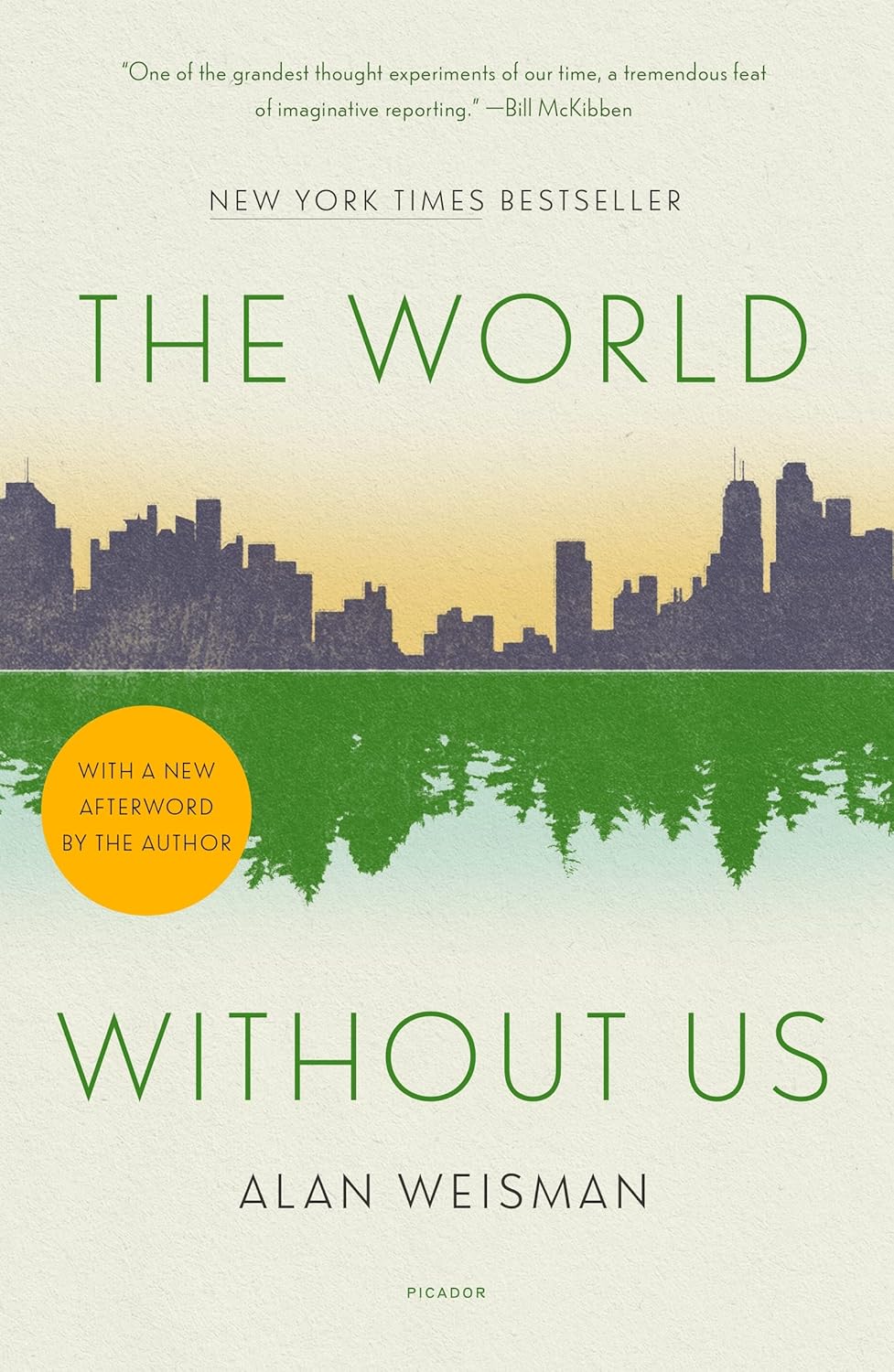
World Without Us

Description:

A NEW YORK TIMES BESTSELLER

A Time #1 Nonfiction Book* An Entertainment Weekly #1 Nonfiction Book *A Finalist for the National Book Critics Circle Award and Salon Book Awards* A Kansas City Star's Top 100 Book of the Year *A Mother Jones' Favorite Book*

The 15th Anniversary edition of the worldwide bestseller that answers the ultimate question: what happens to the Earth when human beings disappear? Now with a new afterword from the author.

The World Without Us is a penetrating, page-turning tour of a post-human Earth. Drawing on the expertise of engineers, atmospheric scientists, art conservators, zoologists, oil refiners, marine biologists, astrophysicists, religious leaders from rabbis to the Dalai Lama, and paleontologists, Alan Weisman deftly illustrates what the planet might be like today, if not for us.

In this revelatory account, Alan Weisman explains how our massive infrastructure would collapse and finally vanish without human presence; which everyday items may become immortalized as fossils; how copper pipes and wiring would be crushed into mere seams of reddish rock; why some of our earliest buildings might be the last architecture left; and how plastic, bronze sculpture, and radio waves may be our most lasting gifts to the universe.

As he shows which human devastations are indelible, and which examples of our highest art and culture would endure longest, Weisman draws on every field of science to present an environmental assessment like no other. This is narrative nonfiction at its finest―one of the most affecting portraits yet of humankind's place on this planet.


Editorial Reviews

Review

“This is one of the grandest thought experiments of our time, a tremendous feat of imaginative reporting.” ―Bill McKibben, author of The End of Nature and Deep Economy: The Wealth of Communities and the Durable Future

“Brilliantly creative...An audacious intellectual adventure...His thought experiment is so intellectually fascinating, so oddly playful, that it escapes categorizing and clichés...It sucks us in with a vision of what is, what has been, and what is yet to come...It's a trumpet call that sounds from the other end of the universe and from inside us all.” ―
Salon

“An astonishing mass of reportage that envisions a world suddenly bereft of humans.” ―
The Atlanta Journal-Constitution

“A fascinating nonfiction eco-thriller...Weisman's gripping fantasy will make most readers hope that at least some of us can stick around long enough to see how it all turns out.” ―
The New York Times Book Review

“Alan Weisman has produced, if not a Bible, at least a Book of Revelation.” ―
Newsweek

“The book boasts an amazingly imaginative conceit that manages to tap into underlying fears and subtly inspire us to consider our interaction with the planet.” ―
The Washington Post

“Extraordinarily farsighted...Beautiful and passionate.” ―
The Boston Globe

“Grandly entertaining.” ―
Time

The World Without Us gradually reveals itself to be one of the most satisfying environmental books of recent memory, one devoid of self-righteousness, alarmism, or tiresome doomsaying.” ―Pittsburgh Post-Gazette

“A refreshing, and oddly hopeful, look at the fate of the environment.” ―
BusinessWeek

“This book is the very DNA of hope.” ―
The Globe and Mail (Toronto)

“Prodigious and impressive.” ―
The New York Times

“I don't think I've read a better nonfiction book this year.” ―Lev Grossman,
Time

“In his provocative new book,
The World Without Us, Alan Weisman adds a dash of fiction to his science to address a despairing problem: the planet's health.” ―U.S. News & World Report

“An exacting account of the processes by which things fall apart. The scope is breathtaking...the clarity and lyricism of the writing itself left me with repeated gasps of recognition about the human condition. I believe it will be a classic." ―Dennis Covington, author of National Book Award finalist
Salvation on Sand Mountain

“One of the most ambitious 'thought experiments' ever.” ―
The Cincinnati Enquirer

“Alan Weisman offers us a sketch of where we stand as a species that is both illuminating and terrifying. His tone is conversational and his affection for both Earth and humanity transparent.” ―Barry Lopez, author of
Arctic Dreams

“Fascinating, mordant, deeply intelligent, and beautifully written,
The World Without Us depicts the spectacle of humanity's impact on the planet Earth in tragically poignant terms that go far beyond the dry dictates of science. This is a very important book for a species playing games with its own destiny.” ―James Howard Kunstler, author of The Long Emergency

“Weisman's enthralling tour of the world of tomorrow explores what little will remain of ancient times while anticipating, often poetically, what a planet without us would be like.” ―
Publishers Weekly (starred)

“The imaginative power of
The World Without Us is compulsive and nearly hypnotic--make sure you have time to be kidnapped into Alan Weisman's alternative world before you sit down with the book, because you won't soon return. This is a text that has a chance to change people, and so make a real difference for the planet.” ―Charles Wohlforth, author of Los Angeles Times Book Prize–winning The Whale and the Supercomputer

“Weisman is a thoroughly engaging and clarion writer fueled by curiosity and determined to cast light rather than spread despair. His superbly well-researched and skillfully crafted stop-you-in-your-tracks report stresses the underappreciated fact that humankind's actions create a ripple effect across the web of life.” ―
Booklist (starred)

About the Author

Alan Weisman is the author of several books, including The World Without Us―a National Book Critics Circle Award finalist, winner of the Wenjin Book Prize of the National Library of China, and an international bestseller translated in 34 languages. An award-winning journalist, his reports have appeared in Harper's, New York Times Magazine, Atlantic Monthly, Discover, Vanity Fair, and Mother Jones. A former contributing editor to Los Angeles Times Magazine, Weisman is a senior radio producer for Homelands Productions. He lives in Massachusetts.

Reviews:

5.0 out of 5 stars The (Mostly) Recovered World after We've Left

C. · April 11, 2014

No matter who you are or where you have lived, you have had an impact on the world, whether it is more global or local, immediate or delayed. When you compile the impact of the approximately 7 billion people alive today as well as the effect of all those that have lived before us, it amounts to many different consequences by our species, and everyday our impact increases. But what if we were all of a sudden gone? What if Homo sapiens no longer tread on the soil that we have so disturbed? What impact would we leave behind?Although Alan Weisman acknowledges that it is unlikely that our species will quickly perish, he still addresses this question in The World Without Us in order to more closely examine our environmental impact. Weisman examines human impact ranging from megafauna extinctions to genetically modified plants and from the altered composition of the atmosphere to what will happen to cities and nuclear plants when we leave. Unlike many authors that address human environmental impact, Weisman takes a surprisingly positive approach. Perhaps our impact may not be as lasting as many view it to be. In many of these chapters he does note that some things will last long after we have gone. Although, this does not appear to be his main focus.The book is well written, captivating, and definitely gives hope that Homo sapiens have not forever destroyed many aspects of the world. The atmosphere can return to normal despite the holes we have contributed to in the ozone layer. Forests can thrive even after we come through and displaced many species and harvest many trees. Despite these positive points, Weisman does some things that will last longer, but I find that Weisman fails to emphasize the fact that our impact will forever alter the world. The species that have gone extinct can never come back. Yes, extinction is a natural part of growth for the world, but many species have gone extinct primarily because of humans. At the same time I think of the fact that we must have an impact. There is no way for a species to have no impact. Each species on the planet affects many others both directly and indirectly.One example of when Weisman fails to bring concern is when he talks of the impact our production of plastics is having. We are not seeing plastics biodegrade. There is hope that something will develop the ability to degrade the plastics, but in the meantime it will continue to kill all sorts of wildlife as they ingest it. The rubber we use for tires also has yet to find something that can degrade it. Both rubber and plastic will likely be around long after Homo sapiens are gone and continue to affect the world we left behind. Yet, after reading these segments by Weisman, I did not feel incredibly compelled to minimize my use of plastic or rubber. Weisman does not seem to be rallying people against their negative environmental impact. Since humans will likely be around a long time, we need to work on lessening the impact that we have, and I found that Weisman did not emphasize this as I believe he should.Comparing Weisman to George Perkins Marsh, we find some things that at least appear to contradict each other. Marsh examines the balance that is a key part of nature. As humans expend resources, they don't come back as they were. Nature is not able to bring itself back to where it was. Weisman seems to find that nature can reflect what it was in the past, and he appears to find this acceptable. Perhaps this is all we can ever expect. It may be best that nature is not exactly as it was. It is ever changing and adjusting together with all its interconnected parts. Whatever the result, Weisman finds hope where many fail to.Weisman also alludes to human's desire to be remembered. We've sent off signals to try and contact other intelligent life, and we do our best to preserve our bodies that inevitably decay anyways. If you think about it, we all have a desire to be remembered by others, to do something which will have impact that will outlast our bodies. However, we want to make sure that what we leave does not doom the earth that housed us for so long.

4.0 out of 5 stars Unique, Intriguing, and Well-researched

J. · April 10, 2014

Many would agree that speculation concerning the sudden extinction of the human race would make a rather morbid premise for a book, but in his book The World without Us Alan Weisman proves that the post-human world is certainly a fascinating topic. As Weisman leads his readers on a hypothetical tour of a world after the mass disappearance of the entirety of the human race, it becomes clear just how much impact every one of our actions has not just on our future, but on the future of the entire planet. In this wide-ranging study of human impact in the distant future, Weisman presents an illuminating picture of the world that we are creating.In each and every speculative future event, Alan Weisman presents pages of scientific evidence and historical precedent to help readers understand and envision what this process of reclamation may actually look like. While his musings on human history may seem rather lengthy for a book that is supposed to be concerned with the future, each and every anecdote leads to an interesting revelation, and his richly descriptive and poetic writing style keeps a hold of the reader’s attention throughout even the most seemingly incongruous meandering of thought. The book also provides many thought-provoking scientific and philosophical ideas concerning where meaning is found and what purpose humans serve on the earth. All of his musings are presented with a refreshingly open-minded approach that leads the reader to seek their own conclusion.My one complaint about this book is that the author can be rather long-winded when it comes to historical anecdotes some of which seem to be completely unnecessary. It seems as though he could have focused more on the hypothetical future earth he was constructing and spent less time expostulating about the earth of the past and present. Overall the book was well written and very interesting. It has a very unique and provocative premise that will keep people reading as they uncover new ways of looking at their world. I would highly recommend it to anyone interested in environmental or political science or who simply wants to read a unique book that promotes deep thought about human action.

Excellent read

K.M. · May 11, 2017

A very thoughtful and thought provoking book. It makes one think beyond our limited lives and on a cosmic scale about the past and future of human existence.

One of the most insightful views of a world where humans themselves play no part - only their legacy is of essence

a. · September 29, 2013

Alan Weisman's international bestseller The World Without Us has been widely acclaimed for its ability to carry its readers on a journey described by the Independent as `Flesh-creepingly good fun...an expert-led fantasia of the post human planet''. But pick up the book, absorb its contents and you will realize that the Independent was being modest in their appraisal of Weisman's love of detail. Detail, which if taken time to digest, will lead you to an epiphany. Here is a world, where the very last human on Earth is no more. `Look around you, at today's world' writes Weisman. `Your house, your city. The surrounding land, the pavement underneath, and the soil hidden below that. Leave it all in place but extract the human beings. Wipe us out and see what's left''.This thought- provoking scenario compels the reader to follow Weisman's string of consciousness which attempts to answer two fundamental questions. Would nature be forever impaired by our destructive practices or would it simply heal itself back to its pristine, pre-human state? Perhaps the only hint that once, we humans were, like many other species whose ancient skeletal frames are now carefully preserved in history museums across the globe, just transient guests in nature's abode. Perhaps the trace of our former presence embedded only in the faint glow of a surface scar, littered with thick cast iron and chromium alloys. But whilst such a prospect is bound to make readers fidget on their sofas uncomfortably, they're also given a light hearted image of fire hydrants, casually sprouting amidst cacti as one of the few remaining signs of `Earthly humanity'.Weisman predicts how other forms of life would adapt without the presence of humans by giving as prime example natural reserves and sanctuaries where human intervention has been minimal. Such places include Białowieża Forest, the Kingman Reef, and the Palmyra Atoll. He also approaches important figures, some of them like biologist E. O. Wilson in an attempt to foresee the return of native plants by looking into the spread of pre historic vegetation. In Weisman's view, megafauna would flourish whilst animals which constitute urban pests such as rats would die off from a lack of a continual supply of food that is plentiful in today's modern cities.The author uses the city of New York as an example of how nature would take over in almost no time, even over a developed urban area such as modern day New York. Weisman foresees how New York's roads will cave in as a result of underground streams flooding subway corridors and how native fauna and flora would slowly take over and out survive the invasive exotic species once brought forth by explorers insistent on diversifying the city's vegetation.But Weisman also looks at the suburban world, and assesses the impact of nature on abandoned middle class, residential homes. Yet again, the eroding power of water will damage the existent wood frames and rusting the metals to the point of collapse. 500 years later and all that'll remain out of a house once booming with human activity are dishwasher parts, stainless steel cookware and plastic handles that stubbornly persist in becoming part of our 21st century legacy.And yet, Weisman does not entirely embrace the notion that the world as a human construct is all doom and gloom. He delves into matters deep, as for instance when he raises the question of the legacy humans will have left behind and strives to reach a verdict in humanity's defence. Perhaps our impact on the natural environment and the planet as a whole has not been as detrimental, as it has changed the face of a planet, where someday our ancestral monuments will tell our story to an entirely new, and altogether different inhabitants.

Das Firmament blaut ewig

J.M. · April 17, 2009

Having read the article ,An Earth without People' about Mr. Weisman'sbook in the July 07 issue of Scientific American I got curious. Thebook turned out to be the most enthralling read I had that year. Itscore is a far-reaching thought experiment. The author poses thequestion: `What if all human beings vanished from the surface of theplanet?' This premise is the starting point of all other questionsraised. What would be left of us and for how long? How long wouldNature need to wipe out all traces left?This is a highly fascinating way of looking at our human achievements,which have changed the Earth's surface more drastically than everbefore in the history of Life. Many of our most imposing artefacts andmost of our infrastructures, that seem so indestructible to us, turnout to be fairly fragile structures which couldn't withstand theeverlasting forces of nature for long, once all humans were gone.Others of our latest and most formidable inventions, many of which didnot come into being until after World War II have a longevity that isalmost unpredictable. Indeed it becomes, more than once, all tooobvious what havoc we have already wreaked on Earth.The author approaches his project from many different perspectives.He has interviewed engineers and maintenance staff in New York Cityabout what it takes to hold off Nature,he has travelled throughoutthe world (Belorussia, Turkey, Korea, Kenya, Cyprus) talking tonatives and experts, looking for places that have already beenabandoned by humans, for he realized quickly, to understand apost-human world, he had to learn what the world was like beforehumans ever evolved. The results are most illuminating.Nothing lasts forever and one can hardly withstand the impression thatour species' mere presence on the planet is nothing but a temporalabnormality.

Saisissant

A.Q. · January 22, 2015

Les descriptions d'un monde sans hommes sont saisissantes de réalisme. On se sent pris d'un curieux sentiment à la lecture de ce livre: à la fois un effroi épouvantable, et une sérénité gênante. L'exploration d'un monde débarrassé de notre espèce et livré à lui-même, donne le vertige. Par moment on en vient à se réjouir d'imaginer que notre monde n'aura pas éternellement à nous subir, et que les choses retourneront à la normale lorsque nous ne serons plus là. Ce livre est utile à tout ceux qui réfléchissent au sujet de l'humanisme et de la place de l'homme dans la nature.

Interessantissimo

T.e.A. · July 21, 2021

Ho comprato questo libro dopo averne sentito parlare in un podcast, il concetto su cui si basa mi ha subito avvinto e la lettura è stata semplicemente piacevole e sempre interessante. L'autore esplora molti scenari e concetti, anche complessi, in maniera accessibile ed al contempo approfondita. Consigliatissimo!

World Without Us

Product ID: U1250834007
Condition: New

4.4

AED8485

Price includes VAT & Import Duties
Type: Paperback
Availability: In Stock

Quantity:

|

Order today to get by 7-14 business days

Delivery fee of AED 20. Free for orders above AED 200.

Returns & Warranty policies

Imported From: United States

At BOLO, we work hard to ensure the products you receive are new, genuine, and sourced from reputable suppliers.

BOLO is not an authorized or official retailer for most brands, nor are we affiliated with manufacturers unless specifically stated on a product page. Instead, we source verified sellers, authorized distributors or directly from the manufacturer.

Each product undergoes thorough inspection and verification at our consolidation and fulfilment centers to ensure it meets our strict authenticity and quality standards before being shipped and delivered to you.

If you ever have concerns regarding the authenticity of a product purchased from us, please contact Bolo Support. We will review your inquiry promptly and, if necessary, provide documentation verifying authenticity or offer a suitable resolution.

Your trust is our top priority, and we are committed to maintaining transparency and integrity in every transaction.

All product information, images, descriptions, and reviews originate from the manufacturer or from trusted sellers overseas. BOLO is not affiliated with, endorsed by, or an authorized retailer for most brands listed on our website unless stated otherwise.

While we strive to display accurate information, variations in packaging, labeling, instructions, or formulation may occasionally occur due to regional differences or supplier updates. For detailed or manufacturer-specific information, please contact the brand directly or reach out to BOLO Support for assistance.

Unless otherwise stated, all prices displayed on the product page include applicable taxes and import duties.

BOLO operates in accordance with the laws and regulations of United Arab Emirates. Any items found to be restricted or prohibited for sale within the UAE will be cancelled prior to shipment. We take proactive measures to ensure that only products permitted for sale in United Arab Emirates are listed on our website.

All items are shipped by air, and any products classified as “Dangerous Goods (DG)” under IATA regulations will be removed from the order and cancelled.

All orders are processed manually, and we make every effort to process them promptly once confirmed. Products cancelled due to the above reasons will be permanently removed from listings across the website.

Similar suggestions by Bolo

More from this brand

Similar items from “Ecology”

World Without Us

Product ID: U1250834007
Condition: New

4.4

World Without Us-0
Type: Paperback

AED8485

Price includes VAT & Import Duties
Availability: In Stock

Quantity:

|

Order today to get by 7-14 business days

Delivery fee of AED 20. Free for orders above AED 200.

Returns & Warranty policies

Imported From: United States

At BOLO, we work hard to ensure the products you receive are new, genuine, and sourced from reputable suppliers.

BOLO is not an authorized or official retailer for most brands, nor are we affiliated with manufacturers unless specifically stated on a product page. Instead, we source verified sellers, authorized distributors or directly from the manufacturer.

Each product undergoes thorough inspection and verification at our consolidation and fulfilment centers to ensure it meets our strict authenticity and quality standards before being shipped and delivered to you.

If you ever have concerns regarding the authenticity of a product purchased from us, please contact Bolo Support. We will review your inquiry promptly and, if necessary, provide documentation verifying authenticity or offer a suitable resolution.

Your trust is our top priority, and we are committed to maintaining transparency and integrity in every transaction.

All product information, images, descriptions, and reviews originate from the manufacturer or from trusted sellers overseas. BOLO is not affiliated with, endorsed by, or an authorized retailer for most brands listed on our website unless stated otherwise.

While we strive to display accurate information, variations in packaging, labeling, instructions, or formulation may occasionally occur due to regional differences or supplier updates. For detailed or manufacturer-specific information, please contact the brand directly or reach out to BOLO Support for assistance.

Unless otherwise stated, all prices displayed on the product page include applicable taxes and import duties.

BOLO operates in accordance with the laws and regulations of United Arab Emirates. Any items found to be restricted or prohibited for sale within the UAE will be cancelled prior to shipment. We take proactive measures to ensure that only products permitted for sale in United Arab Emirates are listed on our website.

All items are shipped by air, and any products classified as “Dangerous Goods (DG)” under IATA regulations will be removed from the order and cancelled.

All orders are processed manually, and we make every effort to process them promptly once confirmed. Products cancelled due to the above reasons will be permanently removed from listings across the website.

Description:

A NEW YORK TIMES BESTSELLER

A Time #1 Nonfiction Book* An Entertainment Weekly #1 Nonfiction Book *A Finalist for the National Book Critics Circle Award and Salon Book Awards* A Kansas City Star's Top 100 Book of the Year *A Mother Jones' Favorite Book*

The 15th Anniversary edition of the worldwide bestseller that answers the ultimate question: what happens to the Earth when human beings disappear? Now with a new afterword from the author.

The World Without Us is a penetrating, page-turning tour of a post-human Earth. Drawing on the expertise of engineers, atmospheric scientists, art conservators, zoologists, oil refiners, marine biologists, astrophysicists, religious leaders from rabbis to the Dalai Lama, and paleontologists, Alan Weisman deftly illustrates what the planet might be like today, if not for us.

In this revelatory account, Alan Weisman explains how our massive infrastructure would collapse and finally vanish without human presence; which everyday items may become immortalized as fossils; how copper pipes and wiring would be crushed into mere seams of reddish rock; why some of our earliest buildings might be the last architecture left; and how plastic, bronze sculpture, and radio waves may be our most lasting gifts to the universe.

As he shows which human devastations are indelible, and which examples of our highest art and culture would endure longest, Weisman draws on every field of science to present an environmental assessment like no other. This is narrative nonfiction at its finest―one of the most affecting portraits yet of humankind's place on this planet.


Editorial Reviews

Review

“This is one of the grandest thought experiments of our time, a tremendous feat of imaginative reporting.” ―Bill McKibben, author of The End of Nature and Deep Economy: The Wealth of Communities and the Durable Future

“Brilliantly creative...An audacious intellectual adventure...His thought experiment is so intellectually fascinating, so oddly playful, that it escapes categorizing and clichés...It sucks us in with a vision of what is, what has been, and what is yet to come...It's a trumpet call that sounds from the other end of the universe and from inside us all.” ―
Salon

“An astonishing mass of reportage that envisions a world suddenly bereft of humans.” ―
The Atlanta Journal-Constitution

“A fascinating nonfiction eco-thriller...Weisman's gripping fantasy will make most readers hope that at least some of us can stick around long enough to see how it all turns out.” ―
The New York Times Book Review

“Alan Weisman has produced, if not a Bible, at least a Book of Revelation.” ―
Newsweek

“The book boasts an amazingly imaginative conceit that manages to tap into underlying fears and subtly inspire us to consider our interaction with the planet.” ―
The Washington Post

“Extraordinarily farsighted...Beautiful and passionate.” ―
The Boston Globe

“Grandly entertaining.” ―
Time

The World Without Us gradually reveals itself to be one of the most satisfying environmental books of recent memory, one devoid of self-righteousness, alarmism, or tiresome doomsaying.” ―Pittsburgh Post-Gazette

“A refreshing, and oddly hopeful, look at the fate of the environment.” ―
BusinessWeek

“This book is the very DNA of hope.” ―
The Globe and Mail (Toronto)

“Prodigious and impressive.” ―
The New York Times

“I don't think I've read a better nonfiction book this year.” ―Lev Grossman,
Time

“In his provocative new book,
The World Without Us, Alan Weisman adds a dash of fiction to his science to address a despairing problem: the planet's health.” ―U.S. News & World Report

“An exacting account of the processes by which things fall apart. The scope is breathtaking...the clarity and lyricism of the writing itself left me with repeated gasps of recognition about the human condition. I believe it will be a classic." ―Dennis Covington, author of National Book Award finalist
Salvation on Sand Mountain

“One of the most ambitious 'thought experiments' ever.” ―
The Cincinnati Enquirer

“Alan Weisman offers us a sketch of where we stand as a species that is both illuminating and terrifying. His tone is conversational and his affection for both Earth and humanity transparent.” ―Barry Lopez, author of
Arctic Dreams

“Fascinating, mordant, deeply intelligent, and beautifully written,
The World Without Us depicts the spectacle of humanity's impact on the planet Earth in tragically poignant terms that go far beyond the dry dictates of science. This is a very important book for a species playing games with its own destiny.” ―James Howard Kunstler, author of The Long Emergency

“Weisman's enthralling tour of the world of tomorrow explores what little will remain of ancient times while anticipating, often poetically, what a planet without us would be like.” ―
Publishers Weekly (starred)

“The imaginative power of
The World Without Us is compulsive and nearly hypnotic--make sure you have time to be kidnapped into Alan Weisman's alternative world before you sit down with the book, because you won't soon return. This is a text that has a chance to change people, and so make a real difference for the planet.” ―Charles Wohlforth, author of Los Angeles Times Book Prize–winning The Whale and the Supercomputer

“Weisman is a thoroughly engaging and clarion writer fueled by curiosity and determined to cast light rather than spread despair. His superbly well-researched and skillfully crafted stop-you-in-your-tracks report stresses the underappreciated fact that humankind's actions create a ripple effect across the web of life.” ―
Booklist (starred)

About the Author

Alan Weisman is the author of several books, including The World Without Us―a National Book Critics Circle Award finalist, winner of the Wenjin Book Prize of the National Library of China, and an international bestseller translated in 34 languages. An award-winning journalist, his reports have appeared in Harper's, New York Times Magazine, Atlantic Monthly, Discover, Vanity Fair, and Mother Jones. A former contributing editor to Los Angeles Times Magazine, Weisman is a senior radio producer for Homelands Productions. He lives in Massachusetts.

Reviews:

5.0 out of 5 stars The (Mostly) Recovered World after We've Left

C. · April 11, 2014

No matter who you are or where you have lived, you have had an impact on the world, whether it is more global or local, immediate or delayed. When you compile the impact of the approximately 7 billion people alive today as well as the effect of all those that have lived before us, it amounts to many different consequences by our species, and everyday our impact increases. But what if we were all of a sudden gone? What if Homo sapiens no longer tread on the soil that we have so disturbed? What impact would we leave behind?Although Alan Weisman acknowledges that it is unlikely that our species will quickly perish, he still addresses this question in The World Without Us in order to more closely examine our environmental impact. Weisman examines human impact ranging from megafauna extinctions to genetically modified plants and from the altered composition of the atmosphere to what will happen to cities and nuclear plants when we leave. Unlike many authors that address human environmental impact, Weisman takes a surprisingly positive approach. Perhaps our impact may not be as lasting as many view it to be. In many of these chapters he does note that some things will last long after we have gone. Although, this does not appear to be his main focus.The book is well written, captivating, and definitely gives hope that Homo sapiens have not forever destroyed many aspects of the world. The atmosphere can return to normal despite the holes we have contributed to in the ozone layer. Forests can thrive even after we come through and displaced many species and harvest many trees. Despite these positive points, Weisman does some things that will last longer, but I find that Weisman fails to emphasize the fact that our impact will forever alter the world. The species that have gone extinct can never come back. Yes, extinction is a natural part of growth for the world, but many species have gone extinct primarily because of humans. At the same time I think of the fact that we must have an impact. There is no way for a species to have no impact. Each species on the planet affects many others both directly and indirectly.One example of when Weisman fails to bring concern is when he talks of the impact our production of plastics is having. We are not seeing plastics biodegrade. There is hope that something will develop the ability to degrade the plastics, but in the meantime it will continue to kill all sorts of wildlife as they ingest it. The rubber we use for tires also has yet to find something that can degrade it. Both rubber and plastic will likely be around long after Homo sapiens are gone and continue to affect the world we left behind. Yet, after reading these segments by Weisman, I did not feel incredibly compelled to minimize my use of plastic or rubber. Weisman does not seem to be rallying people against their negative environmental impact. Since humans will likely be around a long time, we need to work on lessening the impact that we have, and I found that Weisman did not emphasize this as I believe he should.Comparing Weisman to George Perkins Marsh, we find some things that at least appear to contradict each other. Marsh examines the balance that is a key part of nature. As humans expend resources, they don't come back as they were. Nature is not able to bring itself back to where it was. Weisman seems to find that nature can reflect what it was in the past, and he appears to find this acceptable. Perhaps this is all we can ever expect. It may be best that nature is not exactly as it was. It is ever changing and adjusting together with all its interconnected parts. Whatever the result, Weisman finds hope where many fail to.Weisman also alludes to human's desire to be remembered. We've sent off signals to try and contact other intelligent life, and we do our best to preserve our bodies that inevitably decay anyways. If you think about it, we all have a desire to be remembered by others, to do something which will have impact that will outlast our bodies. However, we want to make sure that what we leave does not doom the earth that housed us for so long.

4.0 out of 5 stars Unique, Intriguing, and Well-researched

J. · April 10, 2014

Many would agree that speculation concerning the sudden extinction of the human race would make a rather morbid premise for a book, but in his book The World without Us Alan Weisman proves that the post-human world is certainly a fascinating topic. As Weisman leads his readers on a hypothetical tour of a world after the mass disappearance of the entirety of the human race, it becomes clear just how much impact every one of our actions has not just on our future, but on the future of the entire planet. In this wide-ranging study of human impact in the distant future, Weisman presents an illuminating picture of the world that we are creating.In each and every speculative future event, Alan Weisman presents pages of scientific evidence and historical precedent to help readers understand and envision what this process of reclamation may actually look like. While his musings on human history may seem rather lengthy for a book that is supposed to be concerned with the future, each and every anecdote leads to an interesting revelation, and his richly descriptive and poetic writing style keeps a hold of the reader’s attention throughout even the most seemingly incongruous meandering of thought. The book also provides many thought-provoking scientific and philosophical ideas concerning where meaning is found and what purpose humans serve on the earth. All of his musings are presented with a refreshingly open-minded approach that leads the reader to seek their own conclusion.My one complaint about this book is that the author can be rather long-winded when it comes to historical anecdotes some of which seem to be completely unnecessary. It seems as though he could have focused more on the hypothetical future earth he was constructing and spent less time expostulating about the earth of the past and present. Overall the book was well written and very interesting. It has a very unique and provocative premise that will keep people reading as they uncover new ways of looking at their world. I would highly recommend it to anyone interested in environmental or political science or who simply wants to read a unique book that promotes deep thought about human action.

Excellent read

K.M. · May 11, 2017

A very thoughtful and thought provoking book. It makes one think beyond our limited lives and on a cosmic scale about the past and future of human existence.

One of the most insightful views of a world where humans themselves play no part - only their legacy is of essence

a. · September 29, 2013

Alan Weisman's international bestseller The World Without Us has been widely acclaimed for its ability to carry its readers on a journey described by the Independent as `Flesh-creepingly good fun...an expert-led fantasia of the post human planet''. But pick up the book, absorb its contents and you will realize that the Independent was being modest in their appraisal of Weisman's love of detail. Detail, which if taken time to digest, will lead you to an epiphany. Here is a world, where the very last human on Earth is no more. `Look around you, at today's world' writes Weisman. `Your house, your city. The surrounding land, the pavement underneath, and the soil hidden below that. Leave it all in place but extract the human beings. Wipe us out and see what's left''.This thought- provoking scenario compels the reader to follow Weisman's string of consciousness which attempts to answer two fundamental questions. Would nature be forever impaired by our destructive practices or would it simply heal itself back to its pristine, pre-human state? Perhaps the only hint that once, we humans were, like many other species whose ancient skeletal frames are now carefully preserved in history museums across the globe, just transient guests in nature's abode. Perhaps the trace of our former presence embedded only in the faint glow of a surface scar, littered with thick cast iron and chromium alloys. But whilst such a prospect is bound to make readers fidget on their sofas uncomfortably, they're also given a light hearted image of fire hydrants, casually sprouting amidst cacti as one of the few remaining signs of `Earthly humanity'.Weisman predicts how other forms of life would adapt without the presence of humans by giving as prime example natural reserves and sanctuaries where human intervention has been minimal. Such places include Białowieża Forest, the Kingman Reef, and the Palmyra Atoll. He also approaches important figures, some of them like biologist E. O. Wilson in an attempt to foresee the return of native plants by looking into the spread of pre historic vegetation. In Weisman's view, megafauna would flourish whilst animals which constitute urban pests such as rats would die off from a lack of a continual supply of food that is plentiful in today's modern cities.The author uses the city of New York as an example of how nature would take over in almost no time, even over a developed urban area such as modern day New York. Weisman foresees how New York's roads will cave in as a result of underground streams flooding subway corridors and how native fauna and flora would slowly take over and out survive the invasive exotic species once brought forth by explorers insistent on diversifying the city's vegetation.But Weisman also looks at the suburban world, and assesses the impact of nature on abandoned middle class, residential homes. Yet again, the eroding power of water will damage the existent wood frames and rusting the metals to the point of collapse. 500 years later and all that'll remain out of a house once booming with human activity are dishwasher parts, stainless steel cookware and plastic handles that stubbornly persist in becoming part of our 21st century legacy.And yet, Weisman does not entirely embrace the notion that the world as a human construct is all doom and gloom. He delves into matters deep, as for instance when he raises the question of the legacy humans will have left behind and strives to reach a verdict in humanity's defence. Perhaps our impact on the natural environment and the planet as a whole has not been as detrimental, as it has changed the face of a planet, where someday our ancestral monuments will tell our story to an entirely new, and altogether different inhabitants.

Das Firmament blaut ewig

J.M. · April 17, 2009

Having read the article ,An Earth without People' about Mr. Weisman'sbook in the July 07 issue of Scientific American I got curious. Thebook turned out to be the most enthralling read I had that year. Itscore is a far-reaching thought experiment. The author poses thequestion: `What if all human beings vanished from the surface of theplanet?' This premise is the starting point of all other questionsraised. What would be left of us and for how long? How long wouldNature need to wipe out all traces left?This is a highly fascinating way of looking at our human achievements,which have changed the Earth's surface more drastically than everbefore in the history of Life. Many of our most imposing artefacts andmost of our infrastructures, that seem so indestructible to us, turnout to be fairly fragile structures which couldn't withstand theeverlasting forces of nature for long, once all humans were gone.Others of our latest and most formidable inventions, many of which didnot come into being until after World War II have a longevity that isalmost unpredictable. Indeed it becomes, more than once, all tooobvious what havoc we have already wreaked on Earth.The author approaches his project from many different perspectives.He has interviewed engineers and maintenance staff in New York Cityabout what it takes to hold off Nature,he has travelled throughoutthe world (Belorussia, Turkey, Korea, Kenya, Cyprus) talking tonatives and experts, looking for places that have already beenabandoned by humans, for he realized quickly, to understand apost-human world, he had to learn what the world was like beforehumans ever evolved. The results are most illuminating.Nothing lasts forever and one can hardly withstand the impression thatour species' mere presence on the planet is nothing but a temporalabnormality.

Saisissant

A.Q. · January 22, 2015

Les descriptions d'un monde sans hommes sont saisissantes de réalisme. On se sent pris d'un curieux sentiment à la lecture de ce livre: à la fois un effroi épouvantable, et une sérénité gênante. L'exploration d'un monde débarrassé de notre espèce et livré à lui-même, donne le vertige. Par moment on en vient à se réjouir d'imaginer que notre monde n'aura pas éternellement à nous subir, et que les choses retourneront à la normale lorsque nous ne serons plus là. Ce livre est utile à tout ceux qui réfléchissent au sujet de l'humanisme et de la place de l'homme dans la nature.

Interessantissimo

T.e.A. · July 21, 2021

Ho comprato questo libro dopo averne sentito parlare in un podcast, il concetto su cui si basa mi ha subito avvinto e la lettura è stata semplicemente piacevole e sempre interessante. L'autore esplora molti scenari e concetti, anche complessi, in maniera accessibile ed al contempo approfondita. Consigliatissimo!

Similar suggestions by Bolo

More from this brand

Similar items from “Ecology”