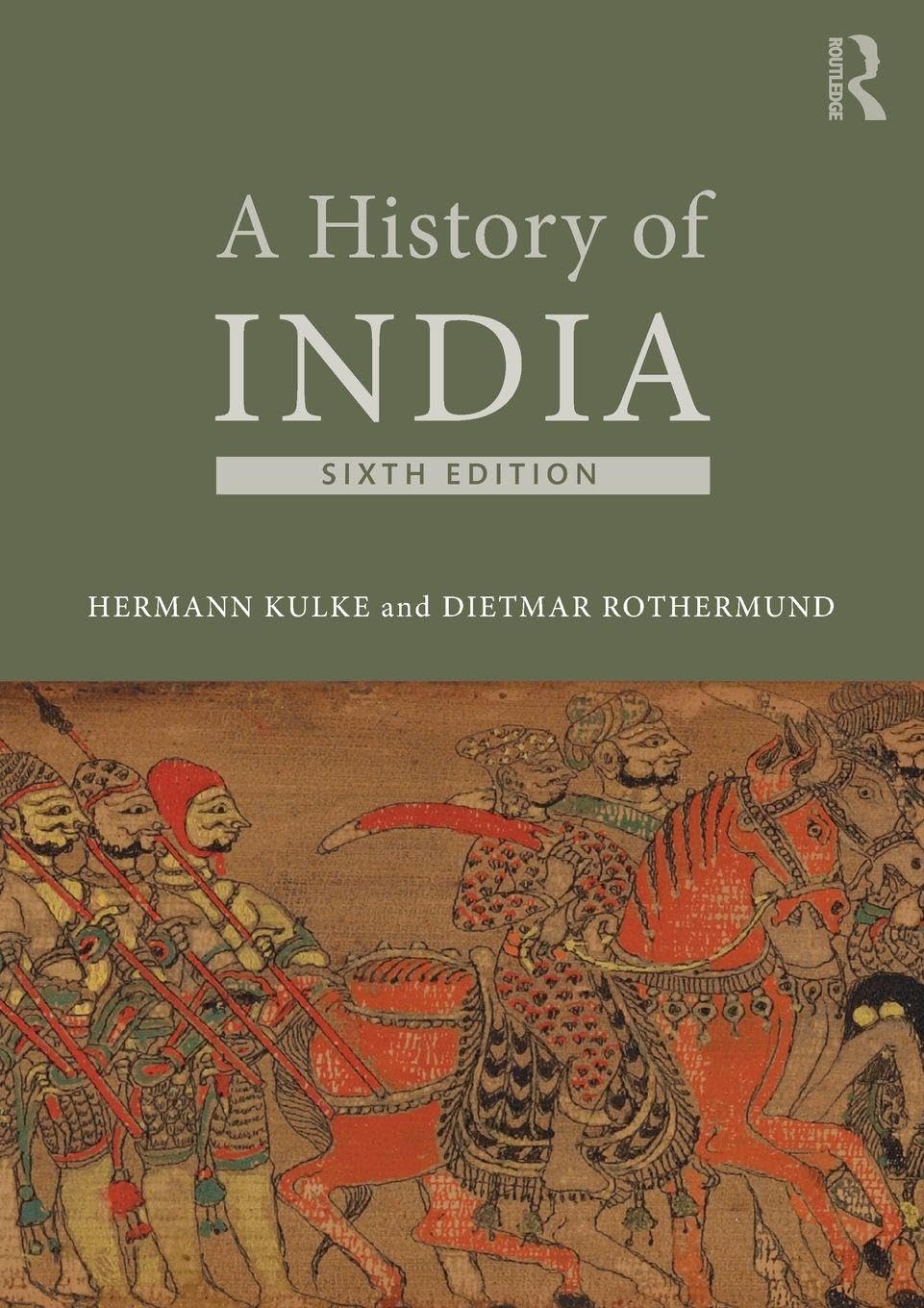
Description:
Editorial Reviews
Review
"This book is one of the few available examples of its kind that succeeds in presenting a broad scale approach to India's complex histories. It achieves this while combining a useful chronological framework with key themes covering not just political events, but also economic contexts, constitutional reform, and cultural transformations. In this sense it is of enormous value as both an introduction to India and as a reference point for those revisiting its politics, culture, society and economy."
William Gould, University of Leeds, UK
About the Author
Hermann Kulke is Professor Emeritus of Asian History at the University of Kiel. He is the author of Kings and Cults: State Formation and Legitimation in India and Southeast Asia (1993) and editor of The State in India 1000-1700 (1995). In 2010 he was awarded the the order of 'Padma Shri' by the Indian government.
Dietmar Rothermund is Professor Emeritus of History at the South Asian Institute, University of Heidelberg. His books include Contemporary India: Political, Economic and Social Developments since 1947 (2012), India: The Rise of an Asian Giant (2008), The Routledge Companion to Decolonization (2006), The Global Impact of the Great Depression, 1929-1939 (1996) and India in the Great Depression (1992).
Reviews:
5.0 out of 5 stars My favorite one-volume history of India
(function() { P.when('cr-A', 'ready').execute(function(A) { if(typeof A.toggleExpanderAriaLabel === 'function') { A.toggleExpanderAriaLabel('review_text_read_more', 'Read more of this review', 'Read less of this review'); } }); })(); .review-text-read-more-expander:focus-visible { outline: 2px solid #2162a1; outline-offset: 2px; border-radius: 5px; } This book is mercifully brief on the deconstruction of literary sources that South Asian area studies are prone to and (again quoting the on-target cover copy) "emphasises and analyses the structural pattern of Indian history." I wish it was longer than 335 pages.The first 2/3 of the book covers the pre-British period -- a good fraction. While relating more of the military viscitudes than I would like, there is some consideration of social, religious, and economic issues as well as ruling strategies. And the focus on 'great empires' is less than in most Indian histories, which is good since India has spent much more time disunited than united.Kulke and Rothermund break with the Hindu/Islamic/British periodization of Indian history, breaking periods before the Guptas and before the Mughals. All in all, it is a substantial improvement over Romila Thapar's effort, and a huge improvement over Stanley Wolpert's book.
4.0 out of 5 stars A very good general history of India
This book is a very good general history of India.Overall, the historical narrative is both lucid and captivating, with the different sections and chapters well connected in a cohesive way.Except for the eighth chapter (which is mostly narrative), historical patterns, concepts and issues are well explored beyond the historical narrative, e.g. religious and political patterns in Medieval India in the 3rd chapter, or the problem of administrative penetration plaguing the Delhi Sultanate in chapter 4. Economic, social and cultural developments are also discussed at length, e.g. the survey of the rise of modern Indian literature in regional languages with its common themes and social significance in chapter 6. At the same time, it is rather disappointing that there is almost no treatment of the content of the Upanishads or the Bhagavad Gita in the early chapters.The authors also go to great lengths to present the reader with the historiography and development of research and research-approaches and theses around major topics. The chronology as well as the glossary of Indian terms at the end of the book are both very helpful.In later chapters, as the authors cover periods in which international developments made the world "smaller" and more interrelated, they go beyond the Indian theater to thoroughly explore developments in other corners of the world - e.g. Portugal and the Netherlands in the 5th chapter - which affected it. And yet, I found the last two chapters, apparently updated for the sixth edition, to be of lesser quality than the previous ones. Separate discussion of internal and external political developments in the 8th chapter makes it very difficult to follow either, given the interdependence between the two. The discussion of the Kashmir issue, saved as the last item of the chapter and also encompassing the 2008 terror attacks in Mumbai , could have been much more profound and orderly.The summarizing chapter, named "Perspectives", was disappointingly far too short to capture the themes, patterns and lessons arising from the long sweep of Indian history presented throughout the book.Nevertheless, despite its faults that are unavoidable in such a broad general history of one of the world's oldest and greatest civilizations, I would highly recommend this book for any reader interested in gaining an introductory knowledge of Indian history.
3.0 out of 5 stars Challenging Book for the Casual Reader
Although this book provides a thorough and comprehensive rendition of the history of India, it is not for the casual traveler. Its verbage is very dense and reflects the sentence and vocabulary of non-native english speakers. Consequently, the intent of some sentences is difficult to discern immediately. It is a scholarly work but a challenge to plow through.
2.0 out of 5 stars Not for me
While this maybe a very scholarly book, it seemed to expect me to KNOW India's History and Geography BEFORE I even started to read it. The maps in the back are VERY small and would require a magnifying glass to see details.
Five Stars
(function() { P.when('cr-A', 'ready').execute(function(A) { if(typeof A.toggleExpanderAriaLabel === 'function') { A.toggleExpanderAriaLabel('review_text_read_more', 'Read more of this review', 'Read less of this review'); } }); })(); .review-text-read-more-expander:focus-visible { outline: 2px solid #2162a1; outline-offset: 2px; border-radius: 5px; } Loved the book.
summarized history of india, well written
well explained, interesting, summarized
Academic
A slim volume with a lot of information. The authors are German which helps to keep their minds clear and avoid letting emotions get in the way of facts.
Nice book
Nice book
A Book to Read.
An elaborate History Book.
Visit the Hermann Kulke (Author), Dietmar Rothermund (Author) Store
A History of India
AED31559
Quantity:
Order today to get by 7-14 business days
This item qualifies for free delivery
Imported From: United States
At BOLO, we work hard to ensure the products you receive are new, genuine, and sourced from reputable suppliers.
BOLO is not an authorized or official retailer for most brands, nor are we affiliated with manufacturers unless specifically stated on a product page. Instead, we source verified sellers, authorized distributors or directly from the manufacturer.
Each product undergoes thorough inspection and verification at our consolidation and fulfilment centers to ensure it meets our strict authenticity and quality standards before being shipped and delivered to you.
If you ever have concerns regarding the authenticity of a product purchased from us, please contact Bolo Support. We will review your inquiry promptly and, if necessary, provide documentation verifying authenticity or offer a suitable resolution.
Your trust is our top priority, and we are committed to maintaining transparency and integrity in every transaction.
All product information, images, descriptions, and reviews originate from the manufacturer or from trusted sellers overseas. BOLO is not affiliated with, endorsed by, or an authorized retailer for most brands listed on our website unless stated otherwise.
While we strive to display accurate information, variations in packaging, labeling, instructions, or formulation may occasionally occur due to regional differences or supplier updates. For detailed or manufacturer-specific information, please contact the brand directly or reach out to BOLO Support for assistance.
Unless otherwise stated, all prices displayed on the product page include applicable taxes and import duties.
BOLO operates in accordance with the laws and regulations of United Arab Emirates. Any items found to be restricted or prohibited for sale within the UAE will be cancelled prior to shipment. We take proactive measures to ensure that only products permitted for sale in United Arab Emirates are listed on our website.
All items are shipped by air, and any products classified as “Dangerous Goods (DG)” under IATA regulations will be removed from the order and cancelled.
All orders are processed manually, and we make every effort to process them promptly once confirmed. Products cancelled due to the above reasons will be permanently removed from listings across the website.
More from this brand
Similar items from “India”
Share with
Or share with link
https://www.bolo.ae/products/U1138961159
Visit the Hermann Kulke (Author), Dietmar Rothermund (Author) Store
A History of India

AED31559
Quantity:
Order today to get by 7-14 business days
This item qualifies for free delivery
Imported From: United States
At BOLO, we work hard to ensure the products you receive are new, genuine, and sourced from reputable suppliers.
BOLO is not an authorized or official retailer for most brands, nor are we affiliated with manufacturers unless specifically stated on a product page. Instead, we source verified sellers, authorized distributors or directly from the manufacturer.
Each product undergoes thorough inspection and verification at our consolidation and fulfilment centers to ensure it meets our strict authenticity and quality standards before being shipped and delivered to you.
If you ever have concerns regarding the authenticity of a product purchased from us, please contact Bolo Support. We will review your inquiry promptly and, if necessary, provide documentation verifying authenticity or offer a suitable resolution.
Your trust is our top priority, and we are committed to maintaining transparency and integrity in every transaction.
All product information, images, descriptions, and reviews originate from the manufacturer or from trusted sellers overseas. BOLO is not affiliated with, endorsed by, or an authorized retailer for most brands listed on our website unless stated otherwise.
While we strive to display accurate information, variations in packaging, labeling, instructions, or formulation may occasionally occur due to regional differences or supplier updates. For detailed or manufacturer-specific information, please contact the brand directly or reach out to BOLO Support for assistance.
Unless otherwise stated, all prices displayed on the product page include applicable taxes and import duties.
BOLO operates in accordance with the laws and regulations of United Arab Emirates. Any items found to be restricted or prohibited for sale within the UAE will be cancelled prior to shipment. We take proactive measures to ensure that only products permitted for sale in United Arab Emirates are listed on our website.
All items are shipped by air, and any products classified as “Dangerous Goods (DG)” under IATA regulations will be removed from the order and cancelled.
All orders are processed manually, and we make every effort to process them promptly once confirmed. Products cancelled due to the above reasons will be permanently removed from listings across the website.
Description:
Editorial Reviews
Review
"This book is one of the few available examples of its kind that succeeds in presenting a broad scale approach to India's complex histories. It achieves this while combining a useful chronological framework with key themes covering not just political events, but also economic contexts, constitutional reform, and cultural transformations. In this sense it is of enormous value as both an introduction to India and as a reference point for those revisiting its politics, culture, society and economy."
William Gould, University of Leeds, UK
About the Author
Hermann Kulke is Professor Emeritus of Asian History at the University of Kiel. He is the author of Kings and Cults: State Formation and Legitimation in India and Southeast Asia (1993) and editor of The State in India 1000-1700 (1995). In 2010 he was awarded the the order of 'Padma Shri' by the Indian government.
Dietmar Rothermund is Professor Emeritus of History at the South Asian Institute, University of Heidelberg. His books include Contemporary India: Political, Economic and Social Developments since 1947 (2012), India: The Rise of an Asian Giant (2008), The Routledge Companion to Decolonization (2006), The Global Impact of the Great Depression, 1929-1939 (1996) and India in the Great Depression (1992).
Reviews:
5.0 out of 5 stars My favorite one-volume history of India
(function() { P.when('cr-A', 'ready').execute(function(A) { if(typeof A.toggleExpanderAriaLabel === 'function') { A.toggleExpanderAriaLabel('review_text_read_more', 'Read more of this review', 'Read less of this review'); } }); })(); .review-text-read-more-expander:focus-visible { outline: 2px solid #2162a1; outline-offset: 2px; border-radius: 5px; } This book is mercifully brief on the deconstruction of literary sources that South Asian area studies are prone to and (again quoting the on-target cover copy) "emphasises and analyses the structural pattern of Indian history." I wish it was longer than 335 pages.The first 2/3 of the book covers the pre-British period -- a good fraction. While relating more of the military viscitudes than I would like, there is some consideration of social, religious, and economic issues as well as ruling strategies. And the focus on 'great empires' is less than in most Indian histories, which is good since India has spent much more time disunited than united.Kulke and Rothermund break with the Hindu/Islamic/British periodization of Indian history, breaking periods before the Guptas and before the Mughals. All in all, it is a substantial improvement over Romila Thapar's effort, and a huge improvement over Stanley Wolpert's book.
4.0 out of 5 stars A very good general history of India
This book is a very good general history of India.Overall, the historical narrative is both lucid and captivating, with the different sections and chapters well connected in a cohesive way.Except for the eighth chapter (which is mostly narrative), historical patterns, concepts and issues are well explored beyond the historical narrative, e.g. religious and political patterns in Medieval India in the 3rd chapter, or the problem of administrative penetration plaguing the Delhi Sultanate in chapter 4. Economic, social and cultural developments are also discussed at length, e.g. the survey of the rise of modern Indian literature in regional languages with its common themes and social significance in chapter 6. At the same time, it is rather disappointing that there is almost no treatment of the content of the Upanishads or the Bhagavad Gita in the early chapters.The authors also go to great lengths to present the reader with the historiography and development of research and research-approaches and theses around major topics. The chronology as well as the glossary of Indian terms at the end of the book are both very helpful.In later chapters, as the authors cover periods in which international developments made the world "smaller" and more interrelated, they go beyond the Indian theater to thoroughly explore developments in other corners of the world - e.g. Portugal and the Netherlands in the 5th chapter - which affected it. And yet, I found the last two chapters, apparently updated for the sixth edition, to be of lesser quality than the previous ones. Separate discussion of internal and external political developments in the 8th chapter makes it very difficult to follow either, given the interdependence between the two. The discussion of the Kashmir issue, saved as the last item of the chapter and also encompassing the 2008 terror attacks in Mumbai , could have been much more profound and orderly.The summarizing chapter, named "Perspectives", was disappointingly far too short to capture the themes, patterns and lessons arising from the long sweep of Indian history presented throughout the book.Nevertheless, despite its faults that are unavoidable in such a broad general history of one of the world's oldest and greatest civilizations, I would highly recommend this book for any reader interested in gaining an introductory knowledge of Indian history.
3.0 out of 5 stars Challenging Book for the Casual Reader
Although this book provides a thorough and comprehensive rendition of the history of India, it is not for the casual traveler. Its verbage is very dense and reflects the sentence and vocabulary of non-native english speakers. Consequently, the intent of some sentences is difficult to discern immediately. It is a scholarly work but a challenge to plow through.
2.0 out of 5 stars Not for me
While this maybe a very scholarly book, it seemed to expect me to KNOW India's History and Geography BEFORE I even started to read it. The maps in the back are VERY small and would require a magnifying glass to see details.
Five Stars
(function() { P.when('cr-A', 'ready').execute(function(A) { if(typeof A.toggleExpanderAriaLabel === 'function') { A.toggleExpanderAriaLabel('review_text_read_more', 'Read more of this review', 'Read less of this review'); } }); })(); .review-text-read-more-expander:focus-visible { outline: 2px solid #2162a1; outline-offset: 2px; border-radius: 5px; } Loved the book.
summarized history of india, well written
well explained, interesting, summarized
Academic
A slim volume with a lot of information. The authors are German which helps to keep their minds clear and avoid letting emotions get in the way of facts.
Nice book
Nice book
A Book to Read.
An elaborate History Book.
More from this brand
Similar items from “India”
Share with
Or share with link
https://www.bolo.ae/products/U1138961159