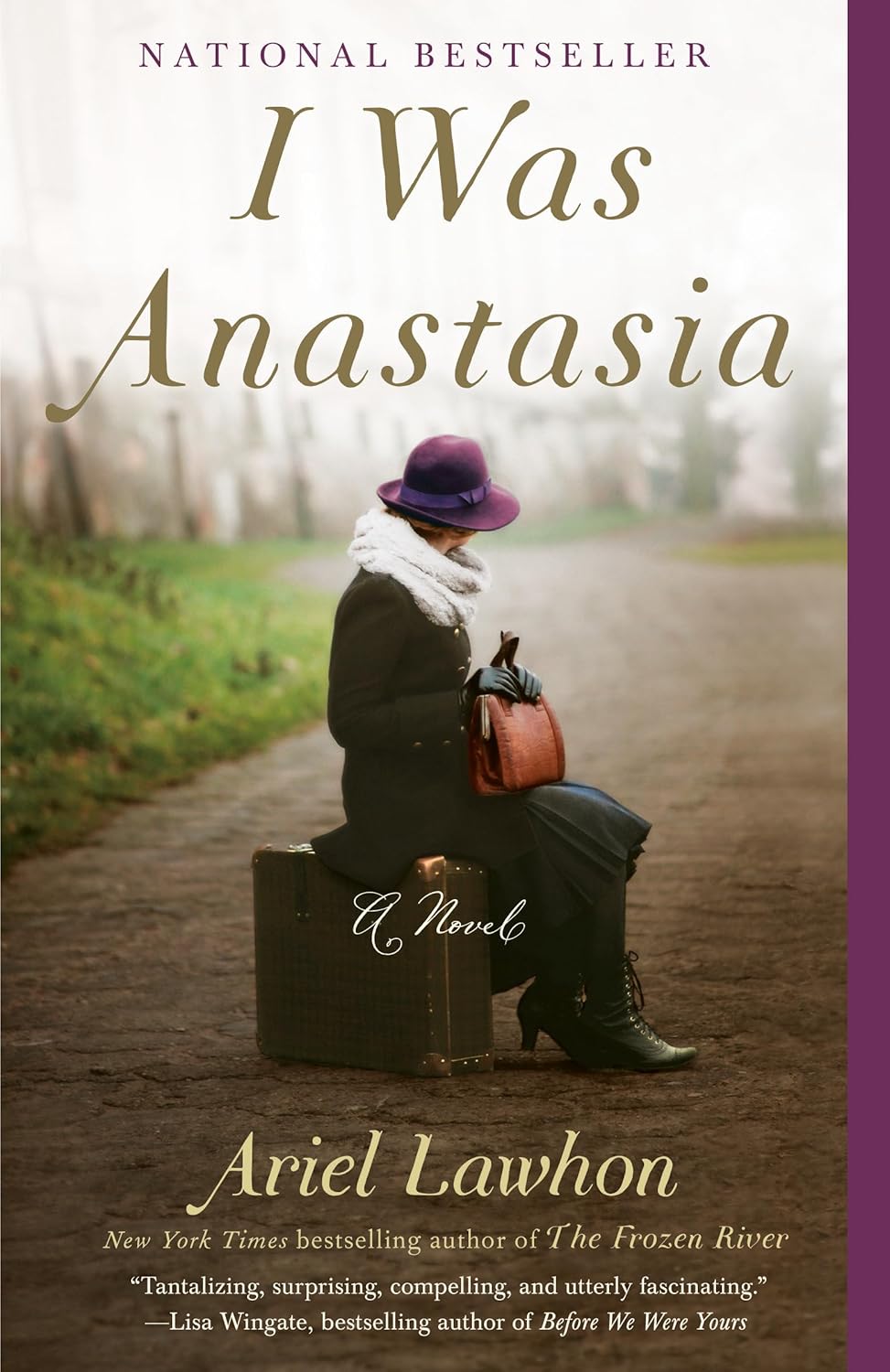
Description:
"Tantalizing, surprising, compelling, and utterly fascinating."—Lisa Wingate, #1 New York Times bestselling author of Before We Were Yours
Russia, July 17, 1918: Under direct orders from Vladimir Lenin, Bolshevik secret police force Anastasia Romanov, along with the entire imperial family, into a damp basement in Siberia, where they face a merciless firing squad. None survive. At least that is what the executioners have always claimed.
Germany, February 17, 1920: A young woman bearing an uncanny resemblance to Anastasia Romanov is pulled shivering and senseless from a canal. Refusing to explain her presence in the freezing water or even acknowledge her rescuers, she is taken to the hospital where an examination reveals that her body is riddled with countless horrific scars. When she finally does speak, this frightened, mysterious young woman claims to be the Russian grand duchess.
The questions swirling around Anna Anderson’s past and the mystery of Anastasia Romanov’s fate chart a saga that spans half a century and touches three continents. Every bit as vivid and climactic as it is poignant and enchanting, this novel brings a piece of legendary history to life.
Editorial Reviews
Review
—USA Today
"I Was Anastasia is a wild train trip through time. The doors swish open here, then there, scenes sometimes racing by, sometimes drifting far into the mysterious lives of Anastasia Romanov and Anna Anderson. Every view is tantalizing, surprising, compelling, and utterly fascinating. Ariel Lawhon unfolds a complicated story with skill, style, and compassion."
—Lisa Wingate, New York Times bestselling author of Before We Were Yours
"A young Tsarina traveling towards tragedy and an aging Grand Duchess penniless and betrayed. Twin stories so gripping you will believe history itself can be rewritten. Told with masterful intensity and moments of true human compassion."
—Helen Simonson, New York Times bestselling author of The Summer Before the War
"Ariel Lawhon is a masterful storyteller; I Was Anastasia is a wild ride, extravagant with its vivid sensory experiences and page turning suspense. Inspired by history, and infused with imagination and intrigue, this novel satisfies with every twist and turn. I was both captivated and enchanted; I will carry this story—from its beguiling opening to its catch-my-breath ending — in my heart and imagination for a long, long while."
—Patti Callahan Henry, New York Times bestselling author of Driftwood Summer and The Bookshop at Water's End
"The fate of the Grand Duchess Anastasia, youngest daughter of the last Tsar, is an old mystery that never gets old. In the hands of Ariel Lawhon, it springs to life again, challenging everything we believe about what we remember and who we are. Was Anna Anderson really the only survivor of the Romanovs or was she a persistent fraud? Somehow, Lawhon, a masterly writer, not only leads her readers to ponder this riddle, but to care about it as well. This is a deft and deeply moving saga."
—Jacquelyn Mitchard, New York Times bestselling author of The Deep End of the Ocean
"I don’t know what’s most impressive about I Was Anastasia: the wildly inventive structure, the ferocious heroine (or is it two?), or the dark, twisted questions it raises about the stories we tell—both to others and to ourselves. Ariel Lawhon has written a gorgeous, haunting puzzle of a book that will grip you until the final page."
—Karen Abbott, New York Times bestselling author of Sin in the Second City and Liar Temptress Soldier Spy
About the Author
Excerpt. © Reprinted by permission. All rights reserved.
ANNA
Folie à Deux
1970 & 1968
Charlottesville, Virginia, February 17, 1970
Fifty years ago tonight Anna threw herself off a bridge in Berlin. It wasn’t her first brush with death, or even the most violent, but it was the only one that came at her hands. Anna’s husband does not know this, however. She watches him, watching her, and she knows he only sees a fragile old woman who has waited too long for vindication. He sees the carefully cultivated image she presents to the world: a crown of thinning, silver hair and tired blue eyes. Age and confusion and the gentle aura of. This could not be further from the truth. She has been many things through the years but—even at seventy-four—helpless is not one of them. At the moment, however, Anna is simply impatient. She sits in this living room, two thousand miles from her past, waiting for a verdict.
Jack is like a frightened rabbit, all nerves and tension. He springs from his chair and begins to pace through the cluttered den. “Why haven’t they called? They should have called by now.”
“I’m sure they read the verdict hours ago,” Anna says, leaning her head against the fold of her wingback chair and closing her eyes.
Whatever news awaits them is not good but Anna does not have the heart to tell him this. Jack is so hopeful. He’s already written the press release and taken a polaroid so he can bring both to The Daily Progress first thing in the morning. Jack spoke with the editor this afternoon, suggesting they reserve a front-page spot for the story. He’s hoping for something above the fold. He’s hoping for exclamation points.
Even though Jack hasn’t admitted it, Anna knows that he is looking forward to reporters showing up again. They haven’t had any in months and she suspects he’s gotten lonely with only her and the animals for company. She feels a bit sad for him, being saddled with her like this. But there was no other way. Gleb insisted on it, and in all the years she knew him, Gleb Botkin remained her truest friend, her staunchest champion. He’s been dead two years now. Another loss in an unending string of losses. And Jack is kind to her—just as Gleb promised—and beggars can’t be choosers anyway. Anna reminds herself of this daily.
The phone rings. Three startling metallic alarms and then Jack snatches it from the cradle.
“Manahan residence.” A pause, and then, “yes, she’s here. Hold on a moment.” The cord won’t stretch across the room so Jack lays it on the sideboard. He grins wildly. “It’s from Germany.”
“Who?”
“The Prince.” He beams, then clarifies—there have been a number of princes in her life. “Frederick.”
Anna feels a wild stab of anger at the name. She hasn’t forgotten what Frederick did, hasn’t forgotten the burn pile behind her cottage at the edge of the Black Forest. All those charred little bones. If the news had come from anyone else she would take the call. “I don’t want to speak with him.”
“But—”
“He knows why.”
“I really think it’s time you—”
Anna holds her hand up, palm out, a firm, final sort of motion. “Take a message.”
Jack pouts but doesn’t protest. He knows that arguing is futile. Anna does not change her mind. Nor does she forgive. He picks up the receiver again. “I’m sorry. She doesn’t want to speak right now. Why don’t you give me the news?”
And then she watches Jack’s countenance fall by tiny, heartbreaking increments. First his smile. Then his lifted, expectant brows. His right arm drops to his side, deflated. “I don’t understand,” he says, finally, then clears his throat as though he’s swallowed a cobweb.
“Write it down,” Anna instructs. “Word for word.” She doesn’t want to interpret the verdict through his anger once he hangs up. Anna wants to know exactly what the appeals court has to say. Jack is too emotional and prone to exaggeration. He needs to transcribe it or vital bits of information will be lost the moment he hangs up. Gleb wouldn’t need this instruction. He would know what to do. He would know what questions to ask. But Gleb is no longer here and, once again this reality leaves her feeling adrift.
“Let me write this down,” Jack says, like it’s his idea. She watches him shuffle through piles of paper on the cluttered sideboard, looking for a notebook with blank pages. Finding none, he grabs an envelope and turns it over. “Go ahead. I’m ready.”
A decade ago Anna’s lawyer told her this lawsuit was the longest running case in German history. This appeal has stretched it into something worse, something interminable. And there stands Jack, writing the footnote to her quest on the back of their electric bill in his tidy, ever-legible script. “How do you spell that?” he asks at one point, holding the phone with one hand and recording the verdict with the other. He doesn’t rush or scribble but rather pens each word with painstaking precision, occasionally asking Frederick to repeat himself.
Jack and Anna don’t have many friends. They haven’t been married long, only two years, and theirs is a relationship based on convenience and necessity, not romance. They are old and eccentric and not fit for polite society in this quaint college town. But a handful of people—mostly former professors at the University of Virginia, like Jack—are due to arrive shortly. Anna doesn’t want to know how he convinced them to come. It would have been awkward before. It will be excruciating now. Anna decides there won’t be a party tonight. She doesn’t have the heart to entertain strangers this evening.
But Jack, in all his eagerness, has catered for a celebration. Their small den is littered with trays of fruit and sandwiches. Deviled eggs and cheese platters. Tiny brined pickles and cocktail sausages skewered with toothpicks. He even bought three bottles of champagne and they sit in a bowl of ice, unopened beneath the string of Christmas lights he’s stapled to the ceiling. Anna stares at the bottles with suspicion. She hasn’t touched the stuff in almost four decades. The last time Anna drank champagne she ended up naked on a rooftop in New York City.
The entire setting is tacky and festive—just like her husband. Jack bought a rhinestone tiara from the costume shop near the college campus just for the occasion. It sits on a gaudy red velvet pillow next to the champagne. He’s been dying to crown her since they met and only today, only in the hopes of a positive verdict, has she humored him. But that hope is gone now. Snuffed out in a German courtroom on the other side of the world.
“Thank you,” he finally says, and then lower, almost a whisper, “I will. I’m sorry. You know how it can be with her. I’m sure she’ll speak with you next time. Goodbye.”
When he turns back to Anna, Jack has the envelope pressed to his chest. He doesn’t speak.
“We need to call our guests and tell them the party’s cancelled.”
He looks crushed. “I’m so sorry.”
“This isn’t your fault. You did what you could.” A deep breath. A shrug. “What did Frederick say?”
“Your appeal was rejected. They won’t reverse the lower court’s ruling.”
“I gathered that. Tell mehis words exactly.”
Jack looks to the paper. “They regard your claim as a ‘non liquet.’”
“Interesting.”
“What does that mean?”
“‘Not clear’ or ‘not proven.’”
When Jack frowns, he puckers his mouth until his upper lip nearly touches his nose. It’s an odd, childish expression and one he’s used with greater frequency the longer he has known her. “Is that German?”
“Latin.”
“You know Latin?”
“Very little at this point.” Anna swats at him. “Go on.”
“The judges said that even though your death has never been proven, neither has your escape.”
“Ah. Clever.” She smiles at this dilemma. It is the ultimate Catch 22. Her escape can’t be proven without a formal declaration of identity from the court. “Read the rest please.”
He holds the envelope six inches from his nose and slowly recites the verdict. “‘We have not decided that the plaintiff is not Grand Duchess Anastasia, but only that the Hamburg court made it’s decision without legal mistakes and without procedural errors.’” He looks up. “So they have decided…nothing?”
She shakes her head slowly and then with more determination. “Oh they have decided everything, Jack.”
“It was that photo, wasn’t it? The court must have seen it. There’s no other reason they would rule against you. Damn that Rasputin. Damn her!” Jack begins to pace again. “We could make a statement—”
“No. It’s over.” Anna lifts her chin with all the dignity she can muster and folds her hands in her lap. She is resigned and regal. “They will never formally recognize me as Anastasia Romanov.”
Two Years Earlier
Charlottesville, Virginia, December 23, 1968
Anna does not want to marry Jack Manahan. She would rather marry Gleb. Even after all the trouble he’s caused through the years. But theirs is a story of false starts and near misses. Bad timing. Distance. And rash decisions. They were not meant to be. So Gleb has urged her to marry Jack instead. This whole fiasco is his idea—the courthouse, the silly pink dress, the bouquet of roses and pinecones, the white, rabbit fur hat that she’s supposed to wear out of the courthouse to greet the photographers (these arranged by Jack because the damnable man cannot help but make a scene everywhere he goes). Gleb insists the hat makes her look the part of Russian Grand Duchess. She refuses to wear the thing. Poor rabbit.
When they discussed this ridiculous plan in August, Gleb said his health was to blame, that he couldn’t marry her himself. He said that she would end up caring for him instead, but Anna believes that this is punishment for a long-held resentment. Tit for tat. Wound for wound. He has loved her for decades and she has never been able to fully reciprocate. Now he stands as witness to her unwilling nuptials. As best man, in fact.
It is snowing outside the courthouse. Not the angry, hard, blistering shards of snow she’s used to in Germany, but fat, lethargic flakes that drift and flutter and take their time getting to the ground. Lazy snow. American snow.
Anna’s had only a single a tryst since that limpid summer in Bavaria all those years ago, but Gleb moved on. Got married. Had children. They’ve never talked about the intervening years and it’s not worth bringing up now. Anna is seventy-two—too old to get married at all, much less for the first time. Jack Manahan is twenty years her junior. A former professor enamored with Russian history, with her—or, at least, the idea of her. Regardless, he hasn’t put up much of a fight since being presented with the plan. Jack’s only show of hesitation was a long, curious look at Gleb. Assessing his attachment and willingness to let Anna go.
It occurred to her, far too late into this arrangement, that she had not considered the issue of sex. Jack is young. Younger at least. And she is…well…she is not. The idea of consummation almost caused her to back out entirely. All of those hormones have shriveled up, turned to dust, and blown away. Desire is little more than a fond memory these days.
Gleb has taken care of that issue as well, however, assuring her that sex isn’t a necessary part of this bargain. She and Jack will have separate bedrooms. This will be a legal marriage, enough to keep her in the United States once her visa expires in three weeks, but it will be a marriage of convenience only. Gleb swore this, endless times, over what ended up being their last shared bottle of wine. Jack will not set a hand on her. Unless she wants him to. Why Gleb added that last part she isn’t sure. He wouldn’t meet her eyes as he said it and she said nothing in return. It was a small cruelty. This is how it is with them, apparently. Little wounds. Paper cuts. Just enough to sting but not really harm. Perhaps it’s best that they aren’t marrying one another after all.
Gleb slips into the antechamber beside the courtroom and surveys her tiny, slender form. “You look nice.”
He looks weary and pale and infirm. He’s lost weight recently and his once broad shoulders seem to have narrowed with illness and age. Anna wants to ask Gleb if his heart has gotten worse. But she’s afraid of what his answer might be. So she says. “I look ridiculous.”
“All brides look ridiculous. That’s why they’re so charming.”
Anna turns back to the window. It’s late afternoon, getting darker by the moment, and the overhead light bounces off the glass, throwing her reflection back at her. She touches a hand to her cheek. Traces one deep wrinkle after another, each of them telling a story she’s long since decided to cast into the sea of forgetfulness.
“I am too old for this,” she says.
“I know.”
“You admit it then?” She studies his reflection too, hovering over her shoulder. “But no apology I see.”
“It is this or you return to Germany,” he says. “We are out of time.”
“That always seems to be the case with us, doesn’t it?”
“Ships in the night,” he whispers and sets a large, warm hand on her shoulder. “Are you ready? Sergeant Pace is waiting. So is Jack.”
“Sergeant?”
“Judge Morris called in sick this morning.”
Anna turns to him and looks, not at his face, but at the knot in his tie. Stares at the red and blue alternating stripes on the fabric, those thin lines circling back on themselves, all twisted and turned around. She’s knotted up as well, but now, suddenly, it’s with mirth.
“I am to be married,” she asks, tilting her chin to meet those twinkling green eyes, “not by a priest, or a judge, but by a police officer?”
“It gives an entirely new meaning to being read your rights, doesn’t it?”
They laugh, then, long and loud. She turns back to the window and they stand in comfortable silence, watching Charlottesville disappear beneath the snow.
Finally Anna leans her head back against Gleb’s chest. “How did I get here?” Anna sighs, already knowing the answer. She has gotten here, she has survived, by always doing the thing that needs to be done.
Details:
Visit the Vintage Store
I Was Anastasia
AED7668
Quantity:
Order today to get by 7-14 business days
Delivery fee of AED 20. Free for orders above AED 200.
 Imported From: United States
At BOLO, we work hard to ensure the products you receive are new, genuine, and sourced from reputable suppliers.
Every product in the BOLO catalogue is sourced through our Verified Global Supply Network of verified sellers, authorized distributors or directly from the manufacturer.
Each product undergoes thorough inspection and verification at our consolidation and fulfilment centers to ensure it meets our strict authenticity and quality standards before being shipped and delivered to you.
If you ever have concerns regarding the authenticity of a product purchased from us, please contact Bolo Support. We will review your inquiry promptly and, if necessary, provide documentation verifying authenticity or offer a suitable resolution.
Your trust is our top priority, and we are committed to maintaining transparency and integrity in every transaction.
While we strive to display accurate information, variations in packaging, labeling, instructions, or formulation may occasionally occur due to regional differences or supplier updates. For detailed or manufacturer-specific information, please contact the brand directly or reach out to BOLO Support for assistance.
Unless otherwise stated, all prices displayed on the product page include applicable taxes and import duties.
BOLO operates in accordance with the laws and regulations of United Arab Emirates. Any items found to be restricted or prohibited for sale within the United Arab Emirates will be cancelled prior to shipment. We take proactive measures to ensure that only products permitted for sale in United Arab Emirates are listed on our website.
All items are shipped by air, and any products classified as “Dangerous Goods (DG)” under IATA regulations will be removed from the order and cancelled.
All orders are processed manually, and we make every effort to process them promptly once confirmed. Products cancelled due to the above reasons will be permanently removed from listings across the website.
Similar suggestions by Bolo
More from this brand
Similar items from “Biographical”
Share with
Or share with link
https://www.bolo.ae/products/U1101973315
Visit the Vintage Store
I Was Anastasia
AED7668
Quantity:
Order today to get by 7-14 business days
Delivery fee of AED 20. Free for orders above AED 200.
Imported From: United States
At BOLO, we work hard to ensure the products you receive are new, genuine, and sourced from reputable suppliers.
Every product in the BOLO catalogue is sourced through our Verified Global Supply Network of verified sellers, authorized distributors or directly from the manufacturer.
Each product undergoes thorough inspection and verification at our consolidation and fulfilment centers to ensure it meets our strict authenticity and quality standards before being shipped and delivered to you.
If you ever have concerns regarding the authenticity of a product purchased from us, please contact Bolo Support. We will review your inquiry promptly and, if necessary, provide documentation verifying authenticity or offer a suitable resolution.
Your trust is our top priority, and we are committed to maintaining transparency and integrity in every transaction.
While we strive to display accurate information, variations in packaging, labeling, instructions, or formulation may occasionally occur due to regional differences or supplier updates. For detailed or manufacturer-specific information, please contact the brand directly or reach out to BOLO Support for assistance.
Unless otherwise stated, all prices displayed on the product page include applicable taxes and import duties.
BOLO operates in accordance with the laws and regulations of United Arab Emirates. Any items found to be restricted or prohibited for sale within the United Arab Emirates will be cancelled prior to shipment. We take proactive measures to ensure that only products permitted for sale in United Arab Emirates are listed on our website.
All items are shipped by air, and any products classified as “Dangerous Goods (DG)” under IATA regulations will be removed from the order and cancelled.
All orders are processed manually, and we make every effort to process them promptly once confirmed. Products cancelled due to the above reasons will be permanently removed from listings across the website.
Description:
"Tantalizing, surprising, compelling, and utterly fascinating."—Lisa Wingate, #1 New York Times bestselling author of Before We Were Yours
Russia, July 17, 1918: Under direct orders from Vladimir Lenin, Bolshevik secret police force Anastasia Romanov, along with the entire imperial family, into a damp basement in Siberia, where they face a merciless firing squad. None survive. At least that is what the executioners have always claimed.
Germany, February 17, 1920: A young woman bearing an uncanny resemblance to Anastasia Romanov is pulled shivering and senseless from a canal. Refusing to explain her presence in the freezing water or even acknowledge her rescuers, she is taken to the hospital where an examination reveals that her body is riddled with countless horrific scars. When she finally does speak, this frightened, mysterious young woman claims to be the Russian grand duchess.
The questions swirling around Anna Anderson’s past and the mystery of Anastasia Romanov’s fate chart a saga that spans half a century and touches three continents. Every bit as vivid and climactic as it is poignant and enchanting, this novel brings a piece of legendary history to life.
Editorial Reviews
Review
—USA Today
"I Was Anastasia is a wild train trip through time. The doors swish open here, then there, scenes sometimes racing by, sometimes drifting far into the mysterious lives of Anastasia Romanov and Anna Anderson. Every view is tantalizing, surprising, compelling, and utterly fascinating. Ariel Lawhon unfolds a complicated story with skill, style, and compassion."
—Lisa Wingate, New York Times bestselling author of Before We Were Yours
"A young Tsarina traveling towards tragedy and an aging Grand Duchess penniless and betrayed. Twin stories so gripping you will believe history itself can be rewritten. Told with masterful intensity and moments of true human compassion."
—Helen Simonson, New York Times bestselling author of The Summer Before the War
"Ariel Lawhon is a masterful storyteller; I Was Anastasia is a wild ride, extravagant with its vivid sensory experiences and page turning suspense. Inspired by history, and infused with imagination and intrigue, this novel satisfies with every twist and turn. I was both captivated and enchanted; I will carry this story—from its beguiling opening to its catch-my-breath ending — in my heart and imagination for a long, long while."
—Patti Callahan Henry, New York Times bestselling author of Driftwood Summer and The Bookshop at Water's End
"The fate of the Grand Duchess Anastasia, youngest daughter of the last Tsar, is an old mystery that never gets old. In the hands of Ariel Lawhon, it springs to life again, challenging everything we believe about what we remember and who we are. Was Anna Anderson really the only survivor of the Romanovs or was she a persistent fraud? Somehow, Lawhon, a masterly writer, not only leads her readers to ponder this riddle, but to care about it as well. This is a deft and deeply moving saga."
—Jacquelyn Mitchard, New York Times bestselling author of The Deep End of the Ocean
"I don’t know what’s most impressive about I Was Anastasia: the wildly inventive structure, the ferocious heroine (or is it two?), or the dark, twisted questions it raises about the stories we tell—both to others and to ourselves. Ariel Lawhon has written a gorgeous, haunting puzzle of a book that will grip you until the final page."
—Karen Abbott, New York Times bestselling author of Sin in the Second City and Liar Temptress Soldier Spy
About the Author
Excerpt. © Reprinted by permission. All rights reserved.
ANNA
Folie à Deux
1970 & 1968
Charlottesville, Virginia, February 17, 1970
Fifty years ago tonight Anna threw herself off a bridge in Berlin. It wasn’t her first brush with death, or even the most violent, but it was the only one that came at her hands. Anna’s husband does not know this, however. She watches him, watching her, and she knows he only sees a fragile old woman who has waited too long for vindication. He sees the carefully cultivated image she presents to the world: a crown of thinning, silver hair and tired blue eyes. Age and confusion and the gentle aura of. This could not be further from the truth. She has been many things through the years but—even at seventy-four—helpless is not one of them. At the moment, however, Anna is simply impatient. She sits in this living room, two thousand miles from her past, waiting for a verdict.
Jack is like a frightened rabbit, all nerves and tension. He springs from his chair and begins to pace through the cluttered den. “Why haven’t they called? They should have called by now.”
“I’m sure they read the verdict hours ago,” Anna says, leaning her head against the fold of her wingback chair and closing her eyes.
Whatever news awaits them is not good but Anna does not have the heart to tell him this. Jack is so hopeful. He’s already written the press release and taken a polaroid so he can bring both to The Daily Progress first thing in the morning. Jack spoke with the editor this afternoon, suggesting they reserve a front-page spot for the story. He’s hoping for something above the fold. He’s hoping for exclamation points.
Even though Jack hasn’t admitted it, Anna knows that he is looking forward to reporters showing up again. They haven’t had any in months and she suspects he’s gotten lonely with only her and the animals for company. She feels a bit sad for him, being saddled with her like this. But there was no other way. Gleb insisted on it, and in all the years she knew him, Gleb Botkin remained her truest friend, her staunchest champion. He’s been dead two years now. Another loss in an unending string of losses. And Jack is kind to her—just as Gleb promised—and beggars can’t be choosers anyway. Anna reminds herself of this daily.
The phone rings. Three startling metallic alarms and then Jack snatches it from the cradle.
“Manahan residence.” A pause, and then, “yes, she’s here. Hold on a moment.” The cord won’t stretch across the room so Jack lays it on the sideboard. He grins wildly. “It’s from Germany.”
“Who?”
“The Prince.” He beams, then clarifies—there have been a number of princes in her life. “Frederick.”
Anna feels a wild stab of anger at the name. She hasn’t forgotten what Frederick did, hasn’t forgotten the burn pile behind her cottage at the edge of the Black Forest. All those charred little bones. If the news had come from anyone else she would take the call. “I don’t want to speak with him.”
“But—”
“He knows why.”
“I really think it’s time you—”
Anna holds her hand up, palm out, a firm, final sort of motion. “Take a message.”
Jack pouts but doesn’t protest. He knows that arguing is futile. Anna does not change her mind. Nor does she forgive. He picks up the receiver again. “I’m sorry. She doesn’t want to speak right now. Why don’t you give me the news?”
And then she watches Jack’s countenance fall by tiny, heartbreaking increments. First his smile. Then his lifted, expectant brows. His right arm drops to his side, deflated. “I don’t understand,” he says, finally, then clears his throat as though he’s swallowed a cobweb.
“Write it down,” Anna instructs. “Word for word.” She doesn’t want to interpret the verdict through his anger once he hangs up. Anna wants to know exactly what the appeals court has to say. Jack is too emotional and prone to exaggeration. He needs to transcribe it or vital bits of information will be lost the moment he hangs up. Gleb wouldn’t need this instruction. He would know what to do. He would know what questions to ask. But Gleb is no longer here and, once again this reality leaves her feeling adrift.
“Let me write this down,” Jack says, like it’s his idea. She watches him shuffle through piles of paper on the cluttered sideboard, looking for a notebook with blank pages. Finding none, he grabs an envelope and turns it over. “Go ahead. I’m ready.”
A decade ago Anna’s lawyer told her this lawsuit was the longest running case in German history. This appeal has stretched it into something worse, something interminable. And there stands Jack, writing the footnote to her quest on the back of their electric bill in his tidy, ever-legible script. “How do you spell that?” he asks at one point, holding the phone with one hand and recording the verdict with the other. He doesn’t rush or scribble but rather pens each word with painstaking precision, occasionally asking Frederick to repeat himself.
Jack and Anna don’t have many friends. They haven’t been married long, only two years, and theirs is a relationship based on convenience and necessity, not romance. They are old and eccentric and not fit for polite society in this quaint college town. But a handful of people—mostly former professors at the University of Virginia, like Jack—are due to arrive shortly. Anna doesn’t want to know how he convinced them to come. It would have been awkward before. It will be excruciating now. Anna decides there won’t be a party tonight. She doesn’t have the heart to entertain strangers this evening.
But Jack, in all his eagerness, has catered for a celebration. Their small den is littered with trays of fruit and sandwiches. Deviled eggs and cheese platters. Tiny brined pickles and cocktail sausages skewered with toothpicks. He even bought three bottles of champagne and they sit in a bowl of ice, unopened beneath the string of Christmas lights he’s stapled to the ceiling. Anna stares at the bottles with suspicion. She hasn’t touched the stuff in almost four decades. The last time Anna drank champagne she ended up naked on a rooftop in New York City.
The entire setting is tacky and festive—just like her husband. Jack bought a rhinestone tiara from the costume shop near the college campus just for the occasion. It sits on a gaudy red velvet pillow next to the champagne. He’s been dying to crown her since they met and only today, only in the hopes of a positive verdict, has she humored him. But that hope is gone now. Snuffed out in a German courtroom on the other side of the world.
“Thank you,” he finally says, and then lower, almost a whisper, “I will. I’m sorry. You know how it can be with her. I’m sure she’ll speak with you next time. Goodbye.”
When he turns back to Anna, Jack has the envelope pressed to his chest. He doesn’t speak.
“We need to call our guests and tell them the party’s cancelled.”
He looks crushed. “I’m so sorry.”
“This isn’t your fault. You did what you could.” A deep breath. A shrug. “What did Frederick say?”
“Your appeal was rejected. They won’t reverse the lower court’s ruling.”
“I gathered that. Tell mehis words exactly.”
Jack looks to the paper. “They regard your claim as a ‘non liquet.’”
“Interesting.”
“What does that mean?”
“‘Not clear’ or ‘not proven.’”
When Jack frowns, he puckers his mouth until his upper lip nearly touches his nose. It’s an odd, childish expression and one he’s used with greater frequency the longer he has known her. “Is that German?”
“Latin.”
“You know Latin?”
“Very little at this point.” Anna swats at him. “Go on.”
“The judges said that even though your death has never been proven, neither has your escape.”
“Ah. Clever.” She smiles at this dilemma. It is the ultimate Catch 22. Her escape can’t be proven without a formal declaration of identity from the court. “Read the rest please.”
He holds the envelope six inches from his nose and slowly recites the verdict. “‘We have not decided that the plaintiff is not Grand Duchess Anastasia, but only that the Hamburg court made it’s decision without legal mistakes and without procedural errors.’” He looks up. “So they have decided…nothing?”
She shakes her head slowly and then with more determination. “Oh they have decided everything, Jack.”
“It was that photo, wasn’t it? The court must have seen it. There’s no other reason they would rule against you. Damn that Rasputin. Damn her!” Jack begins to pace again. “We could make a statement—”
“No. It’s over.” Anna lifts her chin with all the dignity she can muster and folds her hands in her lap. She is resigned and regal. “They will never formally recognize me as Anastasia Romanov.”
Two Years Earlier
Charlottesville, Virginia, December 23, 1968
Anna does not want to marry Jack Manahan. She would rather marry Gleb. Even after all the trouble he’s caused through the years. But theirs is a story of false starts and near misses. Bad timing. Distance. And rash decisions. They were not meant to be. So Gleb has urged her to marry Jack instead. This whole fiasco is his idea—the courthouse, the silly pink dress, the bouquet of roses and pinecones, the white, rabbit fur hat that she’s supposed to wear out of the courthouse to greet the photographers (these arranged by Jack because the damnable man cannot help but make a scene everywhere he goes). Gleb insists the hat makes her look the part of Russian Grand Duchess. She refuses to wear the thing. Poor rabbit.
When they discussed this ridiculous plan in August, Gleb said his health was to blame, that he couldn’t marry her himself. He said that she would end up caring for him instead, but Anna believes that this is punishment for a long-held resentment. Tit for tat. Wound for wound. He has loved her for decades and she has never been able to fully reciprocate. Now he stands as witness to her unwilling nuptials. As best man, in fact.
It is snowing outside the courthouse. Not the angry, hard, blistering shards of snow she’s used to in Germany, but fat, lethargic flakes that drift and flutter and take their time getting to the ground. Lazy snow. American snow.
Anna’s had only a single a tryst since that limpid summer in Bavaria all those years ago, but Gleb moved on. Got married. Had children. They’ve never talked about the intervening years and it’s not worth bringing up now. Anna is seventy-two—too old to get married at all, much less for the first time. Jack Manahan is twenty years her junior. A former professor enamored with Russian history, with her—or, at least, the idea of her. Regardless, he hasn’t put up much of a fight since being presented with the plan. Jack’s only show of hesitation was a long, curious look at Gleb. Assessing his attachment and willingness to let Anna go.
It occurred to her, far too late into this arrangement, that she had not considered the issue of sex. Jack is young. Younger at least. And she is…well…she is not. The idea of consummation almost caused her to back out entirely. All of those hormones have shriveled up, turned to dust, and blown away. Desire is little more than a fond memory these days.
Gleb has taken care of that issue as well, however, assuring her that sex isn’t a necessary part of this bargain. She and Jack will have separate bedrooms. This will be a legal marriage, enough to keep her in the United States once her visa expires in three weeks, but it will be a marriage of convenience only. Gleb swore this, endless times, over what ended up being their last shared bottle of wine. Jack will not set a hand on her. Unless she wants him to. Why Gleb added that last part she isn’t sure. He wouldn’t meet her eyes as he said it and she said nothing in return. It was a small cruelty. This is how it is with them, apparently. Little wounds. Paper cuts. Just enough to sting but not really harm. Perhaps it’s best that they aren’t marrying one another after all.
Gleb slips into the antechamber beside the courtroom and surveys her tiny, slender form. “You look nice.”
He looks weary and pale and infirm. He’s lost weight recently and his once broad shoulders seem to have narrowed with illness and age. Anna wants to ask Gleb if his heart has gotten worse. But she’s afraid of what his answer might be. So she says. “I look ridiculous.”
“All brides look ridiculous. That’s why they’re so charming.”
Anna turns back to the window. It’s late afternoon, getting darker by the moment, and the overhead light bounces off the glass, throwing her reflection back at her. She touches a hand to her cheek. Traces one deep wrinkle after another, each of them telling a story she’s long since decided to cast into the sea of forgetfulness.
“I am too old for this,” she says.
“I know.”
“You admit it then?” She studies his reflection too, hovering over her shoulder. “But no apology I see.”
“It is this or you return to Germany,” he says. “We are out of time.”
“That always seems to be the case with us, doesn’t it?”
“Ships in the night,” he whispers and sets a large, warm hand on her shoulder. “Are you ready? Sergeant Pace is waiting. So is Jack.”
“Sergeant?”
“Judge Morris called in sick this morning.”
Anna turns to him and looks, not at his face, but at the knot in his tie. Stares at the red and blue alternating stripes on the fabric, those thin lines circling back on themselves, all twisted and turned around. She’s knotted up as well, but now, suddenly, it’s with mirth.
“I am to be married,” she asks, tilting her chin to meet those twinkling green eyes, “not by a priest, or a judge, but by a police officer?”
“It gives an entirely new meaning to being read your rights, doesn’t it?”
They laugh, then, long and loud. She turns back to the window and they stand in comfortable silence, watching Charlottesville disappear beneath the snow.
Finally Anna leans her head back against Gleb’s chest. “How did I get here?” Anna sighs, already knowing the answer. She has gotten here, she has survived, by always doing the thing that needs to be done.
Details:
Similar suggestions by Bolo
More from this brand
Similar items from “Biographical”
Share with
Or share with link
https://www.bolo.ae/products/U1101973315