Description:
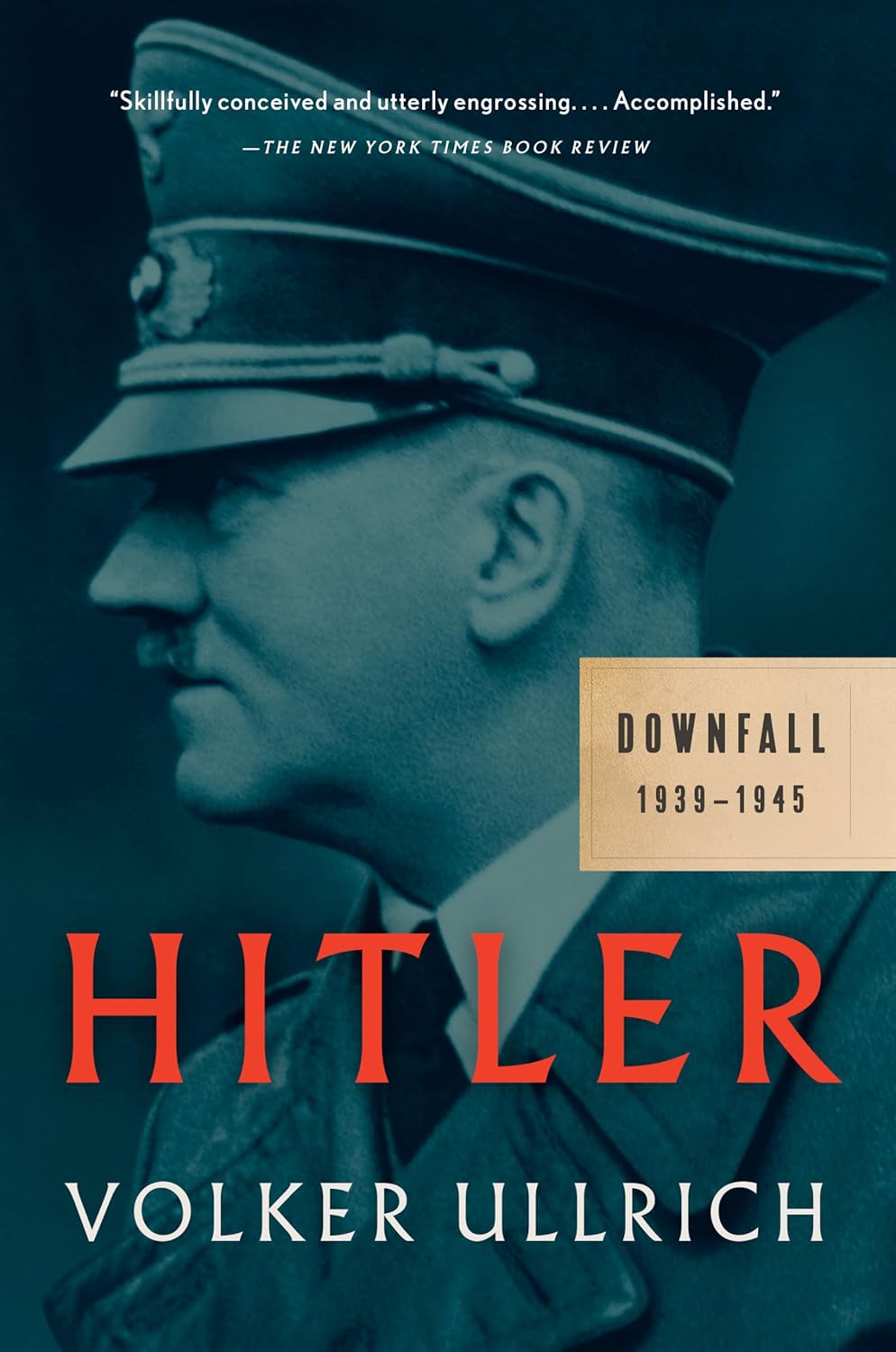
“Skillfully conceived and utterly engrossing.” —The New York Times Book Review
In the summer of 1939, Hitler was at the zenith of his power. Having consolidated political control in Germany, he was at the helm of a newly restored major world power, and now perfectly positioned to realize his lifelong ambition: to help the German people flourish and to exterminate those who stood in the way. Beginning a war allowed Hitler to take his ideological obsessions to unthinkable extremes, including the mass genocide of millions, which was conducted not only with the aid of the SS, but with the full knowledge of German leadership. Yet despite a series of stunning initial triumphs, Hitler’s fateful decision to invade the Soviet Union in 1941 turned the tide of the war in favor of the Allies.
Now, Volker Ullrich, author of Hitler: Ascent 1889–1939, offers fascinating new insight into Hitler’s character and personality. He vividly portrays the insecurity, obsession with minutiae, and narcissistic penchant for gambling that led Hitler to overrule his subordinates and then blame them for his failures. When he ultimately realized the war was not winnable, Hitler embarked on the annihilation of Germany itself in order to punish the people who he believed had failed to hand him victory. A masterful and riveting account of a spectacular downfall, Ullrich’s rendering of Hitler’s final years is an essential addition to our understanding of the dictator and the course of the Second World War.
Review
“The impulsiveness and grandiosity, the bullying and vulgarity, were obvious from the beginning; if anything, they accounted for Adolf Hitler’s anti-establishment appeal. . . . Ullrich argues that the very qualities that accounted for the dictator’s astonishing rise were also what brought about his ultimate ruin.” —New York Times
“Ullrich’s work is much more than just a biography. It is a work of synthesis, certainly, but a thorough and thoroughly readable one nonetheless, which stands muster alongside Hitler’s most significant earlier biographers: Bullock, Toland, Fest and Kershaw. Elegantly written, engaging and insightful, [Hitler] is a new standard work on its subject.” —BBC History
“The reader who plunges in is rewarded with insight, understanding, fine judgements and read-me narrative drive. [Ullrich’s] biography of Hitler makes essential reading . . . deeply researched, beautifully written and finely judged.” —Daily Mail
“Smoothly written and splendidly translated, Ullrich’s book gives us a Hitler we have not seen before, at once cold-blooded and idealistic, chillingly narcissistic and cloyingly sentimental. . . . Probably the most disturbing portrait of Hitler I have ever read.” —The Sunday Times
“Ullrich’s work is a remarkable treatise on the malevolence of power in modern times. Take care, lest we fall into the trap of autocracy.” —New York Journal of Books
"Magisterial. . . . Lucidly formulated for a new generation of readers and scholars."
—Library Journal
“An endlessly revealing look at the Nazi regime that touches on large issues and small details alike.” —Kirkus (starred)
About the Author
Excerpt. © Reprinted by permission. All rights reserved.
“Hitler As Human Being”
Excerpt (pgs. 382-386)
As a rule, people who got a close look at the Führer for the first time were rarely impressed. After a meeting with Hitler in December 1931, the industrialist Günther Quandt deemed him the very definition of average. Sefton Delmer described him as an everyday person reminiscent of a travelling salesman or a junior officer. As we saw, the American reporter Dorothy Thompson called Hitler the exact prototype of the little man on the street. William Shirer, the correspondent for America’s Universal News Service, also came away disappointed after seeing Hitler in September 1934 at the Nuremberg rally. “His face,” Shirer wrote in his diary, “had no particular expression at all—I expected it to be stronger—and for the life of me I could not quite comprehend what hidden springs he undoubtedly unloosened in the hysterical mob which was greeting him so wildly.”
Hitler’s appearance was hardly winning. Finance Minister von Krosigk, who met Hitler for the first time when the new chancellor was sworn in on 30 January 1933, recalled the Führer’s face as being unremarkable. “There was nothing harmonious about his features, nor did they have the irregularity that expresses individual human spirit,” Krosigk wrote. “A lock of hair that flopped down over his forehead and the rudiments of a moustache only two fingers wide gave his appearance something comic.” Hitler’s moustache was the feature that everyone noticed. Early on, Hanfstaengl had urged him to shave it off, arguing that it was fodder for caricaturists. “My moustache will be all the rage one day—you can bet on that,” Hitler replied. Around 1925 or 1926 he told Adelheid Klein, a friend in Munich: “Imagine my face without the moustache! . . . My nose is much too big. I have to soften it with the moustache!” Indeed, Hitler’s large, fleshy nose was rather disproportionate to the rest of his face. Klaus Mann called it the “most foul and most characteristic” aspect of Hitler’s physiognomy. For his part Albert Speer claimed that he only noticed how ugly and disproportionate Hitler’s face was in the final months of the Third Reich, when the Führer’s appeal was declining. “How did I not notice that in all the years?” he wondered in his Spandau prison cell in late November 1946. “Curious!”
Almost everyone who came into contact with Hitler was struck by another feature. Upon seeing the young Hitler for the first time in 1919, Karl Alexander von Müller immediately noted his “large, light-blue, fanatically and coldly gleaming eyes.” Lieselotte Schmidt, an assistant and nanny to Winifred Wagner, had a different impression. Like her mistress, she admired Hitler and found that his eyes shone with goodness and warmth. “One glance from his lovely violet-blue eyes was enough to sense his gentle temperament and good heart,” Schmidt said in 1929. Otto Wagener, the economic adviser who entered Hitler’s service that same year and still professed his admiration of the Führer in a British POW camp in 1946, recalled:
From the first moment, his eyes captivated me. They were clear and large and calm. He stared at me full of self-confidence. But his gaze did not come from his eyeballs. On the contrary, I felt it came from somewhere far deeper, from infinity. You could read nothing in his eyes. But they spoke and wanted to say something.
Christa Schroeder, one of Hitler’s secretaries from 1933 onwards, was somewhat more sober: “I found Hitler’s eyes very expressive. They looked interested and probing and always became more animated whenever he spoke.” The playwright Gerhart Hauptmann also noted Hitler’s “strange and lovely eyes” after meeting the Führer at the inauguration of the Reich Culture Chamber in November 1933.
Whether people perceived Hitler’s gaze as cold or benevolent, impenetrable or friendly and inquisitive depended both on the given situation and their political views. “What admirers praise as the power of his eyes strikes neutral observers as a greedy stare without that hint of decency that makes a gaze truly compelling,” wrote the Hitler detractor Konrad Heiden. “His gaze repels more than it captivates.”
But even critical observers sometimes praised his eyes. “Hitler’s eyes were startling and unforgettable,” wrote Martha Dodd, the daughter of the U.S. ambassador to Germany, William Edward Dodd, after being introduced to Hitler by Hanfstaengl in 1933. “They seemed pale blue in colour, were intense, unwavering, hypnotic.”
Alongside his eyes, Hitler’s hands attracted the most attention. “So expressive in their movements as to compete with the eyes” was how Houston Stewart Chamberlain put it in a fawning letter to Hitler in 1923. For Krosigk, Hitler’s hands were nervous, delicate and “almost feminine.” In 1933, when the philosopher Karl Jaspers voiced doubts as to whether someone as uneducated as Hitler could lead Germany, his colleague Martin Heidegger replied: “Education is irrelevant . . . just look at those lovely hands.” Many of Heidegger’s contemporaries shared his admiration for the Führer’s hands. In an article for the December 1936 edition of New Literature, the head of German radio characterised Hitler’s delicate hands as being the tools of an “artist and great creator.” And in October 1942, while imprisoned in a British POW camp, General Ludwig Crüwell opined: “His hands are truly striking—lovely hands . . . He’s got the hands of an artist. My eyes were always drawn to his hands.”
But more impressive than his eyes and hands was Hitler’s talent for speaking. His appearance may have made him seem average and everyday, but as soon as he took to the stage, he was transformed into a demagogue the likes of which Germany had never known. Admirers and detractors were in absolute agreement on this point. In his essay “Brother Hitler,” Thomas Mann attributed Hitler’s rise to his “eloquence, which although unspeakably base, has huge sway over the masses.” Heiden wrote of “an incomparable barometer of mass moods,” while Otto Strasser spoke of an “unusually sensitive seismograph of the soul.” Strasser also compared Hitler to a “membrane” broadcasting the most secret longings and emotions of the masses. Krosigk concurred. “He sensed what the masses were longing for and translated it into firebrand slogans,” the Reich finance minister wrote. “He appealed to the instincts slumbering in people’s unconsciousness and offered something to everyone.” The American journalist Hubert R. Knickerbocker, who had encountered Hitler as a seemingly polite, small-time politician in the NSDAP’s Munich headquarters in 1931, was astonished by a public appearance that same evening. “He was an evangelist speaking at a tent meeting, the Billy Sunday of German politics,” the Pulitzer Prize winner wrote. “Those he had converted followed him, laughed with him, felt with him. Together they mocked the French. Together they hissed off the Republic. Eight thousand people became one instrument on which Hitler played his symphony of national passion.” As Knickerbocker realised, the secret to Hitler’s success lay in the mutual identification between speaker and audience—in the exchange of individual and collective sensitivities and neuroses.
It was not only the faithful whom Hitler managed to put under his spell. “There won’t be anyone like him for quite some time,” Rudolf Hess wrote in 1924 while imprisoned in Landsberg, “a man who can sweep away both the most left-wing lathe operator and the right-wing government official in a single mass event.” Hess’s view was no exaggeration. Numerous contemporaries who rejected Hitler and his party struggled to resist the lure of Hitler’s overwhelming rhetoric—indeed, some succumbed to it. In his memoirs, the historian Golo Mann described the impression a Hitler speech made on him as a 19-year-old student in the autumn of 1928. “I had to steel myself against the energy and persuasive force of the speaker,” Mann wrote. “A Jewish friend of mine, whom I had brought along, was unable to resist. ‘He’s right,’ he whispered in my ear. How many times had I heard this phrase ‘He’s right’ uttered by listeners from whom I would have least expected it?”
Hitler’s talent for persuasive oration gave him a hypnotic sway over crowds. Part of his secret was his unusually powerful and variable voice. “Those who only know Hitler from the events of later years, after he had mutated into an immoderately thundering dictator and demagogue at the microphone, have no idea what a flexible and mellifluous instrument his natural, non-amplified voice was in the early years of his political career,” noted Hanfstaengl. It was Hitler’s voice, at a speech in Weimar in March 1925, that won over Baldur von Schirach, later the Nazis’ Reich youth leader, at the age of 18. “It was a voice unlike any other I had heard from a public speaker,” Schirach recalled. “It was deep and rough, resonant as a cello. His accent, which we thought was Austrian but was actually Lower Bavarian, was alien to central Germany and compelled you to listen.” he called himself the greatest actor in Europe,” Krosigk recalled. That statement was one of the excessive flights of fancy to which the dictator became increasingly prone in his later years. Nonetheless, Hitler had an undeniable ability to don different masks to suit various occasions and to inhabit changing roles. “He could be a charming conversation partner who kissed women’s hands, a friendly uncle who gave children chocolate, or a man of the people who could shake the callused hands of farmers and artisans,” remarked Albert Krebs, the Gauleiter of Hamburg. When invited to the Bechstein and Bruckmann salons or to afternoon tea at the Schirachs’ in Weimar, he would play the upstanding, suit-and-tie-wearing bourgeois to fit in with such social settings. At NSDAP party conferences, he dressed in a brown shirt and cast himself as a prototypical street fighter who made no secret of his contempt for polite society.
Hitler adapted his speeches to people’s expectations. In front of the Reichstag, he talked like a wise statesman. When he spoke to a circle of industrialists he was a man of moderation. To women he was the good-humoured father who loved children, while in front of large crowds he was a fiery volcano. To his fellow party members he was the truest and bravest soldier who sacrificed himself and was therefore allowed to demand sacrifices of others. André François-Poncet, who witnessed Hitler’s various appearances at the Nuremberg rally in 1935, was impressed by the Führer’s ability to intuit the mood of each given audience. “He found the words and tone he needed for all of them,” the French ambassador remarked. “He ran the gamut from biting to melodramatic to intimate and lordly.” The man who succeeded François-Poncet in 1938, Robert Coulondre, was also surprised by the man he met at the Berghof retreat when he presented his letter of credence in November. “I was expecting a thundering Jove in his castle and what I got was a simple, gentle, possibly shy man in his country home,” Coulondre reported. “I had heard the rough, screaming, threatening and demanding voice of the Führer on the radio. Now I became acquainted with a Hitler who had a warm, calm, friendly and understanding voice. Which one is the true Hitler? Or are they both true?”
Details:
Visit the Vintage Store
Hitler: Downfall: 1939-1945
AED22574
Quantity:
Order today to get by 7-14 business days
This item qualifies for free delivery
 Imported From: United States
At BOLO, we work hard to ensure the products you receive are new, genuine, and sourced from reputable suppliers.
Every product in the BOLO catalogue is sourced through our Verified Global Supply Network of verified sellers, authorized distributors or directly from the manufacturer.
Each product undergoes thorough inspection and verification at our consolidation and fulfilment centers to ensure it meets our strict authenticity and quality standards before being shipped and delivered to you.
If you ever have concerns regarding the authenticity of a product purchased from us, please contact Bolo Support. We will review your inquiry promptly and, if necessary, provide documentation verifying authenticity or offer a suitable resolution.
Your trust is our top priority, and we are committed to maintaining transparency and integrity in every transaction.
While we strive to display accurate information, variations in packaging, labeling, instructions, or formulation may occasionally occur due to regional differences or supplier updates. For detailed or manufacturer-specific information, please contact the brand directly or reach out to BOLO Support for assistance.
Unless otherwise stated, all prices displayed on the product page include applicable taxes and import duties.
BOLO operates in accordance with the laws and regulations of United Arab Emirates. Any items found to be restricted or prohibited for sale within the United Arab Emirates will be cancelled prior to shipment. We take proactive measures to ensure that only products permitted for sale in United Arab Emirates are listed on our website.
All items are shipped by air, and any products classified as “Dangerous Goods (DG)” under IATA regulations will be removed from the order and cancelled.
All orders are processed manually, and we make every effort to process them promptly once confirmed. Products cancelled due to the above reasons will be permanently removed from listings across the website.
More from this brand
Similar items from “Germany”
Share with
Or share with link
https://www.bolo.ae/products/U1101872063
Visit the Vintage Store
Hitler: Downfall: 1939-1945
AED22574
Quantity:
Order today to get by 7-14 business days
This item qualifies for free delivery
Imported From: United States
At BOLO, we work hard to ensure the products you receive are new, genuine, and sourced from reputable suppliers.
Every product in the BOLO catalogue is sourced through our Verified Global Supply Network of verified sellers, authorized distributors or directly from the manufacturer.
Each product undergoes thorough inspection and verification at our consolidation and fulfilment centers to ensure it meets our strict authenticity and quality standards before being shipped and delivered to you.
If you ever have concerns regarding the authenticity of a product purchased from us, please contact Bolo Support. We will review your inquiry promptly and, if necessary, provide documentation verifying authenticity or offer a suitable resolution.
Your trust is our top priority, and we are committed to maintaining transparency and integrity in every transaction.
While we strive to display accurate information, variations in packaging, labeling, instructions, or formulation may occasionally occur due to regional differences or supplier updates. For detailed or manufacturer-specific information, please contact the brand directly or reach out to BOLO Support for assistance.
Unless otherwise stated, all prices displayed on the product page include applicable taxes and import duties.
BOLO operates in accordance with the laws and regulations of United Arab Emirates. Any items found to be restricted or prohibited for sale within the United Arab Emirates will be cancelled prior to shipment. We take proactive measures to ensure that only products permitted for sale in United Arab Emirates are listed on our website.
All items are shipped by air, and any products classified as “Dangerous Goods (DG)” under IATA regulations will be removed from the order and cancelled.
All orders are processed manually, and we make every effort to process them promptly once confirmed. Products cancelled due to the above reasons will be permanently removed from listings across the website.
Description:
“Skillfully conceived and utterly engrossing.” —The New York Times Book Review
In the summer of 1939, Hitler was at the zenith of his power. Having consolidated political control in Germany, he was at the helm of a newly restored major world power, and now perfectly positioned to realize his lifelong ambition: to help the German people flourish and to exterminate those who stood in the way. Beginning a war allowed Hitler to take his ideological obsessions to unthinkable extremes, including the mass genocide of millions, which was conducted not only with the aid of the SS, but with the full knowledge of German leadership. Yet despite a series of stunning initial triumphs, Hitler’s fateful decision to invade the Soviet Union in 1941 turned the tide of the war in favor of the Allies.
Now, Volker Ullrich, author of Hitler: Ascent 1889–1939, offers fascinating new insight into Hitler’s character and personality. He vividly portrays the insecurity, obsession with minutiae, and narcissistic penchant for gambling that led Hitler to overrule his subordinates and then blame them for his failures. When he ultimately realized the war was not winnable, Hitler embarked on the annihilation of Germany itself in order to punish the people who he believed had failed to hand him victory. A masterful and riveting account of a spectacular downfall, Ullrich’s rendering of Hitler’s final years is an essential addition to our understanding of the dictator and the course of the Second World War.
Review
“The impulsiveness and grandiosity, the bullying and vulgarity, were obvious from the beginning; if anything, they accounted for Adolf Hitler’s anti-establishment appeal. . . . Ullrich argues that the very qualities that accounted for the dictator’s astonishing rise were also what brought about his ultimate ruin.” —New York Times
“Ullrich’s work is much more than just a biography. It is a work of synthesis, certainly, but a thorough and thoroughly readable one nonetheless, which stands muster alongside Hitler’s most significant earlier biographers: Bullock, Toland, Fest and Kershaw. Elegantly written, engaging and insightful, [Hitler] is a new standard work on its subject.” —BBC History
“The reader who plunges in is rewarded with insight, understanding, fine judgements and read-me narrative drive. [Ullrich’s] biography of Hitler makes essential reading . . . deeply researched, beautifully written and finely judged.” —Daily Mail
“Smoothly written and splendidly translated, Ullrich’s book gives us a Hitler we have not seen before, at once cold-blooded and idealistic, chillingly narcissistic and cloyingly sentimental. . . . Probably the most disturbing portrait of Hitler I have ever read.” —The Sunday Times
“Ullrich’s work is a remarkable treatise on the malevolence of power in modern times. Take care, lest we fall into the trap of autocracy.” —New York Journal of Books
"Magisterial. . . . Lucidly formulated for a new generation of readers and scholars."
—Library Journal
“An endlessly revealing look at the Nazi regime that touches on large issues and small details alike.” —Kirkus (starred)
About the Author
Excerpt. © Reprinted by permission. All rights reserved.
“Hitler As Human Being”
Excerpt (pgs. 382-386)
As a rule, people who got a close look at the Führer for the first time were rarely impressed. After a meeting with Hitler in December 1931, the industrialist Günther Quandt deemed him the very definition of average. Sefton Delmer described him as an everyday person reminiscent of a travelling salesman or a junior officer. As we saw, the American reporter Dorothy Thompson called Hitler the exact prototype of the little man on the street. William Shirer, the correspondent for America’s Universal News Service, also came away disappointed after seeing Hitler in September 1934 at the Nuremberg rally. “His face,” Shirer wrote in his diary, “had no particular expression at all—I expected it to be stronger—and for the life of me I could not quite comprehend what hidden springs he undoubtedly unloosened in the hysterical mob which was greeting him so wildly.”
Hitler’s appearance was hardly winning. Finance Minister von Krosigk, who met Hitler for the first time when the new chancellor was sworn in on 30 January 1933, recalled the Führer’s face as being unremarkable. “There was nothing harmonious about his features, nor did they have the irregularity that expresses individual human spirit,” Krosigk wrote. “A lock of hair that flopped down over his forehead and the rudiments of a moustache only two fingers wide gave his appearance something comic.” Hitler’s moustache was the feature that everyone noticed. Early on, Hanfstaengl had urged him to shave it off, arguing that it was fodder for caricaturists. “My moustache will be all the rage one day—you can bet on that,” Hitler replied. Around 1925 or 1926 he told Adelheid Klein, a friend in Munich: “Imagine my face without the moustache! . . . My nose is much too big. I have to soften it with the moustache!” Indeed, Hitler’s large, fleshy nose was rather disproportionate to the rest of his face. Klaus Mann called it the “most foul and most characteristic” aspect of Hitler’s physiognomy. For his part Albert Speer claimed that he only noticed how ugly and disproportionate Hitler’s face was in the final months of the Third Reich, when the Führer’s appeal was declining. “How did I not notice that in all the years?” he wondered in his Spandau prison cell in late November 1946. “Curious!”
Almost everyone who came into contact with Hitler was struck by another feature. Upon seeing the young Hitler for the first time in 1919, Karl Alexander von Müller immediately noted his “large, light-blue, fanatically and coldly gleaming eyes.” Lieselotte Schmidt, an assistant and nanny to Winifred Wagner, had a different impression. Like her mistress, she admired Hitler and found that his eyes shone with goodness and warmth. “One glance from his lovely violet-blue eyes was enough to sense his gentle temperament and good heart,” Schmidt said in 1929. Otto Wagener, the economic adviser who entered Hitler’s service that same year and still professed his admiration of the Führer in a British POW camp in 1946, recalled:
From the first moment, his eyes captivated me. They were clear and large and calm. He stared at me full of self-confidence. But his gaze did not come from his eyeballs. On the contrary, I felt it came from somewhere far deeper, from infinity. You could read nothing in his eyes. But they spoke and wanted to say something.
Christa Schroeder, one of Hitler’s secretaries from 1933 onwards, was somewhat more sober: “I found Hitler’s eyes very expressive. They looked interested and probing and always became more animated whenever he spoke.” The playwright Gerhart Hauptmann also noted Hitler’s “strange and lovely eyes” after meeting the Führer at the inauguration of the Reich Culture Chamber in November 1933.
Whether people perceived Hitler’s gaze as cold or benevolent, impenetrable or friendly and inquisitive depended both on the given situation and their political views. “What admirers praise as the power of his eyes strikes neutral observers as a greedy stare without that hint of decency that makes a gaze truly compelling,” wrote the Hitler detractor Konrad Heiden. “His gaze repels more than it captivates.”
But even critical observers sometimes praised his eyes. “Hitler’s eyes were startling and unforgettable,” wrote Martha Dodd, the daughter of the U.S. ambassador to Germany, William Edward Dodd, after being introduced to Hitler by Hanfstaengl in 1933. “They seemed pale blue in colour, were intense, unwavering, hypnotic.”
Alongside his eyes, Hitler’s hands attracted the most attention. “So expressive in their movements as to compete with the eyes” was how Houston Stewart Chamberlain put it in a fawning letter to Hitler in 1923. For Krosigk, Hitler’s hands were nervous, delicate and “almost feminine.” In 1933, when the philosopher Karl Jaspers voiced doubts as to whether someone as uneducated as Hitler could lead Germany, his colleague Martin Heidegger replied: “Education is irrelevant . . . just look at those lovely hands.” Many of Heidegger’s contemporaries shared his admiration for the Führer’s hands. In an article for the December 1936 edition of New Literature, the head of German radio characterised Hitler’s delicate hands as being the tools of an “artist and great creator.” And in October 1942, while imprisoned in a British POW camp, General Ludwig Crüwell opined: “His hands are truly striking—lovely hands . . . He’s got the hands of an artist. My eyes were always drawn to his hands.”
But more impressive than his eyes and hands was Hitler’s talent for speaking. His appearance may have made him seem average and everyday, but as soon as he took to the stage, he was transformed into a demagogue the likes of which Germany had never known. Admirers and detractors were in absolute agreement on this point. In his essay “Brother Hitler,” Thomas Mann attributed Hitler’s rise to his “eloquence, which although unspeakably base, has huge sway over the masses.” Heiden wrote of “an incomparable barometer of mass moods,” while Otto Strasser spoke of an “unusually sensitive seismograph of the soul.” Strasser also compared Hitler to a “membrane” broadcasting the most secret longings and emotions of the masses. Krosigk concurred. “He sensed what the masses were longing for and translated it into firebrand slogans,” the Reich finance minister wrote. “He appealed to the instincts slumbering in people’s unconsciousness and offered something to everyone.” The American journalist Hubert R. Knickerbocker, who had encountered Hitler as a seemingly polite, small-time politician in the NSDAP’s Munich headquarters in 1931, was astonished by a public appearance that same evening. “He was an evangelist speaking at a tent meeting, the Billy Sunday of German politics,” the Pulitzer Prize winner wrote. “Those he had converted followed him, laughed with him, felt with him. Together they mocked the French. Together they hissed off the Republic. Eight thousand people became one instrument on which Hitler played his symphony of national passion.” As Knickerbocker realised, the secret to Hitler’s success lay in the mutual identification between speaker and audience—in the exchange of individual and collective sensitivities and neuroses.
It was not only the faithful whom Hitler managed to put under his spell. “There won’t be anyone like him for quite some time,” Rudolf Hess wrote in 1924 while imprisoned in Landsberg, “a man who can sweep away both the most left-wing lathe operator and the right-wing government official in a single mass event.” Hess’s view was no exaggeration. Numerous contemporaries who rejected Hitler and his party struggled to resist the lure of Hitler’s overwhelming rhetoric—indeed, some succumbed to it. In his memoirs, the historian Golo Mann described the impression a Hitler speech made on him as a 19-year-old student in the autumn of 1928. “I had to steel myself against the energy and persuasive force of the speaker,” Mann wrote. “A Jewish friend of mine, whom I had brought along, was unable to resist. ‘He’s right,’ he whispered in my ear. How many times had I heard this phrase ‘He’s right’ uttered by listeners from whom I would have least expected it?”
Hitler’s talent for persuasive oration gave him a hypnotic sway over crowds. Part of his secret was his unusually powerful and variable voice. “Those who only know Hitler from the events of later years, after he had mutated into an immoderately thundering dictator and demagogue at the microphone, have no idea what a flexible and mellifluous instrument his natural, non-amplified voice was in the early years of his political career,” noted Hanfstaengl. It was Hitler’s voice, at a speech in Weimar in March 1925, that won over Baldur von Schirach, later the Nazis’ Reich youth leader, at the age of 18. “It was a voice unlike any other I had heard from a public speaker,” Schirach recalled. “It was deep and rough, resonant as a cello. His accent, which we thought was Austrian but was actually Lower Bavarian, was alien to central Germany and compelled you to listen.” he called himself the greatest actor in Europe,” Krosigk recalled. That statement was one of the excessive flights of fancy to which the dictator became increasingly prone in his later years. Nonetheless, Hitler had an undeniable ability to don different masks to suit various occasions and to inhabit changing roles. “He could be a charming conversation partner who kissed women’s hands, a friendly uncle who gave children chocolate, or a man of the people who could shake the callused hands of farmers and artisans,” remarked Albert Krebs, the Gauleiter of Hamburg. When invited to the Bechstein and Bruckmann salons or to afternoon tea at the Schirachs’ in Weimar, he would play the upstanding, suit-and-tie-wearing bourgeois to fit in with such social settings. At NSDAP party conferences, he dressed in a brown shirt and cast himself as a prototypical street fighter who made no secret of his contempt for polite society.
Hitler adapted his speeches to people’s expectations. In front of the Reichstag, he talked like a wise statesman. When he spoke to a circle of industrialists he was a man of moderation. To women he was the good-humoured father who loved children, while in front of large crowds he was a fiery volcano. To his fellow party members he was the truest and bravest soldier who sacrificed himself and was therefore allowed to demand sacrifices of others. André François-Poncet, who witnessed Hitler’s various appearances at the Nuremberg rally in 1935, was impressed by the Führer’s ability to intuit the mood of each given audience. “He found the words and tone he needed for all of them,” the French ambassador remarked. “He ran the gamut from biting to melodramatic to intimate and lordly.” The man who succeeded François-Poncet in 1938, Robert Coulondre, was also surprised by the man he met at the Berghof retreat when he presented his letter of credence in November. “I was expecting a thundering Jove in his castle and what I got was a simple, gentle, possibly shy man in his country home,” Coulondre reported. “I had heard the rough, screaming, threatening and demanding voice of the Führer on the radio. Now I became acquainted with a Hitler who had a warm, calm, friendly and understanding voice. Which one is the true Hitler? Or are they both true?”
Details:
More from this brand
Similar items from “Germany”
Share with
Or share with link
https://www.bolo.ae/products/U1101872063