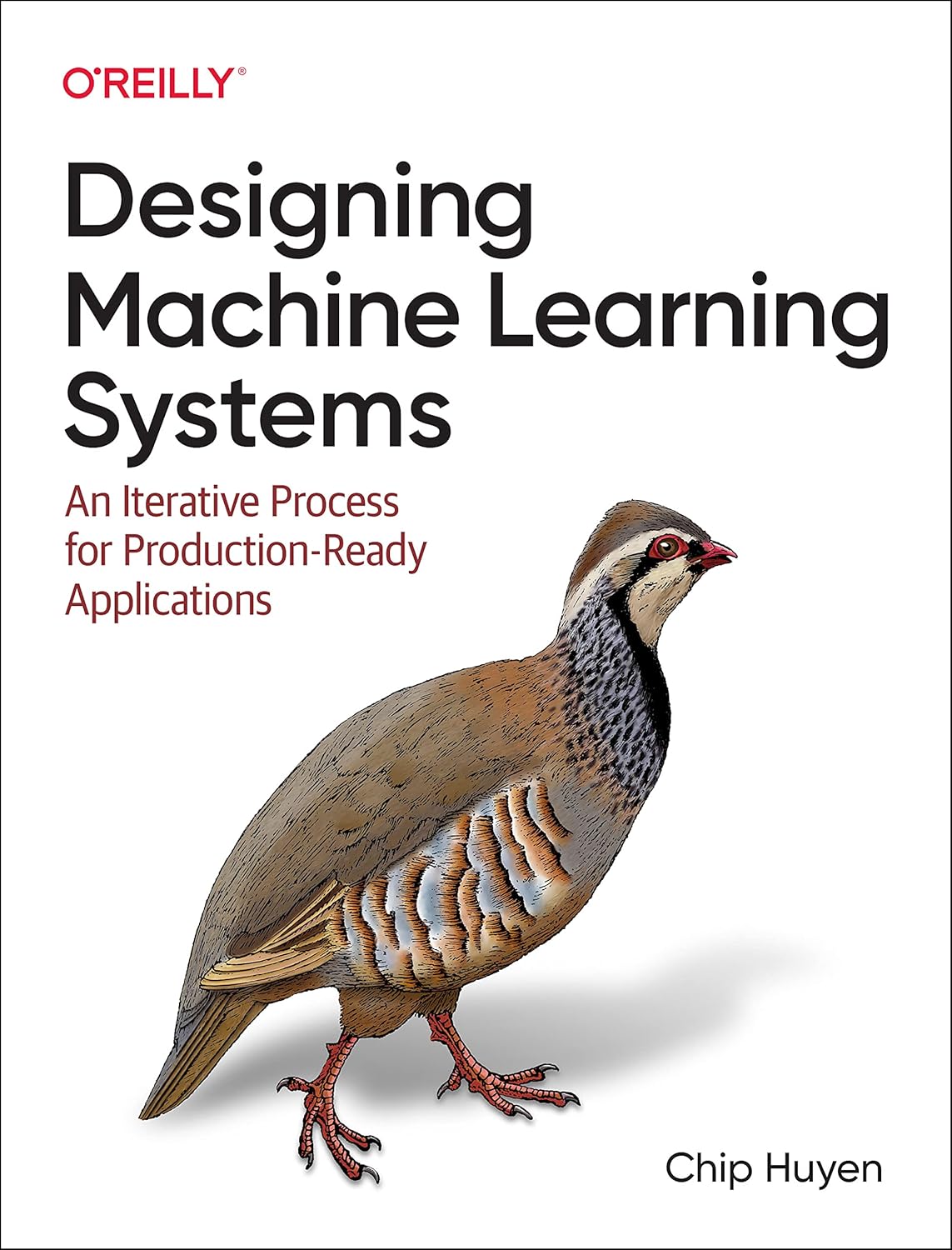
Description:
Machine learning systems are both complex and unique. Complex because they consist of many different components and involve many different stakeholders. Unique because they're data dependent, with data varying wildly from one use case to the next. In this book, you'll learn a holistic approach to designing ML systems that are reliable, scalable, maintainable, and adaptive to changing environments and business requirements.
Author Chip Huyen, co-founder of Claypot AI, considers each design decision--such as how to process and create training data, which features to use, how often to retrain models, and what to monitor--in the context of how it can help your system as a whole achieve its objectives. The iterative framework in this book uses actual case studies backed by ample references.
This book will help you tackle scenarios such as:
- Engineering data and choosing the right metrics to solve a business problem
- Automating the process for continually developing, evaluating, deploying, and updating models
- Developing a monitoring system to quickly detect and address issues your models might encounter in production
- Architecting an ML platform that serves across use cases
- Developing responsible ML systems
Review
- Josh Wills, Software Engineer at WeaveGrid and former Director of Data Engineering, Slack
"There is so much information one needs to know to be an effective machine learning engineer. It's hard to cut through the chaff to get the most relevant information, but Chip has done that admirably with this book. If you are serious about ML in production, and care about how to design and implement ML systems end to end, this book is essential."
- Laurence Moroney, AI and ML Lead, Google
"One of the best resources that focuses on the first principles behind designing ML systems for production. A must-read to navigate the ephemeral landscape of tooling and platform options."
- Goku Mohandas, Founder of Made With ML
"Chip's manual is the book we deserve and the one we need right now. In a blooming but chaotic ecosystem, this principled view on end-to-end ML is both your map and your compass: a must-read for practitioners inside and outside of Big Tech—especially those working at 'reasonable scale.' This book will also appeal to data leaders looking for best practices on how to deploy, manage, and monitor systems in the wild."
- Jacopo Tagliabue, Director of AI, Coveo; Adj. Professor of MLSys, NYU
"Chip is truly a world-class expert on machine learning systems, as well as a brilliant writer. Both are evident in this book, which is a fantastic resource for anyone looking to learn about this topic."
- Andrey Kurenkov, PhD Candidate at the Stanford AI Lab
From the Author
These questions can also be specific, such as "I'm convinced that switching from batch prediction to online prediction will give our model a performance boost, but how do I convince my manager to let me do so?" or "I'm the most senior data scientist at my company and I've recently been tasked with setting up our first machine learning platform; where do I start?"
My short answer to all these questions is always: "It depends." My long answers often involve hours of discussion to understand where the questioner comes from, what they're actually trying to achieve, and the pros and cons of different approaches for their specific use case.
ML systems are both complex and unique. They are complex because they consist of many different components (ML algorithms, data, business logics, evaluation metrics, underlying infrastructure, etc.) and involve many different stakeholders (data scientists, ML engineers, business leaders, users, even society at large). ML systems are unique because they are data dependent, and data varies wildly from one use case to the next.
For example, two companies might be in the same domain (ecommerce) and have the same problem that they want ML to solve (recommender system), but their resulting ML systems can have different model architecture, use different sets of features, be evaluated on different metrics, and bring different returns on investment.
Many blog posts and tutorials on ML production focus on answering one specific question. While the focus helps get the point across, they can create the impression that it's possible to consider each of these questions in isolation. In reality, changes in one component will likely affect other components. Therefore, it's necessary to consider the system as a whole while attempting to make any design decision.
This book takes a holistic approach to ML systems. It takes into account different components of the system and the objectives of different stakeholders involved. The content in this book is illustrated using actual case studies, many of which I've personally worked on, backed by ample references, and reviewed by ML practitioners in both academia and industry. Sections that require in-depth knowledge of a certain topic—e.g., batch processing versus stream processing, infrastructure for storage and compute, and responsible AI—are further reviewed by experts whose work focuses on that one topic. In other words, this book is an attempt to give nuanced answers to the questions mentioned above and more.
When I first wrote the lecture notes that laid the foundation for this book, I thought I wrote them for my students to prepare them for the demands of their future jobs as data scientists and ML engineers. However, I soon realized that I also learned tremendously through the process. The initial drafts I shared with early readers sparked many conversations that tested my assumptions, forced me to consider different perspectives, and introduced me to new problems and new approaches.
I hope that this learning process will continue for me now that the book is in your hand, as you have experiences and perspectives that are unique to you. Please feel free to share with me any feedback you might have for this book!
About the Author
LinkedIn included her among Top Voices in Software Development (2019) and Top Voices in Data Science & AI (2020). She is also the author of four bestselling Vietnamese books, including the series Xach ba lo len va Di (Pack Your Bag and Go). She also runs a Discord server on MLOps with over 6,000 members (https://discord.com/invite/Mw77HPrgjF).
Details:
Visit the O'Reilly Media Store
Designing Machine Learning Systems: An Iterative Process for Production-Ready Applications
AED27759
Quantity:
Order today to get by 7-14 business days
This item qualifies for free delivery
 Imported From: United States
At BOLO, we work hard to ensure the products you receive are new, genuine, and sourced from reputable suppliers.
Every product in the BOLO catalogue is sourced through our Verified Global Supply Network of verified sellers, authorized distributors or directly from the manufacturer.
Each product undergoes thorough inspection and verification at our consolidation and fulfilment centers to ensure it meets our strict authenticity and quality standards before being shipped and delivered to you.
If you ever have concerns regarding the authenticity of a product purchased from us, please contact Bolo Support. We will review your inquiry promptly and, if necessary, provide documentation verifying authenticity or offer a suitable resolution.
Your trust is our top priority, and we are committed to maintaining transparency and integrity in every transaction.
While we strive to display accurate information, variations in packaging, labeling, instructions, or formulation may occasionally occur due to regional differences or supplier updates. For detailed or manufacturer-specific information, please contact the brand directly or reach out to BOLO Support for assistance.
Unless otherwise stated, all prices displayed on the product page include applicable taxes and import duties.
BOLO operates in accordance with the laws and regulations of United Arab Emirates. Any items found to be restricted or prohibited for sale within the United Arab Emirates will be cancelled prior to shipment. We take proactive measures to ensure that only products permitted for sale in United Arab Emirates are listed on our website.
All items are shipped by air, and any products classified as “Dangerous Goods (DG)” under IATA regulations will be removed from the order and cancelled.
All orders are processed manually, and we make every effort to process them promptly once confirmed. Products cancelled due to the above reasons will be permanently removed from listings across the website.
Similar suggestions by Bolo
More from this brand
Similar items from “Intelligence & Semantics”
Share with
Or share with link
https://www.bolo.ae/products/U1098107969
Visit the O'Reilly Media Store
Designing Machine Learning Systems: An Iterative Process for Production-Ready Applications
AED27759
Quantity:
Order today to get by 7-14 business days
This item qualifies for free delivery
Imported From: United States
At BOLO, we work hard to ensure the products you receive are new, genuine, and sourced from reputable suppliers.
Every product in the BOLO catalogue is sourced through our Verified Global Supply Network of verified sellers, authorized distributors or directly from the manufacturer.
Each product undergoes thorough inspection and verification at our consolidation and fulfilment centers to ensure it meets our strict authenticity and quality standards before being shipped and delivered to you.
If you ever have concerns regarding the authenticity of a product purchased from us, please contact Bolo Support. We will review your inquiry promptly and, if necessary, provide documentation verifying authenticity or offer a suitable resolution.
Your trust is our top priority, and we are committed to maintaining transparency and integrity in every transaction.
While we strive to display accurate information, variations in packaging, labeling, instructions, or formulation may occasionally occur due to regional differences or supplier updates. For detailed or manufacturer-specific information, please contact the brand directly or reach out to BOLO Support for assistance.
Unless otherwise stated, all prices displayed on the product page include applicable taxes and import duties.
BOLO operates in accordance with the laws and regulations of United Arab Emirates. Any items found to be restricted or prohibited for sale within the United Arab Emirates will be cancelled prior to shipment. We take proactive measures to ensure that only products permitted for sale in United Arab Emirates are listed on our website.
All items are shipped by air, and any products classified as “Dangerous Goods (DG)” under IATA regulations will be removed from the order and cancelled.
All orders are processed manually, and we make every effort to process them promptly once confirmed. Products cancelled due to the above reasons will be permanently removed from listings across the website.
Description:
Machine learning systems are both complex and unique. Complex because they consist of many different components and involve many different stakeholders. Unique because they're data dependent, with data varying wildly from one use case to the next. In this book, you'll learn a holistic approach to designing ML systems that are reliable, scalable, maintainable, and adaptive to changing environments and business requirements.
Author Chip Huyen, co-founder of Claypot AI, considers each design decision--such as how to process and create training data, which features to use, how often to retrain models, and what to monitor--in the context of how it can help your system as a whole achieve its objectives. The iterative framework in this book uses actual case studies backed by ample references.
This book will help you tackle scenarios such as:
- Engineering data and choosing the right metrics to solve a business problem
- Automating the process for continually developing, evaluating, deploying, and updating models
- Developing a monitoring system to quickly detect and address issues your models might encounter in production
- Architecting an ML platform that serves across use cases
- Developing responsible ML systems
Review
- Josh Wills, Software Engineer at WeaveGrid and former Director of Data Engineering, Slack
"There is so much information one needs to know to be an effective machine learning engineer. It's hard to cut through the chaff to get the most relevant information, but Chip has done that admirably with this book. If you are serious about ML in production, and care about how to design and implement ML systems end to end, this book is essential."
- Laurence Moroney, AI and ML Lead, Google
"One of the best resources that focuses on the first principles behind designing ML systems for production. A must-read to navigate the ephemeral landscape of tooling and platform options."
- Goku Mohandas, Founder of Made With ML
"Chip's manual is the book we deserve and the one we need right now. In a blooming but chaotic ecosystem, this principled view on end-to-end ML is both your map and your compass: a must-read for practitioners inside and outside of Big Tech—especially those working at 'reasonable scale.' This book will also appeal to data leaders looking for best practices on how to deploy, manage, and monitor systems in the wild."
- Jacopo Tagliabue, Director of AI, Coveo; Adj. Professor of MLSys, NYU
"Chip is truly a world-class expert on machine learning systems, as well as a brilliant writer. Both are evident in this book, which is a fantastic resource for anyone looking to learn about this topic."
- Andrey Kurenkov, PhD Candidate at the Stanford AI Lab
From the Author
These questions can also be specific, such as "I'm convinced that switching from batch prediction to online prediction will give our model a performance boost, but how do I convince my manager to let me do so?" or "I'm the most senior data scientist at my company and I've recently been tasked with setting up our first machine learning platform; where do I start?"
My short answer to all these questions is always: "It depends." My long answers often involve hours of discussion to understand where the questioner comes from, what they're actually trying to achieve, and the pros and cons of different approaches for their specific use case.
ML systems are both complex and unique. They are complex because they consist of many different components (ML algorithms, data, business logics, evaluation metrics, underlying infrastructure, etc.) and involve many different stakeholders (data scientists, ML engineers, business leaders, users, even society at large). ML systems are unique because they are data dependent, and data varies wildly from one use case to the next.
For example, two companies might be in the same domain (ecommerce) and have the same problem that they want ML to solve (recommender system), but their resulting ML systems can have different model architecture, use different sets of features, be evaluated on different metrics, and bring different returns on investment.
Many blog posts and tutorials on ML production focus on answering one specific question. While the focus helps get the point across, they can create the impression that it's possible to consider each of these questions in isolation. In reality, changes in one component will likely affect other components. Therefore, it's necessary to consider the system as a whole while attempting to make any design decision.
This book takes a holistic approach to ML systems. It takes into account different components of the system and the objectives of different stakeholders involved. The content in this book is illustrated using actual case studies, many of which I've personally worked on, backed by ample references, and reviewed by ML practitioners in both academia and industry. Sections that require in-depth knowledge of a certain topic—e.g., batch processing versus stream processing, infrastructure for storage and compute, and responsible AI—are further reviewed by experts whose work focuses on that one topic. In other words, this book is an attempt to give nuanced answers to the questions mentioned above and more.
When I first wrote the lecture notes that laid the foundation for this book, I thought I wrote them for my students to prepare them for the demands of their future jobs as data scientists and ML engineers. However, I soon realized that I also learned tremendously through the process. The initial drafts I shared with early readers sparked many conversations that tested my assumptions, forced me to consider different perspectives, and introduced me to new problems and new approaches.
I hope that this learning process will continue for me now that the book is in your hand, as you have experiences and perspectives that are unique to you. Please feel free to share with me any feedback you might have for this book!
About the Author
LinkedIn included her among Top Voices in Software Development (2019) and Top Voices in Data Science & AI (2020). She is also the author of four bestselling Vietnamese books, including the series Xach ba lo len va Di (Pack Your Bag and Go). She also runs a Discord server on MLOps with over 6,000 members (https://discord.com/invite/Mw77HPrgjF).
Details:
Similar suggestions by Bolo
More from this brand
Similar items from “Intelligence & Semantics”
Share with
Or share with link
https://www.bolo.ae/products/U1098107969