Description:
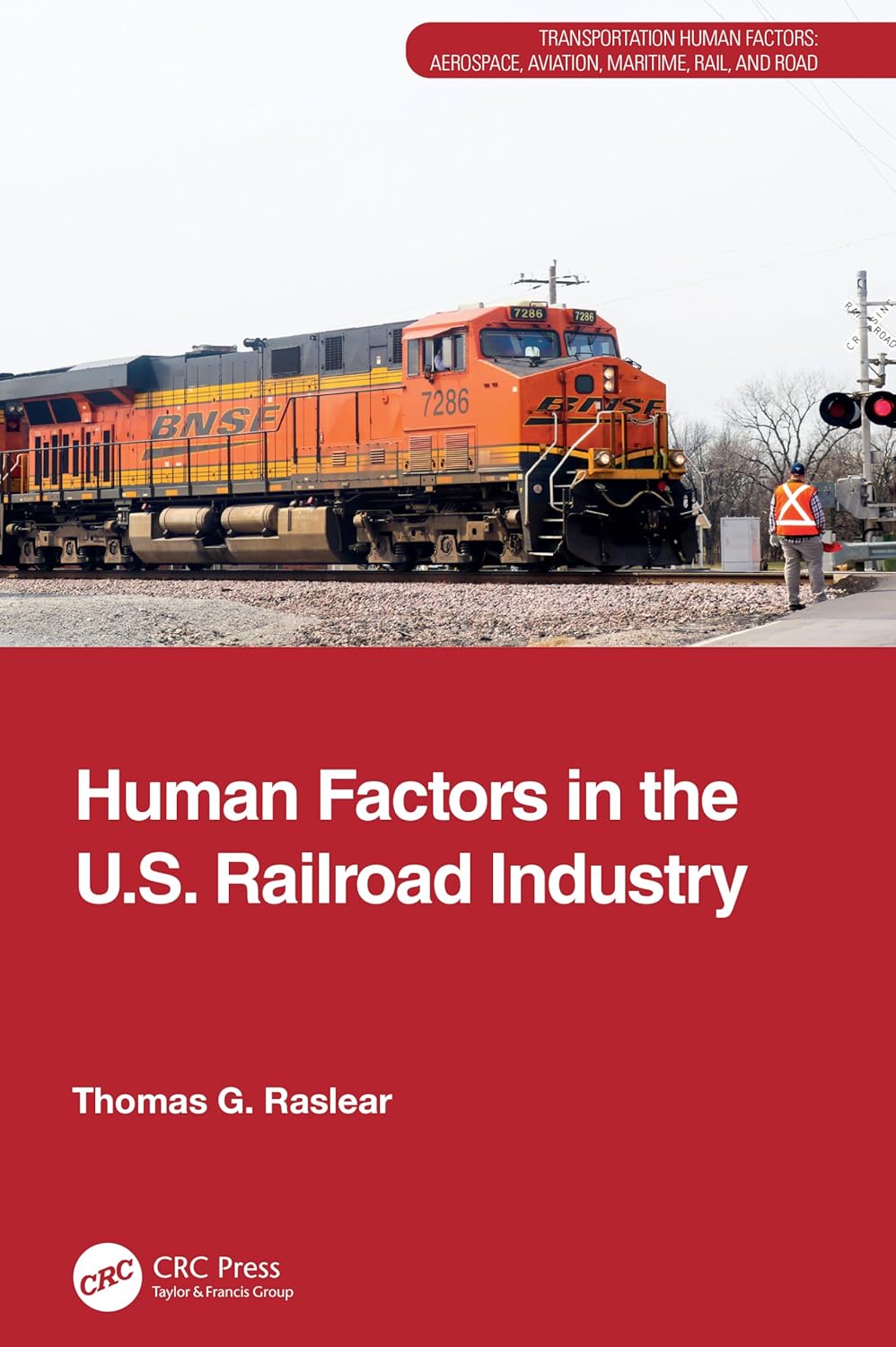
At the heart of the U.S. Railroad Industry are human operators who continue to make it work and operate. However, humans are susceptible to error, fatigue, and risky behaviors. Understanding how these impact the safety of the industry remains a crucial topic to be studied. Human Factors in the U.S. Railroad Industry investigates the human factor behind one of the world’s biggest railway networks and synthesizes the body of research that has been produced by the Federal Railroad Administration (FRA) on Human Factors in the Railroad industry since 1993.
During that time, over 120 FRA reports were published on topics such as accident analysis, grade crossing safety and trespassing, working conditions and ergonomics, employee fatigue, safety culture, and track inspection. This book organizes this body of work into topic areas that correspond to Moray’s Sociotechnical System (2006) to provide a comprehensive way to understand the relationship between policy, organizational culture, and system safety. It discusses tools such as risk exposure, signal detection theory, and program evaluation that have been applied to railroad projects and can be used to improve future railroad and transportation research. It provides a synthesis of the reports across topic areas such as fatigue, ergonomics, and safety culture that are currently important within the wider human factors transportation research community. The reader will develop an understanding of a “human-centered systems” approach to the railroad industry, which focuses on human capabilities and limitations with respect to human/system interfaces, operations, system integration, and organizational influences on safety.
Human Factors in the U.S. Railroad Industry will appeal to researchers, academics, students, and professionals interested in human factors, railway engineering, civil engineering, and industrial engineering.
About the Author
Thomas G. Raslear is an Independent Human Factors Consultant based in Maryland, USA. He has over 40 years of experience in experimental psychology and human factors research. For 23 years, he was based at the Federal Railroad Administration (FRA) until his retirement. At FRA, he was Chief of the Human Factors Research Division in the Office of Research and Development. He is an internationally known expert in fatigue in the railroad industry and has published extensively on the effects of work schedules on fatigue and accidents. Tom was a member and former chair of the U.S. Department of Transportation Human Factors Coordinating Committee and a member of the Transportation Research Board Standing Committee on Railroad Operational Safety (AR070). He is also an internationally known expert on grade crossing human factors and accident causation and has published extensively on the use of Signal Detection Theory in the analysis of motorist behavior at grade crossings.
Details:
Visit the CRC Press Store
Human Factors in the U.S. Railroad Industry (Transportation Human Factors)
AED87020
Quantity:
Order today to get by 7-14 business days
This item qualifies for free delivery
 Imported From: United States
At BOLO, we work hard to ensure the products you receive are new, genuine, and sourced from reputable suppliers.
Every product in the BOLO catalogue is sourced through our Verified Global Supply Network of verified sellers, authorized distributors or directly from the manufacturer.
Each product undergoes thorough inspection and verification at our consolidation and fulfilment centers to ensure it meets our strict authenticity and quality standards before being shipped and delivered to you.
If you ever have concerns regarding the authenticity of a product purchased from us, please contact Bolo Support. We will review your inquiry promptly and, if necessary, provide documentation verifying authenticity or offer a suitable resolution.
Your trust is our top priority, and we are committed to maintaining transparency and integrity in every transaction.
While we strive to display accurate information, variations in packaging, labeling, instructions, or formulation may occasionally occur due to regional differences or supplier updates. For detailed or manufacturer-specific information, please contact the brand directly or reach out to BOLO Support for assistance.
Unless otherwise stated, all prices displayed on the product page include applicable taxes and import duties.
BOLO operates in accordance with the laws and regulations of United Arab Emirates. Any items found to be restricted or prohibited for sale within the United Arab Emirates will be cancelled prior to shipment. We take proactive measures to ensure that only products permitted for sale in United Arab Emirates are listed on our website.
All items are shipped by air, and any products classified as “Dangerous Goods (DG)” under IATA regulations will be removed from the order and cancelled.
All orders are processed manually, and we make every effort to process them promptly once confirmed. Products cancelled due to the above reasons will be permanently removed from listings across the website.
More from this brand
Similar items from “Transportation”
Share with
Or share with link
https://www.bolo.ae/products/U1032771402
Visit the CRC Press Store
Human Factors in the U.S. Railroad Industry (Transportation Human Factors)
AED87020
Quantity:
Order today to get by 7-14 business days
This item qualifies for free delivery
Imported From: United States
At BOLO, we work hard to ensure the products you receive are new, genuine, and sourced from reputable suppliers.
Every product in the BOLO catalogue is sourced through our Verified Global Supply Network of verified sellers, authorized distributors or directly from the manufacturer.
Each product undergoes thorough inspection and verification at our consolidation and fulfilment centers to ensure it meets our strict authenticity and quality standards before being shipped and delivered to you.
If you ever have concerns regarding the authenticity of a product purchased from us, please contact Bolo Support. We will review your inquiry promptly and, if necessary, provide documentation verifying authenticity or offer a suitable resolution.
Your trust is our top priority, and we are committed to maintaining transparency and integrity in every transaction.
While we strive to display accurate information, variations in packaging, labeling, instructions, or formulation may occasionally occur due to regional differences or supplier updates. For detailed or manufacturer-specific information, please contact the brand directly or reach out to BOLO Support for assistance.
Unless otherwise stated, all prices displayed on the product page include applicable taxes and import duties.
BOLO operates in accordance with the laws and regulations of United Arab Emirates. Any items found to be restricted or prohibited for sale within the United Arab Emirates will be cancelled prior to shipment. We take proactive measures to ensure that only products permitted for sale in United Arab Emirates are listed on our website.
All items are shipped by air, and any products classified as “Dangerous Goods (DG)” under IATA regulations will be removed from the order and cancelled.
All orders are processed manually, and we make every effort to process them promptly once confirmed. Products cancelled due to the above reasons will be permanently removed from listings across the website.
Description:
At the heart of the U.S. Railroad Industry are human operators who continue to make it work and operate. However, humans are susceptible to error, fatigue, and risky behaviors. Understanding how these impact the safety of the industry remains a crucial topic to be studied. Human Factors in the U.S. Railroad Industry investigates the human factor behind one of the world’s biggest railway networks and synthesizes the body of research that has been produced by the Federal Railroad Administration (FRA) on Human Factors in the Railroad industry since 1993.
During that time, over 120 FRA reports were published on topics such as accident analysis, grade crossing safety and trespassing, working conditions and ergonomics, employee fatigue, safety culture, and track inspection. This book organizes this body of work into topic areas that correspond to Moray’s Sociotechnical System (2006) to provide a comprehensive way to understand the relationship between policy, organizational culture, and system safety. It discusses tools such as risk exposure, signal detection theory, and program evaluation that have been applied to railroad projects and can be used to improve future railroad and transportation research. It provides a synthesis of the reports across topic areas such as fatigue, ergonomics, and safety culture that are currently important within the wider human factors transportation research community. The reader will develop an understanding of a “human-centered systems” approach to the railroad industry, which focuses on human capabilities and limitations with respect to human/system interfaces, operations, system integration, and organizational influences on safety.
Human Factors in the U.S. Railroad Industry will appeal to researchers, academics, students, and professionals interested in human factors, railway engineering, civil engineering, and industrial engineering.
About the Author
Thomas G. Raslear is an Independent Human Factors Consultant based in Maryland, USA. He has over 40 years of experience in experimental psychology and human factors research. For 23 years, he was based at the Federal Railroad Administration (FRA) until his retirement. At FRA, he was Chief of the Human Factors Research Division in the Office of Research and Development. He is an internationally known expert in fatigue in the railroad industry and has published extensively on the effects of work schedules on fatigue and accidents. Tom was a member and former chair of the U.S. Department of Transportation Human Factors Coordinating Committee and a member of the Transportation Research Board Standing Committee on Railroad Operational Safety (AR070). He is also an internationally known expert on grade crossing human factors and accident causation and has published extensively on the use of Signal Detection Theory in the analysis of motorist behavior at grade crossings.
Details:
More from this brand
Similar items from “Transportation”
Share with
Or share with link
https://www.bolo.ae/products/U1032771402