Description:
Reviews:
5.0 out of 5 stars Invaluable Resource for Educators
As an education major, I assumed that I would use the methods, philosophies, and ideologies presented in class—the methods I really believed in, the methods that were research-supported. Unfortunately, anyone who has taught knows that this is not always the reality in the classroom.When educators lack autonomy, we can lose the “scholar” portion of scholar-practitioner. This book argues (very well) that good teachers need to be both scholars and practitioners, constantly learning from the day-to-day split-second decisions in which books cannot be consulted as well as studying educational theory, research, and best practices. It is only through both experiences that we truly learn. In doing so, we may re-define learning for ourselves and even our students. I absolutely love the definition of learning the authors provide: “Learning is the process of making meaning of experience.” Throughout our lives, not just professional but personal as well, we need to have rich experiences and then study in order to make meaning of those experiences.This book outlines exactly how a teacher goes about doing just that, discussing essential qualities such as understanding and discerning the nuances of experiences, adopting the qualities of an ethical teacher—with engaging in scholarly study being one of these qualities, and understanding the socio-political contexts that effect research and classroom instruction—sometimes merging the two, sometimes creating a divide—amongst countless others. In short, this book provides a framework for new and experienced teachers to become ethical, socially-aware practitioners who can reflect on their experiences and use scholarly research to enhance their teaching. As a new teacher fresh out of school—who feels like she is quickly forgetting what she learned in school—this was a valuable and personally stretching read.
5.0 out of 5 stars Ethical Stewardship
Although this book is intended for educators, I found it to be an encouraging guide for anyone who cares to deepen personal wisdom in service to one's profession or vocation. The definition of scholar-practitioner as "a way of being...that one brings to one's ...work," can be applied to all endeavors across the lifespan. The authors gently accept the moments that feel like failures to us and suggest ways to trust one's humble self while responsibly advancing one's chosen work in ethical ways. However, this is not a personal self-help book. It is a comprehensive overview of education as a complex system involving theory, context, stewardship, reflection and imagination. The bibliography reveals insights are drawn from different professions as the authors inspire practitioners to a high standard of service.
5.0 out of 5 stars Useful perspectives on the relationship between teaching and research
I found this book valuable because it builds a bridge between the educator and the scholar. The authors validate the experience of the practitioner as a source of knowledge about instruction. They assert that quantitive research in controlled experiments is not the only way (and perhaps not the most useful way) to undergird educational practice. The reader is shown how a problem or question which puzzles, yet has no easy answers, can be the fertile ground for investigation. The authors demonstrate how issues can be framed in various ways to yield fresh insights. The graphics are especially useful in understanding these concepts.Educators who feel a gap (if not a chasm) between research and the pressing exigencies of daily practice will find this book invaluable. I consider "On Being a Scholar-Practitioner" a must read. Linda Carroll, Ph.D.
5.0 out of 5 stars Helping teachers to recognize they ARE Scholar-Practitioners!
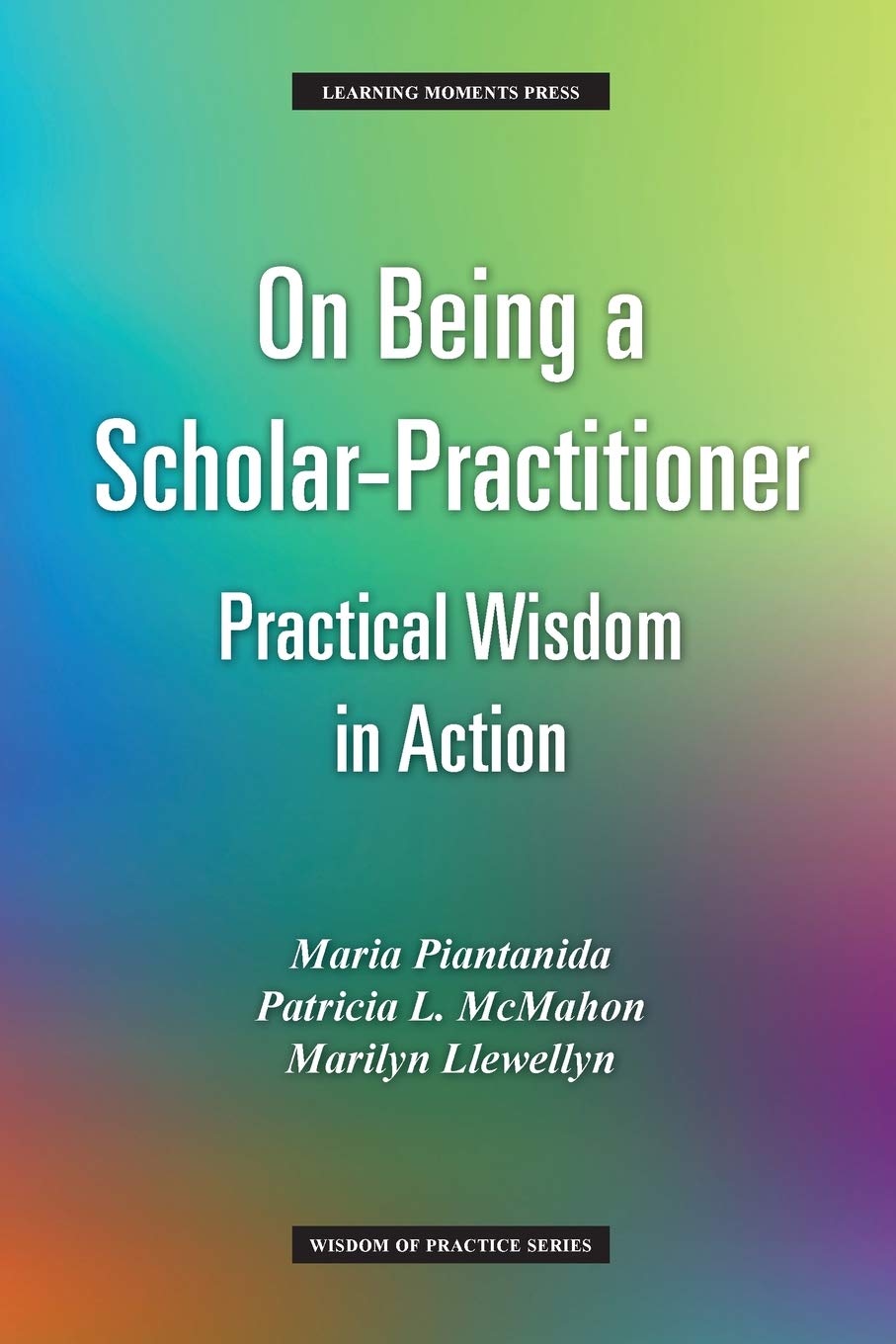
This book introduces and summarizes what it means to be a Scholar-Practitioner and to use practical wisdom in a professional’s practice or in action. As a professor of special education and early childhood in a teacher preparation program who actively strives to provide meaningful and teachable moments inside and outside the classroom, this book fits the bill! Piantanida, McMahon, & Llewellyn skillfully share research and timely topics, with their own experiences as college instructors of teacher preparation programs and researchers carefully interwoven into the narrative on the pages. They also do a wonderful job of revisiting earlier topics to remind the reader of what was shared in previous chapters and to provide scaffolding in linking the material with the newer points that are being made.The book starts by diving into the definition of what the term, Scholar-Practitioner, means and posits it in relatable terms for the reader regardless of the reader’s background. This is a delightful feature of the book as it allows pre-service educators, in-service teachers, staff, administrators, and others in the discipline of education to read with understanding. Actually, even individuals outside of education are able to read and perceive the information being shared thanks to the writing style of the authors.The authors skillfully bring the reader along as they build off the definition of Scholar-Practitioner and bring in the importance of relating to others, communicating for dialogue and not just to listen, and recognizing the consequences of actions within teaching for the good or for the detriment of their students. It is hoped, by reading this book, that Scholar-Practitioners grow in their reflective practice of considering all angles of what occurs in and outside the classroom by recognizing and valuing that meaning leads to learning and learning leads to meaning making.The most important aspects of the book for me, as a professor who works closely with pre-service educators preparing to teach in a variety of settings and licensure areas, are the readability in case I have my students complete assigned readings from the book, the reflective questions that are available at the end of the chapters as prompts to guide the students’ thinking, and the vignettes or personal examples of catalyzing moments that are shared. These real world application examples will go a long way in allowing my students to see the content of the book be applied in a future hypothetical setting that could very well happen for them in their careers. The reflective questions, and the application questions that come up in the narrative, are relevant and worthy of the time and energy spent on creating answers for the questions. I believe that all three of these favorite aspects will help my students (or any reader) to stay engaged with the material and to go to the next level in thinking of themselves as Scholar-Practitioners and what that might look like in their future classrooms. For example, I really appreciated the real world example of the first grade teacher working with Johnny as he struggled with acclimating to the new school year when the authors spoke of the importance of relating to others and taking the time to consider all angles of a situation that may occur in the classroom.The young boy timidly made his way to a self-selected space beneath the teacher’s tan metal desk where he remained for the entire day. The following morning, John…once again made his way to the spot beneath the teacher’s desk. Day after day, John returned to that place…One day the teacher brought a blanket, a pillow, and a flashlight and handed them to John. He took the blanket and laid it out carefully under the desk. John then propped the pillow against the inside of the desk and leaned against it as he explored a children’s book by the light of the flashlight.Additionally, even though I initially started out reading this book with the perspective of what it could provide my students in the higher education setting in my mind, I found myself being drawn in and learning and growing as a Scholar-Practitioner myself as I pondered my openness as a teacher and how I embrace (or maybe do not) pedagogical moments that occur in the classroom. One can never be reminded too often of the importance of being vulnerable and authentic and the authors of the book unexpectedly touch upon those themes as they ponder how being open to change and recognizing the impact actions have on others in teaching can lead to more effective instruction.Probing “the I who teaches” is not for the faint of heart. It requires a willingness to be vulnerable, to admit mistakes, to question taken-for-granted assumptions, to feel foolish, to look honestly at oneself. It requires doubt and humility….[it] is far better to develop as a Scholar-Practitioner if [the teacher] is able to accept his/her own fallibility and to embrace a stance of learner. As hard as it may be, pedagogical moments that have gone awry are often the best clues to the learning we need to pursue.I am very excited to share with my students resources from this book such as the figure that clearly illustrates the components of educational endeavors or encounters in weighing the needs of the group along with the needs of the individual and the purpose of the educational endeavor. Pre-service and in-service teachers must always consider the objective or end goal of the learning experience and seek to balance the needs of the many with the needs of the one. This especially rings true for me as a special education teacher and a person with a special need! The examples provided in this section of the book were applicable and thought provoking for the reader as the reader was invited to consider how he or she might address the problem or situation being described on the pages.As one who covers systematic direct instruction in one class and inquiry-based instruction in another, I especially appreciated Chapter 6 that reviewed different theoretical lenses for thinking about curriculum structures in an easy to understand and follow format. I am already planning to share certain pages from the chapter with my students that will help them to see the differences between these curriculum structures. The detailed yet succinct ways in which each structure was explained will help my students to clearly recognize and analyze the differences and characteristics of each.The diversity in potential audiences for this book is readily apparent through the content being shared on the pages. There really is something for everyone through the information that is covered in this book. See below for an example of what I mean:It is also a journey through some messy terrain, because it entails letting go of Absolute Knowing and recognizing that knowledge is: socially constructed within communities of discourse, dynamic and continually evolving, contested, value-laden, and political…Within any given field of study, individuals are drawn to ask certain types of questions. Consider how questions about curriculum structures might differ among educators working within these various sub-fields: early childhood, elementary, middle level, secondary, and postsecondary education; professional education in teaching, educational administration, the health and human sciences; special education as related to students with visual or hearing impairments, cognitive challenges, attention deficit/hyperactivity disorder; autism spectrum disorders; psychomotor difficulties; multicultural education, culturally relevant/responsive pedagogy; educational testing, measurement, and evaluation; community education such as museum education, leisure learning, corporate-based in-service education; and educational policy and financing.The authors raise pertinent, timely, and relevant questions. Their call to action is inspiring as readers consider their own roles as Scholar-Practitioners and how they will leave a mark on the discipline of education.Aesthetically speaking, the cover of the book itself is very pleasing to the eye with the muted colors evoking a sense of calm. The page layout, along with the chosen figures and diagrams selected for publication, is conducive to ease in reading and perceiving the information that is presented.If you are looking for a book that provides a realistic yet hopeful view of what it means to be an educator and a researcher by way of viewing self as a Scholar-Practitioner, then this book fits the bill. The just under 300 page book provides the reader with an overview of some of the big challenges that exist within education today yet provides inspiration and spurs change in helping the reader to see him or herself as an active change agent in the landscape of education. I will definitely be sharing passages from this book with my pre-service educators in future classes!
Visit the Learning Moments Press Store
On Being a Scholar-Practitioner: Practical Wisdom in Action (Wisdom of Practice)
AED16350
Quantity:
Order today to get by 7-14 business days
Delivery fee of AED 20. Free for orders above AED 200.
Imported From: United States
At BOLO, we work hard to ensure the products you receive are new, genuine, and sourced from reputable suppliers.
BOLO is not an authorized or official retailer for most brands, nor are we affiliated with manufacturers unless specifically stated on a product page. Instead, we source verified sellers, authorized distributors or directly from the manufacturer.
Each product undergoes thorough inspection and verification at our consolidation and fulfilment centers to ensure it meets our strict authenticity and quality standards before being shipped and delivered to you.
If you ever have concerns regarding the authenticity of a product purchased from us, please contact Bolo Support. We will review your inquiry promptly and, if necessary, provide documentation verifying authenticity or offer a suitable resolution.
Your trust is our top priority, and we are committed to maintaining transparency and integrity in every transaction.
All product information, images, descriptions, and reviews originate from the manufacturer or from trusted sellers overseas. BOLO is not affiliated with, endorsed by, or an authorized retailer for most brands listed on our website unless stated otherwise.
While we strive to display accurate information, variations in packaging, labeling, instructions, or formulation may occasionally occur due to regional differences or supplier updates. For detailed or manufacturer-specific information, please contact the brand directly or reach out to BOLO Support for assistance.
Unless otherwise stated, all prices displayed on the product page include applicable taxes and import duties.
BOLO operates in accordance with the laws and regulations of United Arab Emirates. Any items found to be restricted or prohibited for sale within the UAE will be cancelled prior to shipment. We take proactive measures to ensure that only products permitted for sale in United Arab Emirates are listed on our website.
All items are shipped by air, and any products classified as “Dangerous Goods (DG)” under IATA regulations will be removed from the order and cancelled.
All orders are processed manually, and we make every effort to process them promptly once confirmed. Products cancelled due to the above reasons will be permanently removed from listings across the website.
Similar suggestions by Bolo
More from this brand
Similar items from “Administration”
Share with
Or share with link
https://www.bolo.ae/products/U0997648880
Visit the Learning Moments Press Store
On Being a Scholar-Practitioner: Practical Wisdom in Action (Wisdom of Practice)

AED16350
Quantity:
Order today to get by 7-14 business days
Delivery fee of AED 20. Free for orders above AED 200.
Imported From: United States
At BOLO, we work hard to ensure the products you receive are new, genuine, and sourced from reputable suppliers.
BOLO is not an authorized or official retailer for most brands, nor are we affiliated with manufacturers unless specifically stated on a product page. Instead, we source verified sellers, authorized distributors or directly from the manufacturer.
Each product undergoes thorough inspection and verification at our consolidation and fulfilment centers to ensure it meets our strict authenticity and quality standards before being shipped and delivered to you.
If you ever have concerns regarding the authenticity of a product purchased from us, please contact Bolo Support. We will review your inquiry promptly and, if necessary, provide documentation verifying authenticity or offer a suitable resolution.
Your trust is our top priority, and we are committed to maintaining transparency and integrity in every transaction.
All product information, images, descriptions, and reviews originate from the manufacturer or from trusted sellers overseas. BOLO is not affiliated with, endorsed by, or an authorized retailer for most brands listed on our website unless stated otherwise.
While we strive to display accurate information, variations in packaging, labeling, instructions, or formulation may occasionally occur due to regional differences or supplier updates. For detailed or manufacturer-specific information, please contact the brand directly or reach out to BOLO Support for assistance.
Unless otherwise stated, all prices displayed on the product page include applicable taxes and import duties.
BOLO operates in accordance with the laws and regulations of United Arab Emirates. Any items found to be restricted or prohibited for sale within the UAE will be cancelled prior to shipment. We take proactive measures to ensure that only products permitted for sale in United Arab Emirates are listed on our website.
All items are shipped by air, and any products classified as “Dangerous Goods (DG)” under IATA regulations will be removed from the order and cancelled.
All orders are processed manually, and we make every effort to process them promptly once confirmed. Products cancelled due to the above reasons will be permanently removed from listings across the website.
Description:
Reviews:
5.0 out of 5 stars Invaluable Resource for Educators
As an education major, I assumed that I would use the methods, philosophies, and ideologies presented in class—the methods I really believed in, the methods that were research-supported. Unfortunately, anyone who has taught knows that this is not always the reality in the classroom.When educators lack autonomy, we can lose the “scholar” portion of scholar-practitioner. This book argues (very well) that good teachers need to be both scholars and practitioners, constantly learning from the day-to-day split-second decisions in which books cannot be consulted as well as studying educational theory, research, and best practices. It is only through both experiences that we truly learn. In doing so, we may re-define learning for ourselves and even our students. I absolutely love the definition of learning the authors provide: “Learning is the process of making meaning of experience.” Throughout our lives, not just professional but personal as well, we need to have rich experiences and then study in order to make meaning of those experiences.This book outlines exactly how a teacher goes about doing just that, discussing essential qualities such as understanding and discerning the nuances of experiences, adopting the qualities of an ethical teacher—with engaging in scholarly study being one of these qualities, and understanding the socio-political contexts that effect research and classroom instruction—sometimes merging the two, sometimes creating a divide—amongst countless others. In short, this book provides a framework for new and experienced teachers to become ethical, socially-aware practitioners who can reflect on their experiences and use scholarly research to enhance their teaching. As a new teacher fresh out of school—who feels like she is quickly forgetting what she learned in school—this was a valuable and personally stretching read.
5.0 out of 5 stars Ethical Stewardship
Although this book is intended for educators, I found it to be an encouraging guide for anyone who cares to deepen personal wisdom in service to one's profession or vocation. The definition of scholar-practitioner as "a way of being...that one brings to one's ...work," can be applied to all endeavors across the lifespan. The authors gently accept the moments that feel like failures to us and suggest ways to trust one's humble self while responsibly advancing one's chosen work in ethical ways. However, this is not a personal self-help book. It is a comprehensive overview of education as a complex system involving theory, context, stewardship, reflection and imagination. The bibliography reveals insights are drawn from different professions as the authors inspire practitioners to a high standard of service.
5.0 out of 5 stars Useful perspectives on the relationship between teaching and research
I found this book valuable because it builds a bridge between the educator and the scholar. The authors validate the experience of the practitioner as a source of knowledge about instruction. They assert that quantitive research in controlled experiments is not the only way (and perhaps not the most useful way) to undergird educational practice. The reader is shown how a problem or question which puzzles, yet has no easy answers, can be the fertile ground for investigation. The authors demonstrate how issues can be framed in various ways to yield fresh insights. The graphics are especially useful in understanding these concepts.Educators who feel a gap (if not a chasm) between research and the pressing exigencies of daily practice will find this book invaluable. I consider "On Being a Scholar-Practitioner" a must read. Linda Carroll, Ph.D.
5.0 out of 5 stars Helping teachers to recognize they ARE Scholar-Practitioners!
This book introduces and summarizes what it means to be a Scholar-Practitioner and to use practical wisdom in a professional’s practice or in action. As a professor of special education and early childhood in a teacher preparation program who actively strives to provide meaningful and teachable moments inside and outside the classroom, this book fits the bill! Piantanida, McMahon, & Llewellyn skillfully share research and timely topics, with their own experiences as college instructors of teacher preparation programs and researchers carefully interwoven into the narrative on the pages. They also do a wonderful job of revisiting earlier topics to remind the reader of what was shared in previous chapters and to provide scaffolding in linking the material with the newer points that are being made.The book starts by diving into the definition of what the term, Scholar-Practitioner, means and posits it in relatable terms for the reader regardless of the reader’s background. This is a delightful feature of the book as it allows pre-service educators, in-service teachers, staff, administrators, and others in the discipline of education to read with understanding. Actually, even individuals outside of education are able to read and perceive the information being shared thanks to the writing style of the authors.The authors skillfully bring the reader along as they build off the definition of Scholar-Practitioner and bring in the importance of relating to others, communicating for dialogue and not just to listen, and recognizing the consequences of actions within teaching for the good or for the detriment of their students. It is hoped, by reading this book, that Scholar-Practitioners grow in their reflective practice of considering all angles of what occurs in and outside the classroom by recognizing and valuing that meaning leads to learning and learning leads to meaning making.The most important aspects of the book for me, as a professor who works closely with pre-service educators preparing to teach in a variety of settings and licensure areas, are the readability in case I have my students complete assigned readings from the book, the reflective questions that are available at the end of the chapters as prompts to guide the students’ thinking, and the vignettes or personal examples of catalyzing moments that are shared. These real world application examples will go a long way in allowing my students to see the content of the book be applied in a future hypothetical setting that could very well happen for them in their careers. The reflective questions, and the application questions that come up in the narrative, are relevant and worthy of the time and energy spent on creating answers for the questions. I believe that all three of these favorite aspects will help my students (or any reader) to stay engaged with the material and to go to the next level in thinking of themselves as Scholar-Practitioners and what that might look like in their future classrooms. For example, I really appreciated the real world example of the first grade teacher working with Johnny as he struggled with acclimating to the new school year when the authors spoke of the importance of relating to others and taking the time to consider all angles of a situation that may occur in the classroom.The young boy timidly made his way to a self-selected space beneath the teacher’s tan metal desk where he remained for the entire day. The following morning, John…once again made his way to the spot beneath the teacher’s desk. Day after day, John returned to that place…One day the teacher brought a blanket, a pillow, and a flashlight and handed them to John. He took the blanket and laid it out carefully under the desk. John then propped the pillow against the inside of the desk and leaned against it as he explored a children’s book by the light of the flashlight.Additionally, even though I initially started out reading this book with the perspective of what it could provide my students in the higher education setting in my mind, I found myself being drawn in and learning and growing as a Scholar-Practitioner myself as I pondered my openness as a teacher and how I embrace (or maybe do not) pedagogical moments that occur in the classroom. One can never be reminded too often of the importance of being vulnerable and authentic and the authors of the book unexpectedly touch upon those themes as they ponder how being open to change and recognizing the impact actions have on others in teaching can lead to more effective instruction.Probing “the I who teaches” is not for the faint of heart. It requires a willingness to be vulnerable, to admit mistakes, to question taken-for-granted assumptions, to feel foolish, to look honestly at oneself. It requires doubt and humility….[it] is far better to develop as a Scholar-Practitioner if [the teacher] is able to accept his/her own fallibility and to embrace a stance of learner. As hard as it may be, pedagogical moments that have gone awry are often the best clues to the learning we need to pursue.I am very excited to share with my students resources from this book such as the figure that clearly illustrates the components of educational endeavors or encounters in weighing the needs of the group along with the needs of the individual and the purpose of the educational endeavor. Pre-service and in-service teachers must always consider the objective or end goal of the learning experience and seek to balance the needs of the many with the needs of the one. This especially rings true for me as a special education teacher and a person with a special need! The examples provided in this section of the book were applicable and thought provoking for the reader as the reader was invited to consider how he or she might address the problem or situation being described on the pages.As one who covers systematic direct instruction in one class and inquiry-based instruction in another, I especially appreciated Chapter 6 that reviewed different theoretical lenses for thinking about curriculum structures in an easy to understand and follow format. I am already planning to share certain pages from the chapter with my students that will help them to see the differences between these curriculum structures. The detailed yet succinct ways in which each structure was explained will help my students to clearly recognize and analyze the differences and characteristics of each.The diversity in potential audiences for this book is readily apparent through the content being shared on the pages. There really is something for everyone through the information that is covered in this book. See below for an example of what I mean:It is also a journey through some messy terrain, because it entails letting go of Absolute Knowing and recognizing that knowledge is: socially constructed within communities of discourse, dynamic and continually evolving, contested, value-laden, and political…Within any given field of study, individuals are drawn to ask certain types of questions. Consider how questions about curriculum structures might differ among educators working within these various sub-fields: early childhood, elementary, middle level, secondary, and postsecondary education; professional education in teaching, educational administration, the health and human sciences; special education as related to students with visual or hearing impairments, cognitive challenges, attention deficit/hyperactivity disorder; autism spectrum disorders; psychomotor difficulties; multicultural education, culturally relevant/responsive pedagogy; educational testing, measurement, and evaluation; community education such as museum education, leisure learning, corporate-based in-service education; and educational policy and financing.The authors raise pertinent, timely, and relevant questions. Their call to action is inspiring as readers consider their own roles as Scholar-Practitioners and how they will leave a mark on the discipline of education.Aesthetically speaking, the cover of the book itself is very pleasing to the eye with the muted colors evoking a sense of calm. The page layout, along with the chosen figures and diagrams selected for publication, is conducive to ease in reading and perceiving the information that is presented.If you are looking for a book that provides a realistic yet hopeful view of what it means to be an educator and a researcher by way of viewing self as a Scholar-Practitioner, then this book fits the bill. The just under 300 page book provides the reader with an overview of some of the big challenges that exist within education today yet provides inspiration and spurs change in helping the reader to see him or herself as an active change agent in the landscape of education. I will definitely be sharing passages from this book with my pre-service educators in future classes!
Similar suggestions by Bolo
More from this brand
Similar items from “Administration”
Share with
Or share with link
https://www.bolo.ae/products/U0997648880