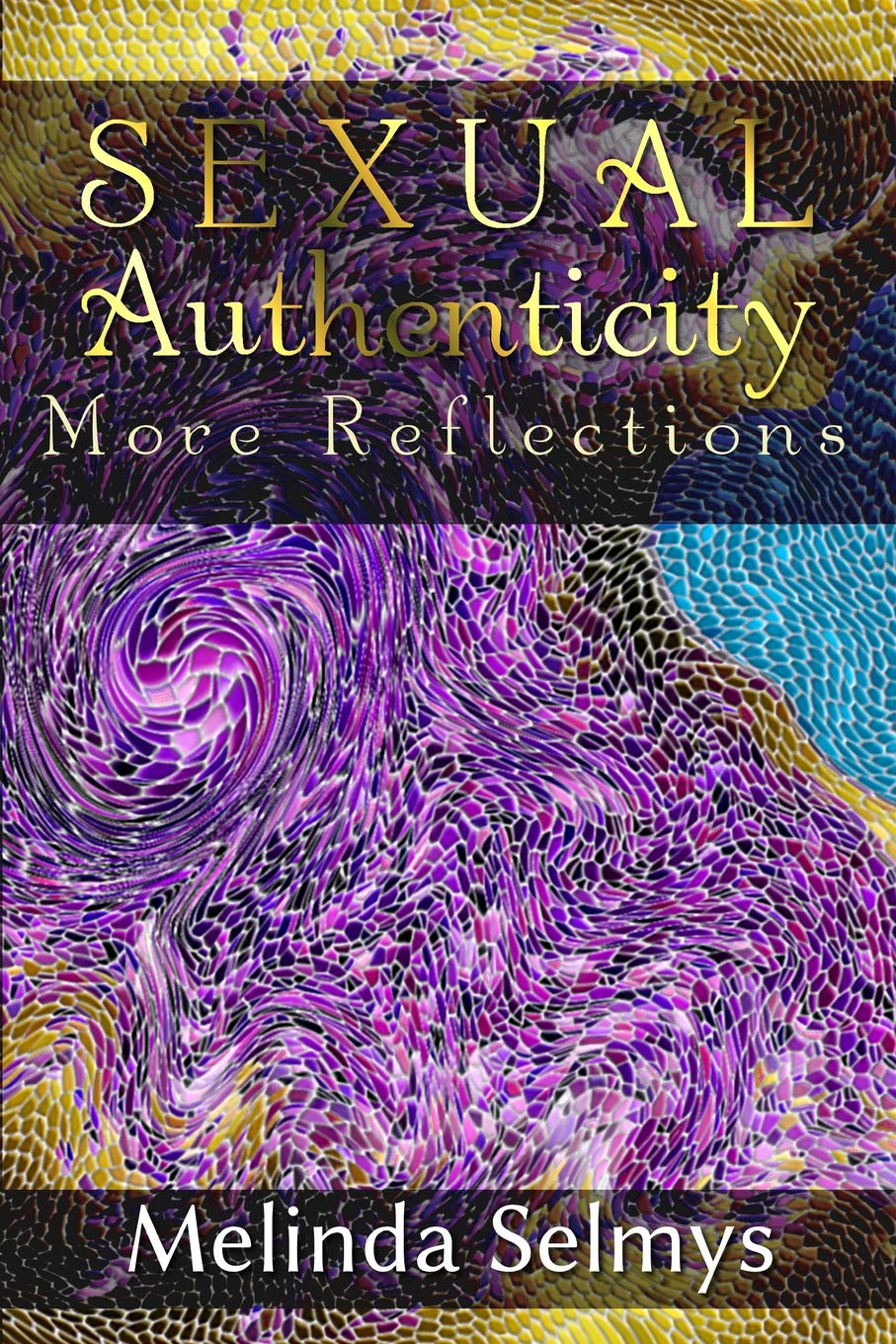
Description:
Reviews:
5.0 out of 5 stars An Exercise in the Removal of Saccharine
I love the exchange between Melinda Selmys and her husband recounted in the opening pages of Sexual Authenticity: More Reflections. They are discussing her earlier book, Sexual Authenticity, and he says of it: “It’s s***. It’s fake. It’s saccharine. It’s not honest. It’s not you. Write it again.”That is part of the backdrop for the book Sexual Authenticity: More Reflections.Another part of her motivation to offer further reflections was the way in which she and her book had been surreptitiously brought into a larger culture war. Reflecting on one of her first public interviews in which she shared the spotlight with a reparative therapist, she writes, “I felt like a fraud. I’d written a book about how the Culture Wars mentality was wrong, and suddenly I was in the thick of that war, an artillery piece in the battle against the Gay Agenda.”But Selmys has another personal reaction I have not known:"Moreover, I knew that the politicization of my sexuality was an obstacle to the work that I actually wanted to be doing. I was producing the kind of ex-gay narrative that appeals to good Catholic mothers and father and sisters and brothers who dearly want their loved one’s to be able to achieve a full, vibrant, healthy, happy heterosexuality – the kind of ex-gay narrative that has failed the LGBTQ community so badly because it falls afoul of the real experience of many people with SSA [same-sex attraction]." (p. 37)I haven’t had this reaction because I do not personally experience my sexuality in this way. As an academic who conducts research on sexual identity, however, I have seen my research used toward political ends in ways that I, too, believe have not been helpful to sexual minorities who are navigating this terrain. I am thinking primarily of the Ex-Gays? study. The reality is that 90% of my research is actually on sexual identity development and the experiences of sexual minorities of faith in Christian colleges and universities, in mixed orientation marriages, and in navigating family relationships. So I appreciated her transparency in sharing this motivation to offer more reflections.The sections that were particularly compelling to me were her personal accounts of how trying to follow the expectations of others (and their related narratives) did great damage to her and her marriage. It gets into the whole area of what to do with one’s same-sex sexuality. Celebrate it? Keep it at arm’s length? Vilify it? Selmys comes to the conclusion that her same-sex sexuality is not “accidental” to her sense of self or her marriage. That doesn’t mean that her same-sex sexuality is central either. She is committed to naming false dichotomies:"Nor is [my homosexuality] accidental to my marriage. I did a lot of damage, both to my identity and to my relationship with my husband, by trying to conform to some sort of one-size-fits all narrative of sexual complementarity. Because I could not acknowledge the part of me that is “queer” in the early years of our relationship, I withheld that part of me from our marriage and tried to replace it with a simulacrum of “authentic femininity” which was not in any way authentic to me. This was a significant omission in my gift of self." (p. 67)Readers of her blog will recognize many section of the book. She will offer a post and then reflect on it as she has clearly interacted with readers around significant themes that have shaped her thinking in an area. That may sound like it would be somewhat disjointed, but the book does not read that way at all. It is well-written and flows from reflection to reflection in ways that readers will appreciate. The two things that stand out to me as possibly “difficult” about her book are that (1) Selmys, as a Catholic, engages with Catholic theology and philosophy in ways that may not be as familiar to evangelical Protestants, and (2) she pulls no punches. I found the connections to Catholic theology interesting and helpful. Too often evangelicals limit their connections to what John Piper or Tim Keller have said. It’s not that these pastors and theologians are the concerns–it’s that evangelicals can forget the broader theological landscape that is in front of them.As for the punches not being pulled, let me offer this as an aside: Melinda helped me with a writing project on gender dysphoria (a workbook soon to be available through the Institute for the Study of Sexual Identity), and she has no qualms about telling a writer what she thinks about his/her work. Within a matter of weeks, I was fully aware of the sections of my writing that she did not like. It was refreshing and humbling. Well, More Reflections is kind of like that. Her writing is refreshing and honest in ways that are just not that comfortable for the existing narratives for faithful sexual minorities in the church today. Those narratives, of course, are largely “ex-gay”, reflecting a clean transformation into a pure heterosexuality, which has not been her experience (she names and challenges an array of narratives on pp. 56ff). And I don’t think it is most people’s experience, and it is THAT narrative (not any one narrative but dozens and dozens of comparable narratives) that needs to be told for the church to come to a more realistic understanding of what pastoral care to sexual minorities can look like.When I first started conducting research on sexual identity, I participated in a think tank with many folks on the topic of sexuality and marriage. (Let me say outright that I love think tanks. This one met in Lourdes, France, and…well…we were there to think. Not a bad arrangement in my view.) One of the other participants was the late Fr. John Harvey, the founder of Courage, a ministry to homosexuals in the Catholic Church. I enjoyed Fr. Harvey as a faithful man with a gentle spirit. I would have loved to have had a “beer summit” with he and Melinda to discuss pastoral care to the sexual minority. In fact, these two would not have needed me; I’d be there for the beer. But to have them engage in a thoughtful, honest discussion about the lives of Christian sexual minorities is the kind of exchange that is needed with many Christian leaders to move the church away from the culture wars and toward genuine pastoral care. I did not experience Fr. Harvey as interested in the culture wars, either, but so many Christian leaders today are–and there is an important shift that simply needs to take place.Pastoral care based on a saccharine-based sexual identity narrative will only offer peace to those of us who do not experience sexual identity conflicts. That’s not pastoral care at all. It’s stress management for the majority while our brothers and sisters suffer in the trenches of a battle they should never have had to face on their own.I have been encouraged lately by the voices of many Christians who are engaging this topic from the standpoint of their own lived reality. People like Melinda Selmys. People like Wesley Hill, Ron Belgau and Julie Rodgers. Others who write alongside them at Spiritual Friendship. This is a book that will stand alongside others like it and alongside the thoughtful wave of younger, devout Christians who are engaging this topic and the church in a more public and honest way.From: [...]
5.0 out of 5 stars A book to shatter every category.
There are books that are interesting, stimulating, informative. Others cause the pulse to pound. Then there are others that transform the way you think. These are the ones that matter. These stay with you for the rest of your life. This is one such book.I expected to hear a fresh perspective, but I did not anticipate that I would have my assumptions shaken and prejudices shattered. I can't say I was not given fair warning. Melinda does not fit neatly into any of the easy, safe, comfortable pigeon-holes: she is an ex-atheist, lesbian, now Catholic, who admits still having same sex attraction, despite being a happily married home-school mother of six. It was due to the sheer queerness (I can now use that term accurately--thanks to her book) that prompted me to buy it. It is a follow up to Sexual Authenticity: An Intimate Reflection on Homosexuality and Catholicism published in 2009--which I have not read.She had me at her first essay. And she had me for good. In it she issues a gentle challenge that hit me with the force of a round stone zipping out of a young shepherd's sling. She proposes that we stop reading as winners and instead "read as losers." The posture she recommends is "a habit of spiritual meekness with respect to the ideas of others." Instead of reading in order to discover whether you agree or disagree, to expose the deficits in the argument, you approach the text "in the role of the student who has come to learn, rather than in the role of an adjudicator who has come to judge. The thought of the other is thus received as a kind of gift, and one's humility before the text is the posture of gratitude and of reciprocity that preserves the gift from contempt and prejudice. . . . " This may not sound like much to some, but to those have been trained to dissect, discriminate, distinguish and dismiss (or destroy--rhetorically, that is) as I have been--thanks to seminary and law school, this is revolutionary stuff indeed.Lest one mistake this for a clever postmodern denial of truth claims, or a Buddhist muzzling of the critical faculty, it is actually a call to love first and criticize later. It is really nothing more radical than an elaboration of what St. James advocated: "be quick to hear and slow to speak." Melinda is not pronouncing a fatwa on "judging" but merely chastening the critical faculty in order to understand fully, so that if criticism is necessary, it be grounded in respect, compassion and honesty. "The reader is then able to disagree with the author through love of the author’s thought rather than through enmity with it. Critique then becomes an act of love.” That pretty well overturns all power trip approaches to a text and, at least for me, taught me a brand new way to look at words on a page or listen to words out of a mouth.That was worth the money for Melinda's book, but the remainder was every bit as helpful, that is if you are interested in listening to a voice that comes out of the wilderness, of sorts, and offers new ways of thinking and responding to the incredibly painful, contentious, and complicated issue of sexual diversity. For, to top it off, besides being wise and gracious, Melinda is also wicked smart. Her reflections will change your mind if you will first let them change your heart.
Five Stars
A must-read for anyone with questions about LGBT people in the Church.
Visit the Vulgata Store
Sexual Authenticity: More Reflections
AED14311
Quantity:
Order today to get by 7-14 business days
Delivery fee of AED 20. Free for orders above AED 200.
Imported From: United States
At BOLO, we work hard to ensure the products you receive are new, genuine, and sourced from reputable suppliers.
BOLO is not an authorized or official retailer for most brands, nor are we affiliated with manufacturers unless specifically stated on a product page. Instead, we source verified sellers, authorized distributors or directly from the manufacturer.
Each product undergoes thorough inspection and verification at our consolidation and fulfilment centers to ensure it meets our strict authenticity and quality standards before being shipped and delivered to you.
If you ever have concerns regarding the authenticity of a product purchased from us, please contact Bolo Support. We will review your inquiry promptly and, if necessary, provide documentation verifying authenticity or offer a suitable resolution.
Your trust is our top priority, and we are committed to maintaining transparency and integrity in every transaction.
All product information, images, descriptions, and reviews originate from the manufacturer or from trusted sellers overseas. BOLO is not affiliated with, endorsed by, or an authorized retailer for most brands listed on our website unless stated otherwise.
While we strive to display accurate information, variations in packaging, labeling, instructions, or formulation may occasionally occur due to regional differences or supplier updates. For detailed or manufacturer-specific information, please contact the brand directly or reach out to BOLO Support for assistance.
Unless otherwise stated, all prices displayed on the product page include applicable taxes and import duties.
BOLO operates in accordance with the laws and regulations of United Arab Emirates. Any items found to be restricted or prohibited for sale within the UAE will be cancelled prior to shipment. We take proactive measures to ensure that only products permitted for sale in United Arab Emirates are listed on our website.
All items are shipped by air, and any products classified as “Dangerous Goods (DG)” under IATA regulations will be removed from the order and cancelled.
All orders are processed manually, and we make every effort to process them promptly once confirmed. Products cancelled due to the above reasons will be permanently removed from listings across the website.
More from this brand
Similar items from “Religious”
Share with
Or share with link
https://www.bolo.ae/products/U0991909836
Visit the Vulgata Store
Sexual Authenticity: More Reflections

AED14311
Quantity:
Order today to get by 7-14 business days
Delivery fee of AED 20. Free for orders above AED 200.
Imported From: United States
At BOLO, we work hard to ensure the products you receive are new, genuine, and sourced from reputable suppliers.
BOLO is not an authorized or official retailer for most brands, nor are we affiliated with manufacturers unless specifically stated on a product page. Instead, we source verified sellers, authorized distributors or directly from the manufacturer.
Each product undergoes thorough inspection and verification at our consolidation and fulfilment centers to ensure it meets our strict authenticity and quality standards before being shipped and delivered to you.
If you ever have concerns regarding the authenticity of a product purchased from us, please contact Bolo Support. We will review your inquiry promptly and, if necessary, provide documentation verifying authenticity or offer a suitable resolution.
Your trust is our top priority, and we are committed to maintaining transparency and integrity in every transaction.
All product information, images, descriptions, and reviews originate from the manufacturer or from trusted sellers overseas. BOLO is not affiliated with, endorsed by, or an authorized retailer for most brands listed on our website unless stated otherwise.
While we strive to display accurate information, variations in packaging, labeling, instructions, or formulation may occasionally occur due to regional differences or supplier updates. For detailed or manufacturer-specific information, please contact the brand directly or reach out to BOLO Support for assistance.
Unless otherwise stated, all prices displayed on the product page include applicable taxes and import duties.
BOLO operates in accordance with the laws and regulations of United Arab Emirates. Any items found to be restricted or prohibited for sale within the UAE will be cancelled prior to shipment. We take proactive measures to ensure that only products permitted for sale in United Arab Emirates are listed on our website.
All items are shipped by air, and any products classified as “Dangerous Goods (DG)” under IATA regulations will be removed from the order and cancelled.
All orders are processed manually, and we make every effort to process them promptly once confirmed. Products cancelled due to the above reasons will be permanently removed from listings across the website.
Description:
Reviews:
5.0 out of 5 stars An Exercise in the Removal of Saccharine
I love the exchange between Melinda Selmys and her husband recounted in the opening pages of Sexual Authenticity: More Reflections. They are discussing her earlier book, Sexual Authenticity, and he says of it: “It’s s***. It’s fake. It’s saccharine. It’s not honest. It’s not you. Write it again.”That is part of the backdrop for the book Sexual Authenticity: More Reflections.Another part of her motivation to offer further reflections was the way in which she and her book had been surreptitiously brought into a larger culture war. Reflecting on one of her first public interviews in which she shared the spotlight with a reparative therapist, she writes, “I felt like a fraud. I’d written a book about how the Culture Wars mentality was wrong, and suddenly I was in the thick of that war, an artillery piece in the battle against the Gay Agenda.”But Selmys has another personal reaction I have not known:"Moreover, I knew that the politicization of my sexuality was an obstacle to the work that I actually wanted to be doing. I was producing the kind of ex-gay narrative that appeals to good Catholic mothers and father and sisters and brothers who dearly want their loved one’s to be able to achieve a full, vibrant, healthy, happy heterosexuality – the kind of ex-gay narrative that has failed the LGBTQ community so badly because it falls afoul of the real experience of many people with SSA [same-sex attraction]." (p. 37)I haven’t had this reaction because I do not personally experience my sexuality in this way. As an academic who conducts research on sexual identity, however, I have seen my research used toward political ends in ways that I, too, believe have not been helpful to sexual minorities who are navigating this terrain. I am thinking primarily of the Ex-Gays? study. The reality is that 90% of my research is actually on sexual identity development and the experiences of sexual minorities of faith in Christian colleges and universities, in mixed orientation marriages, and in navigating family relationships. So I appreciated her transparency in sharing this motivation to offer more reflections.The sections that were particularly compelling to me were her personal accounts of how trying to follow the expectations of others (and their related narratives) did great damage to her and her marriage. It gets into the whole area of what to do with one’s same-sex sexuality. Celebrate it? Keep it at arm’s length? Vilify it? Selmys comes to the conclusion that her same-sex sexuality is not “accidental” to her sense of self or her marriage. That doesn’t mean that her same-sex sexuality is central either. She is committed to naming false dichotomies:"Nor is [my homosexuality] accidental to my marriage. I did a lot of damage, both to my identity and to my relationship with my husband, by trying to conform to some sort of one-size-fits all narrative of sexual complementarity. Because I could not acknowledge the part of me that is “queer” in the early years of our relationship, I withheld that part of me from our marriage and tried to replace it with a simulacrum of “authentic femininity” which was not in any way authentic to me. This was a significant omission in my gift of self." (p. 67)Readers of her blog will recognize many section of the book. She will offer a post and then reflect on it as she has clearly interacted with readers around significant themes that have shaped her thinking in an area. That may sound like it would be somewhat disjointed, but the book does not read that way at all. It is well-written and flows from reflection to reflection in ways that readers will appreciate. The two things that stand out to me as possibly “difficult” about her book are that (1) Selmys, as a Catholic, engages with Catholic theology and philosophy in ways that may not be as familiar to evangelical Protestants, and (2) she pulls no punches. I found the connections to Catholic theology interesting and helpful. Too often evangelicals limit their connections to what John Piper or Tim Keller have said. It’s not that these pastors and theologians are the concerns–it’s that evangelicals can forget the broader theological landscape that is in front of them.As for the punches not being pulled, let me offer this as an aside: Melinda helped me with a writing project on gender dysphoria (a workbook soon to be available through the Institute for the Study of Sexual Identity), and she has no qualms about telling a writer what she thinks about his/her work. Within a matter of weeks, I was fully aware of the sections of my writing that she did not like. It was refreshing and humbling. Well, More Reflections is kind of like that. Her writing is refreshing and honest in ways that are just not that comfortable for the existing narratives for faithful sexual minorities in the church today. Those narratives, of course, are largely “ex-gay”, reflecting a clean transformation into a pure heterosexuality, which has not been her experience (she names and challenges an array of narratives on pp. 56ff). And I don’t think it is most people’s experience, and it is THAT narrative (not any one narrative but dozens and dozens of comparable narratives) that needs to be told for the church to come to a more realistic understanding of what pastoral care to sexual minorities can look like.When I first started conducting research on sexual identity, I participated in a think tank with many folks on the topic of sexuality and marriage. (Let me say outright that I love think tanks. This one met in Lourdes, France, and…well…we were there to think. Not a bad arrangement in my view.) One of the other participants was the late Fr. John Harvey, the founder of Courage, a ministry to homosexuals in the Catholic Church. I enjoyed Fr. Harvey as a faithful man with a gentle spirit. I would have loved to have had a “beer summit” with he and Melinda to discuss pastoral care to the sexual minority. In fact, these two would not have needed me; I’d be there for the beer. But to have them engage in a thoughtful, honest discussion about the lives of Christian sexual minorities is the kind of exchange that is needed with many Christian leaders to move the church away from the culture wars and toward genuine pastoral care. I did not experience Fr. Harvey as interested in the culture wars, either, but so many Christian leaders today are–and there is an important shift that simply needs to take place.Pastoral care based on a saccharine-based sexual identity narrative will only offer peace to those of us who do not experience sexual identity conflicts. That’s not pastoral care at all. It’s stress management for the majority while our brothers and sisters suffer in the trenches of a battle they should never have had to face on their own.I have been encouraged lately by the voices of many Christians who are engaging this topic from the standpoint of their own lived reality. People like Melinda Selmys. People like Wesley Hill, Ron Belgau and Julie Rodgers. Others who write alongside them at Spiritual Friendship. This is a book that will stand alongside others like it and alongside the thoughtful wave of younger, devout Christians who are engaging this topic and the church in a more public and honest way.From: [...]
5.0 out of 5 stars A book to shatter every category.
There are books that are interesting, stimulating, informative. Others cause the pulse to pound. Then there are others that transform the way you think. These are the ones that matter. These stay with you for the rest of your life. This is one such book.I expected to hear a fresh perspective, but I did not anticipate that I would have my assumptions shaken and prejudices shattered. I can't say I was not given fair warning. Melinda does not fit neatly into any of the easy, safe, comfortable pigeon-holes: she is an ex-atheist, lesbian, now Catholic, who admits still having same sex attraction, despite being a happily married home-school mother of six. It was due to the sheer queerness (I can now use that term accurately--thanks to her book) that prompted me to buy it. It is a follow up to Sexual Authenticity: An Intimate Reflection on Homosexuality and Catholicism published in 2009--which I have not read.She had me at her first essay. And she had me for good. In it she issues a gentle challenge that hit me with the force of a round stone zipping out of a young shepherd's sling. She proposes that we stop reading as winners and instead "read as losers." The posture she recommends is "a habit of spiritual meekness with respect to the ideas of others." Instead of reading in order to discover whether you agree or disagree, to expose the deficits in the argument, you approach the text "in the role of the student who has come to learn, rather than in the role of an adjudicator who has come to judge. The thought of the other is thus received as a kind of gift, and one's humility before the text is the posture of gratitude and of reciprocity that preserves the gift from contempt and prejudice. . . . " This may not sound like much to some, but to those have been trained to dissect, discriminate, distinguish and dismiss (or destroy--rhetorically, that is) as I have been--thanks to seminary and law school, this is revolutionary stuff indeed.Lest one mistake this for a clever postmodern denial of truth claims, or a Buddhist muzzling of the critical faculty, it is actually a call to love first and criticize later. It is really nothing more radical than an elaboration of what St. James advocated: "be quick to hear and slow to speak." Melinda is not pronouncing a fatwa on "judging" but merely chastening the critical faculty in order to understand fully, so that if criticism is necessary, it be grounded in respect, compassion and honesty. "The reader is then able to disagree with the author through love of the author’s thought rather than through enmity with it. Critique then becomes an act of love.” That pretty well overturns all power trip approaches to a text and, at least for me, taught me a brand new way to look at words on a page or listen to words out of a mouth.That was worth the money for Melinda's book, but the remainder was every bit as helpful, that is if you are interested in listening to a voice that comes out of the wilderness, of sorts, and offers new ways of thinking and responding to the incredibly painful, contentious, and complicated issue of sexual diversity. For, to top it off, besides being wise and gracious, Melinda is also wicked smart. Her reflections will change your mind if you will first let them change your heart.
Five Stars
A must-read for anyone with questions about LGBT people in the Church.
More from this brand
Similar items from “Religious”
Share with
Or share with link
https://www.bolo.ae/products/U0991909836