Deliver toUnited Arab Emirates
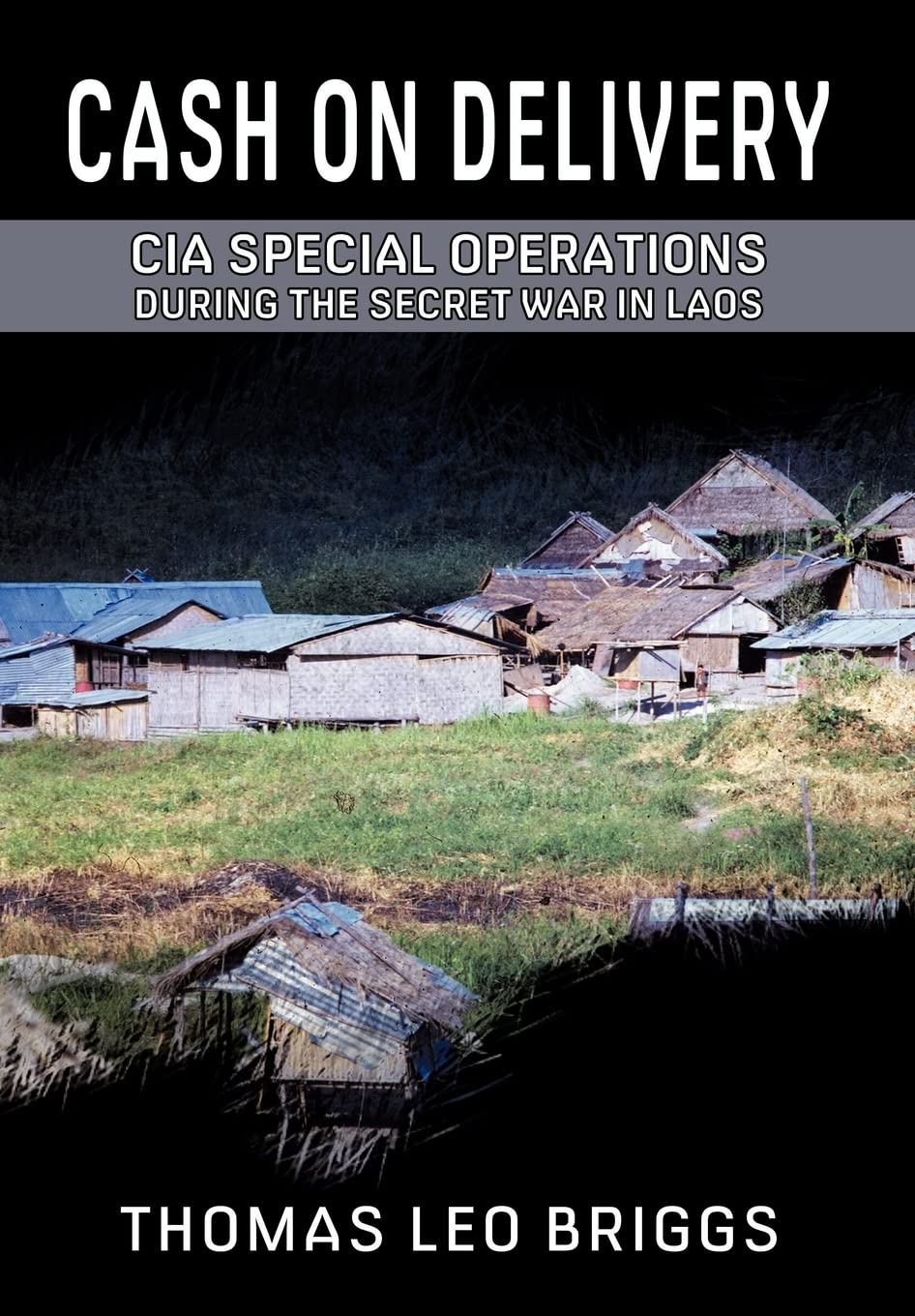
Cash on Delivery: CIA Special Operations During the Secret War in Laos

Description:

"Cash on Delivery: CIA Special Operations During the Secret War in Laos" is a detailed accounting of a CIA program directed by a CIA operations officer that sent small teams of irregulars behind enemy lines in Laos to find, fix and destroy North Vietnamese Army units, capture NVA soldiers or encourage them to defect, intercept NVA radio communications, and recruit NVA soldiers to spy and report on their comrades. It is a unique contribution to the history of the Vietnam War describing valuable experiences using surrogates to conduct intelligence and combat operations that have little or no adverse impact on the United States government's relations with the peoples and governments of other nations. An important lesson in the post 9/11 world of countering terrorism all over the globe where we do not have enough American troops to get the job done without political consequences. The book also describes the daring and dangerous rescue of Raven 42, a U.S. Air Force forward air controller shot down while supporting Lao irregular surrogate forces fighting NVA main force units in Laos, attempts to infiltrate Cambodia to collect intelligence on the North Vietnamese in early 1970, the effort to uncover information about a missing Air America crewman captured in 1963, the tragic fatal crash of an aircraft carrying four of the author's best Thai operational assistants, and the uncovering of a mole hidden in a Royal Lao government military headquarters. Here are intimate details that have never before appeared in print, recounting the planning and execution of a variety of special operations, conceived and carried out behind enemy lines by the CIA using only Lao irregular surrogates. The CIA employed surrogates in southern Laos to force the North Vietnamese Army to keep combat units there to defend their logistical supply line rather than send them to fight U.S. and allied forces in South Vietnam. For the duration of U.S. participation in the Vietnam War the CIA succeeded in that goal.


Reviews:

5.0 out of 5 stars A 'must read' for today's officers

M.i.A. · February 12, 2010

A gripping account of CIA activities in Laos during the Vietnam War, written by one of the officers who ran these operations. Briggs presents in easily readable form details not previously made public and thought processes of those making decisions, ending with a valuable 'lessons learned' segment certain to be useful to those who follow in his footsteps. A 'must read' for today's officers, or they are destined to repeat mistakes made in the past.

5.0 out of 5 stars Accurate story

P.L. · July 29, 2023

I know the author and flew for him in Laos , 1979/1980. True story about my friend, Gene DeBruin, POW. A must read.

4.0 out of 5 stars Read This One

J.H. · January 12, 2012

Numerous books have appeared in the past 15-20 years about the CIA's so-called "secret war" in Laos-- including a recently declassified official Agency history. Insofar as I am aware, however, none of these have focused to any extent on operations in the southern Laos panhandle. Most of them dwell on the struggle up north for control of the Plain of Jars. And until this book, none provided a detailed breakdown of how the indigenous Lao guerrilla teams were organized, how their indigenous team leaders were selected, or on the day to day work of the CIA case officers who managed them. So Cash on Delivery gives us a fresh and unique look at the struggle for Laos. I appreciated it very much.The balance of the narrative focuses on the tactical day to day work carried out from Pakse Base to insert various types of indigenous Lao guerrilla teams into the Ho Chi Minh Trail for roadwatch, sabotage and prisoner-snatch operations. It's a fascinating read, relating the story of often mundane day to day case officer work but punctuated throughout by accounts of the grave dangers confronting CIA Paramilitary Case Officers (PMCOs) and also the personal bravery by those CIA Officers and their indigenous charges. It also details the exceedingly brave actions by contract personnel of the several Agency proprietary airlines, by US Air Force Ravens (forward air controllers), and by uniformed pilots and air crews of the US Air Force and Navy-- all working with CIA as one team in an effort to tie up mainforce North Vietnamese Army units and to interdict their resupply routes along the Ho Chi Minh Trail. And regardless of what anyone thinks about the effort in Laos, it was a resounding strategic success whereby no more than about 50 CIA officers and their indigenous Laotian tribal units led the effort to tie up two full People's Army of Vietnam (PAVN) infantry divisions from 1961 until 1975. The CIA's very successful efforts in Laos only became untenable after the Nixon Administration signed the peace accord with Hanoi and withdraw its support for the South Vietnamese government. With the seizure of southern Vietnam by the PAVN in April 1975, the situation in Laos (and neighboring Cambodia) was no longer tenable.I think the level of detail on team organization, team numbering system and myriad landing, or "Lima" sites upcountry might quickly cause the eyes of the general reader to glaze over. For the student of counterinsurgency, or those of us with first-hand experience in Indochina, however, such detail is terribly interesting. Fortunately, the author includes a map of his theater of operations designating the locations of the action; without it, a general reader unfamiliar with the geography of Laos would quickly get lost.Of particular note are the several examples provided to illustrate how the author worked hard to improve intelligence collection during his tour in Laos. This is an important point, especially for the general reader, who might not be able to discern the difference between civilian paramilitary case officers of the CIA and the special forces of the Pentagon. The crystal clear difference always has been that while both are capable of training planning and executing special operations behind enemy lines, only CIA officers are specially trained and certified as Core Collectors. Thus, while they are training, they are also recruiting sources.The final chapter, "Speaking Truth to Power" hit home and I found myself agreeing with nearly all that the author has to say about senior management failures, a growing risk-averse culture at Langley, political interference and the creation of needless and mindless bureaucratic "reforms" (like the creation of the National Intelligence Director) that have not only failed to reform anything but have made things much much worse. I also agreed with the author's position on the purpose and role of CIA's Special Operations Group.My only disagreement lies with the author's contention that CIA mis-used its SOG teams in the opening volley of the War on Terrorism following 9-11-01. The author is correct that our Jawbreaker teams did take on the role normally reserved for US military special forces teams. But surely he knows that in the immediate aftermath of 9-11-01, the US military had no action plan to get its personnel inside Afghanistan, while CIA/SAD/SOG and CIA/CTC already had a plan on the shelf, enabling our PMCO's to insert and immediately begin organizing tribal resistance to the Taliban and Al Qaeda. It took the US Army weeks to get its teams even to the staging areas in the "stans" north of Afghanistan and then they discovered that their Army helicopters did not have the altitude or power to airlift the Army Triple Nickle teams over the Hindu Kush range and into the Panshir Valley. CiA, on the other hand, was equipped with Russian-built MI-17s-- a jet powered work horse with the ability to fly over the Hindu Kush. And in the end, CIA had to send its MI-17s out to pick up the Army special forces units and deliver them to theater. Were mistakes made? Sure, including some fatal ones. But the reality at the time was that when CIA had the only game-plan in town the President used his authority to send the CIA to war.The author may not have been in a position to know just how much angst this caused Secretary of Defense Donald Rumsfeld, who had to sit and watch the military sit idly by on the sidelines for weeks while Agency personnel were already bringing the war to the enemy. But of this I am certain: Mr. Briggs, as a seasoned paramilitary operations officer, remembers the old saying that, "WHEN AMERICA IS IN PERIL, THE PENTAGON BEGINS PLANNING WHILE THE CIA GUYS GRAB A WEAPON AND JUMP ON THE TRUCK."My point is that CIA had the only viable Special Operations capability in Aghanistan in the early days. As time went on, the Agency PMCOs settled back into their traditional roles as program managers, training indigenous units, training indigenous police and the like-- and recruiting sources.There is some unnecessary redundancy throughout the book. The author explains that he wrote the book over many years, which partially explains these redundancies-- but a good edit and final proof would have eliminated this problem. Perhaps in the next edition?All in all this is a fine book and I would recommend it enthusiastically to anyone interested in the perspective of an experienced and respected CIA street officer. Clearly, as is often said inside the Velvet Prison, Tom Briggs was "one of us."

5.0 out of 5 stars Must Read

s.a.h. · April 10, 2016

As a master's degree student in Thai studies at Bangkok's Chulalongkorn University whose master's thesis is on the Laos war, I must recommend this book as one of the most gripping, knowledgeable, and articulate reads on the CIAs efforts there. The book provides key insights on the war, weaved into an exciting narrative that will leave you unable to put the book down. Congratulations Mr. Briggs for a great book!

5.0 out of 5 stars A great look at the Intel guys behind the SOF war in SE Asia

I.M. · June 24, 2016

Compelling reading. As a former Military Intel guy in the Army I found this story to be a fascinating study on a side of the Spec Ops war in SE Asia one rarely hears of. Amazing anecdotes and a look into History.

5.0 out of 5 stars Briggs wrote an important book

R.L. · April 22, 2015

It is abundantly clear that this personal account of the secret CIA war in Laos was written by Briggs as accurately and as completely as the author could portray. I only wish this story could have been made known closer to real time more than 40 years ago, but I am glad it has finally been written for the good of posterity. I especially enjoyed reading the details of the shoot down and amazing recovery of Raven 42. This book will help people today to understand better what was really happening during the war in Southeast Asia which changed the lives of so many of us who had lived during that tumultuous time.

3.0 out of 5 stars Deep in the Weeds

F. · September 1, 2020

During this pandemic I've been catching up on old Laos books and posting reviews. Yes, I need to get a life. Cash on Delivery is earnest, apparently factual, and deals with a theater rarely covered in other accounts. Some sections read well, such as the one on POW/MIAs and Eugene DeBruin and the one on the rescue of a downed Raven pilot, but much of it is too deep in the weeds for this reader. The author’s interest in creating a historical record leads to numbingly long recitations of units and numbers and also, at the end, a platform to preach. Rarely do I skip over sections in books, but this one broke me. Editing for a general reader would have eliminated a lot of that as well as repetitions.

5.0 out of 5 stars Briggs provides a grass roots explanation of Laos, a creature of the myriad of Geneva Conventions largely unfulfilled.

O.P. · July 24, 2013

I was in the area with a joint higher command at the time frame at least in part. I got to work with all sorts. Briggs nailed the Big Picture on the head, say, 100 percent. I am now in my seventies and retired from the business. It is tough to quit. I have to go back once more to see and walk the ground today. I spent a lot of time in Asia, but Laos got to me.

Parfait

M.M. · March 14, 2014

Tout ce qui concerne le Laos m'intéresse. Ce livre couvre une étape importante de l'histoire du pays. Les témoignages directs sont toujours utiles.

Cash on Delivery: CIA Special Operations During the Secret War in Laos

Product ID: U0984105948
Condition: New

4.5

AED22902

Price includes VAT & Import Duties
Type: Hardcover
Availability: In Stock

Quantity:

|

Order today to get by 7-14 business days

This item qualifies for free delivery

Returns & Warranty policies

Imported From: United States

At BOLO, we work hard to ensure the products you receive are new, genuine, and sourced from reputable suppliers.

BOLO is not an authorized or official retailer for most brands, nor are we affiliated with manufacturers unless specifically stated on a product page. Instead, we source verified sellers, authorized distributors or directly from the manufacturer.

Each product undergoes thorough inspection and verification at our consolidation and fulfilment centers to ensure it meets our strict authenticity and quality standards before being shipped and delivered to you.

If you ever have concerns regarding the authenticity of a product purchased from us, please contact Bolo Support. We will review your inquiry promptly and, if necessary, provide documentation verifying authenticity or offer a suitable resolution.

Your trust is our top priority, and we are committed to maintaining transparency and integrity in every transaction.

All product information, images, descriptions, and reviews originate from the manufacturer or from trusted sellers overseas. BOLO is not affiliated with, endorsed by, or an authorized retailer for most brands listed on our website unless stated otherwise.

While we strive to display accurate information, variations in packaging, labeling, instructions, or formulation may occasionally occur due to regional differences or supplier updates. For detailed or manufacturer-specific information, please contact the brand directly or reach out to BOLO Support for assistance.

Unless otherwise stated, all prices displayed on the product page include applicable taxes and import duties.

BOLO operates in accordance with the laws and regulations of United Arab Emirates. Any items found to be restricted or prohibited for sale within the UAE will be cancelled prior to shipment. We take proactive measures to ensure that only products permitted for sale in United Arab Emirates are listed on our website.

All items are shipped by air, and any products classified as “Dangerous Goods (DG)” under IATA regulations will be removed from the order and cancelled.

All orders are processed manually, and we make every effort to process them promptly once confirmed. Products cancelled due to the above reasons will be permanently removed from listings across the website.

Similar suggestions by Bolo

More from this brand

Similar items from “Vietnam War”

Cash on Delivery: CIA Special Operations During the Secret War in Laos

Product ID: U0984105948
Condition: New

4.5

Cash on Delivery: CIA Special Operations During the Secret War in Laos-0
Type: Hardcover

AED22902

Price includes VAT & Import Duties
Availability: In Stock

Quantity:

|

Order today to get by 7-14 business days

This item qualifies for free delivery

Returns & Warranty policies

Imported From: United States

At BOLO, we work hard to ensure the products you receive are new, genuine, and sourced from reputable suppliers.

BOLO is not an authorized or official retailer for most brands, nor are we affiliated with manufacturers unless specifically stated on a product page. Instead, we source verified sellers, authorized distributors or directly from the manufacturer.

Each product undergoes thorough inspection and verification at our consolidation and fulfilment centers to ensure it meets our strict authenticity and quality standards before being shipped and delivered to you.

If you ever have concerns regarding the authenticity of a product purchased from us, please contact Bolo Support. We will review your inquiry promptly and, if necessary, provide documentation verifying authenticity or offer a suitable resolution.

Your trust is our top priority, and we are committed to maintaining transparency and integrity in every transaction.

All product information, images, descriptions, and reviews originate from the manufacturer or from trusted sellers overseas. BOLO is not affiliated with, endorsed by, or an authorized retailer for most brands listed on our website unless stated otherwise.

While we strive to display accurate information, variations in packaging, labeling, instructions, or formulation may occasionally occur due to regional differences or supplier updates. For detailed or manufacturer-specific information, please contact the brand directly or reach out to BOLO Support for assistance.

Unless otherwise stated, all prices displayed on the product page include applicable taxes and import duties.

BOLO operates in accordance with the laws and regulations of United Arab Emirates. Any items found to be restricted or prohibited for sale within the UAE will be cancelled prior to shipment. We take proactive measures to ensure that only products permitted for sale in United Arab Emirates are listed on our website.

All items are shipped by air, and any products classified as “Dangerous Goods (DG)” under IATA regulations will be removed from the order and cancelled.

All orders are processed manually, and we make every effort to process them promptly once confirmed. Products cancelled due to the above reasons will be permanently removed from listings across the website.

Description:

"Cash on Delivery: CIA Special Operations During the Secret War in Laos" is a detailed accounting of a CIA program directed by a CIA operations officer that sent small teams of irregulars behind enemy lines in Laos to find, fix and destroy North Vietnamese Army units, capture NVA soldiers or encourage them to defect, intercept NVA radio communications, and recruit NVA soldiers to spy and report on their comrades. It is a unique contribution to the history of the Vietnam War describing valuable experiences using surrogates to conduct intelligence and combat operations that have little or no adverse impact on the United States government's relations with the peoples and governments of other nations. An important lesson in the post 9/11 world of countering terrorism all over the globe where we do not have enough American troops to get the job done without political consequences. The book also describes the daring and dangerous rescue of Raven 42, a U.S. Air Force forward air controller shot down while supporting Lao irregular surrogate forces fighting NVA main force units in Laos, attempts to infiltrate Cambodia to collect intelligence on the North Vietnamese in early 1970, the effort to uncover information about a missing Air America crewman captured in 1963, the tragic fatal crash of an aircraft carrying four of the author's best Thai operational assistants, and the uncovering of a mole hidden in a Royal Lao government military headquarters. Here are intimate details that have never before appeared in print, recounting the planning and execution of a variety of special operations, conceived and carried out behind enemy lines by the CIA using only Lao irregular surrogates. The CIA employed surrogates in southern Laos to force the North Vietnamese Army to keep combat units there to defend their logistical supply line rather than send them to fight U.S. and allied forces in South Vietnam. For the duration of U.S. participation in the Vietnam War the CIA succeeded in that goal.


Reviews:

5.0 out of 5 stars A 'must read' for today's officers

M.i.A. · February 12, 2010

A gripping account of CIA activities in Laos during the Vietnam War, written by one of the officers who ran these operations. Briggs presents in easily readable form details not previously made public and thought processes of those making decisions, ending with a valuable 'lessons learned' segment certain to be useful to those who follow in his footsteps. A 'must read' for today's officers, or they are destined to repeat mistakes made in the past.

5.0 out of 5 stars Accurate story

P.L. · July 29, 2023

I know the author and flew for him in Laos , 1979/1980. True story about my friend, Gene DeBruin, POW. A must read.

4.0 out of 5 stars Read This One

J.H. · January 12, 2012

Numerous books have appeared in the past 15-20 years about the CIA's so-called "secret war" in Laos-- including a recently declassified official Agency history. Insofar as I am aware, however, none of these have focused to any extent on operations in the southern Laos panhandle. Most of them dwell on the struggle up north for control of the Plain of Jars. And until this book, none provided a detailed breakdown of how the indigenous Lao guerrilla teams were organized, how their indigenous team leaders were selected, or on the day to day work of the CIA case officers who managed them. So Cash on Delivery gives us a fresh and unique look at the struggle for Laos. I appreciated it very much.The balance of the narrative focuses on the tactical day to day work carried out from Pakse Base to insert various types of indigenous Lao guerrilla teams into the Ho Chi Minh Trail for roadwatch, sabotage and prisoner-snatch operations. It's a fascinating read, relating the story of often mundane day to day case officer work but punctuated throughout by accounts of the grave dangers confronting CIA Paramilitary Case Officers (PMCOs) and also the personal bravery by those CIA Officers and their indigenous charges. It also details the exceedingly brave actions by contract personnel of the several Agency proprietary airlines, by US Air Force Ravens (forward air controllers), and by uniformed pilots and air crews of the US Air Force and Navy-- all working with CIA as one team in an effort to tie up mainforce North Vietnamese Army units and to interdict their resupply routes along the Ho Chi Minh Trail. And regardless of what anyone thinks about the effort in Laos, it was a resounding strategic success whereby no more than about 50 CIA officers and their indigenous Laotian tribal units led the effort to tie up two full People's Army of Vietnam (PAVN) infantry divisions from 1961 until 1975. The CIA's very successful efforts in Laos only became untenable after the Nixon Administration signed the peace accord with Hanoi and withdraw its support for the South Vietnamese government. With the seizure of southern Vietnam by the PAVN in April 1975, the situation in Laos (and neighboring Cambodia) was no longer tenable.I think the level of detail on team organization, team numbering system and myriad landing, or "Lima" sites upcountry might quickly cause the eyes of the general reader to glaze over. For the student of counterinsurgency, or those of us with first-hand experience in Indochina, however, such detail is terribly interesting. Fortunately, the author includes a map of his theater of operations designating the locations of the action; without it, a general reader unfamiliar with the geography of Laos would quickly get lost.Of particular note are the several examples provided to illustrate how the author worked hard to improve intelligence collection during his tour in Laos. This is an important point, especially for the general reader, who might not be able to discern the difference between civilian paramilitary case officers of the CIA and the special forces of the Pentagon. The crystal clear difference always has been that while both are capable of training planning and executing special operations behind enemy lines, only CIA officers are specially trained and certified as Core Collectors. Thus, while they are training, they are also recruiting sources.The final chapter, "Speaking Truth to Power" hit home and I found myself agreeing with nearly all that the author has to say about senior management failures, a growing risk-averse culture at Langley, political interference and the creation of needless and mindless bureaucratic "reforms" (like the creation of the National Intelligence Director) that have not only failed to reform anything but have made things much much worse. I also agreed with the author's position on the purpose and role of CIA's Special Operations Group.My only disagreement lies with the author's contention that CIA mis-used its SOG teams in the opening volley of the War on Terrorism following 9-11-01. The author is correct that our Jawbreaker teams did take on the role normally reserved for US military special forces teams. But surely he knows that in the immediate aftermath of 9-11-01, the US military had no action plan to get its personnel inside Afghanistan, while CIA/SAD/SOG and CIA/CTC already had a plan on the shelf, enabling our PMCO's to insert and immediately begin organizing tribal resistance to the Taliban and Al Qaeda. It took the US Army weeks to get its teams even to the staging areas in the "stans" north of Afghanistan and then they discovered that their Army helicopters did not have the altitude or power to airlift the Army Triple Nickle teams over the Hindu Kush range and into the Panshir Valley. CiA, on the other hand, was equipped with Russian-built MI-17s-- a jet powered work horse with the ability to fly over the Hindu Kush. And in the end, CIA had to send its MI-17s out to pick up the Army special forces units and deliver them to theater. Were mistakes made? Sure, including some fatal ones. But the reality at the time was that when CIA had the only game-plan in town the President used his authority to send the CIA to war.The author may not have been in a position to know just how much angst this caused Secretary of Defense Donald Rumsfeld, who had to sit and watch the military sit idly by on the sidelines for weeks while Agency personnel were already bringing the war to the enemy. But of this I am certain: Mr. Briggs, as a seasoned paramilitary operations officer, remembers the old saying that, "WHEN AMERICA IS IN PERIL, THE PENTAGON BEGINS PLANNING WHILE THE CIA GUYS GRAB A WEAPON AND JUMP ON THE TRUCK."My point is that CIA had the only viable Special Operations capability in Aghanistan in the early days. As time went on, the Agency PMCOs settled back into their traditional roles as program managers, training indigenous units, training indigenous police and the like-- and recruiting sources.There is some unnecessary redundancy throughout the book. The author explains that he wrote the book over many years, which partially explains these redundancies-- but a good edit and final proof would have eliminated this problem. Perhaps in the next edition?All in all this is a fine book and I would recommend it enthusiastically to anyone interested in the perspective of an experienced and respected CIA street officer. Clearly, as is often said inside the Velvet Prison, Tom Briggs was "one of us."

5.0 out of 5 stars Must Read

s.a.h. · April 10, 2016

As a master's degree student in Thai studies at Bangkok's Chulalongkorn University whose master's thesis is on the Laos war, I must recommend this book as one of the most gripping, knowledgeable, and articulate reads on the CIAs efforts there. The book provides key insights on the war, weaved into an exciting narrative that will leave you unable to put the book down. Congratulations Mr. Briggs for a great book!

5.0 out of 5 stars A great look at the Intel guys behind the SOF war in SE Asia

I.M. · June 24, 2016

Compelling reading. As a former Military Intel guy in the Army I found this story to be a fascinating study on a side of the Spec Ops war in SE Asia one rarely hears of. Amazing anecdotes and a look into History.

5.0 out of 5 stars Briggs wrote an important book

R.L. · April 22, 2015

It is abundantly clear that this personal account of the secret CIA war in Laos was written by Briggs as accurately and as completely as the author could portray. I only wish this story could have been made known closer to real time more than 40 years ago, but I am glad it has finally been written for the good of posterity. I especially enjoyed reading the details of the shoot down and amazing recovery of Raven 42. This book will help people today to understand better what was really happening during the war in Southeast Asia which changed the lives of so many of us who had lived during that tumultuous time.

3.0 out of 5 stars Deep in the Weeds

F. · September 1, 2020

During this pandemic I've been catching up on old Laos books and posting reviews. Yes, I need to get a life. Cash on Delivery is earnest, apparently factual, and deals with a theater rarely covered in other accounts. Some sections read well, such as the one on POW/MIAs and Eugene DeBruin and the one on the rescue of a downed Raven pilot, but much of it is too deep in the weeds for this reader. The author’s interest in creating a historical record leads to numbingly long recitations of units and numbers and also, at the end, a platform to preach. Rarely do I skip over sections in books, but this one broke me. Editing for a general reader would have eliminated a lot of that as well as repetitions.

5.0 out of 5 stars Briggs provides a grass roots explanation of Laos, a creature of the myriad of Geneva Conventions largely unfulfilled.

O.P. · July 24, 2013

I was in the area with a joint higher command at the time frame at least in part. I got to work with all sorts. Briggs nailed the Big Picture on the head, say, 100 percent. I am now in my seventies and retired from the business. It is tough to quit. I have to go back once more to see and walk the ground today. I spent a lot of time in Asia, but Laos got to me.

Parfait

M.M. · March 14, 2014

Tout ce qui concerne le Laos m'intéresse. Ce livre couvre une étape importante de l'histoire du pays. Les témoignages directs sont toujours utiles.

Similar suggestions by Bolo

More from this brand

Similar items from “Vietnam War”