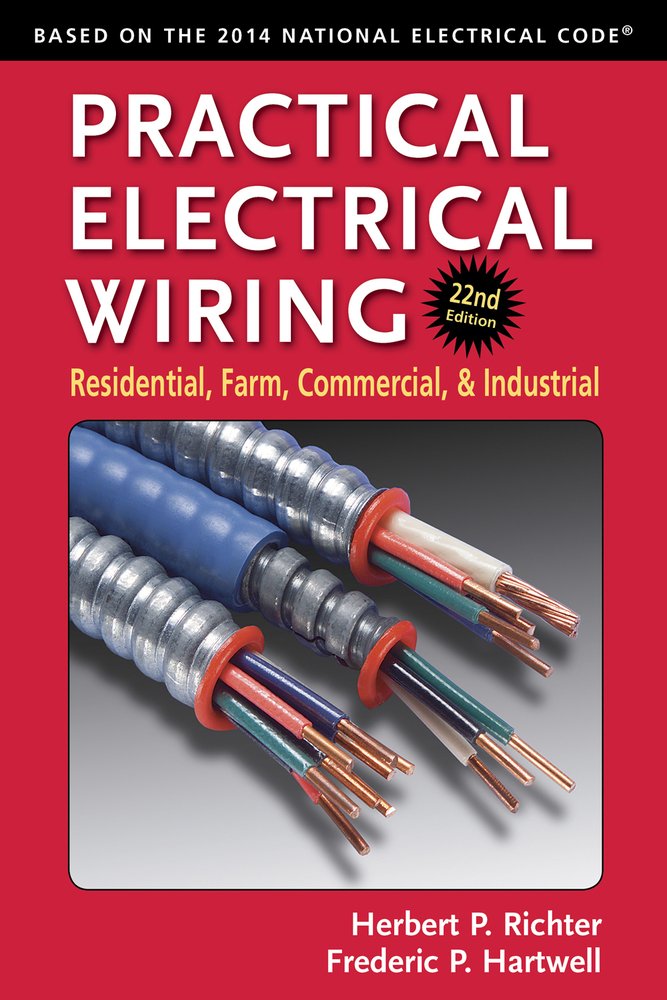
Description:
Editorial Reviews
About the Author
Excerpt. © Reprinted by permission. All rights reserved.
Practical Electrical Wiring
Residential, Farm, Commercial, and Industrial
By F. P. Hartwell, Herbert P. Richter, Marly Cornell, Farkas Graphic ResourcesPark Publishing, Inc.
Copyright © 2014 Park Publishing, Inc.All rights reserved.
ISBN: 978-0-9719779-8-3
CHAPTER 1
NEC®, Product Standards, and Inspection
THE FIRST PART of Practical Electrical Wiring provides the framework for understanding the theory and purpose behind the wiring rules that assure safety. In Parts 2 and 3, the book moves on to the actual practice of wiring — how to select conductors, and the correct wiring methods for installing them and other electrical equipment in accordance with those rules. Practical design guidance is also provided so that installed equipment will provide the benefits we have come to expect from electrical systems in residential, farm, commercial, and industrial settings.
Electricity is powerful. Under control, electricity performs an endless variety of work in a safe manner. But uncontrolled, it can be destructive. Electricity can be controlled if you use the right kinds of wiring and equipment, and install them the right way. It can be dangerous if you use the wrong kinds of wiring or equipment, or if the right kinds are installed improperly. Even properly installed wiring and equipment can become dangerous if not properly maintained. Improper electrical installations can be uneconomical and inconvenient, and they can result in higher insurance rates. Worst of all, unsafe installations can burn, maim, and kill.
Safe wiring practices are the focus of the National Electrical Code® (NEC), but the NEC alone can't provide effective electrical safety. It is only one side of a triangle that comprises the essential elements of electrical safety. Product standards form the second side of this triangle. When you make an electrical installation, you use various electrical products. The most careful electrical installation soon fails if the products used to complete it haven't been adequately designed for their purpose. Inspection provides the third side of the triangle. Because it's human nature to make errors, you can't be sure your electrical installation is really safe until a disinterested party reviews your work. Take away any one of the sides of the triangle, and the electrical safety system is dangerously incomplete. Although the balance of this book focuses on NEC rules, an appreciation of the larger picture helps in understanding the reasons for the rules.
NATIONAL ELECTRICAL CODE (NEC)
The National Electrical Code is a set of rules detailing the proper methods for installing electrical materials so that the finished job will be safe. It is published by the National Fire Protection Association, Inc. (NFPA), 1 Batterymarch Park, Quincy, Massachusetts 02269. The National Electrical Code is referred to in this book as the NEC. As you read this book, you will need to refer frequently to your copy of the 2014 NEC in order to follow the actual electrical requirement under discussion.
Formulation of the NEC by the NEC Committee The National Electrical Code Committee of NFPA formulates the NEC. The NEC Committee has members representing all facets of the electrical industry. The NEC Committee consists of the Technical Correlating Committee and nineteen sectional committees called Code-Making Panels. The members of each panel are nationally recognized experts in one or more fields. These experts revise and update the NEC at three-year intervals, covering new materials and methods and deleting any obsolete rules. In the process, some section numbers of the NEC may change even where the text itself remains unchanged. For example, the NEC article covering grounding — one of the most important in the entire document — was completely reorganized for the 1999 NEC, resulting in every section number being changed. Therefore, a reference to an NEC rule in this book may have a different section number from that used in a former edition of this book in referring to the same NEC rule.
By NFPA rules, no more than one-third of a Code-Making Panel can represent a single interest, and it takes the agreement of two-thirds to accept a change in the NEC. That forces compromises that work toward consensus in developing a new NEC. After the panels meet, the Technical Correlating Committee reviews their work to avoid inadvertent conflicts among NEC articles. Anyone can submit a proposal, and after the initial proposal review NFPA publishes the proposed changes in its official Report on Proposals (available without charge as long as it's in print). Anyone can comment on the changes as well. The public comments go back to the Code-Making Panels for their review prior to a vote at the NFPA annual meeting. For the 2014 NEC cycle, 3,745 proposals were received for Code -Making Panel review, and 1,625 comments on the initial actions were taken on those proposals.
This extraordinary degree of open participation by so many interested parties makes the NEC an authoritative code, and compliance with it will result in a safe installation if the installation is also maintained to remain in compliance. The word "authoritative" as used here means "an accepted source of expert information" rather than "the power to enforce," because the NEC does not become law unless legally adopted as a law or code in a particular locality.
How local codes relate to the NEC In the United States, it is the states rather than the federal government that regulate electrical work. Some states delegate that authority to municipalities; others retain it on the state level. However, almost every locality has an electrical code or ordinance. Any of these local codes will have the National Electrical Code as its basis. It isn't practical for a local or state government to recreate from scratch an entire electrical code. Electrical installations in any locality must meet the requirements of the electrical code in that locality. Many other countries use the NEC as well. For them, the extent to which there are local NEC amendments depends on local needs, culture, and political history.
Some local code rules go beyond NEC requirements; some relax them, and some address local conditions that are beyond the usual scope of the NEC. For example, in the earthquake-prone areas of the West Coast, you'll often find modifications to address seismic problems. Other localities adopt the National Electrical Code without any changes.
Enforcement of the NEC When the NEC is legally adopted by a city, town, state, or other governmental body as an official code of that governmental body, it becomes law. Compliance with the NEC in that locality then becomes mandatory on the effective date determined at the time of official adoption.
The NEC concerns itself with minimum safety, not good design The NEC is concerned with safety only, as made clear by the following two statements excerpted from NEC 90.1:
The purpose of this Code is the practical safeguarding of persons and property from hazards arising from the use of electricity. This Code is not intended as a design specification or an instruction manual for untrained persons.
This Code contains provisions that are considered necessary for safety. Compliance therewith and proper maintenance will result in an installation that is essentially free from hazard but not necessarily efficient, convenient, or adequate for good service or future expansion of electrical use.
The safety measures advocated in this book are based on NEC requirements as the writer interprets the 2014 NEC. Because the NEC is not intended as a design or instruction manual, this book also covers practical design and installation methods, and the economic and convenience aspects of the art as well as safety.
Think of the NEC as an essential tool on your belt, just as essential as a screwdriver. Electrical work constantly changes. Every day you're likely to find a field application that wasn't quite the same as your instructor or this book might have anticipated. The NEC, if you know how to use it, gives you access to more than one hundred years of experience in terms of making safe electrical installations. That's why every person who installs electrical wiring and equipment absolutely needs to have and use a copy of the NEC. One of the objectives of this book is to make it easier to understand and use the NEC so you can properly apply its rules to that unanticipated situation.
Format of the NEC The NEC consists of an introduction and nine chapters, followed by "Informative Annexes" that, although not part of the mandatory rules in the body of the NEC, provide critical explanatory text to assist in uniform application. Each chapter contains several articles, except Chapter 9, which contains general tables. The first four chapters apply generally to all electrical work. The next three chapters cover special occupancies and special equipment and conditions, and supplement or modify the general rules. The eighth chapter covers communications circuits, and generally stands on its own. Some articles are divided into parts designated by Roman numerals, such as Part I, Part II, etc. All articles are divided into sections, but effective with the 2002 NEC the word "section" is no longer used to refer to specific provisions of the NEC. Internal references simply point to the appropriate numerical reference, for example "as covered in 90.1." Many sections have subsections, and some have sub-subsections. Some sections or their subdivisions have numbered paragraphs. Some sections, subsections, etc., are followed by informational notes. All mandatory rules of the NEC are in full-size print. The informational notes contain explanatory or informational material and are not mandatory rules. If you think an informational note you're reading changes the rule it follows, go back and reread the rule to find your error. Informational notes only explain and inform; they never change a rule.
History of the NEC The first electrical code was the "Standard for Electric Light Wires, Lamps, Etc.," which was adopted by the New York Board of Fire Underwriters on October 19, 1881. It contained seven rules plus instructions for applying for permission to use electric lights. That was the ancestor of the NEC.
In May 1882 the National Board of Fire Underwriters adopted the rules of the New York Board of Fire Underwriters. Later, similar rules were adopted by various other groups. Finally, a committee consisting of representatives from the fire insurance groups, the electric utility company association, and a number of other national organizations produced the first National Electrical Code in 1897. This was the first electrical code that represented a nationwide consensus of the entire electrical industry without any single group having a dominant position.
NFPA — a worldwide fire safety organization The National Fire Protection Association is a nonprofit voluntary membership organization formed in 1896 with the primary objective of achieving a fire-safe environment. It has members in the United States and all over the world. No single group has a dominant role. In addition to the fire services, the NFPA membership is representative of architects, engineers, and those from other professions; of industry and commerce; government agencies at local, state, regional, and national levels, including the military branches; hospital and school administrators; and others with vocational or even avocational interests in achieving a "fire-safe" environment. (The term "fire safe" is used here in its broadest sense and includes all facets of fire safety, including but not limited to electrical safety.)
The many codes, standards, recommendations, and manuals developed by NFPA technical committees, which are composed of nationally recognized experts in their respective fields, have been widely adopted by national and local governments and by private industry. One of these, the NEC, is the most widely adopted and used construction code in the world.
Interpretations of the NEC Unfortunately, many parts of the NEC are interpreted differently by different people. The interpretations in this book are the opinions of the writer, based on experience and the opinions of other professionals. There is no "official interpretation" of the NEC as a whole, and very few interpretations of specific parts of the NEC are handed down. (NFPA, in its Regulations Governing Committee Projects, outlines how such interpretations may be obtained; it is not a simple procedure.) NEC 90.4 makes it entirely clear that the local electrical inspector has the final word in any situation. Most jurisdictions have administrative appeal mechanisms in place, however, to prevent an inspector from acting purely on whim.
PRODUCT STANDARDS AND CERTIFICATION
The National Electrical Manufacturers Association (NEMA) has representatives on all of the nineteen NEC Code-Making Panels for a simple reason: It does no good for the NEC to consider a new rule if products, for various reasons, could not economically be made to conform to it. Conversely, when a rule does change, the manufacturers need to know why so they can respond: demands of the market change with each new NEC edition. Just as the NEC is the level playing field for electrical designers and installers, the product standards constitute the level playing field for manufacturers.
Operating within the policy framework established by the NEC, industry product standards set the minimum standard for electrical product design. Although most widely known as a testing laboratory, Underwriters Laboratories (UL) generates the majority of electrical product standards used in the United States. For this reason, UL also has representatives on all of the nineteen Code-Making Panels.
Even if its present size were tripled, the NEC could not possibly encompass the level of detail in a product standard. For example, various NEC rules require luminaires (lighting fixtures) to be marked with certain information. Only the product standards, however, translate that policy requirement into actual markings. The product standards include such details as size of lettering, durability of label adhesive under specific temperature exposure, etc.
Product standards are meaningful Product standards generally establish the testing procedures a product must endure. In order for a test to be meaningful, the product must be tested under the most severe conditions that could be encountered when the product is being used as intended. There must also be a safety factor allowance. A fuse, as one example, must be able to operate (blow) and open the circuit (turn the circuit off as a switch does) within a predetermined time when, for instance, a wire is overloaded beyond its safe capacity; it must also blow if there is a short circuit, in which case the current might be a hundred or more times greater than in an overloaded wire. In other words, it must be able to blow when the current is the maximum amount available; and it must do that without exploding or disintegrating, which could start a fire.
As an example, the old plug fuses, now largely obsolete but still manufactured, are made only in ratings up to (but not exceeding) 30 amps. However, they must function properly in a circuit that can deliver 10,000 amps, which is the amount of current used by UL to test the two fuses shown in Fig. 1–1. Each fuse had a handful of cotton placed on top of it when the fuse was tested inside a fireproof vault. The cotton on the lower fuse did not ignite when the fuse operated (blew). The fuse shown at the top not only burned up the cotton, but it severely damaged the fuseholder as well as itself. Some fuses explode while undergoing this test, sending molten particles flying against the walls and ceiling of the test vault. The fuse at the bottom in Fig. 1–1 was one of a group that had been submitted for testing by a reliable manufacturer. Only that fuse complied with the product standard and was therefore eligible to receive a listing. Similar meaningful tests are built into all product standards governing potential submittals for listing, such as wires, cables, and appliances.
(Continues...)Excerpted from Practical Electrical Wiring by F. P. Hartwell, Herbert P. Richter, Marly Cornell, Farkas Graphic Resources. Copyright © 2014 Park Publishing, Inc.. Excerpted by permission of Park Publishing, Inc..
All rights reserved. No part of this excerpt may be reproduced or reprinted without permission in writing from the publisher.
Excerpts are provided by Dial-A-Book Inc. solely for the personal use of visitors to this web site.
Details:
Visit the Park Publishing, Inc. Store
Practical Electrical Wiring: Residential, Farm, Commercial, and Industrial
AED56176
Quantity:
Order today to get by 7-14 business days
This item qualifies for free delivery
 Imported From: United States
At BOLO, we work hard to ensure the products you receive are new, genuine, and sourced from reputable suppliers.
Every product in the BOLO catalogue is sourced through our Verified Global Supply Network of verified sellers, authorized distributors or directly from the manufacturer.
Each product undergoes thorough inspection and verification at our consolidation and fulfilment centers to ensure it meets our strict authenticity and quality standards before being shipped and delivered to you.
If you ever have concerns regarding the authenticity of a product purchased from us, please contact Bolo Support. We will review your inquiry promptly and, if necessary, provide documentation verifying authenticity or offer a suitable resolution.
Your trust is our top priority, and we are committed to maintaining transparency and integrity in every transaction.
While we strive to display accurate information, variations in packaging, labeling, instructions, or formulation may occasionally occur due to regional differences or supplier updates. For detailed or manufacturer-specific information, please contact the brand directly or reach out to BOLO Support for assistance.
Unless otherwise stated, all prices displayed on the product page include applicable taxes and import duties.
BOLO operates in accordance with the laws and regulations of United Arab Emirates. Any items found to be restricted or prohibited for sale within the United Arab Emirates will be cancelled prior to shipment. We take proactive measures to ensure that only products permitted for sale in United Arab Emirates are listed on our website.
All items are shipped by air, and any products classified as “Dangerous Goods (DG)” under IATA regulations will be removed from the order and cancelled.
All orders are processed manually, and we make every effort to process them promptly once confirmed. Products cancelled due to the above reasons will be permanently removed from listings across the website.
Similar suggestions by Bolo
More from this brand
Similar items from “Do-It-Yourself”
Share with
Or share with link
https://www.bolo.ae/products/U0971977984
Visit the Park Publishing, Inc. Store
Practical Electrical Wiring: Residential, Farm, Commercial, and Industrial
AED56176
Quantity:
Order today to get by 7-14 business days
This item qualifies for free delivery
Imported From: United States
At BOLO, we work hard to ensure the products you receive are new, genuine, and sourced from reputable suppliers.
Every product in the BOLO catalogue is sourced through our Verified Global Supply Network of verified sellers, authorized distributors or directly from the manufacturer.
Each product undergoes thorough inspection and verification at our consolidation and fulfilment centers to ensure it meets our strict authenticity and quality standards before being shipped and delivered to you.
If you ever have concerns regarding the authenticity of a product purchased from us, please contact Bolo Support. We will review your inquiry promptly and, if necessary, provide documentation verifying authenticity or offer a suitable resolution.
Your trust is our top priority, and we are committed to maintaining transparency and integrity in every transaction.
While we strive to display accurate information, variations in packaging, labeling, instructions, or formulation may occasionally occur due to regional differences or supplier updates. For detailed or manufacturer-specific information, please contact the brand directly or reach out to BOLO Support for assistance.
Unless otherwise stated, all prices displayed on the product page include applicable taxes and import duties.
BOLO operates in accordance with the laws and regulations of United Arab Emirates. Any items found to be restricted or prohibited for sale within the United Arab Emirates will be cancelled prior to shipment. We take proactive measures to ensure that only products permitted for sale in United Arab Emirates are listed on our website.
All items are shipped by air, and any products classified as “Dangerous Goods (DG)” under IATA regulations will be removed from the order and cancelled.
All orders are processed manually, and we make every effort to process them promptly once confirmed. Products cancelled due to the above reasons will be permanently removed from listings across the website.
Description:
Editorial Reviews
About the Author
Excerpt. © Reprinted by permission. All rights reserved.
Practical Electrical Wiring
Residential, Farm, Commercial, and Industrial
By F. P. Hartwell, Herbert P. Richter, Marly Cornell, Farkas Graphic ResourcesPark Publishing, Inc.
Copyright © 2014 Park Publishing, Inc.All rights reserved.
ISBN: 978-0-9719779-8-3
CHAPTER 1
NEC®, Product Standards, and Inspection
THE FIRST PART of Practical Electrical Wiring provides the framework for understanding the theory and purpose behind the wiring rules that assure safety. In Parts 2 and 3, the book moves on to the actual practice of wiring — how to select conductors, and the correct wiring methods for installing them and other electrical equipment in accordance with those rules. Practical design guidance is also provided so that installed equipment will provide the benefits we have come to expect from electrical systems in residential, farm, commercial, and industrial settings.
Electricity is powerful. Under control, electricity performs an endless variety of work in a safe manner. But uncontrolled, it can be destructive. Electricity can be controlled if you use the right kinds of wiring and equipment, and install them the right way. It can be dangerous if you use the wrong kinds of wiring or equipment, or if the right kinds are installed improperly. Even properly installed wiring and equipment can become dangerous if not properly maintained. Improper electrical installations can be uneconomical and inconvenient, and they can result in higher insurance rates. Worst of all, unsafe installations can burn, maim, and kill.
Safe wiring practices are the focus of the National Electrical Code® (NEC), but the NEC alone can't provide effective electrical safety. It is only one side of a triangle that comprises the essential elements of electrical safety. Product standards form the second side of this triangle. When you make an electrical installation, you use various electrical products. The most careful electrical installation soon fails if the products used to complete it haven't been adequately designed for their purpose. Inspection provides the third side of the triangle. Because it's human nature to make errors, you can't be sure your electrical installation is really safe until a disinterested party reviews your work. Take away any one of the sides of the triangle, and the electrical safety system is dangerously incomplete. Although the balance of this book focuses on NEC rules, an appreciation of the larger picture helps in understanding the reasons for the rules.
NATIONAL ELECTRICAL CODE (NEC)
The National Electrical Code is a set of rules detailing the proper methods for installing electrical materials so that the finished job will be safe. It is published by the National Fire Protection Association, Inc. (NFPA), 1 Batterymarch Park, Quincy, Massachusetts 02269. The National Electrical Code is referred to in this book as the NEC. As you read this book, you will need to refer frequently to your copy of the 2014 NEC in order to follow the actual electrical requirement under discussion.
Formulation of the NEC by the NEC Committee The National Electrical Code Committee of NFPA formulates the NEC. The NEC Committee has members representing all facets of the electrical industry. The NEC Committee consists of the Technical Correlating Committee and nineteen sectional committees called Code-Making Panels. The members of each panel are nationally recognized experts in one or more fields. These experts revise and update the NEC at three-year intervals, covering new materials and methods and deleting any obsolete rules. In the process, some section numbers of the NEC may change even where the text itself remains unchanged. For example, the NEC article covering grounding — one of the most important in the entire document — was completely reorganized for the 1999 NEC, resulting in every section number being changed. Therefore, a reference to an NEC rule in this book may have a different section number from that used in a former edition of this book in referring to the same NEC rule.
By NFPA rules, no more than one-third of a Code-Making Panel can represent a single interest, and it takes the agreement of two-thirds to accept a change in the NEC. That forces compromises that work toward consensus in developing a new NEC. After the panels meet, the Technical Correlating Committee reviews their work to avoid inadvertent conflicts among NEC articles. Anyone can submit a proposal, and after the initial proposal review NFPA publishes the proposed changes in its official Report on Proposals (available without charge as long as it's in print). Anyone can comment on the changes as well. The public comments go back to the Code-Making Panels for their review prior to a vote at the NFPA annual meeting. For the 2014 NEC cycle, 3,745 proposals were received for Code -Making Panel review, and 1,625 comments on the initial actions were taken on those proposals.
This extraordinary degree of open participation by so many interested parties makes the NEC an authoritative code, and compliance with it will result in a safe installation if the installation is also maintained to remain in compliance. The word "authoritative" as used here means "an accepted source of expert information" rather than "the power to enforce," because the NEC does not become law unless legally adopted as a law or code in a particular locality.
How local codes relate to the NEC In the United States, it is the states rather than the federal government that regulate electrical work. Some states delegate that authority to municipalities; others retain it on the state level. However, almost every locality has an electrical code or ordinance. Any of these local codes will have the National Electrical Code as its basis. It isn't practical for a local or state government to recreate from scratch an entire electrical code. Electrical installations in any locality must meet the requirements of the electrical code in that locality. Many other countries use the NEC as well. For them, the extent to which there are local NEC amendments depends on local needs, culture, and political history.
Some local code rules go beyond NEC requirements; some relax them, and some address local conditions that are beyond the usual scope of the NEC. For example, in the earthquake-prone areas of the West Coast, you'll often find modifications to address seismic problems. Other localities adopt the National Electrical Code without any changes.
Enforcement of the NEC When the NEC is legally adopted by a city, town, state, or other governmental body as an official code of that governmental body, it becomes law. Compliance with the NEC in that locality then becomes mandatory on the effective date determined at the time of official adoption.
The NEC concerns itself with minimum safety, not good design The NEC is concerned with safety only, as made clear by the following two statements excerpted from NEC 90.1:
The purpose of this Code is the practical safeguarding of persons and property from hazards arising from the use of electricity. This Code is not intended as a design specification or an instruction manual for untrained persons.
This Code contains provisions that are considered necessary for safety. Compliance therewith and proper maintenance will result in an installation that is essentially free from hazard but not necessarily efficient, convenient, or adequate for good service or future expansion of electrical use.
The safety measures advocated in this book are based on NEC requirements as the writer interprets the 2014 NEC. Because the NEC is not intended as a design or instruction manual, this book also covers practical design and installation methods, and the economic and convenience aspects of the art as well as safety.
Think of the NEC as an essential tool on your belt, just as essential as a screwdriver. Electrical work constantly changes. Every day you're likely to find a field application that wasn't quite the same as your instructor or this book might have anticipated. The NEC, if you know how to use it, gives you access to more than one hundred years of experience in terms of making safe electrical installations. That's why every person who installs electrical wiring and equipment absolutely needs to have and use a copy of the NEC. One of the objectives of this book is to make it easier to understand and use the NEC so you can properly apply its rules to that unanticipated situation.
Format of the NEC The NEC consists of an introduction and nine chapters, followed by "Informative Annexes" that, although not part of the mandatory rules in the body of the NEC, provide critical explanatory text to assist in uniform application. Each chapter contains several articles, except Chapter 9, which contains general tables. The first four chapters apply generally to all electrical work. The next three chapters cover special occupancies and special equipment and conditions, and supplement or modify the general rules. The eighth chapter covers communications circuits, and generally stands on its own. Some articles are divided into parts designated by Roman numerals, such as Part I, Part II, etc. All articles are divided into sections, but effective with the 2002 NEC the word "section" is no longer used to refer to specific provisions of the NEC. Internal references simply point to the appropriate numerical reference, for example "as covered in 90.1." Many sections have subsections, and some have sub-subsections. Some sections or their subdivisions have numbered paragraphs. Some sections, subsections, etc., are followed by informational notes. All mandatory rules of the NEC are in full-size print. The informational notes contain explanatory or informational material and are not mandatory rules. If you think an informational note you're reading changes the rule it follows, go back and reread the rule to find your error. Informational notes only explain and inform; they never change a rule.
History of the NEC The first electrical code was the "Standard for Electric Light Wires, Lamps, Etc.," which was adopted by the New York Board of Fire Underwriters on October 19, 1881. It contained seven rules plus instructions for applying for permission to use electric lights. That was the ancestor of the NEC.
In May 1882 the National Board of Fire Underwriters adopted the rules of the New York Board of Fire Underwriters. Later, similar rules were adopted by various other groups. Finally, a committee consisting of representatives from the fire insurance groups, the electric utility company association, and a number of other national organizations produced the first National Electrical Code in 1897. This was the first electrical code that represented a nationwide consensus of the entire electrical industry without any single group having a dominant position.
NFPA — a worldwide fire safety organization The National Fire Protection Association is a nonprofit voluntary membership organization formed in 1896 with the primary objective of achieving a fire-safe environment. It has members in the United States and all over the world. No single group has a dominant role. In addition to the fire services, the NFPA membership is representative of architects, engineers, and those from other professions; of industry and commerce; government agencies at local, state, regional, and national levels, including the military branches; hospital and school administrators; and others with vocational or even avocational interests in achieving a "fire-safe" environment. (The term "fire safe" is used here in its broadest sense and includes all facets of fire safety, including but not limited to electrical safety.)
The many codes, standards, recommendations, and manuals developed by NFPA technical committees, which are composed of nationally recognized experts in their respective fields, have been widely adopted by national and local governments and by private industry. One of these, the NEC, is the most widely adopted and used construction code in the world.
Interpretations of the NEC Unfortunately, many parts of the NEC are interpreted differently by different people. The interpretations in this book are the opinions of the writer, based on experience and the opinions of other professionals. There is no "official interpretation" of the NEC as a whole, and very few interpretations of specific parts of the NEC are handed down. (NFPA, in its Regulations Governing Committee Projects, outlines how such interpretations may be obtained; it is not a simple procedure.) NEC 90.4 makes it entirely clear that the local electrical inspector has the final word in any situation. Most jurisdictions have administrative appeal mechanisms in place, however, to prevent an inspector from acting purely on whim.
PRODUCT STANDARDS AND CERTIFICATION
The National Electrical Manufacturers Association (NEMA) has representatives on all of the nineteen NEC Code-Making Panels for a simple reason: It does no good for the NEC to consider a new rule if products, for various reasons, could not economically be made to conform to it. Conversely, when a rule does change, the manufacturers need to know why so they can respond: demands of the market change with each new NEC edition. Just as the NEC is the level playing field for electrical designers and installers, the product standards constitute the level playing field for manufacturers.
Operating within the policy framework established by the NEC, industry product standards set the minimum standard for electrical product design. Although most widely known as a testing laboratory, Underwriters Laboratories (UL) generates the majority of electrical product standards used in the United States. For this reason, UL also has representatives on all of the nineteen Code-Making Panels.
Even if its present size were tripled, the NEC could not possibly encompass the level of detail in a product standard. For example, various NEC rules require luminaires (lighting fixtures) to be marked with certain information. Only the product standards, however, translate that policy requirement into actual markings. The product standards include such details as size of lettering, durability of label adhesive under specific temperature exposure, etc.
Product standards are meaningful Product standards generally establish the testing procedures a product must endure. In order for a test to be meaningful, the product must be tested under the most severe conditions that could be encountered when the product is being used as intended. There must also be a safety factor allowance. A fuse, as one example, must be able to operate (blow) and open the circuit (turn the circuit off as a switch does) within a predetermined time when, for instance, a wire is overloaded beyond its safe capacity; it must also blow if there is a short circuit, in which case the current might be a hundred or more times greater than in an overloaded wire. In other words, it must be able to blow when the current is the maximum amount available; and it must do that without exploding or disintegrating, which could start a fire.
As an example, the old plug fuses, now largely obsolete but still manufactured, are made only in ratings up to (but not exceeding) 30 amps. However, they must function properly in a circuit that can deliver 10,000 amps, which is the amount of current used by UL to test the two fuses shown in Fig. 1–1. Each fuse had a handful of cotton placed on top of it when the fuse was tested inside a fireproof vault. The cotton on the lower fuse did not ignite when the fuse operated (blew). The fuse shown at the top not only burned up the cotton, but it severely damaged the fuseholder as well as itself. Some fuses explode while undergoing this test, sending molten particles flying against the walls and ceiling of the test vault. The fuse at the bottom in Fig. 1–1 was one of a group that had been submitted for testing by a reliable manufacturer. Only that fuse complied with the product standard and was therefore eligible to receive a listing. Similar meaningful tests are built into all product standards governing potential submittals for listing, such as wires, cables, and appliances.
(Continues...)Excerpted from Practical Electrical Wiring by F. P. Hartwell, Herbert P. Richter, Marly Cornell, Farkas Graphic Resources. Copyright © 2014 Park Publishing, Inc.. Excerpted by permission of Park Publishing, Inc..
All rights reserved. No part of this excerpt may be reproduced or reprinted without permission in writing from the publisher.
Excerpts are provided by Dial-A-Book Inc. solely for the personal use of visitors to this web site.
Details:
Similar suggestions by Bolo
More from this brand
Similar items from “Do-It-Yourself”
Share with
Or share with link
https://www.bolo.ae/products/U0971977984