Deliver toUnited Arab Emirates
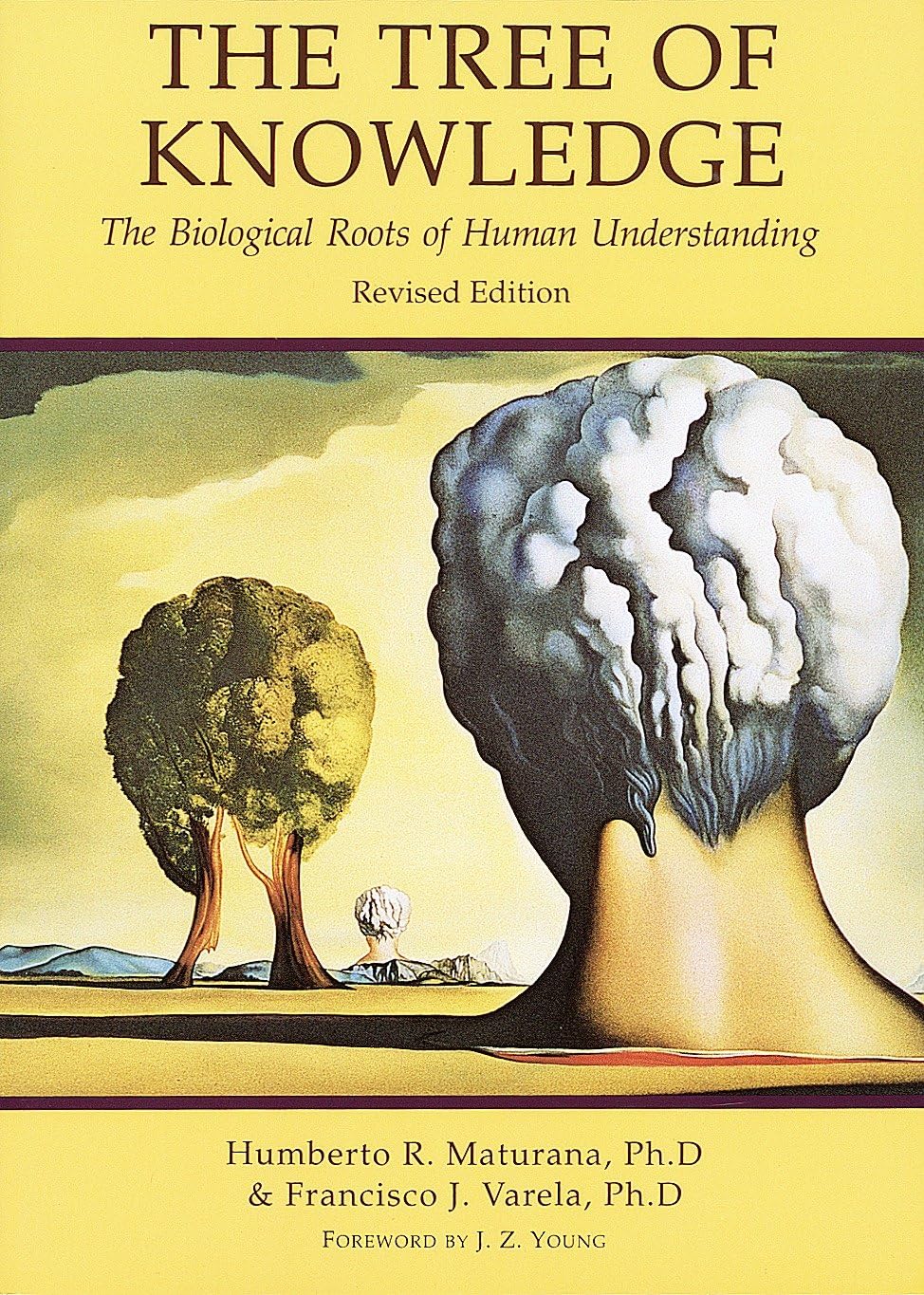
The Tree of Knowledge: The Biological Roots of Human Understanding

Description:

"Knowing how we know" is the subject of this book. Its authors present a new view of cognition that has important social and ethical implications, for, they assert, the only world we humans can have is the one we create together through the actions of our coexistence. Written for a general audience as well as for students, scholars, and scientists and abundantly illustrated with examples from biology, linguistics, and new social and cultural phenomena, this revised edition includes a new afterword by Dr. Varela, in which he discusses the effect the book has had in the years since its first publication.


Editorial Reviews

Review

"A refreshing and new approach to cognition—one which has dramatic cultural, social, and ethical ramifications. . . . While stimulating the imagination of readers it has, however, not received the scholarly acclaim it richly deserves."— Journal of Religion and Psychical Research


"A book with great breadth and ambition . . . In the age of specialization, it is refreshing to come across a book with conceptual breadth and originality."—
Contemporary Psychology

"An important milestone in our current efforts to recognize that science is not value-free, and that fact and value are inevitably tied together."—Morris Berman, author of
Coming to Our Senses


"A beautiful and clearly written guide to thought and perception—something that, like life itself, we take for granted but do not understand. The authors were the pioneers and are now the authoritative figures in the science of cognition: their book is rewarding, thorough, and very readable to anyone curious about the mind and the way that it works."—James Lovelock, author of
Gaia: A New Look at Life on Earth


"The ideas presented in this book are radical and exciting, disturbing and challenging. For the first time we are shown the outlines of a unified
scientific conception of mind, matter, and life. The fruits of Maturana and Varela's Tree of Knowledge include the central insight that cognition is not a representation of the world 'out there,' but rather a 'bringing forth of the world through the process of living itself,' and the stunningly beautiful conclusion: 'We have only the world that we can bring forth with others, and only love helps bring it forth."—Fritjof Capra, author The Tao of Physics

About the Author

Humberto R. Maturana, Ph.D., is a biologist who teaches at the University of Chile. He is also co-author with Dr. Varela of Autopoiesis and Cognition: The Realization of the Living.

Reviews:

5.0 out of 5 stars Read the Book and Change Yourself

J.W.v.E. · January 23, 2015

The Tree of Knowledge,The Biological Roots of Human UnderstandingThis is one of the seminal books that I have studied. Giving five stars I underrate the book enormously. I have bought the book some ten years ago, and once of twice a year I pick it up and study it again.Why is it that I write that it is a seminal book?We all live in a world and most of us think – until you have read the book – that this world is an objective, steadfast phenomenon that we derive information from. Here you have the most important mistakes one can make - there are smaller ones! – and that are dispelled as illusions by the writers, Maturana and Varela, both neuro-biologists from Chili. To be sure, it takes them a while to get at their key point, but the detours are necessary to understand the outcome. And that is that each human being, on his own – although in a coupling with the environment, be it human, family, friends, foe’s, spouse and children, or non-human, nature in all its diversity, - brings forth his world. And because we are with others we bring forth a world together. You can say that each person imagines his world to be, or into being, but always with this aim: to maintain the coupling with, and the conservation of adaptation to his environment. And in doing so he is learning, and so living is learning and learning is living. Much of this is done in language, the most versatile tool we humans have, which makes possible to make discriptions and descriptions of description et cetera, and in the end gives rise to self-consciousness. That is, to understand yourself. But the idea that the outside world is objective and inside us is a representation of it, to derive knowledge from, is utterly destroyed after reading the book, and rightly so.The theory set me on the path of the development of a conflict theory that in essence states that conflict is never about some seeming conflict between people, but always about two or more people acting out their own problems with the conservation of adaptation and maintenance of coupling, which is in normal language that we have to master our human deficiencies. I give an example: there is a just-married couple, deeply in love, and at a party the husband sees his wife chat joyously with one of her ex-es. He gets jealous and he thinks she is deceiving him, but in reality he does not know. He only thinks that she is deceiving him and acting upon that thought alone will bring havock upon them both. This is the stuff of literature and opera’s. The matter is that he is jealous because he has not learned yet not to become jealous. But how can he solve his real problem in another way than look inside into his own mind in self-consciousness and ask himself why he got jealous? Because there is the root of the conflict.Here in a nutshell the theory of autopoiesis is explained. Thinking dat what you see in an outside world is anything else than the productions or distortions of your own mind is self-deceiving. This looks very Buddhist as is taught in Dzogchen and no wonder that Varela was one of the initiators of the Mind Life Institute of the Dalai Lama and also a Buddhist himself.One other point where the theory is at first sight conclusive is on language. Reading the book you will understand that when you say a sentence your listener will hear sounds that through the coordination in a shared domain will enable him to create information from the heard sounds, but not further or more that he has learned to do untill that very moment. If you spoke Chinese and he has nor learned the language he will not be able to create anything out of it. This and some other points make sure that you understand that a person, and that means you too, is not able to act or react outside of the domain of what he has learned already. And that all perturbations (impulses) invite me and you to expand the range of actions, of which, when we succeed, can be said of that we have learned.I have given these examples to give you the taste of the enormous impact that the book will have, when you have really understood its contents. You will never be the same, and it will be impossible to get back to your old ways of looking. Real knowledge cannot be unlearned!So, buy the book and become a different person. You will have the same troubles, but you then will have learned to learn much faster.Jan Willem van EeThe Netherlands

5.0 out of 5 stars So, what's your story?

C.B. · May 2, 2007

I came to this book years ago through, of all things, a two-year course in business and sales, for which it was required reading along with "Computers and Cognition", another eye-opener; the latter anticipated the current transactional nature of the Internet. You might ask how a work as theoretical and speculative as "Tree of Knowledge" could be part of a pragmatic and hardnosed business course, and that is one key to its attraction for me: as intellectually intriguing as the ideas and assertions in this book are, even more engaging is how they might actually change the way we act in the world.The authors drill down to molecular biology and then carefully build upward their premise that we construct the worlds we live in out of language. Each of us exists inside a story we tell ourselves about the way the world is, and we are completely contained within that story. In that sense, we interact with other people through the way our stories talk to their stories. And the success of our relationships and the effectiveness with which we act in our world is dependent on how well we can recognize the stories of others and understand the nature of our own story.This is good news, once we recognize it, because we are a narrative species. On my way to work in the morning, I am telling myself a story about the way I want my day to go: what I expect, what I want to accomplish, how I will confront the challenges along the way. The story I tell myself about my life has heroes and villains, goals and challenges, grand themes and petty foibles. The more we understand the soaring, rich, complex stories those around us are telling themselves, the more we can overcome misunderstandings, conflicts and cultural dissonance - the more, in a sense, we can construct a meta-story that serves us all as human beings.This is not a quick and simple read, but it is so logically and carefully laid out that I never felt lost along the journey. It is a wonderful book to read in tandem with a friend, or as part of a book club. The discussion and the "aha!" experiences it prompts make for a lively exploration of its ideas. Part of the joy of "Tree of Knowledge" is its potential for promoting tolerance of those different from us, through recognition of what drives their story rather than through compromising our own values."ladylucero", in her review, noted that "Tree of Knowledge" is required reading in some American universities. I read that in the authors' native Chile it is even taught in high schools. This, I believe, is good news: the earlier in life we recognize how our individual stories drive our hopes and expectations, our fears and disappointments, the more capable we will be of living well with our fellow human beings.

5.0 out of 5 stars Access to breaking through common sense about how we "know"

E.S. · August 13, 2013

This book completely turned upside down my understanding of language and its importance for how humans operate, social structures, a highly unusual explanation of the "self" (ego), human behavior, Ethics, social phenomena, and why computers can never replace human cognition.This book was assigned reading and study in a business and entrepreneurship program I participated to many years ago. This is a book of transformation for anyone actively working to become a superior leader, innovator and successful businessperson.This is a "foundational" book as far as I can tell, it's a book to study, not to read and critique -- be advised of who wrote it prior to giving in to critique temptations.I am not an expert in biology or neuroscience, but I am looking at the "meanings" of this gem of contribution to human civilization: I speculate Maturana's and Varela's lifetime work -- distilled in this and other books -- will be the foundation for the new emerging biology that future generations will come to learn and rely on for a better human condition. This will be a new biology upon which new explanations of social phenomena will replace old and false ones we still currently follow blindly, unquestioned, and unexamined.I highly recommended this book for businesspeople, executives, social leaders, and entrepreneurs for acquiring a fundamental understanding of humans and social structures.

4.0 out of 5 stars Taking a bigger view of life.

B.L. · May 22, 2016

For those merely linking Maturana and Varela with the idea of autopoiesis, this book will open the mind to the greater sweep of their thinking.

Superbe ouvrage

S.D. · November 10, 2014

Un ouvrage essentiel pour toute personne s'intéressant au savoir, à la connaissance et ses fondements biologiques et notamment la dimension corporelle de la connaissance.

Magnificent theory

l. · July 8, 2024

I loved the way to explain the knowledge through biology. This book is a must to read.

Book in very good condition. Swift delivery. Thanks

J.C.S. · February 17, 2021

The book arrived in very good condition, and was delivered promptley.

Complex Reading

E. · July 31, 2024

The authors get to the roots of things: and, just like roots, they're deep!

Essential reading

R. · January 29, 2016

A clear and valuable read of the journey into understanding the nature and relationship of mind and body by two brilliant scientists. Accessible to researchers and non-academic interested parties alike.

The Tree of Knowledge: The Biological Roots of Human Understanding

Product ID: U0877736421
Condition: New

4.4

AED24821

Price includes VAT & Import Duties
Type: Paperback
Availability: In Stock

Quantity:

|

Order today to get by 7-14 business days

This item qualifies for free delivery

Returns & Warranty policies

Imported From: United States

At BOLO, we work hard to ensure the products you receive are new, genuine, and sourced from reputable suppliers.

BOLO is not an authorized or official retailer for most brands, nor are we affiliated with manufacturers unless specifically stated on a product page. Instead, we source verified sellers, authorized distributors or directly from the manufacturer.

Each product undergoes thorough inspection and verification at our consolidation and fulfilment centers to ensure it meets our strict authenticity and quality standards before being shipped and delivered to you.

If you ever have concerns regarding the authenticity of a product purchased from us, please contact Bolo Support. We will review your inquiry promptly and, if necessary, provide documentation verifying authenticity or offer a suitable resolution.

Your trust is our top priority, and we are committed to maintaining transparency and integrity in every transaction.

All product information, images, descriptions, and reviews originate from the manufacturer or from trusted sellers overseas. BOLO is not affiliated with, endorsed by, or an authorized retailer for most brands listed on our website unless stated otherwise.

While we strive to display accurate information, variations in packaging, labeling, instructions, or formulation may occasionally occur due to regional differences or supplier updates. For detailed or manufacturer-specific information, please contact the brand directly or reach out to BOLO Support for assistance.

Unless otherwise stated, all prices displayed on the product page include applicable taxes and import duties.

BOLO operates in accordance with the laws and regulations of United Arab Emirates. Any items found to be restricted or prohibited for sale within the UAE will be cancelled prior to shipment. We take proactive measures to ensure that only products permitted for sale in United Arab Emirates are listed on our website.

All items are shipped by air, and any products classified as “Dangerous Goods (DG)” under IATA regulations will be removed from the order and cancelled.

All orders are processed manually, and we make every effort to process them promptly once confirmed. Products cancelled due to the above reasons will be permanently removed from listings across the website.

Similar suggestions by Bolo

More from this brand

Similar items from “Neuroscience”

The Tree of Knowledge: The Biological Roots of Human Understanding

Product ID: U0877736421
Condition: New

4.4

The Tree of Knowledge: The Biological Roots of Human Understanding-0
Type: Paperback

AED24821

Price includes VAT & Import Duties
Availability: In Stock

Quantity:

|

Order today to get by 7-14 business days

This item qualifies for free delivery

Returns & Warranty policies

Imported From: United States

At BOLO, we work hard to ensure the products you receive are new, genuine, and sourced from reputable suppliers.

BOLO is not an authorized or official retailer for most brands, nor are we affiliated with manufacturers unless specifically stated on a product page. Instead, we source verified sellers, authorized distributors or directly from the manufacturer.

Each product undergoes thorough inspection and verification at our consolidation and fulfilment centers to ensure it meets our strict authenticity and quality standards before being shipped and delivered to you.

If you ever have concerns regarding the authenticity of a product purchased from us, please contact Bolo Support. We will review your inquiry promptly and, if necessary, provide documentation verifying authenticity or offer a suitable resolution.

Your trust is our top priority, and we are committed to maintaining transparency and integrity in every transaction.

All product information, images, descriptions, and reviews originate from the manufacturer or from trusted sellers overseas. BOLO is not affiliated with, endorsed by, or an authorized retailer for most brands listed on our website unless stated otherwise.

While we strive to display accurate information, variations in packaging, labeling, instructions, or formulation may occasionally occur due to regional differences or supplier updates. For detailed or manufacturer-specific information, please contact the brand directly or reach out to BOLO Support for assistance.

Unless otherwise stated, all prices displayed on the product page include applicable taxes and import duties.

BOLO operates in accordance with the laws and regulations of United Arab Emirates. Any items found to be restricted or prohibited for sale within the UAE will be cancelled prior to shipment. We take proactive measures to ensure that only products permitted for sale in United Arab Emirates are listed on our website.

All items are shipped by air, and any products classified as “Dangerous Goods (DG)” under IATA regulations will be removed from the order and cancelled.

All orders are processed manually, and we make every effort to process them promptly once confirmed. Products cancelled due to the above reasons will be permanently removed from listings across the website.

Description:

"Knowing how we know" is the subject of this book. Its authors present a new view of cognition that has important social and ethical implications, for, they assert, the only world we humans can have is the one we create together through the actions of our coexistence. Written for a general audience as well as for students, scholars, and scientists and abundantly illustrated with examples from biology, linguistics, and new social and cultural phenomena, this revised edition includes a new afterword by Dr. Varela, in which he discusses the effect the book has had in the years since its first publication.


Editorial Reviews

Review

"A refreshing and new approach to cognition—one which has dramatic cultural, social, and ethical ramifications. . . . While stimulating the imagination of readers it has, however, not received the scholarly acclaim it richly deserves."— Journal of Religion and Psychical Research


"A book with great breadth and ambition . . . In the age of specialization, it is refreshing to come across a book with conceptual breadth and originality."—
Contemporary Psychology

"An important milestone in our current efforts to recognize that science is not value-free, and that fact and value are inevitably tied together."—Morris Berman, author of
Coming to Our Senses


"A beautiful and clearly written guide to thought and perception—something that, like life itself, we take for granted but do not understand. The authors were the pioneers and are now the authoritative figures in the science of cognition: their book is rewarding, thorough, and very readable to anyone curious about the mind and the way that it works."—James Lovelock, author of
Gaia: A New Look at Life on Earth


"The ideas presented in this book are radical and exciting, disturbing and challenging. For the first time we are shown the outlines of a unified
scientific conception of mind, matter, and life. The fruits of Maturana and Varela's Tree of Knowledge include the central insight that cognition is not a representation of the world 'out there,' but rather a 'bringing forth of the world through the process of living itself,' and the stunningly beautiful conclusion: 'We have only the world that we can bring forth with others, and only love helps bring it forth."—Fritjof Capra, author The Tao of Physics

About the Author

Humberto R. Maturana, Ph.D., is a biologist who teaches at the University of Chile. He is also co-author with Dr. Varela of Autopoiesis and Cognition: The Realization of the Living.

Reviews:

5.0 out of 5 stars Read the Book and Change Yourself

J.W.v.E. · January 23, 2015

The Tree of Knowledge,The Biological Roots of Human UnderstandingThis is one of the seminal books that I have studied. Giving five stars I underrate the book enormously. I have bought the book some ten years ago, and once of twice a year I pick it up and study it again.Why is it that I write that it is a seminal book?We all live in a world and most of us think – until you have read the book – that this world is an objective, steadfast phenomenon that we derive information from. Here you have the most important mistakes one can make - there are smaller ones! – and that are dispelled as illusions by the writers, Maturana and Varela, both neuro-biologists from Chili. To be sure, it takes them a while to get at their key point, but the detours are necessary to understand the outcome. And that is that each human being, on his own – although in a coupling with the environment, be it human, family, friends, foe’s, spouse and children, or non-human, nature in all its diversity, - brings forth his world. And because we are with others we bring forth a world together. You can say that each person imagines his world to be, or into being, but always with this aim: to maintain the coupling with, and the conservation of adaptation to his environment. And in doing so he is learning, and so living is learning and learning is living. Much of this is done in language, the most versatile tool we humans have, which makes possible to make discriptions and descriptions of description et cetera, and in the end gives rise to self-consciousness. That is, to understand yourself. But the idea that the outside world is objective and inside us is a representation of it, to derive knowledge from, is utterly destroyed after reading the book, and rightly so.The theory set me on the path of the development of a conflict theory that in essence states that conflict is never about some seeming conflict between people, but always about two or more people acting out their own problems with the conservation of adaptation and maintenance of coupling, which is in normal language that we have to master our human deficiencies. I give an example: there is a just-married couple, deeply in love, and at a party the husband sees his wife chat joyously with one of her ex-es. He gets jealous and he thinks she is deceiving him, but in reality he does not know. He only thinks that she is deceiving him and acting upon that thought alone will bring havock upon them both. This is the stuff of literature and opera’s. The matter is that he is jealous because he has not learned yet not to become jealous. But how can he solve his real problem in another way than look inside into his own mind in self-consciousness and ask himself why he got jealous? Because there is the root of the conflict.Here in a nutshell the theory of autopoiesis is explained. Thinking dat what you see in an outside world is anything else than the productions or distortions of your own mind is self-deceiving. This looks very Buddhist as is taught in Dzogchen and no wonder that Varela was one of the initiators of the Mind Life Institute of the Dalai Lama and also a Buddhist himself.One other point where the theory is at first sight conclusive is on language. Reading the book you will understand that when you say a sentence your listener will hear sounds that through the coordination in a shared domain will enable him to create information from the heard sounds, but not further or more that he has learned to do untill that very moment. If you spoke Chinese and he has nor learned the language he will not be able to create anything out of it. This and some other points make sure that you understand that a person, and that means you too, is not able to act or react outside of the domain of what he has learned already. And that all perturbations (impulses) invite me and you to expand the range of actions, of which, when we succeed, can be said of that we have learned.I have given these examples to give you the taste of the enormous impact that the book will have, when you have really understood its contents. You will never be the same, and it will be impossible to get back to your old ways of looking. Real knowledge cannot be unlearned!So, buy the book and become a different person. You will have the same troubles, but you then will have learned to learn much faster.Jan Willem van EeThe Netherlands

5.0 out of 5 stars So, what's your story?

C.B. · May 2, 2007

I came to this book years ago through, of all things, a two-year course in business and sales, for which it was required reading along with "Computers and Cognition", another eye-opener; the latter anticipated the current transactional nature of the Internet. You might ask how a work as theoretical and speculative as "Tree of Knowledge" could be part of a pragmatic and hardnosed business course, and that is one key to its attraction for me: as intellectually intriguing as the ideas and assertions in this book are, even more engaging is how they might actually change the way we act in the world.The authors drill down to molecular biology and then carefully build upward their premise that we construct the worlds we live in out of language. Each of us exists inside a story we tell ourselves about the way the world is, and we are completely contained within that story. In that sense, we interact with other people through the way our stories talk to their stories. And the success of our relationships and the effectiveness with which we act in our world is dependent on how well we can recognize the stories of others and understand the nature of our own story.This is good news, once we recognize it, because we are a narrative species. On my way to work in the morning, I am telling myself a story about the way I want my day to go: what I expect, what I want to accomplish, how I will confront the challenges along the way. The story I tell myself about my life has heroes and villains, goals and challenges, grand themes and petty foibles. The more we understand the soaring, rich, complex stories those around us are telling themselves, the more we can overcome misunderstandings, conflicts and cultural dissonance - the more, in a sense, we can construct a meta-story that serves us all as human beings.This is not a quick and simple read, but it is so logically and carefully laid out that I never felt lost along the journey. It is a wonderful book to read in tandem with a friend, or as part of a book club. The discussion and the "aha!" experiences it prompts make for a lively exploration of its ideas. Part of the joy of "Tree of Knowledge" is its potential for promoting tolerance of those different from us, through recognition of what drives their story rather than through compromising our own values."ladylucero", in her review, noted that "Tree of Knowledge" is required reading in some American universities. I read that in the authors' native Chile it is even taught in high schools. This, I believe, is good news: the earlier in life we recognize how our individual stories drive our hopes and expectations, our fears and disappointments, the more capable we will be of living well with our fellow human beings.

5.0 out of 5 stars Access to breaking through common sense about how we "know"

E.S. · August 13, 2013

This book completely turned upside down my understanding of language and its importance for how humans operate, social structures, a highly unusual explanation of the "self" (ego), human behavior, Ethics, social phenomena, and why computers can never replace human cognition.This book was assigned reading and study in a business and entrepreneurship program I participated to many years ago. This is a book of transformation for anyone actively working to become a superior leader, innovator and successful businessperson.This is a "foundational" book as far as I can tell, it's a book to study, not to read and critique -- be advised of who wrote it prior to giving in to critique temptations.I am not an expert in biology or neuroscience, but I am looking at the "meanings" of this gem of contribution to human civilization: I speculate Maturana's and Varela's lifetime work -- distilled in this and other books -- will be the foundation for the new emerging biology that future generations will come to learn and rely on for a better human condition. This will be a new biology upon which new explanations of social phenomena will replace old and false ones we still currently follow blindly, unquestioned, and unexamined.I highly recommended this book for businesspeople, executives, social leaders, and entrepreneurs for acquiring a fundamental understanding of humans and social structures.

4.0 out of 5 stars Taking a bigger view of life.

B.L. · May 22, 2016

For those merely linking Maturana and Varela with the idea of autopoiesis, this book will open the mind to the greater sweep of their thinking.

Superbe ouvrage

S.D. · November 10, 2014

Un ouvrage essentiel pour toute personne s'intéressant au savoir, à la connaissance et ses fondements biologiques et notamment la dimension corporelle de la connaissance.

Magnificent theory

l. · July 8, 2024

I loved the way to explain the knowledge through biology. This book is a must to read.

Book in very good condition. Swift delivery. Thanks

J.C.S. · February 17, 2021

The book arrived in very good condition, and was delivered promptley.

Complex Reading

E. · July 31, 2024

The authors get to the roots of things: and, just like roots, they're deep!

Essential reading

R. · January 29, 2016

A clear and valuable read of the journey into understanding the nature and relationship of mind and body by two brilliant scientists. Accessible to researchers and non-academic interested parties alike.

Similar suggestions by Bolo

More from this brand

Similar items from “Neuroscience”