Deliver toUnited Arab Emirates
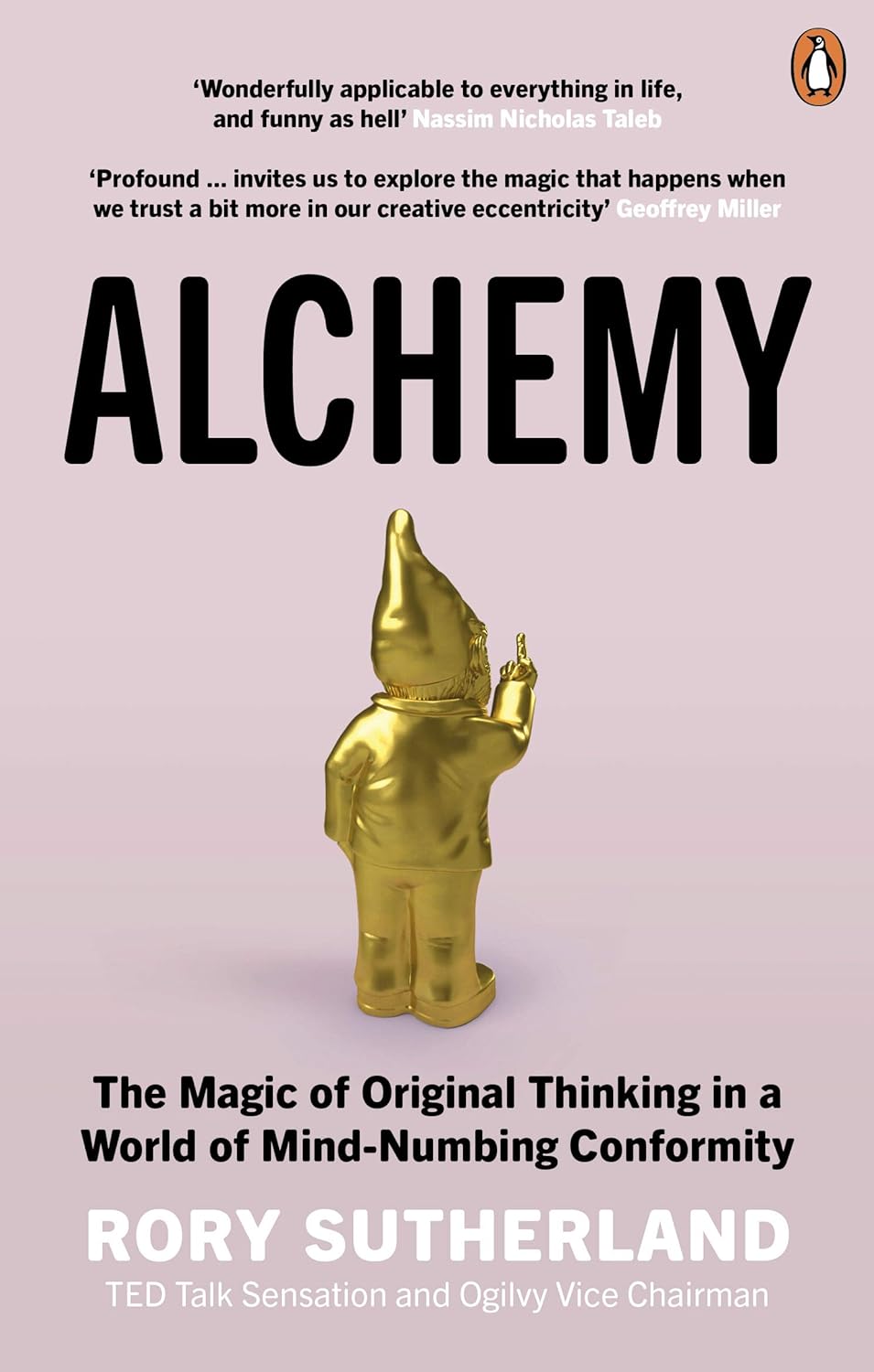
Alchemy: The Surprising Power of Ideas That Don't Make Sense

Description:

A breakthrough book. Wonderfully applicable to everything in life, and funny as hell.’ Nassim Nicholas Taleb

To be brilliant, you have to be irrational

Why is Red Bull so popular – even though everyone hates the taste? Why do countdown boards on platforms take away the pain of train delays? And why do we prefer stripy toothpaste?

We think we are rational creatures. Economics and business rely on the assumption that we make logical decisions based on evidence.

But we aren’t, and we don’t.

In many crucial areas of our lives, reason plays a vanishingly small part. Instead we are driven by unconscious desires, which is why placebos are so powerful. We are drawn to the beautiful, the extravagant and the absurd – from lavish wedding invitations to tiny bottles of the latest fragrance. So if you want to influence people’s choices you have to bypass reason. The best ideas don’t make rational sense: they make you
feel more than they make you think.

Rory Sutherland is the Ogilvy advertising legend whose TED Talks have been viewed nearly 7 million times. In his first book he blends cutting-edge behavioural science, jaw-dropping stories and a touch of branding magic, on his mission to turn us all into idea alchemists. The big problems we face every day, whether as an individual or in society, could very well be solved by letting go of logic and embracing the irrational.


Reviews:

5.0 out of 5 stars What fantastic and brilliant insights into marketing!

A.K. · May 25, 2023

Brilliantly written this book is an enthralling and spellbinding masterpiece that will leave you with a sense of wonder and completely new perspective in the world of marketing and customers. From page 1, I was captivated by Sutherland's enchanting storytelling and delightful thought-provoking insights. But he also blends these with humour and wit that makes it so entertaining, offering a fresh perspective on the art of persuasion and the power of human perception.Through his personal and often shrewd anecdotes, historical examples, and cutting-edge research, he creates a chronicle that feels both informative and deeply human. Through his astute observations, he challenges readers to question their assumptions and explore the untapped and hidden magic that surrounds us in everyday life. We can potentially change the world around us for the better. How? By looking beyond the obvious, embracing ambiguity, and finding imaginative and inspired innovative solutions to age-old problems.Most of his work is based on solid theoretical research, but what truly sets Alchemy apart is Sutherland's ability to impeccably blend interdisciplinary insights into a coherent narrative. He has obviously mastered many diverse intellectual fields: psychology, economics, anthropology, and history, and effortlessly connects dots that have long eluded marketers, exposing the underlying patterns and forces that shape our choices and behaviours.Thus, complex concepts become more accessible and engaging, and he has persuaded me that advertising is not a waste of money, but one of the most intriguing and innovative parts of any business.In conclusion, this book is a true gem.I'm 66 and have more than 2000 books in my business library. If you asked me for the top 10, Rory Sutherland's book would unhesitatingly go into that pile, together with Tom Peters, Jim Collins, Chan Kim and Renee Mauborgne, Seth Godin, Bob Cialdini and Philip Kotler. It invites you to question, experiment, and embrace the art of dealing with customers, and guides the reader through an enthralling exploration of the human mind, disclosing the magic of innovation and creativity. An absolute must-read!

5.0 out of 5 stars Philosophy of life using marketing

J.P. · July 16, 2025

Amazing book and unique view of life in a business book

4.0 out of 5 stars Book for marketers

K.L. · April 3, 2025

Good for marketers early in their career.

5.0 out of 5 stars Worth giving it a shot !

S. · June 19, 2025

Book looks great yet to give it a go. Jus popped in my mailbox without any fuss. Might update once i read it, the title intrigued me.

5.0 out of 5 stars Great for practitioners

S. · October 1, 2025

Great for all marketing practitioners. Rory is a natural storyteller.

5.0 out of 5 stars Not Making Sense Makes Sense

B.L. · December 17, 2019

A refutation of the calculating, rational model economists view the world in, Rory Sutherland's book is a paean to the seemingly illogical choices consumers make. While not the first examination of heuristics or behavioral economics, this is certainly an interesting ride. Marketing exists because it is effective or as the author puts it "a flower is a weed with an advertising budget."Some "illogical" topics discussed:A) New creations are often the work of weird consumers. The sandwich was conceived for a compulsive gambler too lazy to get up.B) Buying the more expensive of two options is not irrational; it may just be "second-order intelligence applied to an uncertain world."C) Brands provide a useful indicator of quality (ie "which is the best hoverboard to buy?"). As Sutherland notes, "people don’t buy brand A over brand B because they think a is better, but because they are more certain that it is good." He also introduces Herbert Simon's term "satisficing" (satisfy + suffice) to explain consumption decisions.D) Sometimes offering fewer items is better. The Walkman removed the record button from its initial launch to make it easier to understand.E) Reframing a product can create consumer surplus. A potato can be transformed to a luxury good if it starts to be grown in the royal garden.F) Packaging can make a product taste better. Saying you will modify a recipe changes peoples perception of flavor.Some interesting examples he cites:- Red Bull, which is relatively expensive and tastes bad, provides a convincing placebo effect- The stripe in striped toothpaste reminds you there are additional ingredients cleaning your teeth- Soap smells like it makes you clean- The "$300mm button" which lets you check out as a guest on websites (even though 90% of people then create an account)- More is spent on female beauty than on female educationWhile a lot of this has been known by marketers for awhile, the author is concerned the problem of model reliance is worsening. First off, in the world of big data, data only comes from the past or as he puts it, "perception may map neatly on to behavior, but reality does not map neatly onto perception." And while big data gives us more needles, it gives us a lot more hay. In fact, Proctor and Gamble cut $150mm of their digital advertising budget because they felt microtargeting was ineffective. Similarly, the narrative that efficiency will dominate also comes into question. The well coined term "doorman fallacy" (automatic doors did not replace doormen) shows that there are lot more reasons things are the way they are than the direct explanation.A lot of ancient cultures have a god devoted to fortune because they knew a lot of the world was governed outside of rational agency. By the end, you will start devoting more time to "alchemy" by questioning everything.Some great quotes he cites:Caribbean Saying: Trust grows at the speed of a coconut tree and falls at the speed of a coconutOgilvy: People don’t think what they feel, they don’t say what they think, and they don’t do what they sayKeynes: Better for the reputation to fail conventionally than to succeed unconventionallyLennon: Time spent doing nothing is rarely wastedKeynes It’s better to be vaguely right than precisely wrongShakespeare: There is nothing either good or bad, but thinking makes it so

2.0 out of 5 stars Non-scientific epistemology

a. · September 2, 2025

This is a well written book by an Oglivy advertising agency senior consultant. Worth buying and enjoying even if much of what is said 55 is unsupported by any credible evidence. Author bases everything on the claim that logic is worthless. The index does not contain a single reference to mathematical logic developed from George Boole, Gottlieve Frege, Ludwig Wittgenstein, Kurt Godel, and Alan Turing. He cherry picks his reference to skirt serious logical studies. Most of his advice is now known as garden variety cheap language tricks with half life of less than a year. Normal consumers are often not aware of the reality of any number of economic transactions but they don't have to be. Common experience spreads knowledge through word of mouth and other means thereby nullifying the 'magic' of clever but false solutions. One day, and not to far in the distance, we will have a media not monetized by advertising and in which advertisers will have to pay consumers to listen to their messages. It's patent medicine all over again.

5.0 out of 5 stars Love the book

I.S. · September 12, 2024

Love the book

Interesting and entertaining

K.s. · January 2, 2025

The writer has a very relaxed and to the point style, almost like listening to a guy at the pub (who has drunk a few drinks). I mean that positively in that he is easy to relate to.There is some very useful info in there too which makes you think about how people buy, and how best to market yourself and your business.

Fascinating anecdotes and compelling arguments

A.N. · July 7, 2020

Rory Sutherland is the vice-chairman of Ogilvy UK and uses his vast experience and trove of interesting anecdotes to put together a book on how irrational thinking often works better, which is interesting even for a logical thinking reader such as me. Right at the outset, Sutherland lists downs his 11 rules of alchemy. These are basically all variations of each other and Rule #6 encapsulates the direction that the book will take: The problem with logic is that it kills off magic.Sutherland's basic premise is that rational analysis is based on big data that comes from the past and cannot account for an unexpected event. Which is why irrational thinking creates alchemy. Also, humans do not behave rationally all the time. Why else would perfectly sane people pay $5 for a drink that they can make for pennies at home (Starbucks) or why would a coarse uncomfortable fabric that takes ages to dry and popular with labourers become fashionable (jeans)? He gathers his argument in six well-structured sections and then follows that up with a seventh where he lays out his recommendations. While a large part of what he writes is related to the advertising or marketing fields in some way or the other, he has used examples from other areas as well to buttress his arguments.One of the most fascinating aspects of the book are the various anecdotes strewn through it such as the one on Red Bull's success (it was expensive, came in a tiny can and had a disgusting taste as per consumer trials, all counterintuitive to a successful launch) or the story of striped toothpaste (it mixes in your mouth anyway but signals to the user that it fulfils two functions) or how mailer donation campaigns work better if the return envelope has the flap on the shorter side (as it seems more appropriate to slip a cheque in).The book is not without its problems. In his desire to hammer down the key argument of the book, Sutherland makes it completely one-sided. In the process, he pooh-poohs economists and logical thinkers several times in the book which can be somewhat off-putting. Having said that, the breezy style of writing and some fascinating insights coupled with interesting stories make this a worthwhile read. The various footnotes in each chapter, by themselves, would make compelling reading!Pros: Fascinating anecdotes, compelling argumentsCons: The constant putting down of logic is somewhat off-putting

Really fun

L. · October 31, 2024

Surprisingly funny and adds a lot of new and interesting information.

Challenges conventional thinking

L.B. · November 11, 2024

Got the book after watching Rory's videos on YouTube. Amazing book. Wish I read it when I was younger. Good ideas and advice for dealing with the real world...especially in a business scenario. Makes you think twice when you think you're right or you go with commonly held beliefs.

Buy the book, short Panworld Global!

E. · May 31, 2020

Thought provoking book. If you read behavioral finance books the basic concept that economic models are predicated on a flawed assumption of consumer rationality will be not be new, however the author brings a different perspective given background in advertising.3 star rating purely a reflection on the seller Panworld Global. Expense relative to other sellers is frustrating but the bigger problem is books often turn up damaged. Try and buy elsewhere.

Alchemy: The Surprising Power of Ideas That Don't Make Sense

Product ID: U0753556529
Condition: New

4.5

AED11439

Price includes VAT & Import Duties
Type: Paperback
Availability: In Stock

Quantity:

|

Order today to get by 7-14 business days

Delivery fee of AED 20. Free for orders above AED 200.

Returns & Warranty policies

Imported From: United States

At BOLO, we work hard to ensure the products you receive are new, genuine, and sourced from reputable suppliers.

BOLO is not an authorized or official retailer for most brands, nor are we affiliated with manufacturers unless specifically stated on a product page. Instead, we source verified sellers, authorized distributors or directly from the manufacturer.

Each product undergoes thorough inspection and verification at our consolidation and fulfilment centers to ensure it meets our strict authenticity and quality standards before being shipped and delivered to you.

If you ever have concerns regarding the authenticity of a product purchased from us, please contact Bolo Support. We will review your inquiry promptly and, if necessary, provide documentation verifying authenticity or offer a suitable resolution.

Your trust is our top priority, and we are committed to maintaining transparency and integrity in every transaction.

All product information, images, descriptions, and reviews originate from the manufacturer or from trusted sellers overseas. BOLO is not affiliated with, endorsed by, or an authorized retailer for most brands listed on our website unless stated otherwise.

While we strive to display accurate information, variations in packaging, labeling, instructions, or formulation may occasionally occur due to regional differences or supplier updates. For detailed or manufacturer-specific information, please contact the brand directly or reach out to BOLO Support for assistance.

Unless otherwise stated, all prices displayed on the product page include applicable taxes and import duties.

BOLO operates in accordance with the laws and regulations of United Arab Emirates. Any items found to be restricted or prohibited for sale within the UAE will be cancelled prior to shipment. We take proactive measures to ensure that only products permitted for sale in United Arab Emirates are listed on our website.

All items are shipped by air, and any products classified as “Dangerous Goods (DG)” under IATA regulations will be removed from the order and cancelled.

All orders are processed manually, and we make every effort to process them promptly once confirmed. Products cancelled due to the above reasons will be permanently removed from listings across the website.

Similar suggestions by Bolo

More from this brand

Similar items from “Direct”

Alchemy: The Surprising Power of Ideas That Don't Make Sense

Product ID: U0753556529
Condition: New

4.5

Alchemy: The Surprising Power of Ideas That Don't Make Sense-0
Type: Paperback

AED11439

Price includes VAT & Import Duties
Availability: In Stock

Quantity:

|

Order today to get by 7-14 business days

Delivery fee of AED 20. Free for orders above AED 200.

Returns & Warranty policies

Imported From: United States

At BOLO, we work hard to ensure the products you receive are new, genuine, and sourced from reputable suppliers.

BOLO is not an authorized or official retailer for most brands, nor are we affiliated with manufacturers unless specifically stated on a product page. Instead, we source verified sellers, authorized distributors or directly from the manufacturer.

Each product undergoes thorough inspection and verification at our consolidation and fulfilment centers to ensure it meets our strict authenticity and quality standards before being shipped and delivered to you.

If you ever have concerns regarding the authenticity of a product purchased from us, please contact Bolo Support. We will review your inquiry promptly and, if necessary, provide documentation verifying authenticity or offer a suitable resolution.

Your trust is our top priority, and we are committed to maintaining transparency and integrity in every transaction.

All product information, images, descriptions, and reviews originate from the manufacturer or from trusted sellers overseas. BOLO is not affiliated with, endorsed by, or an authorized retailer for most brands listed on our website unless stated otherwise.

While we strive to display accurate information, variations in packaging, labeling, instructions, or formulation may occasionally occur due to regional differences or supplier updates. For detailed or manufacturer-specific information, please contact the brand directly or reach out to BOLO Support for assistance.

Unless otherwise stated, all prices displayed on the product page include applicable taxes and import duties.

BOLO operates in accordance with the laws and regulations of United Arab Emirates. Any items found to be restricted or prohibited for sale within the UAE will be cancelled prior to shipment. We take proactive measures to ensure that only products permitted for sale in United Arab Emirates are listed on our website.

All items are shipped by air, and any products classified as “Dangerous Goods (DG)” under IATA regulations will be removed from the order and cancelled.

All orders are processed manually, and we make every effort to process them promptly once confirmed. Products cancelled due to the above reasons will be permanently removed from listings across the website.

Description:

A breakthrough book. Wonderfully applicable to everything in life, and funny as hell.’ Nassim Nicholas Taleb

To be brilliant, you have to be irrational

Why is Red Bull so popular – even though everyone hates the taste? Why do countdown boards on platforms take away the pain of train delays? And why do we prefer stripy toothpaste?

We think we are rational creatures. Economics and business rely on the assumption that we make logical decisions based on evidence.

But we aren’t, and we don’t.

In many crucial areas of our lives, reason plays a vanishingly small part. Instead we are driven by unconscious desires, which is why placebos are so powerful. We are drawn to the beautiful, the extravagant and the absurd – from lavish wedding invitations to tiny bottles of the latest fragrance. So if you want to influence people’s choices you have to bypass reason. The best ideas don’t make rational sense: they make you
feel more than they make you think.

Rory Sutherland is the Ogilvy advertising legend whose TED Talks have been viewed nearly 7 million times. In his first book he blends cutting-edge behavioural science, jaw-dropping stories and a touch of branding magic, on his mission to turn us all into idea alchemists. The big problems we face every day, whether as an individual or in society, could very well be solved by letting go of logic and embracing the irrational.


Reviews:

5.0 out of 5 stars What fantastic and brilliant insights into marketing!

A.K. · May 25, 2023

Brilliantly written this book is an enthralling and spellbinding masterpiece that will leave you with a sense of wonder and completely new perspective in the world of marketing and customers. From page 1, I was captivated by Sutherland's enchanting storytelling and delightful thought-provoking insights. But he also blends these with humour and wit that makes it so entertaining, offering a fresh perspective on the art of persuasion and the power of human perception.Through his personal and often shrewd anecdotes, historical examples, and cutting-edge research, he creates a chronicle that feels both informative and deeply human. Through his astute observations, he challenges readers to question their assumptions and explore the untapped and hidden magic that surrounds us in everyday life. We can potentially change the world around us for the better. How? By looking beyond the obvious, embracing ambiguity, and finding imaginative and inspired innovative solutions to age-old problems.Most of his work is based on solid theoretical research, but what truly sets Alchemy apart is Sutherland's ability to impeccably blend interdisciplinary insights into a coherent narrative. He has obviously mastered many diverse intellectual fields: psychology, economics, anthropology, and history, and effortlessly connects dots that have long eluded marketers, exposing the underlying patterns and forces that shape our choices and behaviours.Thus, complex concepts become more accessible and engaging, and he has persuaded me that advertising is not a waste of money, but one of the most intriguing and innovative parts of any business.In conclusion, this book is a true gem.I'm 66 and have more than 2000 books in my business library. If you asked me for the top 10, Rory Sutherland's book would unhesitatingly go into that pile, together with Tom Peters, Jim Collins, Chan Kim and Renee Mauborgne, Seth Godin, Bob Cialdini and Philip Kotler. It invites you to question, experiment, and embrace the art of dealing with customers, and guides the reader through an enthralling exploration of the human mind, disclosing the magic of innovation and creativity. An absolute must-read!

5.0 out of 5 stars Philosophy of life using marketing

J.P. · July 16, 2025

Amazing book and unique view of life in a business book

4.0 out of 5 stars Book for marketers

K.L. · April 3, 2025

Good for marketers early in their career.

5.0 out of 5 stars Worth giving it a shot !

S. · June 19, 2025

Book looks great yet to give it a go. Jus popped in my mailbox without any fuss. Might update once i read it, the title intrigued me.

5.0 out of 5 stars Great for practitioners

S. · October 1, 2025

Great for all marketing practitioners. Rory is a natural storyteller.

5.0 out of 5 stars Not Making Sense Makes Sense

B.L. · December 17, 2019

A refutation of the calculating, rational model economists view the world in, Rory Sutherland's book is a paean to the seemingly illogical choices consumers make. While not the first examination of heuristics or behavioral economics, this is certainly an interesting ride. Marketing exists because it is effective or as the author puts it "a flower is a weed with an advertising budget."Some "illogical" topics discussed:A) New creations are often the work of weird consumers. The sandwich was conceived for a compulsive gambler too lazy to get up.B) Buying the more expensive of two options is not irrational; it may just be "second-order intelligence applied to an uncertain world."C) Brands provide a useful indicator of quality (ie "which is the best hoverboard to buy?"). As Sutherland notes, "people don’t buy brand A over brand B because they think a is better, but because they are more certain that it is good." He also introduces Herbert Simon's term "satisficing" (satisfy + suffice) to explain consumption decisions.D) Sometimes offering fewer items is better. The Walkman removed the record button from its initial launch to make it easier to understand.E) Reframing a product can create consumer surplus. A potato can be transformed to a luxury good if it starts to be grown in the royal garden.F) Packaging can make a product taste better. Saying you will modify a recipe changes peoples perception of flavor.Some interesting examples he cites:- Red Bull, which is relatively expensive and tastes bad, provides a convincing placebo effect- The stripe in striped toothpaste reminds you there are additional ingredients cleaning your teeth- Soap smells like it makes you clean- The "$300mm button" which lets you check out as a guest on websites (even though 90% of people then create an account)- More is spent on female beauty than on female educationWhile a lot of this has been known by marketers for awhile, the author is concerned the problem of model reliance is worsening. First off, in the world of big data, data only comes from the past or as he puts it, "perception may map neatly on to behavior, but reality does not map neatly onto perception." And while big data gives us more needles, it gives us a lot more hay. In fact, Proctor and Gamble cut $150mm of their digital advertising budget because they felt microtargeting was ineffective. Similarly, the narrative that efficiency will dominate also comes into question. The well coined term "doorman fallacy" (automatic doors did not replace doormen) shows that there are lot more reasons things are the way they are than the direct explanation.A lot of ancient cultures have a god devoted to fortune because they knew a lot of the world was governed outside of rational agency. By the end, you will start devoting more time to "alchemy" by questioning everything.Some great quotes he cites:Caribbean Saying: Trust grows at the speed of a coconut tree and falls at the speed of a coconutOgilvy: People don’t think what they feel, they don’t say what they think, and they don’t do what they sayKeynes: Better for the reputation to fail conventionally than to succeed unconventionallyLennon: Time spent doing nothing is rarely wastedKeynes It’s better to be vaguely right than precisely wrongShakespeare: There is nothing either good or bad, but thinking makes it so

2.0 out of 5 stars Non-scientific epistemology

a. · September 2, 2025

This is a well written book by an Oglivy advertising agency senior consultant. Worth buying and enjoying even if much of what is said 55 is unsupported by any credible evidence. Author bases everything on the claim that logic is worthless. The index does not contain a single reference to mathematical logic developed from George Boole, Gottlieve Frege, Ludwig Wittgenstein, Kurt Godel, and Alan Turing. He cherry picks his reference to skirt serious logical studies. Most of his advice is now known as garden variety cheap language tricks with half life of less than a year. Normal consumers are often not aware of the reality of any number of economic transactions but they don't have to be. Common experience spreads knowledge through word of mouth and other means thereby nullifying the 'magic' of clever but false solutions. One day, and not to far in the distance, we will have a media not monetized by advertising and in which advertisers will have to pay consumers to listen to their messages. It's patent medicine all over again.

5.0 out of 5 stars Love the book

I.S. · September 12, 2024

Love the book

Interesting and entertaining

K.s. · January 2, 2025

The writer has a very relaxed and to the point style, almost like listening to a guy at the pub (who has drunk a few drinks). I mean that positively in that he is easy to relate to.There is some very useful info in there too which makes you think about how people buy, and how best to market yourself and your business.

Fascinating anecdotes and compelling arguments

A.N. · July 7, 2020

Rory Sutherland is the vice-chairman of Ogilvy UK and uses his vast experience and trove of interesting anecdotes to put together a book on how irrational thinking often works better, which is interesting even for a logical thinking reader such as me. Right at the outset, Sutherland lists downs his 11 rules of alchemy. These are basically all variations of each other and Rule #6 encapsulates the direction that the book will take: The problem with logic is that it kills off magic.Sutherland's basic premise is that rational analysis is based on big data that comes from the past and cannot account for an unexpected event. Which is why irrational thinking creates alchemy. Also, humans do not behave rationally all the time. Why else would perfectly sane people pay $5 for a drink that they can make for pennies at home (Starbucks) or why would a coarse uncomfortable fabric that takes ages to dry and popular with labourers become fashionable (jeans)? He gathers his argument in six well-structured sections and then follows that up with a seventh where he lays out his recommendations. While a large part of what he writes is related to the advertising or marketing fields in some way or the other, he has used examples from other areas as well to buttress his arguments.One of the most fascinating aspects of the book are the various anecdotes strewn through it such as the one on Red Bull's success (it was expensive, came in a tiny can and had a disgusting taste as per consumer trials, all counterintuitive to a successful launch) or the story of striped toothpaste (it mixes in your mouth anyway but signals to the user that it fulfils two functions) or how mailer donation campaigns work better if the return envelope has the flap on the shorter side (as it seems more appropriate to slip a cheque in).The book is not without its problems. In his desire to hammer down the key argument of the book, Sutherland makes it completely one-sided. In the process, he pooh-poohs economists and logical thinkers several times in the book which can be somewhat off-putting. Having said that, the breezy style of writing and some fascinating insights coupled with interesting stories make this a worthwhile read. The various footnotes in each chapter, by themselves, would make compelling reading!Pros: Fascinating anecdotes, compelling argumentsCons: The constant putting down of logic is somewhat off-putting

Really fun

L. · October 31, 2024

Surprisingly funny and adds a lot of new and interesting information.

Challenges conventional thinking

L.B. · November 11, 2024

Got the book after watching Rory's videos on YouTube. Amazing book. Wish I read it when I was younger. Good ideas and advice for dealing with the real world...especially in a business scenario. Makes you think twice when you think you're right or you go with commonly held beliefs.

Buy the book, short Panworld Global!

E. · May 31, 2020

Thought provoking book. If you read behavioral finance books the basic concept that economic models are predicated on a flawed assumption of consumer rationality will be not be new, however the author brings a different perspective given background in advertising.3 star rating purely a reflection on the seller Panworld Global. Expense relative to other sellers is frustrating but the bigger problem is books often turn up damaged. Try and buy elsewhere.

Similar suggestions by Bolo

More from this brand

Similar items from “Direct”