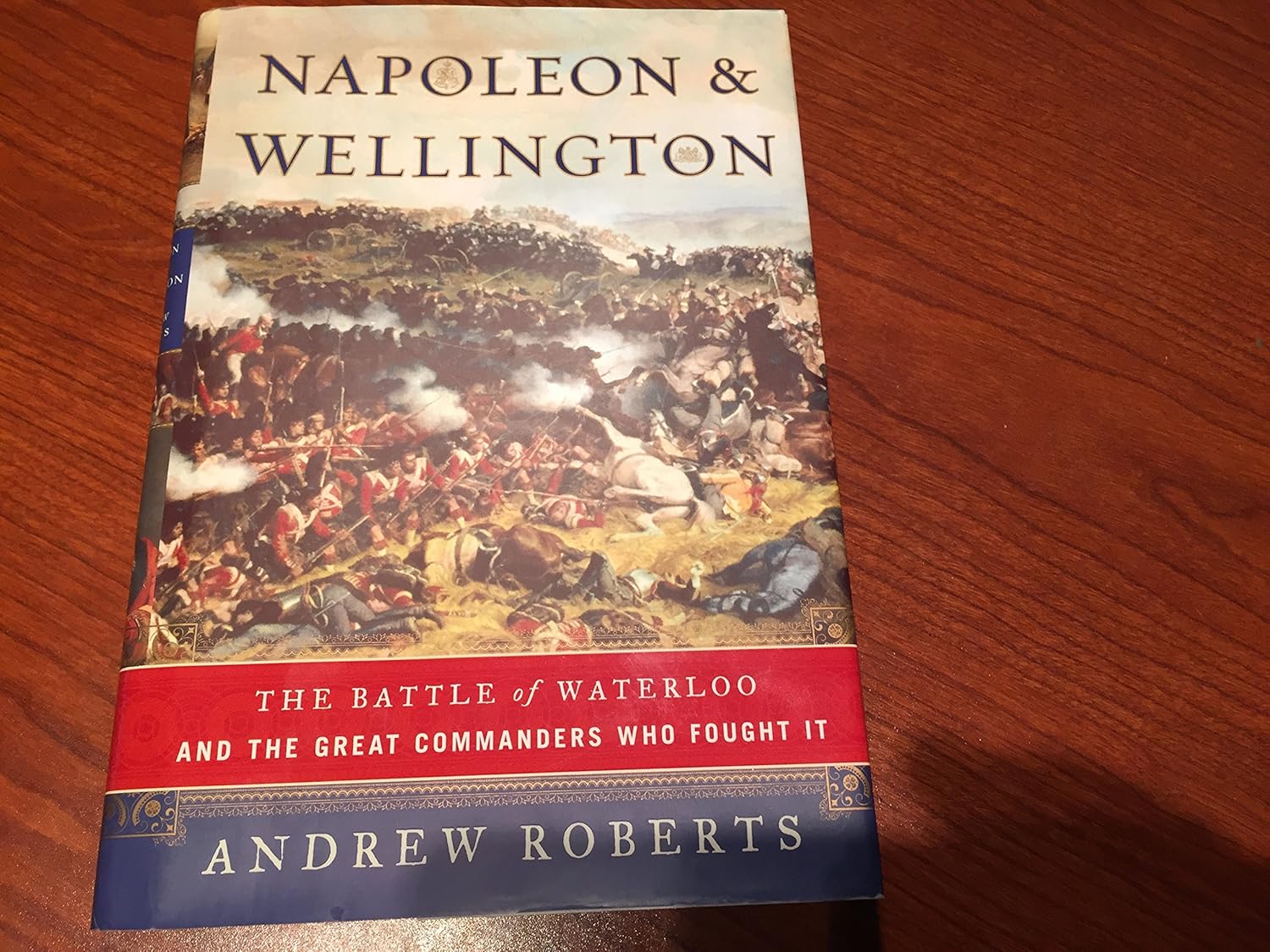
Description:
Editorial Reviews
Amazon.com Review
Publicly, Bonaparte and Wellington professed to despise each other. "Even in the boldest things he did there was always a measure of ... meanness," said Wellington of the French emperor, adding later, "Bonaparte's whole life, civil, political, and military, was a fraud." Napoleon said that Wellington "has no courage. He acted out of fear. He had one stroke of fortune, and he knows that such fortune never comes twice." Yet the two, writes Roberts, were very much alike: social outsiders who found their greatness in the army, scholars of a sort, who brought scientific rigor to the study of topography and logistics, and men capable of inspiring great heroism in their soldiers.
In the end, Roberts suggests, Wellington won his battle, but Napoleon won the war. This intriguing study shows how, and it affords much insight into the workings of these great rivals' minds. --Gregory McNamee
From Library Journal
Robert C. Jones, formerly with Central Missouri State Univ., Warrensburg
Copyright 2002 Reed Business Information, Inc.
From Booklist
Copyright © American Library Association. All rights reserved
Review
About the Author
Excerpt. © Reprinted by permission. All rights reserved.
CHAPTER ONE: 'A Fine Time for an Enterprising Young Man' 1769-1799
The Revolution is over. I am the Revolution.
NAPOLEON
The similarities between Napoleon and Wellington are, at first sight, extraordinary. They were born in the same year -- 1769 -- although controversy exists in both cases as to the precise day. Wellington is generally thought to have been born on 1 May, although the accounts of his nursemaid, the local newspapers and the baptismal record in the parish church differ. Similarly the exact date of Napoleon's birth is contested, but he himself chose 15 August, so it is likely that Wellington was around three months older. Wellington was born in Ireland, the son of a nobleman of English ancestry, part of the Protestant Ascendancy caste that ruled the island for the nearby larger power. Napoleon's father was one of the noblesse of Corsica who helped administer that island for France. Napoleon was educated away from his birthplace, at a French military academy; so too was Wellington. French was their second language. The Earl of Mornington, Wellington's father, died when he was twelve. Carlo Buonaparte died when his son Napoleon was fifteen. Both boys had four brothers and three sisters, and were brought up in straitened circumstances by formidable mothers.
In May 1798 Wellington changed his surname from Wesley to Wellesley (it had only a century before been Colley). Two years earlier, Napoléone Buonaparte (formerly Buona Parte) had become Napoléon Bonaparte, although 'it was one of the little meannesses of English and Royalist writers to insist upon the "u" in order to emphasise his alien origin'. Both men chose Hannibal as their ultimate military hero. Both were autodidacts as young officers, setting aside a certain number of hours each day for intellectual self-improvement; they both took Cæsar's Commentaries on campaign.
They saw their first action within a year of one another: Napoleon in Toulon on 16 September 1793 and Wellington in Holland on 15 September 1794. Their greatest big breaks in life came through the good offices of their brothers: Lucien Bonaparte organised the Brumaire coup to make Napoleon first consul in 1799; and Richard Wellesley, the governor-general of British India, gave Wellington independent command in the Second Mahratta War in 1803. Attractive to women and voraciously sexual, neither man enjoyed a happy marriage. They did share two mistresses, however, or more precisely Wellington picked up two of the emperor's cast-offs. Also, Wellington's brother married Napoleon's brother's ex-wife's sister-in-law. George Bernard Shaw appreciated the paradoxes, quipping that: 'An English army led by an Irish general; that might be a match for a French army led by an Italian general.'
As soldiers, both men gave particular regard to topography and the study of maps, and were at ease with mathematics. (Trigonometry had a crucial practical function in enabling them to calculate the height of an escarpment for the benefit of artillery.) Both came to national prominence fighting in peninsulas. But there the similarities cease. For by the time Wellington -- as I shall call him throughout -- gained his first European command of any great note, in Portugal in 1808, Napoleon was already master of the continent. Yet, in the very meteoric nature of his rise, the seeds of Napoleon's nemesis were sown.
*
Since Wellington's refusal to be overawed by Napoleon primarily stems from his invincible self-assurance, which in turn came largely from the nature of his schooling, it is worth while examining his psychology up to the time, in the summer of 1793, when he, in an action pregnant with symbolism, burned his violin and embarked on a serious professional military career.
Wellington's remark about the battle of Waterloo having been won on the playing fields of Eton might well not have been a reference to the cricket pitches. An Eton historian, Lionel Cust, believes he was more probably alluding to 'the mills at Sixpenny Corner', which was where the boys went to fight one another. It was there, where the Wall Game is now played, that Wellington had a fight with Robert Percy 'Bobus' Smith, although sources differ on the outcome.
In the three years that he was at Eton before being withdrawn, probably but not certainly for financial reasons, Wellington entirely failed to distinguish himself in any capacity. 'A good-humoured, insignificant youth' was all a contemporary, the 3rd Lord Holland (admittedly later a political opponent), could remember about him there. Although it might be too hard to call him 'the fool of the family', as the Eton beak George Lyttelton did in one of his letters to the author Rupert Hart-Davis, he was intellectually far behind his eldest brother Richard, who had so shone at the school that he chose to be buried there.
A glance at the Eton College register for the three years that Wellington was a pupil there, from 1781 to 1784, shows how many of his contemporaries were drawn from the aristocracy. Although Winchester and Westminster had rivalled her socially in the past, by the late eighteenth century Eton was pulling away to become, as she unquestionably was by the early nineteenth century, the grandest school in the country. Wellington was educated with the offspring of three dukes, a marquess, thirteen earls, five viscounts, seven barons and a countess whose title was so ancient that it also went through the female line.
His Etonian contemporaries were a colourful lot, and provided a number of his senior officers later on. Robert Meade, son of the 1st Earl Clanwilliam, was a lieutenant-general by 1814, as was William Lumley, son of the 4th Earl of Scarborough. Hugh Craven, son of the 6th Lord Craven, was a colonel in 1814, a major-general in 1825, and shot himself in his house in Connaught Place in 1836 owing to his losses on the racecourse at Epsom. At least his exit was intentional; Lord Barrymore, son of the 6th Earl of Barrymore, died in an accidental explosion of his musket while conveying French prisoners from Folkestone to Dover in 1793. George Evans, son of the 3rd Baron Carbery, died at Reddish's Hotel in London from a burst blood vessel on New Year's Eve 1804, and George de Grey, son of the 2nd Baron Walsingham, was burned to death in bed at his home in Upper Harley Street. Robert King, son of the 6th Baron Kingston, was tried at Cork assizes in 1798 for the murder of Henry Fitzgerald, who had eloped with his sister. It was a pretty clear-cut case but, astonishingly even for eighteenth-century justice, he was unanimously acquitted by the House of Lords.
One of Wellington's school contemporaries, Henry Fitzroy, son of Lord Southampton, married Anne, Wellington's sister, but he was less fortunate in two others. Lord Holland, son of the 2nd Baron Holland, and Charles Grey, son of Earl Grey, became leading Whigs and political opponents of his. Holland was later a bitter personal critic, describing Wellington in his memoirs as 'destitute of taste, wit, grace or imagination', and a man whose vanity even 'exceeds his ambition' and who, 'little care[s] what troops he leads or what cause he serves, so that he, richly caparisoned in the front, be the chief pageant of the show and reap the benefit of the victory and the grace of the triumph'. (The Whig hostess Lady Holland, an heiress of forceful personality, great beauty and ten thousand pounds a year, had heard Robespierre speak to the National Assembly during her five-year Grand Tour and had been most impressed.) The exaggerated loathing of the Whigs for the man who threatened and finally defeated their idol Napoleon was to be a constant feature throughout Wellington's career. They emerge from this story not as witty, brilliant, big-hearted Olympians of politico-social mythology, but as quotidian, nit-picking, mean-minded quasi-traitors.
Napoleon went to Brienne Military Academy speaking a Corsican patois and returned speaking French, but there is no suggestion that Wellington had even a smattering of an Irish brogue before attending Eton. Indeed throughout his life Wellington felt himself to be markedly superior to the Irish, once saying, albeit perhaps apocryphally, that they required 'only one thing to make them the world's best soldiers. White officers.' He is also believed to have quipped that his own Irish birth no more made him an Irishman than being born in a barn made one a horse.
Eton gave Wellington a belief in himself and his capabilities that his ten subsequent years of doing very little indeed entirely failed to dent. There are suggestions that he was taken away from school not because the Wellesleys were too poor after the death of his father the 1st Earl of Mornington in 1781, but because his academic prospects were so unpromising. This is somewhat discounted by the fact that Lady Mornington took him to Brussels, where the cost of living was noticeably lower, and where Wellington was taught by a local lawyer.
In 1786 Wellington was sent with an English tutor to the Royal Academy of Equitation at Angers in Anjou in western France, which was almost as much a finishing school as a military academy. He was thus able, in the dying days of the aristocracy-dominated, pre-Revolutionary ancien régime of the Bourbons, to catch a whiff of its splendour, while seemingly not noticing the stench of putrefaction below. 'How strange it would have been, Sir,' said a friend sixty years later, 'if instead of Angers you had been sent to Brienne and brought up with Napoleon!' Unfortunately Wellington's severely practical mind failed to speculate on the inherent possibilities, and he merely replied: 'Yes; but it could hardly have been. Brienne was reserved for Royal Military pupils.'
Angers Academy left Wellington a lifelong francophile. Not for him the personalised dislike of the French exhibited by Nelson and Blücher, and reminiscent of Sir Francis Drake's fanatical loathing of the Spanish. Almost the only description we have of Wellington at Angers is of him 'lying on a sofa playing with a white terrier', although we know that he came away fluent in written and spoken French and, having met several of Anjou's nobility, a firm believer in the benefits of aristocratic government, something he upheld for the rest of his life. His year in Angers aged seventeen was under the tuition of an unreconstructed admirer of the ancien régime, Marcel de Pignerolle, who brought him into contact with French nobility such as the Ducs de Brissac and de Praslin and the Duchesse de Sabran. (Brissac was later guillotined.)
'There is a time of life', wrote a wise thinker and Tory statesman, 'when preferences and antipathies are easily implanted, and grow to be ineradicable moral sentiments of maturer years.' Such a time was the late adolescence and early adulthood of Wellington. De Pignerolle helped mould his prejudice in favour of Bourbon Legitimism, the ancient government of France, which never left him. The death of de Pignerolle, shot for his opposition to the Revolution, only confirmed Wellington in his opinion. Political views are often formed as a reaction to external events that take place when in adolescence. Pitt the Younger was deeply affected by the American Revolution, which broke out when he was seventeen; Lord Salisbury was infuriated by the repeal of the Corn Laws when he was sixteen; Lenin was radicalised aged seventeen when his elder brother was hanged for attempted regicide; and Margaret Thatcher's views on Germany could not fail to have been influenced by the events of 1940, which took place when she was fourteen. Wellington was no different.
After Angers, despite his mother's admonition that 'anyone can see he has not the cut of a soldier', Wellington was gazetted a lieutenant in the 73rd Highland Regiment on Christmas Day 1787, but shortly afterwards left for the 76th Regiment, then for the 41st, then for the 33rd, largely for social reasons and to avoid service in the West Indies, which offered few opportunities for promotion or glory but many for illness and an early death. As an aide-de-camp to the lord-lieutenant of Ireland at Dublin Castle, a family-arranged appointment, and as an Irish MP representing his family borough in County Meath after his twenty-first birthday, Wellington simply trod water, showing little capacity for anything very worthwhile. A 438-page book has been written about Napoleon's 'genesis', his intellectual and moral development up to the age of twenty-four. Nothing of the kind could be possible for Wellington. We know that he was musical, taking after his father who, as well as an aristocrat, had been a professor of music at Trinity College, Dublin. He was 5 foot 9 inches tall, slim, with penetrating blue eyes and short curly hair, but by 1793 he was essentially a wallflower-cum-courtier going nowhere in particular in life. Then a Damascene conversion seems to have taken place.
Wellington could simply have sold his violin; he could have given it to a friend or relegated it to a cupboard, but instead he chose deliberately to burn it. We do not know the exact date in the summer of 1793 that it happened, but its message is obvious. The days of organising viceregal picnics were over. He was twenty-four and getting too old for fripperies. France had executed King Louis XVI that January and declared her egalitarian principles to be universal, something the rest of Europe, still largely ruled by their aristocracies, could not accept. In February, Britain formed the First Coalition against Revolutionary France, comprising Austria, Prussia, Holland, Spain and Sardinia. If Wellington was to become a professional soldier, rather than an uninspired amateur, he needed to forswear gambling and hard drinking -- which he also did soon afterwards -- and take his commission in the 33rd Foot seriously. He would soon be sent on active service abroad, in the Low Countries, India, Spain, Portugal and eventually France itself. Did he resolve to roam while his fiddle burned?
In September 1794, Wellington came under fire for the first time during the ill-fated British expedition to the Low Countries in the War of the First Coalition against Revolutionary France. He was under the overall command of the Duke of York, who was grand but at thirty-one not particularly old, and who was as impressive a military administrator as he was unimpressive a battlefield commander. Wellington distinguished himself in the Low Countries, and came away having learned crucial lessons about how not to fight a campaign. Learning much the same lessons at much the same time was Napoleon, who had also been learning many more besides.
*
If his sense of class superiority was central to Wellington's psychological make-up, Napoleon was, at least initially, driven by a no lesser sense of racial insecurity, and by the suspicion that his father might have been a traitor to Corsica. 'I have a presentiment that one day this small island will astonish Europe,' wrote Jean-Jacques Rousseau in The Social Contract in 1762, and seven years later Napoleon was born. Unlike Wellington, who hailed from the upper class, Napoleon was, at least in Corsican terms, upper-middle class. His mother Marie-Letizia Ramolino was the daughter of a military engineer and the half-sister of Joseph Fesch, the archdeacon of Ajaccio Cathedral and a future cardinal. Fesch boasted how 'never had the Bonaparte family bought oil, wine or bread', because they owned the land on which it was produced. (Fesch later became Napoleon's ambassador to the Holy See.)
Wellington considered Napoleon not to be a gentleman, but this was not on account of low birth. 'There are genealogists who would date my family from the Flood and there are people who pretend that I am of plebeian birth,' said Napoleon about his own social background; 'the truth lies between these two. The Buonapartes are a good Corsican family, little known for we have hardly ever left our island but much better than the coxcombs who take upon themselves to vilify us.' When Wellington spotted this quotation in a book about Napoleon he made a pencil mark in the margin.
Although Napoleon was named after an uncle who had been killed fighting for Corsican independence, he was the first of his parents' children to be born a French subject. In 1761 the romantic Corsican patriot General Pasquale Paoli had expelled the Genoese, who had hitherto exercised sovereignty over the island. Then in 1768 France bought Corsica from Genoa and invaded. In 1769, the year of Napoleon's birth, the French defeated Paoli, who fled Corsica for London, where the British Government was considering its own invasion of the island. Had Carlo Buonaparte, a lieutenant and former secretary of Paoli's, gone over with him, Napoleon would have been brought up in England, with unimaginable historical consequences. Instead, however, in 1770 Carlo made his peace with the French and returned to Ajaccio.
His parents' friendship with the French governor, M. de Marbeuf, won Napoleon a place at Brienne, one of the twelve new cadet schools set up for sons of the noblesse. He attended Brienne, in the Champagne region, from 1779 to 1784, when he entered the école Militaire as cadet-gentilhomme to study artillery. As a defence against the teasing he had to endure at school as a Corsican whose claims to nobility were at best rather flimsy, Napoleon became a committed Paolist patriot.
This did not throw him against his father, who died in February 1785 of stomach cancer, and whose accommodation with French rule was probably, like much of Corsica's, at best short term and opportunist. Paoli seems to have admired the young Napoleon, saying, perhaps apocryphally, that 'This young man is formed on the ancient model. He is one of Plutarch's men.' However in 1791, when Napoleon asked Paoli to recommend documents from which he could write a history of the Corsican struggle for liberty, Paoli refused on the altogether laudable grounds that history-writing was no occupation for young men. Instead of writing history Napoleon decided to make it, and stood for election for the lieutenant-colonelcy of the 2nd Battalion of Corsican Volunteers, a more powerful post in the island than it sounds. In a contest violent and corrupt even by eighteenth-century small-town Corsican standards -- featuring kidnapping, bribery, intimidation and thuggery -- Napoleon was elected and his family's political friends in Paris blocked all investigation into the means.
Paoli, however, was horrified by what he called the 'corruption and intrigue' that the Bonaparte family had employed, and within a year Napoleon had broken with him altogether. The Bonapartes were eventually forced by the Paolists to leave Corsica for Toulon, where they arrived on 13 June 1793. Within two months the French Royalists -- who opposed the regicidal Revolution more than they did the idea of British troops on French soil -- handed over Toulon to the Royal Navy. In helping to recapture the vital naval port, Napoleon embarked on the political and military odyssey that ultimately led to Waterloo.
The final break with Paoli, which took place on 3 March 1793, was not just another political event in a life full of such splits. Paoli had introduced Napoleon's parents to one another, had engaged his schoolboy and adolescent dreams for Corsican liberty, and had fired his early ambitions. Corsican independence was the great international liberal cause of the day; even James Boswell wrote an impassioned book on the subject. His schooling had nonetheless taught Napoleon that France, rather than an island of only three thousand square miles, was the proper stage for someone of his talents. To serve France precluded serving Paoli. On St Helena, Napoleon reminisced how at one stage 'Paoli urged me to enter the English service, he then had the power of procuring me a commission in as high a rank as I could expect; but I preferred the French because I spoke the language, was of their religion, understood and liked their manners, and I thought the beginning of a revolution a fine time for an enterprising young man.' Conspicuously absent from this list was any reference to political principle or Gallic patriotism. Napoleon had been deracinated by his schooling; he was no longer fully Corsican, but he was not yet really wholly French. (Napoleon's opponent the writer François René de Chateaubriand later accused him of being 'so lavish with French blood because he does not have a drop of it in his veins'.)
Whether or not Napoleon had a country, he certainly had ambition and phenomenal intelligence. Well read, knowledgeable and keen to discuss literature, he 'studied books like a judge studying evidence in a lawsuit' (Goethe). An historian of his literary culture regards Napoleon as 'the young disciple of Rousseau, the young follower of the philosophes, the lover of French classical theatre, the admirer of Ossian'. The odd man out here is definitely Ossian, the ancient Gaelic martial poet 'discovered' in the 1760s by the impoverished Scottish writer James Macpherson. Ossian's poems had supposedly been written 1,500 years previously. Goethe admired Ossian, Boswell thought he 'excelled Homer', and Thomas Jefferson thought him 'the greatest poet that has ever existed'. So Napoleon, who took an Italian translation of Ossian's poems with him on campaign and had a series of paintings of the scenes from them made for his palace at Malmaison, was in good company in being taken in by Macpherson's elaborate literary hoax. Only Dr Samuel Johnson denounced the poems as forgeries, and, when asked whether he thought any modern man could have written them, answered: 'Yes, sir, many men, many women, and many children.'
We know the books from which Napoleon made notes during his schooldays, including Machiavelli's Histoire de Florence, Voltaire's Essai sur les moeurs, Mirabeau's Sur les lettres de cachet and Barrow's Histoire nouvelle et impartiale d'Angleterre, and it is clear from these, from his recorded table-talk and from many of his actions that he possessed a fantastically powerful brain and cultured sensibility. Here is a man who attended the tragic play Iphigénie en Aulide no fewer than ten times, Cinna twelve times, Andromaque nine times, Phèdre ten times, Hector six times, Mort de César and Mort de Pompée five times each. Small wonder therefore that he saw himself in the classical military tradition.
Napoleon made sure he had a front-row place at the most terrible event of the era, the French Revolution. He was a spectator at the storming of the Tuileries royal palace on 10 August 1792, where the King's Swiss Guard was massacred and after which the royal family was imprisoned. He later said that Louis XVI could have ended the Revolution there and then, 'if only he had got on his horse'. But the virility of earlier days had been replaced by sterility or even lunacy in almost all the courts of Europe. No amount of genius could have permitted Napoleon to impose his will on the Europe of Frederick the Great of Prussia (reg 1740-86), Louis XV (reg 1715-74), Catherine the Great of Russia (reg 1762-96), Maria Theresa of Austria (reg 1740-80) and George III of England (reg 1760- 1820), who had together controlled the continent in the 1760s and 1770s. Yet, a mere sixteen years after 1780, Frederick had been replaced by the weak Frederick William, Catherine by the foolish Tsar Paul, and King George III had gone insane. (Austria took another generation to produce a near-imbecilic ruler, in Emperor Ferdinand, who was described by Lord Palmerston as 'the next thing to an idiot', and whose best-known announcement was 'I am the Emperor and I want dumplings!') By the 1790s, therefore, its leadership ensured that Europe was ripe for anarchy and war. The age made Napoleon quite as much as Napoleon made it.
One of the reasons why France succeeded in dominating Europe militarily is that she had a vast population relative to her neighbours. In 1780 the figures were roughly as follows (in millions): France 25.1, Great Britain 9.5, Prussia 5.4, Austria 20.2, Italy 12.8, Spain 9.9 and Russia 26.8. With national conscription of a substantially larger population than other racially cohesive western European countries, France would have found herself in a strong position militarily even without Napoleon. For all the logistical problems of the Russian campaign of 1812, for example, the difference in the two countries' populations was not so marked.
Napoleon's rise to power could hardly have been more meteoric. In December 1793, a supporter of the Revolution and aged only twenty-four, he was instrumental in recapturing Toulon from the Royalists and the British navy, and he was promoted général de brigade. Only three months later he was given command of the artillery of the Army of Italy, an important theatre of war as France tried to export her revolutionary principles to a rich peninsula the northern part of which was keen to throw off the yoke of Austria. France had been at war with Austria since April 1792, and with Sardinia since the following July, and it was felt that the heaviest blows could be dealt against them in Italy. After a brief but presumably terrifying period in prison at Antibes on suspicion of treason, he was back with the army. By 16 October 1795 he was a général de division, and ten days later he was promoted to command the Army of the Interior. Only five months after that, still aged just twenty-six, Napoleon was appointed to command the Army of Italy.
There were many reasons to explain his rise, relating to the military situation, other generals and French domestic politics, which had little or nothing to do with Napoleon, but the fact remains that he was the right man at the right time, as his brilliant series of victories in April 1796 over the Austrians and Sardinians at Montenotte, Millésimo, Dego and Mondovi all immediately bore witness. Yet just as Shakespearean tragic heroes have a fatal flaw, almost unnoticeable at the time of their greatness, the speed of Napoleon's promotion from chef de bataillon (major), achieved in October 1793, to commander-in-chief of the Army of Italy in March 1796 left him with an Achilles heel. He never handled infantry in combat at regimental level.
'I do not believe in the proverb that in order to be able to command one must know how to obey,' said Napoleon, and from 1796, and certainly after the coup d'état of 18th Brumaire, Year VIII (9 November 1799) which installed him as a consul, and soon afterwards as first consul, he only ever had to obey his own instincts, or (much more occasionally) his conscience. His successes on the field of battle had marked him out for political advancement in a France sick of the Terror and desperate for stability, yet his lack of experience at the regimental level was to cost him dear at Waterloo. Whereas Wellington could, and did, enter into the thick of the fighting and take over the command of individual regiments, such as Maitland's Foot Guards, understanding precisely how such troops could be handled to best effect, Napoleon had spent too long with grand strategy and with maintaining overall morale to know what he could realistically expect even from the Imperial Guard, which he all but wasted during the battle. When on the morning of Waterloo Napoleon's generals begged for manoeuvrability rather than a massed assault, they were demonstrating their experience of warfare at the regimental and company level. Yet Napoleon, who had almost none, overruled them. His experience of company-level action was virtually confined to the suppression of riots, in Lyon in August 1786, Seurre in April 1789, Auxonne in July 1789, Ajaccio in June 1793 and, most famously, the 'whiff of grapeshot' he administered to the Parisian Royalists in putting down the 'Day of the Sections' attempted coup in October 1795.
For twenty years none of this would matter, as Napoleon imposed his genius upon Europe as army commander, then consul, then first consul for life. In one of those superb coincidences in which history abounds, in the same week in May 1804 that Napoleon was proclaimed emperor of the French by the Senate and Tribunate, his greatest British political opponent William Pitt the Younger returned to office as prime minister. Wellington, meanwhile, had to content himself that September with a mere knighthood.
Already by 1804 the scene was therefore set for the next decade. Napoleon, the meteor, was master of France, yet for all his great genius the seeds of his future destruction were being sown. He had never learned how to handle infantry at regimental level and all that he had learned about supply lines and not relying on living off the land on campaign he was starting to forget as victory piled upon victory and his ambitions stretched further and further afield. Meanwhile Wellington's campaigns in India had taught him lessons that were to prove invaluable a decade hence.
Copyright © 2001 by Andrew Roberts
Details:
Visit the Simon & Schuster Store
Napoleon and Wellington: The Battle of Waterloo--and the Great Commanders Who Fought It
 Imported From: United States
At BOLO, we work hard to ensure the products you receive are new, genuine, and sourced from reputable suppliers.
Every product in the BOLO catalogue is sourced through our Verified Global Supply Network of verified sellers, authorized distributors or directly from the manufacturer.
Each product undergoes thorough inspection and verification at our consolidation and fulfilment centers to ensure it meets our strict authenticity and quality standards before being shipped and delivered to you.
If you ever have concerns regarding the authenticity of a product purchased from us, please contact Bolo Support. We will review your inquiry promptly and, if necessary, provide documentation verifying authenticity or offer a suitable resolution.
Your trust is our top priority, and we are committed to maintaining transparency and integrity in every transaction.
While we strive to display accurate information, variations in packaging, labeling, instructions, or formulation may occasionally occur due to regional differences or supplier updates. For detailed or manufacturer-specific information, please contact the brand directly or reach out to BOLO Support for assistance.
Unless otherwise stated, all prices displayed on the product page include applicable taxes and import duties.
BOLO operates in accordance with the laws and regulations of United Arab Emirates. Any items found to be restricted or prohibited for sale within the United Arab Emirates will be cancelled prior to shipment. We take proactive measures to ensure that only products permitted for sale in United Arab Emirates are listed on our website.
All items are shipped by air, and any products classified as “Dangerous Goods (DG)” under IATA regulations will be removed from the order and cancelled.
All orders are processed manually, and we make every effort to process them promptly once confirmed. Products cancelled due to the above reasons will be permanently removed from listings across the website.
Similar suggestions by Bolo
More from this brand
Similar items from “France”
Share with
Or share with link
https://www.bolo.ae/products/U0743228324
Visit the Simon & Schuster Store
Napoleon and Wellington: The Battle of Waterloo--and the Great Commanders Who Fought It
Imported From: United States
At BOLO, we work hard to ensure the products you receive are new, genuine, and sourced from reputable suppliers.
Every product in the BOLO catalogue is sourced through our Verified Global Supply Network of verified sellers, authorized distributors or directly from the manufacturer.
Each product undergoes thorough inspection and verification at our consolidation and fulfilment centers to ensure it meets our strict authenticity and quality standards before being shipped and delivered to you.
If you ever have concerns regarding the authenticity of a product purchased from us, please contact Bolo Support. We will review your inquiry promptly and, if necessary, provide documentation verifying authenticity or offer a suitable resolution.
Your trust is our top priority, and we are committed to maintaining transparency and integrity in every transaction.
While we strive to display accurate information, variations in packaging, labeling, instructions, or formulation may occasionally occur due to regional differences or supplier updates. For detailed or manufacturer-specific information, please contact the brand directly or reach out to BOLO Support for assistance.
Unless otherwise stated, all prices displayed on the product page include applicable taxes and import duties.
BOLO operates in accordance with the laws and regulations of United Arab Emirates. Any items found to be restricted or prohibited for sale within the United Arab Emirates will be cancelled prior to shipment. We take proactive measures to ensure that only products permitted for sale in United Arab Emirates are listed on our website.
All items are shipped by air, and any products classified as “Dangerous Goods (DG)” under IATA regulations will be removed from the order and cancelled.
All orders are processed manually, and we make every effort to process them promptly once confirmed. Products cancelled due to the above reasons will be permanently removed from listings across the website.
Description:
Editorial Reviews
Amazon.com Review
Publicly, Bonaparte and Wellington professed to despise each other. "Even in the boldest things he did there was always a measure of ... meanness," said Wellington of the French emperor, adding later, "Bonaparte's whole life, civil, political, and military, was a fraud." Napoleon said that Wellington "has no courage. He acted out of fear. He had one stroke of fortune, and he knows that such fortune never comes twice." Yet the two, writes Roberts, were very much alike: social outsiders who found their greatness in the army, scholars of a sort, who brought scientific rigor to the study of topography and logistics, and men capable of inspiring great heroism in their soldiers.
In the end, Roberts suggests, Wellington won his battle, but Napoleon won the war. This intriguing study shows how, and it affords much insight into the workings of these great rivals' minds. --Gregory McNamee
From Library Journal
Robert C. Jones, formerly with Central Missouri State Univ., Warrensburg
Copyright 2002 Reed Business Information, Inc.
From Booklist
Copyright © American Library Association. All rights reserved
Review
About the Author
Excerpt. © Reprinted by permission. All rights reserved.
CHAPTER ONE: 'A Fine Time for an Enterprising Young Man' 1769-1799
The Revolution is over. I am the Revolution.
NAPOLEON
The similarities between Napoleon and Wellington are, at first sight, extraordinary. They were born in the same year -- 1769 -- although controversy exists in both cases as to the precise day. Wellington is generally thought to have been born on 1 May, although the accounts of his nursemaid, the local newspapers and the baptismal record in the parish church differ. Similarly the exact date of Napoleon's birth is contested, but he himself chose 15 August, so it is likely that Wellington was around three months older. Wellington was born in Ireland, the son of a nobleman of English ancestry, part of the Protestant Ascendancy caste that ruled the island for the nearby larger power. Napoleon's father was one of the noblesse of Corsica who helped administer that island for France. Napoleon was educated away from his birthplace, at a French military academy; so too was Wellington. French was their second language. The Earl of Mornington, Wellington's father, died when he was twelve. Carlo Buonaparte died when his son Napoleon was fifteen. Both boys had four brothers and three sisters, and were brought up in straitened circumstances by formidable mothers.
In May 1798 Wellington changed his surname from Wesley to Wellesley (it had only a century before been Colley). Two years earlier, Napoléone Buonaparte (formerly Buona Parte) had become Napoléon Bonaparte, although 'it was one of the little meannesses of English and Royalist writers to insist upon the "u" in order to emphasise his alien origin'. Both men chose Hannibal as their ultimate military hero. Both were autodidacts as young officers, setting aside a certain number of hours each day for intellectual self-improvement; they both took Cæsar's Commentaries on campaign.
They saw their first action within a year of one another: Napoleon in Toulon on 16 September 1793 and Wellington in Holland on 15 September 1794. Their greatest big breaks in life came through the good offices of their brothers: Lucien Bonaparte organised the Brumaire coup to make Napoleon first consul in 1799; and Richard Wellesley, the governor-general of British India, gave Wellington independent command in the Second Mahratta War in 1803. Attractive to women and voraciously sexual, neither man enjoyed a happy marriage. They did share two mistresses, however, or more precisely Wellington picked up two of the emperor's cast-offs. Also, Wellington's brother married Napoleon's brother's ex-wife's sister-in-law. George Bernard Shaw appreciated the paradoxes, quipping that: 'An English army led by an Irish general; that might be a match for a French army led by an Italian general.'
As soldiers, both men gave particular regard to topography and the study of maps, and were at ease with mathematics. (Trigonometry had a crucial practical function in enabling them to calculate the height of an escarpment for the benefit of artillery.) Both came to national prominence fighting in peninsulas. But there the similarities cease. For by the time Wellington -- as I shall call him throughout -- gained his first European command of any great note, in Portugal in 1808, Napoleon was already master of the continent. Yet, in the very meteoric nature of his rise, the seeds of Napoleon's nemesis were sown.
*
Since Wellington's refusal to be overawed by Napoleon primarily stems from his invincible self-assurance, which in turn came largely from the nature of his schooling, it is worth while examining his psychology up to the time, in the summer of 1793, when he, in an action pregnant with symbolism, burned his violin and embarked on a serious professional military career.
Wellington's remark about the battle of Waterloo having been won on the playing fields of Eton might well not have been a reference to the cricket pitches. An Eton historian, Lionel Cust, believes he was more probably alluding to 'the mills at Sixpenny Corner', which was where the boys went to fight one another. It was there, where the Wall Game is now played, that Wellington had a fight with Robert Percy 'Bobus' Smith, although sources differ on the outcome.
In the three years that he was at Eton before being withdrawn, probably but not certainly for financial reasons, Wellington entirely failed to distinguish himself in any capacity. 'A good-humoured, insignificant youth' was all a contemporary, the 3rd Lord Holland (admittedly later a political opponent), could remember about him there. Although it might be too hard to call him 'the fool of the family', as the Eton beak George Lyttelton did in one of his letters to the author Rupert Hart-Davis, he was intellectually far behind his eldest brother Richard, who had so shone at the school that he chose to be buried there.
A glance at the Eton College register for the three years that Wellington was a pupil there, from 1781 to 1784, shows how many of his contemporaries were drawn from the aristocracy. Although Winchester and Westminster had rivalled her socially in the past, by the late eighteenth century Eton was pulling away to become, as she unquestionably was by the early nineteenth century, the grandest school in the country. Wellington was educated with the offspring of three dukes, a marquess, thirteen earls, five viscounts, seven barons and a countess whose title was so ancient that it also went through the female line.
His Etonian contemporaries were a colourful lot, and provided a number of his senior officers later on. Robert Meade, son of the 1st Earl Clanwilliam, was a lieutenant-general by 1814, as was William Lumley, son of the 4th Earl of Scarborough. Hugh Craven, son of the 6th Lord Craven, was a colonel in 1814, a major-general in 1825, and shot himself in his house in Connaught Place in 1836 owing to his losses on the racecourse at Epsom. At least his exit was intentional; Lord Barrymore, son of the 6th Earl of Barrymore, died in an accidental explosion of his musket while conveying French prisoners from Folkestone to Dover in 1793. George Evans, son of the 3rd Baron Carbery, died at Reddish's Hotel in London from a burst blood vessel on New Year's Eve 1804, and George de Grey, son of the 2nd Baron Walsingham, was burned to death in bed at his home in Upper Harley Street. Robert King, son of the 6th Baron Kingston, was tried at Cork assizes in 1798 for the murder of Henry Fitzgerald, who had eloped with his sister. It was a pretty clear-cut case but, astonishingly even for eighteenth-century justice, he was unanimously acquitted by the House of Lords.
One of Wellington's school contemporaries, Henry Fitzroy, son of Lord Southampton, married Anne, Wellington's sister, but he was less fortunate in two others. Lord Holland, son of the 2nd Baron Holland, and Charles Grey, son of Earl Grey, became leading Whigs and political opponents of his. Holland was later a bitter personal critic, describing Wellington in his memoirs as 'destitute of taste, wit, grace or imagination', and a man whose vanity even 'exceeds his ambition' and who, 'little care[s] what troops he leads or what cause he serves, so that he, richly caparisoned in the front, be the chief pageant of the show and reap the benefit of the victory and the grace of the triumph'. (The Whig hostess Lady Holland, an heiress of forceful personality, great beauty and ten thousand pounds a year, had heard Robespierre speak to the National Assembly during her five-year Grand Tour and had been most impressed.) The exaggerated loathing of the Whigs for the man who threatened and finally defeated their idol Napoleon was to be a constant feature throughout Wellington's career. They emerge from this story not as witty, brilliant, big-hearted Olympians of politico-social mythology, but as quotidian, nit-picking, mean-minded quasi-traitors.
Napoleon went to Brienne Military Academy speaking a Corsican patois and returned speaking French, but there is no suggestion that Wellington had even a smattering of an Irish brogue before attending Eton. Indeed throughout his life Wellington felt himself to be markedly superior to the Irish, once saying, albeit perhaps apocryphally, that they required 'only one thing to make them the world's best soldiers. White officers.' He is also believed to have quipped that his own Irish birth no more made him an Irishman than being born in a barn made one a horse.
Eton gave Wellington a belief in himself and his capabilities that his ten subsequent years of doing very little indeed entirely failed to dent. There are suggestions that he was taken away from school not because the Wellesleys were too poor after the death of his father the 1st Earl of Mornington in 1781, but because his academic prospects were so unpromising. This is somewhat discounted by the fact that Lady Mornington took him to Brussels, where the cost of living was noticeably lower, and where Wellington was taught by a local lawyer.
In 1786 Wellington was sent with an English tutor to the Royal Academy of Equitation at Angers in Anjou in western France, which was almost as much a finishing school as a military academy. He was thus able, in the dying days of the aristocracy-dominated, pre-Revolutionary ancien régime of the Bourbons, to catch a whiff of its splendour, while seemingly not noticing the stench of putrefaction below. 'How strange it would have been, Sir,' said a friend sixty years later, 'if instead of Angers you had been sent to Brienne and brought up with Napoleon!' Unfortunately Wellington's severely practical mind failed to speculate on the inherent possibilities, and he merely replied: 'Yes; but it could hardly have been. Brienne was reserved for Royal Military pupils.'
Angers Academy left Wellington a lifelong francophile. Not for him the personalised dislike of the French exhibited by Nelson and Blücher, and reminiscent of Sir Francis Drake's fanatical loathing of the Spanish. Almost the only description we have of Wellington at Angers is of him 'lying on a sofa playing with a white terrier', although we know that he came away fluent in written and spoken French and, having met several of Anjou's nobility, a firm believer in the benefits of aristocratic government, something he upheld for the rest of his life. His year in Angers aged seventeen was under the tuition of an unreconstructed admirer of the ancien régime, Marcel de Pignerolle, who brought him into contact with French nobility such as the Ducs de Brissac and de Praslin and the Duchesse de Sabran. (Brissac was later guillotined.)
'There is a time of life', wrote a wise thinker and Tory statesman, 'when preferences and antipathies are easily implanted, and grow to be ineradicable moral sentiments of maturer years.' Such a time was the late adolescence and early adulthood of Wellington. De Pignerolle helped mould his prejudice in favour of Bourbon Legitimism, the ancient government of France, which never left him. The death of de Pignerolle, shot for his opposition to the Revolution, only confirmed Wellington in his opinion. Political views are often formed as a reaction to external events that take place when in adolescence. Pitt the Younger was deeply affected by the American Revolution, which broke out when he was seventeen; Lord Salisbury was infuriated by the repeal of the Corn Laws when he was sixteen; Lenin was radicalised aged seventeen when his elder brother was hanged for attempted regicide; and Margaret Thatcher's views on Germany could not fail to have been influenced by the events of 1940, which took place when she was fourteen. Wellington was no different.
After Angers, despite his mother's admonition that 'anyone can see he has not the cut of a soldier', Wellington was gazetted a lieutenant in the 73rd Highland Regiment on Christmas Day 1787, but shortly afterwards left for the 76th Regiment, then for the 41st, then for the 33rd, largely for social reasons and to avoid service in the West Indies, which offered few opportunities for promotion or glory but many for illness and an early death. As an aide-de-camp to the lord-lieutenant of Ireland at Dublin Castle, a family-arranged appointment, and as an Irish MP representing his family borough in County Meath after his twenty-first birthday, Wellington simply trod water, showing little capacity for anything very worthwhile. A 438-page book has been written about Napoleon's 'genesis', his intellectual and moral development up to the age of twenty-four. Nothing of the kind could be possible for Wellington. We know that he was musical, taking after his father who, as well as an aristocrat, had been a professor of music at Trinity College, Dublin. He was 5 foot 9 inches tall, slim, with penetrating blue eyes and short curly hair, but by 1793 he was essentially a wallflower-cum-courtier going nowhere in particular in life. Then a Damascene conversion seems to have taken place.
Wellington could simply have sold his violin; he could have given it to a friend or relegated it to a cupboard, but instead he chose deliberately to burn it. We do not know the exact date in the summer of 1793 that it happened, but its message is obvious. The days of organising viceregal picnics were over. He was twenty-four and getting too old for fripperies. France had executed King Louis XVI that January and declared her egalitarian principles to be universal, something the rest of Europe, still largely ruled by their aristocracies, could not accept. In February, Britain formed the First Coalition against Revolutionary France, comprising Austria, Prussia, Holland, Spain and Sardinia. If Wellington was to become a professional soldier, rather than an uninspired amateur, he needed to forswear gambling and hard drinking -- which he also did soon afterwards -- and take his commission in the 33rd Foot seriously. He would soon be sent on active service abroad, in the Low Countries, India, Spain, Portugal and eventually France itself. Did he resolve to roam while his fiddle burned?
In September 1794, Wellington came under fire for the first time during the ill-fated British expedition to the Low Countries in the War of the First Coalition against Revolutionary France. He was under the overall command of the Duke of York, who was grand but at thirty-one not particularly old, and who was as impressive a military administrator as he was unimpressive a battlefield commander. Wellington distinguished himself in the Low Countries, and came away having learned crucial lessons about how not to fight a campaign. Learning much the same lessons at much the same time was Napoleon, who had also been learning many more besides.
*
If his sense of class superiority was central to Wellington's psychological make-up, Napoleon was, at least initially, driven by a no lesser sense of racial insecurity, and by the suspicion that his father might have been a traitor to Corsica. 'I have a presentiment that one day this small island will astonish Europe,' wrote Jean-Jacques Rousseau in The Social Contract in 1762, and seven years later Napoleon was born. Unlike Wellington, who hailed from the upper class, Napoleon was, at least in Corsican terms, upper-middle class. His mother Marie-Letizia Ramolino was the daughter of a military engineer and the half-sister of Joseph Fesch, the archdeacon of Ajaccio Cathedral and a future cardinal. Fesch boasted how 'never had the Bonaparte family bought oil, wine or bread', because they owned the land on which it was produced. (Fesch later became Napoleon's ambassador to the Holy See.)
Wellington considered Napoleon not to be a gentleman, but this was not on account of low birth. 'There are genealogists who would date my family from the Flood and there are people who pretend that I am of plebeian birth,' said Napoleon about his own social background; 'the truth lies between these two. The Buonapartes are a good Corsican family, little known for we have hardly ever left our island but much better than the coxcombs who take upon themselves to vilify us.' When Wellington spotted this quotation in a book about Napoleon he made a pencil mark in the margin.
Although Napoleon was named after an uncle who had been killed fighting for Corsican independence, he was the first of his parents' children to be born a French subject. In 1761 the romantic Corsican patriot General Pasquale Paoli had expelled the Genoese, who had hitherto exercised sovereignty over the island. Then in 1768 France bought Corsica from Genoa and invaded. In 1769, the year of Napoleon's birth, the French defeated Paoli, who fled Corsica for London, where the British Government was considering its own invasion of the island. Had Carlo Buonaparte, a lieutenant and former secretary of Paoli's, gone over with him, Napoleon would have been brought up in England, with unimaginable historical consequences. Instead, however, in 1770 Carlo made his peace with the French and returned to Ajaccio.
His parents' friendship with the French governor, M. de Marbeuf, won Napoleon a place at Brienne, one of the twelve new cadet schools set up for sons of the noblesse. He attended Brienne, in the Champagne region, from 1779 to 1784, when he entered the école Militaire as cadet-gentilhomme to study artillery. As a defence against the teasing he had to endure at school as a Corsican whose claims to nobility were at best rather flimsy, Napoleon became a committed Paolist patriot.
This did not throw him against his father, who died in February 1785 of stomach cancer, and whose accommodation with French rule was probably, like much of Corsica's, at best short term and opportunist. Paoli seems to have admired the young Napoleon, saying, perhaps apocryphally, that 'This young man is formed on the ancient model. He is one of Plutarch's men.' However in 1791, when Napoleon asked Paoli to recommend documents from which he could write a history of the Corsican struggle for liberty, Paoli refused on the altogether laudable grounds that history-writing was no occupation for young men. Instead of writing history Napoleon decided to make it, and stood for election for the lieutenant-colonelcy of the 2nd Battalion of Corsican Volunteers, a more powerful post in the island than it sounds. In a contest violent and corrupt even by eighteenth-century small-town Corsican standards -- featuring kidnapping, bribery, intimidation and thuggery -- Napoleon was elected and his family's political friends in Paris blocked all investigation into the means.
Paoli, however, was horrified by what he called the 'corruption and intrigue' that the Bonaparte family had employed, and within a year Napoleon had broken with him altogether. The Bonapartes were eventually forced by the Paolists to leave Corsica for Toulon, where they arrived on 13 June 1793. Within two months the French Royalists -- who opposed the regicidal Revolution more than they did the idea of British troops on French soil -- handed over Toulon to the Royal Navy. In helping to recapture the vital naval port, Napoleon embarked on the political and military odyssey that ultimately led to Waterloo.
The final break with Paoli, which took place on 3 March 1793, was not just another political event in a life full of such splits. Paoli had introduced Napoleon's parents to one another, had engaged his schoolboy and adolescent dreams for Corsican liberty, and had fired his early ambitions. Corsican independence was the great international liberal cause of the day; even James Boswell wrote an impassioned book on the subject. His schooling had nonetheless taught Napoleon that France, rather than an island of only three thousand square miles, was the proper stage for someone of his talents. To serve France precluded serving Paoli. On St Helena, Napoleon reminisced how at one stage 'Paoli urged me to enter the English service, he then had the power of procuring me a commission in as high a rank as I could expect; but I preferred the French because I spoke the language, was of their religion, understood and liked their manners, and I thought the beginning of a revolution a fine time for an enterprising young man.' Conspicuously absent from this list was any reference to political principle or Gallic patriotism. Napoleon had been deracinated by his schooling; he was no longer fully Corsican, but he was not yet really wholly French. (Napoleon's opponent the writer François René de Chateaubriand later accused him of being 'so lavish with French blood because he does not have a drop of it in his veins'.)
Whether or not Napoleon had a country, he certainly had ambition and phenomenal intelligence. Well read, knowledgeable and keen to discuss literature, he 'studied books like a judge studying evidence in a lawsuit' (Goethe). An historian of his literary culture regards Napoleon as 'the young disciple of Rousseau, the young follower of the philosophes, the lover of French classical theatre, the admirer of Ossian'. The odd man out here is definitely Ossian, the ancient Gaelic martial poet 'discovered' in the 1760s by the impoverished Scottish writer James Macpherson. Ossian's poems had supposedly been written 1,500 years previously. Goethe admired Ossian, Boswell thought he 'excelled Homer', and Thomas Jefferson thought him 'the greatest poet that has ever existed'. So Napoleon, who took an Italian translation of Ossian's poems with him on campaign and had a series of paintings of the scenes from them made for his palace at Malmaison, was in good company in being taken in by Macpherson's elaborate literary hoax. Only Dr Samuel Johnson denounced the poems as forgeries, and, when asked whether he thought any modern man could have written them, answered: 'Yes, sir, many men, many women, and many children.'
We know the books from which Napoleon made notes during his schooldays, including Machiavelli's Histoire de Florence, Voltaire's Essai sur les moeurs, Mirabeau's Sur les lettres de cachet and Barrow's Histoire nouvelle et impartiale d'Angleterre, and it is clear from these, from his recorded table-talk and from many of his actions that he possessed a fantastically powerful brain and cultured sensibility. Here is a man who attended the tragic play Iphigénie en Aulide no fewer than ten times, Cinna twelve times, Andromaque nine times, Phèdre ten times, Hector six times, Mort de César and Mort de Pompée five times each. Small wonder therefore that he saw himself in the classical military tradition.
Napoleon made sure he had a front-row place at the most terrible event of the era, the French Revolution. He was a spectator at the storming of the Tuileries royal palace on 10 August 1792, where the King's Swiss Guard was massacred and after which the royal family was imprisoned. He later said that Louis XVI could have ended the Revolution there and then, 'if only he had got on his horse'. But the virility of earlier days had been replaced by sterility or even lunacy in almost all the courts of Europe. No amount of genius could have permitted Napoleon to impose his will on the Europe of Frederick the Great of Prussia (reg 1740-86), Louis XV (reg 1715-74), Catherine the Great of Russia (reg 1762-96), Maria Theresa of Austria (reg 1740-80) and George III of England (reg 1760- 1820), who had together controlled the continent in the 1760s and 1770s. Yet, a mere sixteen years after 1780, Frederick had been replaced by the weak Frederick William, Catherine by the foolish Tsar Paul, and King George III had gone insane. (Austria took another generation to produce a near-imbecilic ruler, in Emperor Ferdinand, who was described by Lord Palmerston as 'the next thing to an idiot', and whose best-known announcement was 'I am the Emperor and I want dumplings!') By the 1790s, therefore, its leadership ensured that Europe was ripe for anarchy and war. The age made Napoleon quite as much as Napoleon made it.
One of the reasons why France succeeded in dominating Europe militarily is that she had a vast population relative to her neighbours. In 1780 the figures were roughly as follows (in millions): France 25.1, Great Britain 9.5, Prussia 5.4, Austria 20.2, Italy 12.8, Spain 9.9 and Russia 26.8. With national conscription of a substantially larger population than other racially cohesive western European countries, France would have found herself in a strong position militarily even without Napoleon. For all the logistical problems of the Russian campaign of 1812, for example, the difference in the two countries' populations was not so marked.
Napoleon's rise to power could hardly have been more meteoric. In December 1793, a supporter of the Revolution and aged only twenty-four, he was instrumental in recapturing Toulon from the Royalists and the British navy, and he was promoted général de brigade. Only three months later he was given command of the artillery of the Army of Italy, an important theatre of war as France tried to export her revolutionary principles to a rich peninsula the northern part of which was keen to throw off the yoke of Austria. France had been at war with Austria since April 1792, and with Sardinia since the following July, and it was felt that the heaviest blows could be dealt against them in Italy. After a brief but presumably terrifying period in prison at Antibes on suspicion of treason, he was back with the army. By 16 October 1795 he was a général de division, and ten days later he was promoted to command the Army of the Interior. Only five months after that, still aged just twenty-six, Napoleon was appointed to command the Army of Italy.
There were many reasons to explain his rise, relating to the military situation, other generals and French domestic politics, which had little or nothing to do with Napoleon, but the fact remains that he was the right man at the right time, as his brilliant series of victories in April 1796 over the Austrians and Sardinians at Montenotte, Millésimo, Dego and Mondovi all immediately bore witness. Yet just as Shakespearean tragic heroes have a fatal flaw, almost unnoticeable at the time of their greatness, the speed of Napoleon's promotion from chef de bataillon (major), achieved in October 1793, to commander-in-chief of the Army of Italy in March 1796 left him with an Achilles heel. He never handled infantry in combat at regimental level.
'I do not believe in the proverb that in order to be able to command one must know how to obey,' said Napoleon, and from 1796, and certainly after the coup d'état of 18th Brumaire, Year VIII (9 November 1799) which installed him as a consul, and soon afterwards as first consul, he only ever had to obey his own instincts, or (much more occasionally) his conscience. His successes on the field of battle had marked him out for political advancement in a France sick of the Terror and desperate for stability, yet his lack of experience at the regimental level was to cost him dear at Waterloo. Whereas Wellington could, and did, enter into the thick of the fighting and take over the command of individual regiments, such as Maitland's Foot Guards, understanding precisely how such troops could be handled to best effect, Napoleon had spent too long with grand strategy and with maintaining overall morale to know what he could realistically expect even from the Imperial Guard, which he all but wasted during the battle. When on the morning of Waterloo Napoleon's generals begged for manoeuvrability rather than a massed assault, they were demonstrating their experience of warfare at the regimental and company level. Yet Napoleon, who had almost none, overruled them. His experience of company-level action was virtually confined to the suppression of riots, in Lyon in August 1786, Seurre in April 1789, Auxonne in July 1789, Ajaccio in June 1793 and, most famously, the 'whiff of grapeshot' he administered to the Parisian Royalists in putting down the 'Day of the Sections' attempted coup in October 1795.
For twenty years none of this would matter, as Napoleon imposed his genius upon Europe as army commander, then consul, then first consul for life. In one of those superb coincidences in which history abounds, in the same week in May 1804 that Napoleon was proclaimed emperor of the French by the Senate and Tribunate, his greatest British political opponent William Pitt the Younger returned to office as prime minister. Wellington, meanwhile, had to content himself that September with a mere knighthood.
Already by 1804 the scene was therefore set for the next decade. Napoleon, the meteor, was master of France, yet for all his great genius the seeds of his future destruction were being sown. He had never learned how to handle infantry at regimental level and all that he had learned about supply lines and not relying on living off the land on campaign he was starting to forget as victory piled upon victory and his ambitions stretched further and further afield. Meanwhile Wellington's campaigns in India had taught him lessons that were to prove invaluable a decade hence.
Copyright © 2001 by Andrew Roberts
Details:
Similar suggestions by Bolo
More from this brand
Similar items from “France”
Share with
Or share with link
https://www.bolo.ae/products/U0743228324