Deliver toUnited Arab Emirates
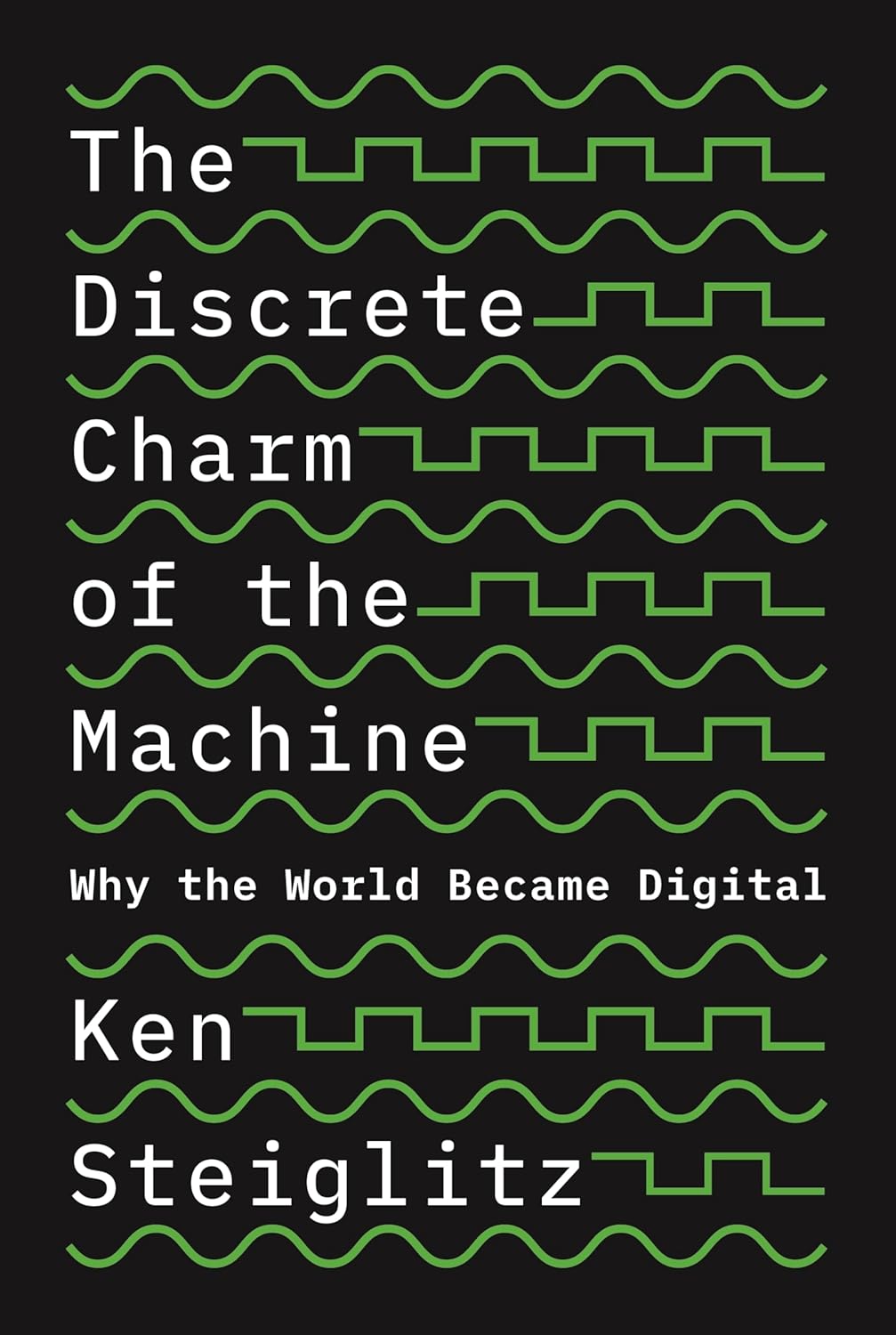
The Discrete Charm of the Machine: Why the World Became Digital

Description:

The genesis of the digital idea and why it transformed civilization

A few short decades ago, we were informed by the smooth signals of analog television and radio; we communicated using our analog telephones; and we even computed with analog computers. Today our world is digital, built with zeros and ones. Why did this revolution occur?
The Discrete Charm of the Machine explains, in an engaging and accessible manner, the varied physical and logical reasons behind this radical transformation.

The spark of individual genius shines through this story of innovation: the stored program of Jacquard’s loom; Charles Babbage’s logical branching; Alan Turing’s brilliant abstraction of the discrete machine; Harry Nyquist’s foundation for digital signal processing; Claude Shannon’s breakthrough insights into the meaning of information and bandwidth; and Richard Feynman’s prescient proposals for nanotechnology and quantum computing. Ken Steiglitz follows the progression of these ideas in the building of our digital world, from the internet and artificial intelligence to the edge of the unknown. Are questions like the famous traveling salesman problem truly beyond the reach of ordinary digital computers? Can quantum computers transcend these barriers? Does a mysterious magical power reside in the analog mechanisms of the brain? Steiglitz concludes by confronting the moral and aesthetic questions raised by the development of artificial intelligence and autonomous robots.

The Discrete Charm of the Machine examines why our information technology, the lifeblood of our civilization, became digital, and challenges us to think about where its future trajectory may lead.


Editorial Reviews

Review

"Computer scientist Steiglitz examines the global transformation from analog to digital and the ways it changed how we calculate, communicate and entertain ourselves. He describes the nuts and bolts of taking something analog, such as waves traveling through the air that make sound, and converting them into 0s and 1s, all in witty and cogent language."---Clara Moskowitz, Scientific American

"This is an engaging and enjoyable book. Readers interested in the differences between analogue and digital approaches to computation and signal processing will not find a better popular treatment."
---Thomas Haigh, Nature Electronics

"Reading this book was a great pleasure and there is lots to be effusive about. . . .this book deserves to be read by everyone interested in, or influenced by, modern digital technologies. When you think about it, this is pretty much everyone. So, in this reviewer's opinion, this book is destined to become a modern classic."
---Rob Ashmore, Mathematics Today

Review

“Well written and well organized, The Discrete Charm of the Machine discusses the transition from analog to digital both in technology and in the way we approach problems in computing. With an expansive scope that ranges from low-level physics to high-level questions about the limitations of computation, this is a welcome book in the field.”―Lance Fortnow, author of The Golden Ticket

The Discrete Charm of the Machine is a fun book! Steiglitz has a beautiful writing style that mixes hardcore facts with playful observations.”―William Cook, author of In Pursuit of the Traveling Salesman

“Written by one of the pioneers of digital signal processing,
The Discrete Charm of the Machine takes readers on an entertaining, accessible stroll through the history of the conversion of computer and entertainment technology from analog to digital. Steiglitz clearly had fun composing this enjoyable book.”―Alan V. Oppenheim, Massachusetts Institute of Technology

The Discrete Charm of the Machine is an inspirational must-read and delightful guide for anyone interested in traveling from the computational past through to the present. Reading this book will make you rethink what computation really is.”―Andrew Adamatzky, University of the West of England

Reviews:

5.0 out of 5 stars Nice collection and synthesis of digital processing topics - somewhat technical

K. · May 2, 2019

I was attracted to the book by the suggestion in the [sub] title that it was going to be about digital audio, since I've been a dabbler in digital recording for some time. But, that is not really the topic of the book, since it ranges over quite a bit of the breadth of the analog to digital (and back) transition that has occurred in all areas within recent years. But, as a former comp sci guy who lived and worked through a fair amount of the history covered in this book, I found it accessible and very interesting.Now, as to organization, well, it reads a lot like it was assembled from essays that had been written over a span of time and edited and arranged into a book. That was done well, but it may not flow as smoothly as some would like.The technical information is probably a hurdle for some readers. Since it was familiar to me, though at times a distant, fuzzy familarity, it didn't become impossibly dense. The author does suggest in places some of the more gritty formulas and like can be skipped if too complex, but I expect that's going to make a complete reading feel disconnected. (I didn't come to the end of this book feeling like I did at, say, "A Brief History of Time," where I was just flipping pages, but it was in my domain, more or less. Others may find it less accessible.)

5.0 out of 5 stars Fascinating and Detailed

J.G. · December 5, 2019

This book is wonderfully written. So far (I'm a few chapters in), it's like a course in Digital Signal Processing, without any of the homework. If you are very curious about this topic and require almost excruciating levels of detail to satisfy said curiosity, buy this book!

4.0 out of 5 stars Well done

M. · December 19, 2019

An incredible journey from vacuum tubes to quantum computing with a stop over for NP-Complete problems, which made my little data scientist heart go pitter pat. If you enjoy computers, their history, how they work, and why they evolved as they did, then I highly recommend this book.

3.0 out of 5 stars Only ok

M. · March 15, 2019

It is not really well organized.

5.0 out of 5 stars On time and as described.

R.T. · November 23, 2022

On time and as described.

High expectations, frustrating results.

A. · July 9, 2020

The book starts very well, not aiming too high, with reasonably clear introduction to the world of digital computers and with a very basic reader in mind. Essentially it gives a basic introduction to the fundamental physics of modern digital transistors and explains why digital is superior to analog when transmitting data.A warning on this statement is that I am very familiar with these subject and I do not read them with the mind of the newcomer, so perhaps I have a 'positively' biased view here.The problem starts in the second half (Part III) of the book (on topics where I am less familiar) when the author tries to explain more conceptually sophisticated issues such as "computation complexity", the Turing machine, NP completeness, quantum computers and the like. None of these concepts is clearly explained and Einstein's recommendation of "Everything Should Be Made as Simple as Possible, But Not Simpler" is totally ignored. I do not think anyone - if not already familiar with these issues - can come out claiming any understanding of these problems and one is left with a sense of profound frustration with this book.I went back to an older book with a very similar content (G. W. Flake, The Computational Beauty of Nature) and I find this last book infinitely clearer and better written if one wants to get a feeling of what is going on with some of these modern fundamental issues, despite the fact that quantum computers are not discussed.

The Discrete Charm of the Machine: Why the World Became Digital

Product ID: U0691229023
Condition: New

4.2

AED12860

Price includes VAT & Import Duties
Type: Paperback
Availability: In Stock

Quantity:

|

Order today to get by 7-14 business days

Delivery fee of AED 20. Free for orders above AED 200.

Returns & Warranty policies

Imported From: United States

At BOLO, we work hard to ensure the products you receive are new, genuine, and sourced from reputable suppliers.

BOLO is not an authorized or official retailer for most brands, nor are we affiliated with manufacturers unless specifically stated on a product page. Instead, we source verified sellers, authorized distributors or directly from the manufacturer.

Each product undergoes thorough inspection and verification at our consolidation and fulfilment centers to ensure it meets our strict authenticity and quality standards before being shipped and delivered to you.

If you ever have concerns regarding the authenticity of a product purchased from us, please contact Bolo Support. We will review your inquiry promptly and, if necessary, provide documentation verifying authenticity or offer a suitable resolution.

Your trust is our top priority, and we are committed to maintaining transparency and integrity in every transaction.

All product information, images, descriptions, and reviews originate from the manufacturer or from trusted sellers overseas. BOLO is not affiliated with, endorsed by, or an authorized retailer for most brands listed on our website unless stated otherwise.

While we strive to display accurate information, variations in packaging, labeling, instructions, or formulation may occasionally occur due to regional differences or supplier updates. For detailed or manufacturer-specific information, please contact the brand directly or reach out to BOLO Support for assistance.

Unless otherwise stated, all prices displayed on the product page include applicable taxes and import duties.

BOLO operates in accordance with the laws and regulations of United Arab Emirates. Any items found to be restricted or prohibited for sale within the UAE will be cancelled prior to shipment. We take proactive measures to ensure that only products permitted for sale in United Arab Emirates are listed on our website.

All items are shipped by air, and any products classified as “Dangerous Goods (DG)” under IATA regulations will be removed from the order and cancelled.

All orders are processed manually, and we make every effort to process them promptly once confirmed. Products cancelled due to the above reasons will be permanently removed from listings across the website.

More from this brand

Similar items from “Electronics”

The Discrete Charm of the Machine: Why the World Became Digital

Product ID: U0691229023
Condition: New

4.2

The Discrete Charm of the Machine: Why the World Became Digital-0
Type: Paperback

AED12860

Price includes VAT & Import Duties
Availability: In Stock

Quantity:

|

Order today to get by 7-14 business days

Delivery fee of AED 20. Free for orders above AED 200.

Returns & Warranty policies

Imported From: United States

At BOLO, we work hard to ensure the products you receive are new, genuine, and sourced from reputable suppliers.

BOLO is not an authorized or official retailer for most brands, nor are we affiliated with manufacturers unless specifically stated on a product page. Instead, we source verified sellers, authorized distributors or directly from the manufacturer.

Each product undergoes thorough inspection and verification at our consolidation and fulfilment centers to ensure it meets our strict authenticity and quality standards before being shipped and delivered to you.

If you ever have concerns regarding the authenticity of a product purchased from us, please contact Bolo Support. We will review your inquiry promptly and, if necessary, provide documentation verifying authenticity or offer a suitable resolution.

Your trust is our top priority, and we are committed to maintaining transparency and integrity in every transaction.

All product information, images, descriptions, and reviews originate from the manufacturer or from trusted sellers overseas. BOLO is not affiliated with, endorsed by, or an authorized retailer for most brands listed on our website unless stated otherwise.

While we strive to display accurate information, variations in packaging, labeling, instructions, or formulation may occasionally occur due to regional differences or supplier updates. For detailed or manufacturer-specific information, please contact the brand directly or reach out to BOLO Support for assistance.

Unless otherwise stated, all prices displayed on the product page include applicable taxes and import duties.

BOLO operates in accordance with the laws and regulations of United Arab Emirates. Any items found to be restricted or prohibited for sale within the UAE will be cancelled prior to shipment. We take proactive measures to ensure that only products permitted for sale in United Arab Emirates are listed on our website.

All items are shipped by air, and any products classified as “Dangerous Goods (DG)” under IATA regulations will be removed from the order and cancelled.

All orders are processed manually, and we make every effort to process them promptly once confirmed. Products cancelled due to the above reasons will be permanently removed from listings across the website.

Description:

The genesis of the digital idea and why it transformed civilization

A few short decades ago, we were informed by the smooth signals of analog television and radio; we communicated using our analog telephones; and we even computed with analog computers. Today our world is digital, built with zeros and ones. Why did this revolution occur?
The Discrete Charm of the Machine explains, in an engaging and accessible manner, the varied physical and logical reasons behind this radical transformation.

The spark of individual genius shines through this story of innovation: the stored program of Jacquard’s loom; Charles Babbage’s logical branching; Alan Turing’s brilliant abstraction of the discrete machine; Harry Nyquist’s foundation for digital signal processing; Claude Shannon’s breakthrough insights into the meaning of information and bandwidth; and Richard Feynman’s prescient proposals for nanotechnology and quantum computing. Ken Steiglitz follows the progression of these ideas in the building of our digital world, from the internet and artificial intelligence to the edge of the unknown. Are questions like the famous traveling salesman problem truly beyond the reach of ordinary digital computers? Can quantum computers transcend these barriers? Does a mysterious magical power reside in the analog mechanisms of the brain? Steiglitz concludes by confronting the moral and aesthetic questions raised by the development of artificial intelligence and autonomous robots.

The Discrete Charm of the Machine examines why our information technology, the lifeblood of our civilization, became digital, and challenges us to think about where its future trajectory may lead.


Editorial Reviews

Review

"Computer scientist Steiglitz examines the global transformation from analog to digital and the ways it changed how we calculate, communicate and entertain ourselves. He describes the nuts and bolts of taking something analog, such as waves traveling through the air that make sound, and converting them into 0s and 1s, all in witty and cogent language."---Clara Moskowitz, Scientific American

"This is an engaging and enjoyable book. Readers interested in the differences between analogue and digital approaches to computation and signal processing will not find a better popular treatment."
---Thomas Haigh, Nature Electronics

"Reading this book was a great pleasure and there is lots to be effusive about. . . .this book deserves to be read by everyone interested in, or influenced by, modern digital technologies. When you think about it, this is pretty much everyone. So, in this reviewer's opinion, this book is destined to become a modern classic."
---Rob Ashmore, Mathematics Today

Review

“Well written and well organized, The Discrete Charm of the Machine discusses the transition from analog to digital both in technology and in the way we approach problems in computing. With an expansive scope that ranges from low-level physics to high-level questions about the limitations of computation, this is a welcome book in the field.”―Lance Fortnow, author of The Golden Ticket

The Discrete Charm of the Machine is a fun book! Steiglitz has a beautiful writing style that mixes hardcore facts with playful observations.”―William Cook, author of In Pursuit of the Traveling Salesman

“Written by one of the pioneers of digital signal processing,
The Discrete Charm of the Machine takes readers on an entertaining, accessible stroll through the history of the conversion of computer and entertainment technology from analog to digital. Steiglitz clearly had fun composing this enjoyable book.”―Alan V. Oppenheim, Massachusetts Institute of Technology

The Discrete Charm of the Machine is an inspirational must-read and delightful guide for anyone interested in traveling from the computational past through to the present. Reading this book will make you rethink what computation really is.”―Andrew Adamatzky, University of the West of England

Reviews:

5.0 out of 5 stars Nice collection and synthesis of digital processing topics - somewhat technical

K. · May 2, 2019

I was attracted to the book by the suggestion in the [sub] title that it was going to be about digital audio, since I've been a dabbler in digital recording for some time. But, that is not really the topic of the book, since it ranges over quite a bit of the breadth of the analog to digital (and back) transition that has occurred in all areas within recent years. But, as a former comp sci guy who lived and worked through a fair amount of the history covered in this book, I found it accessible and very interesting.Now, as to organization, well, it reads a lot like it was assembled from essays that had been written over a span of time and edited and arranged into a book. That was done well, but it may not flow as smoothly as some would like.The technical information is probably a hurdle for some readers. Since it was familiar to me, though at times a distant, fuzzy familarity, it didn't become impossibly dense. The author does suggest in places some of the more gritty formulas and like can be skipped if too complex, but I expect that's going to make a complete reading feel disconnected. (I didn't come to the end of this book feeling like I did at, say, "A Brief History of Time," where I was just flipping pages, but it was in my domain, more or less. Others may find it less accessible.)

5.0 out of 5 stars Fascinating and Detailed

J.G. · December 5, 2019

This book is wonderfully written. So far (I'm a few chapters in), it's like a course in Digital Signal Processing, without any of the homework. If you are very curious about this topic and require almost excruciating levels of detail to satisfy said curiosity, buy this book!

4.0 out of 5 stars Well done

M. · December 19, 2019

An incredible journey from vacuum tubes to quantum computing with a stop over for NP-Complete problems, which made my little data scientist heart go pitter pat. If you enjoy computers, their history, how they work, and why they evolved as they did, then I highly recommend this book.

3.0 out of 5 stars Only ok

M. · March 15, 2019

It is not really well organized.

5.0 out of 5 stars On time and as described.

R.T. · November 23, 2022

On time and as described.

High expectations, frustrating results.

A. · July 9, 2020

The book starts very well, not aiming too high, with reasonably clear introduction to the world of digital computers and with a very basic reader in mind. Essentially it gives a basic introduction to the fundamental physics of modern digital transistors and explains why digital is superior to analog when transmitting data.A warning on this statement is that I am very familiar with these subject and I do not read them with the mind of the newcomer, so perhaps I have a 'positively' biased view here.The problem starts in the second half (Part III) of the book (on topics where I am less familiar) when the author tries to explain more conceptually sophisticated issues such as "computation complexity", the Turing machine, NP completeness, quantum computers and the like. None of these concepts is clearly explained and Einstein's recommendation of "Everything Should Be Made as Simple as Possible, But Not Simpler" is totally ignored. I do not think anyone - if not already familiar with these issues - can come out claiming any understanding of these problems and one is left with a sense of profound frustration with this book.I went back to an older book with a very similar content (G. W. Flake, The Computational Beauty of Nature) and I find this last book infinitely clearer and better written if one wants to get a feeling of what is going on with some of these modern fundamental issues, despite the fact that quantum computers are not discussed.

More from this brand

Similar items from “Electronics”