Description:
“The Inner Game of Tennis is not just a tennis book . . . because inner voices torture all of us—not just country-club tennis players.”—Michael Lewis, author of Moneyball and The Big Short
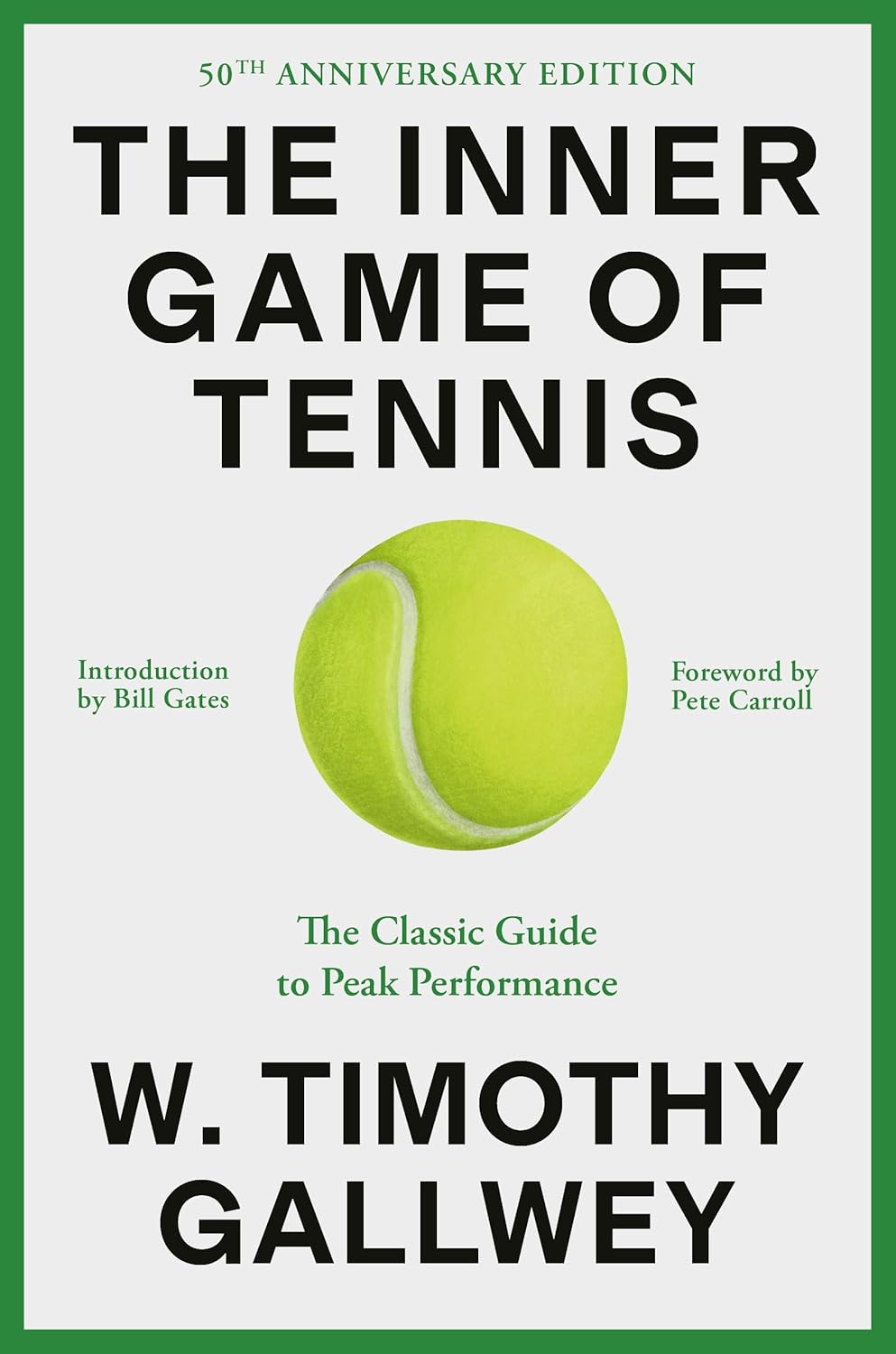
This phenomenally successful guide to mastering the game from the inside out has become a touchstone for hundreds of thousands of people. Billie Jean King has called the book her tennis bible; Al Gore has used it to focus his campaign staff; and Itzhak Perlman has recommended it to young violinists. Based on W. Timothy Gallwey’s profound realization that the key to success doesn’t lie in holding the racket just right, or positioning the feet perfectly, but rather in keeping the mind uncluttered, this transformative book gives you the tools to unlock the potential that you’ve possessed all along.
“The Inner Game” is the one played within the mind of the player, against the hurdles of self-doubt, nervousness, and lapses in concentration. Gallwey shows us how to overcome these obstacles by trusting the intuitive wisdom of our bodies and achieving a state of “relaxed concentration.” With chapters devoted to trusting the self and changing habits, it is no surprise then, that Gallwey’s method has had an impact far beyond the confines of the tennis court.
Whether you want to play music, write a novel, get ahead at work, or simply unwind after a stressful day, Gallwey shows you how to tap into your utmost potential. In this fiftieth-anniversary edition, the principles of the Inner Game shine through as more relevant today than ever before. No matter your goals, The Inner Game of Tennis gives you the definitive framework for long-term success.
Amazon.com Review
The new edition of this remarkable work--Billie Jean King called the original her tennis bible--refines Gallwey's theories on concentration, gamesmanship, breaking bad habits, learning to trust yourself on the court, and awareness. "No matter what a person's complaint when he has a lesson with me, I have found the most beneficial first step," he stressed, "is to encourage him to see and feel what he is doing--that is, to increase his awareness of what actually is."
There are aspects of psychobabble and mysticism to be found here, sure, but Gallwey instructs as much by anecdote as anything else, and time has ultimately proved him a guru. What seemed radical in the early '70s is now accepted ammunition for the canon; the right mental approach is every bit as important as a good backhand. The Inner Game of Tennis still does much to keep that idea in play. --Jeff Silverman
Review
“W. Timothy Gallwey’s handbook has been holy writ for generations of hackers and better players as well. Now it’s been reissued in a special 50th-anniversary edition as sleek as a Roger Federer backhand up the line.”—The Wall Street Journal
“Revolutionary. . . The Inner Game of Tennis is not just a tennis book . . . because inner voices torture all of us—not just country-club tennis players.”—Michael Lewis, author of Moneyball and The Big Short
From the Inside Flap
From the Back Cover
About the Author
Excerpt. © Reprinted by permission. All rights reserved.
Reflections on the Mental Side of Tennis
The problems which most perplex tennis players are not those dealing with the proper way to swing a racket. Books and professionals giving this information abound. Nor do most players complain excessively about physical limitations. The most common complaint of sportsmen ringing down the corridors of the ages is, “It’s not that I don’t know what to do, it’s that I don’t do what I know!” Other common complaints that come constantly to the attention of the tennis pro:
I play better in practice than during the match.
I know exactly what I’m doing wrong on my forehand, I just can’t seem to break the habit.
When I’m really trying hard to do the stroke the way it says to in the book, I flub the shot every time. When I concentrate on one thing I’m supposed to be doing, I forget something else.
Every time I get near match point against a good player, I get so nervous I lose my concentration.
I’m my own worst enemy; I usually beat myself.
Most players of any sport run into these or similar difficulties frequently, but it is not so easy to gain practical insight into how to deal with them. The player is often left with such warmed-over aphorisms as “Well, tennis is a very psychological game, and you have to develop the proper mental attitudes” or “You have to be confident and possess the will to win or else you’ll always be a loser.” But how can one “be confident” or develop the “proper mental attitudes”? These questions are usually left unanswered.
So there seems to be room for comment on the improvement of the mental processes which translate technical information about how to hit a ball into effective action. How to develop the inner skills, without which high performance is impossible, is the subject of The Inner Game of Tennis.
The Typical Tennis Lesson
Imagine what goes on inside the head of an eager student taking a lesson from an equally eager new tennis pro. Suppose that the student is a middle-aged businessman bent on improving his position on the club ladder. The pro is standing at the net with a large basket of balls, and being a bit uncertain whether his student is considering him worth the lesson fee, he is carefully evaluating every shot. “That’s good, but you’re rolling your racket face over a little on your follow-through, Mr. Weil. Now shift your weight onto your front foot as you step into the ball . . . Now you’re taking your racket back too late . . . Your backswing should be a little lower than on that last shot . . . That’s it, much better.” Before long, Mr. Weil’s mind is churning with six thoughts about what he should be doing and sixteen thoughts about what he shouldn’t be doing. Improvement seems dubious and very complex, but both he and the pro are impressed by the careful analysis of each stroke and the fee is gladly paid upon receipt of the advice to “practice all this, and eventually you’ll see a big improvement.”
I too admit to overteaching as a new pro, but one day when I was in a relaxed mood, I began saying less and noticing more. To my surprise, errors that I saw but didn’t mention were correcting themselves without the student ever knowing he had made them. How were the changes happening? Though I found this interesting, it was a little hard on my ego, which didn’t quite see how it was going to get its due credit for the improvements being made. It was an even greater blow when I realized that sometimes my verbal instructions seemed to decrease the probability of the desired correction occurring.
All teaching pros know what I’m talking about. They all have students like one of mine named Dorothy. I would give Dorothy a gentle, low-pressured instruction like, “Why don’t you try lifting the follow-through up from your waist to the level of your shoulder? The topspin will keep the ball in the court.” Sure enough, Dorothy would try hard to follow my instructions. The muscles would tense around her mouth; her eyebrows would set in a determined frown; the muscles in her forearm would tighten, making fluidity impossible; and the follow-through would end only a few inches higher. At this point, the stock response of the patient pro is, “That’s better, Dorothy, but relax, don’t try so hard!” The advice is good as far as it goes, but Dorothy does not understand how to “relax” while also trying hard to hit the ball correctly.
Why should Dorothy—or you or I—experience an awkward tightening when performing a desired action which is not physically difficult? What happens inside the head between the time the instruction is given and the swing is complete? The first glimmer of an answer to this key question came to me at a moment of rare insight after a lesson with Dorothy: “Whatever’s going on in her head, it’s too damn much! She’s trying so hard to swing the racket the way I told her that she can’t focus on the ball.” Then and there, I promised myself I would cut down on the quantity of verbal instructions.
My next lesson that day was with a beginner named Paul who had never held a racket. I was determined to show him how to play using as few instructions as possible; I’d try to keep his mind uncluttered and see if it made a difference. So I started by telling Paul I was trying something new: I was going to skip entirely my usual explanations to beginning players about the proper grip, stroke and footwork for the basic forehand. Instead, I was going to hit ten forehands myself, and I wanted him to watch carefully, not thinking about what I was doing, but simply trying to grasp a visual image of the forehand. He was to repeat the image in his mind several times and then just let his body imitate. After I had hit ten forehands, Paul imagined himself doing the same. Then, as I put the racket into his hand, sliding it into the correct grip, he said to me, “I noticed that the first thing you did was to move your feet.” I replied with a noncommittal grunt and asked him to let his body imitate the forehand as well as it could. He dropped the ball, took a perfect backswing, swung forward, racket level, and with natural fluidity ended the swing at shoulder height, perfect for his first attempt! But wait, his feet; they hadn’t moved an inch from the perfect ready position he had assumed before taking his racket back. They were nailed to the court. I pointed to them, and Paul said, “Oh yeah, I forgot about them!” The one element of the stroke Paul had tried to remember was the one thing he didn’t do! Everything else had been absorbed and reproduced without a word being uttered or an instruction being given!
I was beginning to learn what all good pros and students of tennis must learn: that images are better than words, showing better than telling, too much instruction worse than none, and that trying often produces negative results. One question perplexed me: What’s wrong with trying? What does it mean to try too hard?
Details:
Visit the Random House Trade Paperbacks Store
The Inner Game of Tennis: The Classic Guide to the Mental Side of Peak Performance
AED8152
Quantity:
Order today to get by 7-14 business days
Delivery fee of AED 20. Free for orders above AED 200.
 Imported From: United States
At BOLO, we work hard to ensure the products you receive are new, genuine, and sourced from reputable suppliers.
Every product in the BOLO catalogue is sourced through our Verified Global Supply Network of verified sellers, authorized distributors or directly from the manufacturer.
Each product undergoes thorough inspection and verification at our consolidation and fulfilment centers to ensure it meets our strict authenticity and quality standards before being shipped and delivered to you.
If you ever have concerns regarding the authenticity of a product purchased from us, please contact Bolo Support. We will review your inquiry promptly and, if necessary, provide documentation verifying authenticity or offer a suitable resolution.
Your trust is our top priority, and we are committed to maintaining transparency and integrity in every transaction.
While we strive to display accurate information, variations in packaging, labeling, instructions, or formulation may occasionally occur due to regional differences or supplier updates. For detailed or manufacturer-specific information, please contact the brand directly or reach out to BOLO Support for assistance.
Unless otherwise stated, all prices displayed on the product page include applicable taxes and import duties.
BOLO operates in accordance with the laws and regulations of United Arab Emirates. Any items found to be restricted or prohibited for sale within the United Arab Emirates will be cancelled prior to shipment. We take proactive measures to ensure that only products permitted for sale in United Arab Emirates are listed on our website.
All items are shipped by air, and any products classified as “Dangerous Goods (DG)” under IATA regulations will be removed from the order and cancelled.
All orders are processed manually, and we make every effort to process them promptly once confirmed. Products cancelled due to the above reasons will be permanently removed from listings across the website.
More from this brand
Similar items from “Tennis”
Share with
Or share with link
https://www.bolo.ae/products/U0679778314
Visit the Random House Trade Paperbacks Store
The Inner Game of Tennis: The Classic Guide to the Mental Side of Peak Performance
AED8152
Quantity:
Order today to get by 7-14 business days
Delivery fee of AED 20. Free for orders above AED 200.
Imported From: United States
At BOLO, we work hard to ensure the products you receive are new, genuine, and sourced from reputable suppliers.
Every product in the BOLO catalogue is sourced through our Verified Global Supply Network of verified sellers, authorized distributors or directly from the manufacturer.
Each product undergoes thorough inspection and verification at our consolidation and fulfilment centers to ensure it meets our strict authenticity and quality standards before being shipped and delivered to you.
If you ever have concerns regarding the authenticity of a product purchased from us, please contact Bolo Support. We will review your inquiry promptly and, if necessary, provide documentation verifying authenticity or offer a suitable resolution.
Your trust is our top priority, and we are committed to maintaining transparency and integrity in every transaction.
While we strive to display accurate information, variations in packaging, labeling, instructions, or formulation may occasionally occur due to regional differences or supplier updates. For detailed or manufacturer-specific information, please contact the brand directly or reach out to BOLO Support for assistance.
Unless otherwise stated, all prices displayed on the product page include applicable taxes and import duties.
BOLO operates in accordance with the laws and regulations of United Arab Emirates. Any items found to be restricted or prohibited for sale within the United Arab Emirates will be cancelled prior to shipment. We take proactive measures to ensure that only products permitted for sale in United Arab Emirates are listed on our website.
All items are shipped by air, and any products classified as “Dangerous Goods (DG)” under IATA regulations will be removed from the order and cancelled.
All orders are processed manually, and we make every effort to process them promptly once confirmed. Products cancelled due to the above reasons will be permanently removed from listings across the website.
Description:
“The Inner Game of Tennis is not just a tennis book . . . because inner voices torture all of us—not just country-club tennis players.”—Michael Lewis, author of Moneyball and The Big Short
This phenomenally successful guide to mastering the game from the inside out has become a touchstone for hundreds of thousands of people. Billie Jean King has called the book her tennis bible; Al Gore has used it to focus his campaign staff; and Itzhak Perlman has recommended it to young violinists. Based on W. Timothy Gallwey’s profound realization that the key to success doesn’t lie in holding the racket just right, or positioning the feet perfectly, but rather in keeping the mind uncluttered, this transformative book gives you the tools to unlock the potential that you’ve possessed all along.
“The Inner Game” is the one played within the mind of the player, against the hurdles of self-doubt, nervousness, and lapses in concentration. Gallwey shows us how to overcome these obstacles by trusting the intuitive wisdom of our bodies and achieving a state of “relaxed concentration.” With chapters devoted to trusting the self and changing habits, it is no surprise then, that Gallwey’s method has had an impact far beyond the confines of the tennis court.
Whether you want to play music, write a novel, get ahead at work, or simply unwind after a stressful day, Gallwey shows you how to tap into your utmost potential. In this fiftieth-anniversary edition, the principles of the Inner Game shine through as more relevant today than ever before. No matter your goals, The Inner Game of Tennis gives you the definitive framework for long-term success.
Amazon.com Review
The new edition of this remarkable work--Billie Jean King called the original her tennis bible--refines Gallwey's theories on concentration, gamesmanship, breaking bad habits, learning to trust yourself on the court, and awareness. "No matter what a person's complaint when he has a lesson with me, I have found the most beneficial first step," he stressed, "is to encourage him to see and feel what he is doing--that is, to increase his awareness of what actually is."
There are aspects of psychobabble and mysticism to be found here, sure, but Gallwey instructs as much by anecdote as anything else, and time has ultimately proved him a guru. What seemed radical in the early '70s is now accepted ammunition for the canon; the right mental approach is every bit as important as a good backhand. The Inner Game of Tennis still does much to keep that idea in play. --Jeff Silverman
Review
“W. Timothy Gallwey’s handbook has been holy writ for generations of hackers and better players as well. Now it’s been reissued in a special 50th-anniversary edition as sleek as a Roger Federer backhand up the line.”—The Wall Street Journal
“Revolutionary. . . The Inner Game of Tennis is not just a tennis book . . . because inner voices torture all of us—not just country-club tennis players.”—Michael Lewis, author of Moneyball and The Big Short
From the Inside Flap
From the Back Cover
About the Author
Excerpt. © Reprinted by permission. All rights reserved.
Reflections on the Mental Side of Tennis
The problems which most perplex tennis players are not those dealing with the proper way to swing a racket. Books and professionals giving this information abound. Nor do most players complain excessively about physical limitations. The most common complaint of sportsmen ringing down the corridors of the ages is, “It’s not that I don’t know what to do, it’s that I don’t do what I know!” Other common complaints that come constantly to the attention of the tennis pro:
I play better in practice than during the match.
I know exactly what I’m doing wrong on my forehand, I just can’t seem to break the habit.
When I’m really trying hard to do the stroke the way it says to in the book, I flub the shot every time. When I concentrate on one thing I’m supposed to be doing, I forget something else.
Every time I get near match point against a good player, I get so nervous I lose my concentration.
I’m my own worst enemy; I usually beat myself.
Most players of any sport run into these or similar difficulties frequently, but it is not so easy to gain practical insight into how to deal with them. The player is often left with such warmed-over aphorisms as “Well, tennis is a very psychological game, and you have to develop the proper mental attitudes” or “You have to be confident and possess the will to win or else you’ll always be a loser.” But how can one “be confident” or develop the “proper mental attitudes”? These questions are usually left unanswered.
So there seems to be room for comment on the improvement of the mental processes which translate technical information about how to hit a ball into effective action. How to develop the inner skills, without which high performance is impossible, is the subject of The Inner Game of Tennis.
The Typical Tennis Lesson
Imagine what goes on inside the head of an eager student taking a lesson from an equally eager new tennis pro. Suppose that the student is a middle-aged businessman bent on improving his position on the club ladder. The pro is standing at the net with a large basket of balls, and being a bit uncertain whether his student is considering him worth the lesson fee, he is carefully evaluating every shot. “That’s good, but you’re rolling your racket face over a little on your follow-through, Mr. Weil. Now shift your weight onto your front foot as you step into the ball . . . Now you’re taking your racket back too late . . . Your backswing should be a little lower than on that last shot . . . That’s it, much better.” Before long, Mr. Weil’s mind is churning with six thoughts about what he should be doing and sixteen thoughts about what he shouldn’t be doing. Improvement seems dubious and very complex, but both he and the pro are impressed by the careful analysis of each stroke and the fee is gladly paid upon receipt of the advice to “practice all this, and eventually you’ll see a big improvement.”
I too admit to overteaching as a new pro, but one day when I was in a relaxed mood, I began saying less and noticing more. To my surprise, errors that I saw but didn’t mention were correcting themselves without the student ever knowing he had made them. How were the changes happening? Though I found this interesting, it was a little hard on my ego, which didn’t quite see how it was going to get its due credit for the improvements being made. It was an even greater blow when I realized that sometimes my verbal instructions seemed to decrease the probability of the desired correction occurring.
All teaching pros know what I’m talking about. They all have students like one of mine named Dorothy. I would give Dorothy a gentle, low-pressured instruction like, “Why don’t you try lifting the follow-through up from your waist to the level of your shoulder? The topspin will keep the ball in the court.” Sure enough, Dorothy would try hard to follow my instructions. The muscles would tense around her mouth; her eyebrows would set in a determined frown; the muscles in her forearm would tighten, making fluidity impossible; and the follow-through would end only a few inches higher. At this point, the stock response of the patient pro is, “That’s better, Dorothy, but relax, don’t try so hard!” The advice is good as far as it goes, but Dorothy does not understand how to “relax” while also trying hard to hit the ball correctly.
Why should Dorothy—or you or I—experience an awkward tightening when performing a desired action which is not physically difficult? What happens inside the head between the time the instruction is given and the swing is complete? The first glimmer of an answer to this key question came to me at a moment of rare insight after a lesson with Dorothy: “Whatever’s going on in her head, it’s too damn much! She’s trying so hard to swing the racket the way I told her that she can’t focus on the ball.” Then and there, I promised myself I would cut down on the quantity of verbal instructions.
My next lesson that day was with a beginner named Paul who had never held a racket. I was determined to show him how to play using as few instructions as possible; I’d try to keep his mind uncluttered and see if it made a difference. So I started by telling Paul I was trying something new: I was going to skip entirely my usual explanations to beginning players about the proper grip, stroke and footwork for the basic forehand. Instead, I was going to hit ten forehands myself, and I wanted him to watch carefully, not thinking about what I was doing, but simply trying to grasp a visual image of the forehand. He was to repeat the image in his mind several times and then just let his body imitate. After I had hit ten forehands, Paul imagined himself doing the same. Then, as I put the racket into his hand, sliding it into the correct grip, he said to me, “I noticed that the first thing you did was to move your feet.” I replied with a noncommittal grunt and asked him to let his body imitate the forehand as well as it could. He dropped the ball, took a perfect backswing, swung forward, racket level, and with natural fluidity ended the swing at shoulder height, perfect for his first attempt! But wait, his feet; they hadn’t moved an inch from the perfect ready position he had assumed before taking his racket back. They were nailed to the court. I pointed to them, and Paul said, “Oh yeah, I forgot about them!” The one element of the stroke Paul had tried to remember was the one thing he didn’t do! Everything else had been absorbed and reproduced without a word being uttered or an instruction being given!
I was beginning to learn what all good pros and students of tennis must learn: that images are better than words, showing better than telling, too much instruction worse than none, and that trying often produces negative results. One question perplexed me: What’s wrong with trying? What does it mean to try too hard?
Details:
More from this brand
Similar items from “Tennis”
Share with
Or share with link
https://www.bolo.ae/products/U0679778314