Deliver toUnited Arab Emirates
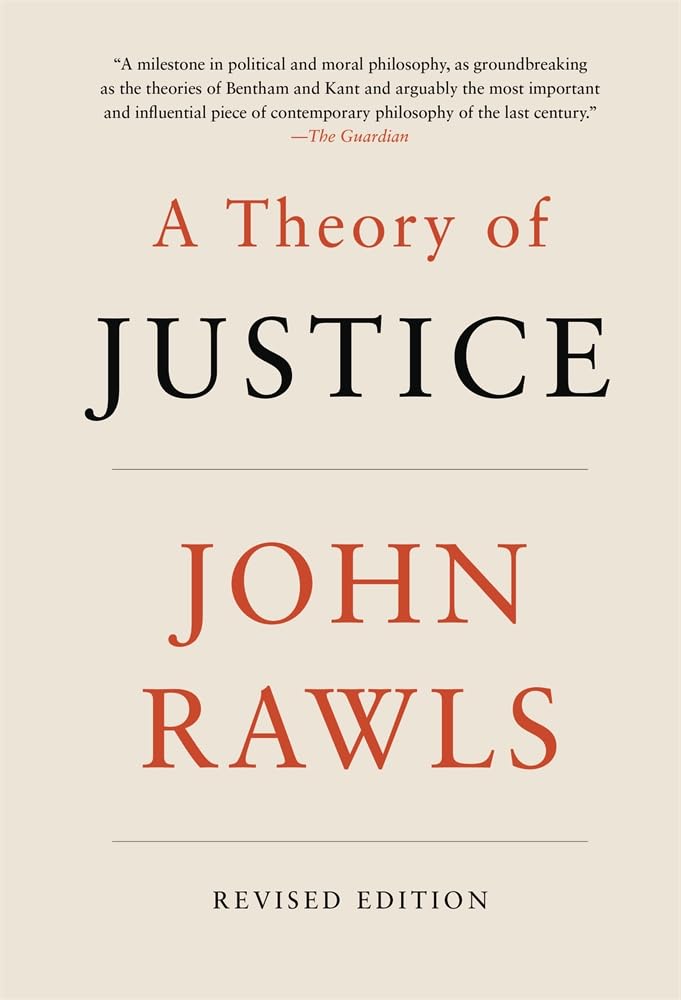
A Theory of Justice

Description:

“A milestone in political and moral philosophy, as groundbreaking as the theories of Bentham and Kant and arguably the most important and influential piece of contemporary philosophy of the last century.” ―The Guardian
The principles of justice that Rawls set forth in this book are those that free and rational people would accept in an “original position” of equality. In this hypothetical situation, which corresponds to the state of nature in social contract theory, no one knows their place in society; their class or social status; their fortune in the distribution of natural assets and abilities―their intelligence, strength, and the like―or even their conception of the good. Deliberating behind this “veil of ignorance,” people naturally determine their proper rights and duties. Thus, as Rawls writes, “each person possesses an inviolability founded on justice that even the welfare of society as a whole cannot override.”

Incorporating the ideas of Rousseau, Kant, Emerson, and Lincoln, Rawls’s theory is as powerful today as it was when first published in 1971. For more than half a century,
A Theory of Justice has been taught and debated, celebrated and translated into more than thirty languages. This revised edition includes changes, discussed in the preface, that Rawls considered to be significant, especially to the discussions of liberty and primary social goods.


Editorial Reviews

Review

“The most influential work of liberal political philosophy of the twentieth century.”Kwame Anthony Appiah, New York Review of Books

“I don’t know of a more lucid articulation of the intuitions many of us share about what is just.”
Scott Turow, New York Times Book Review

“Impeccably high-minded in its goals, meticulous in execution, optimistic in its view of humanity…Rawls’s theory continues to provide both a compelling framework within which such basic principles can be debated, and a flexible but robust defence of liberal human values. That is a monumental achievement.”
Prospect

“A much-needed affirmation of a free, tolerant, and democratic society…at a time when individual freedom and democracy are under attack.”
The Nation

“Magisterial…John Rawls draws on the most subtle techniques of contemporary analytic philosophy to provide the social contract tradition with what is, from a philosophical point of view at least, the most formidable defense it has yet received…[and] makes available the powerful intellectual resources and the comprehensive approach that have so far eluded antiutilitarians. He also makes clear how wrong it was to claim, as so many were claiming only a few years back, that systematic moral and political philosophy are dead… Whatever else may be true it is surely true that we must develop a sterner and more fastidious sense of justice. In making his peerless contribution to political theory, John Rawls has made a unique contribution to this urgent task. No higher achievement is open to a scholar.”
Marshall Cohen, New York Times Book Review

“Rawls’s
Theory of Justice is widely and justly regarded as this century’s most important work of political philosophy. Originally published in 1971, it quickly became the subject of extensive commentary and criticism, which led Rawls to revise some of the arguments he had originally put forward in this work… This edition will certainly become the definitive one; all scholars will use it, and it will be an essential text for any academic library. It contains a new preface that helpfully outlines the major revisions, and a ‘conversion table’ that correlates the pagination of this edition with the original, which will be useful to students and scholars working with this edition and the extensive secondary literature on Rawls’s work. Highly recommended.”J. D. Moon, Choice

“[Rawls] has elucidated a conception of justice which goes beyond anything to be found in Kant or Rousseau. It is a convincing refutation, if one is needed, of any lingering suspicions that the tradition of English-speaking political philosophy might be dead. Indeed, his book might plausibly be claimed to be the most notable contribution to that tradition to have been published since Sidgwick and Mill.”
Times Literary Supplement

“Enlightenment comes in various forms, sometimes even by means of books. And it is a pleasure to recommend…an indigenous American philosophical masterpiece of the first order… I mean…to press my recommendation of [this book] to non-philosophers, especially those holding positions of responsibility in law and government. For the topic with which it deals is central to this country’s purposes, and the misunderstanding of that topic is central to its difficulties… And the central idea is simple, elegant, plausible, and easily applied by anybody at any time as a measure of the justice of his own actions.”
Peter Caws, New Republic

“With the simple carpentry of its arguments, its egalitarian leanings, and its preoccupation with fairness, Rawls’s classic 1971 work,
A Theory of Justice, is as American a book as, say, Mark Twain’s The Adventures of Huckleberry Finn.”Will Blythe, Civilization

From the Back Cover

"Each person" writes John Rawls, "possesses an inviolability founded on justice that even the welfare of society as a whole cannot override. Therefore in a just society the rights secured by justice are not subject to political bargaining or to the calculus of social interests".

In this book Mr. Rawls attempts to account for these propositions, which he believes express our intuitive convictions of the primacy of justice. The principles of justice he sets forth are those that free and rational persons would accept in an initial position of equality. In this hypothetical situation, which corresponds to the state of nature in social contract theory, no one knows his or her place in society; his or her class position or social status; his or her fortune in the distribution of natural assets and abilities; his or her intelligence, strength, and the like; or even his or her conception of the good. Thus, deliberating behind a veil of ignorance, people determine their rights and duties. The first, theoretical, section of the book addresses objections to the theory and alternative positions, especially utilitarianism. The author then applies his theory to the philosophical basis of the constitutional liberties, the problem of distributive justice, and the definition of the ground and limits of political duty and obligation. He includes here discussion of the issues of civil disobedience and conscientious objection. Finally, he connects the theory of justice with a doctrine of the good and of moral development. This enables him to formulate a conception of society as a social union of social unions and to use the theory of justice to explain the values of community.

Since the appearance ofthe book in 1971, A Theory of Justice has been translated into 23 languages. Revisions to the original English text have been included in translations since 1975. This new English edition incorporates all those revisions, which the author considers to be significant improvements, especially to the discussions of liberty and primary goods. The Preface for the Revised Edition discusses the revisions in some detail.

Reviews:

5.0 out of 5 stars So much depends on it

A.B. · April 21, 2024

If you want to read modern philosophers, Martha Nussbaum, Timothy Williamson, Owen Flanagan, Daniel Dennett, etc etc., they all seem to employ concepts or frameworks from Theory of Justice in the background. That's my impression anyway. So in other words, the author and the book are brilliant. It's as fascinating a read as you would think.

5.0 out of 5 stars Justice as Fairness

D.C. · February 19, 2002

This is one of the most important books on social philosophy written in the last century. As the other mis-informed reviews illustrate, Rawls requires careful reading and a conviction to work through his arguments. Basically, Rawls tries to argue for a theory of Justice based on non-utilitarian principles. How can we have a Just Society that preserves individual rights and at the same time functions above the level of anarchy? Tilting too far one way results in a Communistic state that places the group above the individual. Tilting too far the other way results in a state that is a "war of all against all".Rawls proposes that we arrive at a conception of Justice using minimal assumptions. He uses something called the "Veil of Ignorance" to derive his principles of Justice. This "Veil of Ignorance" assumes we would act in our own self-interest, but we don't know where in society we would end up. Given these two principles, people actint in their own self-interest but not knowing what place they might occupy in society, Rawls argues that we would come up with two principles of Justice; 1) each person has the most extensive basic liberties that are compatible for everyone having these liberties, and 2) social inequalities will be arranged so that they benefit everyone and such that we all have equal access to beneficial social positions.(Some reviews here apparently feel that Rawls was trying to describe an historical situation with the Veil of Ignorance. I would suggest that they actually read Rawls.)What Rawls is arguing is that taking a very minimal assumption about human nature (we rationally act in our own self interest) and assuming that no one knows his or her eventual social position, we will come up with these two principles of Justice (Justice as Fairness). A society is Just if it provides the most extensive set of liberties possible to everyone in the society and if it contains ways to balance social inequalities and provide equal access. Most people (even the Ann Rand folk) would agree with the first principle (equal rights), but likely have problems with the second.Most of the people writing reviews, I believe, have not really read what Rawls has written or understood what they have read. If you want to disagree with Rawls then you must meet him with argument and reason, and not vituperative comment. I may not agree with everything in this book, but I must first understand Rawls' powerful arguments and reasoning before I can propose alternative ideas. Love him or hate him, Rawls cannot be ignored and neither can this book.

5.0 out of 5 stars I'm not going to summarize his arguments here--others have already done that much better than I ever could--but Rawls' vision of a truly ...

R.K. · June 23, 2018

All right, I'll confess--I haven't actually read this whole book. I don't know if anyone, even Rawls, ever has. A Theory of Justice is famously difficult and dense, but nevertheless absolutely essential reading for anyone interested in political philosophy. I'm not going to summarize his arguments here--others have already done that much better than I ever could--but Rawls' vision of a truly just society is so brilliant and innovative you can't help but admire it, even if you think it's a bad idea. This book has influenced generations of political thinkers and policymakers, and serves as a justification for so many of the redistributive economic policies in place today. If you're interested in political philosophy or just want to know why Western states dole out welfare like they do, read this book. Or at least parts of it.

5.0 out of 5 stars Still the Best of It's Kind!

P.G.P. · June 20, 2014

John Rawls was the first to gain fame contending that genetic luck is not the same as merit. This work builds on many thinkers, most notably Vico, but it raises the issue that every Capitalist and Ayn Rand aficionado should have drummed into what grey matter remains: even if we have equal opportunity (which we don't) humans do not have equal capabilities or inclinations. It leads to the inescapable conclusion that the skills with the highest value in Capitalist societies were given that value by the very people with those skills—not by any magical "market." When Elizabeth Warren says the game is rigged, this is certainly a great example. Rawls builds a convincing case that the welfare of societies as a whole cannot improve if the fruits of genetic luck go to the lucky and are not re-distributed back into society to benefit the General Welfare. Selfish financial hoarders find Rawls' argument threatening, and anyone who buys into the American myth of the "self-made man" will vehemently oppose Rawls' expose of the real source of their success. All the more reason to make this required reading for everyone in America.

5.0 out of 5 stars For those who know why they must have the book then they know that they need to get it

S. · November 5, 2024

A must for any serious library particularly those interested in social political philosophy.

4.0 out of 5 stars good corrective tonic

C. · May 22, 2016

Yeah, well, sure if we were to completely redesign everything and forget everything we know about human nature and hide behind a veil of ignorance and make rational laws and be willing to redistribute the wealth for which we competed because our fellow humans, however lazy or inept they be, "deserve" a "fair" distribution of comfortable resources no matter the mess they make of their individual lives, GREAT!But to be more fair: as an idealist vision, Rawls challenges us to reconsider the vast "wealth gap" currently yawning, and maybe we'll see that the ultra-rich really DON'T deserve it and the rest of us ought tax them. It's not as if they're creating high-paying or even upper-middle-class or even comfortable middle-class jobs for the rest of us, contrary to the fairy-tale myth of the "job creators" theory. They just bank most of it and absolve themselves of responsibility for the society that made it possible. Therefore, Rawls is a good corrective tonic.

5.0 out of 5 stars A Must Read

S.P. · June 9, 2023

This is the most important work in anglophone political philosophy in the 20th century. Bringing together welfare economics and the Kantian tradition in ethics, Rawls set the terms of the current debate. Even if you aren’t a Rawlsian, your position is in large part defined by how it relates to his.

I was able to read a book a little.

A.カ. · June 14, 2016

I like the power of morality. It is necessary to adhere to justice in order to protect the power of morality. Justice is a very nice power, morality is thought that it is a very good force. There is a basis and the power and membership that really want to help the human beings. Freedom will be protected fairness by justice. Justice is in the international organizations. We will do our best.

Usefull for every person

j. · August 30, 2018

Find very usefull .Simple language used .No prerequisite knowledge necessary to read this book. Gives a new sence of justice .Reviews earlier ethical theories and finds inconcistency in them .prepare a new theory by combining them and adding new.Like- whenever contradiction between liberty and equality ,which balance of these two is just balace?Should property right or any other right be fundamental right?Criteria for any right to be a fundamental right .Thus designing a just and efficient society and institutions.

Une théorie essentielle

R. · February 17, 2021

Il s'agit selon moi d'un livre essentiel si on s'intéresse à la philosophie politique, car il propose une théorie complète de ce qu'est une société juste. C'est par ailleurs la référence si on s'intéresse à la philosophie social-libérale ou libérale de gauche.

Soddisfatto

E.C.N. · February 7, 2013

Sono soddisfatto del servizio del venditore. Il libro e' arrivatto in tempo e in buono condizione come e' stato descritto dal venditore. Grazie!

Ambitious, but ultimately failed, attempt at laying the foundatios of moral an political philosophy

L.F. · March 20, 2022

In this book, John Rawls articulates an understanding of social justice. For Rawls, social justice refers to the basic principles that organize a society; these principles are just if they would be hypothetically chosen by the members of that society when they started from an initial position of equality and ignorance of their particular situation, interests and abilities (the original position). Moreover, he argues that this choice has a definite unique answer; the principles chosen would be (p. 266):- P1: Each person is to have an equal right to the most extensive total system of equal basic liberties compatible with a similar system of liberty for all.- P2: Social and economic inequalities are to be arranged so that they are both:(a) to the greatest benefit of the least advantaged; (b) attached to offices and positions open to all under conditions of fair equality of opportunity.By “fair equality of opportunity” it is meant that “those who are at the same level of talent and ability, and have the same willingness to use them, should have the same prospects of success regardless of their initial place in the social system.” (p. 63).In order to interpret those principles, two priority rules need to be applied:- P1 has priority over P2 and therefore the basic liberties can be restricted only for the sake of liberty: (a) a less extensive liberty must strengthen the total system of liberties shared by all; (b) a less than equal liberty must be acceptable to those with the lesser liberty.- P2b is prior to P2a. An inequality of opportunity must enhance the opportunities of those with the lesser opportunity (p. 266).Rawls then goes on to explore what type of society could implement these principles, finding that a constitutional democracy would be a possibility. In addition, he analyzes whether such society would be stable, in the sense of whether individuals in such society would acquire and benefit from having the proposed sense of justice. To this question he also answers in the affirmative, providing a number of developmental and psychological arguments.The book is extremely ambitious, aiming at laying the ground of most moral and political philosophy. Unfortunately I believe that the text fails in this goal, since the arguments presented have many weaknesses and the conclusions found are unconvincing. Nevertheless, the book is an interesting read, since it is carefully written and thought-provoking (and indeed has been extremely influential).The idea of the original position (OP) as a fundamental device to establish justice, while interesting, is nevertheless problematic. In the OP we are asked to think how we would reason if we did not know, not only our position in society, but also our interests and abilities, as well as the particular circumstances of our society (such as the level of civilization and culture). We are, however, assumed to know the general facts about human societies (principles of economics, politics and social organization, as well as human psychology, pp.118-119). It is clear that some of these stipulations are needed to ensure that our choices are not guided by narrow self-serving interests (which presumably have little to do with justice). However, by leaving aside any knowledge about ourselves it becomes unclear who is really choosing, and how we could make or accept that choice. It seems it would be some impersonal being rather than actual people. This becomes particularly problematic if we take Rawls’ Kantian interpretation of the OP whereby he claims that in the OP we express our nature as free an equal rational beings. The idea that in order to express our true selves we need to ignore everything about ourselves seems unsatisfactory. In addition, ignoring the particulars of our society can lead us to make unwise choices (the road to hell is paved with good intentions) or even make the choice itself meaningless.The objections to the reasoning leading from the OP to the two principles are even more profound. The fundamental problem is that Rawls’ analysis in many ways ignores the moral significance of liberty. This contention might seem surprising, given that P1 (which has priority over P2) establishes a claim to “the most extensive total system of equal basic liberties”. The problem is that Rawls has a somewhat narrow notion of “basic liberties”. Basic liberties are to be given by a list, but are not exhaustively enumerated; it is noted, however, that the right to own certain kinds of property (eg. means of production) and laissez-faire freedom of contract are not included in the list; other arguably less fundamental liberties, such as political ones, are, however, included in the list. These choices seem somewhat arbitrary and are not justified. But it seems clear that Rawls’ notion of basic liberties is a relatively limited one. Note that it is this narrow notion of liberty that allows Rawls to propose P2, since P2 would be overridden by a more expansive notion of liberty. One could even say that Rawls presentation is misleading, since he often appeals to the priority of liberty (with the powerful emotional response which this term elicits), but only briefly notes that his notion is a rather constrained one. Without going as far as accusing Rawls of being misleading, we can certainly wish that he had discussed in more detail his notion of liberty, given the centrality of this concept in his theory, and consider this hole a serious deficiency of the book. Moreover, when initially arguing for P2, it is indicated that socioeconomic differences arising due to unequal endowments (be them family wealth and position or innate or acquired abilities) have no moral relevance, and it is therefore legitimate to eliminate them. It is overlooked, however, that those socioeconomic differences can be the result of the application of individual liberty. To the extent that liberty has moral value, those differences would seem to inherit that moral significance. In addition, the argumentation leading for the 2 principles mainly tries to show that they would be preferable to utility maximization. It seems surprising that Rawls does not consider, for example, the possibility that the parties might choose a more minimal set of principles, for example P1 alone (which could resemble Classical Liberalism, provided that an extensive enough notion of liberty is considered). Moreover, the arguments seem rather ad-hoc. For example, it is first argued that in the original position the agents don’t have particular interests (or are unaware of them), but they do value their liberties, therefore they would choose P1; this argument, however, seems to fall into the begging the question fallacy.In conclusion, the book presents a stimulating articulation of fundamental political philosophy ideas. Even if it falls short of its (very ambitious) goals, it is still a work worth contending with.

A Theory of Justice

Product ID: U0674000781
Condition: New

4.7

AED27999

Price includes VAT & Import Duties
Type: Paperback
Availability: In Stock

Quantity:

|

Order today to get by 7-14 business days

This item qualifies for free delivery

Returns & Warranty policies

Imported From: United States

At BOLO, we work hard to ensure the products you receive are new, genuine, and sourced from reputable suppliers.

BOLO is not an authorized or official retailer for most brands, nor are we affiliated with manufacturers unless specifically stated on a product page. Instead, we source verified sellers, authorized distributors or directly from the manufacturer.

Each product undergoes thorough inspection and verification at our consolidation and fulfilment centers to ensure it meets our strict authenticity and quality standards before being shipped and delivered to you.

If you ever have concerns regarding the authenticity of a product purchased from us, please contact Bolo Support. We will review your inquiry promptly and, if necessary, provide documentation verifying authenticity or offer a suitable resolution.

Your trust is our top priority, and we are committed to maintaining transparency and integrity in every transaction.

All product information, images, descriptions, and reviews originate from the manufacturer or from trusted sellers overseas. BOLO is not affiliated with, endorsed by, or an authorized retailer for most brands listed on our website unless stated otherwise.

While we strive to display accurate information, variations in packaging, labeling, instructions, or formulation may occasionally occur due to regional differences or supplier updates. For detailed or manufacturer-specific information, please contact the brand directly or reach out to BOLO Support for assistance.

Unless otherwise stated, all prices displayed on the product page include applicable taxes and import duties.

BOLO operates in accordance with the laws and regulations of United Arab Emirates. Any items found to be restricted or prohibited for sale within the UAE will be cancelled prior to shipment. We take proactive measures to ensure that only products permitted for sale in United Arab Emirates are listed on our website.

All items are shipped by air, and any products classified as “Dangerous Goods (DG)” under IATA regulations will be removed from the order and cancelled.

All orders are processed manually, and we make every effort to process them promptly once confirmed. Products cancelled due to the above reasons will be permanently removed from listings across the website.

Similar suggestions by Bolo

More from this brand

Similar items from “Modern”

A Theory of Justice

Product ID: U0674000781
Condition: New

4.7

A Theory of Justice-0
Type: Paperback

AED27999

Price includes VAT & Import Duties
Availability: In Stock

Quantity:

|

Order today to get by 7-14 business days

This item qualifies for free delivery

Returns & Warranty policies

Imported From: United States

At BOLO, we work hard to ensure the products you receive are new, genuine, and sourced from reputable suppliers.

BOLO is not an authorized or official retailer for most brands, nor are we affiliated with manufacturers unless specifically stated on a product page. Instead, we source verified sellers, authorized distributors or directly from the manufacturer.

Each product undergoes thorough inspection and verification at our consolidation and fulfilment centers to ensure it meets our strict authenticity and quality standards before being shipped and delivered to you.

If you ever have concerns regarding the authenticity of a product purchased from us, please contact Bolo Support. We will review your inquiry promptly and, if necessary, provide documentation verifying authenticity or offer a suitable resolution.

Your trust is our top priority, and we are committed to maintaining transparency and integrity in every transaction.

All product information, images, descriptions, and reviews originate from the manufacturer or from trusted sellers overseas. BOLO is not affiliated with, endorsed by, or an authorized retailer for most brands listed on our website unless stated otherwise.

While we strive to display accurate information, variations in packaging, labeling, instructions, or formulation may occasionally occur due to regional differences or supplier updates. For detailed or manufacturer-specific information, please contact the brand directly or reach out to BOLO Support for assistance.

Unless otherwise stated, all prices displayed on the product page include applicable taxes and import duties.

BOLO operates in accordance with the laws and regulations of United Arab Emirates. Any items found to be restricted or prohibited for sale within the UAE will be cancelled prior to shipment. We take proactive measures to ensure that only products permitted for sale in United Arab Emirates are listed on our website.

All items are shipped by air, and any products classified as “Dangerous Goods (DG)” under IATA regulations will be removed from the order and cancelled.

All orders are processed manually, and we make every effort to process them promptly once confirmed. Products cancelled due to the above reasons will be permanently removed from listings across the website.

Description:

“A milestone in political and moral philosophy, as groundbreaking as the theories of Bentham and Kant and arguably the most important and influential piece of contemporary philosophy of the last century.” ―The Guardian
The principles of justice that Rawls set forth in this book are those that free and rational people would accept in an “original position” of equality. In this hypothetical situation, which corresponds to the state of nature in social contract theory, no one knows their place in society; their class or social status; their fortune in the distribution of natural assets and abilities―their intelligence, strength, and the like―or even their conception of the good. Deliberating behind this “veil of ignorance,” people naturally determine their proper rights and duties. Thus, as Rawls writes, “each person possesses an inviolability founded on justice that even the welfare of society as a whole cannot override.”

Incorporating the ideas of Rousseau, Kant, Emerson, and Lincoln, Rawls’s theory is as powerful today as it was when first published in 1971. For more than half a century,
A Theory of Justice has been taught and debated, celebrated and translated into more than thirty languages. This revised edition includes changes, discussed in the preface, that Rawls considered to be significant, especially to the discussions of liberty and primary social goods.


Editorial Reviews

Review

“The most influential work of liberal political philosophy of the twentieth century.”Kwame Anthony Appiah, New York Review of Books

“I don’t know of a more lucid articulation of the intuitions many of us share about what is just.”
Scott Turow, New York Times Book Review

“Impeccably high-minded in its goals, meticulous in execution, optimistic in its view of humanity…Rawls’s theory continues to provide both a compelling framework within which such basic principles can be debated, and a flexible but robust defence of liberal human values. That is a monumental achievement.”
Prospect

“A much-needed affirmation of a free, tolerant, and democratic society…at a time when individual freedom and democracy are under attack.”
The Nation

“Magisterial…John Rawls draws on the most subtle techniques of contemporary analytic philosophy to provide the social contract tradition with what is, from a philosophical point of view at least, the most formidable defense it has yet received…[and] makes available the powerful intellectual resources and the comprehensive approach that have so far eluded antiutilitarians. He also makes clear how wrong it was to claim, as so many were claiming only a few years back, that systematic moral and political philosophy are dead… Whatever else may be true it is surely true that we must develop a sterner and more fastidious sense of justice. In making his peerless contribution to political theory, John Rawls has made a unique contribution to this urgent task. No higher achievement is open to a scholar.”
Marshall Cohen, New York Times Book Review

“Rawls’s
Theory of Justice is widely and justly regarded as this century’s most important work of political philosophy. Originally published in 1971, it quickly became the subject of extensive commentary and criticism, which led Rawls to revise some of the arguments he had originally put forward in this work… This edition will certainly become the definitive one; all scholars will use it, and it will be an essential text for any academic library. It contains a new preface that helpfully outlines the major revisions, and a ‘conversion table’ that correlates the pagination of this edition with the original, which will be useful to students and scholars working with this edition and the extensive secondary literature on Rawls’s work. Highly recommended.”J. D. Moon, Choice

“[Rawls] has elucidated a conception of justice which goes beyond anything to be found in Kant or Rousseau. It is a convincing refutation, if one is needed, of any lingering suspicions that the tradition of English-speaking political philosophy might be dead. Indeed, his book might plausibly be claimed to be the most notable contribution to that tradition to have been published since Sidgwick and Mill.”
Times Literary Supplement

“Enlightenment comes in various forms, sometimes even by means of books. And it is a pleasure to recommend…an indigenous American philosophical masterpiece of the first order… I mean…to press my recommendation of [this book] to non-philosophers, especially those holding positions of responsibility in law and government. For the topic with which it deals is central to this country’s purposes, and the misunderstanding of that topic is central to its difficulties… And the central idea is simple, elegant, plausible, and easily applied by anybody at any time as a measure of the justice of his own actions.”
Peter Caws, New Republic

“With the simple carpentry of its arguments, its egalitarian leanings, and its preoccupation with fairness, Rawls’s classic 1971 work,
A Theory of Justice, is as American a book as, say, Mark Twain’s The Adventures of Huckleberry Finn.”Will Blythe, Civilization

From the Back Cover

"Each person" writes John Rawls, "possesses an inviolability founded on justice that even the welfare of society as a whole cannot override. Therefore in a just society the rights secured by justice are not subject to political bargaining or to the calculus of social interests".

In this book Mr. Rawls attempts to account for these propositions, which he believes express our intuitive convictions of the primacy of justice. The principles of justice he sets forth are those that free and rational persons would accept in an initial position of equality. In this hypothetical situation, which corresponds to the state of nature in social contract theory, no one knows his or her place in society; his or her class position or social status; his or her fortune in the distribution of natural assets and abilities; his or her intelligence, strength, and the like; or even his or her conception of the good. Thus, deliberating behind a veil of ignorance, people determine their rights and duties. The first, theoretical, section of the book addresses objections to the theory and alternative positions, especially utilitarianism. The author then applies his theory to the philosophical basis of the constitutional liberties, the problem of distributive justice, and the definition of the ground and limits of political duty and obligation. He includes here discussion of the issues of civil disobedience and conscientious objection. Finally, he connects the theory of justice with a doctrine of the good and of moral development. This enables him to formulate a conception of society as a social union of social unions and to use the theory of justice to explain the values of community.

Since the appearance ofthe book in 1971, A Theory of Justice has been translated into 23 languages. Revisions to the original English text have been included in translations since 1975. This new English edition incorporates all those revisions, which the author considers to be significant improvements, especially to the discussions of liberty and primary goods. The Preface for the Revised Edition discusses the revisions in some detail.

Reviews:

5.0 out of 5 stars So much depends on it

A.B. · April 21, 2024

If you want to read modern philosophers, Martha Nussbaum, Timothy Williamson, Owen Flanagan, Daniel Dennett, etc etc., they all seem to employ concepts or frameworks from Theory of Justice in the background. That's my impression anyway. So in other words, the author and the book are brilliant. It's as fascinating a read as you would think.

5.0 out of 5 stars Justice as Fairness

D.C. · February 19, 2002

This is one of the most important books on social philosophy written in the last century. As the other mis-informed reviews illustrate, Rawls requires careful reading and a conviction to work through his arguments. Basically, Rawls tries to argue for a theory of Justice based on non-utilitarian principles. How can we have a Just Society that preserves individual rights and at the same time functions above the level of anarchy? Tilting too far one way results in a Communistic state that places the group above the individual. Tilting too far the other way results in a state that is a "war of all against all".Rawls proposes that we arrive at a conception of Justice using minimal assumptions. He uses something called the "Veil of Ignorance" to derive his principles of Justice. This "Veil of Ignorance" assumes we would act in our own self-interest, but we don't know where in society we would end up. Given these two principles, people actint in their own self-interest but not knowing what place they might occupy in society, Rawls argues that we would come up with two principles of Justice; 1) each person has the most extensive basic liberties that are compatible for everyone having these liberties, and 2) social inequalities will be arranged so that they benefit everyone and such that we all have equal access to beneficial social positions.(Some reviews here apparently feel that Rawls was trying to describe an historical situation with the Veil of Ignorance. I would suggest that they actually read Rawls.)What Rawls is arguing is that taking a very minimal assumption about human nature (we rationally act in our own self interest) and assuming that no one knows his or her eventual social position, we will come up with these two principles of Justice (Justice as Fairness). A society is Just if it provides the most extensive set of liberties possible to everyone in the society and if it contains ways to balance social inequalities and provide equal access. Most people (even the Ann Rand folk) would agree with the first principle (equal rights), but likely have problems with the second.Most of the people writing reviews, I believe, have not really read what Rawls has written or understood what they have read. If you want to disagree with Rawls then you must meet him with argument and reason, and not vituperative comment. I may not agree with everything in this book, but I must first understand Rawls' powerful arguments and reasoning before I can propose alternative ideas. Love him or hate him, Rawls cannot be ignored and neither can this book.

5.0 out of 5 stars I'm not going to summarize his arguments here--others have already done that much better than I ever could--but Rawls' vision of a truly ...

R.K. · June 23, 2018

All right, I'll confess--I haven't actually read this whole book. I don't know if anyone, even Rawls, ever has. A Theory of Justice is famously difficult and dense, but nevertheless absolutely essential reading for anyone interested in political philosophy. I'm not going to summarize his arguments here--others have already done that much better than I ever could--but Rawls' vision of a truly just society is so brilliant and innovative you can't help but admire it, even if you think it's a bad idea. This book has influenced generations of political thinkers and policymakers, and serves as a justification for so many of the redistributive economic policies in place today. If you're interested in political philosophy or just want to know why Western states dole out welfare like they do, read this book. Or at least parts of it.

5.0 out of 5 stars Still the Best of It's Kind!

P.G.P. · June 20, 2014

John Rawls was the first to gain fame contending that genetic luck is not the same as merit. This work builds on many thinkers, most notably Vico, but it raises the issue that every Capitalist and Ayn Rand aficionado should have drummed into what grey matter remains: even if we have equal opportunity (which we don't) humans do not have equal capabilities or inclinations. It leads to the inescapable conclusion that the skills with the highest value in Capitalist societies were given that value by the very people with those skills—not by any magical "market." When Elizabeth Warren says the game is rigged, this is certainly a great example. Rawls builds a convincing case that the welfare of societies as a whole cannot improve if the fruits of genetic luck go to the lucky and are not re-distributed back into society to benefit the General Welfare. Selfish financial hoarders find Rawls' argument threatening, and anyone who buys into the American myth of the "self-made man" will vehemently oppose Rawls' expose of the real source of their success. All the more reason to make this required reading for everyone in America.

5.0 out of 5 stars For those who know why they must have the book then they know that they need to get it

S. · November 5, 2024

A must for any serious library particularly those interested in social political philosophy.

4.0 out of 5 stars good corrective tonic

C. · May 22, 2016

Yeah, well, sure if we were to completely redesign everything and forget everything we know about human nature and hide behind a veil of ignorance and make rational laws and be willing to redistribute the wealth for which we competed because our fellow humans, however lazy or inept they be, "deserve" a "fair" distribution of comfortable resources no matter the mess they make of their individual lives, GREAT!But to be more fair: as an idealist vision, Rawls challenges us to reconsider the vast "wealth gap" currently yawning, and maybe we'll see that the ultra-rich really DON'T deserve it and the rest of us ought tax them. It's not as if they're creating high-paying or even upper-middle-class or even comfortable middle-class jobs for the rest of us, contrary to the fairy-tale myth of the "job creators" theory. They just bank most of it and absolve themselves of responsibility for the society that made it possible. Therefore, Rawls is a good corrective tonic.

5.0 out of 5 stars A Must Read

S.P. · June 9, 2023

This is the most important work in anglophone political philosophy in the 20th century. Bringing together welfare economics and the Kantian tradition in ethics, Rawls set the terms of the current debate. Even if you aren’t a Rawlsian, your position is in large part defined by how it relates to his.

I was able to read a book a little.

A.カ. · June 14, 2016

I like the power of morality. It is necessary to adhere to justice in order to protect the power of morality. Justice is a very nice power, morality is thought that it is a very good force. There is a basis and the power and membership that really want to help the human beings. Freedom will be protected fairness by justice. Justice is in the international organizations. We will do our best.

Usefull for every person

j. · August 30, 2018

Find very usefull .Simple language used .No prerequisite knowledge necessary to read this book. Gives a new sence of justice .Reviews earlier ethical theories and finds inconcistency in them .prepare a new theory by combining them and adding new.Like- whenever contradiction between liberty and equality ,which balance of these two is just balace?Should property right or any other right be fundamental right?Criteria for any right to be a fundamental right .Thus designing a just and efficient society and institutions.

Une théorie essentielle

R. · February 17, 2021

Il s'agit selon moi d'un livre essentiel si on s'intéresse à la philosophie politique, car il propose une théorie complète de ce qu'est une société juste. C'est par ailleurs la référence si on s'intéresse à la philosophie social-libérale ou libérale de gauche.

Soddisfatto

E.C.N. · February 7, 2013

Sono soddisfatto del servizio del venditore. Il libro e' arrivatto in tempo e in buono condizione come e' stato descritto dal venditore. Grazie!

Ambitious, but ultimately failed, attempt at laying the foundatios of moral an political philosophy

L.F. · March 20, 2022

In this book, John Rawls articulates an understanding of social justice. For Rawls, social justice refers to the basic principles that organize a society; these principles are just if they would be hypothetically chosen by the members of that society when they started from an initial position of equality and ignorance of their particular situation, interests and abilities (the original position). Moreover, he argues that this choice has a definite unique answer; the principles chosen would be (p. 266):- P1: Each person is to have an equal right to the most extensive total system of equal basic liberties compatible with a similar system of liberty for all.- P2: Social and economic inequalities are to be arranged so that they are both:(a) to the greatest benefit of the least advantaged; (b) attached to offices and positions open to all under conditions of fair equality of opportunity.By “fair equality of opportunity” it is meant that “those who are at the same level of talent and ability, and have the same willingness to use them, should have the same prospects of success regardless of their initial place in the social system.” (p. 63).In order to interpret those principles, two priority rules need to be applied:- P1 has priority over P2 and therefore the basic liberties can be restricted only for the sake of liberty: (a) a less extensive liberty must strengthen the total system of liberties shared by all; (b) a less than equal liberty must be acceptable to those with the lesser liberty.- P2b is prior to P2a. An inequality of opportunity must enhance the opportunities of those with the lesser opportunity (p. 266).Rawls then goes on to explore what type of society could implement these principles, finding that a constitutional democracy would be a possibility. In addition, he analyzes whether such society would be stable, in the sense of whether individuals in such society would acquire and benefit from having the proposed sense of justice. To this question he also answers in the affirmative, providing a number of developmental and psychological arguments.The book is extremely ambitious, aiming at laying the ground of most moral and political philosophy. Unfortunately I believe that the text fails in this goal, since the arguments presented have many weaknesses and the conclusions found are unconvincing. Nevertheless, the book is an interesting read, since it is carefully written and thought-provoking (and indeed has been extremely influential).The idea of the original position (OP) as a fundamental device to establish justice, while interesting, is nevertheless problematic. In the OP we are asked to think how we would reason if we did not know, not only our position in society, but also our interests and abilities, as well as the particular circumstances of our society (such as the level of civilization and culture). We are, however, assumed to know the general facts about human societies (principles of economics, politics and social organization, as well as human psychology, pp.118-119). It is clear that some of these stipulations are needed to ensure that our choices are not guided by narrow self-serving interests (which presumably have little to do with justice). However, by leaving aside any knowledge about ourselves it becomes unclear who is really choosing, and how we could make or accept that choice. It seems it would be some impersonal being rather than actual people. This becomes particularly problematic if we take Rawls’ Kantian interpretation of the OP whereby he claims that in the OP we express our nature as free an equal rational beings. The idea that in order to express our true selves we need to ignore everything about ourselves seems unsatisfactory. In addition, ignoring the particulars of our society can lead us to make unwise choices (the road to hell is paved with good intentions) or even make the choice itself meaningless.The objections to the reasoning leading from the OP to the two principles are even more profound. The fundamental problem is that Rawls’ analysis in many ways ignores the moral significance of liberty. This contention might seem surprising, given that P1 (which has priority over P2) establishes a claim to “the most extensive total system of equal basic liberties”. The problem is that Rawls has a somewhat narrow notion of “basic liberties”. Basic liberties are to be given by a list, but are not exhaustively enumerated; it is noted, however, that the right to own certain kinds of property (eg. means of production) and laissez-faire freedom of contract are not included in the list; other arguably less fundamental liberties, such as political ones, are, however, included in the list. These choices seem somewhat arbitrary and are not justified. But it seems clear that Rawls’ notion of basic liberties is a relatively limited one. Note that it is this narrow notion of liberty that allows Rawls to propose P2, since P2 would be overridden by a more expansive notion of liberty. One could even say that Rawls presentation is misleading, since he often appeals to the priority of liberty (with the powerful emotional response which this term elicits), but only briefly notes that his notion is a rather constrained one. Without going as far as accusing Rawls of being misleading, we can certainly wish that he had discussed in more detail his notion of liberty, given the centrality of this concept in his theory, and consider this hole a serious deficiency of the book. Moreover, when initially arguing for P2, it is indicated that socioeconomic differences arising due to unequal endowments (be them family wealth and position or innate or acquired abilities) have no moral relevance, and it is therefore legitimate to eliminate them. It is overlooked, however, that those socioeconomic differences can be the result of the application of individual liberty. To the extent that liberty has moral value, those differences would seem to inherit that moral significance. In addition, the argumentation leading for the 2 principles mainly tries to show that they would be preferable to utility maximization. It seems surprising that Rawls does not consider, for example, the possibility that the parties might choose a more minimal set of principles, for example P1 alone (which could resemble Classical Liberalism, provided that an extensive enough notion of liberty is considered). Moreover, the arguments seem rather ad-hoc. For example, it is first argued that in the original position the agents don’t have particular interests (or are unaware of them), but they do value their liberties, therefore they would choose P1; this argument, however, seems to fall into the begging the question fallacy.In conclusion, the book presents a stimulating articulation of fundamental political philosophy ideas. Even if it falls short of its (very ambitious) goals, it is still a work worth contending with.

Similar suggestions by Bolo

More from this brand

Similar items from “Modern”