Description:
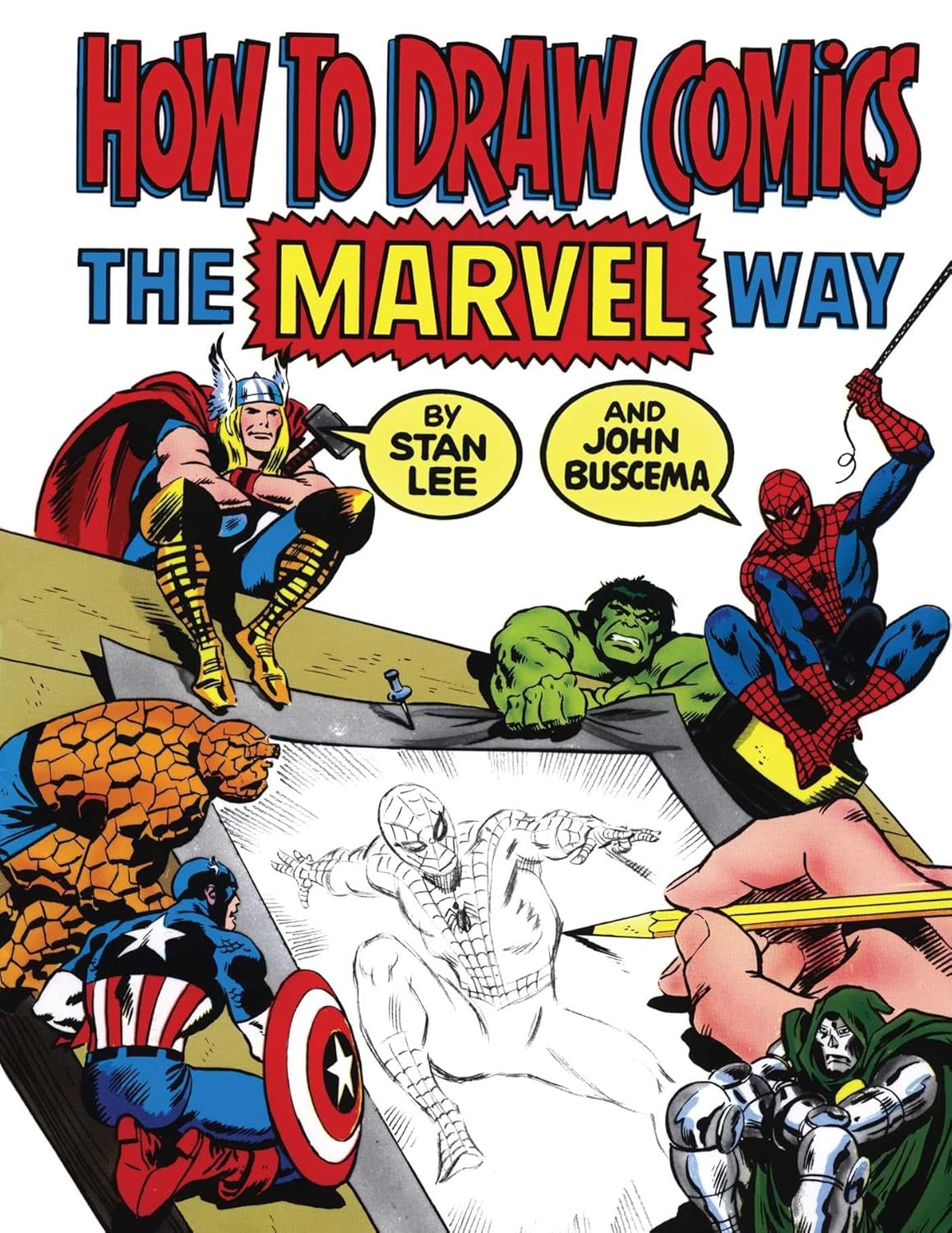
Stan Lee, the Mighty Man from Marvel, and John Buscema, active and adventuresome artist behind the Silver Surfer, Conan the Barbarian, the Mighty Thor and Spider-Man, have collaborated on this comics compendium: an encyclopedia of information for creating your own superhero comic strips. Using artwork from Marvel comics as primary examples, Buscema graphically illustrates the hitherto mysterious methods of comic art. Stan Lee’s pithy prose gives able assistance and advice to the apprentice artist. Bursting with Buscema’s magnificent illustrations and Lee’s laudable word-magic, How to Draw Comics the Marvel Way belongs in the library of everyone who has ever wanted to illustrate his or her own comic strip.
About the Author
Excerpt. © Reprinted by permission. All rights reserved.
THE TOOLS-
AND THE TALK- OF THE TRADE!
Since very few of us draw with just our fingernails, let's start off with what you'll need. Then we're got to make sure we're all speaking the same language. This part's the easiest.
Here we go! On these two pages you'll find just about everything you'll need to get you started. One of the nice things about being a comicbook artist is the fact that your equipment is no big deal. Let's just give the various items a fast once-over...
Pencil. Some artists prefer a soft lead, some like the finer hard lead. It's up to you.
Pen. A simple drawing pen with a thin point, for inking and bordering.
Brush. Also for inking. A sable hair #3 is your best bet.
Erasers. One art gum and one smooth kneaded eraser -- which is cleaner to use.
India ink. Any good brand of black india ink is okay.
White opaquing paint. Invaluable for covering errors in inking.
A glass Jar. This holds the water for cleaning your brushes.
Pushpins. Handy for keeping your illustration paper from slipping off the drawing board.
Triangle. A must for drawing right angles and working in perspective.
T square. Invaluable for drawing borders and keeping lines parallel.
Ruler. For everyone who says "1 can't draw a straight line without a ruler." Now you've no excuse!
Illustration paper. We use 2-ply Bristol board, large enough to accommodate artwork 10" x 15".
Drawing board. This can be a drawing table or merely a flat board which you hold on your lap. Either way, you always need some such thing upon which to rest your sheet of illustration paper.
Rag. This plain ol' hunk of any kind of cloth is used to wipe your pen points, brushes, and whatever. The sloppier you are, the more you'll need it.
Ink compass. Well, how else are you gonna draw circles? While you're at it, you might as well get a pencil compass, too-even though Johnny forgot to draw one for you.
Of course, there are some things we omitted, like a chair to sit on and a light so that you can see what you're doing in case you work in the dark. Also, it's a good idea to have a room to work in-otherwise your pages can get all messy in the rain. But we figured you'd know all this.
And now, onward!
Just to make sure we all use the same language and there's no misunderstanding when we refer to things, let's review the various names for many of the elements that make up a typical comicbook page.
A. The first page of a story, with a large introductory illustration, is called the splash page.
B: Letters drawn in outline, with space for color to be added, are called open letters.
C: Copy which relates to a title is called a blurb.
D: The name of the story is, of course, the title.
E: An outline around lettering done in this jagged shape is called a splash balloon.
F: A single illustration on a page is called a panel.
G: The space between panels is called the gutter.
H: You won't be surprised to know that this "ZAT" is a sound effect.
I: Copy which represents what a character is thinking is a thought balloon.
J: The little connecting circles on thought balloons are called bubbles. (We'd feel silly calling them "squares"!)
K: The regular speech indicators are called dialogue balloons.
L: The connecting "arrows" on dialogue balloons, showing who is speaking, are called pointers.
M: The words in balloons which are lettered heavier than the other words are referred to as bold words, or bold lettering.
N: This is my favorite part-where the names are. We call it the credits, just like in the movies.
O: All this little technical stuff, showing who publishes the mag and when and where, usually found on the bottom of the first page, is the indicia (pronounced in-deeé -shah).
P: Copy in which someone is talking to the reader, but which is not within dialogue balloons, is called a caption.
Chances are we left out a few other things, but this is all we can think of right now. However, not to worry; we'll fill you in on anything else that comes up as we keep zooming along.
Movin' right along, we now introduce you to one of Marvel's many widely heralded close-ups, so called because the "camera" (meaning the reader's eye) has moved in about as close as possible.
This type of panel, in which the reader's view of the scene is from farther away, enabling him to see the figures from head to toe, is called a medium shot.
And here we have a long shot. In fact, since it shows such an extreme wide-angle scene, you might even call it a panoramic long shot without anyone getting angry at you.
When you're up above the scene, looking down at it, as in this panel, what else could you possibly call it but a bird's-eye view?
On the other hand, when you're below the scene of action, as in this panel, where your eye, level is somewhere near Spidey's heel, we're inclined to refer to it as a worm's-eye view.
A drawing in which the details are obscured by solid black (or any other single tone or color) is called a silhouette. And now that we agree upon the language, let's get back to drawing the pictures...
Copyright © 1978 by Stan Lee and John Buscema
Details:
Visit the Atria Books Store
How To Draw Comics The Marvel Way
AED9640
Quantity:
Order today to get by 7-14 business days
Delivery fee of AED 20. Free for orders above AED 200.
 Imported From: United States
At BOLO, we work hard to ensure the products you receive are new, genuine, and sourced from reputable suppliers.
Every product in the BOLO catalogue is sourced through our Verified Global Supply Network of verified sellers, authorized distributors or directly from the manufacturer.
Each product undergoes thorough inspection and verification at our consolidation and fulfilment centers to ensure it meets our strict authenticity and quality standards before being shipped and delivered to you.
If you ever have concerns regarding the authenticity of a product purchased from us, please contact Bolo Support. We will review your inquiry promptly and, if necessary, provide documentation verifying authenticity or offer a suitable resolution.
Your trust is our top priority, and we are committed to maintaining transparency and integrity in every transaction.
While we strive to display accurate information, variations in packaging, labeling, instructions, or formulation may occasionally occur due to regional differences or supplier updates. For detailed or manufacturer-specific information, please contact the brand directly or reach out to BOLO Support for assistance.
Unless otherwise stated, all prices displayed on the product page include applicable taxes and import duties.
BOLO operates in accordance with the laws and regulations of United Arab Emirates. Any items found to be restricted or prohibited for sale within the United Arab Emirates will be cancelled prior to shipment. We take proactive measures to ensure that only products permitted for sale in United Arab Emirates are listed on our website.
All items are shipped by air, and any products classified as “Dangerous Goods (DG)” under IATA regulations will be removed from the order and cancelled.
All orders are processed manually, and we make every effort to process them promptly once confirmed. Products cancelled due to the above reasons will be permanently removed from listings across the website.
More from this brand
Similar items from “Illustration”
Share with
Or share with link
https://www.bolo.ae/products/U0671530771
Visit the Atria Books Store
How To Draw Comics The Marvel Way
AED9640
Quantity:
Order today to get by 7-14 business days
Delivery fee of AED 20. Free for orders above AED 200.
Imported From: United States
At BOLO, we work hard to ensure the products you receive are new, genuine, and sourced from reputable suppliers.
Every product in the BOLO catalogue is sourced through our Verified Global Supply Network of verified sellers, authorized distributors or directly from the manufacturer.
Each product undergoes thorough inspection and verification at our consolidation and fulfilment centers to ensure it meets our strict authenticity and quality standards before being shipped and delivered to you.
If you ever have concerns regarding the authenticity of a product purchased from us, please contact Bolo Support. We will review your inquiry promptly and, if necessary, provide documentation verifying authenticity or offer a suitable resolution.
Your trust is our top priority, and we are committed to maintaining transparency and integrity in every transaction.
While we strive to display accurate information, variations in packaging, labeling, instructions, or formulation may occasionally occur due to regional differences or supplier updates. For detailed or manufacturer-specific information, please contact the brand directly or reach out to BOLO Support for assistance.
Unless otherwise stated, all prices displayed on the product page include applicable taxes and import duties.
BOLO operates in accordance with the laws and regulations of United Arab Emirates. Any items found to be restricted or prohibited for sale within the United Arab Emirates will be cancelled prior to shipment. We take proactive measures to ensure that only products permitted for sale in United Arab Emirates are listed on our website.
All items are shipped by air, and any products classified as “Dangerous Goods (DG)” under IATA regulations will be removed from the order and cancelled.
All orders are processed manually, and we make every effort to process them promptly once confirmed. Products cancelled due to the above reasons will be permanently removed from listings across the website.
Description:
Stan Lee, the Mighty Man from Marvel, and John Buscema, active and adventuresome artist behind the Silver Surfer, Conan the Barbarian, the Mighty Thor and Spider-Man, have collaborated on this comics compendium: an encyclopedia of information for creating your own superhero comic strips. Using artwork from Marvel comics as primary examples, Buscema graphically illustrates the hitherto mysterious methods of comic art. Stan Lee’s pithy prose gives able assistance and advice to the apprentice artist. Bursting with Buscema’s magnificent illustrations and Lee’s laudable word-magic, How to Draw Comics the Marvel Way belongs in the library of everyone who has ever wanted to illustrate his or her own comic strip.
About the Author
Excerpt. © Reprinted by permission. All rights reserved.
THE TOOLS-
AND THE TALK- OF THE TRADE!
Since very few of us draw with just our fingernails, let's start off with what you'll need. Then we're got to make sure we're all speaking the same language. This part's the easiest.
Here we go! On these two pages you'll find just about everything you'll need to get you started. One of the nice things about being a comicbook artist is the fact that your equipment is no big deal. Let's just give the various items a fast once-over...
Pencil. Some artists prefer a soft lead, some like the finer hard lead. It's up to you.
Pen. A simple drawing pen with a thin point, for inking and bordering.
Brush. Also for inking. A sable hair #3 is your best bet.
Erasers. One art gum and one smooth kneaded eraser -- which is cleaner to use.
India ink. Any good brand of black india ink is okay.
White opaquing paint. Invaluable for covering errors in inking.
A glass Jar. This holds the water for cleaning your brushes.
Pushpins. Handy for keeping your illustration paper from slipping off the drawing board.
Triangle. A must for drawing right angles and working in perspective.
T square. Invaluable for drawing borders and keeping lines parallel.
Ruler. For everyone who says "1 can't draw a straight line without a ruler." Now you've no excuse!
Illustration paper. We use 2-ply Bristol board, large enough to accommodate artwork 10" x 15".
Drawing board. This can be a drawing table or merely a flat board which you hold on your lap. Either way, you always need some such thing upon which to rest your sheet of illustration paper.
Rag. This plain ol' hunk of any kind of cloth is used to wipe your pen points, brushes, and whatever. The sloppier you are, the more you'll need it.
Ink compass. Well, how else are you gonna draw circles? While you're at it, you might as well get a pencil compass, too-even though Johnny forgot to draw one for you.
Of course, there are some things we omitted, like a chair to sit on and a light so that you can see what you're doing in case you work in the dark. Also, it's a good idea to have a room to work in-otherwise your pages can get all messy in the rain. But we figured you'd know all this.
And now, onward!
Just to make sure we all use the same language and there's no misunderstanding when we refer to things, let's review the various names for many of the elements that make up a typical comicbook page.
A. The first page of a story, with a large introductory illustration, is called the splash page.
B: Letters drawn in outline, with space for color to be added, are called open letters.
C: Copy which relates to a title is called a blurb.
D: The name of the story is, of course, the title.
E: An outline around lettering done in this jagged shape is called a splash balloon.
F: A single illustration on a page is called a panel.
G: The space between panels is called the gutter.
H: You won't be surprised to know that this "ZAT" is a sound effect.
I: Copy which represents what a character is thinking is a thought balloon.
J: The little connecting circles on thought balloons are called bubbles. (We'd feel silly calling them "squares"!)
K: The regular speech indicators are called dialogue balloons.
L: The connecting "arrows" on dialogue balloons, showing who is speaking, are called pointers.
M: The words in balloons which are lettered heavier than the other words are referred to as bold words, or bold lettering.
N: This is my favorite part-where the names are. We call it the credits, just like in the movies.
O: All this little technical stuff, showing who publishes the mag and when and where, usually found on the bottom of the first page, is the indicia (pronounced in-deeé -shah).
P: Copy in which someone is talking to the reader, but which is not within dialogue balloons, is called a caption.
Chances are we left out a few other things, but this is all we can think of right now. However, not to worry; we'll fill you in on anything else that comes up as we keep zooming along.
Movin' right along, we now introduce you to one of Marvel's many widely heralded close-ups, so called because the "camera" (meaning the reader's eye) has moved in about as close as possible.
This type of panel, in which the reader's view of the scene is from farther away, enabling him to see the figures from head to toe, is called a medium shot.
And here we have a long shot. In fact, since it shows such an extreme wide-angle scene, you might even call it a panoramic long shot without anyone getting angry at you.
When you're up above the scene, looking down at it, as in this panel, what else could you possibly call it but a bird's-eye view?
On the other hand, when you're below the scene of action, as in this panel, where your eye, level is somewhere near Spidey's heel, we're inclined to refer to it as a worm's-eye view.
A drawing in which the details are obscured by solid black (or any other single tone or color) is called a silhouette. And now that we agree upon the language, let's get back to drawing the pictures...
Copyright © 1978 by Stan Lee and John Buscema
Details:
More from this brand
Similar items from “Illustration”
Share with
Or share with link
https://www.bolo.ae/products/U0671530771