Deliver toUnited Arab Emirates
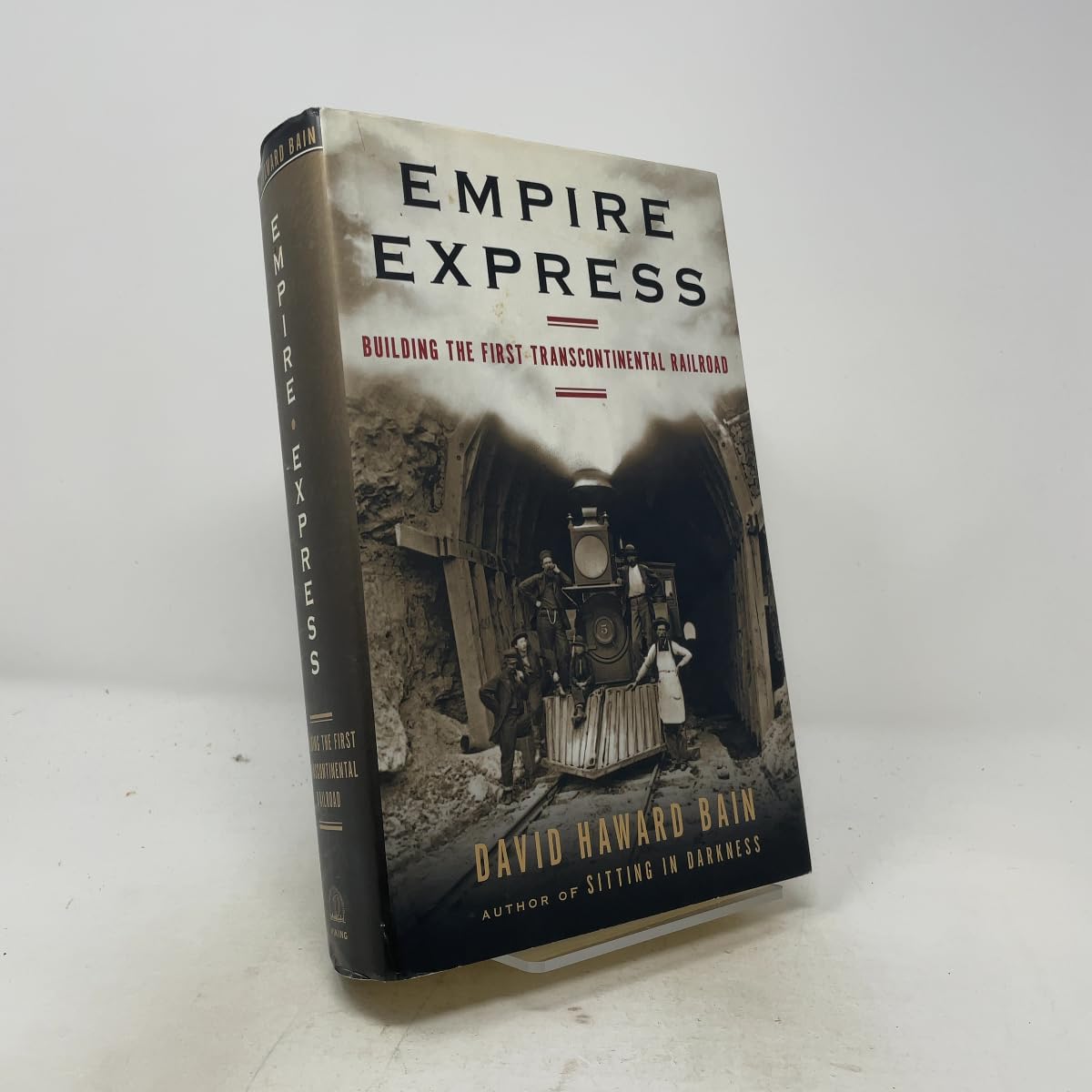
Empire Express: Building the First Transcontinental Railroad

Description:

A dramatic history of the construction of America's first transcontinental railroad chronicles three seminal decades in American history, describing the vast enterprise to build a railroad from Missouri to the Pacific in terms of the remarkable expansion of the United States of America. 30,000 first printing.


Editorial Reviews

Amazon.com Review

On the morning of May 10, 1869, a gang of Irish immigrants met a party of Chinese laborers on a windy bluff northwest of Salt Lake City, Utah. Tired to the bone, the two groups laid down the last of countless wooden ties, bought at the exorbitant cost of six dollars apiece, and thus joined two great rail lines, the Union Pacific and the Central Pacific, to form a single transcontinental route. That rail line made possible the mass settlement of the West, and, as those who conceived it well knew, it changed the course of American history.

David Haward Bain's superb narrative of westward rail history, weighing in at 800 pages, ends not with this great achievement but with the political and financial scandal that would almost overshadow it. Along the way Bain looks closely at the entrepreneurial men who foresaw the possibilities of a vast nation joined by a steel ribbon--most memorably the hit-and-miss businessman Asa Whitney, who proposed to Congress an ingenious scheme to fund the building of the railroad through commercializing the right of way. Some of the men who came after Whitney, such as Mark Hopkins, Collis Huntington, and Leland Stanford, amassed great fortunes in realizing this dream. Others died penniless and nearly forgotten in the wake of political maneuverings and bad deals. Bain's vigorous, well-written narrative does much to restore those overlooked actors to history. --Gregory McNamee

From Library Journal

Connecting the coasts by rail was one of the great achievements of 19th-century America. To tell the story of this epic, Bain knits together excellent storytelling and exhaustive research in a rich contextual tale of vision, ambition, and, ultimately, political and personal corruption.
Copyright 2000 Reed Business Information, Inc.

Reviews:

5.0 out of 5 stars Thoroughly Researched and Comprehensive

M.T. · February 8, 2011

Empire Express tells the history of the origin, surveying, financing, organizing, and building of the first transcontinental railroad in the United States by the Central Pacific and Union Pacific companies during the 1860s. Bain's book is a thoroughly researched and comprehensive history, the cast of characters is enormous and no detail is left uncovered. Bain begins in the 1830s with a visionary named Asa Whitney who first introduced the idea of building a transcontinental railroad. At the time it took well over a hundred days to sail from New York to China; with tracks from New York to San Francisco, the total journey would require a mere thirty. However, Whitney was soon forgotten and construction would not begin until the Civil War (when the South was out of the way). President Abraham Lincoln, once a lawyer for an Illinois rail line, comes off as instrumental in the railroad's development. Bain's treatment of Lincoln's funeral train is one of the book's highlights.Bain switches between the Central Pacific line and the Union Pacific line. The Central Pacific started in Sacramento and following the route of the Donner Party battled through the almost impassible Sierra Nevadas, the toughest railroad construction accomplished anywhere in the world up to that time. The Union Pacific started in Omaha, Nebraska, and had to cross Cheyenne, Sioux, and Arapaho lands to meet up with the Central Pacific in Utah. Bain describes both companies as being guilty of bending the truth. The Central Pacific's trestles were hastily built on unstable gravel, cottonwood ties were substituted for iron, and they rotted accordingly. Bain also details the people involved in this enterprise, including such well-known individuals as Leland Stanford, Charles Crocker, Collis Huntington, Samuel Montague, Thomas C. Durant, and Silas Seymour.Bain explains that just as the transcontinental railroad represented a grand link to Asia, so too did it bring Asia to America. By 1865, some ninety percent of the Central Pacific's workers were Chinese men, mostly from the famine-struck Kwantung province. Unlike their better-paid Irish coworkers, who drank cold water, the Chinese preferred boiled tea. As a result, Bain reveals, the Chinese contracted much less illness and came to dominate the work force.The Union Pacific's work was stained by Indian battles and Thomas Durant, the book's biggest villain. Durant cooked the books, made unnecessary detours, and bribed politicians. The Union Pacific's lines bisected the hunting grounds of many tribes, and the Cheyenne, Arapaho, and Sioux, threatened by starvation, began raiding the new railroad towns, sabotaging the tracks, stopping the trains to steal food and supplies, and scalping and killing passengers and settlers. Atrocities and reprisals proliferated on both sides.Despite these troubles, on May 10, 1869, the Central Pacific and the Union Pacific were finally joined in a "Mountain Wedding" in the tiny Gentile settlement of Promontory Summit, Utah. Bain explains that the site was a terrific snub to Brigham Young, a substantial railroad backer, whose Mormon followers helped build the railroad in the vain hope that it would cross through a strategic Mormon town.Empire Express is overloaded with facts, but this account of the transcontinental railroad does justice to one of the great American achievements.

5.0 out of 5 stars An Elegant, Scholarly, Highly Entertaining Read

D.B. · April 5, 2000

Imagine America before the transcontinental railroad was built. California must have seemed as distant and exotic to those who lived on the Eastern seaboard as Mongolia or Morocco seem to us today. Indeed, the journey was one of either six months of bone-jarring travel in a horse-drawn wagon or 3-4 months on a series of steamers to Panama and then up the West Coast to San Francisco.David Haward Bain's definitive account of the construction of the Transcontinental Railroad captures the enthusiasm and the energy and the fortitude which was required to make this monumental feat possible. Not only was it a marvelous example of American ingenuity, but it was also the product of a good deal of backroom politics and high stakes dealmaking.You will learn how men of modest means caught the vision of what could be, and became not only fabulously wealthy, but also emerged as giants in the history of The West. You will learn of the hardships and opportunities of the Irish and Chinese immigrants who did the real work, laying miles of ties and steel rails across the prairies and over the mountains.When it was completed in 1869, the "ribbon of steel" that extended from sea to sea transformed America, ushering in a wave of immigration to California and contributing greatly to America's rise to prominence as one of the Great Powers at the dawn of the 20th century.The book is long, but rarely tedious. And because the scope of the subject matter is so sweeping, Bain can be forgiven for the book's length, because there is such a wealth of material to cover.If you are a student of American history, a lover of railroads, or just curious about what America was like when there were still frontiers to be conquered, I highly recommend "Empire Express".

4.0 out of 5 stars Read Only If Really Interested

J.A.M. · August 8, 2001

This book is thick and long on detail. Many have complained that it lacks adequate maps and that it does not focus enough on the men on the ground who built the railroad.It is unfortunate that the publisher did not do a better job making clear exactly what this book is about. All of these complaints are true, but their stories are an aside to the topic of this book. The chapters dealing with things like the Chinese who built the railroad and the social changes caused by their immigration feel tacked on and not true to the subject of this book. Indeed all of the engineering and other gritty details about this great monument to ingenuity seem out of place because that is not what this book is about.What is it about? The struggle for money, power, and the behind the scenes politics that went into the creation of the railroad. If you are interested in finance or 19th century history, then you may really enjoy this book. At its best, it focuses on the wealthy men who went from rich to supra-rich through this project. Their personalities and personal beliefs are explored in great detail.I read this because of my interest in the comparisons often made between the railroads and the internet as market bubbles. I learned a lot and was not at all disapointed. Again, only read this if you want to know about the finance, the politics, and the persoanlities.

5.0 out of 5 stars Exactly

A.C. · August 26, 2025

Book was delivered exactly as described. Outstanding packaging. Would absolutely purchase from this company again.

Un ouvrage titanesque, mais bien trop souvent rébarbatif à l’extrême.

K. · November 10, 2015

Trente huit... Voilà le nombre de jours qu'il m'aura fallu pour parcourir ce volumineux "Empire Express", dont la foule de sentiments contradictoires que j'éprouve à son sujet rendent difficile la rédaction de cet avis.Tout d'abord, il serait criminel de commencer cette critique sans souligner l''énorme travail de recherche effectué par l'auteur afin de rédiger ce que l'on pourrait qualifier de synthèse ultime sur le sujet. Le sujet est passionnant, car la construction de la ligne transcontinental fut une entreprise incroyable, et les deux compagnies qui en sont à l'origine, l'Union Pacific et la Central Pacific, sont extrêmement intéressantes à étudier. De plus, les acteurs principaux des deux camps pourraient largement concourir au titre de personnages de roman tellement leur psychologie, et leur manière d'agir, sont hors du commun.Malgré cette introduction flatteuse, et un concept propice à un ouvrage historique haletant et passionnant, le livre de David Haward Bain ne parvient pas à captiver le lecteur sur le long terme, la faute revenant principalement à un choix de priorité malheureux. Tout d'abord, l'auteur s'attarde tellement sur des points qui n'ont pas vraiment de lien avec la construction de la ligne, que les hors sujets sont légions et font perdre un peu le fil de l'histoire. Par exemple, une cinquantaine de pages traitent des guerres indiennes, alors qu'un simple paragraphe aurait très largement suffit pour placer le lecteur dans le contexte. Cependant ces hors sujets ont au moins le mérite de ne pas se montrer incroyablement barbants, ce qui nous amène au plus grand défaut du livre : l'obsession de monsieur Bain à nous plonger dans les méandres de la gestion financière et directoriale des deux entreprises.Autant le dire tout de suite, ces moments (beaucoup, beaucoup trop fréquents) sont d'un ennuis, et écrits avec une telle aridité, qu'ils plombent littéralement le livre tout entier. En réalité, comme la fait remarquer un critique anglophone, l'ouvrage aurait très bien pu être renommé "Financing the Transcontinental Railroad" tellement l'auteur s'attarde la dessus, au détriment de choses plus intéressantes finalement peu traitées (par exemple, la vie de ouvriers n'est que brièvement décrite). Franchement, quand l'on doit supporter des pages et des pages (très grandes et écrites en petit caractères soit dit en passant) de "X a donné 135 actions de 100$ faciale qui en valaient en fait 95 à Y, puis 68 de 90$ qui pouvaient être revendu 85$ si tel chose se produisait à Z qui en échange à dit à V que W aimerait bien que X l'aide pour quelque chose en échange de quoi W aidera X à écouler 5000 actions de 90$" ... Il est très difficile de conserver l'envie de poursuivre la lecture.Bien entendu la partie finance est extrêmement importante, et se devait d'être traité; cependant elle est tellement mise en avant par l'auteur qu'au final, la création de la ligne en elle même passe largement au second plan. Mais surtout, elle est introduite sans la moindre explication pour les néophytes de la gestion des chemins de fers, si bien que de très nombreuses parties du livre paraîtront littéralement incompréhensible pour les non connaisseurs.L'ouvrage aurait tellement gagné à être divisé en au moins deux tomes, car en l'état, Empire Express est littéralement noyé dans cette mare de chapitres imbuvables ou inutiles à l'histoire. Le plus révélateur reste la fin du livre. En effet, une fois la cérémonie de Promontory Summit abordée, pas le moindre mot n'est écrit concernant la ligne terminée. En quarante pages de conclusion, pas un seul mot ! La conclusion de la construction ? Son rôle dans le commerce ? Dans le transport des personnes ? Son état aujourd'hui ? Rien ! A la place, l'auteur s'attarde sur le scandale financier du Crédit Mobilier, et consacre deux pages sur la fin de la vie des "Associés" de la Central Pacific. Très honnêtement, je n'ai pas pu faire mieux que du survoler ce dernier chapitre, tellement ce n'était pas intéressant (franchement, je pourrai compter sur les doigts d'une main le nombre de livre où j'ai survolé certaines parties au lieu de les lire).Un autre problème vient de la surabondance des personnages. Beaucoup de personnes ont effectivement contribué à la création de la ligne, mais la plupart sont introduits assez brutalement, par "grappe", et à moins de prendre des notes, on se contente vite de ne se concentrer que sur les personnages principaux sans chercher à suivre les centaines de personnages secondaires.Autrement, l'histoire en elle même de la construction de cette ligne de chemin de fer est passionnante. Quel dommage que l'auteur l'ait rendu atrocement rébarbative, voire quasiment illisible par moment. Délesté de 400 ou 500 pages, ou bien rédigé en plusieurs volumes, Empire Express aurait été un must have que j'aurais certainement recommandé à tout le monde... En l'état, seul les historiens, les étudiants de cette période historique ou les immenses passionnées y trouveront leur compte.J'ai longtemps hésité pour la note, mais malgré ses défauts, le travail de recherche effectué est tellement impressionnant, que malgré tout ces défauts rédhibitoire je ne peux mettre en dessous de 3/5.Simple curieux ou légèrement intéressé par le sujet : passez votre chemin !

What an interesting period that was

R.E. · October 30, 2014

You want to know everything that was going on in the mid 19th century in the US, all about Trains, politics around it People involved....this is the Bible to it.

Empire Express: Building the First Transcontinental Railroad

Product ID: U067080889K
Condition: New

4.4

AED16260

Price includes VAT & Import Duties
Type: Hardcover
Availability: In Stock

Quantity:

|

Order today to get by 7-14 business days

Delivery fee of AED 20. Free for orders above AED 200.

Returns & Warranty policies

Imported From: United States

At BOLO, we work hard to ensure the products you receive are new, genuine, and sourced from reputable suppliers.

BOLO is not an authorized or official retailer for most brands, nor are we affiliated with manufacturers unless specifically stated on a product page. Instead, we source verified sellers, authorized distributors or directly from the manufacturer.

Each product undergoes thorough inspection and verification at our consolidation and fulfilment centers to ensure it meets our strict authenticity and quality standards before being shipped and delivered to you.

If you ever have concerns regarding the authenticity of a product purchased from us, please contact Bolo Support. We will review your inquiry promptly and, if necessary, provide documentation verifying authenticity or offer a suitable resolution.

Your trust is our top priority, and we are committed to maintaining transparency and integrity in every transaction.

All product information, images, descriptions, and reviews originate from the manufacturer or from trusted sellers overseas. BOLO is not affiliated with, endorsed by, or an authorized retailer for most brands listed on our website unless stated otherwise.

While we strive to display accurate information, variations in packaging, labeling, instructions, or formulation may occasionally occur due to regional differences or supplier updates. For detailed or manufacturer-specific information, please contact the brand directly or reach out to BOLO Support for assistance.

Unless otherwise stated, all prices displayed on the product page include applicable taxes and import duties.

BOLO operates in accordance with the laws and regulations of United Arab Emirates. Any items found to be restricted or prohibited for sale within the UAE will be cancelled prior to shipment. We take proactive measures to ensure that only products permitted for sale in United Arab Emirates are listed on our website.

All items are shipped by air, and any products classified as “Dangerous Goods (DG)” under IATA regulations will be removed from the order and cancelled.

All orders are processed manually, and we make every effort to process them promptly once confirmed. Products cancelled due to the above reasons will be permanently removed from listings across the website.

Similar suggestions by Bolo

More from this brand

Similar items from “History”

Empire Express: Building the First Transcontinental Railroad

Product ID: U067080889K
Condition: New

4.4

Empire Express: Building the First Transcontinental Railroad-0
Type: Hardcover

AED16260

Price includes VAT & Import Duties
Availability: In Stock

Quantity:

|

Order today to get by 7-14 business days

Delivery fee of AED 20. Free for orders above AED 200.

Returns & Warranty policies

Imported From: United States

At BOLO, we work hard to ensure the products you receive are new, genuine, and sourced from reputable suppliers.

BOLO is not an authorized or official retailer for most brands, nor are we affiliated with manufacturers unless specifically stated on a product page. Instead, we source verified sellers, authorized distributors or directly from the manufacturer.

Each product undergoes thorough inspection and verification at our consolidation and fulfilment centers to ensure it meets our strict authenticity and quality standards before being shipped and delivered to you.

If you ever have concerns regarding the authenticity of a product purchased from us, please contact Bolo Support. We will review your inquiry promptly and, if necessary, provide documentation verifying authenticity or offer a suitable resolution.

Your trust is our top priority, and we are committed to maintaining transparency and integrity in every transaction.

All product information, images, descriptions, and reviews originate from the manufacturer or from trusted sellers overseas. BOLO is not affiliated with, endorsed by, or an authorized retailer for most brands listed on our website unless stated otherwise.

While we strive to display accurate information, variations in packaging, labeling, instructions, or formulation may occasionally occur due to regional differences or supplier updates. For detailed or manufacturer-specific information, please contact the brand directly or reach out to BOLO Support for assistance.

Unless otherwise stated, all prices displayed on the product page include applicable taxes and import duties.

BOLO operates in accordance with the laws and regulations of United Arab Emirates. Any items found to be restricted or prohibited for sale within the UAE will be cancelled prior to shipment. We take proactive measures to ensure that only products permitted for sale in United Arab Emirates are listed on our website.

All items are shipped by air, and any products classified as “Dangerous Goods (DG)” under IATA regulations will be removed from the order and cancelled.

All orders are processed manually, and we make every effort to process them promptly once confirmed. Products cancelled due to the above reasons will be permanently removed from listings across the website.

Description:

A dramatic history of the construction of America's first transcontinental railroad chronicles three seminal decades in American history, describing the vast enterprise to build a railroad from Missouri to the Pacific in terms of the remarkable expansion of the United States of America. 30,000 first printing.


Editorial Reviews

Amazon.com Review

On the morning of May 10, 1869, a gang of Irish immigrants met a party of Chinese laborers on a windy bluff northwest of Salt Lake City, Utah. Tired to the bone, the two groups laid down the last of countless wooden ties, bought at the exorbitant cost of six dollars apiece, and thus joined two great rail lines, the Union Pacific and the Central Pacific, to form a single transcontinental route. That rail line made possible the mass settlement of the West, and, as those who conceived it well knew, it changed the course of American history.

David Haward Bain's superb narrative of westward rail history, weighing in at 800 pages, ends not with this great achievement but with the political and financial scandal that would almost overshadow it. Along the way Bain looks closely at the entrepreneurial men who foresaw the possibilities of a vast nation joined by a steel ribbon--most memorably the hit-and-miss businessman Asa Whitney, who proposed to Congress an ingenious scheme to fund the building of the railroad through commercializing the right of way. Some of the men who came after Whitney, such as Mark Hopkins, Collis Huntington, and Leland Stanford, amassed great fortunes in realizing this dream. Others died penniless and nearly forgotten in the wake of political maneuverings and bad deals. Bain's vigorous, well-written narrative does much to restore those overlooked actors to history. --Gregory McNamee

From Library Journal

Connecting the coasts by rail was one of the great achievements of 19th-century America. To tell the story of this epic, Bain knits together excellent storytelling and exhaustive research in a rich contextual tale of vision, ambition, and, ultimately, political and personal corruption.
Copyright 2000 Reed Business Information, Inc.

Reviews:

5.0 out of 5 stars Thoroughly Researched and Comprehensive

M.T. · February 8, 2011

Empire Express tells the history of the origin, surveying, financing, organizing, and building of the first transcontinental railroad in the United States by the Central Pacific and Union Pacific companies during the 1860s. Bain's book is a thoroughly researched and comprehensive history, the cast of characters is enormous and no detail is left uncovered. Bain begins in the 1830s with a visionary named Asa Whitney who first introduced the idea of building a transcontinental railroad. At the time it took well over a hundred days to sail from New York to China; with tracks from New York to San Francisco, the total journey would require a mere thirty. However, Whitney was soon forgotten and construction would not begin until the Civil War (when the South was out of the way). President Abraham Lincoln, once a lawyer for an Illinois rail line, comes off as instrumental in the railroad's development. Bain's treatment of Lincoln's funeral train is one of the book's highlights.Bain switches between the Central Pacific line and the Union Pacific line. The Central Pacific started in Sacramento and following the route of the Donner Party battled through the almost impassible Sierra Nevadas, the toughest railroad construction accomplished anywhere in the world up to that time. The Union Pacific started in Omaha, Nebraska, and had to cross Cheyenne, Sioux, and Arapaho lands to meet up with the Central Pacific in Utah. Bain describes both companies as being guilty of bending the truth. The Central Pacific's trestles were hastily built on unstable gravel, cottonwood ties were substituted for iron, and they rotted accordingly. Bain also details the people involved in this enterprise, including such well-known individuals as Leland Stanford, Charles Crocker, Collis Huntington, Samuel Montague, Thomas C. Durant, and Silas Seymour.Bain explains that just as the transcontinental railroad represented a grand link to Asia, so too did it bring Asia to America. By 1865, some ninety percent of the Central Pacific's workers were Chinese men, mostly from the famine-struck Kwantung province. Unlike their better-paid Irish coworkers, who drank cold water, the Chinese preferred boiled tea. As a result, Bain reveals, the Chinese contracted much less illness and came to dominate the work force.The Union Pacific's work was stained by Indian battles and Thomas Durant, the book's biggest villain. Durant cooked the books, made unnecessary detours, and bribed politicians. The Union Pacific's lines bisected the hunting grounds of many tribes, and the Cheyenne, Arapaho, and Sioux, threatened by starvation, began raiding the new railroad towns, sabotaging the tracks, stopping the trains to steal food and supplies, and scalping and killing passengers and settlers. Atrocities and reprisals proliferated on both sides.Despite these troubles, on May 10, 1869, the Central Pacific and the Union Pacific were finally joined in a "Mountain Wedding" in the tiny Gentile settlement of Promontory Summit, Utah. Bain explains that the site was a terrific snub to Brigham Young, a substantial railroad backer, whose Mormon followers helped build the railroad in the vain hope that it would cross through a strategic Mormon town.Empire Express is overloaded with facts, but this account of the transcontinental railroad does justice to one of the great American achievements.

5.0 out of 5 stars An Elegant, Scholarly, Highly Entertaining Read

D.B. · April 5, 2000

Imagine America before the transcontinental railroad was built. California must have seemed as distant and exotic to those who lived on the Eastern seaboard as Mongolia or Morocco seem to us today. Indeed, the journey was one of either six months of bone-jarring travel in a horse-drawn wagon or 3-4 months on a series of steamers to Panama and then up the West Coast to San Francisco.David Haward Bain's definitive account of the construction of the Transcontinental Railroad captures the enthusiasm and the energy and the fortitude which was required to make this monumental feat possible. Not only was it a marvelous example of American ingenuity, but it was also the product of a good deal of backroom politics and high stakes dealmaking.You will learn how men of modest means caught the vision of what could be, and became not only fabulously wealthy, but also emerged as giants in the history of The West. You will learn of the hardships and opportunities of the Irish and Chinese immigrants who did the real work, laying miles of ties and steel rails across the prairies and over the mountains.When it was completed in 1869, the "ribbon of steel" that extended from sea to sea transformed America, ushering in a wave of immigration to California and contributing greatly to America's rise to prominence as one of the Great Powers at the dawn of the 20th century.The book is long, but rarely tedious. And because the scope of the subject matter is so sweeping, Bain can be forgiven for the book's length, because there is such a wealth of material to cover.If you are a student of American history, a lover of railroads, or just curious about what America was like when there were still frontiers to be conquered, I highly recommend "Empire Express".

4.0 out of 5 stars Read Only If Really Interested

J.A.M. · August 8, 2001

This book is thick and long on detail. Many have complained that it lacks adequate maps and that it does not focus enough on the men on the ground who built the railroad.It is unfortunate that the publisher did not do a better job making clear exactly what this book is about. All of these complaints are true, but their stories are an aside to the topic of this book. The chapters dealing with things like the Chinese who built the railroad and the social changes caused by their immigration feel tacked on and not true to the subject of this book. Indeed all of the engineering and other gritty details about this great monument to ingenuity seem out of place because that is not what this book is about.What is it about? The struggle for money, power, and the behind the scenes politics that went into the creation of the railroad. If you are interested in finance or 19th century history, then you may really enjoy this book. At its best, it focuses on the wealthy men who went from rich to supra-rich through this project. Their personalities and personal beliefs are explored in great detail.I read this because of my interest in the comparisons often made between the railroads and the internet as market bubbles. I learned a lot and was not at all disapointed. Again, only read this if you want to know about the finance, the politics, and the persoanlities.

5.0 out of 5 stars Exactly

A.C. · August 26, 2025

Book was delivered exactly as described. Outstanding packaging. Would absolutely purchase from this company again.

Un ouvrage titanesque, mais bien trop souvent rébarbatif à l’extrême.

K. · November 10, 2015

Trente huit... Voilà le nombre de jours qu'il m'aura fallu pour parcourir ce volumineux "Empire Express", dont la foule de sentiments contradictoires que j'éprouve à son sujet rendent difficile la rédaction de cet avis.Tout d'abord, il serait criminel de commencer cette critique sans souligner l''énorme travail de recherche effectué par l'auteur afin de rédiger ce que l'on pourrait qualifier de synthèse ultime sur le sujet. Le sujet est passionnant, car la construction de la ligne transcontinental fut une entreprise incroyable, et les deux compagnies qui en sont à l'origine, l'Union Pacific et la Central Pacific, sont extrêmement intéressantes à étudier. De plus, les acteurs principaux des deux camps pourraient largement concourir au titre de personnages de roman tellement leur psychologie, et leur manière d'agir, sont hors du commun.Malgré cette introduction flatteuse, et un concept propice à un ouvrage historique haletant et passionnant, le livre de David Haward Bain ne parvient pas à captiver le lecteur sur le long terme, la faute revenant principalement à un choix de priorité malheureux. Tout d'abord, l'auteur s'attarde tellement sur des points qui n'ont pas vraiment de lien avec la construction de la ligne, que les hors sujets sont légions et font perdre un peu le fil de l'histoire. Par exemple, une cinquantaine de pages traitent des guerres indiennes, alors qu'un simple paragraphe aurait très largement suffit pour placer le lecteur dans le contexte. Cependant ces hors sujets ont au moins le mérite de ne pas se montrer incroyablement barbants, ce qui nous amène au plus grand défaut du livre : l'obsession de monsieur Bain à nous plonger dans les méandres de la gestion financière et directoriale des deux entreprises.Autant le dire tout de suite, ces moments (beaucoup, beaucoup trop fréquents) sont d'un ennuis, et écrits avec une telle aridité, qu'ils plombent littéralement le livre tout entier. En réalité, comme la fait remarquer un critique anglophone, l'ouvrage aurait très bien pu être renommé "Financing the Transcontinental Railroad" tellement l'auteur s'attarde la dessus, au détriment de choses plus intéressantes finalement peu traitées (par exemple, la vie de ouvriers n'est que brièvement décrite). Franchement, quand l'on doit supporter des pages et des pages (très grandes et écrites en petit caractères soit dit en passant) de "X a donné 135 actions de 100$ faciale qui en valaient en fait 95 à Y, puis 68 de 90$ qui pouvaient être revendu 85$ si tel chose se produisait à Z qui en échange à dit à V que W aimerait bien que X l'aide pour quelque chose en échange de quoi W aidera X à écouler 5000 actions de 90$" ... Il est très difficile de conserver l'envie de poursuivre la lecture.Bien entendu la partie finance est extrêmement importante, et se devait d'être traité; cependant elle est tellement mise en avant par l'auteur qu'au final, la création de la ligne en elle même passe largement au second plan. Mais surtout, elle est introduite sans la moindre explication pour les néophytes de la gestion des chemins de fers, si bien que de très nombreuses parties du livre paraîtront littéralement incompréhensible pour les non connaisseurs.L'ouvrage aurait tellement gagné à être divisé en au moins deux tomes, car en l'état, Empire Express est littéralement noyé dans cette mare de chapitres imbuvables ou inutiles à l'histoire. Le plus révélateur reste la fin du livre. En effet, une fois la cérémonie de Promontory Summit abordée, pas le moindre mot n'est écrit concernant la ligne terminée. En quarante pages de conclusion, pas un seul mot ! La conclusion de la construction ? Son rôle dans le commerce ? Dans le transport des personnes ? Son état aujourd'hui ? Rien ! A la place, l'auteur s'attarde sur le scandale financier du Crédit Mobilier, et consacre deux pages sur la fin de la vie des "Associés" de la Central Pacific. Très honnêtement, je n'ai pas pu faire mieux que du survoler ce dernier chapitre, tellement ce n'était pas intéressant (franchement, je pourrai compter sur les doigts d'une main le nombre de livre où j'ai survolé certaines parties au lieu de les lire).Un autre problème vient de la surabondance des personnages. Beaucoup de personnes ont effectivement contribué à la création de la ligne, mais la plupart sont introduits assez brutalement, par "grappe", et à moins de prendre des notes, on se contente vite de ne se concentrer que sur les personnages principaux sans chercher à suivre les centaines de personnages secondaires.Autrement, l'histoire en elle même de la construction de cette ligne de chemin de fer est passionnante. Quel dommage que l'auteur l'ait rendu atrocement rébarbative, voire quasiment illisible par moment. Délesté de 400 ou 500 pages, ou bien rédigé en plusieurs volumes, Empire Express aurait été un must have que j'aurais certainement recommandé à tout le monde... En l'état, seul les historiens, les étudiants de cette période historique ou les immenses passionnées y trouveront leur compte.J'ai longtemps hésité pour la note, mais malgré ses défauts, le travail de recherche effectué est tellement impressionnant, que malgré tout ces défauts rédhibitoire je ne peux mettre en dessous de 3/5.Simple curieux ou légèrement intéressé par le sujet : passez votre chemin !

What an interesting period that was

R.E. · October 30, 2014

You want to know everything that was going on in the mid 19th century in the US, all about Trains, politics around it People involved....this is the Bible to it.

Similar suggestions by Bolo

More from this brand

Similar items from “History”